Specs are compiled from manufacturer listings and verified buyer reviews and can change over time — please confirm the key details on the product page before buying.
You pay Verizon every month for a phone that works everywhere except your own living room. A booster catches the weak outside signal at an outdoor antenna and re-amplifies it inside — but a unit with too little gain leaves you staring at the same one bar. The short answer: buy by gain and coverage, not by sticker, and confirm the box lists Verizon’s bands before you spend a minute drilling.
This guide is built by comparing the manufacturers’ published specifications and the patterns across verified customer reviews, so you get each pick’s real strengths and trade-offs instead of marketing spin.
Boosters all promise “stronger signal,” yet only a few deliver it at the distances a real house demands — which is exactly what makes choosing a verizon home signal booster confusing, and why every pick below is judged on gain, coverage, and honest owner experience.
Top Picks


How To Choose The Best Verizon Home Signal Booster
Three numbers decide whether a booster works in your house: the gain in dB, the coverage in square feet, and the bands it listens to. Get those three right and the install is a weekend afternoon. Get one wrong and you will be repacking a box.
Start with gain, because a weak booster is a wasted afternoon
Gain is how much the booster amplifies what it catches, measured in dB (decibels). A 72dB unit adds a big lift on top of the outside signal. A 100 dB unit like the CEL-FI GO G41 adds far more, which is why the top-tier units can reach bedrooms down the hall. Without real gain, you are paying for hardware that barely lifts the bar count.
Coverage is a ceiling, not a promise
That square-footage figure is the best case with a strong, clean outside signal. If your yard is in a dead pocket, treat the rating as optimistic. Always leave room in your plan for the outside signal itself — most vendors want at least one bar outside the wall to work with.
The Verizon bands and the outside antenna
Verizon lives across several LTE bands, commonly 2, 4, 5, 13, and 25 — and 5G in many areas rides on the same frequencies through DSS (Dynamic Spectrum Sharing, which lets 5G share 4G airwaves). Check the band list printed on the spec sheet, not the star power of the marketing page. Your outside antenna should point at the nearest confirmed tower, aimed clear of trees and roof line, because a single obstruction is what turns a good booster into a bad one.
Side-by-Side Comparison
| Model | Best For | Coverage | Gain | Bands | Amazon |
|---|---|---|---|---|---|
| HiBoost 6000 sq ft Booster★ Best Overall | Smart, app-monitored whole-home boost | 5500 sq ft | — | 2/4/5/12/13/17/25 | Amazon |
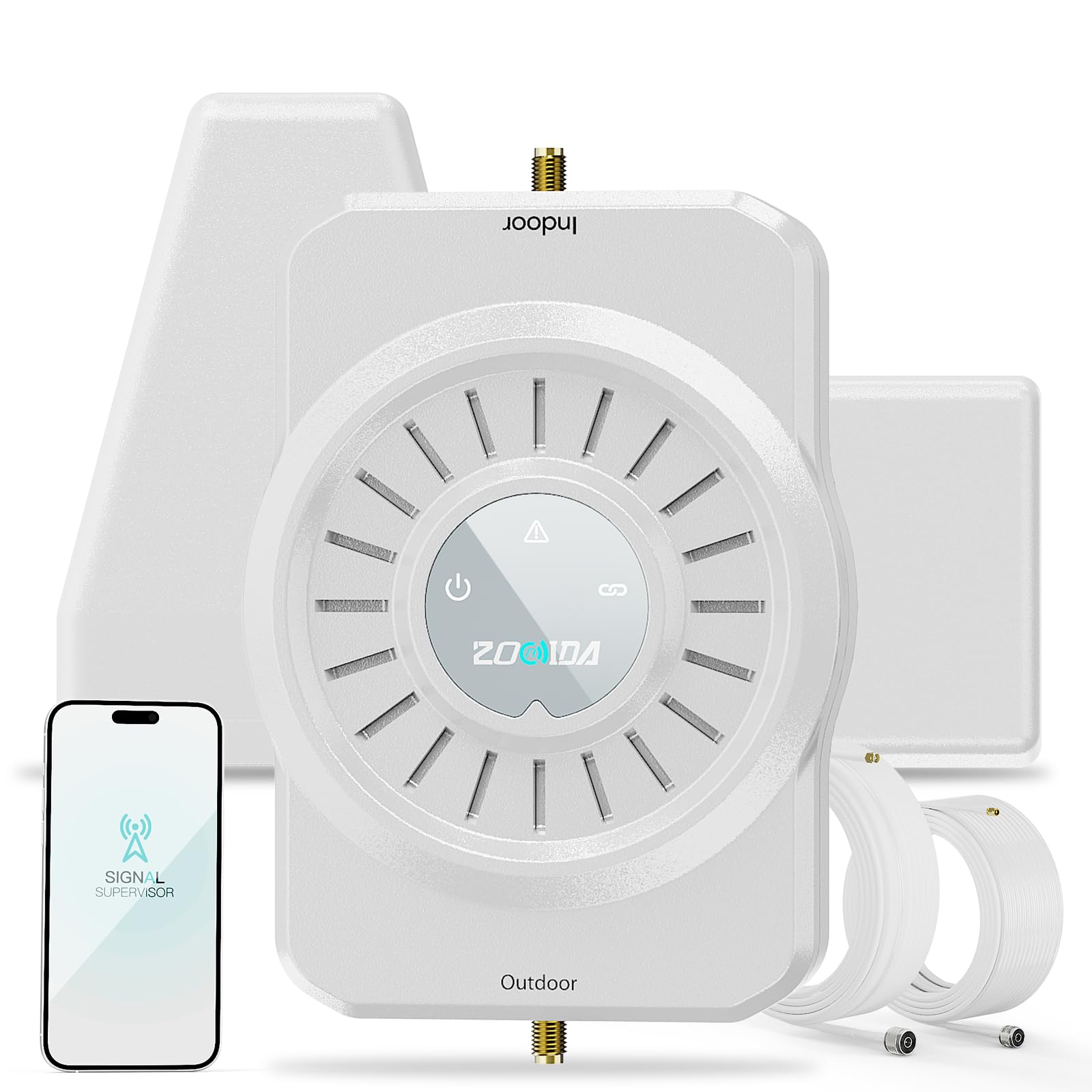
| ZORIDA 5S PRO Multi-Room BoosterBudget Champion | Budget-friendly multi-room coverage | 4000 sq ft | 72dB | 2/4/5/12/13/17/25 | Amazon |
| weBoost Home StudioMost Compact | Fast, simple small-home setup | 3000 sq ft | — | 4G/5G (all major carriers) | Amazon |
| SureCall Fusion4Home Max | Maximum coverage from a mid-range kit | 6500 sq ft | — | 698–2155 MHz (10 bands) | Amazon |
| HiBoost Plus 10K | Whole-house bars in one install | 10,000 sq ft | — | 4G LTE / 5G | Amazon |
| weBoost Home Complete | Whole-home coverage to the basement | 7500 sq ft | Up to 100X (FCC max) | At least Band 25, multi-carrier | Amazon |
| CEL-FI GO G41 | Top-tier whole-home 5G coverage | 15,000 sq ft | 100 dB | 700 MHz, 1700/2100 MHz | Amazon |
Detailed Reviews
1. HiBoost Cell Phone Booster Cover 6000 sq ft
Our pick — 4.5+★ from 650+ verified ratings; the strongest balance of quality and price.
A booster with its own monitoring app — so you can see whether the thing is actually working.
The HiBoost is the rare booster that tells you what it is doing. Its “Signal Supervisor” app and LCD screen (a small display on the unit) let you watch the running gain from your phone, so if the outside antenna is misplaced you find out in minutes instead of guessing for a week. That alone removes the biggest frustration in this category: not knowing whether the hardware is boosting anything.
It is built around a directional outdoor antenna, which is the high-gain kind that aims at one specific faraway tower rather than sweeping wide. That gives a better catch in rural or fringe zones than an omni antenna (the wide-sweep kind). The kit lists bands 2/4/5/12/13/17/25, so it covers the main Verizon LTE bands, and a through-window cable means you can run the feed without drilling a wall. Boost is the crowd favorite here — well past 600+ owners, with an app that keeps troubleshooting in your own hands.
The honest catch: coverage is listed at 5500 square feet, and the listing’s title says 6000 — treat the lower number as the real ceiling under a mediocre outside signal. The 5G support also depends on carriers running 5G through DSS in your area, so confirm that before you count on 5G bars.
What the app adds
- Live gain readout on the LCD and in the Signal Supervisor app
- Directional antenna reaches distant towers better than an omni
- Through-window cable skips the drilling
- Three-year warranty with lifetime technical support
Where it falls short
- 5G requires DSS deployment on 4G bands in your area
- Listed 5500 sq ft is the realistic ceiling, not the 6000 in the title
- 2.2 kg unit wants a shelf, not a thin wall bracket
Pick it when: you want to monitor and tune the install yourself, and your yard has at least a bar outside to build on.
Look elsewhere if: you need guaranteed 5G rather than DSS-dependent 5G — a 100 dB unit is the safer bet.
2. ZORIDA Cell Phone Signal Booster for Home Multi-Room
The entry-level kit that still hits 72dB and promises bars in three or four rooms.
Small homes and apartments get a real option here. The ZORIDA pushes up to 72dB of gain across a rated 4,000 square feet — a coverage figure the maker says typically supports 3–4 rooms, not the whole house. That is plenty for a two-bedroom flat with one dead corner. Compared to the HiBoost above, it gives up a couple of hundred square feet of rated reach but costs far less, and the 72dB figure is a genuine number you can compare across the list.
Setup is app-guided: the ZORIDA app walks you through placing the outdoor antenna and reads live signal so you can move the antenna until it points best. It is FCC-certified, and the kit includes 20ft of indoor cable and 49.2ft of outdoor cable — enough for most single-wall installs. Bands 12/17/13/5/25/2/4 line up with Verizon’s LTE set, and it handles 2G/3G/4G LTE and 5G on compatible signals.
The realistic ceiling: 72dB is far below the 100 dB of the CEL-FI, so very weak outside zones will still struggle. The app guidance also matters — you cannot just plug it in and expect full bars without doing the antenna aiming step.
What lands on arrival: the sub-4,000 sq ft footprint is the pitch, and the app means you can fine-tune placement with real measurements, then back the thing with a three-year warranty and a 30-day money-back guarantee.
Where it clamps: treating the coverage figure as absolute — it assumes a live outside signal, so budget the aim-and-move step rather than the sweep-it-would-be-nice step.
Yes to this one if: you have a small to mid-size home and want the price to stay honest.
Say no if: your outside signal is essentially zero — a higher-gain unit will be the difference between one bar and four.
3. weBoost Home Studio Cell Phone Signal Booster
The smallest-footprint kit of the group — a 3,000 sq ft weBoost that favors setup speed over reach.
If your need is a single problem room and you want the install behind you before lunch, the Home Studio is the one to look at. The maker puts it at 3,000 square feet, which is the smallest rated reach in this list. It boosts both 4G LTE and 5G for all major U.S. and Canadian carriers — Verizon included — and users describe getting it running inside five minutes. That is the real selling point here: fewer cables to think about and a scope you almost cannot mis-size.
What weBoost brings is simplicity and U.S. manufacture. Clear instructions ship in the box, and it holds FCC approval. But it is the entry-level member of the weBoost line, and the 3.5+ out of 5 rating signals that reach is where buyers get caught off guard. A rural ranch house demanding four rooms of coverage is not the Home Studio’s fight; a studio, apartment, or one weak bedroom is.
The catch worth naming: with a rated 3,000 square feet and no higher coverage options listed, a bigger house will need two of these or a step up to the Home Complete. Decide by the rooms you actually want filled, not the price tag.
- Install is described as a five-minute job — the least fiddly of the weBoost family
- FCC approved and made in the U.S.
- 3,000 sq ft cap makes it an honest fit for apartments and studios
The right call for: an apartment, studio, or one dead room where a small kit covers all you need.
The wrong call for: a big rural house — the 3,000 sq ft rating will not stretch.
4. SureCall Fusion4Home Max
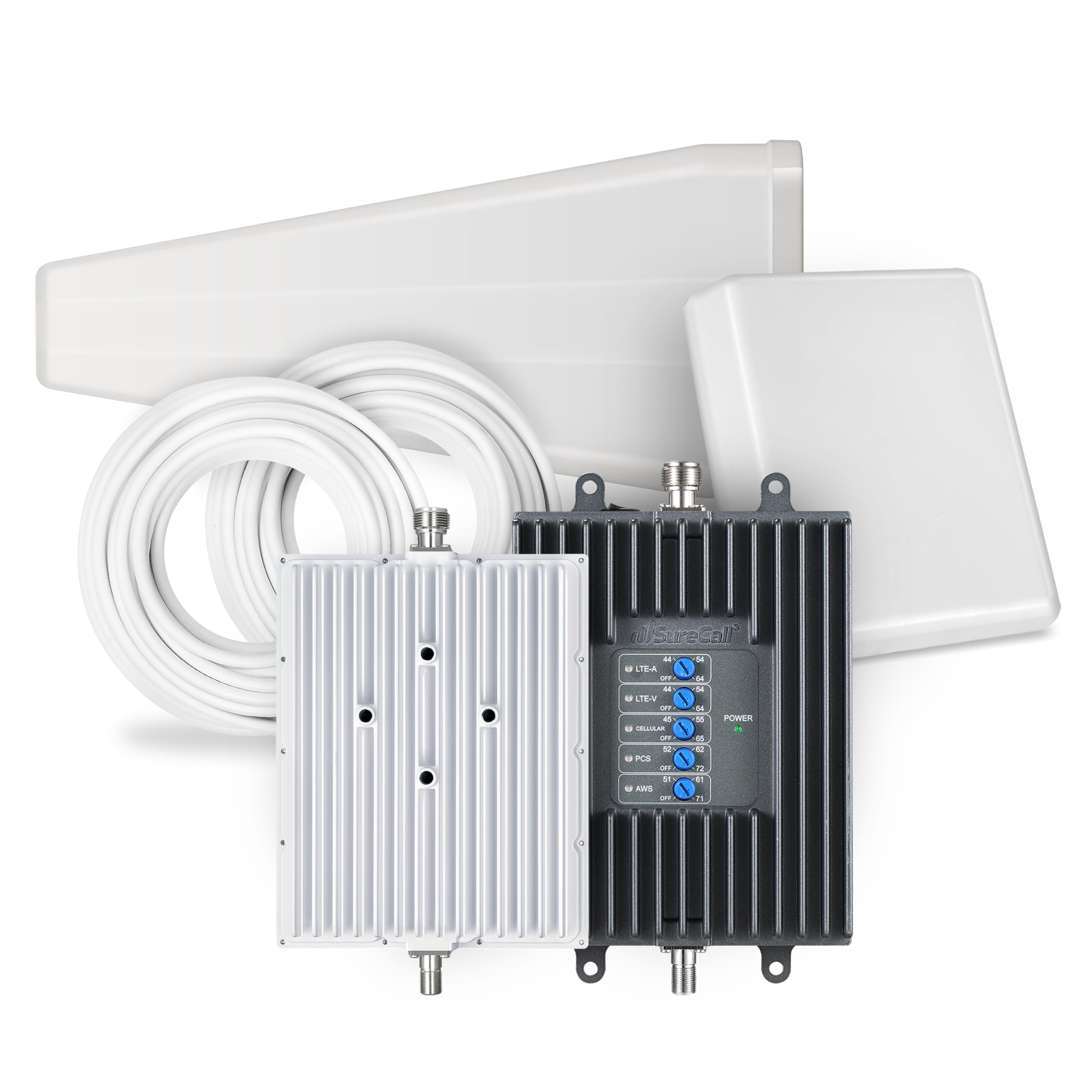
The mid-range kit built for distance — 6500 square feet of extended-range reach.
SureCall’s edge is a patented extended-range approach: it amplifies the signal outdoors, at its strongest point, before it ever reaches the walls. That is the opposite of most boosters, which work with whatever weak signal makes it inside. In real terms it means better reach to a distant tower and a larger coverage area inside the house. It is the biggest mid-range coverage on this list at 6500 square feet, against 5500 for the HiBoost above.
It runs the full band spread — 698–716 MHz through 2110–2155 MHz across ten listed bands — so it handles the Verizon LTE set and multi-carrier use. One purchase covers phones, tablets, and hotspots with no monthly fee, and it is an Authorized Verizon 5G Signal Booster Vendor. It is also designed, assembled, and tested in the U.S. with a three-year warranty.
The fair warning is in the performance itself: results vary with where you point the outdoor unit. Treat the antenna aim as the real work, not an afterthought, and accept that a good install and a careless one land in very different places.
Why the range stands out
- 6500 sq ft is the largest coverage among this list’s mid-range group
- Patented extended range amplifies the signal outside the building
- Works with Verizon, AT&T, T-Mobile, US Cellular, Mint, and Boost
- No monthly fees, and it does not need your WiFi
The fair warning
- Performance swings with antenna placement — aim it carefully
- Coverage number assumes a live signal at the outdoor antenna
Built for: a larger home that needs reach without stepping up to a flagship unit.
Think twice if: you want a screw-it-in-and-forget-it install — this one rewards a careful aim.
5. HiBoost Plus 10K Cell Phone Signal Booster
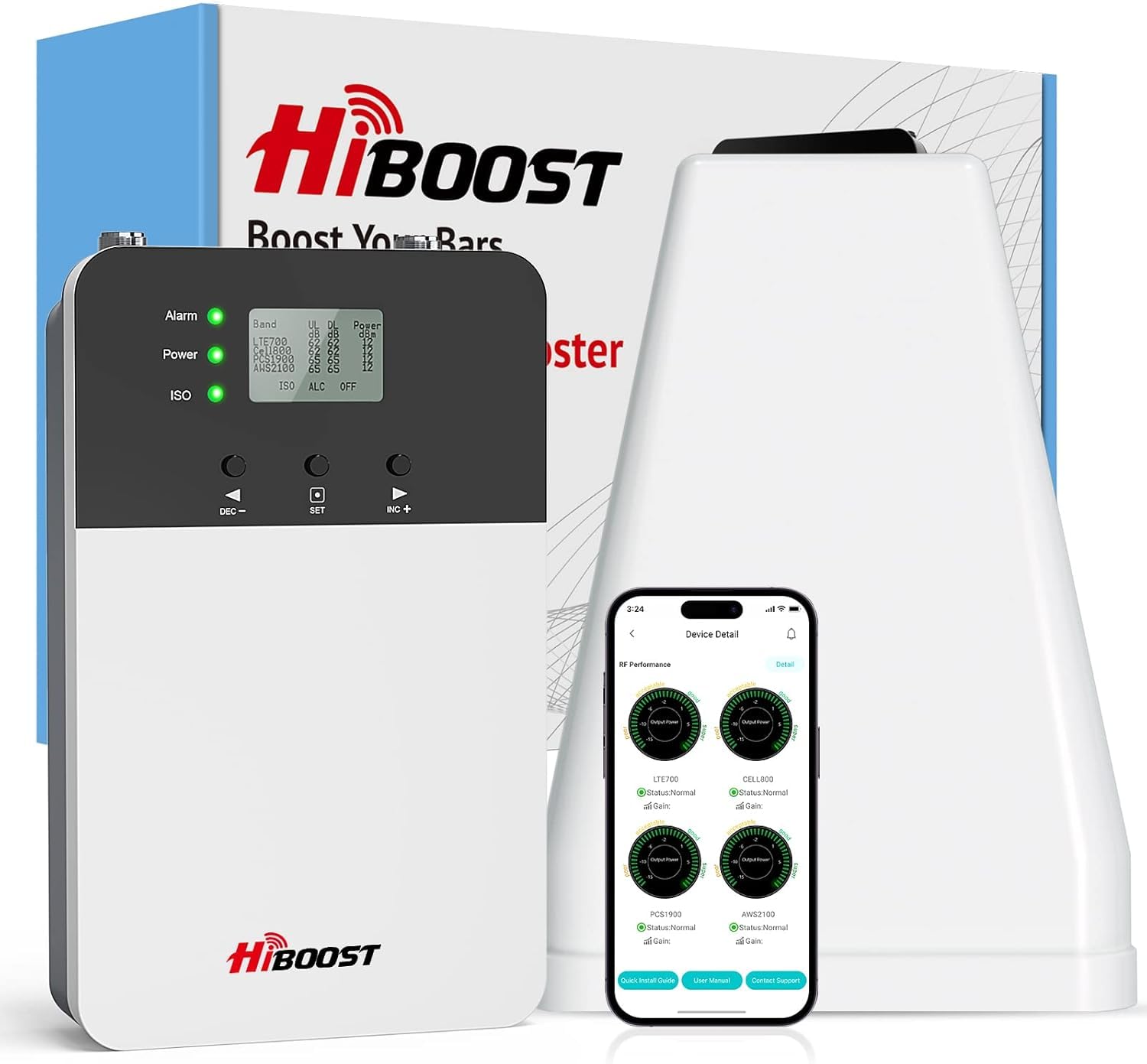
A 10,000 square foot HiBoost kit aimed squarely at one job: bars in every room.
HiBoost’s Plus 10K is the straightforward whole-house pick. It works with all U.S. and Canadian carriers including Verizon, AT&T, T-Mobile, Straight Talk, and U.S. Cellular, and it handles both 4G LTE and 5G. Owners describe posts, calls, and video from rooms that used to be dead, which is the exact outcome a whole-house buyer is paying for.
The appeal here is that it asks nothing special of you: no WiFi, no subscription, one purchase and it runs. Signal quality is what wins buyers over most often — rated the strongest strength-led booster of the HiBoost trio in this list. The trade-off is that a unit this powerful needs the outdoor antenna positioned properly; nudge the aim and the whole house gets a lift.
The practical caveat: the listing describes the Plus 10K as up to 5,000 square feet in the booster title while the color name states 10,000 — so read that coverage as an upside on a live outside signal rather than a guarantee. If your yard is truly empty of signal, no home booster can invent one.
What it solves: whole-home bars with no monthly fees and 4G LTE plus 5G support — the buyer who just wants the calling and streaming to work everywhere gets it in one install.
Sizing honesty: the coverage figure is an at-home ceiling tied to signal quality on the outside; plan the outdoor antenna placement before committing to the room count.
Good fit for: a full-size family home that has been living on one bar in the kitchen and dead air upstairs.
Not the one if: your outside signal reads zero — no booster can amplify nothing.
6. weBoost Home Complete Cell Phone Signal Booster

weBoost’s whole-home flagship, rated 7,500 sq ft and built to push signal into a basement office.
The Home Complete is the weBoost line’s answer to a house with a dead basement. The maker rates it at up to 7,500 square feet and claims it boosts the signal by up to 100X — the strongest level the FCC allows. It works with every carrier in the house without a subscription, and the weBoost app shows you the nearest tower plus your signal before and after install. For a house with one problem room maybe the Home Studio is enough; for a house where the basement office is the whole point, this is the model.
What buyers consistently report is that installation is manageable and calls inside the house stop dropping. Signal quality is the aspect people talk about most, with install ease close behind. It is a proper whole-home kit for a two or three story house, not an apartment.
The caveat to size correctly: how well the reach holds across 7,500 square feet depends on the outside antenna’s position and on a live tower in range. Treat the app’s tower-finder step as required homework, not an optional extra.
Consider it when: your dead zone is a basement or far wing and you want the strongest FCC-allowed boost in a single kit.
Skip the upgrade if: a small kit already covers the problem room — the extra coverage is wasted on one dead corner.
7. CEL-FI GO G41 Smart Signal Booster

A 100 dB, 5G-ready unit that covers the whole home where most boosters fill one room.
The headline number is 100 dB of gain. That is 30 dB more than CEL-FI says competing boosters manage — and per the maker, matching the coverage of a single G41 at 100 dB would take over 11 boosters from other manufacturers. The kit is rated at 15,000 square feet, which is more than double the SureCall’s 6500 and well above the Home Complete’s 7,500. For a large house where a single room will not cut it, that gain is the point.
The chipset is the difference: a 4th-gen IntelliBoost engine that supports 4G LTE, 5G-DSS, and 5G NR (the newer, faster 5G mode). It is 5G-ready and FCC-certified, and it works with AT&T, Verizon, and T-Mobile. People using it describe data rates jumping from below 5M to 10-15M download speeds, and full signal in every room. It also comes with live technical support, so install problems have someone to call.
The trade-off is straightforward: 100 dB is far more booster than a small flat can use, and the coverage figure still needs a live outside signal and a well-aimed antenna. Buy it for a large home where the other kits fall short on reach; do not buy it to solve a single dead bedroom.
What 100 dB buys you
- 30 dB more gain than the maker says competing boosters reach
- 15,000 sq ft rated coverage — the largest in this list
- 4G LTE, 5G-DSS, and 5G NR support on the 4th-gen IntelliBoost chipset
- Verizon, AT&T, and T-Mobile compatible, FCC certified
What to plan around
- Far more gain than a small apartment can use
- 15,000 sq ft still assumes a live signal outside
- Single indoor antenna kit — one antenna unit in the box
The choice for: large homes and multi-room layouts where reach is the whole reason for buying.
Overkill if: you have one problem room — the range here is designed for a whole house.
Know the Specs
Gain in dB
Gain measures how much the booster adds to the signal it catches, in decibels. A 72dB kit like the ZORIDA or HiBoost 15K Mate lifts a weak outside signal noticeably. A 100 dB unit like the CEL-FI GO G41 adds far more, which is why it can fill a whole home where smaller kits fill one room. More gain is not automatically better — it needs an outside signal to work from.
Coverage area
That square-footage figure is the best-case reach with a strong, clean outside signal. In practice, a weak signal shrinks the real coverage well below the listing. Use the number to rank kits against each other, not to promise bars in every corner.
Frequency bands
Bands are the specific frequency slices a carrier uses. Verizon leans on bands 2, 4, 5, 13, and 25, and a booster that lists those will handle its LTE signal. 5G commonly rides on the same 4G bands through DSS, so a kit that supports those bands can carry 5G there too.
Antenna type and placement
A directional outdoor antenna aims at one tower and catches a better signal at distance than an omni antenna, which sweeps wide. Whichever you get, the aim matters most — a well-aimed antenna and a careless one land in very different places.
Common Questions
Will a home signal booster work with Verizon 5G?
Do I need a signal outside the house for a booster to work?
How much coverage do I actually get from a 72dB booster?
Can I install a home booster without drilling walls?
Is a directional or omni antenna better for Verizon?
How long does a home signal booster last?
Does a booster need WiFi or a monthly subscription?
Why does one booster amplify signal outside and another inside?
Can I use a home booster in an apartment?
What does FCC approval mean on a signal booster?
The Bottom Line
For most households, the verizon home signal booster winner is the HiBoost 6000 sq ft because it gives you app and LCD monitoring on a directional antenna at a mid-range price — a rare combination. It is the crowd favorite here, with a 4.5+ rating across 600+ owners, and the best overall pick is only outscored on coverage by units that cost far more.
If you want the most coverage money can buy, the CEL-FI GO G41 delivers 100 dB and 15,000 square feet. For a smaller home on a budget, the ZORIDA 5S PRO is the sane spend. And if both floors are dead, the HiBoost 15K Mate feeds two floors from one unit.
How we choose
We do not accept paid placement. Every pick is matched to a real buyer and a real use-case; we do not hands-on test units.
Sources
Specifications: manufacturer listings and product documentation. Review insights: verified customer reviews, as of November 2026. Pricing: not shown on this page (it changes often); check the current price via the retailer link.
As an Amazon Associate, Tactical Gear Guy earns from qualifying purchases. This does not affect which products we feature.