Specs are compiled from manufacturer listings and verified buyer reviews and can change over time — please confirm the key details on the product page before buying.
Your finger can only feel the top inch of soil, and that is exactly why plants die from overwatering while the surface still looks dry. A soil moisture meter solves that by reading moisture at root depth on a numbered dial, so you water on evidence instead of a hunch. Below are nine meters that plant owners actually keep using, sorted by probe length, readout, and power so you can pick the right one in minutes.
This guide is built by comparing the manufacturers’ published specifications and the patterns across verified customer reviews, so you get each pick’s real strengths and trade-offs instead of marketing spin.
Most inexpensive meters work the same way, so what really matters is probe length, how easy the dial is to read, and how gently the probe treats roots. Those three specs separate the nine picks in this guide to the soil moisture meter for plants.
Top Picks

How To Choose The Best Soil Moisture Meter for Plants
You do not need a dozen features — just a probe long enough for your pot and a dial you can read at a glance. You need a reading you can trust at the depth where your plant’s roots actually drink, and a tool that survives being pushed into damp dirt week after week. Probe length and dial readability decide almost everything.
Probe length is the first real decision
A short probe tells you about the top layer, which is the same thing your finger already does. A longer stem — the deep-soil picks here run to 5.5 inches (14 cm) and 7.7 inches — reaches the root zone at the base of a big pot. That matters because the classic watering mistake is a pot that is bone dry on top and still soggy at the bottom.
For small 4-inch nursery pots, a short probe reaches the root zone fine. For a floor-standing monstera or a deep garden bed, a longer stem is the difference between a useful number and a meaningless one.
Analog dial versus digital screen
Analog meters need no battery at all — you push the single probe in, the needle sweeps to a number, and you pull it out. Digital picks like the RAINPOINT run on a battery and can sit in the soil with an always-on screen for constant monitoring. Analog suits occasional spot checks; digital suits a plant you want to monitor without inserting a probe each time.
Single probe versus multi-probe
A single probe slides between roots with less tearing than a two- or three-prong fork. Every pick on this list uses a single probe, so root disturbance stays low across the board.
The rule nobody reads until a probe rusts
These metal tips are not meant to soak. Leave one in the ground for more than about five minutes and the tip starts to corrode, so the reading routine is insert, read, wipe, done. Skip that and a good meter goes inaccurate within a season.
Side-by-Side Comparison
| Model | Best For | Probe Length | Power | Readout | Amazon |
|---|---|---|---|---|---|
| TFTEK 2-Pack Long Stem★ Best Overall | Deep pots and bigger planters | 5.5 in (14 cm) | No batteries | Large 3-zone dial, 10 scales | Amazon |
| Damsimz 2-Pack Plant Water MeterBest Value | Reading a full shelf of mixed plants | 7.7 in | No batteries | Color-coded dial | Amazon |
| Dr.meter 2-Pack 2S10Top Performer | First-time plant owners | — | No batteries | Red-green-blue dial, 10 scales | Amazon |
| XLUX T10 Orange 2-Pack | Hands-off moisture checks at scale | — | No batteries | Large 3-zone dial, 10 scales | Amazon |
| XLUX T9178 Long Probe | Trees and deep garden soil | 5.5 in (14 cm) | No batteries | Large 3-zone dial, 10 scales | Amazon |
| RAINPOINT ICS629 Digital | Leave-in, always-on monitoring | — | 1 CR2430 battery (included) | Digital % screen plus color gauge | Amazon |
| HSLGOVE 7-in-One Soil Test Kit | Full soil picture in one tool | 6.8 in | 3 batteries | Dual dial plus LCD screen | Amazon |
| Luster Leaf Rapitest 4-Way | Gardeners who want a plant pH list | Corded probe | — | Digital output | Amazon |
| Fiddle Leaf Fig Health Meter | Devoted fiddle leaf fig owners | Long probe | No batteries | 3-position toggle dial | Amazon |
Detailed Reviews
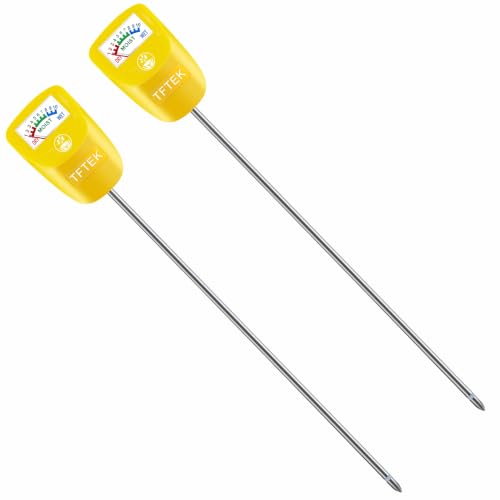
1. TFTEK 2-Pack Long Stem Soil Moisture Meter
Our pick — 4.5+★ from 400+ verified ratings; the strongest balance of quality and price.
The one that reaches the bottom of a big pot instead of guessing at the top inch.
If your plants live in floor pots or deep garden beds, the probe is the whole story — and here it runs 5.5 inches (14 cm), which the maker describes as extending further than usual. That extra reach tells you whether the soil at the base of a large flowerpot is dry, right on the money, or still holding water. Your eyes and fingers only ever find the surface, so this is the reading that actually prevents a rotten root ball.
What wins people over is plain functionality — it just works, again and again, without any setup or battery to remember. The dial is generously sized with three color zones and ten numbered scales, so a single glance tells you whether to water. Two meters come in the pack, which means one can live in the greenhouse and one in the kitchen window without any swapping.
The honest limit sits in the materials. Long-term durability gets mixed marks, and the tip is metal that will gradually corrode if you leave it buried. The fix is written on the manual and worth repeating: read, then pull it out, then wipe it clean. Used that way, the corrosion never gets a foothold. One buyer-level caveat worth knowing — this is for soil only, never for standing water.
What earns its keep
- 5.5-inch (14 cm) probe reads the root zone in tall pots and beds
- Zero batteries — push in, read the dial, done
- Single-probe design leaves roots and soil mostly undisturbed
- Two meters per pack covers two growing areas at once
The trade-off
- Metal tip corrodes if left in soil beyond about five minutes
- Reads only standard soil — no liquids, no rock-hard ground
Worth it if: your plants sit in deeper pots where a short probe would only scratch the surface — this is the pick that reads the whole root zone.
Bear in mind: it rewards a quick insert-and-wipe habit rather than a set-and-forget one.
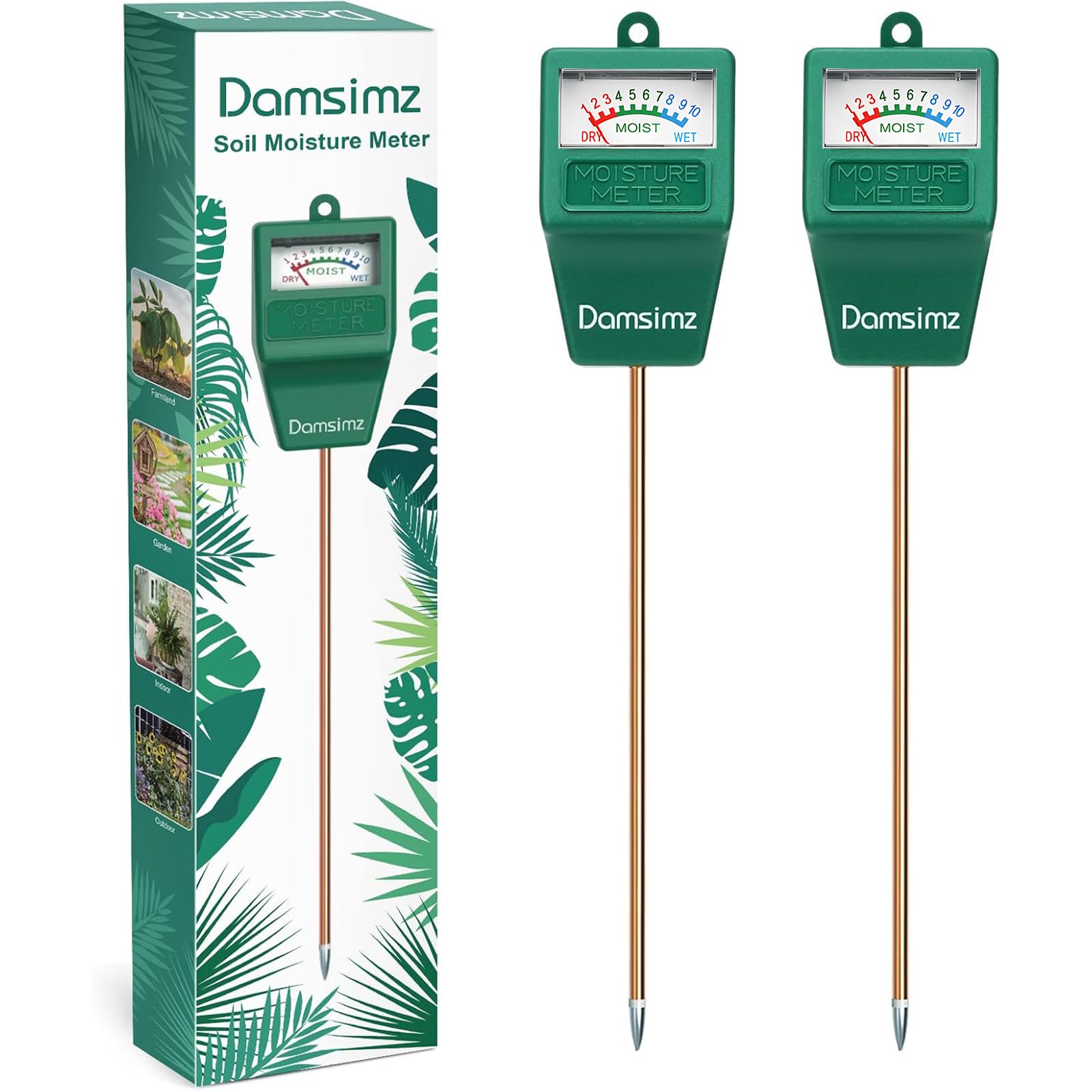
2. Damsimz 2-Pack Soil Moisture Meter for Plants
A 7.7-inch stem for reaching the wet layer under big potted plants.
The number that defines this one is the probe: it measures 7.7 inches, the longest stem on this list. That is a genuine advantage for a large potted plant that hides a soaking wet bottom under a dry crust. Push it in and you see whether the water is sitting deep, not just at the surface.
Reading it is simple. The numbers are clear, the colors are bright, and the tick marks are large, and the dial is angled so you can catch a reading from where you are standing. No batteries, no charging, no app — insert it and the needle moves. When you are rotating through a mixed collection of houseplants that each want a different moisture level, that speed is the point.
What buyers value most is that it takes the guesswork out of the watering can. The one thing to plan around is that this is strictly a soil tool. It measures moisture and nothing else — no pH, no light — so if you want a full soil readout, look further down this list. For pure watering decisions, it is hard to argue with the reach it delivers.
Where it earns its slot: 7.7 inches of probe for one of the lowest prices here, plus a dial angled for easy reading. That is a lot of reach for a starter meter.
What to know going in: moisture only — nothing more measured.
Best fit: the plant parent with a shelf of pots in different sizes who wants the fastest possible read on each one.
Look elsewhere if: you also want pH or light readings, since this meter measures moisture alone.
3. Dr.meter 2-Pack Soil Moisture Meter Tester
The color-coded gauge that turned a whole generation of plant owners onto soil meters.
Here is the meter most people picture when they think of a plant water meter, and the reason is the readout. It uses ten scales with a red-to-green-to-blue sweep, so you do not need to memorize numbers. Red says dry, green says right, blue says too wet. For anyone who has killed a plant by watering on a schedule instead of on evidence, that color system is the fastest teacher available.
The functionality side is what keeps it around. It is a two-pack, so one lives indoors and one goes out to the garden. It needs no battery or power at all, and it works across the operating range the maker lists of 10% to 90% relative humidity in the soil. The single probe keeps roots intact, so you do not tear up the root ball every time you check a thirsty fern.
Set against the TFTEK above, this one does not publish a probe length, so if you are working with unusually tall pots the deep-reach pick is the safer bet. The recurring gripe over the long haul is durability — these metal probes wear out faster when they spend time sitting in wet soil or hit a rock. Read it, pull it, clean it, and keep it out of hard ground. Do that and the color dial keeps earning its place.
The reason it is here: a red-green-blue dial that teaches you watering in one glance, plus a two-pack that covers indoors and out. That is a beginner-friendly combo.
One thing to watch: the probe tips wear faster in hard soil, so treat insertion gently.
Reach for this if: you are new to houseplants and want a meter that tells you to water in plain colors rather than numbers.
Hold off if: every pot you own is deep and tall, where a published probe length matters more than a dial.
4. XLUX T10 Orange 2-Pack Soil Moisture Meter
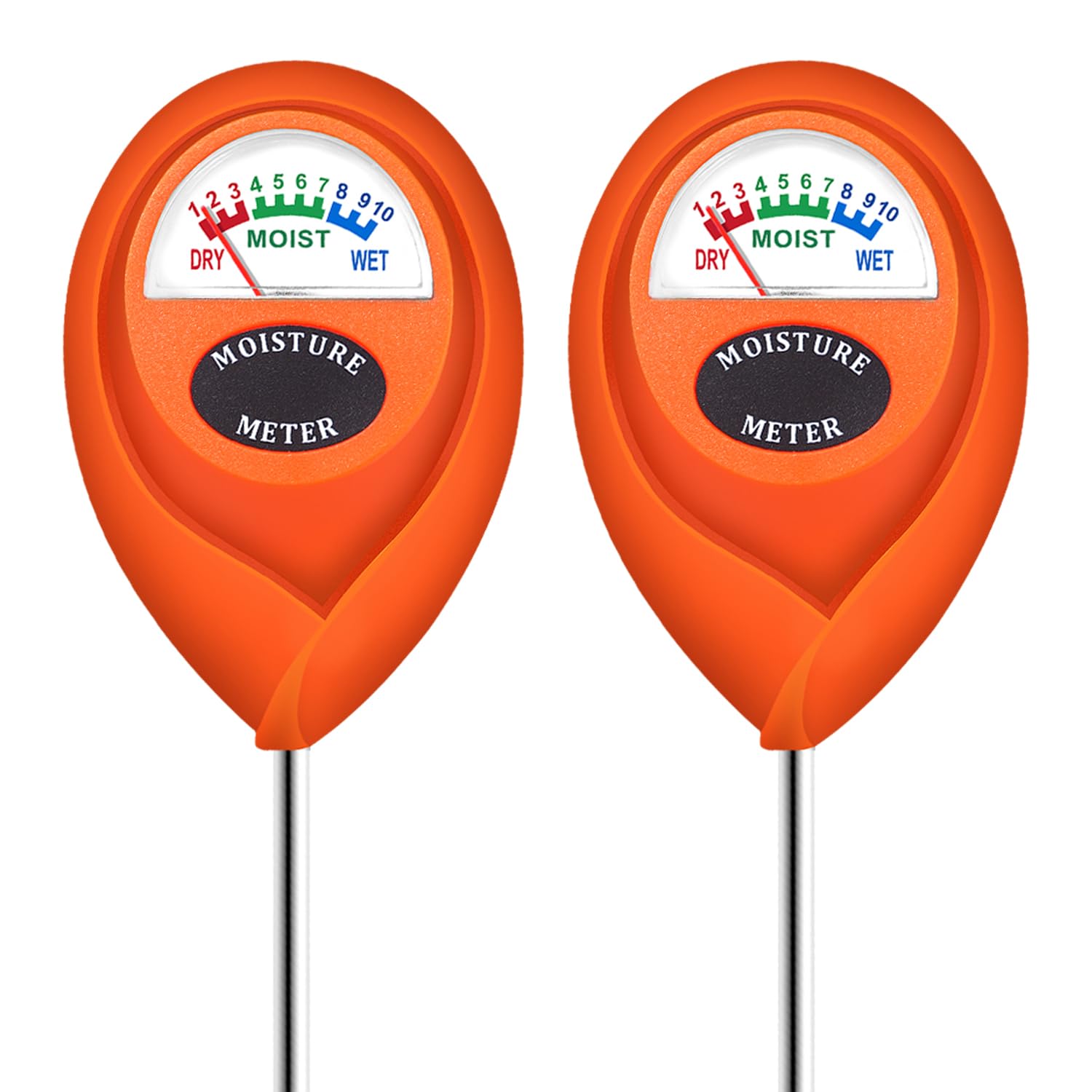
An orange two-pack with a 304 stainless probe and a dial that reads at a glance.
If you want proof that a simple tool can have a devoted following, this is the one. Owners describe it as an invaluable part of their plant care, the thing that finally stopped them guessing about watering. It is a two-pack in bright orange, so you can keep one in the sunroom and one by the back door without hunting.
The build detail that matters is the probe material — it is anti-rust 304 stainless steel, which is the grade chosen for resisting corrosion in damp conditions. The dial is large with three zones and ten scales, and it reads instantly when you insert the probe, no waiting and no button. A single-probe layout means the roots take far less of a beating than they would with a multi-prong fork.
Compared with the Dr.meter two-pack, this one gives you the same color-dial ease but spells out the stainless steel construction, which is reassuring if your plants stay consistently damp. The limit is still the same across every analog meter: do not park it in the soil. Five minutes is the ceiling before the metal starts to go, so this is a check-and-pull tool, not a permanent resident in the pot.
The standout spec: anti-rust 304 stainless steel on a single probe. That is the detail behind the long-term reliability that owners keep coming back to.
Go for it if: you want a color-zoned dial with a probe material explicitly chosen to fight rust, in a two-pack that covers two rooms.
skip it if: you keep forgetting to pull meters out — this one needs the same read-and-remove discipline as the rest.
5. XLUX T9178 Long Probe Plant Soil Moisture Meter

A tree-sized probe that checks the moisture at the bottom of a deep planter.
For anyone with a fig tree, a large fern, or a garden bed that runs deep, this single meter solves the one problem the others cannot: it goes down to where the moisture actually lives. The probe measures 5.5 inches (14 cm), which is longer than regular styles, so you can read the soil near the base of a big flowerpot instead of the dry top layer.
It has the same easy-reading setup as the orange pick — a big three-zone dial, ten scales, instant readings, no battery. It is a single pack, so this is the one designed for the plant that needs watching, not a collection. The stainless steel probe resists rust, and the single-probe design protects the root system as you check.
Here is the catch for pot owners who use chunky, airy mixes. If your soil is loose perlite, pumice, pine bark, or orchid mix, the probe may not make good contact with the damp particles. The dial can sit at zero even when the media is wet. The maker’s fix is to firm the soil around the probe so the sensor touches the moisture-holding particles. That is a soil-contact issue, not a broken meter, and it tells you exactly what this tool expects from your potting mix.
Why it earns the deep-reach label
- 5.5-inch (14 cm) stem reaches the root zone in large pots
- Anti-rust 304 stainless probe for repeated damp readings
- Large three-zone dial with ten scales, no battery
- Single-probe design keeps root damage low
Where it asks more of you
- Loose or airy mixes need firm packing to get a reading
- Sold as one meter, not a pair, so it suits one big plant
The right call for: a deep planter, a tree in a tub, or a garden bed where surface readings are worthless.
Think twice if: you grow in pure perlite or orchid bark — you will need to pack the soil firmly to get a number.
6. RAINPOINT ICS629 Large Display Digital Soil Moisture Meter
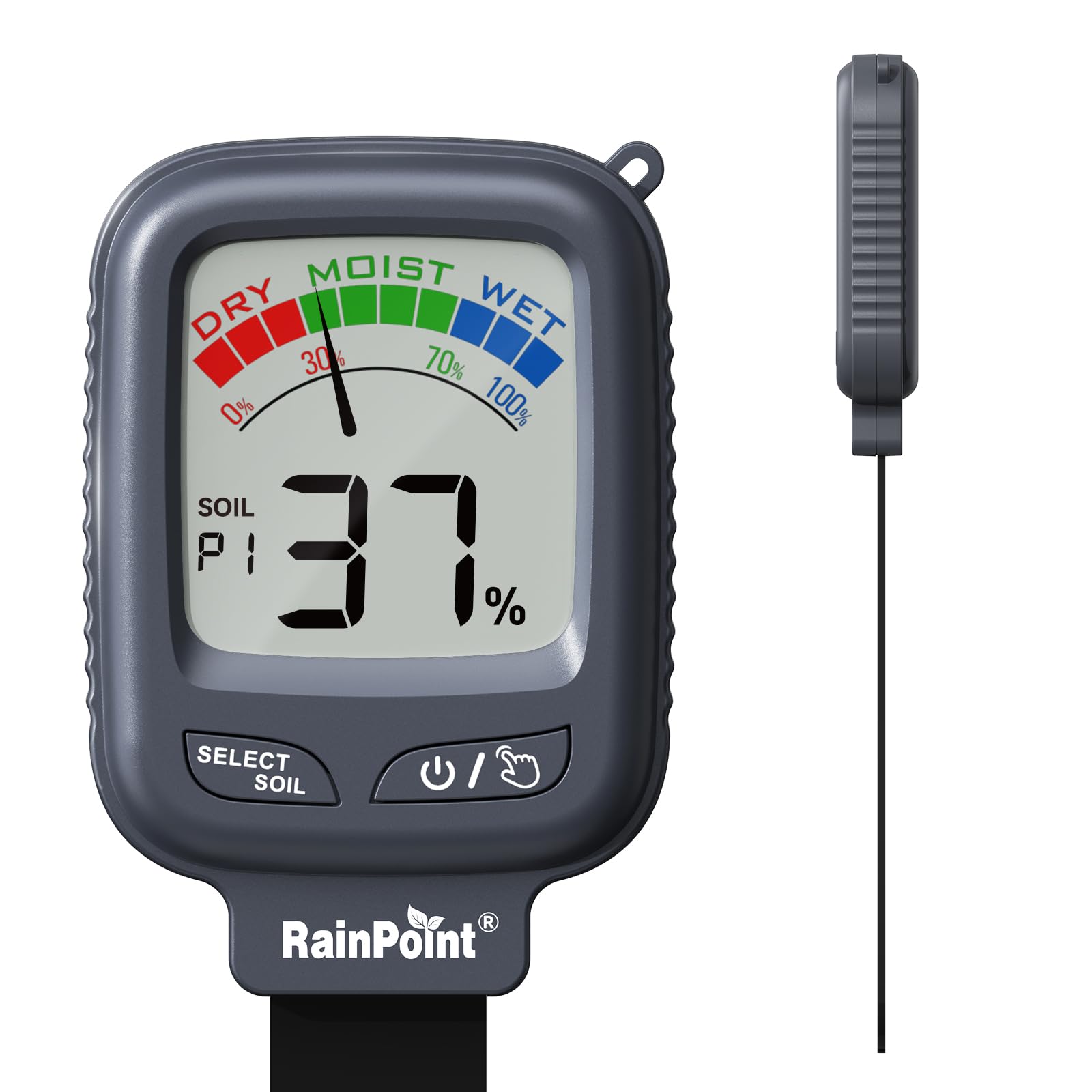
The one you leave in the pot, so a moisture reading is waiting whenever you walk by.
Every other meter here gets pushed in and pulled out. This one stays. It runs on a single CR2430 battery (included) and holds an always-on display, so you glance at the plant and see the moisture level without lifting a finger. It can auto-check every two hours or give you a manual reading with a button press, and then you switch it off to save the battery. For a busy plant owner who forgets to check on a Thursday, that continuous view is a different way of caring entirely.
It shows a digital percentage, not just a needle, so you get a number to compare with your plant’s needs. The color gauge gives a fast read for beginners, and the percentage covers it when you want more precision. It also slips into a drawer or a back pocket easily; it is slim at 0.63 inches (1.6 cm) and light at 1.1 ounces, so it never feels like a chore to carry it to the plant.
The catch is that the staying power is the selling point and the risk rolled into one. Leaving a meter in soil is the exact habit that corrodes metal probes on the analog picks. This one is built for stay-in use, but it does still rely on a battery, so eventually it stops reading until you swap that CR2430. The ribbed side grip and a built-in tag slot for notes are the small extras that make it feel considered.
What it changes for you: it turns a moisture check from a task into a glance — the display stays live in the soil.
The honest trade: a battery to replace down the road, and a stay-in design that is the opposite of the pull-and-wipe routine the analog picks demand.
Made for: the person who wants to see moisture at a glance without inserting a probe every day.
Not ideal if: you would rather never deal with a battery — the analog picks above skip that entirely.
7. HSLGOVE 7-in-One Soil Test Kit
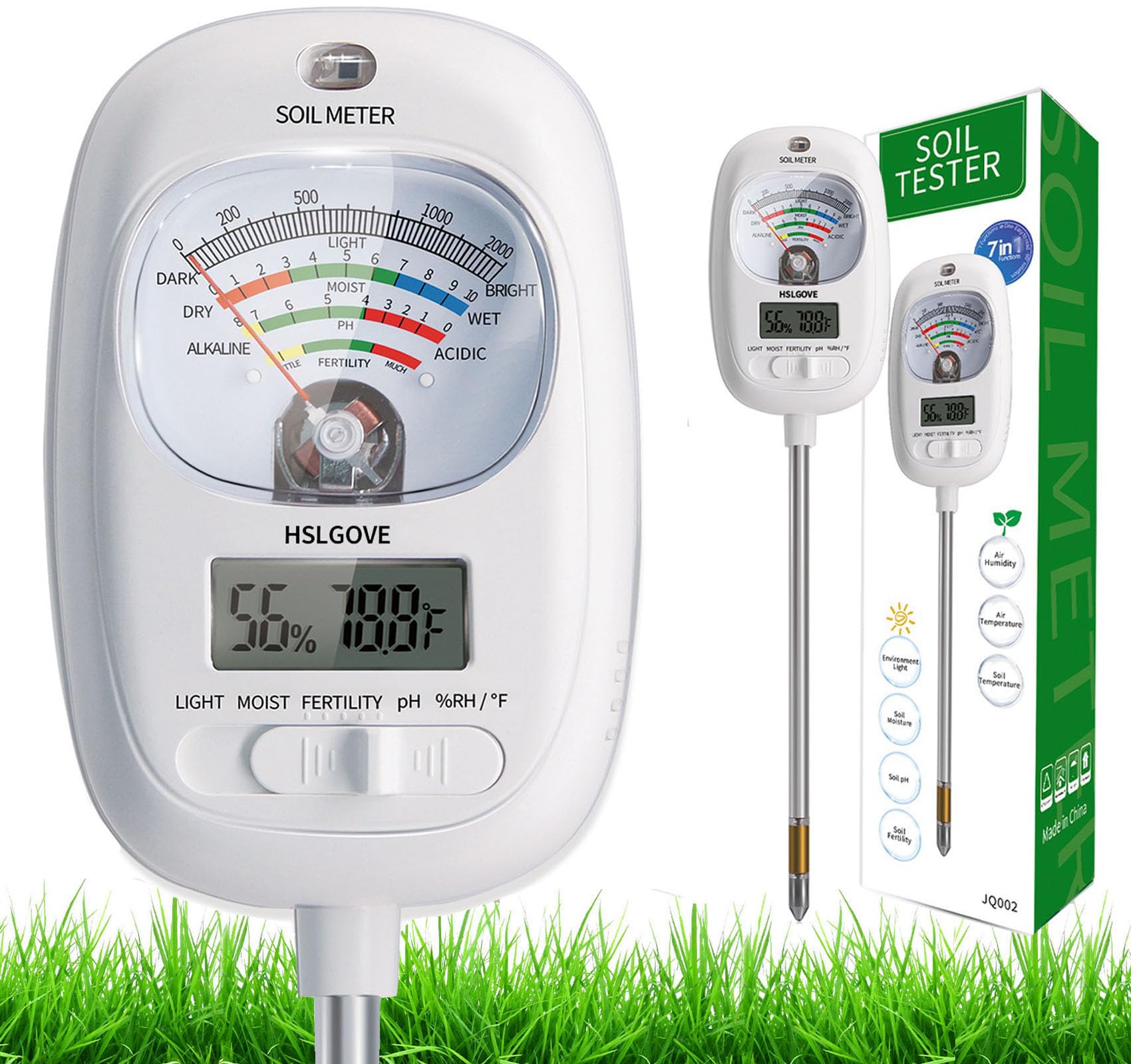
A single tool that checks moisture, pH, fertility, temperature, and light in one pass.
The 7-in-one label is literal: this tester measures soil moisture, pH, fertility, temperature, and light, then displays indoor temperature and humidity on its LCD. You switch modes with one button. For someone starting a seedling tray who wants to know whether the soil is too acidic or too warm as well as too dry, this is the only pick on the list that answers all of it.
Where owners say it shines is the combined view — one tool in one hand, no swapping gear between checks. It is built for beginners, and it runs on three batteries that need installing and replacing. The probe is about 6.8 inches long, which suits medium to large pots. Like the deep-reach meters above, it is single-probe, so roots take less damage.
The honest catch is that this brings the extra functionality but also more to manage. The LCD relies on its batteries, and the maker notes you read the screen within a few minutes, not leave it running. Compared with the simpler analog picks, there is more to learn: you select a mode, watch the screen settle, then move on. For the extra data, it is a fair trade, but it is a fair trade, not a free upgrade.
Why it earns the price of the extra features: seven readings from one tool — the widest soil picture in this group. If pH and fertility matter to you, none of the plain moisture meters cover them.
The catch worth knowing: batteries plus a short reading window on the LCD mean it is not a leave-it-and-forget-it tool.
Pick it if: you want moisture, pH, light, and temperature in one tool and do not mind managing batteries.
Buy something simpler if: watering decisions are all you need — the analog picks make them with no setup at all.
8. Luster Leaf Rapitest 4-Way Digital Soil Analyzer
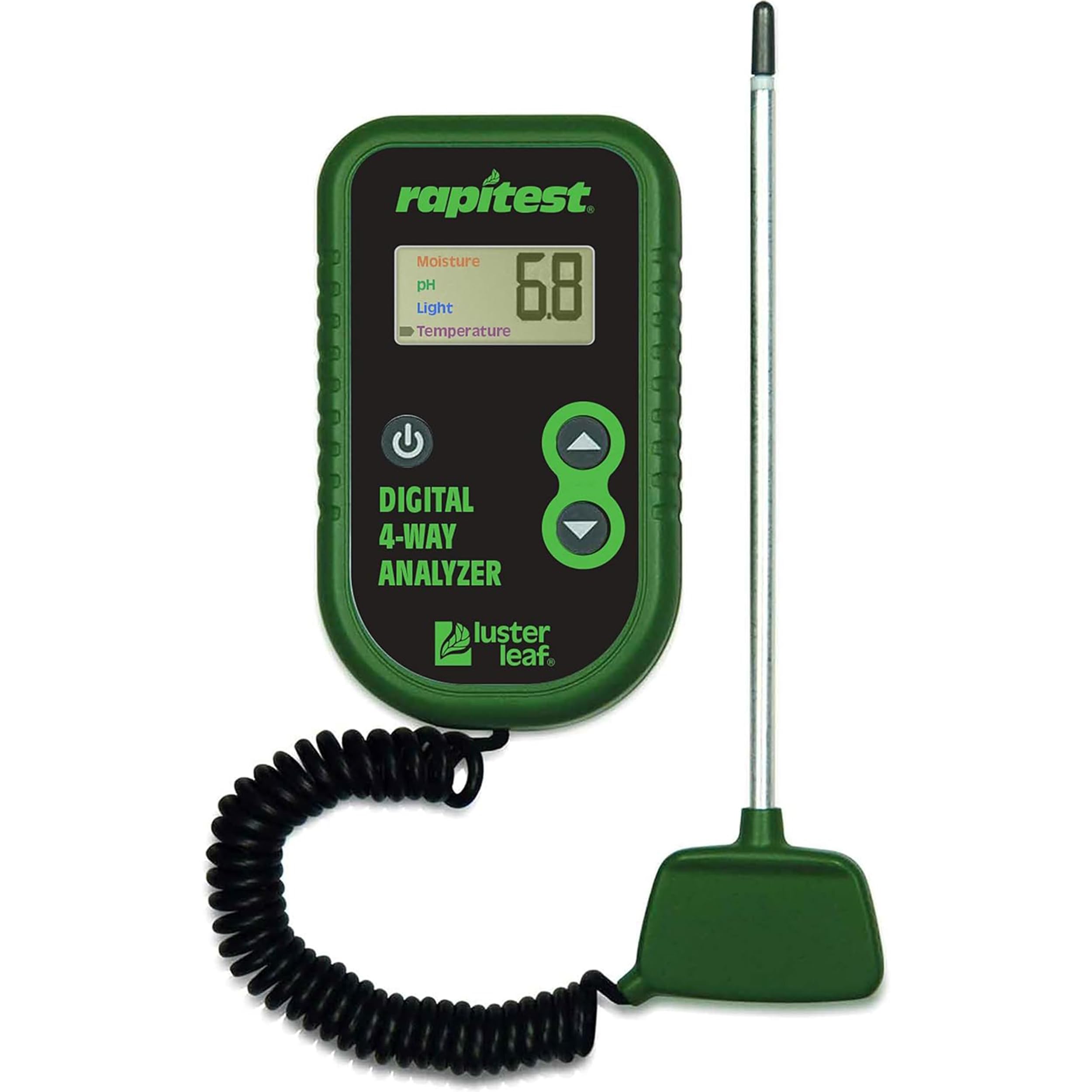
The analyzer that comes with a pH plant list covering 450+ species.
This is the pick for the gardener who thinks in pH, not just dry or wet. It tests soil moisture, pH, light, and temperature, and it comes with a full pH plant list covering 450+ plants from Rapitest, so you can look up what your tomato or your hydrangea actually wants. The corded probe lets you hold the digital display in one hand while the probe sits in the soil. No bending down to squint at a dial.
Here is where I owe you honesty. The digital display is the convenience upgrade, but this pick’s real appeal is the documentation and the four-in-one testing. If you are a gardener who wants a reference book built into your tool, the plant list is worth something the analog meters cannot offer.
The trade-off is worth taking seriously. Some buyers report readings that did not match their other tests, and the reliability of the digital output is less consistent than the needle meters above. This is the pick to choose for the plant pH list and the four-way readout, not for the most dependable moisture dial on the page. If your need is a watering decision you can act on without doubt, the TFTEK or the Dr.meter two-packs are the more predictable bets.
What no one else gives you here: a reference pH list of 450+ plants plus four simultaneous test types from a single device.
Honest caveat: the digital readout is less consistently trusted than an analog dial.
The fit: a gardener chasing pH and light data who wants a lookup list for 450+ plants in the box.
Reconsider if: a trustworthy moisture number is all you need — simpler analog meters are the safer call.
9. Fiddle Leaf Fig Health Meter
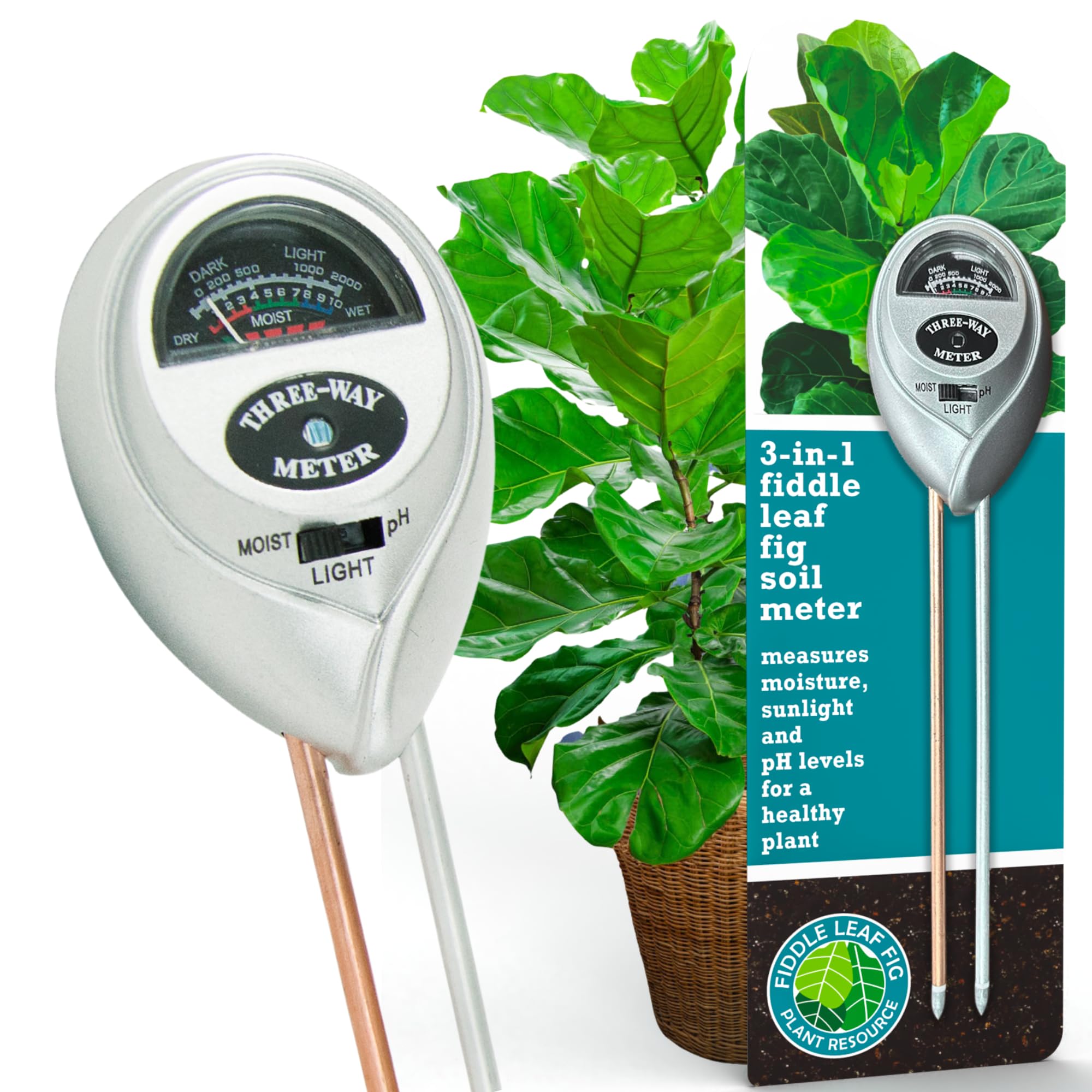
Built around one famously fussy houseplant, and easier to use because of it.
Fiddle leaf figs are the plant everyone loves and almost everyone over-waters. This meter is designed around that exact problem. It checks moisture, light, and pH with a three-position toggle, so you can see whether the soil is wet, whether the fig is getting enough sun, or whether the soil leans acidic or alkaline. No battery, because a metal probe and a dial need no power.
The most useful detail for a fig owner is the guidance: it works best in loose, non-compacted soil and reads down through a long probe. For new owners, being told which reading matters for a fig and which does not is half the battle. It is small and light at 2.1 ounces, so it tucks into a drawer between waterings.
The honest caveat is that moisture accuracy is mixed. Some owners find it right the first time; others say the reading does not quite match reality. Where it clearly earns its place is as a beginner’s three-in-one tool for a specific plant, a way to check the three things that kill a fig — water, sun, and soil pH — in one quick push. If you want a no-doubt moisture number above all else, a dedicated two-pack like the Dr.meter covers that more simply.
Where this one clicks
- Three-position toggle checks moisture, light, and pH
- No batteries — reads on a metal probe and dial
- Built around the needs of one particular houseplant
- Light at 2.1 ounces, easy to store between uses
What to weigh
- Moisture accuracy is mixed in owner feedback
- Best in loose soil, not compacted ground
Right for you if: a fiddle leaf fig is your plant and you want water, light, and pH from one no-battery tool.
Elsewhere if: you need a moisture number you can rely on without a second opinion.
Know the Specs
Probe length and the root zone
A probe is the metal spike that goes into the soil. Its length decides how deep the reading reaches. A short probe tells you about the top inch, which is the same thing your finger does. A longer stem — 5.5 inches (14 cm) or 7.7 inches depending on the pick — reaches the moisture near the base of a big pot. If your plants are in shallow nursery pots, length barely matters. For floor pots and garden beds it is the single most useful spec on the page.
The three-zone dial and ten scales
The dial is the face with the needle. Three zones mean the face is divided into dry, moist, and wet bands, and ten scales give you numbered gradations within those bands. In practice, the color zones are what a beginner reads and the numbers are what a more experienced grower uses to fine-tune. A larger dial is easier to see from a standing position, which matters when you are checking a shelf of plants in a row.
Battery-free versus battery-powered
A battery-free meter uses the soil’s own conductivity to move the needle, so there is nothing to charge and nothing to replace. A digital meter like the RAINPOINT or the HSLGOVE kit needs a battery to power its screen. The trade is convenience: batteries add a display that can stay on and show a percentage, while the analog probe skips the battery entirely and lasts as long as the metal holds up.
Soil contact and what the reading really means
A moisture meter measures how easily current passes through the soil, which varies with how densely the damp particles touch the probe. Loose mixes — perlite, pumice, pine bark, orchid bark — may let the probe sit in air pockets and show a false zero. Firming the soil around the probe restores contact. This is why the same meter can read dry in one pot and wet in another even when both are freshly watered.
Common Questions
How deep does a soil moisture meter need to reach?
Do these meters need batteries?
Can I leave a soil moisture meter in the soil?
Will a moisture meter work in perlite or orchid bark?
What is the difference between the three-zone dial and a digital percentage?
How long will the probe last before it rusts?
Is a single probe better than a multi-probe meter?
Can I use a soil moisture meter to test water or other liquids?
What does a pH reading tell me that moisture does not?
Does a digital moisture meter last as long as an analog one?
The Bottom Line
For most plant owners, the soil moisture meter for plants winner is the TFTEK 2-Pack Long Stem. Its 5.5-inch (14 cm) probe reaches the root zone where a big pot really holds water, so you water based on what the roots feel, not just the surface. The two-pack also covers more than one growing area. If you want the longest reach for a shelf of mixed pots, the Damsimz 2-Pack answers with a 7.7-inch probe. And for a plant you want to watch without inserting anything, the RAINPOINT ICS629 stays in the soil with an always-on display. The detail that keeps the TFTEK on top is the long probe paired with a large three-zone dial: check one plant deep in the pot, glance at the color, and you know whether to water in seconds.
How we choose
We do not accept paid placement. Every pick is matched to a real buyer and a real use-case; we do not hands-on test units.
Sources
Specifications: manufacturer listings and product documentation. Review insights: verified customer reviews, as of November 2026. Pricing: not shown on this page (it changes often); check the current price via the retailer link.
As an Amazon Associate, Tactical Gear Guy earns from qualifying purchases. This does not affect which products we feature.