Specs are compiled from manufacturer listings and verified buyer reviews and can change over time — please confirm the key details on the product page before buying.
You want real hot espresso on a campsite, in a hotel room, or at a desk with no outlet nearby — and you do not want to haul a kettle to get it. That is exactly what a rechargeable coffee maker does: it carries its own battery, heats its own water, and pushes a 20-bar pump through grounds or a capsule. The catch is that hot-cup counts per charge range from about 3 to 9, and some models ship without a battery. This guide sorts the nine strongest contenders by what they truly brew, so you pick the one that fits your mornings.
This guide is built by comparing the manufacturers’ published specifications and the patterns across verified customer reviews, so you get each pick’s real strengths and trade-offs instead of marketing spin.
Portable espresso has moved well past hand-pump novelty, and the current crop heats water in-house, remembers your temperature, and fits in a backpack side pocket. Below are the nine strongest rechargeable coffee makers, ranked by hot-cup count, heat-up time, and carry weight.
Top Picks

How To Choose The Best Rechargeable Coffee Maker
The single question that decides everything: does the machine heat its own water from cold, or does it need you to pour in hot water first? A true self-heating brewer carries a bigger battery and does the whole job on its own. A preheat-only machine can pull far more shots, but you are still boiling water somewhere else before you brew — which defeats the point on a cold campsite morning. Decide this first: it sets your battery size, shot count, and carry weight.
Battery capacity and how many hot cups it really means
Capacity in mAh (milliamp-hours — a measure of how much charge the battery holds) is the headline number, but it only matters alongside the water volume you brew. A 5000mAh pack and a 13500mAh pack are doing very different amounts of heating work. Look for the manufacturer’s stated hot-cup count at room temperature, because that is the honest figure — brewing with preheated water can push a machine to hundreds of extractions, but that is not cordless coffee making, it is assisted coffee making. Match the hot-cup count to your real trip length.
Pressure, capsule format, and what fits in the basket
Pressure is quoted in bar (a unit of pump force — 20 bar is espresso territory), and most of these machines sit at 20 bar. What separates them is the coffee input: some take ground coffee only, some take ground plus NS Original capsules, and a couple add DG capsules or 44mm E.S.E. pods. If you already own a capsule stash, verify the exact format before buying. Ground-coffee capacity in grams also matters — an 8g basket is a fuller dose than a smaller one, and it changes how strong your shot tastes.
Weight, heating time, and charging speed
Weight is quoted in grams or pounds, and it is the number that decides whether the machine rides in your jacket pocket or stays in the car. Heating time — the seconds it takes to bring room-temperature water to extraction temperature — is the other daily annoyance to check, because a two-minute wait at 6 a.m. feels very different from a four-minute one. Finally, look at the charging standard: USB-C at 30W or 45W refills far faster than a 10–15W trickle, and a full recharge in about 100 minutes is very different from two and a half hours.
Side-by-Side Comparison
Every machine below is cordless and battery-powered. The three spec columns compare the same three things on every row: battery capacity, water capacity, and weight — so you can scan how much power, how much coffee, and how much carry weight you are trading against each other.
| Model | Best For | Battery (mAh) | Water Capacity | Weight | Amazon |
|---|---|---|---|---|---|
| OutIn Nano 2★ Best Overall | Best overall for travel espresso | 5000mAh | 85 ml | 1.5 lb | Amazon |
| BESCOST 4-in-1Four Pod Formats | Most pod formats supported | 9600mAh | 80 ml | 578 g (body) | Amazon |
| FANSHAIN PCM2501Best Battery Reserve | Longest hot-cup run on a charge | 15,000mAh | 8 cups | 1.05 kg | Amazon |
| Fanttik Cafein 11 | Fastest heat-up in the lineup | — | 80 ml | 1.8 lb | Amazon |
| CERA+ PCM03S | Long battery plus fast USB-C refill | 13500mAh | 80 ml | 1.6 lb | Amazon |
| AMZCHEF Portable | Commuting and hotel-room brewing | 9000mAh | 2.7 oz | 1.8 lb | Amazon |
| HAUSHOF 20 Bar | Entry-level capsule brewing | 3×2500mAh | 80 ml | 732.9 g | Amazon |
| Makita CM501DZ | Drip-style batches on a tool battery | — (battery sold separately) | 240 ml | 1.5 kg (no battery) | Amazon |
Detailed Reviews
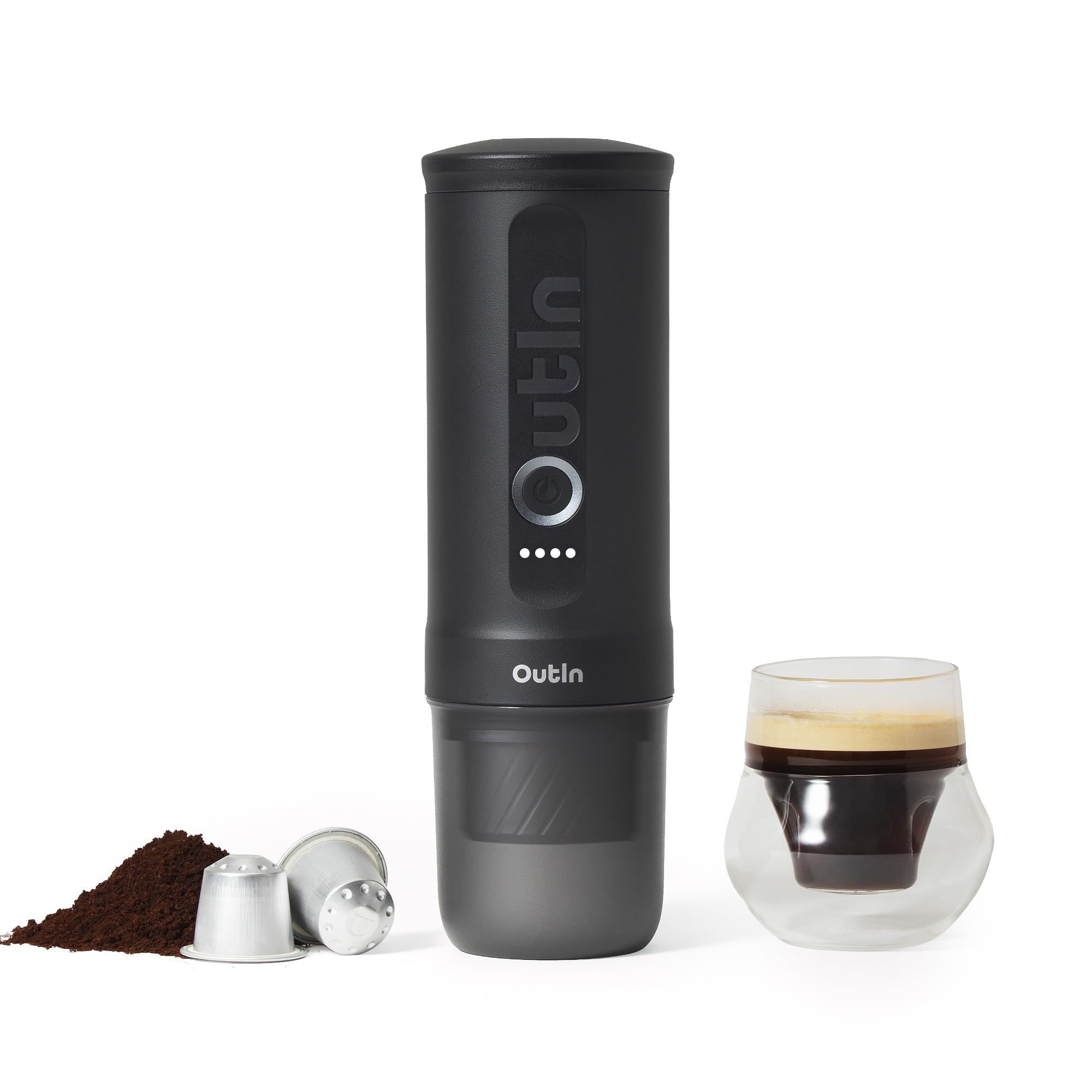
1. OutIn Nano 2 Portable Espresso Machine
Our pick — 4.5+★ from 200+ verified ratings; the strongest balance of quality and price.
The thermos-weight machine that heats its own water and pulls nine hot shots without a wall socket.
What earns the OutIn Nano 2 the top slot is the combination of a genuinely self-heating brew and a carry weight of 740 grams — about the same as a full water bottle. The 5000mAh battery holds 54Wh of energy, which the maker states is good for up to 9 hot shots from 1.7oz (50ml) of 77°F water on a full charge. That 9-shot figure is the number to plan a trip around.
Heating is where this machine separates itself. It takes 1.7oz of 77°F room-temperature water up to 199°F in as little as 159 seconds, then pushes 20-bar pressure through the puck for a smooth extraction with real crema. When the battery runs low, 45W USB-C PD charging refills it in as little as 100 minutes. That 100-minute refill means a power bank or car charger can top it up between brews.
The water chamber is an 85ml SUS316L stainless steel vessel — that is the food-grade alloy used in high-end cookware — and it gives you a bit more room than the HAUSHOF’s 80ml tank. The coffee basket holds up to 8g of ground coffee, and the machine accepts NS capsules as well. One button handles both heating and extraction, so there is no dial-fiddling in the dark. Note that it will not work with the 1st Gen Basket Plus, and it is a carry-on-only item on flights.
What presses the right buttons
- Heats cold water to 199°F in as little as 159 seconds — no kettle, no stove
- Up to 9 hot shots per charge from the 5000mAh pack
- 45W USB-C PD brings it back to full in as little as 100 minutes
- 740 grams and a Ø71 × 236 mm profile — genuinely pocketable for a heated brewer
- 85ml SUS316L chamber and an 8g ground basket for a fuller dose
Where it asks for patience
- Cold-water brewing caps you at 9 shots — plan longer trips around a power bank
- Incompatible with the 1st Gen Basket Plus, so old accessories will not fit
- Carry-on only on flights, and you cannot brew mid-air
Reach for this if: you want a true one-piece, heat-it-yourself espresso maker that weighs about as much as a thermos.
Look elsewhere if: your trips run long and you would rather brew from preheated water for hundreds of shots than carry a power bank.
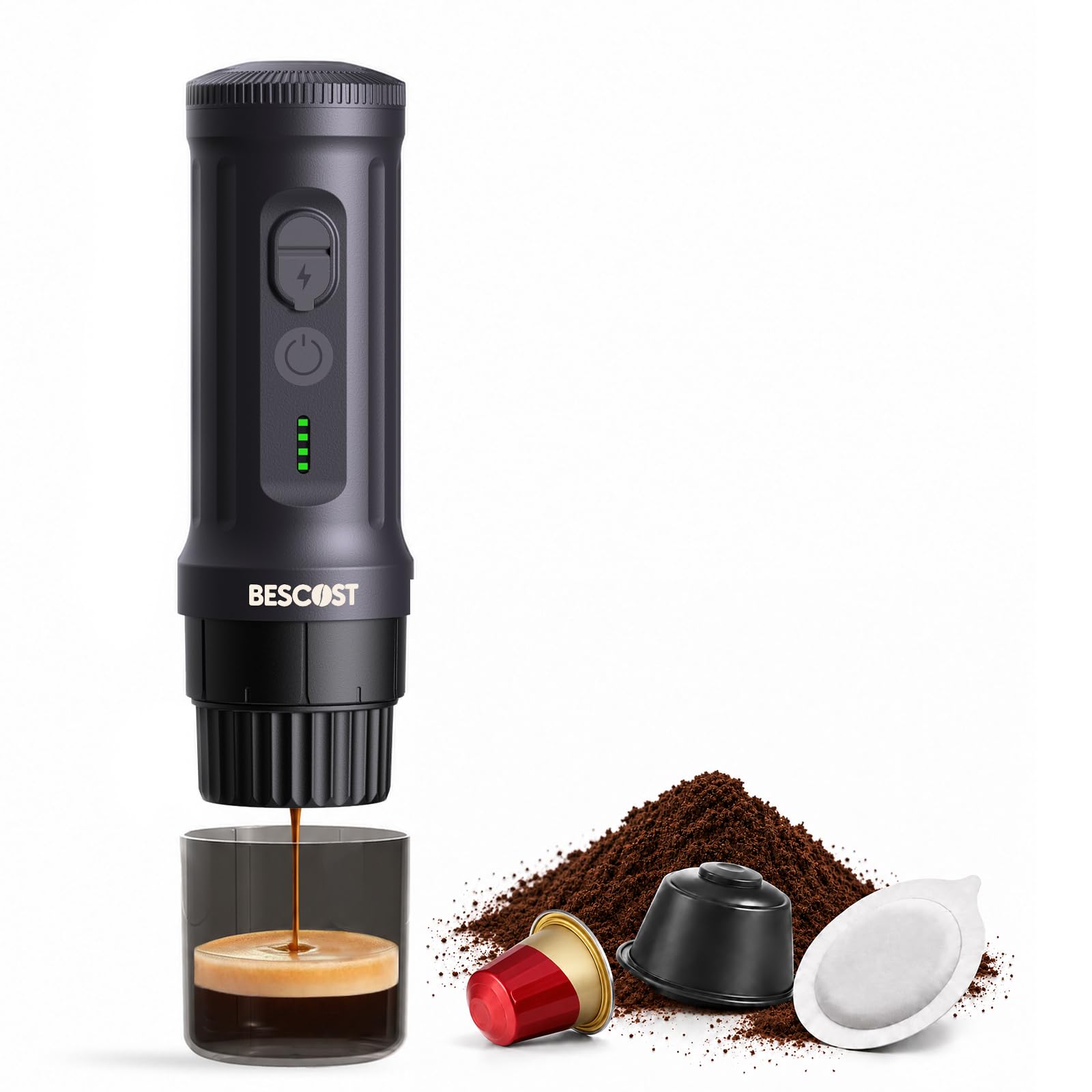
2. BESCOST Portable Espresso Machine 4-in-1
Grounds, NS, DG, or E.S.E. pods — this one brews whichever coffee you happen to have in the drawer.
Most portables lock you into one capsule family. The BESCOST runs four inputs — ground coffee, NS-compatible capsules, DG-compatible capsules, and 44mm E.S.E. pods — so you are never stuck with a bag of the wrong format on a camping trip. Its 80ml water tank also lets you dial the water volume up or down per cup, which is how you go from a tight ristretto to a longer morning cup on the same machine.
The battery is the headline spec: a built-in 3×3200mAh pack, which totals 9600mAh — the maker states this brews about 5 hot cups from 50ml of 77°F water on a full charge, or up to 400 extractions if you pour in preheated water. Compared with the OutIn Nano 2’s 5000mAh, that is a notably bigger reserve for cold-water brewing. Type-C charging works from a car charger or a power bank, and self-heating to 198°F takes about 180 seconds before extraction starts automatically.
The body weighs 578 grams, and with the adapter ring and cup it climbs to roughly 716–741 grams — so it is a backpack item, not a jacket-pocket one. The build is stainless steel with a leak-resistant, insulated body, and the hands-free cup design means you can walk away during extraction instead of holding the machine upright. A travel bag and scoop come in the box.
Why the format range wins: four brew inputs and an adjustable 80ml tank make this the pick for anyone with a mixed capsule stash.
The honest trade-off: at roughly 716–741 grams with the ring and cup fitted, it is heavier than the AMZCHEF’s 1.8 pounds only marginally — but the bulk means it lives in a pack, not a pocket.
Go with this if: capsule-format chaos is your reality and you want one machine to cover grounds, NS, DG, and E.S.E. pods.
Think twice if: you want the smallest possible carry — the ring-and-cup setup pushes it toward backpack territory.
3. FANSHAIN Portable Coffee Machine PCM2501
Fifteen thousand milliamp-hours and eight hot cups per charge — this is the group-trip brewer.
If your mornings involve more than one person, the battery math matters more than anything else. The FANSHAIN carries a 15,000mAh pack and the maker states it supports approximately 8 heating and extraction cycles for 40ml of 77°F water on a full charge. That 8-cup count is the largest in this lineup, enough for two people at a campsite.
Heating is deliberate rather than fast: 80ml of room-temperature water reaches 92°C in 240 seconds, while 40ml takes 150 seconds, driven by a 120W heating element. An NTC temperature control system holds the heat steady through extraction so the brew stays consistent cup to cup. The 20-bar pump is what builds the crema, and the OLED display shows remaining battery on a short press of any button — a small thing that saves you guessing before you commit to a brew.
Capsule support is broad within one family: Starbucks, L’OR, original Nespresso, and illy espresso capsules all fit. It will not take reusable capsules, so plan on buying pods. A 35W PD fast-charge brings the pack back up in around 2.5 hours from a compatible car charger. At 1.05 kg it is the heaviest of the compact uprights here, so treat it as a car-camping machine rather than a hiking one.
The case for the big pack
- 15,000mAh battery and about 8 hot cups from 40ml of room-temperature water
- 30W-plus PD charging refills in around 2.5 hours
- OLED display shows battery level on a tap
- Accepts Starbucks, L’OR, Nespresso, and illy espresso capsules
What to know before you commit
- 1.05 kg — car-camping weight, not backpack weight
- No reusable capsule support, so you are locked into pods
- Heating 80ml takes 240 seconds, slower than the fastest units here
The right call for: couples and camp kitchens where several cups come out of one charge.
Keep looking if: you refuse to buy capsules — this one will not run a reusable pod.
4. Fanttik Cafein 11 Portable Espresso Maker
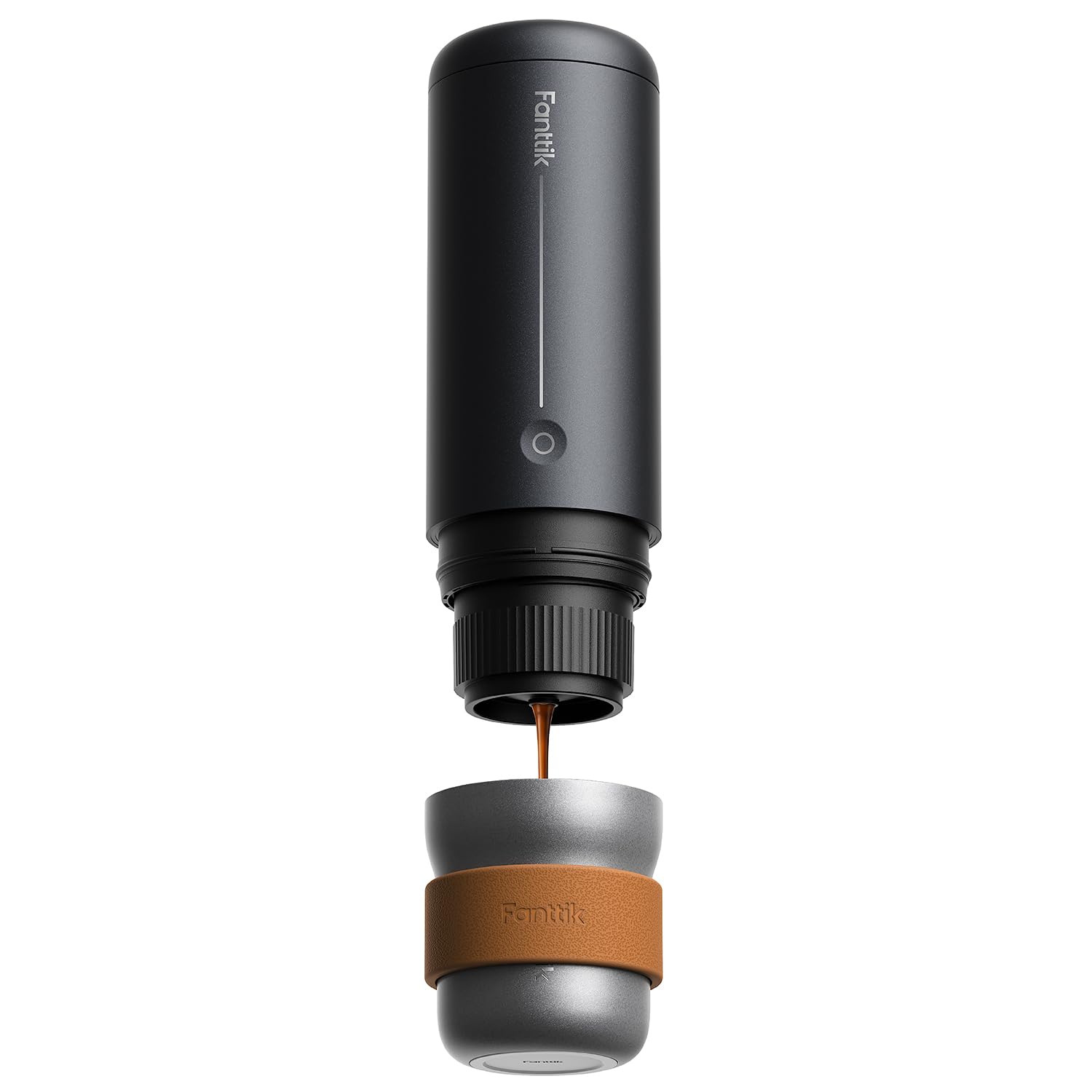
One hundred and thirty-five seconds from cold water to 198°F — the quickest warm-up of the bunch.
Waiting is the quiet tax on cordless espresso, and the Cafein 11 pays it down fastest. It heats room-temperature water to 198°F (about 92°C) in just 135 seconds, which is quicker than the OutIn’s 159 seconds and comfortably ahead of the AMZCHEF’s roughly 200. That is 24 seconds faster than the OutIn Nano 2 and about 65 seconds faster than the AMZCHEF.
Extraction leans on 20-bar pressure plus an 8-second pre-soak that wets the grounds evenly before the main push — that combination is what evens out the flavor and builds a thick crema. You can run ground coffee or Nespresso Original capsules, but no other capsule brand. The body is food-grade stainless steel and weighs 825 grams, roughly thermos weight. A pressure-sensitive touch switch handles all extraction steps and seals out dust and moisture outdoors. A ground-blower accessory pops the used puck out cleanly, which keeps the basket from turning into a mess on day three of a trip.
Where it gives ground back is battery confidence. Owners rave about shot quality and portability, but battery life is the recurring sore point, with reports of packs failing over time. There is no mAh figure published for this machine, which makes it hard to plan exactly how many shots you get per charge. If you want a machine to lean on trip after trip with a known shot count, the CERA+ or the FANSHAIN give you a clearer number to work from.
Speed with a caveat: the 135-second heat-up and 8-second pre-soak are the best warm-up story here, and the stainless build feels like a tool rather than a gadget.
Where it asks for trust: the battery is the weak point, and there is no published capacity to plan around — carry a power bank and treat it as a short-trip machine.
Pick it for: the fastest cold-to-hot brew and a metal body that shrugs off camp life.
Pass if: you need to know exactly how many shots a charge buys you before you leave the driveway.
5. CERA+ PCM03S Portable Espresso Machine
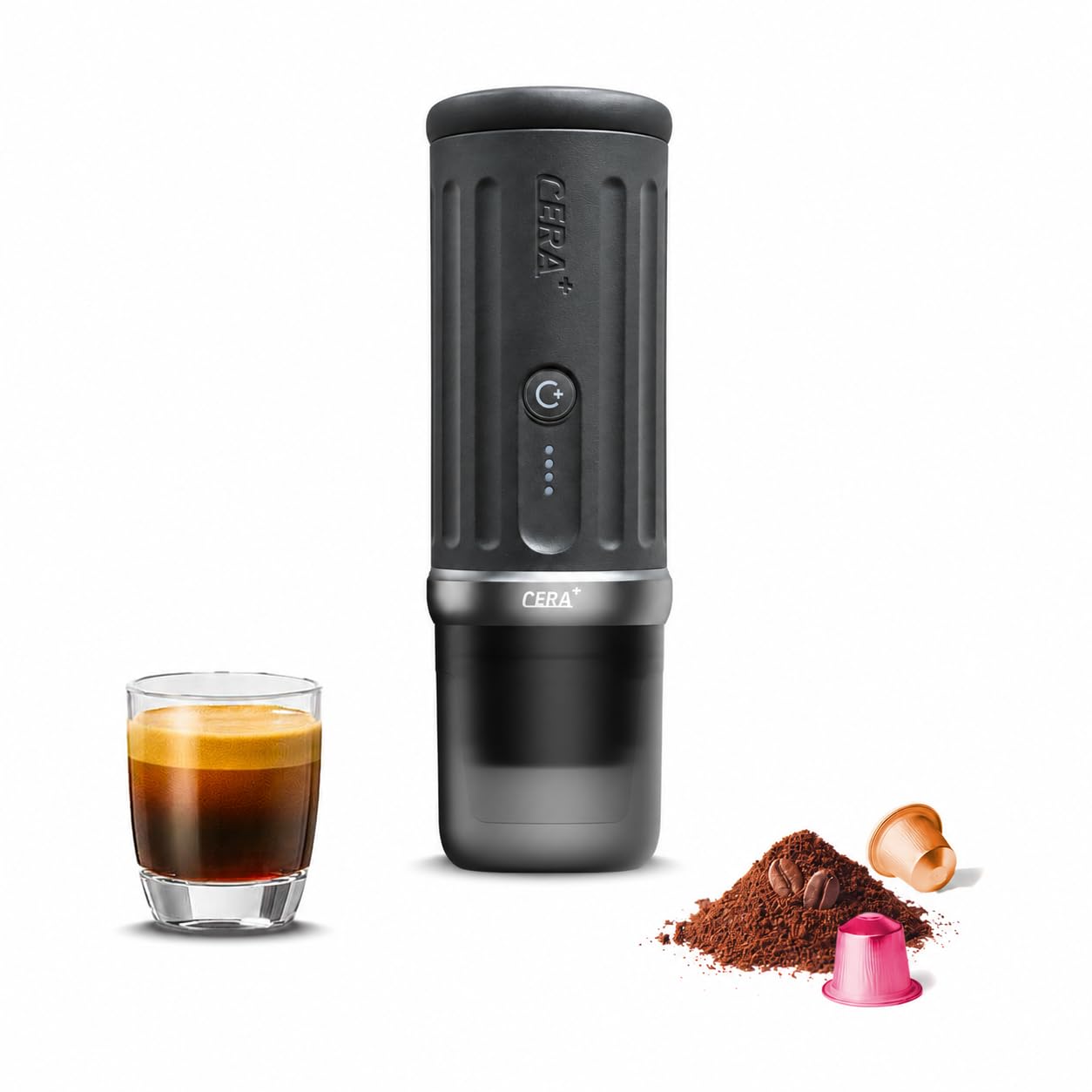
A 13500mAh pack, an 80ml tank, and a 140-second heat-up that needs no phone app to run.
The PCM03S pairs a 3×4500mAh battery — 13500mAh in total — with a stated 8 hot espresso cups per charge from 1.7oz (50ml) of cold water. Pour in preheated water and the maker claims 500+ shots from the same pack. Sitting between the OutIn’s 5000mAh and the FANSHAIN’s 15,000mAh, it is the middle path for anyone who wants a long cold-water run without the heaviest machine.
Heating is quick: 1.7oz of water goes from 77°F to 198°F in just 140 seconds, with no kettle or external power source needed. Charging is the standout — 30W Type-C fast charging reaches full in about 1.5 hours, which is faster than the AMZCHEF’s 9000mAh pack and its slower USB-C top-up. The 20-bar pump pulls through NS-compatible pods or ground coffee, and the whole thing runs on a single button with no Bluetooth, Wi-Fi, or app pairing.
Finish and shape are travel-focused: 80ml capacity, 1.6 pounds, a 2.75-inch-diameter body, and a matte space-gray exterior. Performance is what owners talk about most, and the espresso comes out consistently well. The honest note is reliability nuance — some units have been reported to stop charging or become inoperable, which is the kind of thing that shows up in a small percentage of any battery machine. Buy from a seller with a solid return window and you are covered.
Best fit for: travelers who want a long cold-water battery plus a 1.5-hour refill and no app to fuss with.
Worth a thought: the battery is the one component with a mixed track record — keep your receipt and check it charges fully on arrival.
6. AMZCHEF Portable Coffee Maker
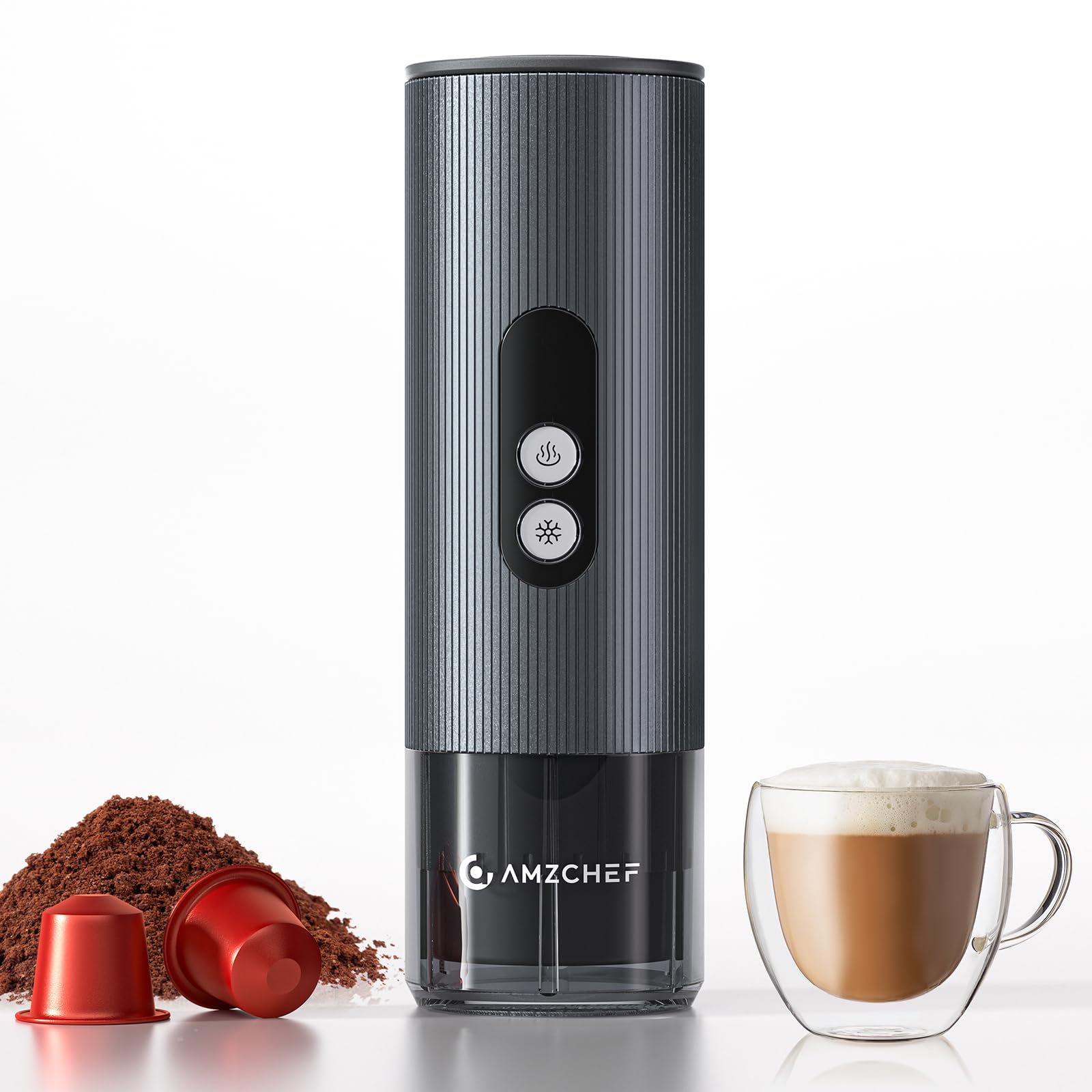
Nine thousand milliamp-hours, an LCD readout, and a self-standing base that sits right on your cup.
For a desk or a hotel room, the AMZCHEF is built around convenience rather than wilderness survival. It heats 2.7 oz of water from 77°F to 198°F in approximately 200 seconds, so a hot single-serve cup arrives without a separate kettle. The three built-in 3000mAh batteries total 9000mAh and support 6 or more self-heated 1.35 oz brews per charge, or more than 200 extractions with preheated water.
The 20-bar pump drives concentrated espresso-style extraction with crema, and two dedicated buttons split heating from extraction for clearer control. The LCD displays battery level and water temperature, which takes the guesswork out of whether you have enough charge for one more cup. It brews ground coffee and NS capsules, so you can go fresh-ground or grab-and-go depending on the morning.
At 1.8 pounds with a 2.87-inch-diameter body, it fits many backpacks and vehicle cup holders, and the self-standing base rests directly over a compatible cup during extraction — no hands needed to hold it upright. USB-C charging pulls from power banks and car adapters. One note from the maker: it is not suitable for people under 12, so keep it out of small hands.
Where it shines: the LCD temperature and battery readout plus the self-standing base make it the least fiddly machine for a desk or hotel room.
The catch: 6 hot brews per charge at 1.35 oz is modest — if you drink long cups, expect to recharge or preheat water.
Choose it when: your brewing happens at a desk, in a hotel, or on a commute where the LCD and self-standing base earn their keep.
Look past it if: you need a big cold-water reserve for a multi-day backcountry trip.
7. HAUSHOF 20 Bar 2-in-1 Portable Espresso Machine
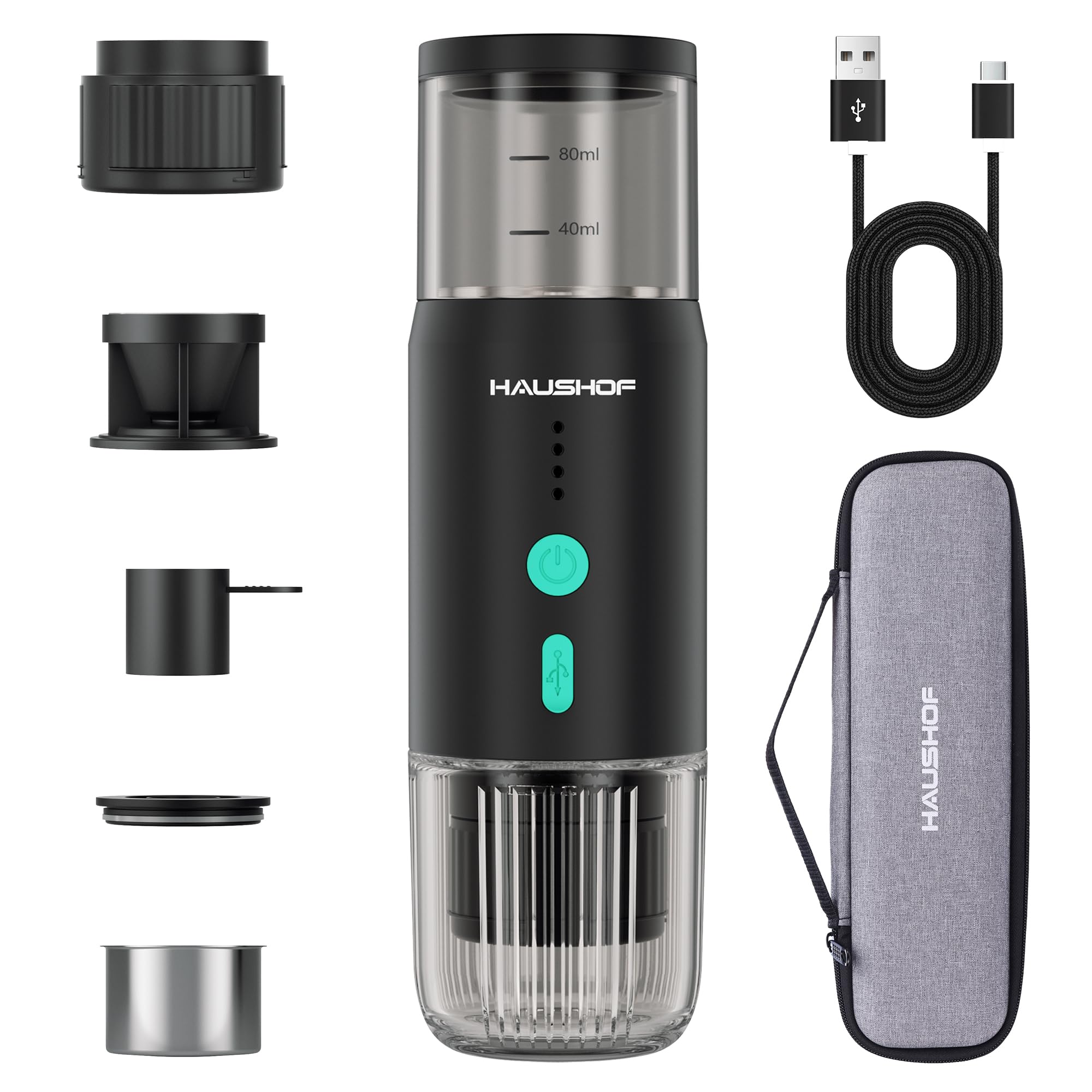
The lightest fully self-heating espresso machine here, at 732.9 grams and a budget-friendly ask.
For a first cordless espresso maker, the HAUSHOF keeps the spec list honest. It weighs 732.9 grams, holds 80ml of water in a visible measuring tank, and uses a 20-bar pump with a built-in heating system that takes 80ml from 77°F to 198°F in under 4 minutes. Ground coffee and NS capsules both work, and every part comes apart for cleaning.
Battery reality matters here: three 2500mAh cells are stated to heat 40ml about 5 times, or 80ml about 3 times, from room-temperature water on a full charge. With preheated water it delivers over 200 direct extractions. That 3-to-5 hot-cup range is the smallest in this lineup, so it suits a single morning cup rather than a group. The included 39.4-inch USB-C cable charges from a wall outlet, car charger, or power bank (adapter not included).
The 3-point groove alignment between the cup and the extraction bowl saves you from needing a separate stand, but the alignment step is the one thing owners must get right — seat the grooves, do not drop the bowl straight into the cup. A storage bag for the cup, cable, and capsules rounds out the travel kit. With 60+ ratings and a 3.5+ average, this is a machine for light, single-cup use where the budget is the deciding factor.
Worth it for: a light single-cup user who wants 20-bar espresso at the lowest outlay.
Hold off if: you brew more than three cold-water cups a day — the battery range is the tightest here.
8. Makita CM501DZ Rechargeable Coffee Maker

A 240ml drip brewer that runs off Makita slide batteries you may already own.
This is the odd one out and the useful one if you already run Makita tools. Instead of a built-in pouch cell, the CM501DZ takes slide-type Li-ion batteries in 10.8V, 14.4V, or 18V — which means one battery platform powers your drill and your coffee. The 240ml water tank is by far the largest in this lineup, so it brews a proper drip batch rather than a single shot. It accepts both pods and ground coffee.
Now the part that decides it: the battery and charger are sold separately. Without a compatible Makita battery in hand, the machine cannot run at all. That changes the value math completely — if you are already on the platform, it is a clever extension of gear you own; if you are not, you are buying into a tool battery system just to brew. At 1.5 kg without battery or cup, it is also a sit-down car-camping machine rather than a pocket carry.
Owner experience is split on the obvious point. The brewing performance itself draws positive feedback — it makes a solid drip cup — but battery life is the consistent complaint, with the machine reported to drain packs heavily and some units stopping working entirely. That is a fair warning for a battery-platform device: keep a spare charged cell on hand and treat the battery as a consumable rather than a permanent part. For a Makita household that already has batteries and a charger, the 240ml batch size is genuinely handy.
The platform advantage: a 240ml tank and compatibility with 10.8V, 14.4V, and 18V Makita slide batteries — the biggest batch size here if you already own the cells.
The catch to plan for: battery and charger are not included, and the machine is known to pull hard on packs — budget for a spare battery, not just the brewer.
Buy it if: you are already deep in Makita batteries and want a 240ml drip batch from cells you own.
Leave it if: you have no Makita platform — the battery and charger cost sits on top of the machine.
Know the Specs
Battery capacity in mAh and what “hot cups per charge” really means
Milliamp-hours tell you how much charge the battery holds — think of it as the size of the fuel tank. But the number that matters on a trip is the hot-cup count, because heating cold water drains far more power than pushing it through a puck. A machine rated for 8 hot cups from 1.7oz of cold water is doing far more work per cup than one rated for 50 extractions from preheated water. Read the manufacturer’s stated count at room temperature, then subtract one cup for cold mornings — batteries deliver less in the chill.
20-bar pressure, pre-infusion, and why the puck matters
Bar is a measure of pump force, and 20 bar is the espresso standard — enough to push water through a packed bed of coffee and build crema. Pre-infusion is a short low-pressure soak before the main push that wets the grounds evenly so the extraction is uniform rather than channeled. In a portable machine, the ground basket’s capacity in grams matters too, because an 8g dose is a fuller puck than a smaller one. A bigger basket means a stronger, more espresso-like shot; a smaller one leans toward a longer, lighter cup.
Self-heating time and USB-C charging wattage
Heating time is the seconds it takes to bring room-temperature water to extraction temperature, and it ranges widely: the fastest machines do it in around 135 seconds, the slowest near four minutes. Charging wattage works the same way — a 45W USB-C PD charger refills a pack in about 100 minutes, while a lower-wattage top-up can take over two hours. If you plan to brew and recharge in the same day, both numbers matter more than the raw mAh figure.
Capsule formats: NS Original, DG, E.S.E., and the ones that will not fit
Portable espresso machines lock into specific capsule families. NS Original is the most common, DG capsules are smaller and used by a few machines, and 44mm E.S.E. pods are paper-wrapped single servings that a handful of machines accept. K-Cup and spherical pods are almost never supported in this category, so check before you buy a capsule stash. A few machines also refuse reusable capsules entirely, which changes your long-term pod cost.
Common Questions
Can a rechargeable coffee maker really heat cold water without a plug?
How many cups of hot coffee will one charge actually make?
Do these portable espresso makers work with Nespresso capsules?
Is 20 bar pressure better than a lower-pressure portable brewer?
How fast do these machines heat water from room temperature?
What kind of charging cable do these portable coffee makers use?
Can I take a rechargeable espresso maker on a plane?
Does the Makita CM501DZ come with a battery and charger?
What is the difference between a self-heating brewer and a preheat-only one?
How much does a portable espresso maker weigh and does weight affect performance?
The Bottom Line
For most people, the rechargeable coffee maker that earns the spot is the OutIn Nano 2 because it heats its own water to 199°F in as little as 159 seconds, weighs only 740 grams, and still delivers up to 9 hot shots from its 5000mAh pack. If pod flexibility is what you need, the BESCOST 4-in-1 runs grounds, NS, DG, and 44mm E.S.E. pods from one 9600mAh battery. And when a group is brewing, the FANSHAIN PCM2501 with its 15,000mAh pack and roughly 8 hot cups per charge is the one to reach for.
One last nudge before you click: check the two numbers that decide your daily experience — the cold-water hot-cup count and the heat-up time. A machine that makes 3 cups in four minutes and one that makes 8 cups in 159 seconds feel like different products on day two of a trip, even though both say 20 bar on the box.
How we choose
We do not accept paid placement. Every pick is matched to a real buyer and a real use-case; we do not hands-on test units.
Sources
Specifications: manufacturer listings and product documentation. Review insights: verified customer reviews, as of November 2026. Pricing: not shown on this page (it changes often); check the current price via the retailer link.
As an Amazon Associate, Tactical Gear Guy earns from qualifying purchases. This does not affect which products we feature.