Specs are compiled from manufacturer listings and verified buyer reviews and can change over time — please confirm the key details on the product page before buying.
You want a vacuum pump you can carry to the truck, up a ladder, or out to a mini-split on a rooftop — without dragging an extension cord behind you. That single need splits this whole category in two: battery-powered pumps that go anywhere, and corded pumps that pull a deeper, faster vacuum but need an outlet. Below you get both, sorted by what each one actually does well, so you can pick in a couple of minutes instead of an afternoon.
This guide is built by comparing the manufacturers’ published specifications and the patterns across verified customer reviews, so you get each pick’s real strengths and trade-offs instead of marketing spin.
Cordless freedom and deep-vacuum performance rarely live in the same tool, so this shortlist pairs two battery pumps with two corded ones. Here is the honest breakdown of the best portable vacuum pump options for real jobs.
Top Picks

How To Choose The Best Portable Vacuum Pump
Start with the job: a rooftop mini-split pull and a quick single-unit pull-down call for different pumps. A pump that pulls a vacuum quickly on a rooftop mini-split is a different tool from one you tuck in a service bag for a quick single-unit pull-down. Decide where the pump will actually sit before you compare a single number.
Cordless freedom or corded power
A battery-powered pump frees you from finding an outlet, which matters on rooftops and in tight mechanical rooms. The trade-off is runtime: a rechargeable pump runs on a set charge, then needs a swap or a recharge. A corded pump runs as long as you have power and typically pulls a deeper vacuum, but you are tethered. If most of your work is on rooftops or in mechanical rooms without an outlet, go cordless; if you always have power and pull large systems, go corded.
Flow rate in CFM sets the clock
CFM means cubic feet per minute — the volume of air and moisture the pump can move each minute. A higher CFM number generally means a faster pull-down on larger systems. For small residential work, a lower figure can be plenty; for bigger lines, more flow saves time per job. Compare CFM apples to apples across the pumps you are weighing.
Microns and Pascals: how deep the vacuum goes
A micron measures how little pressure is left in the system — a lower micron number means a deeper, drier vacuum. Pascals measure the same idea on a different scale. Deep-vacuum performance matters because trapped moisture and non-condensable gases are what shorten a refrigeration system’s life. If a pump can only reach a shallow vacuum, it shows up on the gauge.
Battery platform and swap options
Check the battery voltage and capacity, and whether the pack is replaceable with a common platform you already own. A swappable pack means you can carry a spare and keep working. A sealed pack means the pump’s runtime is fixed. If you already run Makita 18V LXT packs, a pump that accepts them saves you buying a second battery platform.
Side-by-Side Comparison
| Model | Best For | Flow Rate | Power Source | Weight | Amazon |
|---|---|---|---|---|---|
| OMT Cordless HVAC Vacuum Pump★ Best Overall | Cord-free HVAC service | 3 cfm | 20V 5000mAh Li-ion battery | 9.53 pounds | Amazon |
| LeLuv Magna Smart LCD Controller | Precise handheld control | — | USB rechargeable, built-in battery | 6 ounces | Amazon |
| NAVAC NP7DP Pro | Deep, fast pulls on big systems | 7 cfm | AC adapter (corded) | 26 pounds | Amazon |
| Makita DVP180Z | LXT users with no outlet nearby | 50 liters per minute | 18V LXT (batteries not included) | 3.47 kg | Amazon |
Detailed Reviews
1. OMT Cordless HVAC Vacuum Pump, 3 cfm, Battery-Powered
Our pick — 4.0+★ from 150+ verified ratings; the strongest balance of quality and price.
A cordless pump that swaps onto a Makita pack you may already own.
This is the pick that best balances price and ability, with 4.0+ stars across 100+ ratings. What wins people over is quality — it is the single most-praised attribute of the pump, and the functionality praise backs it up. The 3 cfm flow rate pulls a vehicle or mini-split system down to as low as 37.5 microns (5 Pa) — a genuinely deep vacuum for a cordless tool. Put in a service call with no outlet close by, and it is the difference between working and hunting for a cord.
You get 70 minutes of continuous run time per charge, so you can finish several small pulls before you need a fresh battery. That comes from a 20V 5000mAh lithium-ion battery (a rechargeable pack rated at 5000 milliamp-hours, a measure of stored energy). The pack is also replaceable: the pump accepts a broad list of Makita 18V LXT batteries (Makita’s 18-volt cordless battery line), so if you already run that platform you can carry spares and never stall. Both points make it easier to haul around than the OMT’s own corded competition in this guide: at 9.53 pounds, it is far easier to lug to a rooftop than the 26-pound NAVAC NP7DP below.
The honest catch is battery life: some owners find it dies after about 30 minutes of use rather than the rated 70, so treat the runtime figure as a best case and keep a spare pack on hand. Durability is the other thing to watch — a few report it was not built to last, so it rewards careful handling in the truck. Oil monitoring is easy thanks to a 7.4 fl. oz. (220 mL) reservoir with a sight glass and scale, and the nonskid handle makes hauling it painless.
Where it earns its keep
- Pulls to 37.5 microns (5 Pa) for a deep pull with no cord
- 70 minutes of rated runtime on the 20V 5000mAh pack
- Accepts a long list of Makita 18V LXT batteries you may own
- 7.4 fl. oz. reservoir with sight glass for easy oil checks
What to keep in mind
- Real runtime can fall short — some see about 30 minutes
- A few say it is not built to last
Grab this one if: you service vehicle and mini-split systems where an outlet is not guaranteed and you already run Makita 18V packs.
Look elsewhere if: you need a pump that runs all day without a battery swap — the corded NAVAC covers that.
2. LeLuv Magna Smart LCD Vacuum Pump Controller
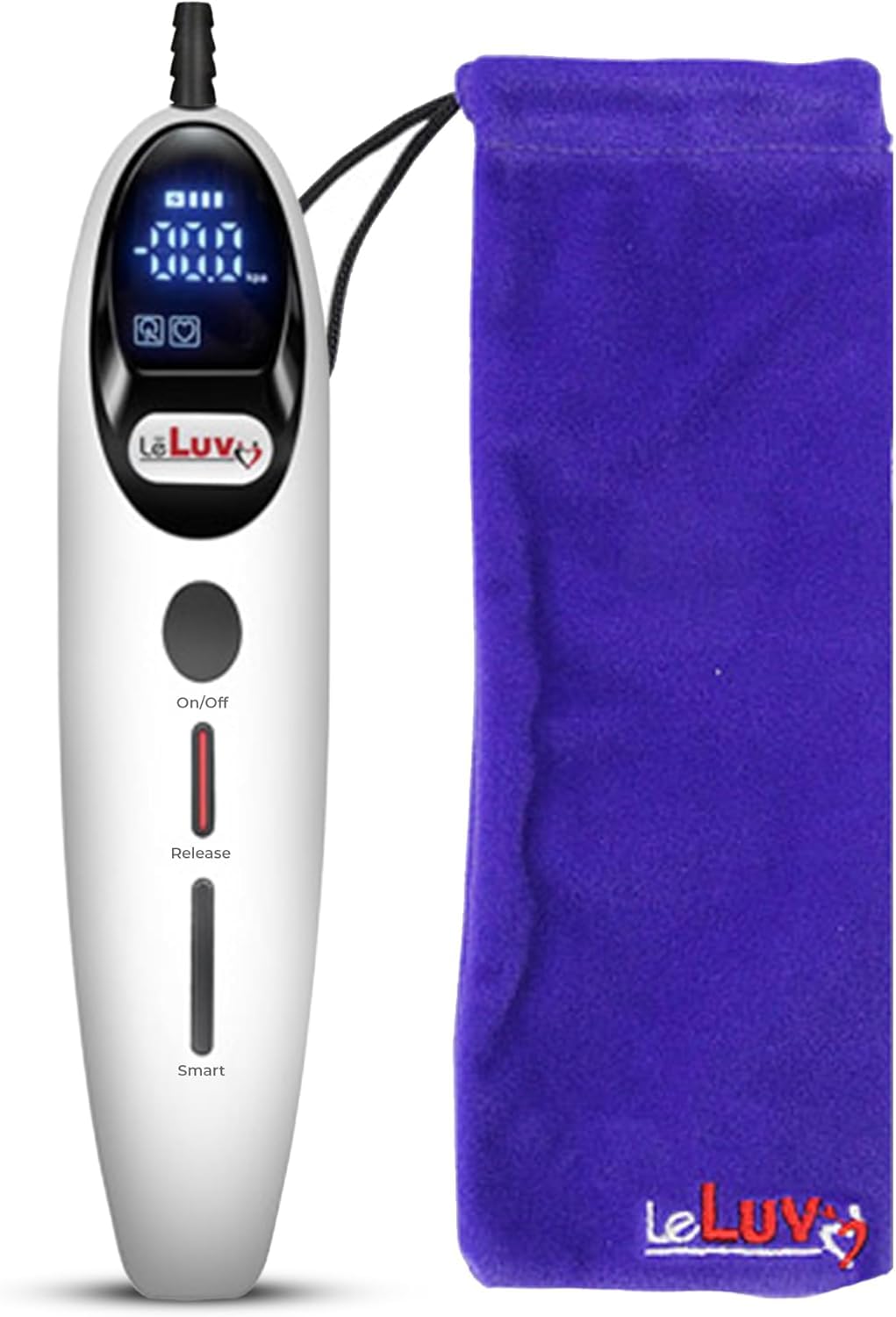
Six smart modes and a real-time gauge, in a body that weighs six ounces.
If you want fine control over vacuum level rather than raw flow, this is a different kind of tool. The adjustable range runs 0–60 KPa, shown on a digital interface with a real-time vacuum gauge — so you set a level and read it clearly instead of guessing. Six smart modes handle the rhythm for you: four preset vacuum levels with variable cycles, plus two programs where you set your own levels, and smart memory saves your settings for repeat tasks.
Two modes split how you work. Automatic pulls follow intelligent 20-minute patterns that gently pulse, release, and rebuild pressure, so you can step away. Manual mode gives steady control with no timer, and a quick-release safety button drops pressure instantly if things feel too strong. All of that sits in a handheld that weighs 6 ounces — light enough to hold for longer sessions without arm fatigue.
Here is where it diverges sharply from the OMT and NAVAC picks above: it is not a CFM workhorse for pulling a refrigerant system down. Durability and battery life are the recurring sore points — multiple buyers report it won’t hold a charge and doesn’t last long, so plan on managing the USB rechargeable pack closely. It is the lowest-rated pick here, so treat it as a precision tool rather than a primary pump. What it does well is effective, controlled suction for precision tasks where a hand pump used to slow you down.
The control story: A 0–60 KPa range on a live digital gauge, six modes, and a quick-release safety button give you tighter control than a manual hand pump.
The honest trade-off: Charge retention and long-term durability are the weak spots — if you need full-shift runtime, look to the corded NAVAC instead.
Pick it when: precise, programmable vacuum levels matter more to you than flow rate, and short sessions suit your work.
Think twice if: you need a tool that holds a charge through a full day — this one has a reputation for fading fast.
3. NAVAC NP7DP Pro Vacuum Pump, 7 CFM, Dual-Stage
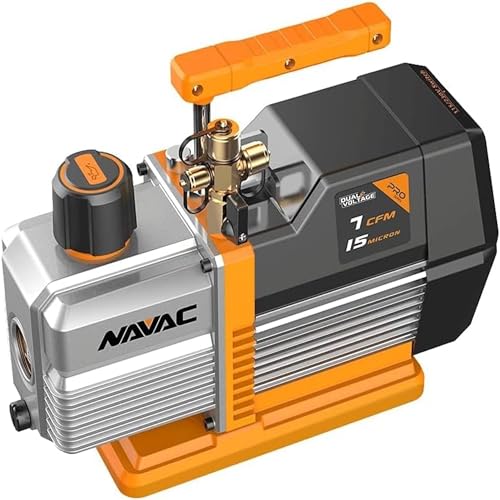
A 7 CFM twin-cylinder that pulls deep and pulls fast, at a serious weight.
When the job is a large system and you have an outlet, this is the pump that ends the argument. It delivers a 7 cfm flow rate from a dual-stage AC motor, reaching an ultimate vacuum of 15 microns at the pump. That is more than double the flow of the OMT’s 3 cfm — 7 cfm vs 3 cfm for the same pull — so bigger lines get evacuated in far less time. A twin-cylinder design runs more efficiently than a single-cylinder pump, and forced oil circulation keeps the internals working properly.
The build details are aimed at pros. A built-in check valve holds the vacuum even if the pump is unplugged or power drops, preventing backflow and keeping oil out of the system. An oil mist filter traps escaping oil smoke so your work area stays clean. Quality and reliability are the two attributes that carry the most weight with owners here, and it shows in the hardware.
The trade-off is size and weight: 26 pounds, versus the OMT’s 9.53 pounds, so it is a truck-and-cart tool rather than a carry-in-your-hand one. It is light enough to move, but you feel it on stairs. Vacuum performance reads mixed — some report it can’t get below 50,000 mtorr — so verify the gauge on your own setup rather than assuming the rated 15 microns on every unit. At 14″L x 5″W x 11.3″H it is also the longest pump here; the Makita below is far more compact at 10.43″L x 2.48″W x 6.89″H.
Why pros reach for it
- 7 cfm flow and 15 microns at the pump for fast, deep evacuations
- Built-in check valve holds vacuum through a power loss
- Oil mist filter keeps the work area clean
- Dual-stage twin-cylinder runs efficiently
Where it costs you
- 26 pounds makes it a truck-and-cart tool
- Some units reportedly struggle to pull below 50,000 mtorr
This is your pump if: you work on larger systems with power available and want the fastest deep pull in this guide. If you mostly work off a battery on rooftops, pick the OMT or the Makita DVP180Z instead.
Not for you if: you work off rooftops with no outlet and haul your tool by hand — go cordless.
4. Makita DVP180Z 18V Li-ion LXT Vacuum Pump

Built for the LXT owner who wants a pump that vanishes into a tool bag.
You likely already own the batteries for this one if you live inside Makita’s 18V LXT system, and that is its quiet advantage over the OMT. It moves up to 50 liters per minute (a measure of how much air it shifts) and pulls an ultimate vacuum of 20 Pascals (how low it can drive the pressure), so it handles small-to-mid jobs where no AC outlet is available. The body is compact and lightweight, built for exactly that no-outlet situation. If you need the fastest deep pull on larger systems, the NAVAC NP7DP below is the stronger tool.
Details show it was built for service work. An oil capacity of 115ml and a drain port with valve make oil changes cleaner, and it uses a compression-type oil rotary design (vane type, single stage). The 5/16″ inlet port is a standard size, so your existing hoses should connect without adapters. At 10.43″L x 2.48″W x 6.89″H, it is the most compact pick here and disappears into a bag.
The one thing to read twice on the listing: batteries and charger are not included, so factor that in if you do not already run LXT packs. It is also the lowest-rated entry alongside the LeLuv and the costliest of the four, so it best suits buyers already invested in the Makita ecosystem. It earns its place for compact cordless pulls on small-to-mid jobs; for a fast deep pull on a big system, the 7 cfm NAVAC is the tool.
Why it fits a service bag: 50 liters per minute in the most compact body here, running on batteries you may already own, with a 5/16″ inlet and a drain-valve oil port.
What to confirm first: Batteries and charger are sold separately, so the real cost includes a pack if you are new to LXT.
Reach for it when: you already own Makita 18V LXT batteries and want the most portable cordless pump in this lineup.
skip it if: you are not on the LXT platform — the OMT bundles its battery and swaps onto the same packs anyway.
Know the Specs
CFM vs liters per minute
CFM (cubic feet per minute) and liters per minute both measure how much air and moisture a pump moves each minute — the two units just use different scales. A higher flow means a faster pull-down on a given system. It pays to convert mentally before comparing a 7 cfm pump against a 50 liters-per-minute one, because the raw numbers look wildly different on different scales.
Microns and Pascals explained
These both describe how deep the vacuum gets — how little pressure is left inside the system. A micron is a very small unit of pressure; a Pascal is another. The lower the number, the deeper and drier the pull. A pump rated to 15 microns and one rated to 20 Pascals are both aiming at a thorough evacuation, but the scales are not directly readable side by side.
Battery voltage and milliamp-hours
Voltage sets the power level and milliamp-hours (mAh) sets how much charge the pack holds — together they hint at runtime. A 20V 5000mAh pack is a large-capacity battery; runtime figures like 70 minutes are measured under ideal conditions. A swappable pack lets you carry a spare, which matters more than the headline number on a long day.
Oil capacity and the sight glass
Oil-lubricated vacuum pumps need clean oil to pull properly, so the reservoir size and a sight glass for checking the level matter. A 7.4 fl. oz. reservoir with a visible scale, or a 115ml tank with a drain valve, both make routine maintenance simpler. Cloudy or low oil is the most common reason a pump stops pulling to its rated depth.
Common Questions
Will a cordless vacuum pump pull as deep a vacuum as a corded one?
How long does a cordless pump actually run on a charge?
Can I use my existing Makita 18V batteries in the OMT cordless pump?
What is the difference between CFM and microns?
Does the Makita DVP180Z come with a battery and charger?
How often do I need to change the vacuum pump oil?
Is a dual-stage pump better than a single-stage one?
What does the check valve on the NAVAC do?
Which pump is best for a mini-split or vehicle AC?
Can the LeLuv Magna controller pull down a refrigerant system?
The Bottom Line
For most people, the portable vacuum pump winner is the OMT Cordless HVAC Vacuum Pump. It pulls down to 37.5 microns (a micron is a tiny pressure unit; lower means a deeper vacuum) and runs 70 minutes per charge, and its battery swaps onto Makita 18V LXT packs you may already own. If you need the fastest deep pull on larger systems and have power available, the NAVAC NP7DP Pro is the tool, with its 7 cfm (cubic feet per minute, a measure of airflow) and 15-micron rating. And if you already live inside the Makita ecosystem and want a pump that vanishes into a bag, the Makita DVP180Z is the compact cordless pick worth having.
How we choose
We do not accept paid placement. Every pick is matched to a real buyer and a real use-case; we do not hands-on test units.
Sources
Specifications: manufacturer listings and product documentation. Review insights: verified customer reviews, as of November 2026. Pricing: not shown on this page (it changes often); check the current price via the retailer link.
As an Amazon Associate, Tactical Gear Guy earns from qualifying purchases. This does not affect which products we feature.