Specs are compiled from manufacturer listings and verified buyer reviews and can change over time — please confirm the key details on the product page before buying.
Sand a cabinet door in a closed garage and you will learn the real problem fast: it is not the motor, it is the cloud. A sander without a working dust path coats every surface in your shop, clogs your lungs behind a mask, and hides the swirl marks you are trying to erase. So the picks below all include a real dust system — a bag, a canister, or a port you can hook a shop vacuum to.
This guide is built by comparing the manufacturers’ published specifications and the patterns across verified customer reviews, so you get each pick’s real strengths and trade-offs instead of marketing spin.
You will see which models trap fine dust instead of blowing it around, which pads are quick to swap, and which corded or cordless setup suits your bench. Here is the honest shortlist of the best orbital sander with dust collector for real shop work.
Top Picks


How To Choose The Best Orbital Sander with Dust Collector
Most first-time buyers hunt for the biggest amp number on the box. That is the wrong hunt. For dust-heavy work — refinishing trim, sanding drywall patches, prepping a tabletop — the part that decides whether you enjoy the job is how well the sander captures what it creates.
Start with the dust path, not the motor
Three dust systems show up in this category: a cloth or paper bag that locks onto the port, a rigid canister with a filter inside, and a bare port meant for a shop vacuum hose. A bag is the lightest and most portable option because it hangs off the tool. A canister traps finer particles and empties without a bag change. A vacuum port gives the strongest suction, but only if your hose fits. Check the port size on the listing before you buy — some tools ship with adapters for several hose sizes and some ship with none.
Orbit size and OPM decide the finish
A random orbital sander spins a pad while the whole pad orbits, which is what keeps swirl marks from lining up in one direction. Higher OPM (oscillations per minute) removes material faster; lower OPM gives you control on a delicate veneer. Variable speed is the feature that lets one tool do both. If you finish furniture rather than strip paint, dialing down matters more than topping out.
Pad attachment: hook-and-loop or PSA
Hook-and-loop pads let you peel a disc off and press a new one on in seconds, which is what you want when you work through 60, 80, 120 and 220 grit in one session. PSA discs use adhesive backing — they hold flat and firm but take longer to change. Neither is better in the abstract. Match it to how often you swap grits.
Corded or cordless
Corded sanders run as long as the job does and generally carry more amps. Cordless models free you from a cord dragging across a vertical surface or a finished panel, but runtime is tied to the battery you already own. If you are already inside a battery platform, a bare-tool cordless sander is often the smarter add.
Side-by-Side Comparison
| Model | Best For | Power | Speed | Dust System | Amazon |
|---|---|---|---|---|---|
| DEWALT DWE6421K★ Best Overall | All-round shop work | 3.0 A corded | 12,000 OPM | Locking dust bag + vacuum port | Amazon |
| Metabo HPT SV13YSTBest Value | Fine finishing on a budget | 2.8 A corded | Variable speed dial | Dust bag + vacuum adapter | Amazon |
| DEWALT DWE6420PSA Pick | PSA disc users | 3.0 A corded | 12,000 OPM | Locking dust bag + vacuum port | Amazon |
| WORKPRO 20V Brushless | Cord-free overhead work | 20V 2000mAh battery | 6,000–12,000 RPM | Removable dust canister | Amazon |
| Bosch GSS20-40 | Detail and edge work | 2.0 A corded | 12,000 OPM | Micro-filter canister | Amazon |
| MAXXT 6-Inch Brushless | Fast stock removal | 350W corded | 4,000–10,000 RPM | Vacuum port + 1m hose | Amazon |
| Metabo HPT SV1813DAQ4 | Pro cordless finishing | 18V battery | 6 speed settings | One-handed dust bag + port | Amazon |
| Bosch ROS20VSK | Swirl-free finish with a case | 2.5 A corded | 7,500–12,000 OPM | Micro-filter canister | Amazon |
| VEVOR 5 & 6-Inch Brushless | Two pad sizes in one kit | 350W corded | 4,000–10,000 RPM | Dust connector + hose | Amazon |
Detailed Reviews
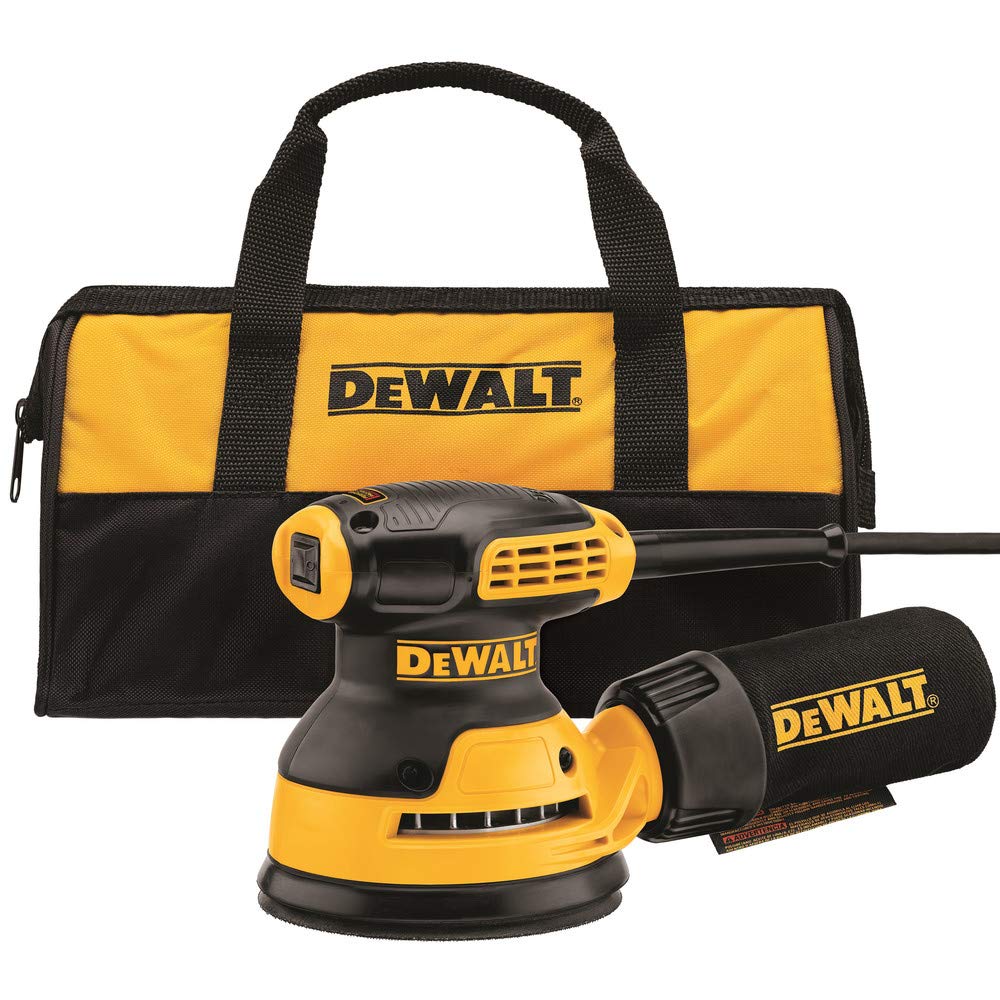
1. DEWALT DWE6421K Orbital Sander Kit
Our pick — 4.5+★ from 5,500+ verified ratings; the strongest balance of quality and price.
The shop default: a 3-amp pad that traps dust and lands at the size of a coffee can on your shelf.
If you want one sander that handles stripping a teak patio table and smoothing a cabinet face, this is the one to start with. The 3.0 amp motor drives the pad at 12,000 OPM, so it removes material with a steady rhythm instead of bucking. The short body keeps your hand close to the work piece, which is what lets you feel a low spot before you sand through the veneer.
Dust is where this tool earns its keep. The dust bag locks one-handed — you press it on with the same palm you are holding the sander with — and the port is built to mate directly to the DWV010 or DWV012 dust collectors. To run other vacuum systems with 1-1/4 in. hoses, you add the DWV9000 Universal Quick Connector. The rubber skirt around the pad draws the dust toward the opening instead of flinging it across the bench, which is the difference between a clean cut line and a fresh coat of dust on the whole project.
What wins people over is the build quality, and it is the aspect that shows up most in how this tool is talked about. The separate counterweight design cuts the vibration that numbs your fingers after twenty minutes, and the rubber over-mold covers all the critical grip areas. The dust-sealed switch is a small thing that matters: dust ingestion is what kills switches on cheap sanders, and this one is built against it. A three-year limited warranty backs the whole thing.
What makes it the default pick
- Dust port mounts straight to DEWALT DWV010 or DWV012 collectors with no adapter.
- One-handed locking bag means less time fiddling with a clip and more time sanding.
- Counterweight design and full rubber over-mold cut hand fatigue on long sessions.
- Dust-sealed switch is built to survive the grit that shortens the life of cheaper tools.
The honest trade-offs
- At 3.0 amps it is a finishing and general-prep tool, not a floor-drum replacement.
- Other hose brands need the DWV9000 connector, sold separately.
- Both the DEWALT picks here share the same 12,000 OPM pad speed, so neither is the faster cutter.
The right call if: you sand indoors, want dust captured at the pad, and prefer a tool backed by a three-year warranty.
Know this first: the buyer comments here are the most extensive of any pick on this list by a wide margin, and the consensus is that the dust path and the build hold up over repeated jobs.
2. Metabo HPT SV13YST Random Orbit Finishing Sander
A dial on the body that lets you creep up on a finish instead of blasting past it.
For a kitchen table refinish or a set of oak doors, control beats brute power. This sander gives you a variable speed dial so you can slow the pad for a topcoat-ready surface and speed it up to cut through an old varnish. The 2.8 amp motor is fed by a 230W drivetrain, and both are built with a dust-sealed rocker switch to keep grit from eating the internals.
Solid oak surfaces are where users say it does its best work, and the long cord is what lets you reach a doorway without hunting for an extension. The palm-style soft grip is there to keep vibration off your knuckles on long sessions. It comes with a five-year professional tool warranty — the longest coverage on this list.
Here is the catch a buyer needs to hear. The dust collection on this model is the mixed part of its story. Some owners get along well with the included dust bag; others find the vacuum adapter arrangement fussy. If dust capture is your number-one reason for buying, look at the DEWALT above or the Bosch canister model further down. If you already own a shop vacuum and plan to run a hose, the awkwardness matters far less. Also worth knowing: it is the lightest of the corded 5-inch sanders here at 3.1 pounds, comfortably under the DEWALT PSA model’s 3.4 pounds.
Where it shines: the finishing dial, the long cord, and a five-year warranty on a tool that costs less than most competitors in this group.
The one caveat: plan your dust strategy around a shop vacuum rather than relying on the bag alone.
Reach for this one: furniture finishers who want a speed dial, a light 3.1-pound body, and five-year coverage.
Look elsewhere: if you want the dust bag to be the whole solution with no vacuum involved.
3. DEWALT Random Orbit Sander, PSA, 5-Inch (DWE6420)
Built for the woodworker who wants sticky-backed discs to sit dead flat on the pad.
Take everything good about the kit version and swap the pad attachment. This is the PSA version — pressure-sensitive adhesive, meaning the disc presses onto the pad and sticks. For a project where you want the disc to stay put on a curved or contoured surface, that firm bond is the point. The 3.0 amp motor runs the pad at the same 12,000 OPM as the DWE6421K, so the cutting feel is identical.
Physically, the two DEWALT models are close but not twins. This one measures 10.31″L x 5.69″W x 6″H while the kit version runs 10.08″L x 7.23″W x 6.24″H, and it weighs 3.4 pounds to the kit model’s listed dimension set. Both share the separate counterweight and rubber over-mold that tame vibration, plus the dust-sealed switch and one-handed locking bag. The dust port also fits straight to the DWV010 or DWV012 collectors, with the DWV9000 Universal Quick Connector opening it up to 1-1/4 in. hoses.
Two honest notes come with this one. First, a number of people miss the hook-and-loop convenience and find the PSA pad slower to change discs between grits — if that describes you, the kit model is the better buy. Second, the durability record is more varied here. Some owners call it sturdy; a few report it giving out after four months, which is well under the three-year limited warranty period and worth acting on if it happens to you. Neither point is a reason to avoid the tool; both are things to know before you commit to the PSA format.
Who it is built for: anyone who prefers a flat, firm PSA disc over a peel-and-press hook-and-loop pad, and wants the DEWALT dust port and three-year warranty.
Think twice if: you change grits often and want the fastest possible swap.
Best match for: the PSA-loyal builder who already knows the format and wants the DEWALT dust path.
Not your pick if: you swap discs every few minutes and prefer hook-and-loop.
4. WORKPRO 5-Inch Cordless Random Orbital Sander 20V Brushless

No cord dragging across the panel you just sanded — sand a wall or a shelf without a tether.
The moment you sand a vertical surface, a cord stops being a mild annoyance and starts being a real problem. It sags, it catches on the work, it pulls your hand off line. This WORKPRO runs on a 20V lithium-ion battery rated at 2000mAh, and the brushless motor means no brushes to spark and wear out — it is built to run quietly and last longer than a brushed equivalent. Six speeds take it from 6,000 to 12,000 RPM, and the speed switch sits where you can move it mid-stroke without letting go.
The kit is genuinely generous for its position on this list: one sander, one 20V 2.0Ah 2000mAh battery, a charger, a dust collector, a tool bag, and 15 sanding discs. Those discs cover five grades — 60, 80, 120, 180 and 240 grit — and they are hook-and-loop, so you peel and press rather than fiddle. At 3.1 pounds in the palm it is easy to control overhead.
The dust story needs an honest framing. The sander blows dust into a collector canister that lifts off for emptying, and that works for light work — but the most-discussed part of this tool is its overall performance, and the feedback there is split. Some owners find the collector effective; others find it does not catch enough. If you are sanding a small cabinet face this is fine. If you are filling the air in a closed garage, plan to add a shop vacuum or work outdoors. That said, the value-for-money reaction is the strongest positive thread, and with 15 discs and a battery in the box that is easy to believe.
Why the cordless crowd likes it
- 20V 2000mAh battery frees you from a cord on walls and overhead panels.
- Brushless motor runs quietly and avoids the spark-and-wear problem of brushed motors.
- 15 discs across five grits from 60 to 240 means you can start the job from the start.
What to expect honestly
- The dust canister performance is the split point in owner feedback — it is not a vacuum-grade capture.
- Runtime depends on the single included 2000mAh battery.
Fits best: the home woodworker sanding upright surfaces who values freedom from a cord over maximum dust capture.
Bear in mind: this is a dust collector, not a dust extractor — treat it as a first pass and use a vacuum for the fine dust.
5. BOSCH GSS20-40 Orbital Finishing Sander

A quarter-sheet pad that reaches into corners the round sanders physically cannot enter.
Round pads are great on flat panels. They are useless in the inside corner of a door frame, along a raised panel edge, or against a perpendicular wall — that is where the 1/4-sheet format wins. This Bosch is a palm sander with a tight orbital motion, driven by a 2.0 amp motor at 12,000 oscillations per minute. It also does flush sanding, so the sheet can sit against a surface the pad body cannot fit beside.
The sanding plate is precision-machined aluminum, and that detail is what delivers even sanding across the whole sheet instead of a hot spot in the middle. The dust system here is a screw-off micro-filter canister that pulls dust through the pad — coarse and fine particles both route through the sheet rather than around it. That is a different design from a bag hanging off a port, and it means less reaching around to empty it.
Where this tool feels good in the hand is exactly where the reviews land: it is quiet, it runs with low vibration, and changing paper is easy. The soft-grip was shaped for stability rather than looks. Two things to weigh: it is a finishing sander, not a stock remover, so do not expect it to strip a floor; and the sandpaper hold-down mechanism is the point where some owners get frustrated with paper slipping. If you mostly run along edges and want a quiet, low-vibration hand tool, this is the one.
Its real job: corners, edges, and flush cuts on furniture and trim, with a micro-filter canister handling the dust at the pad.
Fit-note: the hold-down clips are not everyone’s favourite part — check that your sheets seat fully before a long pass.
Reach for it: when the round pad will not physically fit and you need a quiet tool with a built-in filter canister.
Better to pass on it: if your job is heavy material removal rather than finishing.
6. MAXXT 6-Inch Brushless Random Orbit Sander
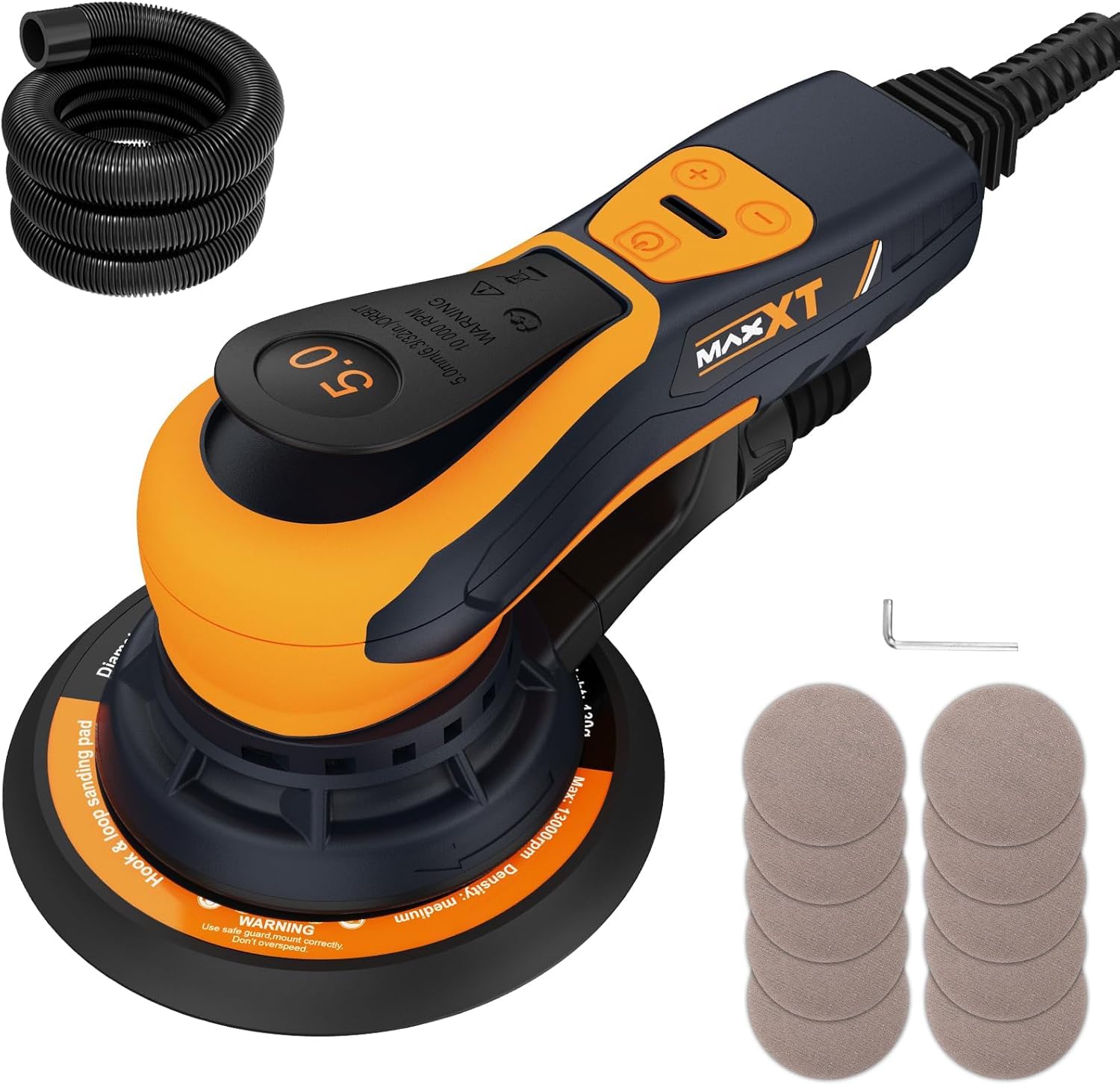
A 6-inch disc with a stop brake that halts the pad in two seconds when you set it down.
Bigger pad, more coverage per pass. This MAXXT runs a 6-inch disc, which spreads the same pressure over more surface — useful on a large tabletop where a 5-inch pad means more passes and more chance of an uneven cut. The 5.0mm eccentricity gives the orbit its throw, and the flexible edge guard around the disc is there to reduce the risk of catching the work as it spins. The 350W brushless motor keeps the power steady and the noise down to 83dB.
Control is well thought out. Six speed levels from 4,000 to 10,000 RPM can be adjusted with the “+” or “-” button, and a second lever on top does the same job — you can change speeds without breaking your grip. The quick-stop function uses an electronic brake to bring the pad to a halt in about two seconds, which matters at shutdown when a spinning pad can scuff a finished edge. Dust runs through a Ø 35 connector for a vacuum, or you can use the 1-meter flexible hose that comes in the box.
The trade-off, and it is a genuine one to weigh: durability is the aspect that draws negative feedback here, while the smooth, low-vibration operation draws positive feedback. That means this tool is the one you buy when you want a big-pad finishing tool at a mid-market level rather than a lifetime shop investment. If you sand daily in a cabinet shop, spend up. If you want a 6-inch pad with a real brake and a vacuum hookup for occasional large-surface work, it earns its place on the bench.
Where the spec sheet delivers
- 6-inch disc covers more of a large panel per pass.
- The 2-second electronic brake cuts the risk of a scuff after you lift off.
- Ø 35 vacuum port plus a 1-meter hose in the box means dust control out of the gate.
- Dual speed controls — buttons and a top lever — let you adjust mid-stroke.
What buyers should know
- Durability is the weakest thread in the feedback — not a daily-driver pro tool.
- The 6-inch pad takes 6-inch paper, not the 5-inch discs most people already have on the shelf.
Certified match for: large tabletop and panel sanding where pad coverage saves passes.
Go elsewhere if: you want a tool you can lean on every working day.
7. Metabo HPT SV1813DAQ4 Cordless Random Orbital Sander

The lightest body here at 2.6 pounds, with a one-handed dust bag on an 18V platform.
For remodelers and finish carpenters working off a ladder or inside a client’s home, cord-free and light beats powerful and tethered. This sander covers both: 2.6 pounds in the hand, six speed settings, and an electric brake that lets you stop the pad quickly between passes. The one-handed dust bag design means you can empty it without putting the tool down or hunting for a second hand.
It runs on the Metabo HPT MultiVolt battery system, which is the detail that matters if you are already in that ecosystem. You can run it on an 18V battery to stay light, or move to the MultiVolt 18V/36V battery for runtime up to 8.0Ah per charge. The tool is a bare unit — no battery is included — so the real question is whether you already own one. The dust kit is thorough on paper: a dust bag, a 1-3/8-inch dust port, a 1-1/2-inch collection adaptor, and a 1-3/4-inch dust collection adapter, giving you options across hose sizes.
The honest caveat is the one that always comes with bare tools: no battery, no charger, no sandpaper in the box. If you are starting fresh, add those costs to your reckoning. If you are already running Metabo HPT batteries and want a 5-inch finishing pad with a bag you can empty one-handed, this is the top of the cordless ladder here, and it carries a five-year warranty.
The case for it: lightest body on the list, six speeds, a one-handed dust bag, and three dust adapters to fit your hose.
The cost of entry: it is sold as a bare tool — budget for a battery and charger if you are not already on the MultiVolt system.
Ideal if: you are on Metabo HPT batteries and want a 2.6-pound cordless finisher with a five-year warranty.
Not for you: a first-time buyer with no battery platform to build on.
8. BOSCH ROS20VSK Palm Sander
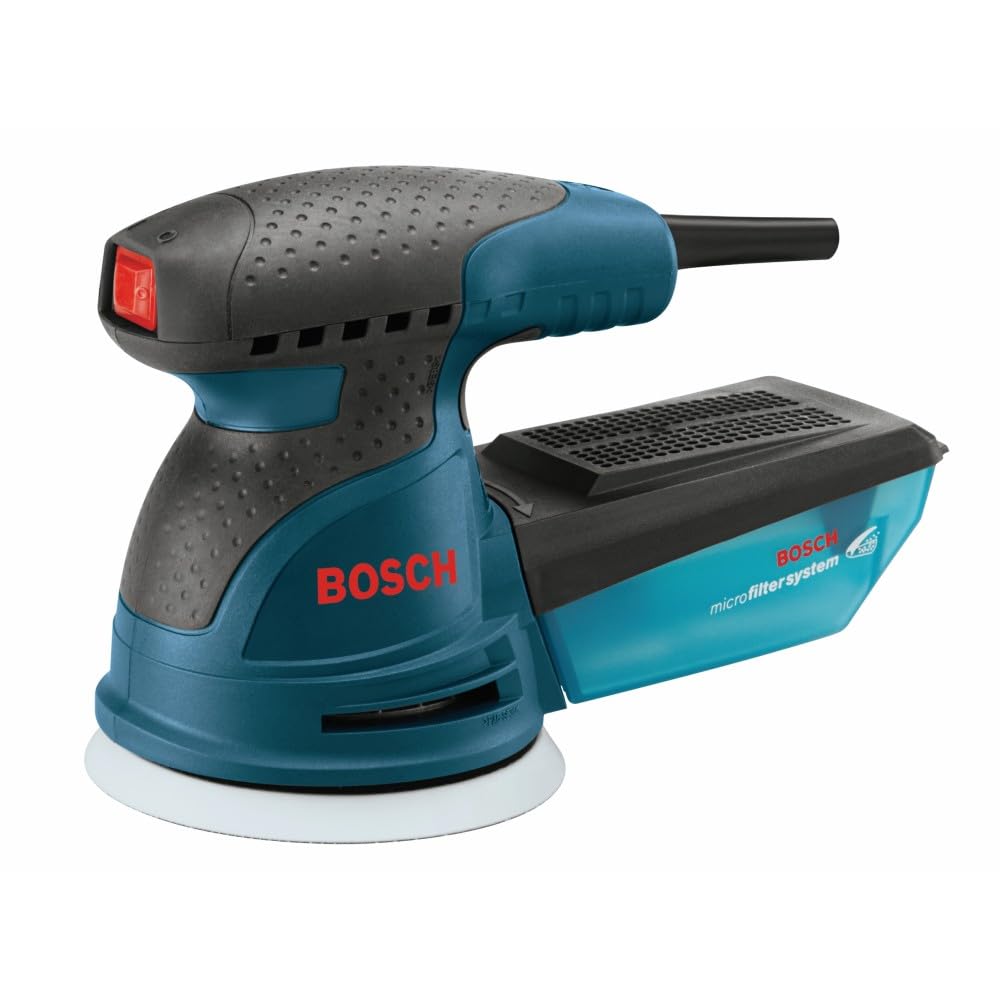
The swirl-mark fix: a dampening pad that lets you sand a curved surface without leaving circles.
Swirl marks come from the pad rocking against the work. This Bosch answers that directly with a pad dampening system designed to eliminate swirl marks on both flat and contoured surfaces. Sanding a cabriole leg or a rounded edge with a rigid pad leaves tell-tale rings; this one floats the pad enough to follow the shape. The 2.5 amp motor lets you match speed to task across a 7,500–12,000 OPM range, so you can slow down for a fine pass or speed it up to remove old finish.
The dust system is the part that stands out. Its micro-filter canister traps particles as small as a 1/2-micron in diameter — the fine dust that hangs in the air and settles across a whole room. The canister shows the dust level so you know when to empty it, and it detaches cleanly for mess-free dumping. Discs stick on through Bosch’s hook-and-loop attachment, so a grit change is a peel and a press. It comes as a kit with a sanding pad, sanding disc, dampening ring, dust canister, vacuum adapter and hard carrying case.
The one recurring frustration is the dust canister lid — some users find it fiddly to seat. It is a small annoyance on an otherwise strong finishing tool, and it does not affect the sanding result. The tool itself is quiet, adjustable in speed and easy to steer — a solid choice for prepping furniture, sanding drywall patches, or polishing a coat between finish passes.
Where it delivers: swirl-free sanding on curved surfaces, a 1/2-micron micro-filter canister, and a complete kit with a hard case.
One small gripe: the canister lid takes a little care to seat — empty it over a bin, not over your project.
Goes to: the finisher who cares about a smooth, mark-free surface and wants a case to keep the kit tidy.
Skip if: you want a small canister-free setup for quick touch-up work.
9. VEVOR Random Orbital Sander 5 & 6-Inch
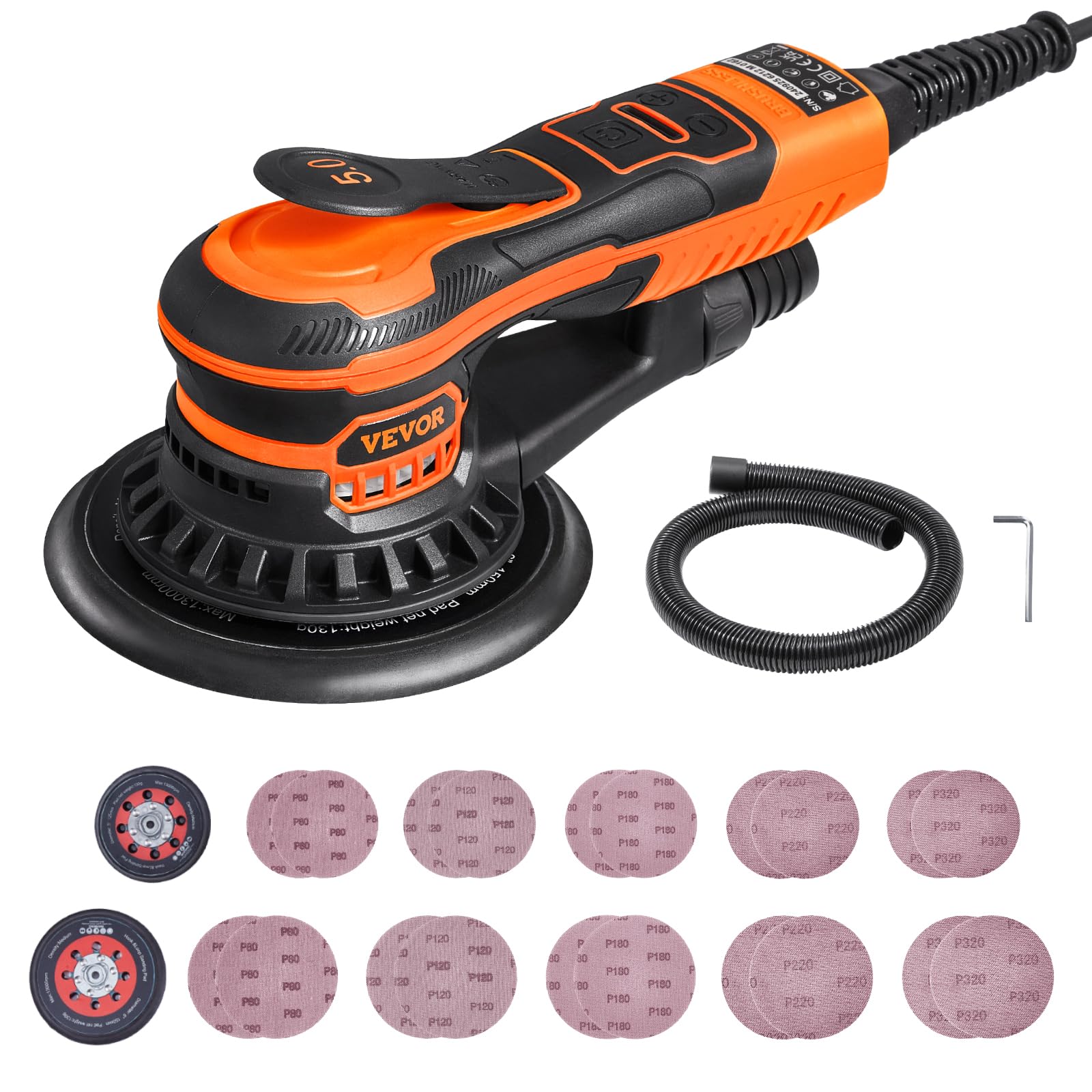
Two pads, twenty discs, and a dust hose — one box that covers a whole first project.
The practical argument for this VEVOR is that you do not buy a pad size, you buy both. A 5-inch pad handles detail and a 6-inch pad covers panels, and swapping them takes a moment. The 350W brushless motor runs a 5mm orbit up to 10,000 RPM, and six speed settings from 4,000 to 10,000 RPM let you ease off for delicate surfaces. An “instant stop” function halts rotation when you release the handle, which is a real safety feature on a tool that spins at this speed.
The kit is where the value sits. It ships with both pads, 20 sandpapers across five grits — 80, 120, 180, 220 and 320, with two of each grit per pad size — plus a dust connector and hose that runs to a vacuum. It also handles wood, metal, walls, car putty and paint according to the maker. Symmetrical body design means left- and right-handed users get the same grip, and the weight of 4.4 pounds keeps it planted on the surface.
Two honest points before you decide. Durability is the split part of the feedback — some units keep running, while the occasional one gives up early. With the kit contents and the two pad sizes, it is a sensible first sander for a home workshop rather than a pro shop’s daily tool.
Why it makes sense as a first sander
- Interchangeable 5-inch and 6-inch pads cover detail and panel work in one box.
- 20 sandpapers in five grits from 80 to 320 means no immediate disc shopping.
- Dust connector and hose ship in the kit, so vacuum hookup is ready.
- Instant-stop safety function cuts the pad when you let go of the handle.
What to weigh
- At 4.4 pounds it is the heaviest pick here — overhead work tires your arm faster.
- Durability feedback splits, so treat it as a home-shop tool rather than a daily driver.
Best for: a home workshop that wants both pad sizes, a full grit range, and a dust hose in one purchase.
Consider the lighter picks if you mostly sand ceilings, walls, or anything above shoulder height.
Know the Specs
OPM, RPM and orbit size
OPM stands for oscillations per minute — how many times the pad cycles side to side in sixty seconds. RPM is how fast the motor spins. A random orbital sander uses both at once, which is why the pad orbits while it spins and why swirl marks do not line up in a single direction. The orbit size (listed here as eccentricity, or as a millimeter figure for some models) sets how far the pad travels on each cycle: a larger throw cuts faster, a smaller one finishes finer. A high OPM with a variable speed dial is what lets one tool do both jobs.
Dust collection: bag, canister or port
A dust bag hangs off the tool and is the lightest option — good for portability, but it fills and needs emptying. A canister is a rigid container with a filter inside; the Bosch models here use a micro-filter canister rated to 1/2-micron particles. A bare port is meant for a shop vacuum hose, and its usefulness lives and dies on whether the port size matches your hose. Check that before buying: some tools ship with adapters for several hose sizes, others need a separate connector.
Pad attachment and disc format
Hook-and-loop pads use a Velcro-style surface so discs peel off and press on in seconds. PSA discs use pressure-sensitive adhesive and press flat against the pad — firmer, but slower to change. Sheet sanders like the 1/4-sheet Bosch take a cut sheet held by clamps, which lets the paper reach into a corner the round pads cannot enter. Choose the format by how you work, not by which sounds more modern.
Amps and watts on a corded sander
Amps describe current draw; watts describe power output. Both appear on tool listings and neither tells you the whole story on its own. What matters in practice is whether the motor holds speed under load — a tool that bogs down on hard oak leaves swirl marks regardless of its amperage. Match the number to the job: a 2.0 amp finishing sander is built for surface refinement, while a 3.0 amp model is built to remove material faster.
Common Questions
Will a 5-inch sander’s dust port fit my shop vacuum hose?
Is a dust bag enough, or do I need a shop vacuum?
What is the difference between hook-and-loop and PSA sanding discs?
Can a random orbital sander leave swirl marks?
Do I need variable speed, or is a single speed fine?
Is a cordless orbital sander as powerful as a corded one?
What grits should I run through when refinishing furniture?
What does the orbit size actually change in my finish?
How do I stop fine dust from filling the room when I sand indoors?
Do I need different sanders for corners and for flat panels?
The Bottom Line
The sander that earns the top spot here is the DEWALT DWE6421K, because its one-handed locking dust bag and vacuum port work together as a genuine dust path rather than an afterthought — and its 3.0 amp, 12,000 OPM motor has the build quality to back it up. It is the most discussed tool in this group by a wide margin, and the consensus points the same direction. If you want a speed dial for finish work, grab the Metabo HPT SV13YST. And for the freest hand on a vertical panel or overhead, the cordless Metabo HPT SV1813DAQ4 is the one to reach for.
How we choose
We do not accept paid placement. Every pick is matched to a real buyer and a real use-case; we do not hands-on test units.
Sources
Specifications: manufacturer listings and product documentation. Review insights: verified customer reviews, as of November 2026. Pricing: not shown on this page (it changes often); check the current price via the retailer link.
As an Amazon Associate, Tactical Gear Guy earns from qualifying purchases. This does not affect which products we feature.