Specs are compiled from manufacturer listings and verified buyer reviews and can change over time — please confirm the key details on the product page before buying.
You are standing in a dim camper with a dead fridge and a fuse box that has no spare slots, and that is the moment this purchase stops being abstract. The right RV power distribution panel splits incoming shore power into 120-volt AC branch circuits for your outlets and air conditioner and 12-volt DC circuits for your lights, water pump, and fan. Get the circuit count and amperage right and the install is a weekend afternoon of wiring. Get them wrong and you are shipping back a metal box.
This guide is built by comparing the manufacturers’ published specifications and the patterns across verified customer reviews, so you get each pick’s real strengths and trade-offs instead of marketing spin.
Most buyers trip on the same detail: whether the panel is a bare distribution box or a converter combo that also charges your battery. Below are the honest differences between the leading options, so you can match one to your rig and wiring the first time.
Every pick here is judged on circuit count, amperage, and how cleanly it drops into a cabinet, and you can read the whole lineup as a straight rv power distribution panel comparison.
Top Picks


How To Choose The Best RV Power Distribution Panel
Start with what comes into the rig, not with what the panel looks like. If your camper is fed by a 30-amp shore cord, a box rated for 30-amp service is your match. If you have a 50-amp feed, you need a panel that can take it without strain.
Count your circuits before you count features
Walk the rig and count what actually needs power. Lights, water pump, furnace blower, and vent fans all pull 12-volt DC. Outlets, air conditioning, and the microwave pull 120-volt AC. If your count lands near the top of a panel’s capacity, step up a size rather than squeezing in.
Decide if you need a converter charger built in
A distribution panel only routes power. A converter charger combo also takes that incoming AC and turns it into DC to charge your house battery. Many older rigs have a separate converter and only need the distribution side. New builds often want one box that does both.
Match the cabinet cutout to your existing opening
These boxes mount into a wall opening, so the cutout dimensions matter as much as the circuits. If you are replacing an existing unit, measure the opening in the cabinet before ordering. A panel that matches your circuits but not your cabinet opening is still the wrong panel.
Side-by-Side Comparison
| Model | Best For | DC Circuits | AC Circuits | Converter Output | Amazon |
|---|---|---|---|---|---|
| WFCO WF-8930/50NPB★ Best Overall | Most RV builds | 15 | 12 branch | — | Amazon |
| WF-8930/50NPB Camper PanelSmart Value | Flexible 30A or 50A use | 15 | 12 | — | Amazon |
| WF-8735-AD ConverterCompact Pick | Small trailers on a budget | 6 | 5 | 35A | Amazon |
| PowerMax PPC-30-55LK | WF-8900 replacements | 11 | 5 branch | 55A | Amazon |
| WFCO WF-8735-AD | 30-amp rigs wanting a genuine WFCO | 6 | 5 | 35A | Amazon |
| Progressive Dynamics PD4045KV | All-in-one AC, DC, and charging | — | — | 45A | Amazon |
| Blue Sea Systems 8023 | Simple 8-circuit DC distribution | 8 | — | — | Amazon |
Detailed Reviews
1. WFCO WF-8930/50NPB Power Distribution Panel
Our pick — 4.5+★ from 200+ verified ratings; the strongest balance of quality and price.
Fifteen DC circuits and a choice of 30 or 50 amp service in a box the size of a lunch pail.
Here is a panel that answers the two questions before you ask them. It handles either a 30-amp or a 50-amp AC service, so the same box covers you whether you feed a small travel trailer or a bigger fifth wheel. It spreads 12-volt DC power across 15 circuits, which is enough for lights, the water pump, the furnace blower, a vent fan, and still some room to spare. And it does all of this at 3.75 pounds, light enough that one person can hold it against the wall and drive screws with the other hand.
You get room for separate breakers, and that is where this panel pulls ahead of the smaller WF-8735 converter further down the list. It carries 12 AC branch circuits against the 5 on that unit, so the air conditioner, the microwave, and the outlets can each get their own breaker instead of sharing a tight cluster. The cabinet measures 9.5 x 13.75 x 4 inches, compact for a full-size distribution panel, so it tucks into a narrow corner or a cabinet wall without eating living space.
The reviews read like a box that has quietly become the default in home-built campers. What owners talk about most is the build quality, and the second theme is functionality — the fact that it carries both 120-volt and 12-volt systems in one enclosure without a mess of pigtails. Wiring is described as logical and well-labeled, and people building from a bare trailer shell call it the natural pick. The honest caveat is the door latch. It is the one recurring complaint, and a gentle hand when the panel cover opens and closes goes a long way. Open and close the cover by the latch, not by pulling the door, and it holds up.
What earns it the top spot
- 15 DC circuits plus 12 AC branch circuits — the widest spread on this list for a single box
- Accepts a 30-amp or 50-amp feed, so one part number covers two rig classes
- Just 3.75 pounds and 4 inches deep, so it mounts into tight cabinet walls
- AC breakers and DC fuses sit together in one accessible faceplate, which makes troubleshooting simple
The trade-off to know about
- The door latch is the recurring weak point — open and close the cover carefully
- Ships as a distribution panel only, so you still need a separate converter to charge your battery
The right buy for: anyone building or rewiring a rig who wants both AC and DC distribution in one compact box and already has a converter.
Think twice if: your heart is set on a single unit that also charges the house battery — you will need to add a converter or step to the Progressive Dynamics combo.
2. WF-8930/50NPB RV Power Distribution Center
The same circuit spread as the top pick, with 120/240-volt input flexibility and a quieter price tag.
The name may look familiar because this unit is built on the same WF-8930/50NPB platform as the best overall pick: 15 DC circuits, 12 AC circuits, the same 13.75 x 9.5 x 4 inch cabinet, and the same 3.75-pound carry weight. The input side is what changes. This one accepts 120-volt AC or 240-volt AC (standard household and campground power), so it tolerates a wider range of campground feeds without complaint. The maker also states it runs silent, which matters if you mount the panel under a bed or in a bedroom wall, because you will not hear the electronics click and hum while you sleep.
This panel is built to pair with a separate converter rather than replace one. The listing names the WF-9800 switch-mode converter family (a power supply that converts AC to DC) in 55, 65, or 75 amp versions as the companion piece, so if you already own one of those, this is a direct route to a full AC and DC panel. On raw circuit count it edges past the PowerMax PPC-30-55LK: 12 AC circuits here against 5 branch breakers there, and 15 DC circuits against 11 fused DC circuits.
Buyers report that the wiring layout is straightforward the moment they open the box. The listing states a six-month free return and exchange window, which takes some of the risk out of a part you only learn about after it is screwed to the wall. Longevity is the caution to weigh. Word has spread about units that did not go the distance, so this is a sensible budget call for a build where the panel stays accessible. It is less sensible if the panel is buried behind a cabinet you would have to dismantle to swap it out.
Where the math works: a 27-circuit box (12 AC plus 15 DC) that accepts both 120-volt and 240-volt input gives you more flexibility than most campers will ever call on. It also comes in a cabinet shallow enough for a thin wall.
The honest catch: durability is the soft spot in the reviews, so choose this when the install location stays reachable and pair it with the converter you already own.
Reach for this if: you already run a WF-9800 converter and want the full 15-DC, 12-AC layout without paying for the WFCO badge.
Look elsewhere if: the panel will live in a spot nobody can reach again — spend up for the Progressive Dynamics or the genuine WFCO instead.
3. WF-8735-AD RV Converter
A small trailer box that both distributes and charges, at 35 amps of DC output.
This is the panel to look at if your rig is a compact travel trailer and you want the charging handled in the same box. It puts out 35 amps of DC at 595 watts, and that current is what refills your house battery while it also feeds your 12-volt loads. The charging side is a three-stage automatic setup, stepping through 13.2 VDC in float mode, 13.6 VDC in absorption mode, and 14.4 VDC in high-capacity mode. In plain terms, that staging tapers the charge as the battery fills rather than hammering it at full rate right to the end.
The circuit count tells you who this suits. You get a 30-ampere main circuit with six DC circuits and five AC circuits, so it fits a small camper with a modest appliance list. Compare that to the WF-8930/50NPB above, which carries 15 DC and 12 AC circuits — if you are running a big fifth wheel with air conditioning and a microwave on separate breakers, this box is too small. If you are wiring a teardrop or a small trailer with lights, a pump, and a fan, the count is right-sized.
The charging intelligence is where buyers get split. The three-stage taper and the built-in protection set — overcharge, short circuit, and temperature control — are real and they protect your battery. But the auto-detect function that reads your battery chemistry and picks a mode has drawn complaints from buyers whose units did not behave as expected. Treat auto-detect as a convenience to verify on your first charge cycle rather than something to assume, and check the displayed mode against your battery type before you trust it through a long trip.
Fits best: a small travel trailer running six DC and five AC circuits where you want battery charging built in at 35 amps.
skip it if: you need more than five AC branch circuits or you are dead set on chemistry detection you do not have to double-check.
4. PowerMax PPC-30-55LK RV Power Center

One cabinet that divides your power and charges your battery at 55 amps at the same time.
Here is the all-in-one answer: a 30-amp AC distribution panel, 12-volt DC distribution, and a 55-amp converter charger all sharing one enclosure. The 55 amps of DC output is split between whatever 12-volt loads are running and the battery charging, so the more lights and fans you have on, the less headroom is left for the battery. On the AC side you get space for one main breaker and five branch breakers. On the DC side, 11 pre-wired fused circuits, each with an LED indicator that lights when a fuse blows — a small thing that saves a long hunt with a flashlight.
The features that make this a smart replacement concern safety and heat. There is over-temperature protection, reverse-polarity protection, and a temperature-controlled cooling fan that only spins up when the box warms. The 9 x 14 x 11 inch cabinet is also sized as a drop-in for WF-8900 series power centers, so if you are replacing an aging WF-8900, this is a familiar footprint rather than a rerouted nightmare. The maker backs it with a 2-year limited manufacturer’s warranty.
The battery chemistry handling deserves a careful read, because it is where people get surprised. This charger covers lead-acid, AGM, and compatible lithium batteries, but it uses 3-stage charging plus a user-selected fixed-voltage mode. For lithium you set the voltage yourself; there is no automatic chemistry detection here. That is not a fault — it is a different design philosophy that many long-time RVers prefer because they control the charge profile. Just know that you are the one setting it, not the box.
Why owners keep it
- 55 amps of DC output handles charging and 12-volt loads from one unit, no separate converter to wire
- 11 pre-wired DC circuits with LED blown-fuse indicators make troubleshooting instant
- Drops into a WF-8900 opening at 9 x 14 x 11 inches, so existing cabinets usually fit
- Over-temperature, reverse-polarity protection and a temperature-controlled fan keep it cool and safe
The fine print
- Lithium charging means you pick the fixed voltage yourself — no automatic chemistry sensing
- Five AC branch breakers is a tighter AC side than the 12-circuit WFCO above
Pick this when: you want distribution and a strong 55-amp charger in one box and you are replacing or upgrading a WF-8900.
Pass if: you want the panel to detect your battery chemistry automatically or you need a wide bank of AC branch breakers.
5. WFCO WF-8735-AD Power Center
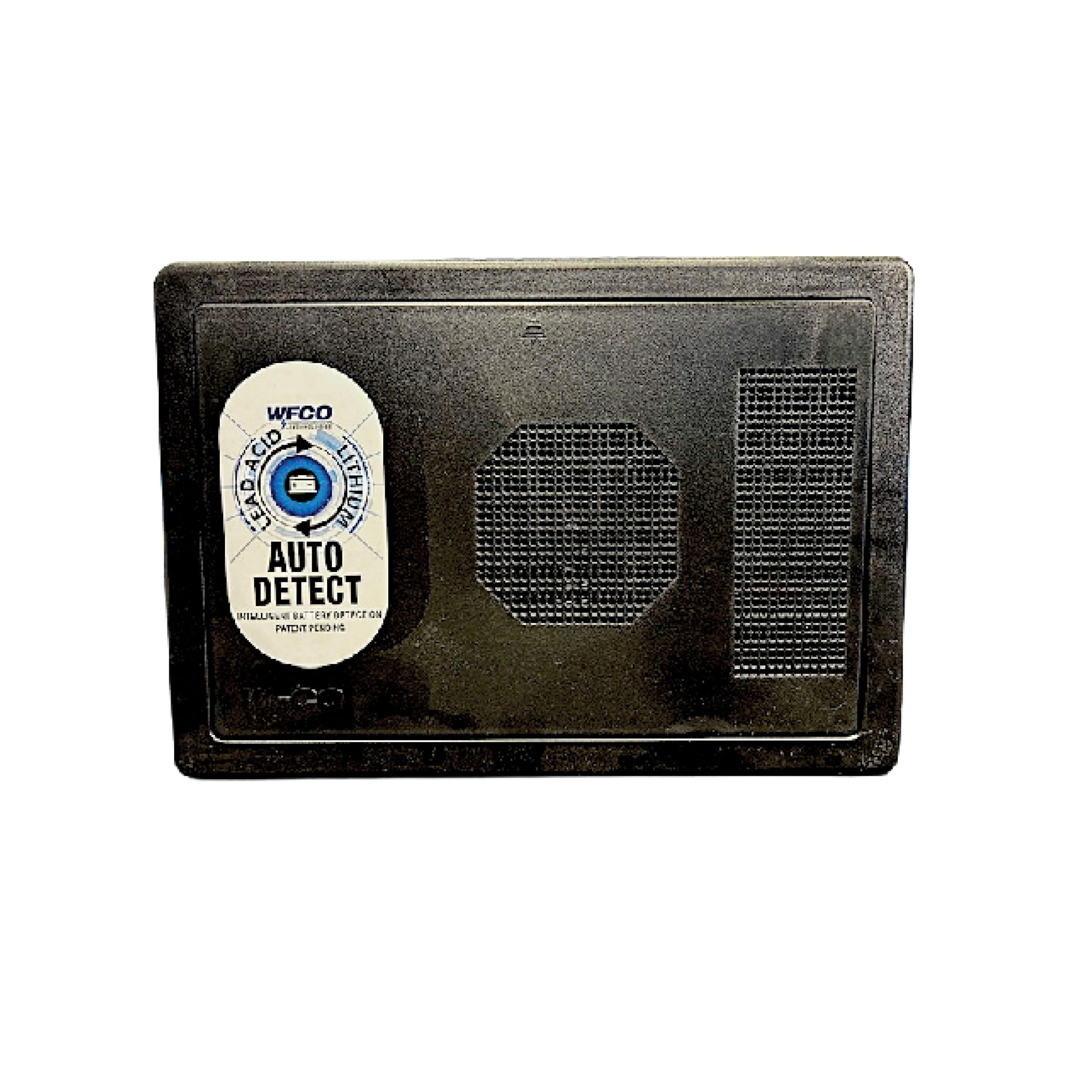
The genuine WFCO 35-amp power center with the patented battery-detection chip built in.
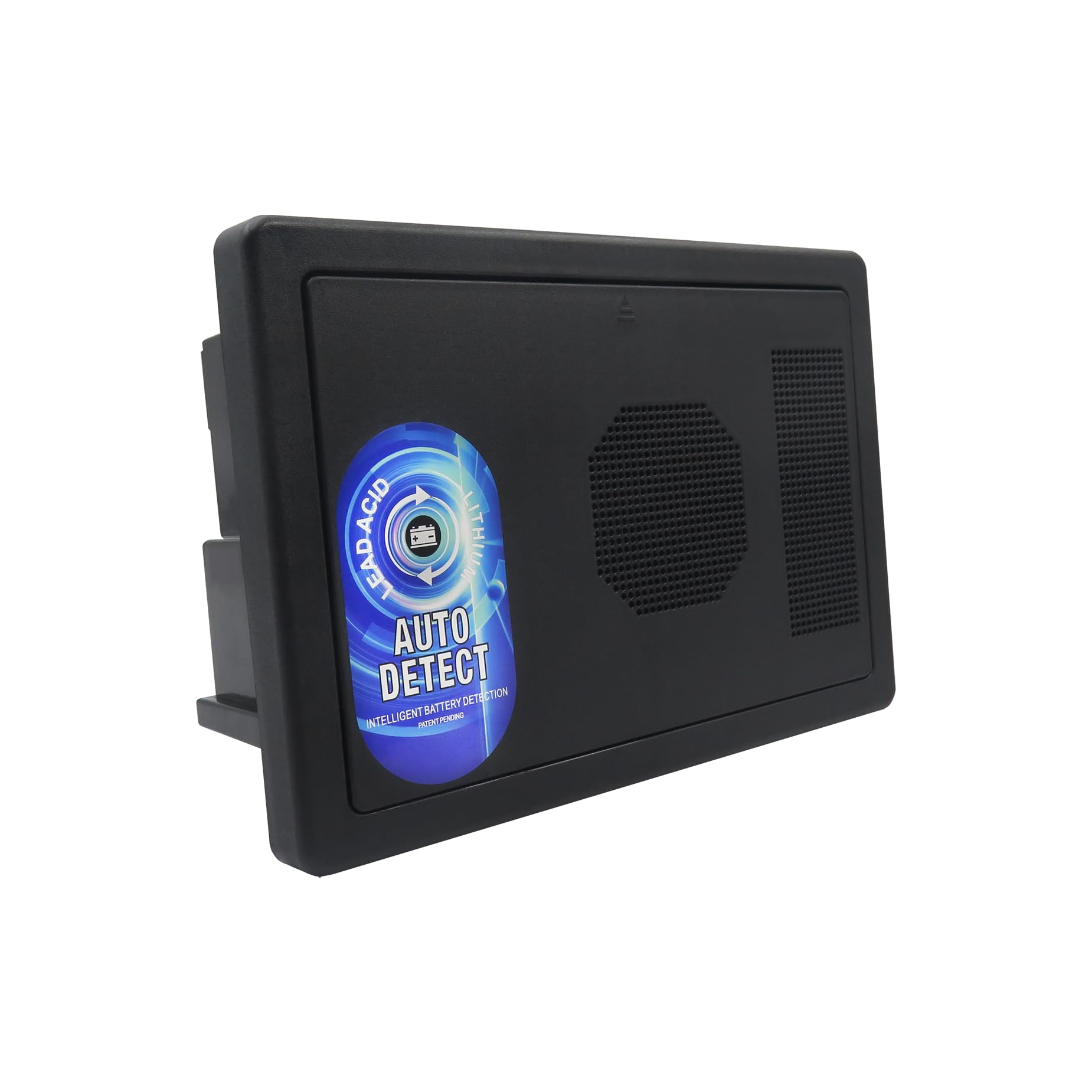
This is the manufacturer’s own version of the 30-amp power center, and the headline is the patented Auto-Detect technology — patent #12,113,377 on the listing. That chip reads whether you are running a lead-acid or a LiFePO4 battery and adjusts the charge profile to match, so you do not flip a switch or set a voltage. It also holds full output power down to 100 volts of input, which is aimed squarely at the low-voltage campground pedestal that sags when a hundred rigs are drawing at once. That sag is what slows battery charging on lesser units, and a charger that holds output through it keeps your battery filling at the normal rate.
Safety credentials are spelled out: UL and CSA listing plus FCC compliance, which are the third-party standards that confirm the panel has been tested for electrical safety. The 35-amp DC output matches the smaller rig target — this is a 30-amp RV power center. On circuit count it lines up with the WF-8735-AD above at six DC circuits and five AC circuits, so it suits the same class of trailer: lights, pump, fan, and a modest AC loadout.
The charging performance is the area to go in with your eyes open. Reviews are split — a solid share of owners find it charges perfectly, while others report the unit stalling out short of a full charge. The Auto-Detect feature in particular has a following of unhappy buyers whose units did not recognize a lithium battery. The smart move is to verify the detected profile on your first charging session. If your unit and your battery agree, this is a clean, well-listed power center. If it misreads, work the return path early rather than hoping it settles in.
A specification worth the money: full output down to 100 volts of input is the kind of detail that only matters on a crowded campground pedestal — and then it matters a lot.
Check on day one: confirm the Auto-Detect reads your battery chemistry correctly before you rely on it for a trip, because reports are mixed on lithium recognition.
Good match for: a 30-amp rig owner who wants the genuine WFCO part with the patent-protected detection and full UL/CSA listing.
Second thoughts if: you run LiFePO4 and want a panel that handles chemistry detection without you watching it closely.
6. Progressive Dynamics PD4045KV Converter

An AC panel, a DC panel, and a battery charger in one cabinet — that is the whole job.
Read the way owners describe this one and the phrase that keeps coming back is that it does three jobs. This is a 45-amp converter charger with the Charge Wizard, and owners talk about it as a full AC panel, DC panel, and battery charger rolled together. That triple duty is what makes it a serious replacement candidate for a rig with a failing all-in-one unit — one part gets your distribution and your charging back online instead of chasing two separate components.
The engineering details fit that role. There is reverse battery protection with easy-to-replace fuses, so a slip during wiring does not cook the unit. Electronic current limiting plus high and low AC input protection keeps it steady when camp power wobbles. An intelligent variable-speed cooling fan only ramps up when it needs to, keeping the box quieter in a quiet trailer. The cabinet is listed at 7 pounds and arrives as a self-contained converter set, so plan the mounting wall to carry that weight.
It also compares well against the PowerMax PPC-30-55LK above on the charger side — 45 amps of output here against 55 amps there. What it gives back in amps it tends to make up on flexibility, working as an AC panel, DC panel, and charger in a single enclosure. The detail to know before you buy is the documentation. The instruction materials draw consistent criticism for being thin, and wiring a power center from a sparse manual is a task that rewards a second opinion. Bring a wiring diagram from your rig, or a knowledgeable pair of hands, and the install stays manageable.
Best for: an owner replacing a failed all-in-one unit who wants AC distribution, DC distribution, and 45 amps of charging restored in one part.
Not for: anyone who needs a step-by-step manual in the box — plan to source your own wiring references.
7. Blue Sea Systems 8023 DC Panel
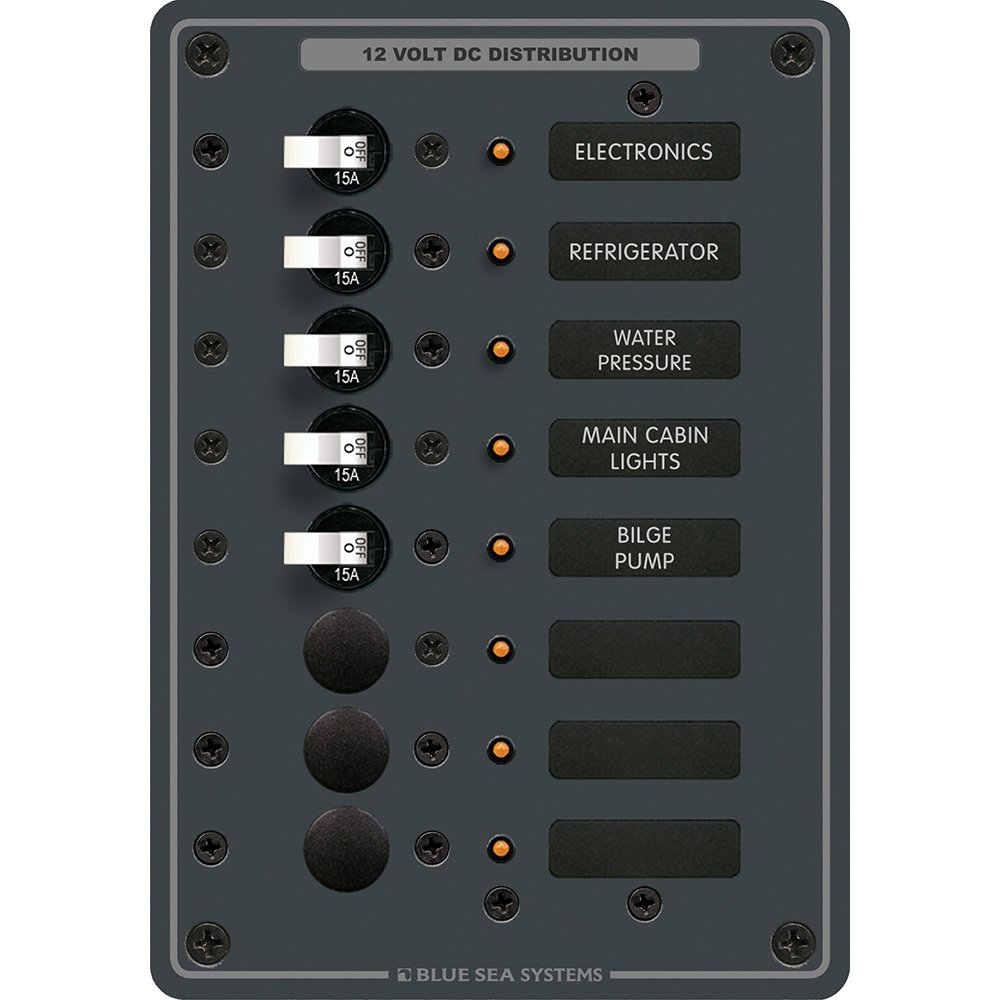
Eight DC positions in a panel built for boats that works just as well in a camper.
Blue Sea Systems makes this one for the marine world, but the job it does is the same one a camper needs: eight switched 12-volt DC positions in a compact faceplate. At 2 pounds it hangs lightly and takes up little wall space inside a cabinet — 11.1 inches long, 6.2 inches wide, and 4.3 inches deep. If your goal is a clean, labeled bank of DC switches for lights, pumps, and accessories rather than a full AC and DC center, this is a focused tool for that job.
What sets this unit apart is what it leaves out. There is no converter charger (the part that converts AC to DC and charges your battery), no AC distribution, and no 30-amp or 50-amp feed. You get eight DC circuits and that is the scope. If your rig already has an AC panel and a converter and you only need a tidy DC switch bank for a remodel or an added circuit group, the 8-position layout keeps things simple. Just do not expect this to be the brain of the whole 12-volt system, because it is one component.
Owners describe this panel as well made and praise the construction quality, which is what you want in a panel that will live in a damp, vibration-prone space. Value is the caveat. Some buyers feel the panel is expensive for eight positions and no charger, so it depends on whether you value the marine-grade construction and the brand’s reputation over raw feature count. For a camper that needs eight DC switches and nothing more, the build justifies it. For a full system build, this is a small piece of a larger puzzle.
Where the value sits
- Eight switched DC positions in an 11.1 x 6.2 x 4.3 inch faceplate — a tidy bank for a focused circuit group
- Construction quality is the praise theme, which suits a damp, vibration-heavy environment
- At 2 pounds it mounts quickly and stays out of the way
Keep in mind
- DC only — no AC distribution and no converter charger
- The price is higher than its feature count suggests, which some buyers notice
Grab it if: you already have an AC side and a charger in the rig and want eight DC switches built to last.
Move on if: you need the panel to feed AC loads or charge your battery — this one does neither.
Know the Specs
DC Circuits and AC Branch Breakers
DC circuits are the 12-volt slots that feed your lights, water pump, fans, and furnace — the low-voltage loads that run even when you are not plugged into shore power. AC branch breakers are the 120-volt slots that feed your outlets, air conditioner, and microwave. The two counts are separate and both matter. A box with 15 DC circuits and 12 AC circuits handles a full-size rig; a box with 6 DC and 5 AC fits a small trailer. Count what you actually run before you pick.
Converter Output and Charging Amps
Converter output is measured in DC amps, and it is the rate at which the panel refills your house battery while also powering your 12-volt loads. A 35-amp converter suits a modest trailer; a 45-amp or 55-amp converter suits a rig with a large battery bank or heavy loads. Remember that the DC output is shared between the loads and the battery — turn on more lights and fans, and less of that amperage goes to charging.
Common Questions
Can I put a 50-amp panel in a 30-amp RV?
Do I need a converter if my panel already distributes power?
How many DC circuits does a typical camper need?
What does Auto-Detect actually do on a WFCO power center?
Will a 35-amp converter charge a large lithium battery bank?
How do I confirm the panel will fit my cabinet opening?
Is a marine DC panel like the Blue Sea 8023 suitable for an RV?
Should I pick a panel with a separate converter or an all-in-one unit?
What does it mean that a panel holds full output down to 100 volts?
Can I wire a 30-amp panel into a 50-amp feed?
The Bottom Line
For most RV owners, the winner is the WFCO Genuine WF-8930/50NPB. Its 15 DC circuits and 12 AC branch circuits fit in a 4-inch-deep, 3.75-pound box, so it covers a full-size rig without eating cabinet space. If you want the charger built in and want to control the charge profile yourself, grab the PowerMax PPC-30-55LK with its 55-amp converter and 11 LED-indicated DC circuits. For a small trailer that needs both routing and charging in one compact unit, reach for the WF-8735-AD. If all you need is a tidy bank of eight DC switches alongside your existing AC setup, the Blue Sea 8023 handles it and nothing more. Counting your rig’s actual circuits before you order is what turns this list into the right purchase.
How we choose
We do not accept paid placement. Every pick is matched to a real buyer and a real use-case; we do not hands-on test units.
Sources
Specifications: manufacturer listings and product documentation. Review insights: verified customer reviews, as of November 2026. Pricing: not shown on this page (it changes often); check the current price via the retailer link.
As an Amazon Associate, Tactical Gear Guy earns from qualifying purchases. This does not affect which products we feature.