Specs are compiled from manufacturer listings and verified buyer reviews and can change over time — please confirm the key details on the product page before buying.
You need your snowboards off the back seat and out of the wet slush, and you need a box that opens without you climbing over the roof. Everything else — capacity, bar fit, lock design, how loud it howls at highway speed — is detail you sort out before you buy, because a roof box is bolted on once and lived with all winter. This guide covers nine hard-shell rooftop boxes that genuinely carry boards, matches each to the cars it fits, and names the one worth your money.
This guide is built by comparing the manufacturers’ published specifications and the patterns across verified customer reviews, so you get each pick’s real strengths and trade-offs instead of marketing spin.
A roof box either swallows your boards with room for boots and bags or it does not, and the deciding numbers are interior length, load limit, and crossbar width. The picks below compare those numbers directly so you can choose the right snowboard roof box once.
Top Picks

How To Choose The Best Snowboard Roof Box
Most people buy a roof box by cubic feet and then discover their boards will not lie flat inside it. Capacity in cubic feet (the internal volume, measured as length times width times height) tells you how much luggage fits, but it says nothing about whether a 155cm snowboard slides in without going diagonal. Length is the number that decides your purchase.
Measure the board, then measure the box
Lay your longest board flat and measure tip to tail. Then look at the box’s external length and subtract a few inches for the tapered nose and tail — the usable flat floor is always shorter than the outside shell. A box listed at 80 inches long gives you real room for long boards and skis. A box at 46.5 inches long means your board goes in at an angle or rides in the back seat instead.
The crossbar question decides fit more than anything
Your roof rack’s crossbars (the two bars running across the roof that everything clamps to) come in different widths and shapes — round, square, factory aero, and aftermarket aero. Some boxes clamp to bars up to 13 inches wide; the Goplus asks for a rack between 17 and 22.8 inches wide with crossbar thickness under 1.0 inch. Check your bar width and bar shape before you buy anything. Getting this wrong is the single most common reason a box goes back.
Load limit is about the roof, not the box
Your car’s roof rating is the real ceiling, not the box’s capacity. Most vehicle roofs are rated for far less dynamic load (the weight the roof can carry while you drive) than a 110 lb box suggests. Boards, boots, and a duffle add up fast. Stay well under the box’s stated max load — the 165 lb figure on the Goplus and the 130 lb figure on the pidock both leave headroom, but your car’s own roof rating is the limit that actually matters.
Opening side and lock behaviour
Dual-side opening means the lid lifts from either side of the car, which matters when you are parked against a snowbank or a wall. Passenger-side-only opening keeps the driver away from traffic. Either way, look for a lock that will not release the key until every latch point is fastened — that is your guarantee the lid is actually shut before you pull onto the highway.
Side-by-Side Comparison
| Model | Best For | Capacity | External Length | Max Load | Amazon |
|---|---|---|---|---|---|
| INNO Wedge 660★ Best Overall | Long boards and quiet highway runs | 11 cu ft | 80″ | — | Amazon |
| JEGS 10 cu ft CarrierBest Value | Tight budgets and small cars | 10 cu ft | 46.5″ | 110 lb | Amazon |
| JEGS 18 cu ft CarrierMost Capacity | Maximum volume for family trips | 18 cu ft | 57″ | 110 lb | Amazon |
| D SOLUTIONS 11 cu ft | Hard shell protection on a budget | 11 cu ft | 53″ | 110 lb | Amazon |
| Auto Dynasty Roof Box | Wide gear and duffle loads | 11 cu ft | 53″ | 110 lb | Amazon |
| pidock 16 cu ft Box | Low garage doors and bulky gear | 15.5 cu ft | 58.3″ | 130 lb | Amazon |
| SportRack Horizon | Skis and boards alongside other rack gear | 11 cu ft | 88.75″ | 110 lb | Amazon |
| Goplus 14 cu ft Carrier | Heavy loads and wide crossbars | 14 cu ft | 62.5″ | 165 lb | Amazon |
| Yakima SkyBox NX Skinny | Keeping crossbar space free for a bike or kayak | 12 cu ft | 84″ | — | Amazon |
Detailed Reviews
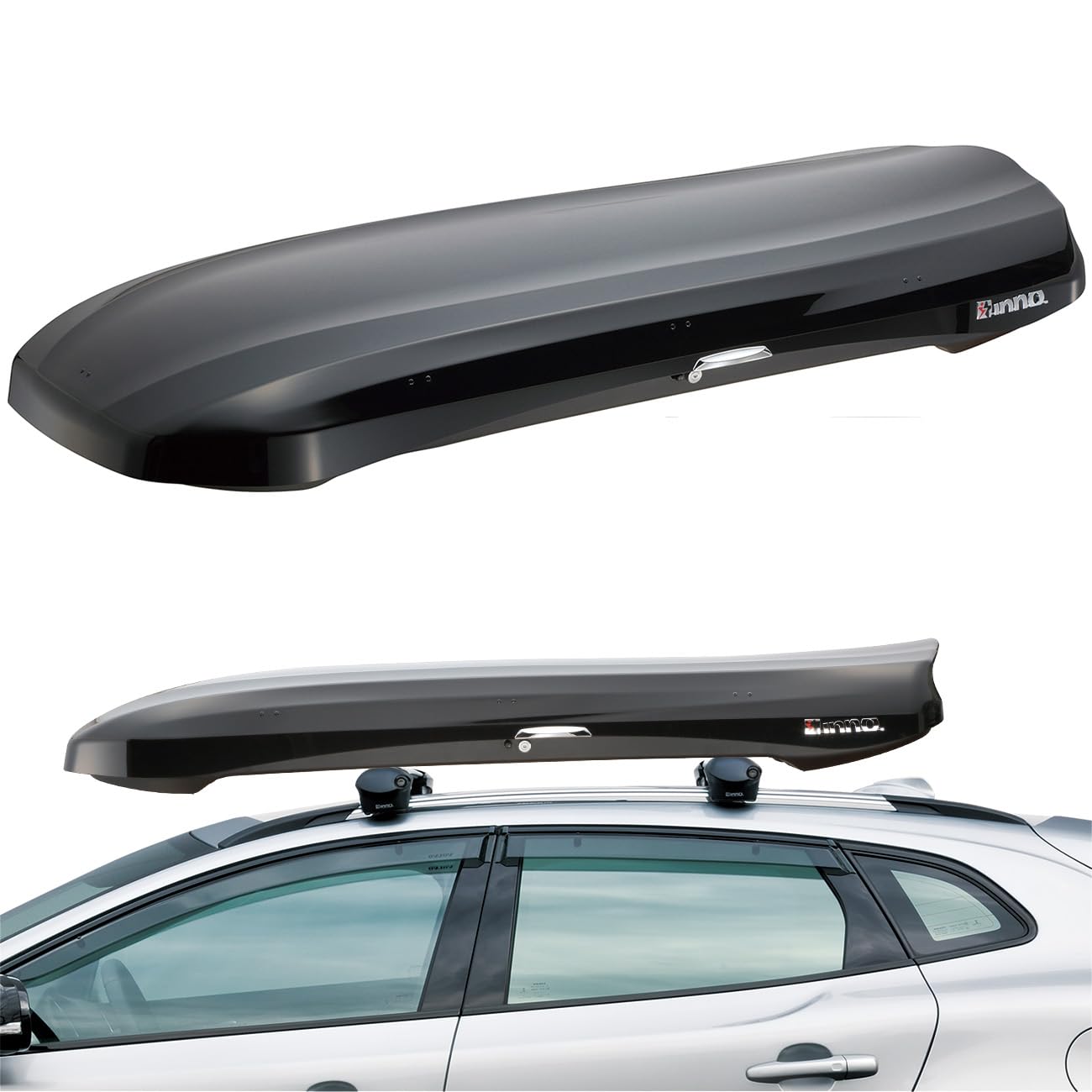
1. INNO Wedge 660 Black 11 cu ft Roof Box
Our pick — 4.5+★ from 70+ verified ratings; the strongest balance of quality and price.
Eighty inches of low, quiet shell that ends the board-in-the-back-seat argument.
The Wedge 660 is built for the specific problem of long gear. Inside, 11 cubic feet holds up to 4 snowboards or 6 to 8 pairs of skis, so a family of four can load boards and still have corner space for boots and a duffle.
What wins people over is the physical footprint. The size is the most-discussed strength by a wide margin, with appearance close behind — and that fits the design. The wedge shape sits low and tapered at the front, so the box reads as part of the roofline rather than a bubble bolted on top. On the highway it stays quiet; drivers run it at 65mph without the whistle that flat-front boxes produce, which on a long winter drive is the difference between talking in the car and shouting over it.
You get a stronger shell for the higher price. INNO’s SPM injection molding holds the shell walls to a uniform thickness instead of thinning them at the corners, and the maker claims up to 50% greater strength than conventional vacuum-formed boxes. The whole thing still weighs 42 pounds, so two people can lift it onto the roof without a struggle. The Memory Mount system (brackets that stay set to your bars after the first install) means every mount and removal after that first one takes minutes with no tools.
Here is the honest catch on carrying boards. The lock will not release your key until the box is fully secured, which is a good safety habit and a slightly annoying one when you are cold and in a hurry. And with dual-side opening and no stated max load figure, you should size your own pile of gear against the 11 cubic feet rather than assuming the box is the limit — the vehicle roof is.
Where the Wedge 660 earns its place
- 80-inch shell — 33.5 inches longer than the JEGS 10 cu ft carrier, so full-size boards lie flat
- Holds up to 4 snowboards or 6 to 8 pairs of skis in 11 cubic feet
- Quiet at 65mph — the low wedge nose cuts the highway drone
- Memory Mount brackets make every re-install after the first one tool-free
- Dual-side opening gets you in from whichever side is clear
What to know before you bolt it on
- At 42 pounds it takes two people to lift onto the roof safely
- The key stays captive until every lock point is fastened — secure, but slow in the cold
- Premium tier, and the widest shell here at 33 inches across the roof
Made for: the family loading long boards and skis who wants the roof to stay quiet and the shell to stay slim.
Two hands required: that 42 lb weight is a two-person lift, so plan the first install with a helper.
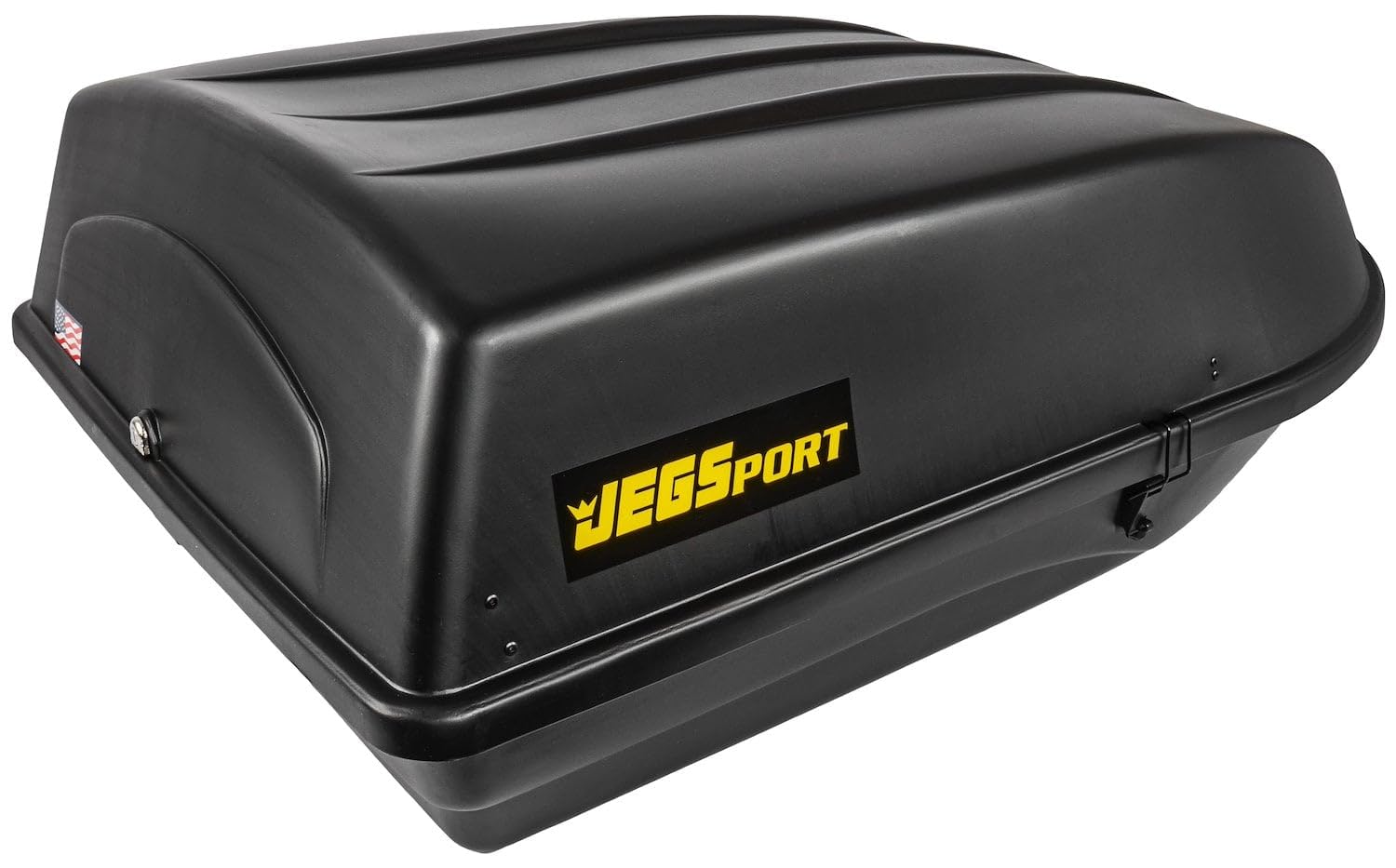
2. JEGS 10 cu. ft. Rooftop Cargo Carrier
The entry ticket that still clamps down tight, seals out weather, and costs the least of the nine.
If your boards are on the shorter side and your car is compact, this is where you start. The JEGS 10 cu ft box measures 46.5 inches long — the shortest shell in this lineup and 33.5 inches shorter than the INNO above — which makes it easy to live with on a small sedan roof. It holds 110 lb and swallows 2 duffle bags plus a small carry-on, so a board bag, a boot bag, and a weekend of clothing fit without drama.
For the money you get a hard HDPE plastic shell (the same high-density plastic used in heavy-duty bins), a weather-tight seal, and a dual side locking system that lets you load from either side of the car. It needs no tools for assembly and ships with all the mounting hardware. Buyers report it as a good car top carrier with a 100lb capacity that fits 2 duffle bags and a small carry-on suitcase — a straightforward read on what the interior actually takes.
Know the length limit before you buy. At 46.5 inches long, a 160cm board will not lie flat, so short boards, skis taken down, or duffle-only trips are this box’s balance. It is also the lightest-lifting option here at 24.5 pounds — 25.8 pounds lighter than the D SOLUTIONS 11 cu ft at 50.3 pounds — so one person can hoist it up alone.
The short-board answer: a sealed, lockable hard shell that mounts without tools and lifts solo at 24.5 pounds — the practical first roof box for someone who has never owned one.
Stated warranty is short: the manufacturer lists 30 days of coverage, so inspect the shell and latches the day it arrives.
Reach for this if: you run a compact car, carry shorter boards or luggage, and want weather protection without the premium-tier outlay.
Look elsewhere if: your board measures near 160cm — the 46.5-inch floor will not take it flat.
3. JEGS 18 cu. ft. Rooftop Cargo Carrier
The volume king — eight cubic feet bigger than the brand’s own 10 cu ft box, for teams packing everything.
You get room for bulky boot bags and a tent stacked on top. The interior runs 57 inches long by 39 inches wide by 19.5 inches tall. That 39-inch width is 8.5 inches wider than the JEGS 10 cu ft at 30.5 inches, and the 19.5-inch height sits 8.5 inches taller than the INNO’s 11-inch shell.
Loading happens from the rear rather than the sides, which suits a hatchback or SUV where you walk up to the tailgate anyway. Assembly needs no tools and the mounting hardware comes in the box. Storage capacity is what this box is known for — the interior space draws the strongest praise, and reviewers describe it as fairly spacious.
Be clear-eyed about the trade-off, though: this is a mixed-feedback product. Durability, quality, and value all draw split reactions — some find it very durable, others describe it as flimsy — and the lid functionality is the most-discussed weak point. It is also the heaviest non-premium shell at 35.5 pounds, so lifting it up is a two-person job. Think of it as the high-volume option for buyers who prioritize space over long-haul refinement.
For maximum load: 18 cubic feet and a 57 by 39 by 19.5-inch interior make this the one to pick when nothing else will hold the trip.
Split opinions on build: durability, quality, and value draw mixed reactions, and the lid is the most-discussed complaint — so check the latch action carefully in the first week.
Best for: the family that hauls boards plus camping gear and needs raw interior volume above all.
Weigh the lift: at 35.5 pounds this shell wants two people on the roof during install.
4. D SOLUTIONS Hard Shell Rooftop Cargo Carrier, 11 cu ft
A 110 lb load limit wrapped in UV-stabilized ABS that shrugs off snow, sun, and the odd rock.
The material is the headline here. The shell is UV-stabilized, weatherproof ABS plastic (a rigid, impact-tolerant plastic that resists cracking in cold), built to keep gear dry through rain, sunlight, snow, and minor impacts while holding its shape across conditions. At 53 inches long by 34 inches wide by 15 inches tall it sits between the compact and long shells, and the non-slip bottom stops your board from sliding around when you brake hard on a mountain road.
Quality is what earns the praise on this box — it is the most-discussed positive, with value close behind — and the low wind noise gets consistent mention too. The security setup is the same careful design as the INNO: an integrated key lock where the key only comes out once all locking points are fastened, so you cannot drive away with a latch undone. It mounts to crossbars up to 13 inches wide, tool-free, with four heavy-duty brackets and two keys in the box.
The trade-off is weight. At 50.3 pounds this is 25.8 pounds heavier than the JEGS 10 cu ft carrier at 24.5 pounds — a two-person lift for sure, and a real consideration if you take the box on and off through the season. The locking mechanism and installation also draw split feedback; some find both easy, others hit faulty locks or thin instructions. Mount it once, test every latch, and leave it up.
Why it holds up in winter
- UV-stabilized ABS shell handles snow, sun, and minor impacts
- Non-slip bottom keeps boards and bags from shifting on descents
- Key releases only after every lock point is fastened
- Fits crossbars up to 13 inches wide with no tools
Where it costs you
- 50.3 pounds — 25.8 pounds heavier than the JEGS 10 cu ft, so plan a helper
- Locking and installation feedback is split — inspect latches early
Pick it when: you want a weather-tough shell, a no-slip floor, and a lock that holds you accountable.
Skip the solo install: 50.3 pounds on the roof is a two-person job from the first mounting.
5. Auto Dynasty Hard Shell Roof Top Mount Cargo Carrier

A 14-inch-wide mouth that takes bulky gear without you wrestling it through a slit.
Loading is the thing this box solves. The opening runs 14 inches wide, so a stuffed boot bag or a duffle slides in without you trying to angle it through a narrow gap. Inside you get 11 cubic feet and a 110 lb weight limit, with 53 inches of length by 34 inches of width by 15 inches of height — the same footprint as the D SOLUTIONS above, but opened from the passenger side so you load away from passing traffic.
Build is UV-protected, weather-resistant ABS that shields contents from rain, sun, snow, and impacts while keeping its structural shape. The lock works the same careful way: the key will not come out until all lock points are fully secured, and contents stay put even on rough roads with no shifting or spillage. Quality is the strongest thing about it — the most-discussed positive by a wide margin, with functionality next — and the size gets consistent credit for holding a lot despite modest external dimensions.
The honest limit is the passenger-side-only opening. You get one loading side instead of two, which is fine when you have curb space and awkward when you are parked against a snowbank on the driver’s side. Fit and locking both draw mixed notes, so verify your crossbar width before you buy and test the latch on arrival.
Built for bulky loads: that 14-inch opening plus 11 cubic feet of volume makes short work of duffles, boots, and board bags.
One-sided access: passenger-side opening only — plan your parking around which side of the car is clear.
Suits you if: you pack bulky winter gear and want a wide, forgiving opening on a hard shell.
Check first: your crossbar width — fit draws mixed feedback on this model.
6. pidock Car Rooftop Cargo Box, 16 cu ft

Low enough to clear the garage door, wide enough to hold 130 lbs of winter kit.
Clearance is the problem this box was designed around. At 13 inches tall across a 58.3 by 35.4-inch footprint, it slips into most garages with the box mounted — a real advantage over the 19.5-inch-tall JEGS 18 cu ft, which sits 6.5 inches taller and turns a garage entry into a math problem. Inside, the listing calls it 15.5 cubic feet while the title says 16; either way it carries up to 130 lbs of cargo, which is 20 lbs more than most of the 110 lb shells here.
The lid opens from either side on strong support arms that hold it up while you load, so you are not fighting a falling lid with a board in your hands. The shell combines ABS and PMMA plastic (PMMA is the clear, UV-resistant acrylic layer, which is why the white gloss finish holds up in sun) and stays water resistant, impact resistant, and UV protected. A central locking system keeps the key captive until the box is fully secured. Installation is tool-free, clamping to most round, square, and aerodynamic crossbars.
The look is the standout for owners — it does not read like a rocket ship on the roof, and the gloss white finish is a deliberate departure from the sea of black boxes. That whiteness is also the honest catch: it shows road grime and salt spray faster than a textured black shell, and this is a newer listing with a thin track record, so buy it for the clearance and the finish with eyes open.
Clearance and colour: a 13-inch height that clears most garages and a white gloss finish that is genuinely different from every black box here.
Newer to the market: a short track record and a white shell that shows salt and road grime faster than textured black.
Choose this if: your garage door is tight and you want 130 lbs of capacity without a tall shell.
Be ready to wash it: gloss white means salt spray shows, so budget a rinse after mountain runs.
7. SportRack Horizon Cargo Box

A long, narrow ski tube that leaves half your roof rack free for a bike or kayak.
The Horizon solves a different problem than the wide boxes: it takes boards and skis without eating your whole roof. At 88.75 inches long but only 21 inches wide, it runs as a narrow strip down the centre of the rack and leaves room either side for other accessories. Capacity is 11 cubic feet (311 liters), enough for 3 to 6 pairs of skis up to 210cm or 2 to 3 snowboards, with a 110 lb max load.
It is made from rugged, impact-resistant ABS that handles cold and impacts without complaint. Quality is the most-discussed strength — praised most by a clear margin — with value and size next, which lines up with a box that does one job with no fuss. It opens on the passenger side, away from traffic, and the quick-release attachment kit lets you pull it off the roof between trips.
What it fits is worth checking twice: SportRack rack systems, square bars, round bars, and most factory racks. Sturdiness, fit, and the locking mechanism all draw split feedback, so test your bar shape against the clamp before committing. And if you want a box that swallows a full family’s luggage, this narrow profile is not that box — it is the sports-gear tube that leaves your roof usable.
What the narrow profile buys you
- 88.75 inches long but only 21 inches wide — leaves rack space for other gear
- Carries 3 to 6 pairs of skis up to 210cm or 2 to 3 snowboards
- Passenger-side opening keeps you out of traffic
- Quick-release kit takes it off the roof between trips
The honest trade-offs
- At 21 inches wide it is a gear tube, not a luggage box
- Sturdiness, fit, and the latch draw mixed notes — test the clamp against your bars
Great match for: skiers and riders who want long boards on the roof without surrendering the whole rack.
Not a family hauler: 21 inches of width means luggage goes elsewhere.
8. Goplus Rooftop Cargo Carrier, 14 cu ft

A 165 lb load ceiling — the highest here — for the trip where everything comes along.
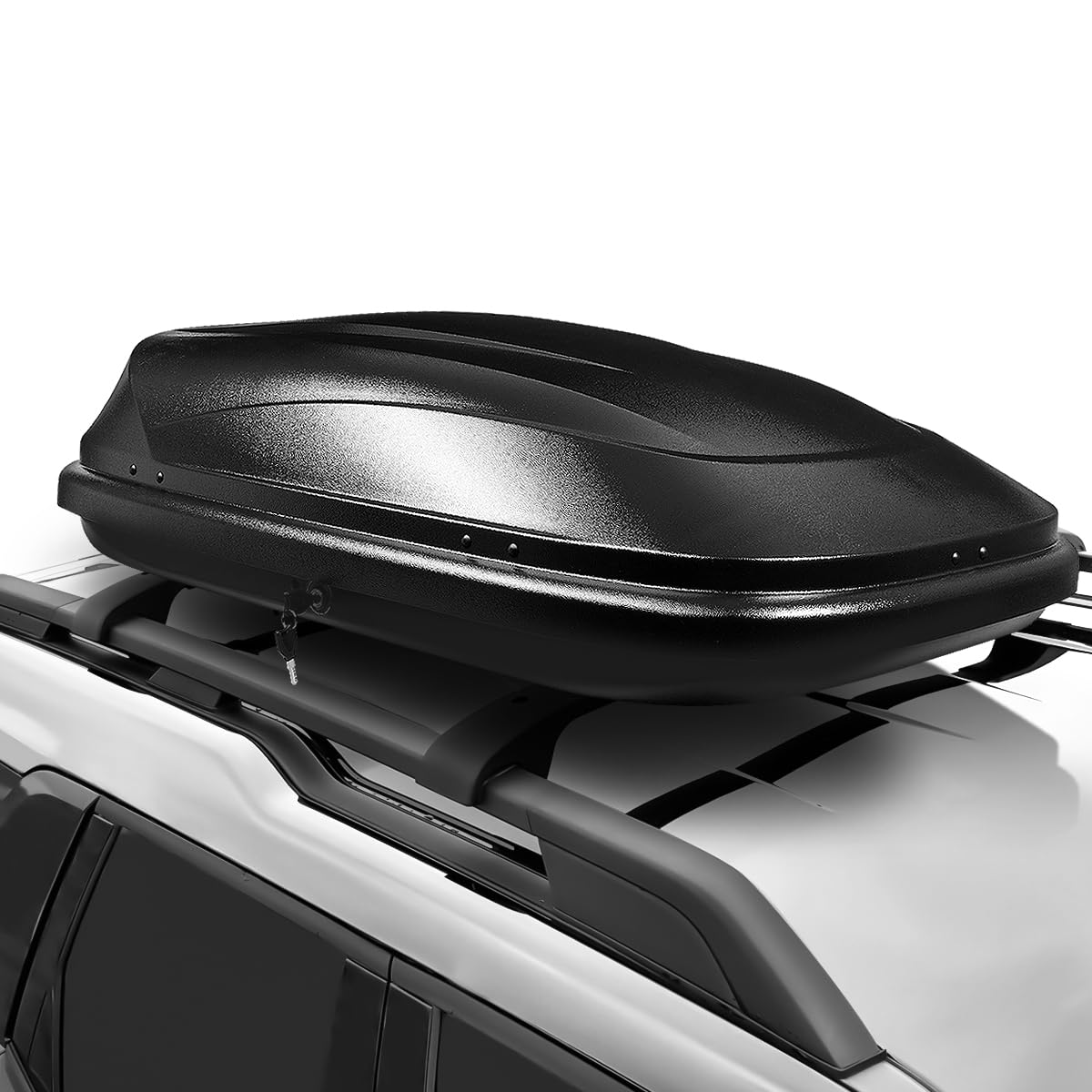
Most boxes here cap at 110 lbs. This one takes 165 lbs, so the board bags, boots, and duffles do not have to be sorted against a hard ceiling. It holds 14 cubic feet across a 62.5 by 30 by 15-inch shell, with metal lid stiffeners at the bottom that keep the box stable and the lid rigid even when loaded heavy. Dual-side opening gets you in from whichever side is clear, and four quick-connect anchors clamp it down with no tools.
Stability is what owners notice. The box does not move an inch on the road, and it has a track record across long trips — one owner logged 2,000-plus miles of road trips with it mounted. Quality is the strongest and most-discussed thing about it, with value next in line, which is why it holds a large, well-established following. The shell is sturdy ABS and PC material that protects contents from weather while keeping its shape season after season.
Read the fit note before you order. This box wants a rack between 17 and 22.8 inches wide, with crossbar thickness under 1.0 inch and width under 3.1 inches — a different spec from the 13-inch crossbar limit on several boxes here, so measure your bars first. And it asks that you open one side at a time rather than both together. The opening mechanism draws mixed notes, so treat the lid carefully and close it deliberately.
Load ceiling and stability: 165 lbs of capacity in a 14 cu ft shell that stays planted on rough roads, with quality the most-praised trait in owner reviews.
Very specific bar spec: needs a rack 17 to 22.8 inches wide with crossbars under 1.0 inch thick — measure before you buy.
Your pick for: the heavy-load trip where the 110 lb boxes feel like a constraint.
Verify the bars: this one’s crossbar window is narrower than most, so confirm your rack dimensions first.
9. Yakima SkyBox NX Skinny Roof Cargo Carrier, 12 cu ft

Yakima’s skinny box: 12 cubic feet down the centre, crossbar real estate left over for the rest.
The SkyBox NX Skinny is built for the vehicle that carries everything at once. At 84 inches long by 26.5 inches wide by 16 inches tall, it holds 12 cubic feet — enough for up to 3 campers — and fits snowboards and skis up to 195cm. That 26.5-inch width is 5.5 inches narrower than the INNO’s 33-inch shell, which is exactly the point: the skinny design leaves valuable crossbar space free for a bike tray or kayak cradle.
Access is dual-sided, so either side of the car works. The security setup goes a step further than the key-captive designs: a full metal opening handle both locks the gear inside the box and locks the box to the vehicle, so the whole unit is secured rather than just the lid. The NX nano-texture on both lid and base gives it a clean, matte look that does not show scratches the way glossy black does.
Quality is the strongest and most-discussed strength, with installation next — the integrated clamps make it simple to secure to crossbars, and it works well as an expansion fit on a mid-size SUV. Storage capacity gets consistent credit for holding snowboarding gear. The sturdiness is the honest caveat: the shell feels solid, but a few notes say the hinges come unhinged easily, so check them before every trip and treat the lid gently.
Built to share the roof: 84 inches long and just 26.5 inches wide, so a bike or kayak still has rack space.
Hinge watch: the shell is solid, but hinge retention is the one recurring gripe — inspect before each drive.
Ideal if: you need boards and ski gear on the roof alongside a bike or kayak.
Check the hinges: a handful of owners mention the hinges coming loose, so verify them before every loading.
Know the Specs
Cubic feet versus usable length
Cubic feet (the internal volume, length times width times height) tells you how much luggage fits — but not whether a board lies flat. A box at 46.5 inches long will hold 10 cubic feet of duffles yet force a 160cm snowboard to sit at an angle or ride in the back seat. Read the external length first, then check the volume. Length decides board fit; volume decides luggage fit.
Crossbar width and bar shape
Crossbars are the two bars running across your roof that the box clamps to. They come round, square, factory aero, and aftermarket aero, and they come in different widths. Several boxes here clamp to bars up to 13 inches wide; the Goplus asks for a rack between 17 and 22.8 inches wide with crossbars under 1.0 inch thick. Measure both the width and the profile of your bars before ordering — fit is the biggest reason a box goes back.
Load limit versus roof rating
The box’s max load (110 lbs, 130 lbs, or 165 lbs depending on the model) is the ceiling the shell can carry. Your vehicle’s own roof rating is often lower once you are moving. Boards, boots, and a duffle stack up quickly, so stay comfortably under the stated load and check what your car’s manual allows on the roof while driving.
Lock design and key-captive systems
The best boxes hold the key captive until every latch point is fastened — you physically cannot remove the key with a latch undone. That is your guarantee the lid is shut before you pull onto the highway. Dual-side opening means you can load from either side; passenger-side-only keeps you away from traffic. Know which you are getting before you park against a snowbank.
Common Questions
Will a 160cm snowboard fit in a rooftop cargo box?
How do I know if a roof box will fit my car’s crossbars?
Can I put boots and bags in a box designed for snowboards?
Is a dual-side opening box worth the extra cost?
How much wind noise does a low-profile roof box make?
Can I mount a roof box on a car with no factory rack?
How much does a hard-shell roof box weigh to lift on and off?
Are hard-shell roof boxes fully waterproof in snow?
Will adding a roof box fit under my garage door?
Can I open the box and leave the key in place?
The Bottom Line
For most people, the snowboard roof box worth mounting first is the INNO Wedge 660 — an 80-inch shell that lies full-size boards flat, holds 4 snowboards in 11 cubic feet, and stays quiet at 65mph. Its 4.5+ star average across 70+ ratings backs that up, though the JEGS 10 cu ft box has far more reviews behind it; the INNO simply holds the higher score.
If you want maximum volume, the JEGS 18 cu ft carrier takes the most luggage of any box here. If you need boards alongsidea bike or kayak, the Yakima SkyBox NX Skinny keeps 26.5 inches of width and leaves the rest of the rack free. And if a tight budget and a compact car are your reality, the JEGS 10 cu ft carrier seals, locks, and lifts solo at 24.5 pounds.
One practical nudge before you commit: measure your crossbar width and your longest board tonight, write both numbers down, and match them against the spec table above. Those two numbers decide whether the box swallows your gear or spends the season in the return pile.
How we choose
We do not accept paid placement. Every pick is matched to a real buyer and a real use-case; we do not hands-on test units.
Sources
Specifications: manufacturer listings and product documentation. Review insights: verified customer reviews, as of November 2026. Pricing: not shown on this page (it changes often); check the current price via the retailer link.
As an Amazon Associate, Tactical Gear Guy earns from qualifying purchases. This does not affect which products we feature.