Specs are compiled from manufacturer listings and verified buyer reviews and can change over time — please confirm the key details on the product page before buying.
Here is the short answer: buy the Victorinox Fibrox Pro 8 Inch if you want the safest everyday chopper, and buy the HENCKELS Classic 8-Inch if you want a traditional forged blade with real heft behind it. Everything else on this list solves a narrower problem — a prettier blade, a Japanese edge, a gift-worthy handle — and you will read exactly which one fits your kitchen below.
This guide is built by comparing the manufacturers’ published specifications and the patterns across verified customer reviews, so you get each pick’s real strengths and trade-offs instead of marketing spin.
A chef knife earns its place by how it feels after twenty minutes of onions, not by how it looks on a hook. This breakdown covers blade steel, handle grip, weight, and edge angle so you can pick with confidence. The right stainless steel chef knife is the one you reach for without thinking — this list narrows nine 8-inch blades down to that one.
Top Picks


How To Choose The Best Stainless Steel Chef Knife
The knife you actually enjoy using holds its edge through a full prep session and does not slip when your hands are wet. Two numbers drive most of that: blade steel and handle material. Get steel and handle right and blade length, weight, and finish become preference.
Blade length and why 8 inches dominates
An 8-inch blade is long enough to sweep through a cabbage and short enough to control on a garlic clove. Every pick here runs an 8-inch blade, so length will not be the deciding factor for you. Weight and handle shape will.
Forged versus stamped construction
A forged blade is shaped from a single heated piece of steel, which usually means a thicker spine and more mass behind the cut. A stamped blade is cut from a sheet of steel, so it tends to be thinner and lighter. Neither is better on its own — a stamped knife can feel quicker in the hand, and a forged one can feel planted. Match the construction to your cooking: stamped for speed and light prep, forged for heavy chopping and dense vegetables.
Blade steel and edge retention
Stainless steel resists rust, but the exact alloy decides how long the edge lasts. Japanese VG10 steel appears on several picks here, sometimes rated around 60 to 62 on the Rockwell hardness scale (a measure of how hard the steel is). Harder steel holds an edge longer but is less forgiving if you twist the blade. German high-carbon stainless tends to be a little softer and tougher.
Handle material and wet-hand safety
Thermoplastic rubber grips when wet. Pakkawood and stabilized wood look richer and feel warmer. Stainless handles look sharp but can get slick with soapy hands. If you cook fast with wet or oily hands, prioritize a textured rubber or G10 grip over a polished handle.
Side-by-Side Comparison
| Model | Best For | Blade Length | Construction | Handle Material | Amazon |
|---|---|---|---|---|---|
| Victorinox Fibrox Pro 8 Inch★ Best Overall | Everyday chopping with wet hands | 8 inches | Stamped | Thermoplastic Rubber | Amazon |
| KitchenAid Gourmet Forged 8 InchForged Bargain | Forged feel with a storage cover | 8 inches | Forged | Brushed Stainless Steel | Amazon |
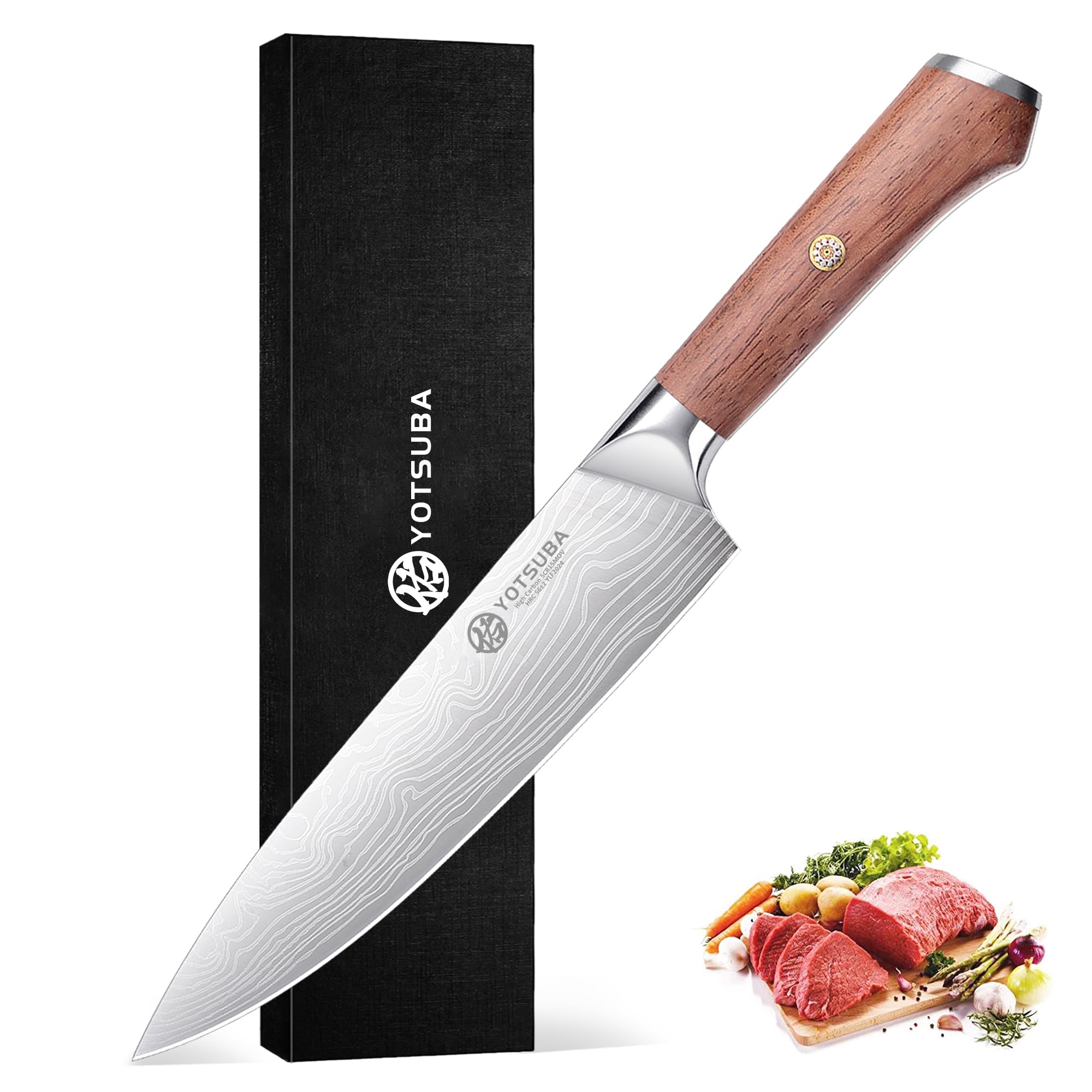
| YOTSUBA 8 Inch Japanese Chef KnifeBest Balance | Full tang balance for long prep | 8 inches | Forged | Pakkawood | Amazon |
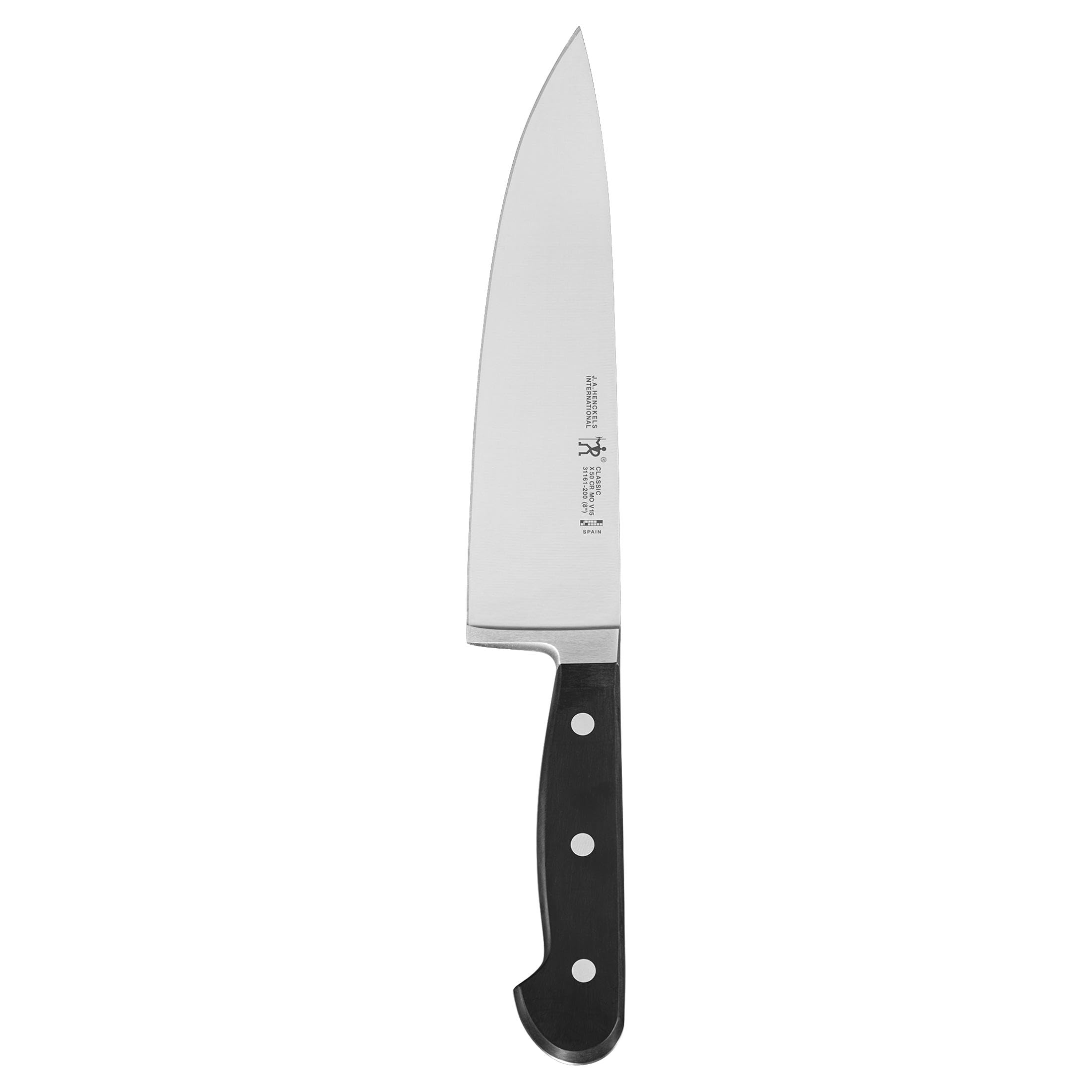
| HENCKELS Classic 8-Inch | Traditional forged heft and stability | 8 inches | Forged | Composite | Amazon |
| KYOKU Shogun Series 8 Inch | Damascus looks with a sheath and case | 8 inches | Forged | G10 Handle | Amazon |
| WÜSTHOF Gourmet 8 Inch | Heavy-duty work on thick vegetables | 8 inches | Stamped | Polypropylene | Amazon |
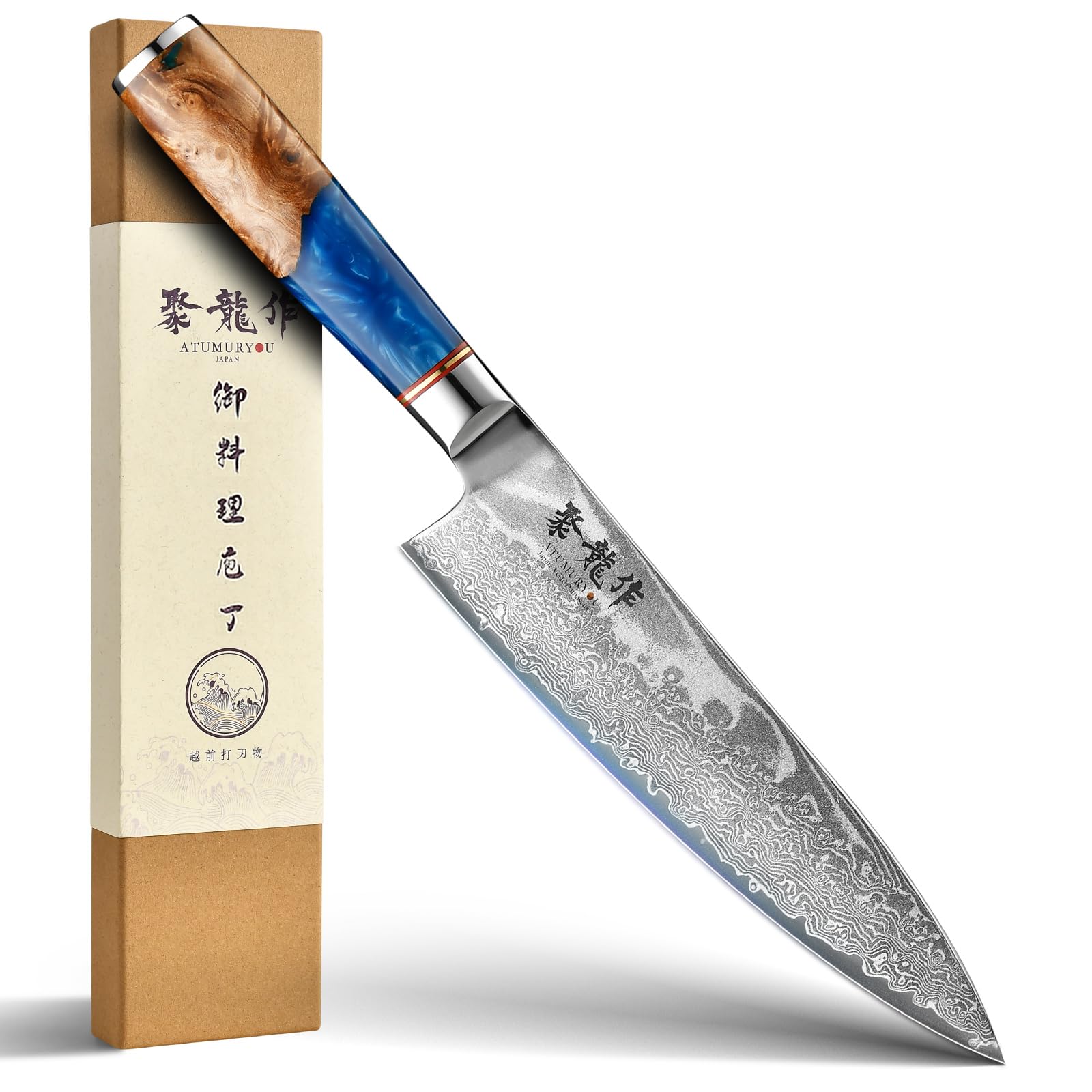
| Atumuryou Japanese Chef Knife 8 Inch | A hand-finished edge on a gift box | 8 inches | Forged | Stabilized Wood, Resin | Amazon |
| ZWILLING Pro 8-inch | Precision control and heavy daily use | 8 inches | Forged | Polyoxymethylene (POM) | Amazon |
| Miyabi Kaizen II 8-inch | Thin Japanese profile and hard steel | 8 inches | Forged | Pakkawood | Amazon |
Detailed Reviews
1. Victorinox Fibrox Pro Chef’s Knife, 8 Inch
Our pick — 4.5+★ from 9,500+ verified ratings; the strongest balance of quality and price.
The knife that stays glued to a soapy hand — and keeps its edge doing it.
The defining number here is the handle: thermoplastic rubber, a soft grippy material that holds even when your palm is wet. You get an 8-inch stainless steel blade with a plain edge, and the whole knife weighs just 8 ounces. That light weight is why it moves fast through a pile of onions without your forearm tiring out.
This knife is stamped, meaning the blade is cut from a sheet of steel rather than forged from a single heated block. Stamped knives tend to feel quicker and thinner, and this one leans into that. What wins people over is the quality of the build relative to what you pay — it is the crowd favorite, sitting at 4.5+ stars across 9,000+ ratings, and it gets there on grip and sharpness rather than badge appeal. It slices through fruit and vegetables with a clean, light motion and stays that way far longer than most light knives.
The honest catch is that a stamped blade carries less mass than a forged one, so heavy work like splitting a squash takes a bit more push. It is also dishwasher safe, which is convenient but will dull any edge faster than a quick hand wash and dry.
What earns it first place
- Thermoplastic rubber handle grips tight even with wet hands
- 8 ounces in the hand, so long prep sessions do not wear you down
- Stamped stainless blade arrives sharp and holds that edge
- Dishwasher safe for easy cleanup
What to know before you buy
- No forged heft for splitting dense squash or bone work
- Dishwasher cycles shorten edge life compared to hand washing
Go with this if: you chop daily, your hands get wet, and you want a blade that will not twist or slide mid-cut.
Worth knowing: it is lighter and thinner than a forged knife, so heavy cleaver-style work asks a little more from you.
2. KitchenAid Gourmet Forged Stainless Steel Chef Knife, 8 Inch
A forged Japanese-steel blade that arrives in a cover you can actually store it in.
If you want the solid feel of a forged knife on an entry-level budget, this is the one to look at. The blade is forged from semi-polished imported Japanese stainless steel, hardened and tempered for an edge that holds through slicing, dicing, and mincing. At 10.2 ounces it is a genuinely substantial knife — versus the HENCKELS Classic at 4.48 ounces — so it feels planted and steady in the hand rather than flickable.
The brushed stainless steel handle runs eastern-style, meaning a straighter shape than a traditional curved German handle. That gives you a controlled pinch grip and a secure hold, and the knife comes with a custom-fit blade cover so you can toss it in a drawer without nicking the edge. Top-rack dishwasher safe, though the maker recommends hand washing and drying right away to keep the edge alive.
Quality and sharpness are the two things buyers keep coming back to, and they are well-made and sharp straight from the start. The trade-off is the weight — 10.2 ounces takes some getting used to if you are coming from a light stamped blade, and the stainless handle can feel slick if your hands are coated in oil.
Weight and control: the 10.2-ounce forged body gives you stability for longer cuts, but it is a heavy knife, so plan for an adjustment period.
The cover matters: a custom-fit blade cover is a small thing that protects both your edge and your fingers during storage.
Reach for this if: you want forged construction and a straighter eastern handle without moving into premium territory.
Look elsewhere if: you have wrist fatigue issues — this is a heavy knife and the weight is the whole point.
3. YOTSUBA 8 Inch Japanese Chef Knife
Full tang construction and a pakkawood handle at a price that undercuts the big German names.
The full tang build is the story here — the steel runs the full length of the handle, so the knife behaves as one balanced piece rather than a blade stuck on a stick. At 9.92 ounces it sits comfortably between the light stamped picks and the heavy forged ones. The blade is 2mm thick high-carbon stainless steel with a hand-polished edge, and it is forged, not stamped.
What buyers keep returning to is the quality for the price. It handles the whole prep list — veggies, bread, fish fillet, beef, chicken — and it cuts through hard squash rind without complaint. The pakkawood handle has a natural grain finish that dresses up a kitchen drawer and stays comfortable through extended prep. Sharpening is straightforward, which matters when you are maintaining a high-carbon edge over months of use.
The recurring gripe to know about is durability, which some buyers rate as mixed. Treat it well — hand wash, dry promptly, store it where the edge is protected — and it should serve you for years. It is also not a premium slicer in the way the Miyabi is; the money goes into the tang and handle rather than exotic steel.
Where the value sits
- Full tang runs the length of the handle for balanced control
- 2mm high-carbon stainless blade with a hand-polished edge
- Pakkawood handle with natural grain that looks good and feels warm
- Easy to sharpen and maintain through regular use
The fine print
- Durability reviews are mixed — treat it as a well-cared-for tool, not a beater
- Not the thinnest or most precise Japanese profile on this list
The fit: home cooks who want forged balance and a handsome handle without paying German-brand money.
Think twice if: you want a knife you can abuse — this one rewards a little care.
4. HENCKELS Classic 8-Inch Chef Knife
German forging and a heavy bolster that makes slicing feel almost unfair.
Fully forged construction means the blade and bolster come from one piece of steel, and that heavy bolster does real work — it adds stability right where your hand sits and gives you a pivot point for rocking cuts. The blade is stainless with a satin finish and a plain edge, finely honed for long-lasting sharpness, and it is built to move through everything from herbs to large slabs of meat.
Compared to the KYOKU, this knife runs longer overall at 16 inches to the KYOKU’s 13.2 inches. In the hand, it weighs just 4.48 ounces versus the KitchenAid’s 10.2 ounces, and that makes the HENCKELS feel quick and easy during long meal-prep sessions. It is also dishwasher safe and the blades resist stains and rust.
What owners rave about most is how long it holds that professional-level edge — it starts razor-sharp and stays that way even with minimal care, and the balance is routinely called out as a standout. The caveat is that the lightweight feel that makes it quick can feel less planted than a heavy forged blade if you like a knife with real mass behind every chop.
Edge and balance: the combination of a honed satin blade and the heavy bolster is what makes this feel like a serious tool rather than a drawer afterthought.
Ease of care: dishwasher safe and rust-resistant, so it survives a busy household.
Pick this up if: you want a classic German forged knife with a stable bolster and easy cleanup.
skip it if: you prefer a heavier-feeling blade — this one is deliberately light on the wrist.
5. KYOKU Chef Knife 8 Inch, Shogun Series VG10 Damascus

A 67-layer Damascus blade sharpened to an 8 to 12 degree edge — and it ships with a sheath.
The blade is the headline: a VG-10 steel core wrapped in 67 layers of Damascus cladding, cryogenically treated and rated 58-60 HRC. That hard core is why it holds an edge so well you can go months between sharpenings, and the 8 to 12 degree edge angle is a much finer, more acute bevel than the typical Western knife — it glides through meat, fish, and vegetables with almost no resistance. At 1.4 pounds this is a genuinely hefty knife that feels substantial in the palm.
The G10 fiberglass handle withstands cold, heat, corrosion, and moisture, and the signature mosaic pin and Damascus pattern give it real display appeal. You also get a sheath and a case, so the edge stays protected in a drawer or during travel. At 13.2 inches overall, it is notably more compact than the HENCKELS Classic at 16 inches.
The thing buyers love is the quality-to-price ratio — it performs like a far more expensive knife and looks like one too. The honest note is that durability gets mixed marks, and a hard, thin, acute edge like this demands care: no twisting, no dishwasher, no chopping through frozen food. Treat it like a precision instrument and it rewards you.
Edge geometry: the 8 to 12 degree Honbazuke-honed edge is razor-sharp from the start and stays that way for months of normal use.
Storage included: a sheath and case mean you protect the edge instead of rattling it loose in a drawer.
Best for: cooks who want Japanese sharpness and a showpiece blade without the premium markup.
Handle with care: this acute edge is fragile against bone, frozen food, and twisting motions.
6. WÜSTHOF 8″ Gourmet Chef’s Knife

The German kitchen workhorse built for thick vegetables and heavy-duty prep.
This is a stamped blade, laser-cut for precision, with a high-carbon stainless steel edge and synthetic polypropylene handles that resist fading, discoloration, heat, and impact. Stamped construction keeps it light and quick, and that is the point — it is built for the daily grind of chopping, mincing, slicing, and dicing without your wrist paying for it. The knife weighs 240 grams.
What buyers consistently praise is how long it stays sharp — it holds its edge well and cuts through meat and thick vegetables with ease. The balance point is right, and the knife feels substantial and comfortable in hand despite the lighter build. Whether you are working through a full brisket or breaking down a pile of root vegetables, it keeps up.
WÜSTHOF backs this one with a limited lifetime warranty, which tells you something about the manufacturer’s confidence in the steel. The catch is that it is a stamped knife and not a forged one — you do not get the heavy bolster feel of a fully forged blade, and although the polypropylene handle is durable, it lacks the warmth of wood or pakkawood.
Why it earns its spot
- High-carbon stainless steel edge stays sharp through heavy daily use
- Laser-cut stamped blade keeps the weight light and the motion quick
- Polypropylene handle resists heat and impact without fading
- Limited lifetime warranty from WÜSTHOF
The honest limits
- Stamped, not forged — no heavy bolster feel
- Handle is durable but lacks the warmth of a wooden one
Suits: cooks who want a dependable, quick-cutting German blade for heavy daily prep.
Consider another pick if: you want the planted weight of a forged bolster in your hand.
7. Atumuryou Japanese Chef Knife 8 Inch, Damascus VG10
Sixty-two Rockwell hardness in a hand-sharpened 12-degree edge, wrapped in 67-layer Damascus.
The 62 HRC VG-10 core is the standout spec — that is a genuinely hard steel, and it is why this knife holds its edge far longer than ordinary kitchen blades while resisting stains. The 67-layer Damascus cladding adds durability along with the flowing rust-proof pattern, and the edge is hand-sharpened using traditional Japanese techniques to a 12-degree bevel. It glides through meat, fish, and vegetables with surgical precision straight from the start.
The handle is stabilized wood and resin, ergonomic and slip-resistant, and the balance helps cut down on wrist fatigue through long prep sessions. It arrives in a gift box, so it works as a present for a cooking enthusiast — the sharp edge and elegant handle give it real gift-worthy appeal. It is forged and hand-finished in a way that shows in both the cut and the looks.
Where it gives ground is edge fragility. A 62 HRC blade at a 12-degree angle is a true precision tool; it does not tolerate bones, frozen food, or twist cuts. It also asks for careful hand washing and prompt drying. If you treat it like a scalpel in the kitchen, it will outperform knives that cost much more.
The hardness payoff: 62 HRC VG-10 is the kind of steel that keeps a fine edge for a long stretch between honing sessions, and buyers find it holds its edge well.
The gift factor: the stabilized wood-and-resin handle and gift box make it a presentation knife, not just a working one.
Best fit: cooks who want a hand-sharpened Japanese edge and a blade that looks as good on a magnetic strip as it cuts.
The caveat: hard, thin steel at 12 degrees demands careful handling and hand washing.
8. ZWILLING Pro 8-inch German Chef’s Knife

A curved bolster that turns your hand into an extension of the blade — made for control.
The SIGMAFORGE construction is forged from a single piece of special-formula high-carbon stainless steel, and the curved bolster is what makes this knife feel different. It encourages a true pinch grip and a safe, precise cutting angle. The blade is ice-hardened using the FRIODUR process, which starts it razor-sharp and helps it keep the edge through heavy daily use. At 12.8 ounces it has real presence in the hand.
A full tang with a triple-riveted POM handle rounds out the build — that is a dense, stable polymer that keeps its grip and its look over years of work. Overall it runs 16.5 inches, making it the longest knife on this list. The precision-honed blade and laser-controlled edge are set to an ideal cutting angle for both sharpness and durability, and it cleanly slices through raw chicken without skipping.
The one thing opinions split on is weight. Some buyers love how substantial it feels, and others find 12.8 ounces heavier than they expected. The curved bolster also asks for a specific grip — if you are used to a straight bolster, it takes a cook or two to adjust. Beyond that, it is a buy-once knife built for a lifetime of heavy kitchen work.
Control and safety: the curved bolster and full tang are designed to keep your hand locked in a safe cutting position — worth the adjustment period.
Durability: ice-hardened FRIODUR steel is built to hold an edge through heavy daily use, not light weekend prep.
Built for: serious home cooks who want a forged German knife with maximum control and a buy-once mentality.
Know before you commit: 12.8 ounces is heavy, and the curved bolster wants a specific grip.
9. Miyabi Kaizen II 8-inch Chef’s Knife

The thin Japanese profile with 61 Rockwell steel and a hand-honed 9.5 to 12 degree edge.
Miyabi takes a different route than the German knifes here — the FC61 steel core has fine carbide distribution, which produces a blade that is both razor-sharp and durable, protected by 48 layers of Damascus steel. At 61 Rockwell hardness that core is close to the Atumuryou’s 62 HRC, and the double ice-hardened FRIODUR process means it holds its cutting edge remarkably well. The 9.5 to 12 degree hand-honed Honbazuke edge is about as sharp as a production kitchen knife gets.
The profile is a genuine thin Japanese blade — at 7.04 ounces it is a light, quick blade, and it moves through ingredients like it is cutting air. The black pakkawood handle is stamped with a mosaic pin and finished with the Miyabi logo on the end cap, and the D-shaped Japanese handle with its thicker, rounded bolster is shaped for comfort and balance through long prep.
This is the most expensive knife on the list, and it is a precision blade that deserves care — no bones, no frozen food, no dishwasher. The thin profile also means it is more delicate than a heavy German blade. If you want a knife that brings pure Japanese geometry and edge refinement to your cutting board, this is where it lives.
The case for Miyabi
- FC61 core at 61 HRC with fine carbide distribution for a razor-sharp, durable edge
- 9.5 to 12 degree Honbazuke hand-honed edge
- Thin 7.04-ounce profile that feels nearly weightless in hand
- 48 layers of Damascus steel and a mosaic-pin pakkawood handle
Where it asks for care
- Delicate thin Japanese profile — not for heavy or frozen work
- Premium-tier blade that expects careful handling and hand washing
The knife for: cooks who prize a thin Japanese profile, a refined hard-steel edge, and do not mind handling it with care.
Not the one if: you want a single knock-around knife for everything — this one lives for precision cuts.
Know the Specs
Rockwell Hardness (HRC)
Rockwell hardness measures how hard the steel is on a scale where higher numbers mean harder steel. Harder steel, like the 61 to 62 HRC VG10 and FC61 cores on this list, holds an edge longer but becomes less forgiving if you twist it. Softer German-style steel needs more frequent honing but takes more abuse.
Edge Angle
The edge angle is how narrow the bevel is sharpened. A 9.5 to 12 degree Japanese edge slices more cleanly than a wider Western bevel, but it is more delicate. When you see a knife honed to 8 to 12 degrees, treat it as a precision slicer rather than a bone-chopper.
Forged Versus Stamped
A forged knife is shaped from one heated piece of steel, which usually means a thicker blade and more mass. A stamped knife is cut from a sheet, which tends to make it lighter and quicker. Both work well — choose forged for a planted feel through squash and root vegetables, stamped for a fast, light motion through onions and herbs.
Handle Material
Thermoplastic rubber grips well when wet. Pakkawood and stabilized wood feel warm and look rich. Stainless and POM handles are durable and easy to clean but can feel slick with oily hands. Grip matters most if you cook fast with messy hands.
Common Questions
Is an 8-inch or a 6-inch chef knife better for home cooking?
Can I put a stainless steel chef knife in the dishwasher?
What is the difference between VG10 steel and German high-carbon stainless?
How often will I need to sharpen my chef knife?
What is a full tang handle and does it matter?
Can I cut through bone or frozen food with these knives?
Is a heavier chef knife better for control?
What does a Damascus pattern actually mean?
Which chef knife is best for wet or oily hands?
The Bottom Line
The winner depends on how you cook. For most people, the stainless steel chef knife to buy is the Victorinox Fibrox Pro 8 Inch — the thermoplastic rubber handle grips when wet, the stamped blade stays sharp, and the whole thing weighs 8 ounces, so it moves through prep without wearing you out.
If you want a forged German blade with a planted feel and a heavier bolster, grab the HENCKELS Classic 8-Inch — it runs light at 4.48 ounces and stays sharp with minimal care. For a Japanese precision profile with a 61 HRC core and a 9.5 to 12 degree edge, the Miyabi Kaizen II is where the refined cut lives. Whatever you pick, hand wash it, dry it promptly, and store it with the edge protected — it will outlast the drawer clutter.
How we choose
We do not accept paid placement. Every pick is matched to a real buyer and a real use-case; we do not hands-on test units.
Sources
Specifications: manufacturer listings and product documentation. Review insights: verified customer reviews, as of November 2026. Pricing: not shown on this page (it changes often); check the current price via the retailer link.
As an Amazon Associate, Tactical Gear Guy earns from qualifying purchases. This does not affect which products we feature.