Specs are compiled from manufacturer listings and verified buyer reviews and can change over time — please confirm the key details on the product page before buying.
A ball feeder lets you drill alone, throwing steady feeds so you can groove a stroke for an hour straight. A tennis ball feeder throws ball after ball at you at a steady pace, so you can groove a forehand, fix a backhand, or run down lobs for an hour straight. The catch is that they split into two families: compact feeders that toss easy balls a few feet away, and full launchers that fire groundstrokes across the baseline at up to 80 MPH. This guide sorts through both kinds, with the honest trade-offs spelled out.
This guide is built by comparing the manufacturers’ published specifications and the patterns across verified customer reviews, so you get each pick’s real strengths and trade-offs instead of marketing spin.
Speed, ball capacity, and how long the battery actually lasts are the numbers that decide whether a machine helps or just frustrates you. Below, each pick is matched to a practice style and budget, with the trade-offs spelled out.
Top Picks


How To Choose The Best Tennis Ball Feeder
Start with the drill you plan to run, not the spec sheet. A driveway feeder that tosses gentle balls at your kids needs something completely different from a launcher that throws 80 MPH groundstrokes across a full court. A driveway toss to your kids and an 80 MPH baseline feed are different machines.
Feed speed and who it is for
Ball speed is measured in miles per hour (MPH), and it sets the ceiling on your practice. A feeder capped at 30 MPH suits beginners learning fundamentals and timing. A launcher that reaches 75 or 80 MPH lets advanced players rehearse match-speed reaction. Buy only the top speed your level will actually use.
Oscillation and elevation explained
Oscillation means the machine swings its aim side to side, so balls land at random spots and you have to move your feet. Elevation control sets the arc, from a flat groundstroke to a high lob. Oscillation plus elevation makes you chase balls and hit on the run instead of standing still.
Battery runtime and ball capacity
Runtime is how long the rechargeable battery keeps feeding before it needs a charge. Ball capacity is how many balls the hopper holds. A 100-ball hopper means fewer reload breaks, and 4+ hours of runtime covers a full session off-outlet.
Side-by-Side Comparison
| Model | Best For | Max Speed | Weight | Battery / Power | Amazon |
|---|---|---|---|---|---|
| LOBSTER Sports Elite★ Best Overall | Full-court drills | 80 MPH | 42 lbs | 4-6 hours rechargeable | Amazon |
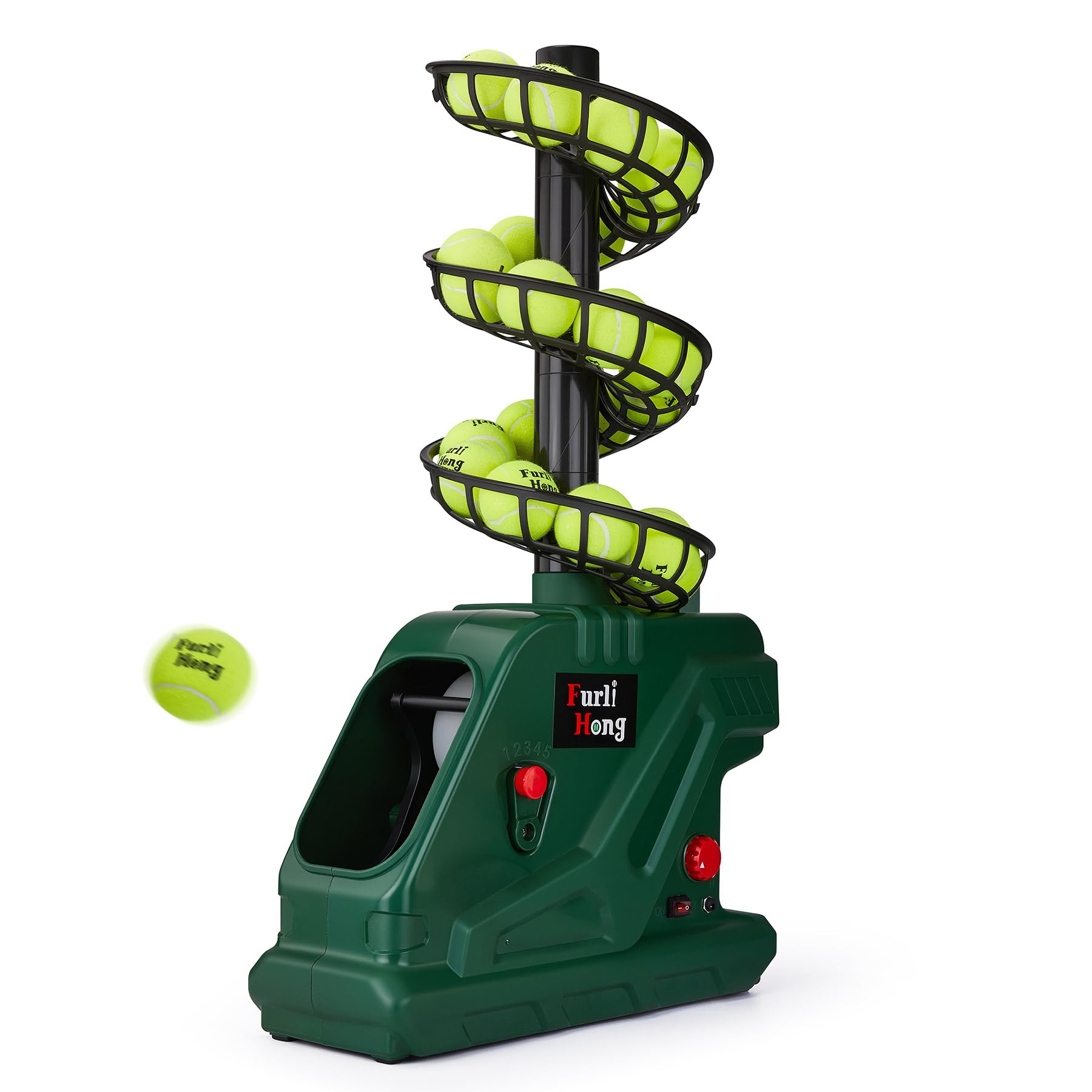
| Furlihong 3819BHBest for Beginners | Beginners and form work | 30 MPH | 3.99 kg | AC adapter (mains power) | Amazon |
| Furlihong 3807BHMost Stable Base | Stable solo practice | Low to High | 6.78 kg | Battery and AC adapter | Amazon |
| Fast Track GEN2 | Indoor and garage drills | 20 feeds per minute | 12 lbs (feeder) | Not specified | Amazon |
| TENNIIX Basic | Smart app and voice control | 75 MPH | 8.5 kg (18.7 lbs) | 4H runtime, 1,800 shots | Amazon |
| Spinshot Pro | Knob-control simplicity | Not specified | 49.8 lbs | Battery sold separately | Amazon |
| Nisplay N1 | Portable power | 68 MPH | 26 lbs | 4+ hours external lithium | Amazon |
| PUSUN PT-Smart | App-driven precision | 75 MPH | 32.6 lbs | 4-6h, 5,700+ shots | Amazon |
| Wilson Portable | Simple knob controls | 75 MPH | 38 lbs | Up to four hours internal | Amazon |
Detailed Reviews
1. LOBSTER Sports Elite Tennis Ball Machine
Our pick — 4.0+★ from 100+ verified ratings; the strongest balance of quality and price.
The one that fires from a soft volley to an 80 MPH bullet, with spin and lobs on command.
The number you keep coming back to is 80 MPH. That is the top of the speed range on this launcher, and it lets you rehearse match-speed groundstrokes instead of just gentle rally balls. You dial speed anywhere from 10 to 80 MPH, then add heavy topspin or backspin to mimic how a real opponent loads up a shot. The speed gap here is big: the LOBSTER reaches 80 MPH while the Furlihong 3819BH tops out at 30 MPH, so the Lobster is built for players chasing a serious workout rather than a soft toss.
Oscillation is the feature that stops it from being a one-note machine. It launches balls from the left, right, center, or at random, so you are always moving your feet and hitting on the run. Electronic elevation takes the ball from flat groundstrokes up to soaring lobs as high as 60 degrees. The multi-function remote means you can change settings without walking back to the unit between reps.
Portability was clearly on the design sheet: it weighs 42 lbs but folds via an inverting hopper and a folding handle to slip into a small car or SUV. The 8-inch all-terrain wheels roll over grass and onto the court without fighting you. Owners describe it as delivering consistent balls and running for a long session, and the group favorite holds 4.0+ stars across 110+ owners. The catch is durability — some owners have had theirs fail and need repair, and adjustability feedback splits, so treat the moving parts with a little care. Think twice if you want zero maintenance, and lean in if you want a broad, match-ready feed.
What players cheer for
- Speed dials from 10 all the way to 80 MPH for true match coverage.
- Topspin, backspin, and lob elevation up to 60 degrees in one machine.
- Random oscillation forces footwork and hitting on the run.
- All-terrain 8-inch wheels and a folding handle handle transport.
What to weigh first
- At 42 lbs it is a two-hand lift in and out of a trunk.
- Durability reports are mixed, so the moving parts need gentle handling.
- Adjustability and oscillation feedback split, so expect a learning curve.
Best for: Competitive players who want full-court speed, spin, and lobs without a partner.
Heads up: The 42-lb weight and mixed durability reports mean it rewards careful storage over rough hauling.
2. Furlihong 3819BH Portable Tennis Ball Machine
A lightweight training partner that feeds easy balls so you can groove form without a hitting buddy.
If your goal is form drills rather than match-speed reaction, the modest 30 MPH cap here is a feature, not a shortfall. You get five angle settings to work forehand, backhand, flat, slice, and volleys. Two power levels and four serve intervals let you choose short bursts for quick reaction or longer gaps to reset your stroke. The casing is compact enough that it lists at just 3.99 kg, making it easy to carry to any court.
What works here is simplicity. It sets up fast and plugs into an outlet, so you can focus on reps. What wins people over most is the build and functionality of the unit itself — it feels purpose-built for feeding easy balls to work on form rather than overpowering you. It is not built for advanced pace, and that is fine, because the buyer here is a beginner chasing clean contact.
The honest catch: this is a plug-in machine at heart, and battery life draws mixed notes, so plan to work near an outlet. A few owners have also had balls jam now and then. Those are small trade-offs against a feeder that gets beginners rallying on their own quickly, and the reliability of the case makes it a solid entry point.
Where it shines: The 5 angle settings and 2 power levels give a beginner a structured plan — flat, slice, and volley reps all from one small machine.
What to know: Expect to run it plugged into an outlet; battery life is not its strong suit.
Reach for this if: You are learning the game and want easy, repeatable feeds to fix your swing.
Look elsewhere if: You need a long battery session away from any outlet.
3. Furlihong 3807BH Tennis Ball Machine with Triangular Base
A triangular iron base that stays planted while the launch port swings up and down on its own.
The triangular iron base is the detail that earns this machine its spot. That wider footing keeps it from creeping or tipping while the automatic up-and-down swing launch port moves through its arc. You press a button and the port holds at any angle you want, so you can rehearse net play one minute and a baseline feed the next. Speed runs from a low setting to high, which keeps it usable from your first sessions up through intermediate drills.
At 6.78 kg it is noticeably heavier than the 3819BH, and that extra mass is exactly why the base feels steady. You get two ways to power it — batteries or an AC adapter — so you can train indoors or outdoors without hunting for an outlet. A portable carrying bag is included, which softens the weight on the walk to court. Beginners and intermediates report it is a reliable partner for solo sessions, and the battery side holds up well.
Assembly and reliability draw mixed feedback, so give yourself a relaxed first setup rather than a rushed one. Value opinions split between “worth it” and “not,” which usually reflects how much you use it. Load it up, let the swing port do the work, and this becomes a steady practice companion for players who mostly hit alone.
Why it stays grounded: The triangular iron base plus the auto swing port let you dial in an angle and trust it will not wander.
Set-up reality: It arrives in pieces with a 12-month warranty; the first assembly takes patience.
Solid pick for: Solo hitters who want a stable machine with both battery and mains power.
One honest limit: At 6.78 kg plus a mixed assembly experience, it is not the grab-and-go option.
4. Fast Track GEN2 Ball Machine for Practice with 7×7 Net
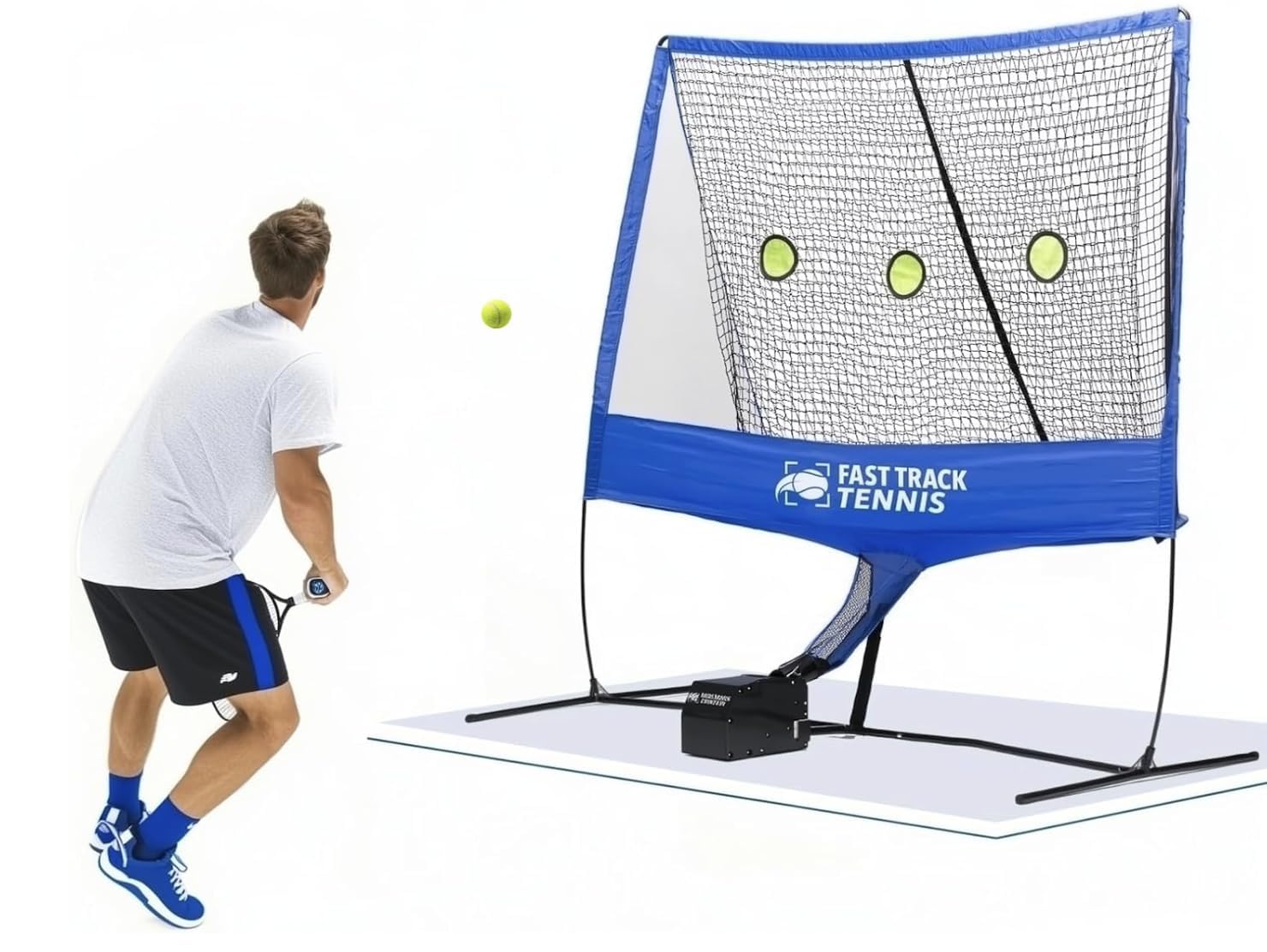
The bedroom-to-basement trainer that turns any flat space into a full drill station.
This one is a different animal from the court launchers above. It feeds up to 20 balls per minute — one roughly every 3 seconds — with each toss about 6 ft high and 9 ft out. That gentle arc is built for form work, not for simulating a 70 MPH passing shot. The included 7×7 ft net with 3 Velcro targets lets you run it in a driveway, garage, basement, or gym on any hard, flat surface, no court required.
What makes it clever is the tracking layer. An iOS app works with the included smartphone tripod to show shot placement after each rally, run skill-building drills, and record your session so you can review progress over time. Load 3-6 balls and you get more than 1,000 hits per hour with far less time chasing balls. The feeder is about 12 lbs, the packed net box is 16 lbs, and setup runs 5 to 10 minutes.
The main thing to accept: for all the app smarts, this is a short-range feedback trainer, not a full-court launcher. There is also a restocking fee on returns, so buy with intent. If you are short on court access and want to build consistency indoors, the net, balls, tripod, and app all arrive in one box and start paying off quickly.
Why it earns a place
- 7×7 ft net and tripod let you drill almost anywhere flat.
- iOS app tracks shot placement and session progress.
- 1,000+ hits per hour keeps the reps flowing.
- 12-lb feeder boxes up with the net for easy storage.
The trade-offs to know
- Short 6 ft toss is not match-speed realism.
- A restocking fee applies to returns.
- Needs an Apple device to use the tracking and drills.
Choose it when: You want to practice at home without booking a court.
Pass it up when: You need real firing power across the baseline.
5. TENNIIX Basic Portable Tennis Robot
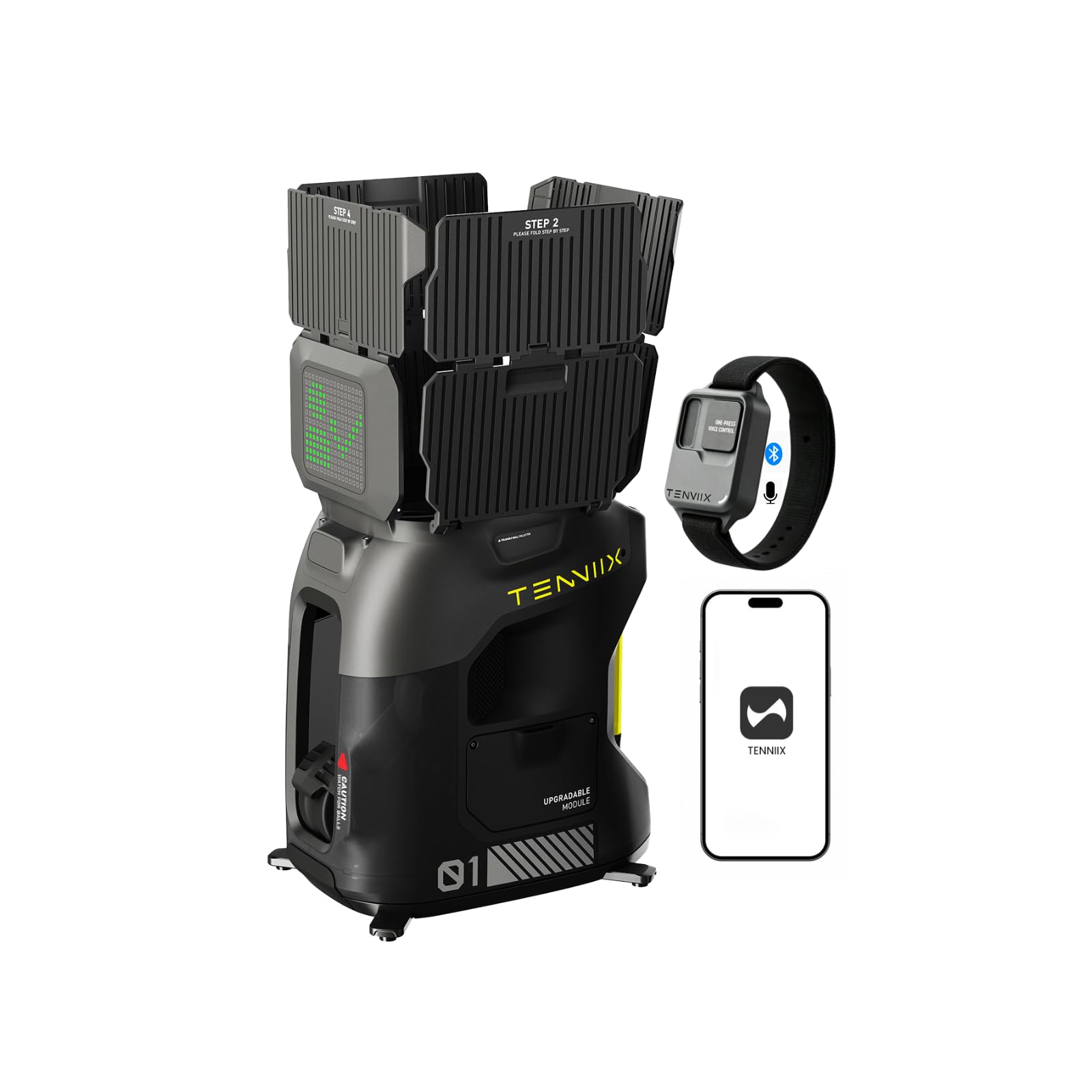
A robot you talk to — 46 voice commands and a 75 MPH arm that folds down to trunk size.
The dual-wheel system fires up to 75 MPH with consistent placement, which is the recipe for repeatable precision drills. Pair that with the removable battery’s 4 hours of play and up to 1,800 shots per charge and you have a full practice session in one compact body. It folds to 15.4″ × 10.7″ × 17.6″, so it drops into any trunk or tucks onto a garage shelf, and at 8.5 kg (18.7 lbs) the non-slip handles make it manageable to carry.
The control story is where it pulls ahead of both Furlihong machines. Bluetooth 5.2, WiFi, a microphone, a speaker, and LED indicators support 46 direct voice keywords, so you adjust speed, spin, feed timing, and drills through a wireless wrist controller instead of walking back to the unit. The app fine-tunes everything at once — speed, topspin and backspin, launch angle, interval timing — for 1,000+ unique ball combinations. Nine shot patterns and six rally styles with NTRP presets L1-L3 cover everything from baseline flatties to moon balls.
Across the review pages, performance and functionality are what get praised, and the 4.0+ star score across 50+ owners backs that up. One point worth knowing: an AI vision module is an accessory upgrade down the line, not something in the base box. If you like the idea of engineering a custom drill on your wrist and letting the robot run it, this is the pick.
The control angle: Voice, wrist remote, and app together mean you adjust mid-session without breaking your rhythm.
The honest note: The AI vision module is an add-on, so the base package is what you drill with.
Worth grabbing for: Players who want the deepest set of drills and controls in a truly portable body.
Skip if: You would rather turn knobs than talk to an app.
6. Spinshot Pro Tennis Ball Machine

No app, no menu — just knobs anyone in the family can turn, on a tank-like frame.
This is the machine for people who would rather not think about software. Every feature runs off simple knob controls, and the maker bills it as easy enough for a child to operate. It is also the one pick here built without plastics in the shell, using iron and a TPU and PU construction instead. That build shows in the 49.8-pound weight, which is the heaviest on this list.
Owners describe it as built like a tank, with reliable performance and adjustable features, including oscillation for side-to-side transitions. That oscillation is the feature that turns a static feed into moving practice, and it pairs well with the knob layout. It helps players sharpen their game without a partner. If you grew up feeding a machine by turning dials, this will feel instantly familiar.
Two things to plan for. The battery is shipped separately and is not included in the box, so budget for that before your first session. Battery life and value feedback are mixed, and a ball can occasionally get stuck. Get those sorted and you have a rugged, no-nonsense launcher that anyone on the family court day can run.
Plain controls, serious frame: Knob dials and a TPU and PU build mean very little to fuss with, but very little to break.
Before you buy: The battery ships separately and is not in the box, so plan for that addition.
Matches well with: Families and players who want dial-in-simple operation from a rugged frame.
Think twice if: You expect a battery in the box — this one ships without it.
7. Nisplay N1 Portable Tennis Ball Machine

Basketball-sized and 26 pounds, with a dual motor that throws topspin and backspin on demand.
The size is the headline. At 26 pounds and roughly basketball-sized, this is a launcher you can truly haul around, and the oversized wheels and 3-foot folding handle roll it over grass, gravel, and curbs. A small external lithium battery gives 4+ hours of play and travels with the machine. A dual motor throws the ball end to end every 1 to 9 seconds, and speed reaches 68 MPH with elevation from 0 to 50 degrees.
Spin control is what separates it in its price band. You adjust topspin and backspin at different levels, so you can rehearse a heavy topspin baseline pattern or a slice that skids. Manual oscillation adds side-to-side movement. Owners consistently call it reliable and well-built, and its portability and lightweight design come up repeatedly — the aluminum frame holds up to constant use while staying easy to move.
The catch is the oscillator’s responsiveness, which draws mixed feedback. It works, but expect to learn its quirks over your first few sessions. Weigh that against a machine you can lift with one hand, wheel across a parking lot, and run for a long session on its own battery, and it makes sense for players who practice at multiple courts.
Standout strengths
- 26-lb aluminum body with a 3-foot folding handle and oversized wheels.
- Dual motor throws 0 to 50 degrees of elevation at up to 68 MPH.
- Adjustable topspin and backspin at different levels.
- External lithium battery delivers 4+ hours of play.
Where it asks patience
- Manual oscillation responsiveness is mixed.
- The battery travels separately, so pack it each trip.
- Manual aiming means you set the swing yourself.
Reach for this if: You move between courts and want real spin control in a one-hand carry.
Look elsewhere if: You want fully automatic aiming with zero manual setup.
8. PUSUN PT-Smart Tennis Ball Machine
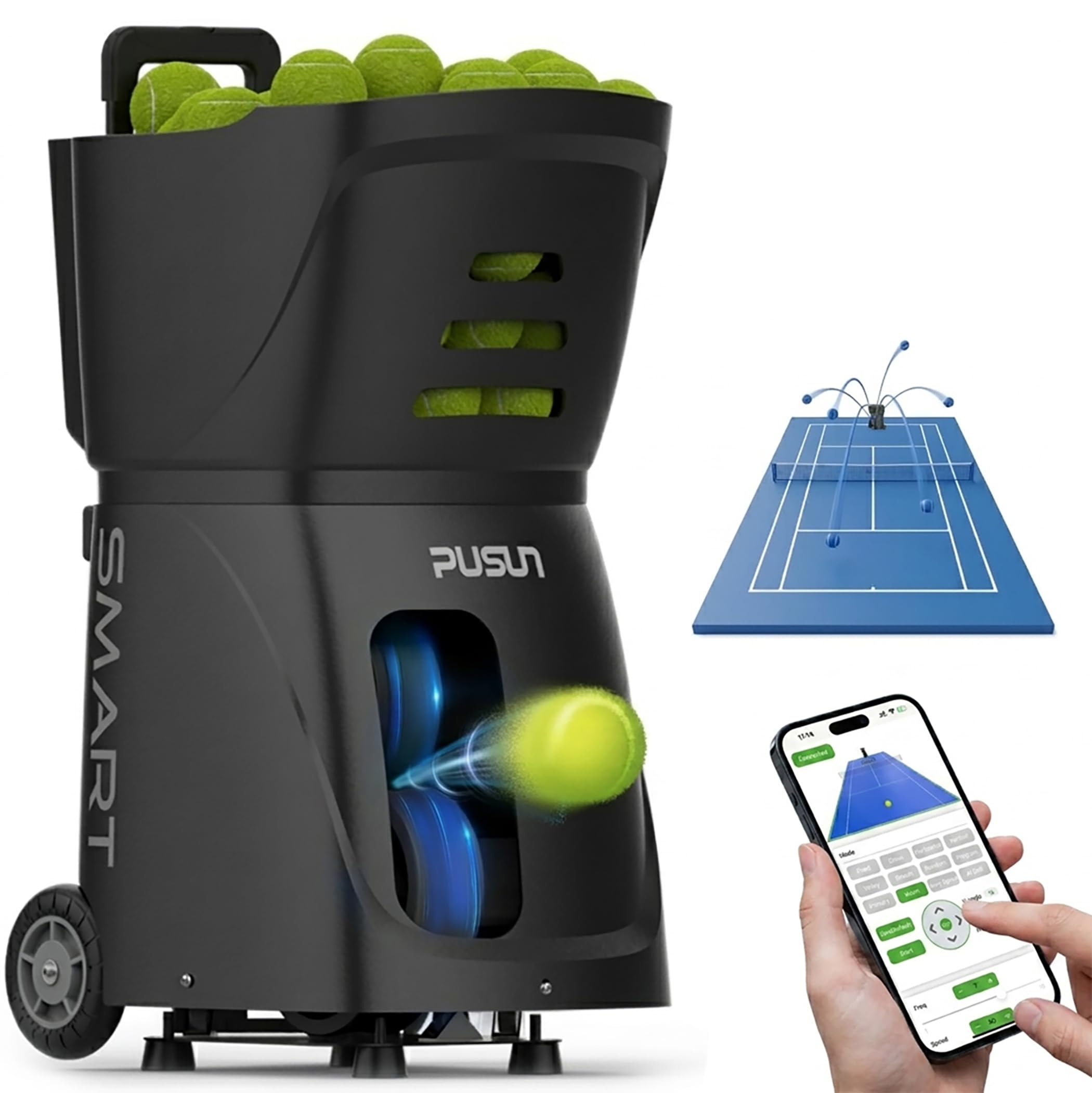
Twenty-eight programmable landing points and a triple-control system that runs from your wrist.
Where the LOBSTER Oscillation hands you random placement, the PUSUN hands you the map. You get 28 programmable landing points for full-court coverage and reactive training, and an external oscillation design that visibly swings so you can read the machine’s movement and sharpen anticipation. Speed spans 12 to 75 MPH with feed intervals from 1.8 to 8 seconds and 6 spin levels. That is a lot of tuning, and it is meant to be (NTRP 1.0 to 5.0 progression lives in the app, including a one-tap Padel Mode with 14 specialized drills).
The control spread is the real draw. You can run it from the App, the included Remote, or an Apple Watch, and pause, start, or fine-tune speed and spin on the fly without running back to the unit. It uses a 100-ball collapsible hopper and a 153.6Wh external battery for 4-6 hours and 5,700+ shots, with the external pack charging anywhere you happen to be. At 14.8 kg (32.6 lbs) it still fits a typical SUV trunk. The high-impact ABS shell and metal base handle hard courts and red clay, and a dust-proof mainboard resists clay erosion.
Ball performance draws mixed notes — some owners love the powerful delivery while others find short balls creeping in, so spend your first session dialing in the interval and speed. Quality and functionality are what get praised most overall. This is the choice for the player who wants to program drills rather than just press start.
The programmability edge: 28 landing points, 6 spin levels, and Apple Watch control put real drill design on your wrist.
True to name: The dust-proof mainboard and 100-ball hopper are built for long clay-court sessions.
Best suited to: Data-minded players who want to script exact landing patterns and spin levels.
The honest caveat: Short balls show up mixed in feedback, so budget a tuning session before drills feel right.
9. Wilson Portable Tennis Ball Machine

A 110-ball hopper, 75 MPH throws, and a three-year warranty, all on plain knobs.
Built with Sports Tutor, this launcher throws from 10 to 75 MPH with a 110-ball capacity, which is the largest hopper on this list. A single control adjusts topspin and underspin from light to heavy, and electronic elevation takes you from flat groundstrokes to lobs. Feed intervals run from every 1-1/2 seconds for quick-reaction volleys out to every 10 seconds. A random oscillator spreads shots across the court so you have to hit on the run.
No programming or phone app is needed — everything is a knob. The internal rechargeable battery provides up to four hours per charge, and the included Smart Battery Charger tops it up overnight and shuts off automatically to avoid overcharging. Towing handle and large wheels roll it to court. Backing all that is a 3-year parts and labor warranty from a U.S. factory in Burbank, CA.
The trade-off is heft at 38 pounds and the fact that it asks you to do your practice setup by hand rather than through a drill library. If you value a simple machine, a big hopper, and real warranty coverage over app features, this is the one that quietly does its job every session.
The capacity and warranty play: A 110-ball hopper plus a 3-year warranty makes long, uninterrupted sessions easy to trust.
The trade-off: At 38 pounds it is a cart-and-roll machine, not a one-hand carry.
Fits best with: Players who want a big hopper, knob simplicity, and long warranty cover.
Consider twice if: You want app-driven drills and wrist control instead of dials.
Know the Specs
Ball speed in MPH
Speed is the ceiling on what a machine can throw. A 30 MPH cap keeps feeds gentle for beginners, while a 75 or 80 MPH top end is built for match-pace groundstrokes. Match this number to your skill level so you are paying for power you will actually use.
Oscillation and elevation
Oscillation swings the aim side to side so balls land in random spots and you must move. Elevation sets the arc, from a flat drive to a lob. Together they turn a repetitive drill into point-like movement.
Battery runtime
Runtime is how long the rechargeable battery keeps feeding before a charge. Some machines run up to 4 hours, others up to 4-6 hours with external packs. Check whether the battery ships in the box or separately.
Ball capacity
Capacity is how many balls the hopper holds. Small feeders hold a handful; full launchers hold 100 to 110 balls. Bigger hoppers mean fewer reload breaks during a session.
Common Questions
Do I need a court to use a tennis ball feeder?
What is the difference between a ball feeder and a ball machine?
How long does the battery last on these machines?
Can beginners use an 80 MPH machine?
Do these machines run on their own with no outlet?
What is oscillation on a tennis ball machine?
How heavy are these machines to move?
Do these feeders come with balls included?
Can a ball machine replace a coach or hitting partner?
Which machine is best for practicing at home with limited space?
The Bottom Line
For most players, the best tennis ball feeder winner is the LOBSTER Sports Elite because 80 MPH speed, spin control, and random oscillation cover everything from warm-up volleys to match-speed reaction. If you want a small, do-anything trainer you can talk to and program, grab the TENNIIX Basic for its 75 MPH arm and 46 voice commands. And for practicing at home with no court booked, the Fast Track GEN2 with its 7×7 ft net is the one to reach for. The genuine nudge: the LOBSTER earns its top spot because it pulls off real practice in any one of those settings.
How we choose
We do not accept paid placement. Every pick is matched to a real buyer and a real use-case; we do not hands-on test units.
Sources
Specifications: manufacturer listings and product documentation. Review insights: verified customer reviews, as of November 2026. Pricing: not shown on this page (it changes often); check the current price via the retailer link.
As an Amazon Associate, Tactical Gear Guy earns from qualifying purchases. This does not affect which products we feature.