Specs are compiled from manufacturer listings and verified buyer reviews and can change over time — please confirm the key details on the product page before buying.
Knowing your foot measures a 29.5 (the mondo size, a boot’s length in centimeters) settles the length. The real decision is flex (how stiff the boot resists bending) and last width (the shell’s width across the forefoot). This guide sorts eight boots that all come in 29.5 by what each does well. That way you can match one to your ankle shape, your budget, and if you want a wide comfort shell or a precision fit.
This guide is built by comparing the manufacturers’ published specifications and the patterns across verified customer reviews, so you get each pick’s real strengths and trade-offs instead of marketing spin.
Mondo sizing is only half the equation, so we broke down every pick by last width, flex, and weight. Here are the best Ski Boots in Size 29.5 to help you get the right fit and feel on the mountain.
Top Picks

How To Choose The Best Ski Boots in Size 29.5
Once you’re locked into the 29.5 mondo size, three numbers decide whether a boot feels like a slipper or a vice on the hill. Those are the last width, the flex rating, and the weight. Get those right and the boot disappears under your foot. Get them wrong and no buckle setting will save your day.
Last width: the number that decides comfort before you buckle
The last width is the internal width of the shell at the widest point, measured in millimeters. A 104 mm last is a roomy comfort shell, and a 102 mm last is only a touch narrower but noticeably more snug through the forefoot. If your normal shoes run wide or you have a high instep, start with a 104 mm boot. If you have a narrower foot, the 102 mm shell will give you more control with less slop.
Flex rating: how much force it takes to bend the boot forward
Flex is a rough scale for stiffness. A lower flex bends more easily, so it forgives a lighter or more casual skier and it’s kinder on your shins. A higher flex pushes back harder, which transfers your movements into the ski faster but demands more strength and better technique. Match flex to your weight and how aggressively you ski, not to what your friend owns. Never confuse flex with quality — a stiff boot isn’t a better boot, it’s just a different tool.
Easy entry: the feature you’ll appreciate at the car
The throat of a boot is the opening your foot slides through. Some boots use a soft-flap instep, where softer plastic in that area opens the throat extra wide. Rear-entry designs go further by opening the whole back of the shell. Both matter when it’s below freezing and your fingers are stiff. If you’ve ever fought a boot for five minutes on a cold morning, this feature is worth prioritizing.
Side-by-Side Comparison
| Model | Best For | Last Width | Weight | Size | Amazon |
|---|---|---|---|---|---|
| Nordica The Cruise★ Best Overall | All-day comfort on a wide foot | 104 mm | — | 9.2 pounds | Amazon |
| Rossignol Evo 70Top Rated Fit | Easy on-off in the cold | 104 mm | 9.9 pounds | 29.5 | Amazon |
| Fischer Rc One 8.5Precision Pick | Precision for stronger skiers | — | 8 pounds | 29.5 | Amazon |
| Atomic HAWX Magna 80 | Responsive fit on a wider foot | 102 mm | — | 29.5 | Amazon |
| Head Edge LYT 80 HV | All-mountain cruising | — | — | 29.5 | Amazon |
| K2 BFC 80 | Comfort liner with easy entry | — | 10.6 pounds | 29.5 | Amazon |
| Nordica Sportmachine 3 90 | Insulation for cold days | — | — | 29.5 | Amazon |
Detailed Reviews
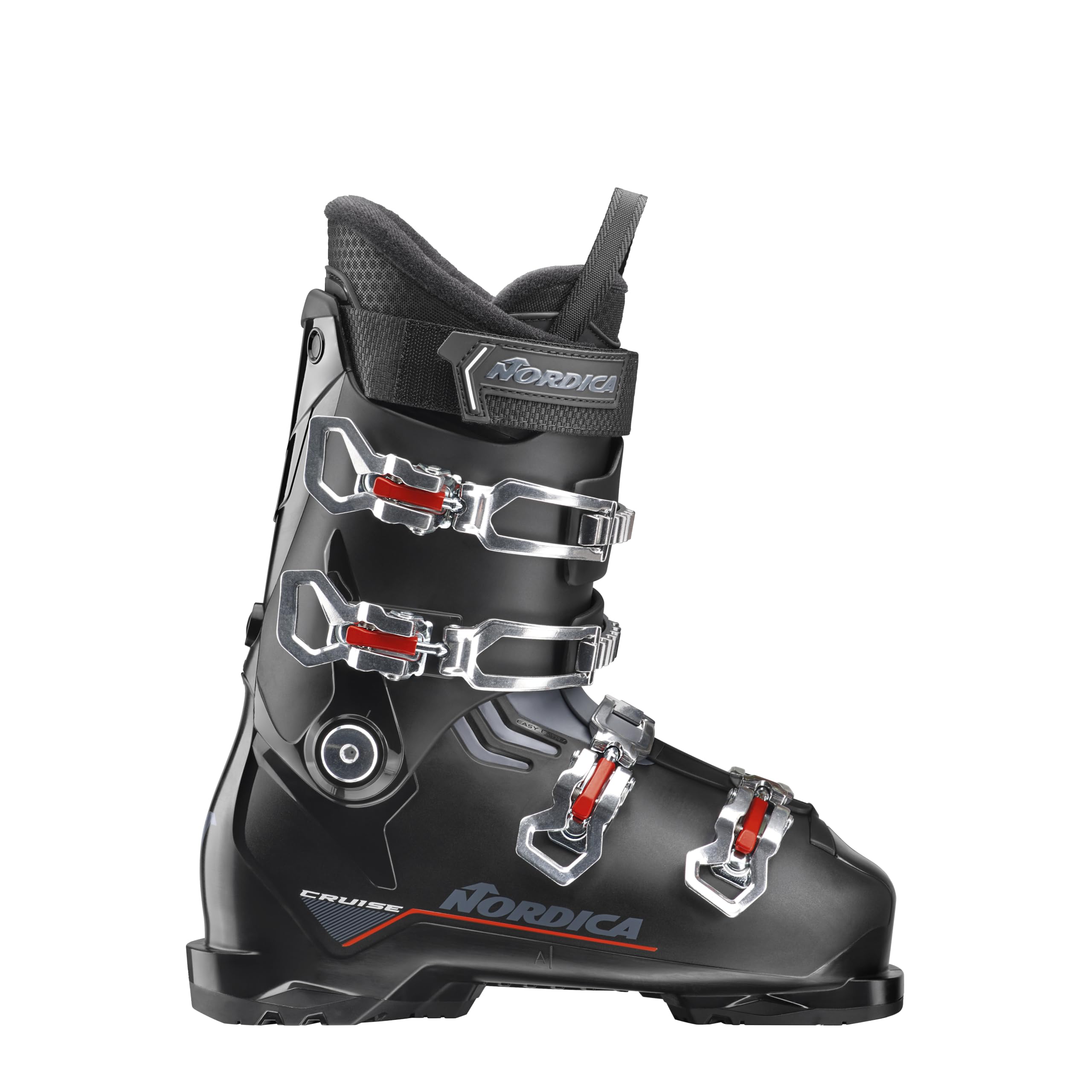
1. Nordica The Cruise Men’s Ski Boots
Our pick — 4.0+★ from 70+ verified ratings; the strongest balance of quality and price.
The 104 mm comfort shell that opens wide and forgives everything
If your foot measures a 29.5 but your old boots made you dread the lift line, this is where to start. Nordica builds The Cruise around a 104 mm last, which is the roomy end of the spectrum — think a boot that cradles a wider forefoot instead of pinching it. The dual soft-flap instep opens the throat of the boot unusually wide, so you step in and out without a wrestling match.
The Instep Volume Control is the detail that separates this from a plain comfort boot. It raises or lowers the boot board by +/- 4 mm, so you can fine-tune how much room sits over the top of your foot. A high instep gets relief, a low one gets a snugger hold, all with a quick adjustment rather than a new liner. Nordica also designed the shell for infrared fitting: heat the pressure point with an infrared lamp, press with the included suction method, and the shell re-shapes to your foot.
Where this boot earns its keep is the combination of easy entry and adjustability at a mid-range tier. It’s the pick for the skier who wants comfort first and doesn’t want to fight a stiff race shell every morning. The honest catch: this is a comfort-focused boot, so a hard-charging expert who wants a rigid, immediate flex will find it too soft and too roomy for precise edge control.
What makes it the top pick
- 104 mm last gives a wide, forgiving fit for a broader forefoot
- Dual soft-flap instep opens the throat wide for quick entry and exit
- Instep Volume Control adjusts the boot board by +/- 4 mm
- Infrared fitting system lets you customize pressure points at home
Where it gives ground
- Comfort-first flex is softer than a hard-charging expert wants
- The roomy 104 mm shell gives up some precision on aggressive turns
Reach for this if: you want a wide, adjustable comfort boot for all-day cruising and easy entry.
Look elsewhere if: you ski aggressively and need a stiff, tight shell for sharp edge control.
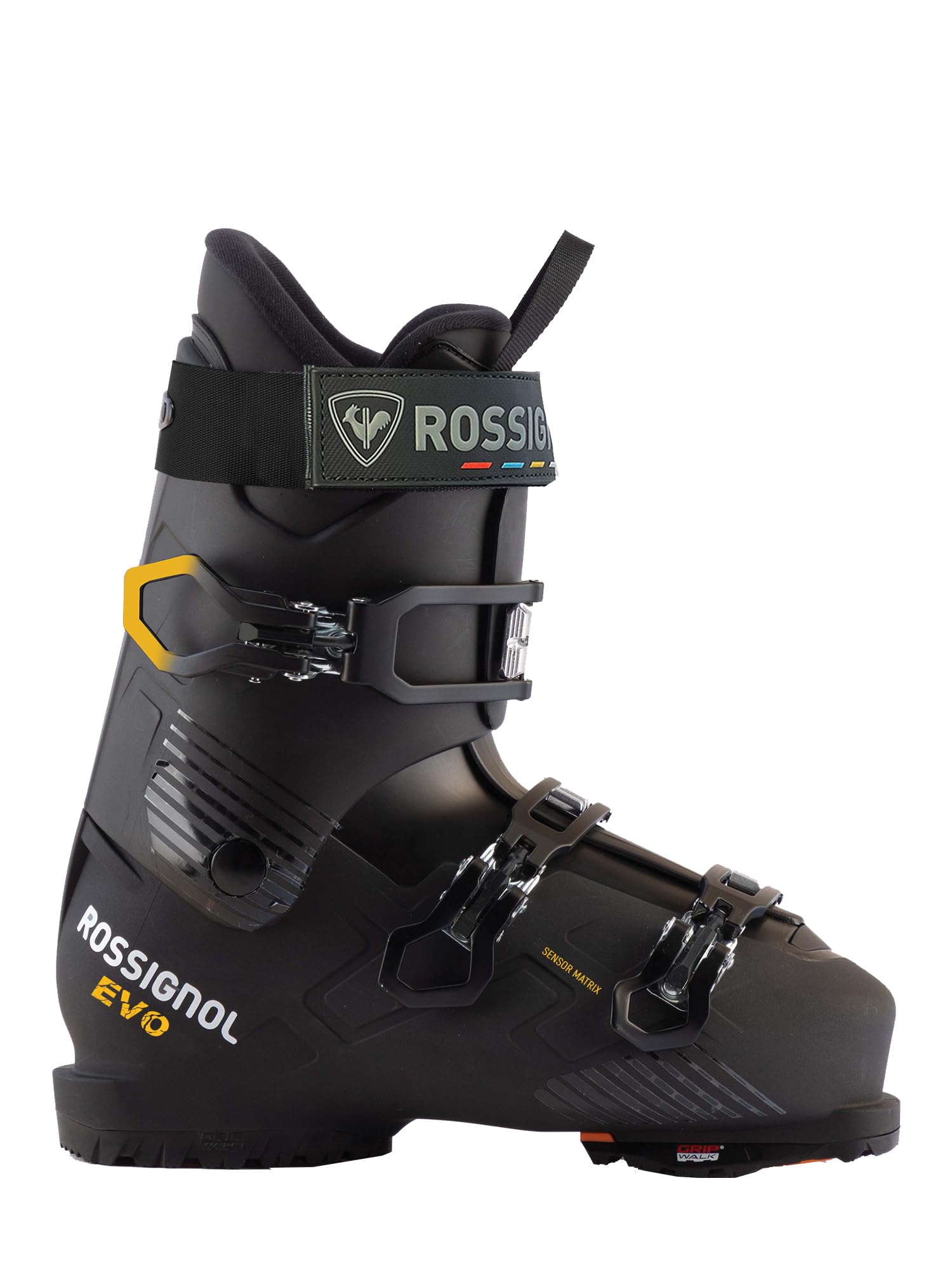
2. Rossignol Evo 70 – Ski Boots for Men
A relaxed 104 mm shell that steps in easy even when the plastic is cold
Your forefoot gets more room in the Evo 70, which runs a 104 mm last (the shell’s width across the forefoot). That is the same width as the Nordica above and 2 mm wider than the Atomic HAWX Magna’s 102 mm. That extra 2 mm is what makes it feel generous through the forefoot, toe box, and ankle. Rossignol shapes the overlap so the boot opens smoothly for entry and exit. That matters most on a freezing morning, when stiff plastic wants to stay shut.
A custom fit liner with softer padding through the ankle and instep lets the boot settle around your foot rather than press on it. The Sensor Matrix shell design trims weight and pushes energy straight to the ski, while the GRIPWALK-compatible sole accepts rubber-tread, rockered toes (sold separately) for better footing when you’re walking across the lodge floor. At 9.9 pounds the pair stays reasonable for a relaxed all-day boot.
Fit is what this boot is known for, and that’s exactly what a 29.5 buyer is hunting for — a shell that doesn’t punish a wider foot or a high instep. The trade-off is honest: the relaxed 104 mm last trades some edge-to-edge quickness for comfort, so a skier chasing high-speed precision may want something tighter.
The fit story: the 104 mm last gives a roomy forefoot and toe box, and the softer ankle and instep padding means no shin pressure on long days.
One thing to plan for: GRIPWALK soles are sold separately, so budget for that upgrade if you want the rockered rubber tread for walking.
The right call for: skiers who prioritize fit and easy on-off over a race-tight hold.
Think twice if: you want a narrow, locked-down shell for carving at speed.
3. FISCHER Rc One 8.5 Alpine Skis Boots
The lightest shell here, built for the skier who wants to feel the ski
At 8 pounds, the Rc One 8.5 is the featherweight of this group — and it’s a full 4.9 pounds lighter than the K2 BFC 80’s 10.6 pounds. That gap is the whole pitch: less boot swinging off your foot means quicker direction changes and less fatigue on a long descent. Fischer aims this one squarely at advanced and expert skiers chasing precision and responsiveness.
The shell uses advanced materials to sharpen power transfer, and the liner is customizable so you can dial in the fit around your specific pressure points. If you ski aggressively and want a boot that translates your input straight into the ski, this is the shape and the weight to do it. The medium-width shell keeps the hold tighter than the 104 mm comfort boots.
Here’s the honest limit: this is a lower-volume, performance-first boot, so a casual skier with a truly wide foot may find it unforgiving, and the stiffness isn’t aimed at beginners. It’s a specialist’s tool, not a slipper.
The weight wins: 8 pounds per pair keeps the swing weight low, so turns feel quicker and your legs last longer.
Know before you buy: the precision-first fit rewards aggressive technique and can feel tight on a wide foot.
Bold choice for: strong skiers who want a light, precise boot that responds instantly.
Pass on it if: you need a wide comfort fit or you’re still building confidence on the hill.
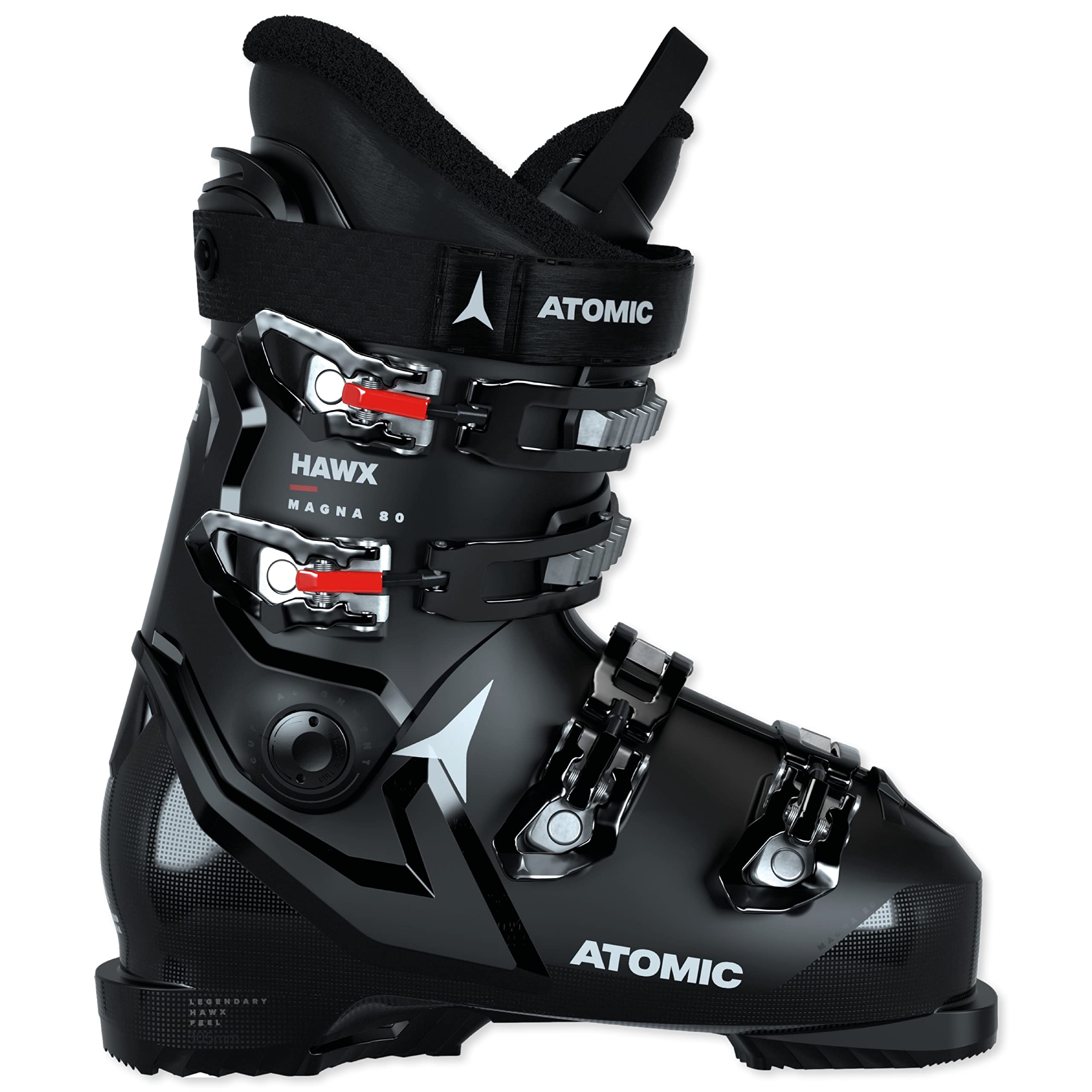
4. Atomic HAWX Magna 80 Men’s Ski Boots
The 102 mm shell that splits the difference between wide and locked-down
The HAWX Magna 80 hits a 102 mm last — just 2 mm narrower than the Rossignol Evo 70’s 104 mm, but enough to sharpen the hold through the forefoot. Atomic calls it a wide-fit shell for a reason: it still accommodates a broader foot, but the anatomical shape keeps you connected to the ski instead of floating in it.
The Energy Link construction is the feature to care about. It links the cuff and the shell so movement travels from your leg into the ski with more immediacy, which you feel as quicker, more controlled turns. Combine that with the mid flex and you get a boot that works for a developing skier without feeling like a noodle.
This is the smart middle ground for someone whose foot is too wide for a race shell but who doesn’t want a slipper. The honest caveat is that at 102 mm it will feel snug if your foot really is on the wide side — a true wide-foot skier should lean toward the 104 mm options instead.
Best matched to: a mid-width foot that wants a responsive, connected feel with some room.
Consider the wider shells if: 102 mm sounds tight for your forefoot — the 104 mm boots above give more space.
5. Head Edge LYT 80 HV All Mountain Ski Boots

A high-volume all-mountain boot that keeps the whole mountain in play
The Edge LYT 80 HV is Head’s high-volume shape, which is the shell to consider if your 29.5 foot needs room across the top and sides. It’s built as an all-mountain boot, so the design targets a do-it-all day — groomers, mixed snow, and everything between — rather than a single discipline.
The HV tag is the key detail: high-volume shells run wider than a standard last, which is exactly the forgiving feel a lot of skiers in this size are after. With a mid flex, it bends for a developing or moderate skier without folding under pressure. The package weight comes in at 3.67 kg, making it the lighter-shipping of the wide options against the Fischer’s 5.06 kg package.
This is a solid fit for a skier who tours the whole mountain and wants one boot to cover it. The catch is that a high-volume, mid-flex boot gives up the razor precision a dedicated expert wants on hardpack — it’s a versatility trade, not a flaw.
What it does well: a high-volume shell with a flexible mid flex, ready for varied terrain across the mountain.
The trade: all-mountain forgiveness means less edge-to-edge sharpness than a stiff performance shell.
Worth grabbing if: you want one high-volume boot for a mixed day across the mountain.
Skip the HV fit if: you chase hardpack precision and want a tight, stiff hold.
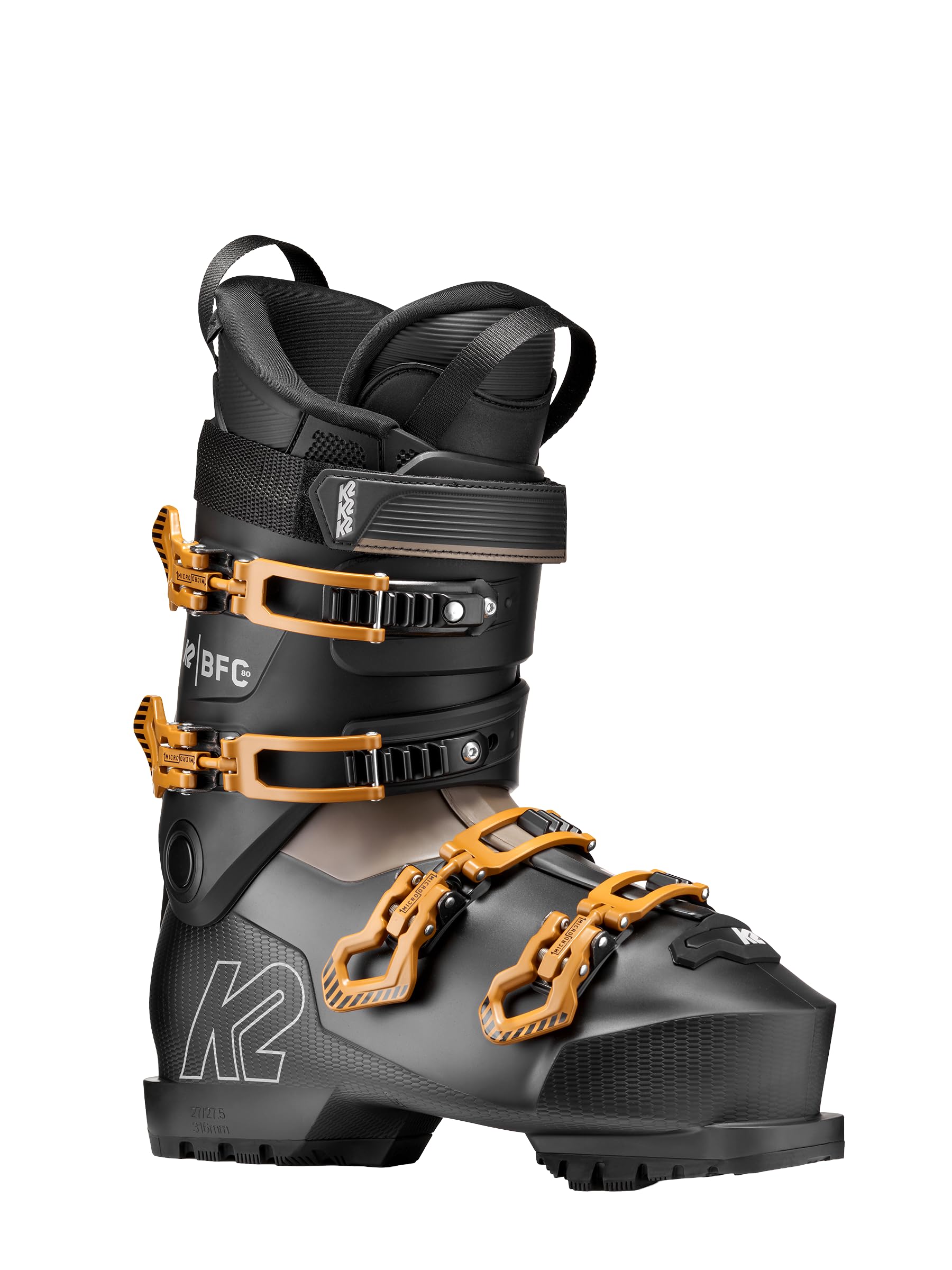
6. K2 BFC 80 Men’s Ski Boots
A soft-instep, GripWalk-ready boot that treats entry and walking as features
The BFC 80 leans into the parts of boot ownership that aren’t skiing. The Fastfit Instep uses softer TPU plastic in the instep area so you get quick, easy entry and exit — the kind of detail you notice every single time you clip in. The CushFit liner adds extra foam in key spots on top of the classic Cushfit fit, so comfort is dialed up from day one.
GripWalk outsoles come preinstalled, and they’re removable and interchangeable ISO 23223 alpine rockered soles. In plain terms, those give you better grip and comfort when you’re walking and standing around in the boots, without giving up power transmission or release between boot and binding on the hill. That makes the walk from the car to the base lodge a lot less awkward.
That extra heft is the price of the comfort liner and outsoles. If you ski a modest vertical and value the ease, that’s a fair trade. If you’re counting every ounce, the lighter boots above make more sense.
The comfort-first wins
- Fastfit Instep uses soft TPU for quick entry and exit
- CushFit liner adds foam in key areas for all-day comfort
- GripWalk ISO 23223 outsoles come preinstalled for better walking grip
What you give up
- At 10.6 pounds, it’s the heaviest boot here
- Comfort-forward flex isn’t tuned for aggressive, high-speed skiing
Made for: skiers who put comfort, easy entry, and walkable outsoles above saving grams.
Look past it if: low swing weight and a stiff flex top your priority list.
7. Nordica Sportmachine 3 90 All-Mountain Boots
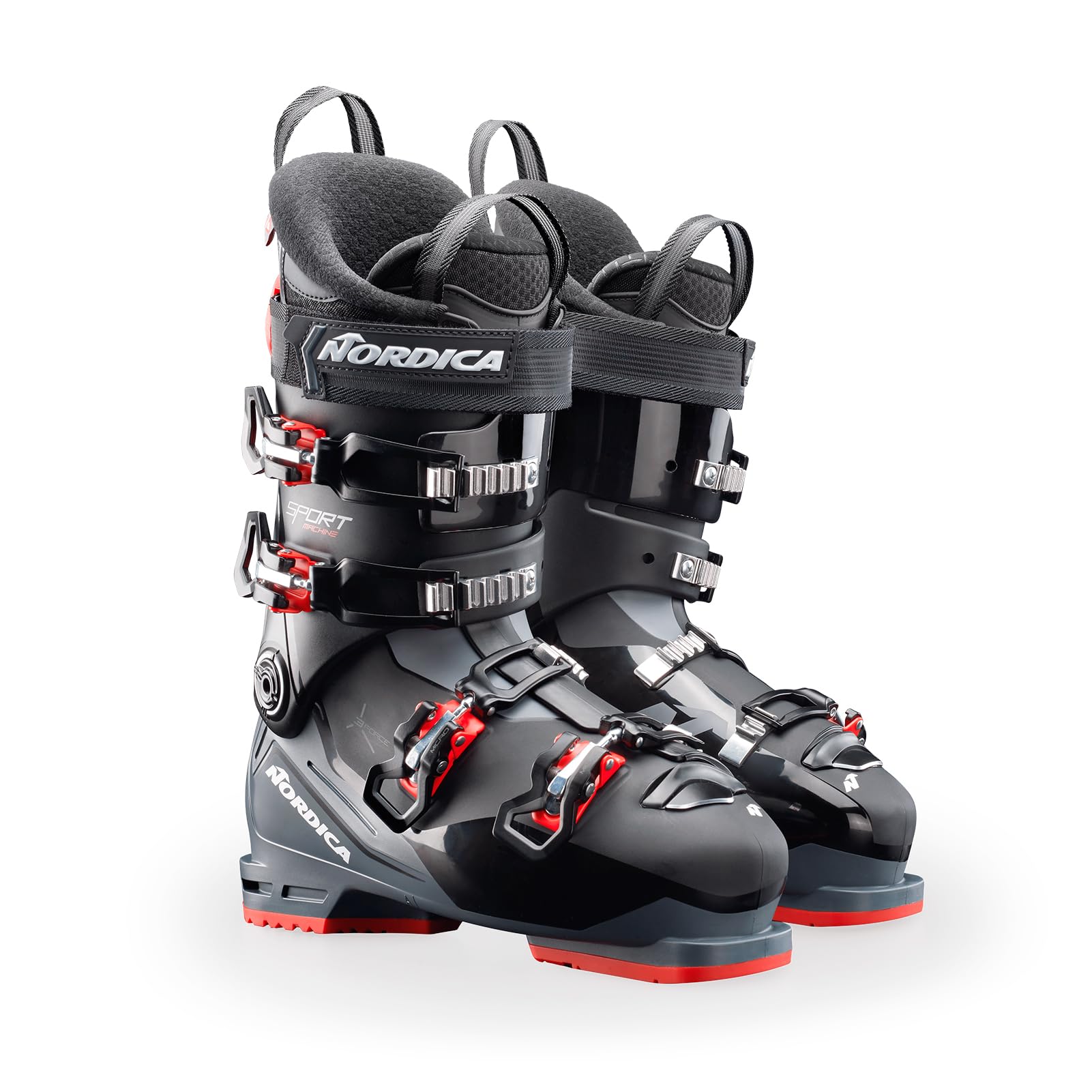
Built around insulation and a wide, forgiving shell for cold mountain days
If your feet go numb on the lift, the Sportmachine 3 90 is the boot in this group aimed at that problem. PrimaLoft insulation in the liner is water-resistant and keeps its insulating and lightweight properties, so cold and damp don’t strip the warmth out of it. A 3D Custom Cork Liner adds thermal insulation and stays dry, and the cork in the heel helps transmit your movements sideways for control.
The Tri Force Shell construction is Nordica’s way of maximizing energy transfer from your leg through the liner and shell. Combined with a wider fit and a softer shell, this is a boot tuned for forgiveness and flexibility rather than a rigid race feel. The Adjustable Cuff Profile lets you increase the cuff volume to fit your calf shape, and the Dual soft-flap instep opens the throat wide for easier entry.
A flex of 90 sits at the upper end of this lineup’s comfort range, so it adds stiffness over the 80-flex boots without turning into a race shell. It’s the premium cold-weather comfort pick. The trade-off: the warm, wide, softer build gives up the direct, precise feel a hard-charging expert prefers.
The cold-day answer: PrimaLoft insulation plus a dry cork liner target warmth and dryness on long lift rides.
Who it isn’t for: precision-chasing experts who want a stiff, tight, direct shell.
Ideal for: a skier who battles cold feet and wants a wide, warm, adjustable boot with a stiffer 90 flex.
You’ll want another pick if: warmth and room matter less to you than razor precision.
Know the Specs
Last Width (In mm)
The last width is the internal width of the shell at its widest point. A 104 mm last is a roomy, high-volume fit; a 102 mm last is slightly narrower and more snug. Choose wider for comfort with a broad foot, narrower for a tighter, more controlled hold.
Flex Rating
Flex is a rough stiffness scale. A lower number bends more easily, which suits lighter or more casual skiers. A higher number resists bending, transferring more force to the ski but demanding stronger technique. Match flex to your weight and skiing style, not to a friend’s preference.
Easy-Entry Shell
This is how wide the boot’s throat opens for your foot. A soft-flap instep uses softer plastic to open wide. A rear-entry design opens the entire back of the shell, sometimes up to 40 degrees, so your foot slides in. Both cut down on wrestling boots in the cold.
Boot Weight
Lighter boots swing off your foot with less effort, which means quicker turns and less leg fatigue. Heavier boots often carry more comfort features and padding. Weights here range from 8 pounds up to 10.6 pounds per pair, so weigh that feel against the comfort you want.
Common Questions
Is a 29.5 the same as a 29.0 ski boot shell?
What last width should I pick for a 29.5 foot?
Do I need a rear-entry boot for easy on and off?
What does the flex number actually change?
Are GripWalk soles worth getting on a ski boot?
How much does boot weight really affect skiing?
Can I customize a ski boot’s pressure points at home?
Is a four-buckle boot better than a rear-entry for control?
What is the difference between a 104 mm and 102 mm last in practice?
The Bottom Line
For most skiers shopping in this size, ski boots in size 29.5 come down to matching your foot to the right last and flex. The Nordica The Cruise does that best for a wide, comfort-first foot, with its 104 mm shell and +/- 4 mm instep adjustment (a dial that raises or lowers the shell over the top of your foot). If fit and easy on-off in the cold are your top priorities, reach for the Rossignol Evo 70. And if you want a precision-first, light shell for aggressive skiing, grab the Fischer Rc One 8.5.
How we choose
We do not accept paid placement. Every pick is matched to a real buyer and a real use-case; we do not hands-on test units.
Sources
Specifications: manufacturer listings and product documentation. Review insights: verified customer reviews, as of November 2026. Pricing: not shown on this page (it changes often); check the current price via the retailer link.
As an Amazon Associate, Tactical Gear Guy earns from qualifying purchases. This does not affect which products we feature.