Specs are compiled from manufacturer listings and verified buyer reviews and can change over time — please confirm the key details on the product page before buying.
Here is the short answer to the question you are actually asking: buy on R-value and packed weight, not on how thick a pad looks in a photo. A pad that feels wonderfully plush at the store can still dump your body heat straight into cold ground by 2 a.m. The eight pads below cover the whole range, from a foam workhorse that never deflates to a 13 oz backpacking pad that packs down to the size of a water bottle.
This guide is built by comparing the manufacturers’ published specifications and the patterns across verified customer reviews, so you get each pick’s real strengths and trade-offs instead of marketing spin.
Every pad here is judged on the same three things: insulation, packed size, and how comfortable you actually are at three in the morning. The best top rated sleeping pads get the R-value honest and the weight down, and these eight do exactly that.
Top Picks

How To Choose The Best Top Rated Sleeping Pads
The mistake most first-time buyers make is shopping by thickness. A tall inflated pad feels amazing in the store and still lets ground cold through if it has no insulation inside. Choose in this order instead: insulation first, packed size second, comfort third.
Start with the R-value, not the thickness
The R-value is a number that measures how well a pad resists heat escaping through it. Higher is warmer, and there is no unit attached — it is just a rating. A pad rated around 2 suits warm-weather summer camping. Anything in the 4 to 6 range covers three-season use and shoulder-season frost. A pad rated in the high range or at 9 is built for genuine cold, including snow.
Then decide inflatable versus self-inflating foam
An inflatable pad is an air chamber you blow up, so it packs small but depends on the valve holding all night. A self-inflating pad has open-cell foam inside that springs back and pulls air in when you open the valve, so it never fully deflates on you. Foam pads are heavier and bulkier but immune to the slow leak that ruins an air pad.
Match packed size to how you travel
If you carry the pad on your back, packed size and weight drive the decision. If it rides in a car boot to a campsite, weight matters far less than comfort and thickness. Be honest about which camper you are: a 13 oz pad that disappears into a backpack often feels thin on a car-camping weekend.
Side-by-Side Comparison
| Model | Best For | R-Value | Thickness | Weight | Amazon |
|---|---|---|---|---|---|
| NEMO Switchback Foam★ Best Overall | Bombproof foam simplicity | 2 | 5.5″ | 0.42 kg | Amazon |
| TREKOLOGY 4″ R7.2Budget Four-Season | Budget four-season air pad | 7.2 | 4″ | 900 g | Amazon |
| Hikenture R6.2Packs Down Small | Light pack, warm sleeper | 6.2 | 3.2″ | 1.5 lb | Amazon |
| Elegear 4″ 9 R-Value | Serious cold-weather camping | 9 | 4″ | 2.2 lb | Amazon |
| Sea to Summit Camp Plus SI | Self-inflating all-rounder | 4.3 | 2.6″ | 3.2 lb | Amazon |
| Big Agnes Divide | Ultralight insulated backpacking | 4.0 | 3.5″ | 23 oz | Amazon |
| Therm-a-Rest BaseCamp | Frontcountry car camping luxury | 6 | 2″ | 2 lb 8 oz | Amazon |
| Therm-a-Rest NeoAir Xlite NXT | Ultralight backpacking warmth | 4.5 | 3″ | 13 oz | Amazon |
Detailed Reviews
1. NEMO Equipment Switchback Foam Sleeping Pad
Our pick — 4.5+★ from 650+ verified ratings; the strongest balance of quality and price.
A closed-cell foam pad with no air chamber to puncture, backed by 25 years of campers who stopped worrying about leaks.
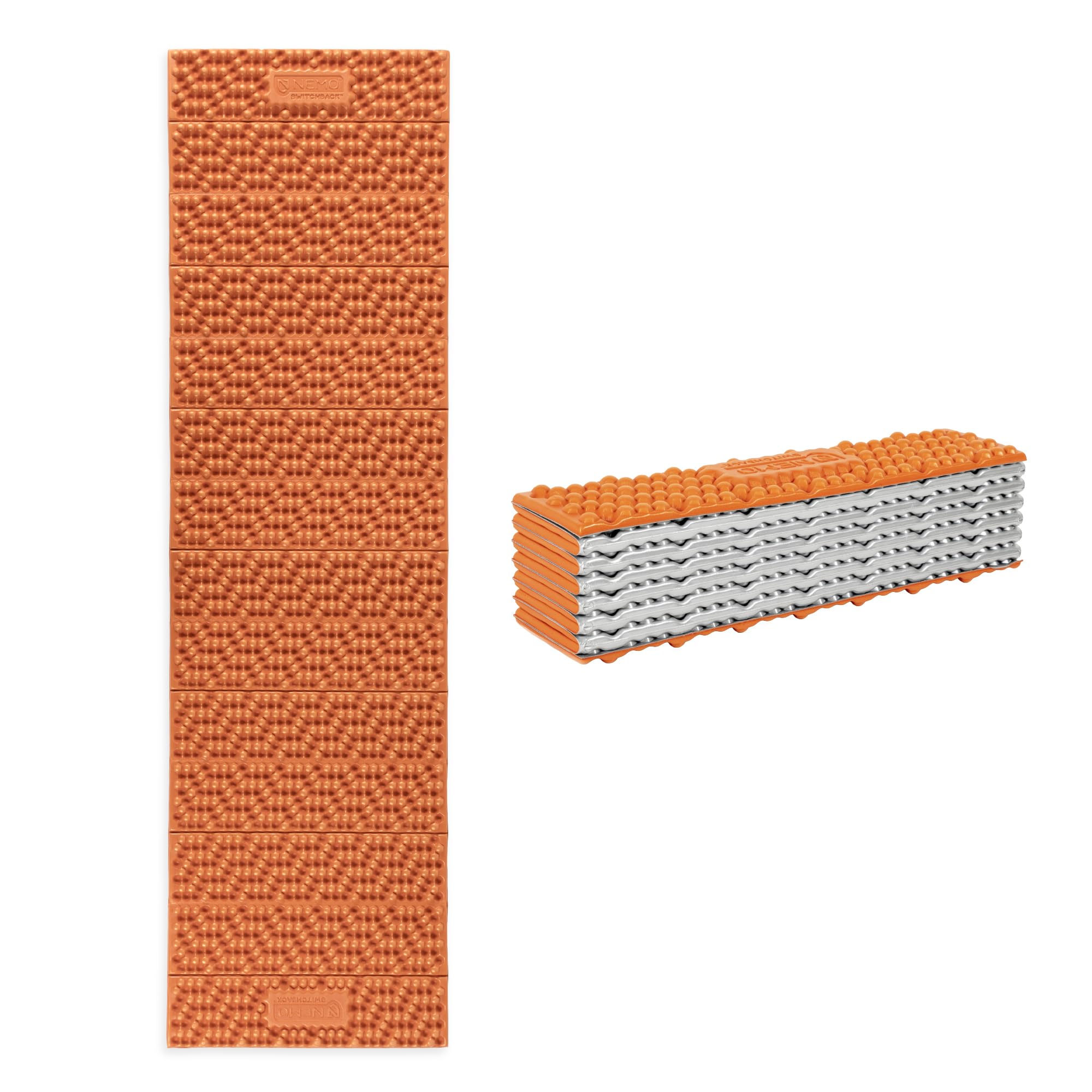
If your worst camping nightmare is waking up at 2 a.m. on a flat, cold pad with a mystery puncture, this is the pick that removes that fear completely. It is a closed-cell foam pad, meaning there is no air chamber to puncture — the support is solid foam, so a stray branch or a rough tent floor cannot end your night. It weighs 0.42 kg and its defining trick is the hexagonal nesting pattern, a honeycomb of tall and short foam nodes that lets the thick sections sit tight against each other when folded, so it packs smaller than a flat slab of the same comfort level would.
What wins people over is the build. The phrase that turns up again and again in the reviews is that it simply never bottoms out, and the folding and storing routine earns steady praise too. The taller nodes also create space for your sleeping bag insulation to stay uncompressed, so the bag can trap warmth around you instead of being squashed flat under your hips. A metallized thermal reflective film bounces body heat back at you, and a protective film keeps that coating from scuffing off. Its R-value is 2, which is warm-weather territory — think summer and mild shoulder seasons, not frozen ground.
The trade-off is honest and worth naming. At 20″L x 5″W x 5.5″Th as a compact folded bundle, this is not a pad you strap to a fastpack for a three-day traverse — foam has bulk that air pads do not. Comfort is the other divider; it is a firmer, more supportive surface than a plush air mattress, which some bodies love and others find too firm. It is also a 4.5+ star item across hundreds of owners, which tells you most people are happy with that firmness trade.
Where the Switchback shines
- Zero puncture risk — closed-cell foam has no air chamber to fail
- Hexagonal node pattern packs tighter than a flat foam slab of similar comfort
- Taller nodes leave sleeping-bag insulation uncompressed so it traps warmth
- Metallized reflective film protected by a durable outer layer
- 0.42 kg is easy to carry for a foam pad of this footprint
Where it asks you to compromise
- R-value of 2 is a warm-weather pad, not a snow pad
- Foam bulk means it rides outside a pack rather than inside one
- Firmer surface than a plush air mattress — not everyone’s ideal feel
Soundest bet for: anyone who wants a pad that will still work after a decade of rough treatment, and who camps in summer warmth rather than deep cold.
Look elsewhere if: you need serious cold-weather insulation or a packable pad for long-distance backpacking.
2. TREKOLOGY Sleeping Pad
A 7.2 R-value air pad at a price that undercuts most three-season foam mats.
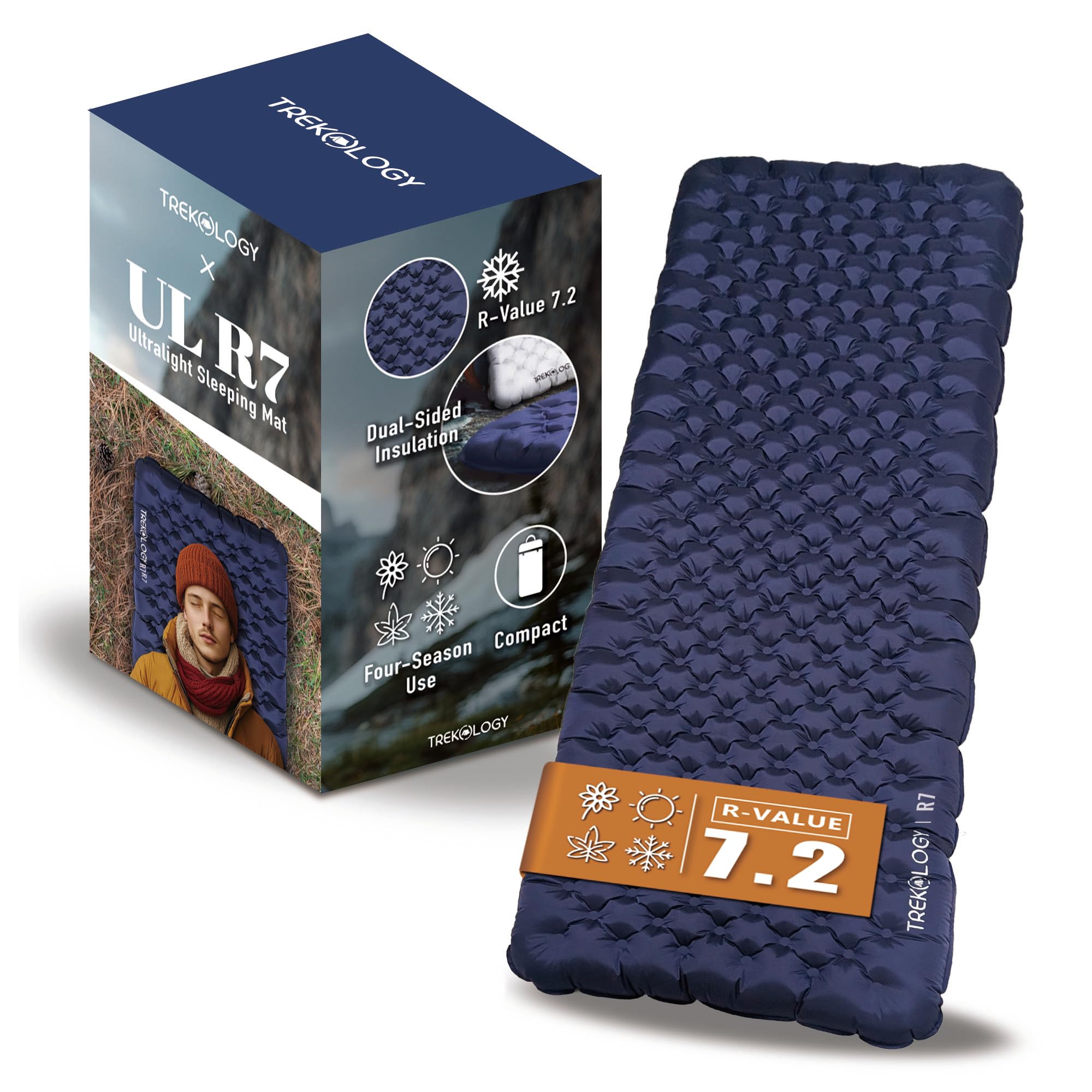
Here is the number that separates this pad from its price peers: an R-value of 7.2, the measure of how hard it fights ground chill, and it carries SGS certification — independent lab testing rather than a self-declared figure. That number sits far above the NEMO Switchback’s rating of 2, so on a frosty October night these two pads are not in the same conversation. The 4-inch thickness is delivered through insulating air chambers that spread your body weight out and cut heat loss to the ground, and the manufacturer lists the whole thing at 900 g with a packed size near a water bottle.
Owners describe it as a warm sleeper’s pad, with use well below freezing coming up repeatedly. The overall look and feel of the mat is what draws the most positive attention, and warmth is right behind it. The 40D ripstop nylon with a TPU coating is the reason it shrugs off moisture and wipes clean, and the anti-leak valve is designed to seal firmly after you inflate. Capacity is generous too — the maker rates it to 330 lbs (150 kg), which is not something every ultralight air pad can claim.
Be clear-eyed about inflation. This pad inflates by mouth or with a separate pump bag that is not included, and there is no built-in pump. Reviews split here: plenty of owners find it easy to inflate and holding firm all night, while some report it slowly deflating and rolling up fast. The weight split is similar — some call it fairly light, others wish it were lighter. A 4.0+ star item across hundreds of buyers, it is a strong value that rewards a careful first inflation check at home.
Warmth per dollar: a 7.2 R-value and a 330 lb capacity at this tier is the value story of the list, and the anti-leak valve plus TPU coating back it up.
Check before you go: inflate it fully at home first and confirm it holds overnight — air retention is the one thing buyers are divided on, and a pre-trip check answers the question before the trail does.
Grab it if: you want genuine cold-weather warmth without paying premium prices, and you don’t mind bringing a pump bag.
Think twice if: you expect a built-in pump or you want a pad that survives an unverified leak without a home test first.
3. Hikenture R6.2 Insulated Sleeping Pad
A 1.5 lb air pad with a 6.2 R-value that out-warms foam mats twice its weight.
This is the pad for the camper who refuses to choose between a light pack and a warm night. It weighs 1.5 lb and rated an R-value of 6.2 under ASTM F3340-22, the standard lab method for testing a pad’s insulation. The insulation comes from an aluminum film construction that reflects body heat back at you rather than letting it leak into the ground. Compare it to the Elegear’s 4-inch body: at 3.2 inches the Hikenture gives up thickness, but it also gives up weight and packed bulk to get there.
What makes it easy to live with is the inflation setup. The storage bag pulls double duty as a 40L pump sack, a large fabric bag you wave to push air into the pad, so the maker says you fill it in just 3 pumps instead of huffing into a valve. The airbag structure underneath spreads pressure evenly so you don’t bottom out, whether you’re sitting up or lying flat. Air retention is the thing that earns the most praise — the pad holds firm — and build quality follows close behind. It also ships with two repair patches, which is the kind of small inclusion that saves a trip.
The one honest wrinkle is noise. Opinions split sharply: some owners find it quiet, others find the fabric-and-film surface loud when they shift position in the night. That is a real consideration for light sleepers or anyone sharing a small tent. This is a 4.0+ star pick with a 12-month warranty and a TPU liner the maker positions as an environmentally friendlier material, and it sits comfortably in the light-and-warm category.
The weight-to-warmth read: a 6.2 R-value in a 1.5 lb pad is the sweet combination backpackers hunt for, and the pump sack makes setup painless after a long day.
A light-sleeper caveat: the reflective surface has a rustle that some people notice — pitch it on a closed-cell foam layer or a quieter site if you are a restless sleeper.
Made for: backpackers who want three-season insulation without carrying a heavyweight foam mat.
Not the one for: anyone who needs silent gear in a shared tent, or who wants a pad that inflates without a pump sack.
4. Elegear 4″ Thick Sleeping Pad with 9 R-Value, Single
The warmest pad on this list: a nine-layer insulation stack rated to 9 R-value and tested to ASTM F3340-22.
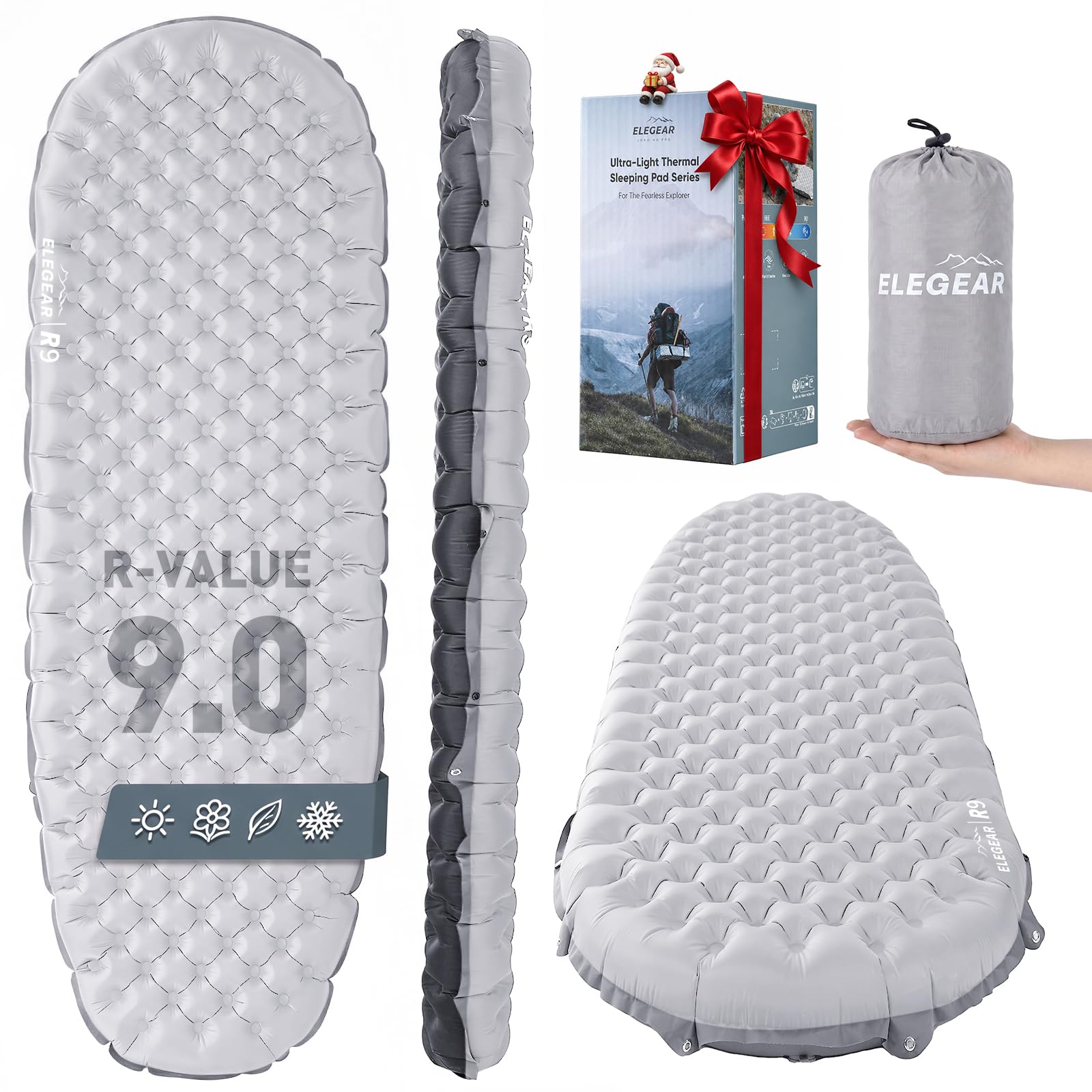
If you sleep in real cold — snowy mountains, high country, deserts that swing from hot days to freezing nights — the number that matters here is 9. That is the R-value, independently SGS tested and ASTM F3340-22 certified, and it tops every other pad on this list by a wide margin. It sits a full 4.5 times higher than the NEMO Switchback’s rating of 2, which tells you how differently these two pads behave once the sun goes down. The nine-layer insulation system is what earns that number, and the maker rates it for conditions down to -40°C.
Comfort is not an afterthought. At a full 4 inches thick, this pad is 25% thicker than the 3.2-inch Hikenture above, and the mummy shape with densely packed support cells spreads your weight so your hips and shoulders don’t sink to the ground. It weighs 2.2 lbs and packs small enough to earn its place in a hiking pack; the included pump sack fills it in 4 to 6 pumps without a built-in pump. The 20D tear-resistant nylon with a reinforced TPU layer holds moisture out and shrugs off rock and gravel, and every unit ships with a repair patch and storage bag.
Owners consistently find it plush and insulated — one common account is that you can feel your own body heat building in the mat. Weight is the honest caveat here: at 2.2 lbs it is heavier than the ultralight picks, and the reviews show that is the one spec people notice. It is a 4.0+ star pad across a hundred-plus buyers, so most owners accept the weight as the price of that warmth.
Why cold campers pick it
- 9 R-value takes the cold-weather crown of this list
- Full 4-inch thickness with a mummy shape for all-night support
- Nine-layer insulation rated for conditions down to -40°C
- 20D ripstop nylon with a reinforced waterproof TPU layer
- Pump sack fills it in 4 to 6 pumps, no built-in pump needed
The honest trade
- 2.2 lbs is heavier than the ultralight options here
- All that insulation adds bulk, so pack space is a consideration
- Premium warmth commands a premium placement in the range
Best for: four-season campers, high-altitude trips, and anyone who would rather carry a little extra weight than spend a night shivering.
Skip if: every ounce counts and you only camp in mild weather.
5. Sea to Summit Camp Plus SI Sleeping Mat, Rectangular/Regular
A self-inflating foam mat with a 4.3 R-value for four-season use at just 2.6 inches thick.
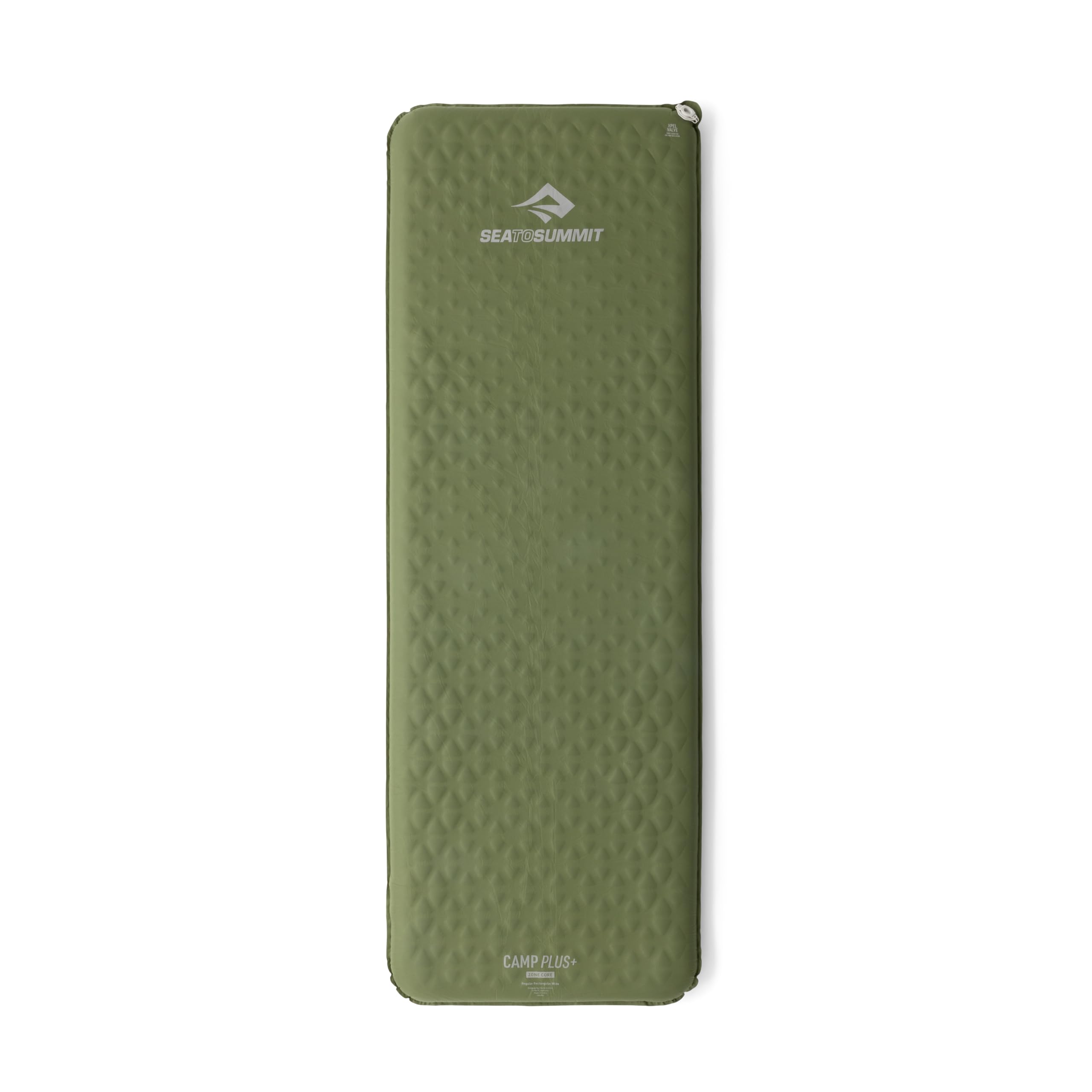
For the camper who likes the reliability of foam but wants more comfort than a thin closed-cell mat, this is the middle ground. It is a self-inflating foam pad — open the valve and the foam springs back, pulling air in with it, so you’re doing far less work with your lungs than on a pure air pad. Its 4.3 R-value insulates all but the coldest ground, which makes it a genuine four-season choice, and the coring technique keeps the body-contact areas warm and supported while shaving bulk out of the sections that don’t need it.
The detail that separates it from the pack is the valve. This is a multi-function reversible valve that handles fast inflation, one-way deflation for quick packup, and fine-tuning of air pressure so you can dial in firmness instead of guessing. The 75D polyester face fabric is the reason it keeps feeling like a real bed year after year rather than wearing through. It measures 72 x 25.2 inches in the regular rectangular size, weighs 3.2 pounds, and comes with a stuff sack, a field repair kit, and PillowLock patches for clipping a Sea to Summit pillow to the mat.
Quality and comfort are the two things that come up most in the reviews, and a lot of owners call it the pad that finally made sleeping on cold ground feel like sleeping. The size and weight split opinions: some find it bulky, others appreciate how compact the 13 x 7.5-inch packed size is. Self-inflation is likewise mixed — some say it works well, others report it doesn’t inflate properly, so give it a top-up by breath. It is a 4.5+ star mat across a large body of owners, which says the system works for most.
The valve is the star: one-way deflation and pressure tuning in a single reversible valve is the kind of small engineering detail that saves frustration at dusk.
Mixed on self-inflation: expect to add a few breaths of your own on arrival — the foam does most of the work, but not all of it.
Reach for this if: you want a durable self-inflating mat with real cold-weather insulation and a comfortable rectangular footprint.
Look elsewhere if: you’re backpacking long distances — 3.2 pounds and that packed size are a car-camping load, not a fastpacking one.
6. Big Agnes Divide Insulated Air Chamber Sleeping Pad, Regular

Twenty-three ounces, a 4.0 R-value, and a lifetime warranty to back it up.
The Divide carries a 4.0 R-value, the mark of a pad built for three-season use, and it does it at 23 oz with a packed size of just 5″ x 8″. Those two figures are why it belongs in a backpacker’s kit — a warm-three-season pad that rolls up roughly the size of a shoe. Therm-a-Rest pads get all the ultralight attention, but this Big Agnes checks in lighter on warmth-per-ounce than the bulkier options on this list, and the THERMOLITE insulation works with a heat-reflective film to bounce your body heat back at you.
The design detail worth knowing is the proprietary I-Beam construction: internal beams keep the pad stable instead of letting it wobble like a waterbed when you shift. The pad is 3.25 inches thick with 3.5-inch outer chambers that cradle you toward the middle. High-volume valves with micro-adjustments handle fast inflation and deflation, and the included inflation sack saves you from a lung workout. The nylon ripstop shell is recycled, with aviation-grade TPU lamination for weld strength, and every pad is individually inflated and tested at the factory with a lifetime warranty against manufacturing defect.
The reviews back the spec sheet: owners find it comfortable, easy to inflate and deflate, and warm down to around 30°F. The size split is the one thing to weigh — some call it perfect for two people, others find it a little bigger than they need, so measure your tent floor. With a 4.5+ star standing across roughly a hundred owners, it is the light backpacker’s pad that doesn’t skimp on stability.
What it does well
- 23 oz and a 5″ x 8″ packed size for real ultralight packability
- I-Beam construction keeps the surface stable, not wobbly
- Thermolite insulation plus heat-reflective film traps warmth
- Inflation sack included; micro-adjust valves tune firmness
- Lifetime warranty against manufacturing or material defect
What to keep in mind
- 4.0 R-value is a three-season rating for cold sleepers — pair it with a foam layer for frozen ground
- The regular size may feel large for a solo lightweight kit — check tent fit first
The obvious choice for: weight-conscious backpackers who still want insulated comfort and a brand warranty behind the pad.
Pass on it if: you only camp in a car or you need a snow-ready R-value for genuinely freezing conditions.
7. Therm-a-Rest BaseCamp Self-Inflating Camping Sleeping Pad

A self-inflating foam pad rated to a 6 R-value, built for the campsite you drive to.
This is a luxury camper’s pad, not a trailhead one. The BaseCamp carries a 6 R-value, enough for year-round insulation, so it holds up through cold nights without you stacking an extra blanket underneath. The thick thermal foam gives you a warm, comfy surface, and because it is self-inflating, the foam does the pumping when you open the valve. Its WingLock valve is the brand’s headline feature: the maker rates it as inflating 3 times faster than a classic valve, with matching fast deflation, so you’re not standing over the pad squeezing a bag for ten minutes.
Owners love the quality and comfort — the recurring picture is the sense of sleeping on a real bed on a cot. The 72x20x2-inch regular size and 2-pounds-8-ounces weight are a car-camping load that you set up once at camp and wander away from. The stuff sack uses a PFAS-free DWR coating so it still keeps your gear dry without the coatings concern. It’s a 4.0+ star pad from a hundred-plus reviews, and it lives up to its frontcountry-luxury billing.
Here’s the honest part. It’s too big for long backpacking trips, and some owners find the self-inflation needs topping off by breath to get it fully firm — inflate it, leave it a couple of hours before first use for the foam to reach its full loft. Portability is a mixed bag by design, so treat it as the home base for car trips and not the packable mat for a ridge line.
The setup is the reason to buy: a self-inflating 6 R-value pad with a WingLock valve gets you a warm, plush bed at camp with almost no effort.
The bulk is the reason to pause: at 2 pounds 8 ounces and 21×7 inches rolled, it belongs beside a car, not on your back on a multi-day trek.
For you if: you’re a car camper who wants a warm, thick, low-effort bed at a base camp.
Not it if: you’re counting every pound for a backpacking trip.
8. Therm-a-Rest NeoAir Xlite NXT Ultralight Sleeping Pad

Thirteen ounces, a 4.5 R-value, and a pack-down roughly the size of a 1-liter bottle.
Backpackers pay attention to this pad for one reason: it weighs 13 oz (370 g) in size Regular and rolls up as small as a conventional 1-liter bottle. That is the lightest pad on this entire list, and it carries a 4.5 R-value — the insulation number — that beats the Big Agnes Divide’s 4.0. The foam-free NeoAir design gets there with Reflective ThermaCapture technology, which traps radiant heat, plus a Triangular Core Matrix internal structure that cuts convective heat loss, so you stay warm on a cold floor without carrying a heavy foam core. The 3-inch profile with its baffled internal structure gives you a stable platform rather than a wobbly air sack.
It sets up fast, thanks to the WingLock valve for easy inflation and lightning-fast deflation, and it includes a pump sack, stuff sack, and patch kit. The regular wide measures 25 x 72 inches, so you get a little more sleeping real estate than a standard 20-inch pad. Owners consistently call it top-notch on quality and comfortable for its thickness, and warmth and performance hold up in their accounts, with the pump sack making inflation painless.
The caveat built into that extreme light weight is durability-minded handling. A 30D ripstop nylon shell is thin, so pitch it on clear ground and keep it away from sharp rocks and stakes. Its size draws both praise and a few wish-for-smaller comments, and value is split — you are paying a premium for the lightest packable warmth on the list, and the 16 oz figure for the regular wide tells you where the savings go. If you want a 13 oz pad for long-distance trails, this is the one, and the pump sack, patch kit, and US build round out the package.
Choose this if: every ounce counts and you want a 13 oz pad with a 4.5 R-value for long-distance backpacking.
Consider otherwise if: you want a bombproof foam pad for rocky, rough pitches or your budget is the deciding factor.
Know the Specs
R-Value: The Warmth Number
The R-value measures how well a pad resists heat passing through it — higher is warmer, with no unit attached. Around 2 suits summer warmth, the 4 to 6 band covers three-season and shoulder-season frost, and a pad rating near 9 is built for genuine cold and snow. Check it before thickness, packed size, or price.
Inflatable vs. Self-Inflating Foam
An inflatable pad is an air chamber you fill with breath or a pump sack — it packs small but depends on the valve holding all night. A self-inflating pad has open-cell foam inside that rebounds and pulls air in when you open the valve, so it is heavier and bulkier but far less likely to fail on you in the night.
Common Questions
What R-value do I need for cold-weather camping?
Is an air pad or a self-inflating foam pad better for side sleepers?
How small does a backpacking sleeping pad pack down?
Do I need a pump sack to inflate these pads?
How much does a top rated sleeping pad weigh?
Will these sleeping pads fit in a two-person tent?
How do I stop an air pad from deflating overnight?
Is a higher R-value worth the extra weight?
Can I use a sleeping pad on hard or rocky ground?
Do these sleeping pads come with a warranty?
The Bottom Line
For most campers, the top rated sleeping pads winner is the NEMO Switchback Foam Sleeping Pad because it pairs a tried-and-true closed-cell foam build with a hexagonal nesting pattern that packs tighter and a reflective film that bounces body heat back — the crowd favorite and the one pad here that can’t spring a leak. If you need serious cold-weather insulation in a packable air pad, go with the Elegear 4″ 9 R-Value or the lighter Hikenture R6.2. And if you count every ounce on a long trail, the Therm-a-Rest NeoAir Xlite NXT at 13 oz with a 4.5 R-value is the one to reach for.
How we choose
We do not accept paid placement. Every pick is matched to a real buyer and a real use-case; we do not hands-on test units.
Sources
Specifications: manufacturer listings and product documentation. Review insights: verified customer reviews, as of November 2026. Pricing: not shown on this page (it changes often); check the current price via the retailer link.
As an Amazon Associate, Tactical Gear Guy earns from qualifying purchases. This does not affect which products we feature.