Specs are compiled from manufacturer listings and verified buyer reviews and can change over time — please confirm the key details on the product page before buying.
Most people buy a roller, use it twice, and let it collect dust in a closet corner. The reason is rarely laziness — it is that the roller was the wrong density, the wrong shape, or the wrong type of pressure for the muscle that actually hurts. A rock-hard roller is agony on a sore lower back. A soft one does nothing for a knotted quad. This list ranks nine rollers, sticks, wheels, and guns by the one job each does better than the rest.
This guide is built by comparing the manufacturers’ published specifications and the patterns across verified customer reviews, so you get each pick’s real strengths and trade-offs instead of marketing spin.
Some work best lying on the floor, others standing up, and a few reach spots no roller can touch. The picks below split cleanly along those lines. Here is the honest shortlist of stretching and recovery equipment, sorted by the muscle each tool reaches best.
Top Picks


How To Choose The Best Stretching and Recovery Equipment
The first decision is not which brand to buy, but which body part you need to work on. It is which body part you actually need to work on, because a tool built for a thigh will feel useless on a shoulder blade.
Match the density to the tissue
Foam density (how hard the surface pushes back) decides whether a roller feels like relief or like punishment. Extra-firm surfaces dig into thick muscle like quads and IT bands. Softer foam is far kinder over a spine, a sensitive hip, or a bony area after injury. Buy the density that matches your most-complained-about muscle group, not the hardest roller on the shelf.
Round, half-round, or not a roller at all
A full round roller rolls in every direction, so it works the back, legs, and hips. A half round sits flat on the floor and stays put, which makes it steadier for balance and ankle work. But some tight spots — the inner thigh, the psoas deep in the hip — are almost impossible to reach lying on a tube. That is where a wheel, a stick, or a stand-up frame earns its keep.
Length and diameter change where it fits
A longer roller covers more of your spine in one pass and stays under you as you roll. A shorter one travels well and targets calves, arms, and feet. Diameter matters too: a bigger wheel gives gentler, broader pressure, while a smaller one concentrates force into a tighter spot. Measure your gym bag and the body area you are treating before you commit to a length and diameter.
Side-by-Side Comparison
| Model | Best For | Tool Type | Firmness | Size | Amazon |
|---|---|---|---|---|---|
| TRIGGERPOINT GRID Foam Roller★ Best Overall | All-round daily rolling | Multi-density foam roller | Extra firm | 13 in | Amazon |
| 5 in 1 Foam Roller SetBest All-in-One Kit | One kit for the whole body | Roller + stick + ball + band | High density | 13 in roller | Amazon |
| Mobility Mentor Bamboo Yoga StickBest for Mobility | Active mobility and posture | Bamboo stretch stick | Rigid bamboo | 58 in | Amazon |
| Soft TPE Foam Roller | Sensitive backs and rehab | Soft full-round roller | Soft TPE | 18 in | Amazon |
| Yoga Wheel Set of 3+1 | Spine and backbending | Four padded wheels | 10MM TPE padding | 13 in / 10 in / 6 in | Amazon |
| Wave Psoas Muscle Release Tool | Hip flexors and lower back | Floor release board | Adjustable heads | 17.28 in board | Amazon |
| Lifepro Sonic Massage Gun | Fast post-workout relief | Percussion massager | 6 speeds | 2.2 lb | Amazon |
| RAD 2-in-1 Muscle Flushing Kit | IT bands and full-body flush | Roller + roller stick | Extra firm EVA | 22 in roller | Amazon |
| DoubleUP Roller D5 | Standing deep-tissue control | Stand-up dual-roller frame | 5 swappable rollers | Metal frame | Amazon |
Detailed Reviews
1. TRIGGERPOINT GRID Foam Roller, 13-Inch
Our pick — 4.5+★ from 8,000+ verified ratings; the strongest balance of quality and price.
The one textured roller that treats your back like a set of separate muscles.
What you get here is a 13-inch roller with a patented multi-density surface built over a rigid, hollow core. In plain terms, the surface is not one flat tube of foam — it has raised zones and recessed channels that mimic the feel of fingertips pressing in while the flat parts glide. That shape is why it works on a knot without bruising the bone beside it. The 13-inch length is short enough to fit under one section of your spine at a time, which is exactly how you want to roll a back.
Density is where this roller separates from soft options like the TPE roller further down. It is billed as extra firm, so it takes real body weight without collapsing. Made from ethylene vinyl acetate (EVA — a dense, rubbery foam that springs back), it is built to keep its shape through repeated sessions rather than flattening into a soft pancake. If you have ever had a cheap roller turn mushy after a month, this is the opposite experience.
The honest catch: extra firm is a lot to take on a sensitive lower back or a fresh injury, and this is not the tool to start with if hard pressure makes you flinch. Its 13-inch body also means a very tall user gets less full-spine coverage per pass than a longer roller would give. The deeper multi-density surface and rigid core have made it the roller people replace other rollers with, and it holds the highest confidence of any pick here — 4.5+ stars across 8,000+ ratings.
What works in its favor
- Multi-density grid surface digs into knots while the channels relieve pressure over bony spots
- Extra-firm EVA foam holds its shape instead of going soft after weeks of use
- 13-inch length is easy to position under a single spinal section
- Rigid hollow core takes full body weight without bowing
Where it asks more of you
- Extra-firm feel is harsh on a tender back or a brand-new injury
- Shorter body gives a tall user less spine coverage per stroke than a long roller
Roll with it if: you want one honest, firm roller for quads, calves, and back and you are ready for real pressure.
Start softer if: your spine is sensitive or you are weeks out from an injury — the TPE roller suits that stage better.
2. 5 in 1 Foam Roller Set, High Density
Five recovery tools in one bag, so you never buy the next piece separately.
The match here is a 13-inch foam roller, a 16-inch muscle roller stick, a 2.5-inch massage ball, a stretching band, and a storage bag — a full starter kit that covers the roller you roll on, the stick for hard-to-reach spots, and the ball for pinpoint work. If you are building a recovery corner from scratch, this replaces four separate purchases. The whole set weighs 2.8 pounds and packs into the included nylon mesh bag for the gym or a trip.
On the numbers, that 2.8-pound load is heavier than the Mobility Mentor bamboo stick at 1.7 pounds — worth knowing if you plan to carry it daily. The foam is high-density and billed as solid with good cushioning elasticity, pressure-resistant, waterproof, and easy to clean. The set is protected by a stack of US patents, which tells you the design has been engineered rather than thrown together.
Here is the trade-off you want to know up front: firmness divides opinion. Some people find the roller very firm and helpful, others find it too hard for comfort on sensitive spots. As a set it also trades depth for breadth — the roller itself is not as specialized as a single-purpose extra-firm model like the RAD kit. Still, for one purchase that arms a beginner across the whole body, it earns its place — 4.5+ stars across 800+ ratings.
What lands well: the breadth. Roller, stick, ball, band, and bag in one box covers the floor work, the reach spots, and the pinpoints without hunting down four products. Owners consistently find it effective on tired legs and back, and easy to drag to the gym.
The fair caveat: firmness is the split point. If a hard roller over your back makes you tense up, this one will divide you the same way it divides the reviews.
Built for: the person setting up a first recovery kit who wants every tool in one go.
Pass if: you already own a roller you love and only need one specialized piece.
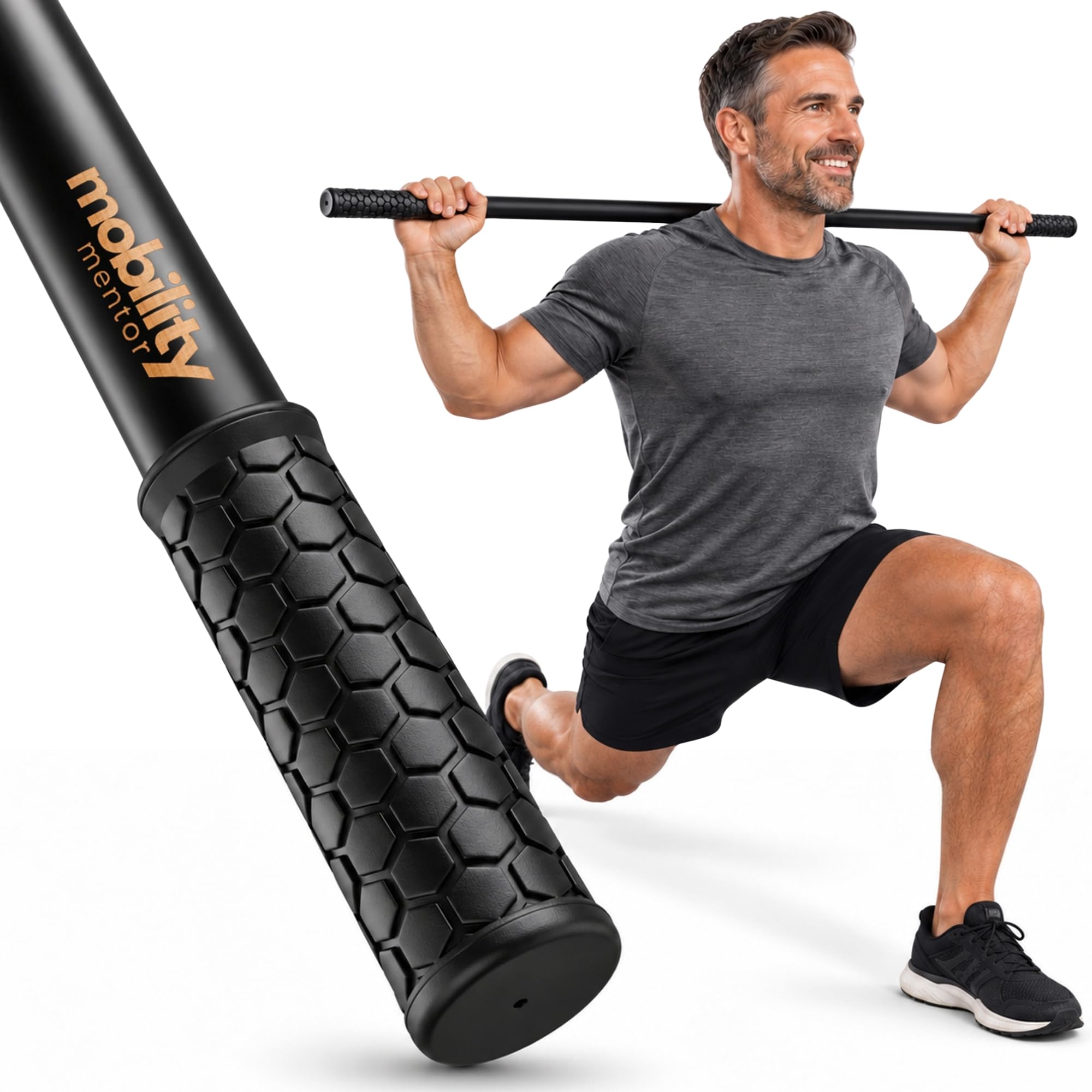
3. Mobility Mentor 5ft Bamboo Yoga Stick
A 58-inch bamboo rod that turns passive stretching into active work your body holds onto.
Most stretching tools sit there and do nothing — foam rollers, straps, and static holds let your body relax without ever pushing back. This one flips that. It is a 58-inch solid bamboo stick, 1.25 inches wide, that you press, pull, and brace against to create an active stretch. The idea is simple: your muscles work while you lengthen, and that is what makes new range of motion stick rather than snapping back.
The length is the story here. At 58 inches it is dramatically longer than the TriggerPoint GRID roller’s 12.95 inches — roughly four and a half times the reach — so it spans both hands wide for shoulder and thoracic spine work that a short roller cannot touch. For comparison, the 13-inch yoga wheels above are 13 inches across, versus this stick’s 58-inch span. It weighs just 1.7 pounds, lighter than the 2.8-pound 5-in-1 kit, so it is easy to hold for a full routine.
What wins people over is the build — natural bamboo rather than painted PVC or heavy steel, with non-slip grips at the ends and rubberized caps that keep it from sliding on hardwood or tile. The catch is that this is a deliberate, technique-driven tool: you have to learn the moves, and it does nothing for a knotted calf the way a roller does. Twenty-plus guided video tutorials are included to start you off. It is the most craft-forward pick on the list — 4.5+ stars across 400+ ratings.
The draw: a one-piece solid bamboo rod with non-slip grips and rubberized end caps that hold on hard floors. It doubles as a balance stick and dowel for physical therapy-style work, so one tool serves mobility, posture, and stability.
The reality check: it rewards practice. If you want something to lie down and roll on after a run, this is not that tool — it asks you to learn and repeat specific movements.
The right fit: desk-bound shoulders and tight hips that need active, load-bearing stretching, not passive pressure.
Not the pick: if you want instant, hands-off relief after a workout with zero learning curve.
4. Soft TPE Foam Roller, 18-Inch Full Round
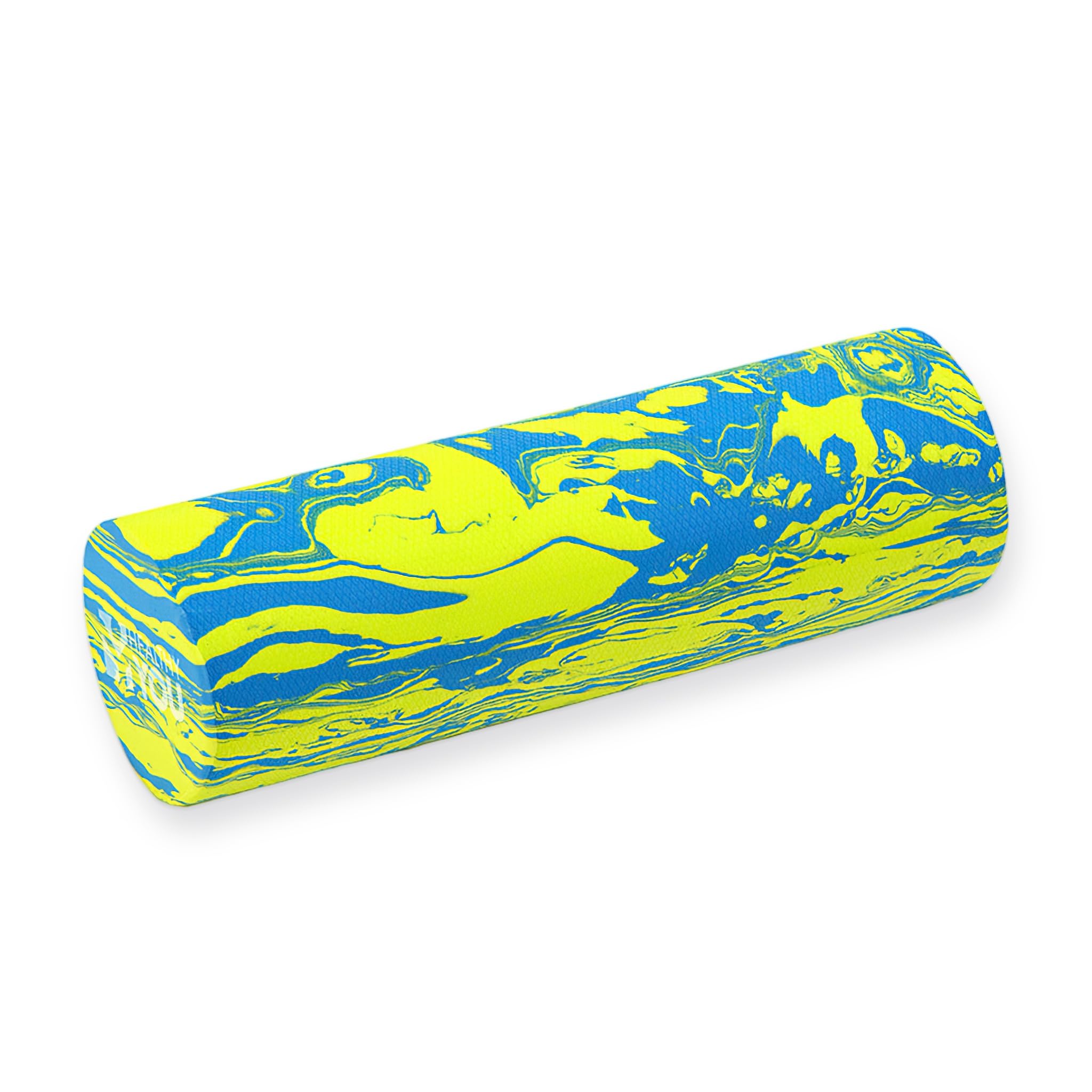
The roller you can actually lie on without your spine complaining.
This is the pick for anyone who tried a hard roller once and never went back. It is an 18-inch full-round roller in soft TPE foam — a gentler material with real give, softer than standard black or white high-density rollers while still doing useful work on tight muscle. Softer is the whole point, and it is what people single out most about this roller. Lay your back on it and it cushions rather than digs.
The 18-inch length is a deliberate middle ground: long enough to support a stretch of spine, short enough to roll a thigh or travel with. It comes in six configurations — full round at 6 inches diameter and a half round at 6 inches wide by 3 inches high, across 12-inch, 18-inch, and 36-inch lengths. The 36-inch gives full-spine support, 18-inch suits targeted rolling and travel, and 12-inch fits calves, arms, and feet. The full round also works for posture and Pilates lying lengthwise, while a half round stays flat for ankle mobility and balance.
The non-porous TPE surface will not soak up sweat or lotion, so a quick wipe keeps it clean at home or in a clinic. The honest limit: soft foam does not deliver the deep, aggressive release that an extra-firm roller like the TriggerPoint gives on a thick quad. This is the recovery-stage and beginner tool, not the deep-tissue tool. For a spine you can relax into, it does its job — 4.5+ stars across 400+ ratings.
Why it earns the slot: the density. Gentle give that is still effective on sore, tight muscle, ideal for beginners, seniors, and bony or sensitive areas where a hard roller feels like too much.
Where it stops short: deep pressure. If you want to crush a stubborn knot in a thick thigh, this will not push hard enough — that is a different tool’s job.
Reach for it if: your back is tender, you are easing into rolling, or you are recovering from injury and need gentleness.
Look elsewhere if: you already roll hard and want more bite than soft foam can give.
5. Yoga Wheel Set of 3+1, 10MM Padding

Four wheels in four diameters, so you can dial back pressure from gentle to deep.
Wheels do something a flat roller cannot: they let you arch over a curve and open the chest, shoulders, and upper back. This set gives you four sizes to do it at different intensities. The big 13-inch wheel applies gentle pressure and suits deep posture and backbending. A 10-inch medium wheel handles back and hip stretching. The smallest 6-inch wheel concentrates deep pressure for the neck, back, and legs. Think of it as a pressure dial you turn by swapping wheels.
The 13-inch diameter is where the set makes its presence felt — compare it to the 1.25-inch width of the Mobility Mentor bamboo stick, and the scale difference is enormous. The padding is 10MM thick TPE, billed as the thickest available, to cushion your back, palms, and feet. The rigid ABS (a hard, impact-resistant plastic) core is rated to support up to 500 lbs. The surface resists water and sweat, wipes clean, and adds grip so you do not slide mid-pose.
The trade-off to weigh: comfort and size split opinions. Some love the different sizes and the way they feel during use; others find the pressure painful at first and note the padding is not as wide as some competing wheels. Deep backbending is not a gentle entry point — respect that. Get the progression right and it opens range a flat roller never reaches — 4.0+ stars across 500+ ratings.
Reasons it climbs the list
- Four diameters let you graduate from gentle 13-inch pressure down to deep 6-inch work
- 10MM TPE padding cushions the spine, palms, and feet
- Rigid ABS core rated to support up to 500 lbs
- Sweat- and water-resistant surface wipes clean and holds grip
What to brace for
- Deeper backbends can feel intense or even painful before they feel good
- Padding runs narrower than some competing wheels, so check width if you want a broad rest
Made for: yoga and posture work where you want to arch and open the upper back at graded intensities.
Hold off if: you have a sensitive spine that dislikes extension, or you want one simple tool rather than a set to learn.
6. Wave Patented Psoas Release Tool
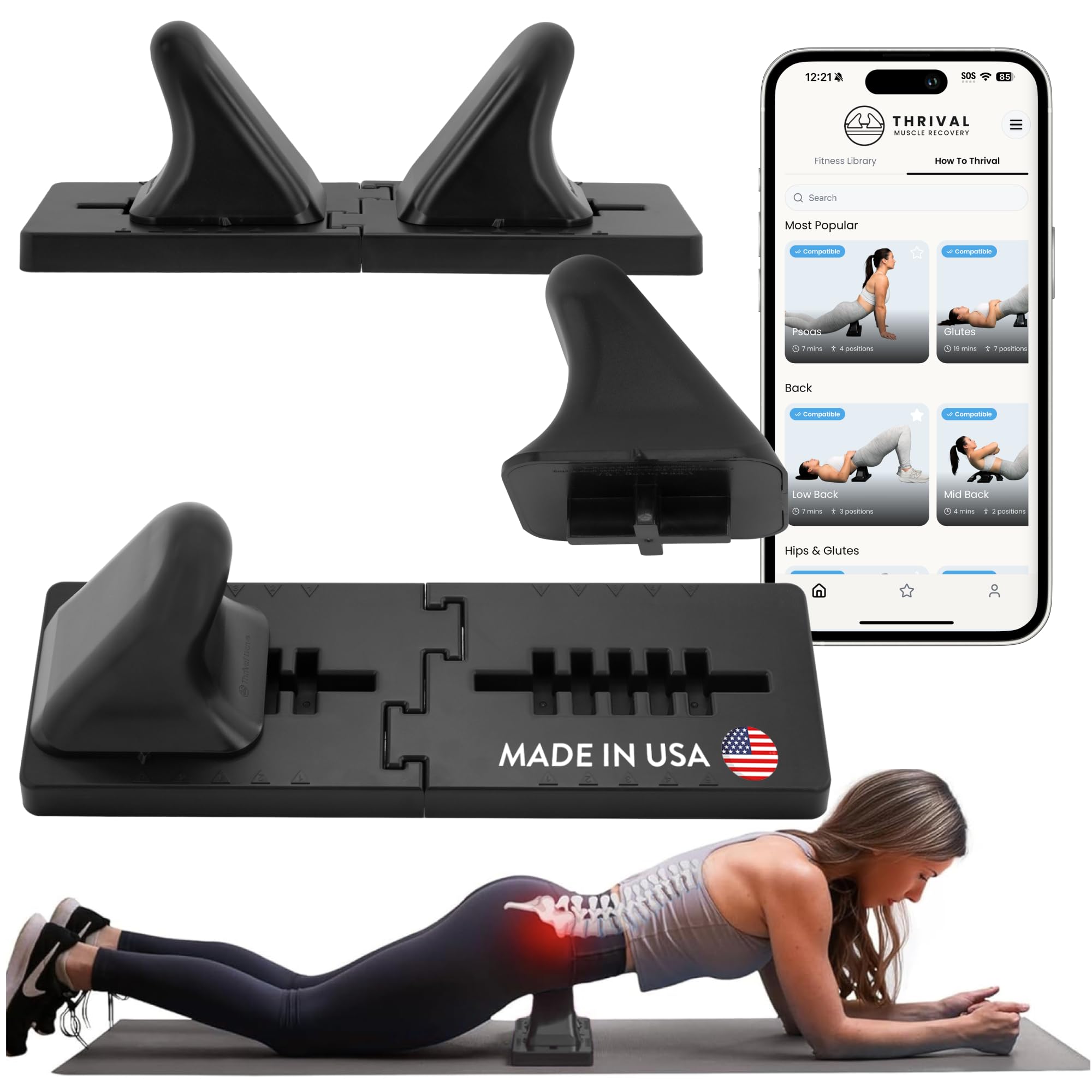
A floor board built to reach the psoas — the deep hip muscle no roller can find.
The psoas is a deep hip-flexor muscle buried where a foam roller simply cannot press. This tool is a release board you lie on, with adjustable placement settings and a range of attachment heads that mimic a therapist’s hand, elbow, or thumb. Each head locks into one of five positions per side, so you can angle pressure into a specific muscle. It is a targeted self-myofascial release tool for the lower back, hips, and legs — not an all-over roller.
The board measures 17.28 inches and weighs 1.6 pounds, portable enough to carry to the gym or while traveling. The attachment heads are designed to stay put — they do not fall out of the board even when it is shaken upside down. Soft elastomer covers, available separately, spread the surface area to make deep work gentler. What people find most is that it actually works — the effectiveness shows up again and again in how owners describe relief in the lower back and legs.
Now the real caveat, and it is a fair one: releasing tight muscles can be uncomfortable or even painful, and that is reflected in the honest feedback — pain comes up as a mixed theme. The soft covers help, but you may want them. It also comes with a detailed manual and step-by-step techniques, so the learning curve is real but well supported. For stubborn hip and lower-back tension a roller cannot touch, it does what it is built to do — 4.0+ stars across 700+ ratings.
The strong suit: adjustability. Five positions per side and swappable heads let it adapt to different body types and target the deepest hip and back muscles.
The honest catch: deep release is not pain-free. If you are the type to stop at the first twinge, budget for the soft covers or build up slowly.
Choose it if: tight hip flexors and a stiff lower back are your daily complaint and rollers have not reached the spot.
Think twice if: you want gentle, pain-free rolling — this one asks you to tolerate real pressure.
7. Lifepro Sonic Massage Gun

Percussion power in a 2.2-pound body, with eight heads for every muscle group.
When rolling takes too long or you cannot reach a muscle, a percussion gun is the fast answer. This one runs six speeds and ships with eight interchangeable heads so you can target quads, traps, calves, and glutes without repositioning a roller. At 2.2 pounds it is light enough for a gym bag, and the included travel case lets you toss it in a carry-on. Use it to wake up muscles before a session or flush them after.
Runtime is stated at up to 1.5 to 3 hours from a single charge, which covers multiple sessions between top-ups. The scale of this pick is hard to overstate in comparison terms — the healthiest signals on it run into the thousands, dwarfing the counts on any other tool here, and it is by far the most-discussed pick on the list. Owners find it quiet-running and easy to operate, and the eight attachments get named specifically as a highlight.
One honest note sits inside the battery story: while plenty report strong runtime and quick charging, some units have come up short on holding a charge. It is worth the mention because the battery is a part you cannot replace. Everything else points to a fast, convenient tool that saves your hands the work — 4.5+ stars across a deep pool of 21,000+ ratings.
Why it fits: speed and coverage. Six speeds, eight heads, and up to 1.5–3 hours of runtime mean you can hit a sore spot in seconds, anywhere, with quiet operation.
The one watch-point: battery consistency. Runtime is a range, and a few units have not held a charge — treat it as the moving part of an otherwise strong tool.
Good fit for: runners and lifters who want fast, hand-held relief and would rather press a button than lie on the floor.
Not for you if: you prefer the slower, self-directed work of a roller or stick and do not want to manage a battery.
8. RAD 2-in-1 Muscle Flushing Kit

A hard roller plus a hand-held stick, built for flushing out stubborn muscle.
This kit pairs an extra-firm, high-density foam roller with a massage roller stick, giving you floor work and reach work in one box. The roller runs 22 inches over 4 inches, wraps a steel core in high-density EVA foam that grips the skin and wipes clean, and holds its shape without bending. The stick handles the spots — necks, forearms, calves — where a big roller is awkward to control.
The 22-inch length sits between the shorter 13-inch TriggerPoint and a full-spine roller, long enough for the IT bands, quads, and hamstrings it is aimed at. The foam grip comes from EVA — a firm, rubbery material — so it catches the skin rather than sliding over it. A 10-minute daily session is the routine the maker outlines, targeting IT bands, quads, neck, SCM, triceps, forearms, glutes, psoas, hamstrings, and calves across more than 20 uses.
Where it stands apart is depth without appliance gimmicks. There is no battery, no motor, nothing to charge — just a hard roller and a stick that work as long as you do. The honest limit is that extra-firm pressure is not for a sensitive back or a first-timer easing in, and a two-piece kit takes more storage than a single roller. For people who roll hard and want both tools matched, it is a clean pairing — 4.5+ stars across a modest set of ratings.
What earns it a spot
- Steel core with high-density EVA foam holds shape without bending
- 22-inch roller covers IT bands and quads in fewer passes
- Massage stick adds reach for necks, forearms, and calves
- No battery or motor — nothing to charge, nothing to wear out
Where it asks you to commit
- Extra-firm pressure is a lot for sensitive backs or first-timers
- Two pieces take more room to store than a single roller
Suits you if: you roll hard, want both a roller and a stick, and prefer no batteries or moving parts.
skip it if: soft pressure is what your body responds to — this set is built firm.
9. DoubleUP Roller D5 Leg & Arm Massager
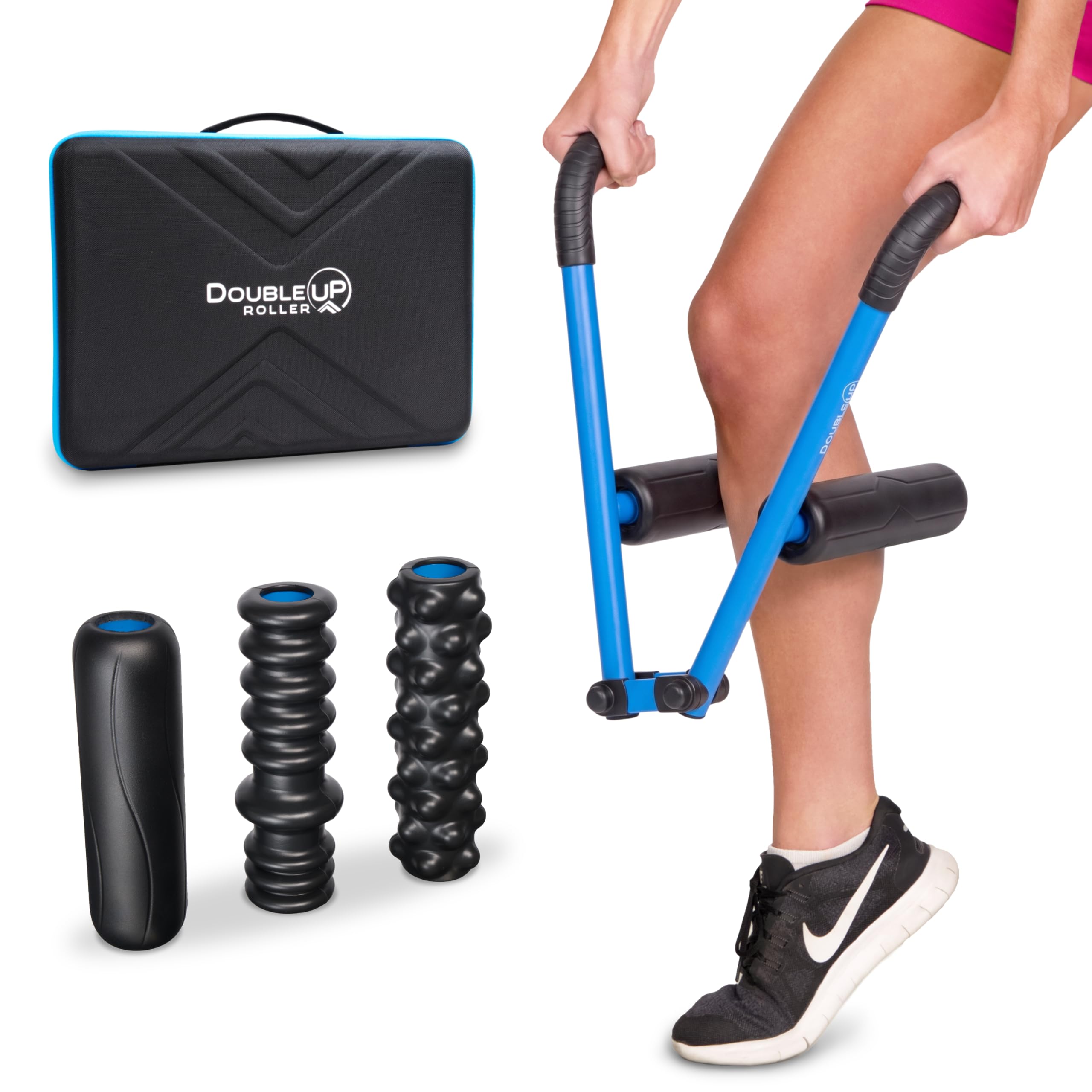
Roll your legs while standing up, and control the pressure with one hand.
Lying on a foam roller is awkward for a lot of people — the floor is hard to get down to, and you cannot see what you are working. This frame flips the whole routine upright. You stand or sit and roll against a patented all-metal DoubleUP frame with dual rollers that reach the inner thigh and IT bands at the same time. A force-multiplying design lets you dial rolling pressure from a gentle warmup to intense deep tissue with minimal effort.
The Performance Kit arrives with five quick-change rollers — two medium, one soft, one ribbed firm, one bumpy firm — so you can switch density and contour in seconds to mimic different therapy techniques. The frame is high-strength steel and aluminum with precision ball bearings on the rollers, and the whole thing collapses into the included travel and storage case. It weighs 4 pounds, the heaviest pick here by a clear margin. Standing and pressing with control is what owners praise most, and the roller swaps are quick and easy.
The one thing to size up before you buy: this is a premium, single-purpose stand-up tool, and 4 pounds plus a case is more to store and move than a foam tube. If your recovery is floor-based and simple, you are paying for a design you may not need. But for legs and arms worked standing up with real pressure control, few tools match it — 4.5+ stars across 300+ ratings.
The standout: standing, force-multiplied rolling with five swappable rollers and a collapsing metal frame — pressure control with almost no effort.
What it costs you: portability. At 4 pounds with a case, it lives where you set it down and takes real space to store.
The pick for: anyone who finds floor rolling awkward and wants deep, controlled pressure on legs and arms while standing.
Not worth it if: you are happy with a simple floor roller and want something you can tuck in a drawer.
Know the Specs
Foam Density and Firmness
Density is how hard the surface pushes back, and it decides whether a tool feels like relief or like punishment. Extra-firm foam digs into thick muscle like quads and IT bands; soft TPE is far gentler over a spine, a sensitive hip, or a bony area. Match the density to your most-complained-about tissue, not the hardest roller on the shelf.
Roller Diameter and Length
Diameter sets how broad or focused the pressure feels — a bigger wheel spreads force gently, a smaller one concentrates it. Length decides where the tool fits: a long roller covers more spine in a pass, a short one travels easily and targets calves and feet, and a 58-inch stick spans both hands for shoulder and hip work a tube cannot reach.
Common Questions
What is the difference between a soft and an extra-firm foam roller?
Can a foam roller reach the psoas muscle in my hip?
How long should I roll each muscle group?
Is a massage gun better than a foam roller?
Can I use a yoga wheel if I have a sensitive lower back?
What does a multi-density grid roller actually do?
How long does a foam roller last before it loses shape?
Do I need a stretching stick like the bamboo yoga bar?
How much space do these recovery tools take up?
Are these tools safe to use on a fresh injury?
The Bottom Line
For most people, the stretching and recovery equipment to start with is the TRIGGERPOINT GRID roller, because its multi-density surface and extra-firm EVA foam handle quads, calves, and back in one honest tool that holds its shape. If mobility in the shoulders and hips is the real goal, the long bamboo Mobility Mentor stick gives you active stretching a roller cannot. And when a muscle is too sore or too hard to reach, the Lifepro Sonic massage gun gets you relief in seconds with its six speeds and eight heads. Pick the tool that matches the muscle that actually nags you, and it will not end up in the closet.
How we choose
We do not accept paid placement. Every pick is matched to a real buyer and a real use-case; we do not hands-on test units.
Sources
Specifications: manufacturer listings and product documentation. Review insights: verified customer reviews, as of November 2026. Pricing: not shown on this page (it changes often); check the current price via the retailer link.
As an Amazon Associate, Tactical Gear Guy earns from qualifying purchases. This does not affect which products we feature.