Specs are compiled from manufacturer listings and verified buyer reviews and can change over time — please confirm the key details on the product page before buying.
You only notice the regulator when your heater starts short-cycling or your generator bogs down under load. A second stage regulator (the part that takes the tank-side first stage pressure and steps it down to a steady low pressure) keeps every appliance on the line burning evenly. The one worth buying is the Fisher-type R622 body in 3/4″ sizing: it gives you a wide 9″-13″ water column adjustment band (the range you can fine-tune the output pressure) and real whole-house capacity.
This guide is built by comparing the manufacturers’ published specifications and the patterns across verified customer reviews, so you get each pick’s real strengths and trade-offs instead of marketing spin.
Before you scroll, know this: the list uses flexible matching for second stage regulators, so not every pick is the exact model number you typed into the search bar. The nearest same-type, same-size body does the same job. Below I break down capacity, connection sizing, and vent placement so you can spot the one that drops straight into your setup. This breakdown of the second stage propane regulator covers nine real bodies and the specs that actually matter.
Top Picks

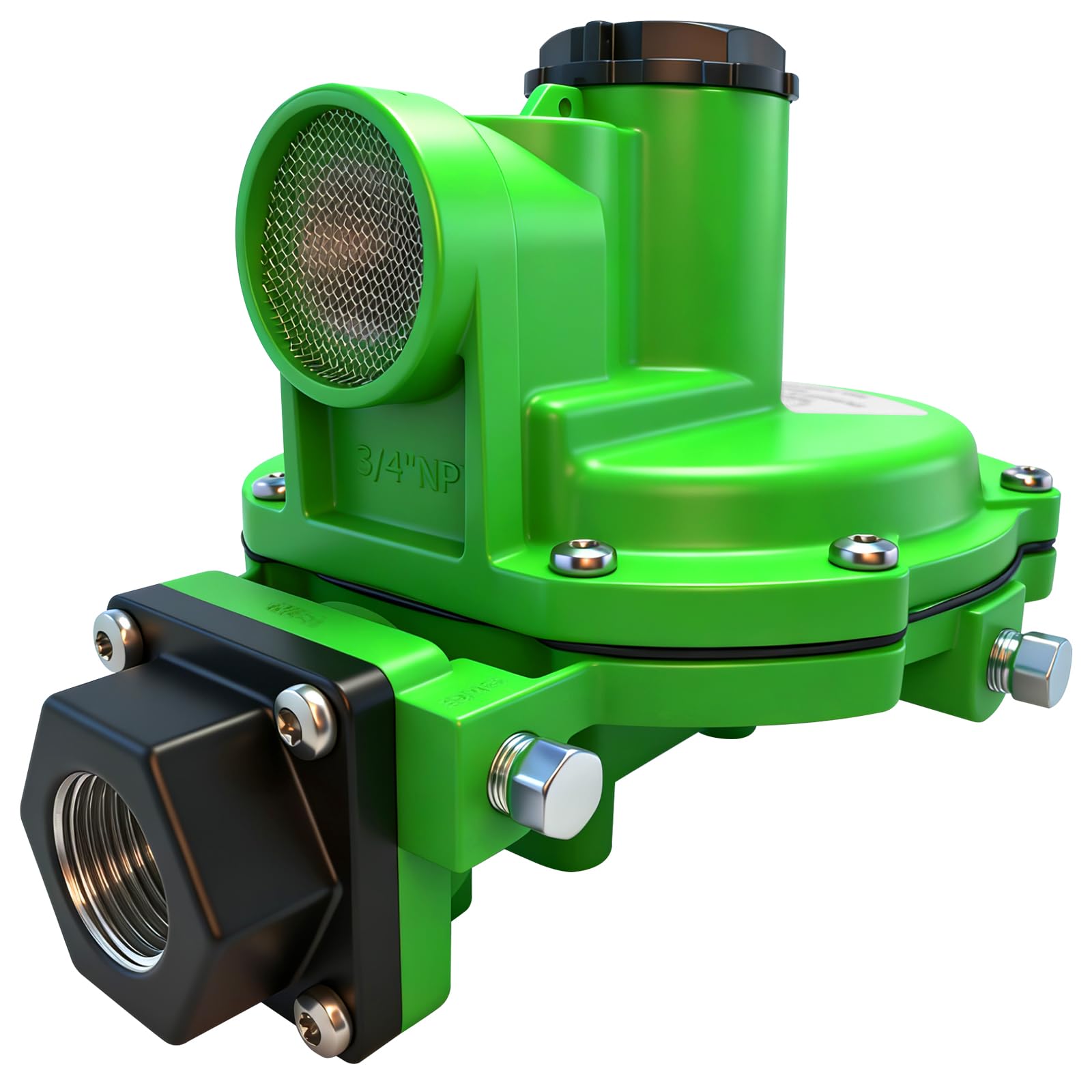

How To Choose The Best Second Stage Propane Regulator
You are not shopping for a gadget here. You are buying the piece that keeps gas pressure steady between the tank and the things that burn it, so the two numbers that decide almost everything are your BTU load and your pipe size. Get those right and the rest is fit and finish.
Match the BTU rating to your total appliance load
Look at what you are running at the same time, not what is on the property. A water heater and a furnace firing together can draw more than either one alone, so add the appliance ratings up and buy capacity above that total. The bodies here range from 710,000 BTU at the low end up to 1,600,000 BTU/hr, which is the difference between a single-piece install and a whole-house setup.
Match the ports to your existing pipe
A second stage regulator has an inlet and an outlet, and both need to line up with the pipe you already have. The picks below come in 1/2″ x 1/2″, 1/2″ x 3/4″, and 3/4″ x 3/4″ combinations, all in female NPT thread so they screw onto standard tapered pipe fittings. Measure the pipe at the point of replacement before you order anything.
Decide on straight-through, back-mount, or side-outlet
The body orientation decides how the whole assembly hangs on the wall or bracket.
- Straight through runs the gas in one side and out the opposite side, so the pipe continues in a line.
- Back mount puts inlet and outlet at the rear face, which suits a wall bracket where the pipe comes out of the wall.
- Side outlet turns the gas ninety degrees for a tighter corner run.
Wrong orientation is not a safety problem so much as a headache — the body ends up facing a joist or the vent ends up against a surface it should not sit against.
Look for a relief valve and a screened vent
The relief valve is the part that dumps excess pressure instead of feeding it downstream, and the screen over the vent keeps dirt and insects from getting into the diaphragm chamber. Every body in this list carries some form of relief protection, which is what you want in a home or shop installation.
Side-by-Side Comparison
All three spec columns below are directly comparable across every pick, so you can scan capacity, thread size, and output band in one pass.
| Model | Best For | Capacity | Inlet x Outlet | Output Range | Amazon |
|---|---|---|---|---|---|
| R622-DFF★ Best Overall | Whole-house LP systems | 1,400,000 BTU | 3/4″ x 3/4″ FNPT | 9″-13″ WC | Amazon |
| R622LHighest Capacity | High-flow home and shop | 1,600,000 BTU/hr | 3/4″ FNPT | 9″-13″ W.C | Amazon |
| Marshall 1622-BCFDrop-In Replacement | Replacing an old LV4403B4 or R622-BCF | 710,000 BTU | 1/2″ x 1/2″ FNPT | 9″-13″ water column | Amazon |
| LV4403B4 | Structure-mounted LP feeds | 935,000 BTU | 1/2″ x 1/2″ | 11″ water column | Amazon |
| LV4403B66R | Back-mount wall installs | 935,000 BTU | 3/4″ x 3/4″ FNPT | 11″ water column | Amazon |
| R622-CFF | RV and outdoor equipment | 1,400,000 BTU | 1/2″ x 3/4″ FNPT | 9″-13″ WC | Amazon |
| R652-CFF | Tight-wall back-mount runs | 1,000,000 BTU/hr | 1/2″ x 3/4″ FNPT | 9″-13″ W.C | Amazon |
| R642-DFF | Corner and side-run installs | 900,000 BTU/hr | 3/4″ x 3/4″ FNPT | 9″-13″ W.C | Amazon |
| R652-DFF | Heavy back-mount whole-home builds | 1,000,000 BTU/Hr | 3/4″ x 3/4″ FNPT | 9″-13″ W.C. | Amazon |
Detailed Reviews
1. R622-DFF Propane Second Stage Regulator
Our pick — 4.5+★ from 900+ verified ratings; the strongest balance of quality and price.
Whole-house gas demand handled by one body, with 3/4″ ports on both ends.
The number that earns this pick the top slot is capacity: 1,400,000 BTU feeding a generator, a heater, a water heater, and a fireplace without the last one on the line going weak. It takes the first stage down to a 9″-13″ water column range, and that band is broad enough that you can nudge the output to suit a fussy appliance instead of swapping the whole body.
Both ports are 3/4″ female NPT, so the body screws directly onto standard tapered pipe on the inlet and outlet sides. Inside, a relief valve and a 3/4″ screened vent handle overpressure and keep grit out of the diaphragm. The body is metal and weighs in around 635 g, which says something about the wall thickness — this is not a stamped sheet-metal piece.
Buyers report it running shop ceiling heaters off 100 lb tanks and holding pressure for generator loads. Quality is the second thing that gets talked about, and installation comes up as straightforward, with the unit arriving ready to fit rather than needing to be assembled. Threads on some units run a touch tight in the first turn, so start by hand rather than reaching for a wrench.
Where it pulls ahead
- 1,400,000 BTU covers a whole house’s appliances firing at once
- 3/4″ x 3/4″ FNPT on both ends matches common residential pipe
- Built-in relief valve and screened vent on a UL-listed body
Before you order
- Threads can fight you on the first engagement — hand-start before torquing
- You still need a proper first stage regulator feeding it from the tank
The verdict: If you are running a house’s worth of propane appliances, this is the body that carries the load without losing pressure at the far end.
Pair it with: A first-stage regulator at the tank, since this unit is built to sit after that first step-down.
2. R622L 2nd Stage Propane Regulator
The biggest flow rating in the lineup, with a dial you can actually turn.
Start with the capacity figure, because it is the reason to pick this one: 1,600,000 BTU/hr versus the R622-DFF’s 1,400,000 BTU/hr at the top of this list. In plain terms, that is room for commercial burners and propane generators on the same run without the last appliance starved. The 1,600,000 figure also leaves the Marshall 1622-BCF’s 710,000 BTU far behind — this body is built for a much heavier gas draw.
The adjustable side is what separates it from a fixed body. You can dial the outlet anywhere from 9″ to 13″ W.C. — roughly 22 to 32 mbar — and it ships set at 11″ W.C., which is the usual target for most household appliances. Inlet and outlet are both 3/4″ FNPT, the vent is 3/4″ NPT screened, and the body handles up to 10 PSI inlet pressure with a 1/4″ orifice.
The one honest catch: this body has only 20+ buyer ratings so far, and the maker recommends professional installation. That is not a knock on the hardware so much as a fit note — if you want confirmation from a crowd of prior buyers, the top pick above has that. If you want maximum flow and a turnable adjustment, this is the one.
What stands out: 1,600,000 BTU/hr is the largest capacity on this list, and the 9″-13″ W.C. adjustment (22–32 mbar) plus a built-in high-performance relief valve and screened vent make it the most flexible body here for awkward gas loads.
What to plan for: The regulator works with LP, propane, natural gas, and manufactured gas within rated pressures. Always check the label on the regulator to confirm it matches your specific system before you fit it.
Reach for this if: You are feeding a high-draw setup — commercial burners, a propane generator, or several appliances at once — and want to set the outlet pressure yourself.
Look elsewhere if: You want a body with a long track record of buyer feedback, in which case the 3/4″ R622-DFF is the safer first order.
3. Marshall 1622-BCF Second Stage Propane LP Regulator
A named cross-reference that swaps straight onto an old Rego or Fisher body.
This is the pick for anyone repairing rather than designing: it is listed as a replacement for the Rego LV4403B4, the Fisher R622-BCF, and the Cavagna 998LP-22. If one of those part numbers is what came off your wall, you already know the pipe will line up. The fixed 11″ water column output is adjustable anywhere from 9″ to 13″.
Capacity is 710,000 BTU max, and that is the real dividing line. This body is sized for a single appliance or a light pair, not for a whole house firing at once — the R622-CFF further down carries 1,400,000 BTU, so plan accordingly if your load is bigger. Inlet and outlet are both 1/2″ female NPT in a straight-through body, so the gas continues along the same line without a corner turn.
Owners describe it as soundly made and reliable once installed. Nothing exotic, nothing fussy. The physical footprint runs about 8.86 x 5.91 x 5.63 inches per the package dimensions, so check that against the bracket you are mounting to. And like every second stage body here, it needs a first stage high-pressure regulator at the tank feeding it 10 PSI.
The case for it
- Lists as a direct replacement for the Rego LV4403B4, Fisher R622-BCF, and Cavagna 998LP-22
- Adjustable 9″–13″ water column output despite the fixed 11″ rating
- Straight-through 1/2″ body keeps the pipe run in one line
Read the label first
- 710,000 BTU max is a single-appliance rating, not whole-house
- 1/2″ ports only — 3/4″ pipe needs a different body
Who it suits: The repair buyer who pulled a dead Rego or Fisher off the wall and wants the pipe to line up on the first try.
The one caveat: It tops out at 710,000 BTU, so a multi-appliance house should size up to a body with 1,400,000 BTU or more.
4. LV4403B4 Low Pressure Second Stage Regulator, 1/2″ x 1/2″
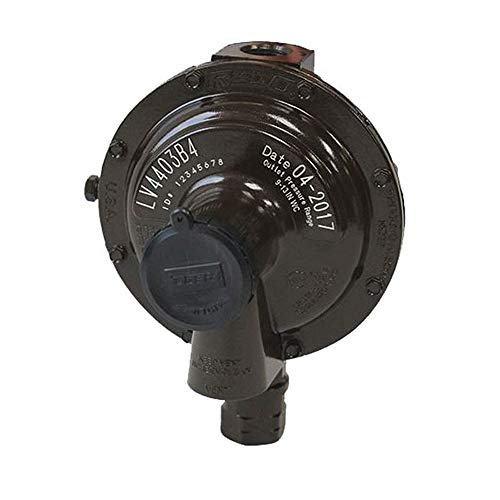
The plain Rego body that has been hanging on structure walls for years.
Rego’s LV4403B4 is the reference part a lot of installers reach for out of habit, and the appeal is that there is nothing to figure out. Gas comes in at 1/2″ NPT, goes straight through, and leaves at 1/2″ NPT with 11″ water column on the outlet. Capacity is 935,000 BTU, which sits between the Marshall’s 710,000 and the 1,400,000-class bodies — enough for a solid two-appliance run.
Physically it is the heavyweight of the group at 3.21 pounds, and held against the R622-CFF’s 2.9 pounds the difference is noticeable in the hand. That heft is brass and cast metal doing the work, and it is part of why this body has been a fixture on structure-mounted installations. Mount orientation is straight-through, so plan a linear pipe run rather than a corner.
The honest note here is that the outlet is not listed as adjustable in the published specs — it states 11″ water column, full stop. If your appliance wants a nudge either direction, a body rated 9″-13″ like the R622-DFF gives you that room. For a standard low-pressure feed where 11″ is the target, this one does not ask anything of you beyond a clean pipe connection.
Why installers know the number: 935,000 BTU and a straight-through 1/2″ body is a known quantity that drops into structure-mounted feeds without a bracket puzzle.
The straight trade-off: The published outlet is fixed at 11″ water column rather than adjustable across a band, so a fussy appliance that wants a different setting is better served by a 9″-13″ body.
Choose this when: You are replacing a known-good body on a structure wall and want the same straight-through 1/2″ layout back in place.
Skip it during: A rebuild where you need to adjust outlet pressure — that calls for one of the 9″-13″ spring bodies in this list.
5. LV4403B66R Low Pressure Second Stage Regulator

Brass, back-mounted, and sized at 3/4″ on both ends for a clean wall drop.
Two things define this body: the 3/4″ female NPT inlet and outlet pair, and the back-mount layout that puts both ports on the rear face. That second detail is what you want when the pipe comes straight out of a wall and the regulator needs to sit flat against it, rather than hanging out into the open. Output is 11″ water column and capacity is 935,000 BTU.
The brass exterior sets this one apart. Unlike the stainless-bodied regulators in this list, this one has a brass finish and a back-mount orientation that suits outdoor structure walls. It is rated for the same 935,000 BTU as the LV4403B4 above, so the choice between those two depends on thread size and body orientation, not flow.
Where this one fits best is a 3/4″ pipe run on a wall bracket — the layout solves a mount problem the straight-through bodies cannot. The trade-off is that the fixed 11″ outlet leaves no adjustment band, and the back-mount footprint means it will not drop into a linear pipe run without rework.
What it solves
- Back-mount body hangs flat against a structure wall
- 3/4″ x 3/4″ female NPT suits common residential pipe
- Solid brass finish on a 935,000 BTU body
What it will not do
- Fixed 11″ water column outlet, no 9″-13″ adjustment band
- Back-mount layout will not swap into a straight-through run
Built for: A 3/4″ wall run where the pipe exits the wall and you want the body mounted flat and out of the way.
Worth knowing: Capacity and output match the 1/2″ LV4403B4 — the reason to pick this one is the 3/4″ thread and back-mount face, not extra flow.
6. R622-CFF Propane Second Stage Regulator
The camper and grill body that steps down to 1/2″ on the inlet side.
Here is the sizing twist that decides this one: the inlet is 1/2″ and the outlet is 3/4″. That mixed pair is exactly what an RV, camper, or patio setup often needs when the tank-side line is smaller than the appliance-side feed. Capacity is the same 1,400,000 BTU as the top pick, so this is not a compromise on flow despite the smaller inlet.
The body is brass and stainless steel with an inlet screen that catches debris before it reaches the diaphragm, and the internal relief valve works with a large screened vent to dump overpressure. Output adjusts across that 9″ to 13″ water column band, so you can tune it for a grill burner or a fireplace without changing parts.
Against the R622-DFF, the capacity is identical at 1,400,000 BTU, and the difference is purely the connection layout — that one is 3/4″ on both ends, this one steps down on the inlet. If your supply line is 1/2″, this body saves you an adapter. If it is 3/4″ all the way through, the top pick is the cleaner fit.
The reason it earns a spot: 1,400,000 BTU in a body that accepts a 1/2″ inlet is a rare combination, and the brass and stainless construction with an inlet screen is built for outdoor use.
The fit question: That mixed 1/2″ x 3/4″ pairing is only an advantage if your supply line is the smaller size — otherwise you are buying an adapter you did not need.
Ideal for: RV, camper, grill, and fireplace setups where the incoming line is 1/2″ and the appliance feed is 3/4″.
Not the fit for: A full 3/4″ run — the 3/4″ x 3/4″ R622-DFF matches that pipe without adapters.
7. R652-CFF 2nd Stage Regulator, Back Mount, 1/2″ x 3/4″ NPT

Back-mount body for a 1/2″ supply feeding a 3/4″ appliance line.
This body answers a specific installation question: what do you hang when the gas comes out of the wall through a 1/2″ line but the run downstream is 3/4″? The R652-CFF takes 1/2″ in, pushes 3/4″ out, and mounts at the back — three constraints solved in one casting. Capacity is 1,000,000 BTU/hr, and the outlet adjusts across 9″ to 13″ W.C. (22 to 32 mbar).
Emergency ratings are note for a garage or utility install: maximum inlet is 10 psig (0.69 bar) with an emergency inlet allowance of 50 psig (3.4 bar). The 3/4″ NPT screened vent keeps the diaphragm chamber clean, and the body weighs in at 2.6 pounds — lighter than the LV4403B4’s 3.21 pounds, mostly because of the smaller inlet casting.
The limit to understand is capacity versus the bigger R622 bodies. At 1,000,000 BTU/hr it trails the R622-CFF’s 1,400,000 BTU by a clear margin, so a whole-house load with several appliances running simultaneously is better served upstream. For a shop heater or a pair of appliances behind a 1/2″ wall stub, this is a tidy answer.
Why it works here
- Solves the 1/2″ in / 3/4″ out mismatch without adapters
- Adjustable 9″–13″ W.C. output (22–32 mbar)
- Emergency inlet allowance of 50 psig (3.4 bar)
The honest ceiling
- 1,000,000 BTU/hr trails the 1,400,000 BTU R622 bodies
- Back-mount face will not drop into a straight pipe run
Take this route if: Your supply stub is 1/2″, your downstream pipe is 3/4″, and the body needs to sit against a wall.
Think bigger if: Multiple large appliances fire together — step up to a 1,400,000 BTU body for the headroom.
8. R642-DFF 2nd Stage Regulator, Side Outlet, 3/4″ x 3/4″ NPT

The corner-turner: 3/4″ both sides, with the outlet turned ninety degrees.
Tight spaces are what this body is for. Both ports are 3/4″ female NPT, but the outlet is on the side rather than the back, which lets the pipe take a corner without an elbow fitting. On a wall where a straight-through body would run out of room, that single design choice is the reason to pick it.
Capacity is 900,000 BTU/hr, the lowest of the 3/4″ bodies here, so this is a fit-over-flow choice rather than a capacity one. Output adjusts 9″ to 13″ W.C. (22 to 32 mbar), the vent is 3/4″ NPT screened, and it carries the same emergency inlet rating as its R652 siblings. Performance and build quality are what get talked about in the feedback, and both land positive.
The physical envelope runs about 9.49 x 6.5 x 6.42 inches, so measure the mounting space before you commit — a side outlet needs clearance on the face the pipe exits.
What makes it useful: A side outlet on a 3/4″ body turns a corner without an elbow, which is worth more than raw capacity on a cramped wall.
What you give up: 900,000 BTU/hr is the lowest capacity among the 3/4″ picks, so a heavy multi-appliance load wants the larger R622-CFF or R652-DFF.
Made for: Corner and side-run installs where the pipe needs to turn and the space is tight.
Reconsider if: You need maximum flow — the side outlet here trades capacity for that ninety-degree exit.
9. R652-DFF Second Stage Regulator, Back Mount, 3/4″ x 3/4″ NPT
The 3/4″ back-mount body for a full-size wall install with real headroom.
Full-size pipe, back-mount face, and 1,000,000 BTU/hr — this is the body you fit when the run is 3/4″ throughout and there is a bracket on the wall waiting for it. Output adjusts across 9″ to 13″ W.C. (22 to 32 mbar), and the vent is 3/4″ NPT screened to keep the diaphragm chamber clear.
It shares a capacity figure with the R652-CFF above — both are 1,000,000 BTU/hr — so the real distinction is the connection pair. That one steps down from a 1/2″ inlet; this one is 3/4″ on both sides. If your supply is already 3/4″, this body needs no adapter at all. The metal construction and 9.06 x 6.06 x 5.94 inch dimensions put it in the same bracket footprint family as the side-outlet R642-DFF.
Emergency inlet handling matches the rest of the R652 line at 50 PSIG (3.4 bar), with a 10 PSIG (0.69 bar) normal maximum. The trade-off is the same one the whole back-mount family carries: no corner turn, so the pipe has to run straight into the wall. For a 3/4″ whole-home feed with a bracket already in place, this is the most straightforward body in the list.
What earns it a spot
- 3/4″ x 3/4″ female NPT matches full-size residential pipe
- 1,000,000 BTU/hr with a 9″–13″ W.C. adjustment band
- Back-mount face sits flat against a wall bracket
What to weigh
- Trails the 1,400,000 BTU R622 bodies on capacity
- No side exit, so a corner run needs a different body
Best matched to: A 3/4″ whole-home feed where the regulator hangs on an existing wall bracket.
Swap to the R642-DFF if: The pipe needs to turn a corner — same thread size, different outlet face.
Know the Specs
Water column output (inches W.C.)
Water column is the unit used to express very small gas pressures — 11″ W.C. is roughly the pressure a household appliance expects, and 9″ to 13″ is the band most second stage bodies let you adjust within. If a body is listed as fixed at 11″, you cannot nudge it for an appliance that wants a slightly different setting; a 9″-13″ body gives you that room. This is the number that decides whether a burner lights cleanly or surges.
BTU capacity per hour
BTU is a measure of heat energy, and in a regulator the BTU/hr rating tells you how much gas volume the body can pass without choking the flow. Add up the ratings of every appliance you might run at the same time, and buy capacity above that total. A 710,000 BTU body suits a single appliance; a 1,400,000 or 1,600,000 BTU body handles a whole house with appliances firing together.
NPT thread sizing (1/2″ vs 3/4″)
NPT means National Pipe Tapered — a standard thread that seals by wedging tighter as it screws on. The 1/2″ and 3/4″ figures refer to the pipe size, not the physical diameter of the fitting. Match both the inlet and the outlet to the pipe you already have; a mixed pair like 1/2″ x 3/4″ is useful for stepping between two different line sizes without an adapter.
Relief valve and screened vent
The relief valve opens and dumps excess pressure instead of pushing it downstream to your appliances. The screened vent covers the diaphragm chamber’s breathing port — the screen keeps dirt and insects from getting in and fouling the diaphragm. Both are standard on a proper second stage body and both matter for safe long-term operation.
Common Questions
Can I use a second stage regulator without a first stage regulator?
What does 11 inches of water column actually mean for my appliance?
Will a 1,600,000 BTU regulator be too much for a small heater?
How do I tell a second stage regulator from a first stage one?
Does the vent need to point a certain direction?
What is the difference between straight-through, back-mount, and side-outlet bodies?
Can the same regulator handle propane and natural gas?
How often should a second stage propane regulator be replaced?
Do I need a bigger BTU rating if I run several appliances at once?
Which body works if my pipe is 1/2 inch but my appliance feed is 3/4 inch?
Final Thoughts: The VerdictFor most people, the second stage propane regulator winner is the R622-DFF because 1,400,000 BTU covers a whole house’s appliances firing at once, and the 3/4″ x 3/4″ FNPT ports match common residential pipe without adapters. It also carries 4.5+ stars across 900+ ratings, and owners describe the relief valve, screened vent, and metal body as a fit-and-forget install.
If you want the largest flow rating and a dial you can actually turn, grab the R622L — 1,600,000 BTU/hr with a 9″-13″ W.C. adjustment band. And for a 1/2″ supply feeding a 3/4″ appliance line, the R622-CFF is the one to reach for.
For a straight repair swap where a known Rego or Fisher body came off the wall, the Marshall 1622-BCF names the cross-references outright so the pipe lines up on the first try.
Two things are worth repeating before you order. Every body here is a second stage unit, so it needs a first stage regulator at the tank ahead of it — none of them are built to take full tank pressure. And check both the inlet and the outlet against your pipe, not just one end; a mixed 1/2″ x 3/4″ body only helps if your line actually steps between those two sizes.
Size the BTU rating above your combined appliance load, match the body orientation to your wall, and any of these nine will hold a steady 9″ to 13″ water column.
How we choose
We do not accept paid placement. Every pick is matched to a real buyer and a real use-case; we do not hands-on test units.
Sources
Specifications: manufacturer listings and product documentation. Review insights: verified customer reviews, as of November 2026. Pricing: not shown on this page (it changes often); check the current price via the retailer link.
As an Amazon Associate, Tactical Gear Guy earns from qualifying purchases. This does not affect which products we feature.