Specs are compiled from manufacturer listings and verified buyer reviews and can change over time — please confirm the key details on the product page before buying.
If the grid goes down, the panel that saves you is the one you can actually carry and unfold in the wind. A survival solar panel is not a rooftop array shrunk down — it is a folding, weather-sealed sheet of cells that turns daylight into power for your battery bank, your phone, or your power station when there is nothing else. The picks below cover the whole spread, from a premium dual-sided panel that squeezes extra light from the back to a mid-range suitcase that clips straight onto a 12V battery.
This guide is built by comparing the manufacturers’ published specifications and the patterns across verified customer reviews, so you get each pick’s real strengths and trade-offs instead of marketing spin.
Every foldable panel here was vetted for portability and real off-grid use, so you can match one to your power station or battery without guessing. Below you will find the honest trade-offs behind the best survival solar panels.
Top Picks

How To Choose The Best Survival Solar Panels
Buying a folding panel for emergencies is a different exercise from buying one for a sunny weekend. In a blackout or a stuck-on-the-trail situation, you cannot choose the weather, you cannot choose the angle of the sun, and you probably cannot choose how far you have to lug the thing. So you should shop for the worst day, not the best one. Here are the four things that actually separate a useful panel from a disappointing one.
Match the connector before you fall in love with the wattage
A panel only charges something if the plug fits. Most of these panels output through an MC4 connector (the industry-standard two-pin solar plug), then bundle adapters to XT60 (a common power-station input), Anderson, DC7909 and DC5525. Check the input port on your power station or battery first, then confirm the panel ships that adapter in the box. The Renogy panel, for instance, has MC4 cables only and needs its own 4-in-1 adapter sold separately, while other picks in this list throw the whole adapter set in.
Think in watts per pound, not watts alone
A 200W panel sounds twice as good as a 100W one — until you have to carry it up a hill. The Ecosonique packs 200 watts into 11 pounds and folds to a briefcase footprint. The smaller Renogy gets 100 watts out of 7.3 pounds. If your plan involves a car trunk and a driveway, weight hardly matters; if it involves a backpack, it matters more than efficiency.
Understand what the IP number really promises
The IP rating tells you how well the panel survives dust and water — the first digit is solids, the second is liquids. IP65 handles rain spray; IP67 survives a dunk; IP68 is the toughest of the common ratings. Importantly, that protection often covers the cells and not the junction box behind them, so a heavy downpour still deserves caution. All of these panels expect to get rained on eventually, so treat the rating as a margin of safety, not a license to leave it out in a storm.
Decide if you need the controller built in
Charging a bare 12V battery is not the same job as charging a modern power station. A power station handles its own charging logic, so a plain panel works fine. A raw battery needs a charge controller (a small box that stops overcharging and reverse current) in between. The DOKIO suitcase is the odd one out here — it includes a PWM controller (pulse-width modulation, a basic on-board charge controller) built in, which is why it is the natural pick if you are topping up a car, boat, or deep-cycle battery rather than a Jackery-style box.
Side-by-Side Comparison
| Model | Best For | Max Power | Efficiency | Weight | Amazon |
|---|---|---|---|---|---|
| Renogy 100W Portable★ Best Overall | Balanced all-rounder | 100W | 25% | 7.3 lb | Amazon |
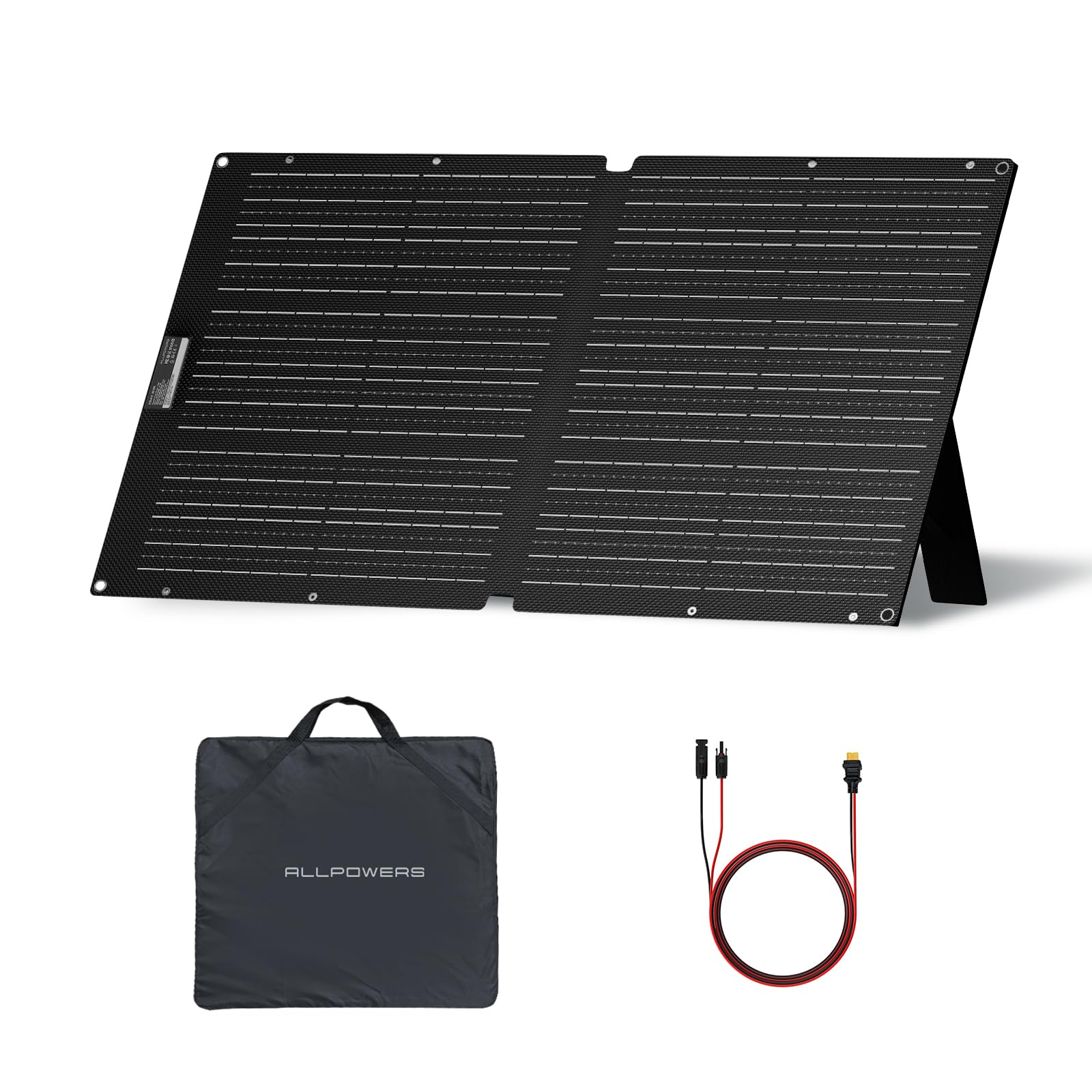
| ALLPOWERS SE100Best for Expansion | Chaining multiple panels | 100W | High Efficiency | 7.9 lb | Amazon |
| DOKIO 100W Suitcase | 12V battery charging | 100W | High Efficiency | 10.1 lb | Amazon |
| Ecosonique 200W | Most power per carry | 200W | 23.5% | 11 lb | Amazon |
| AFERIY 200W | Rugged weather use | 200W | 23% | 12.3 lb | Amazon |
| GEYOTO 100W Bifacial | Low-light harvesting | 100W | 26% | 8.4 lb | Amazon |
| SOKIOVOLA 200W | RV and basecamp power | 200W | 25.5% | 11.57 lb | Amazon |
Detailed Reviews
1. Renogy 100W Portable Solar Panel
Our pick — 4.5+★ from 950+ verified ratings; the strongest balance of quality and price.
The 100W panel that quietly does the boring job right — fold it, prop it, forget it.
For a first panel that has to work in an emergency and on a camping trip, this is the one to start with. It converts 25% of the sunlight hitting it into usable electricity — a conversion efficiency (the share of incoming sun that becomes power) that beats standard 9BB panels rated at 22.5%. In plain terms, you get more charge out of the same patch of sky, which matters most when clouds are cutting your light in half.
What wins people over is how little fuss it makes. The build feels solid, the foldable format packs down to 22.99 x 22.54 x 1.57 inches for storage, and setup is a matter of unfolding and kicking out the stands. Owners talk about realistic jobs rather than lab numbers — sailboat decks, basecamps, a flat battery that needs reviving. Buyers report it bringing a flooded battery to full in roughly four hours of decent sun, with the 5.66 A output holding a steady feed rather than spiking and sagging.
The catch to plan around is the connector situation. This panel terminates in MC4 cables only, so if your power station wants an XT60 or Anderson plug, you need Renogy’s own 4-in-1 adapter, which is not in the box. It is rated IP67, meaning the cells shrug off a dunking, and the ETFE coating is described as hail-resistant. It is also the lightest 100W option here at 7.3 pounds, though heavier than the GEYOTO bifacial at 8.4 pounds it is not — the Renogy actually carries less bulk than that one.
What earns it the top slot
- 25% conversion efficiency from N-Type cells, ahead of the 22.5% common to standard 9BB panels
- IP67 body with an ETFE coating built to take hail and storm weather
- 7.3 pounds — the lightest 100-watt pick in this lineup
- Direct USB-C PD at 45W plus two USB-A ports for phones and tablets
Where it asks a little of you
- MC4 output only — the 4-in-1 adapter for XT60 and Anderson is sold separately
- Charging a bare 12V battery needs a controller you supply yourself
Strongest all-rounder: a first-time emergency panel for power-station owners who want efficiency and weatherproofing without extra bulk.
Add to the cart separately: the matching adapter cable if your station does not take MC4.
2. ALLPOWERS SE100 100W Portable Solar Panel Charger
Buy one now, link another later — a 100W panel built to grow with the sun you have.
The trick here is the chainable wiring. ALLPOWERS lets you link a maximum of more SE100 panels together through the solar cable, so your array grows as your needs do. One 100W sheet today, a second one next summer, same kit. That alone puts it in a different category from the single-shot panels around it.
The output side is respectable too. It pushes 20.8 volts, running 16% higher than the DOKIO range at 18 volts, and delivers 4.8 A. That higher voltage gives it more headroom to feed a power station across a longer stretch of cable. The adjustable bracket swings from 0 to 180 degrees so you can chase the sun through the day, and the whole thing folds to 23.11 x 21.46 x 0.98 inches at 7.9 pounds.
Here is where to be clear-eyed. Reliability is the single most-discussed topic on this panel’s review pages, and the verdict is genuinely mixed — plenty of owners say it works as intended, while a reported failure after four months of use shows up in the mix. The 3-year warranty is the backstop. Treat this as a good expansion play if you want growth potential, and lean on the middle of that review spread rather than the extremes.
The expansion angle: chainable wiring and a 20.8V output give it more upside than a fixed single panel — worth the bet if you plan to scale.
Buy with eyes open: the reliability record is mixed, so the 3-year warranty is doing real work here — register it and keep the receipt.
Reach for this if: you want to start small and add panels later without replacing your kit.
Look elsewhere if: you want a single panel with the clearest reliability consensus — the Renogy above is the safer single buy.
3. DOKIO 100W Portable Solar Panel Suitcase
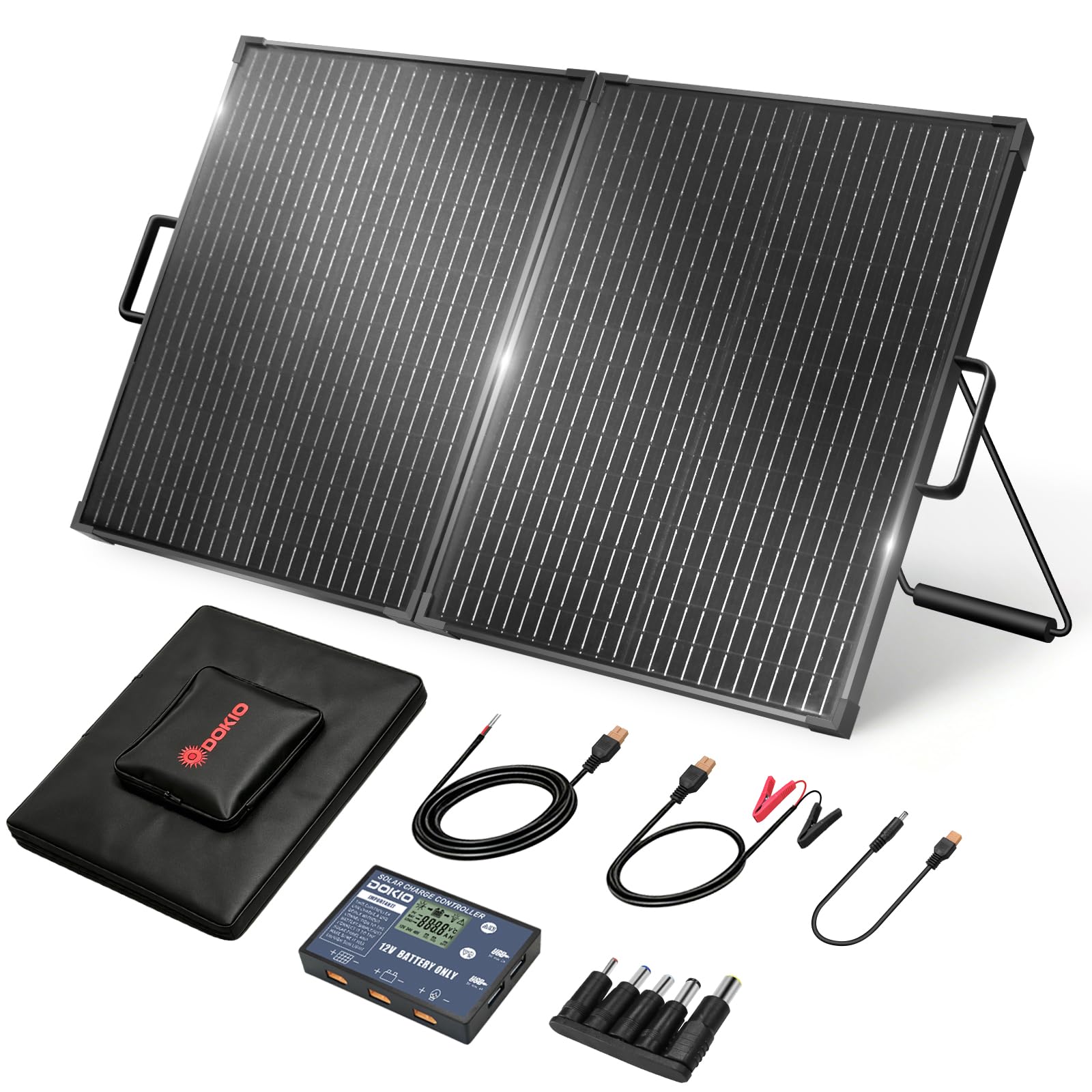
Clips, cable, controller — the only 100W panel here that charges a bare 12V battery on day one.
Most panels in this list assume you already own a power station. The DOKIO assumes you own a battery — a car, a boat, a caravan, a deep-cycle box in the shed — and it charges it with nothing else required. Unfold, clamp the alligator clips to the terminals, and it starts feeding. The quality of the build is what owners rate highest, and the functionality follows close behind; this is the pick that just works from the start.
The details that make it practical are all around the edges. The cable runs 9.8 feet, long enough to leave the battery in the shade while the panel sits in the sun. An adjustable bracket lets you square the panel to the light for the best angle. That integrated PWM controller (pulse-width modulation — a simple, reliable way to regulate charging current) protects against reverse polarity, overcharging, short-circuit and reverse current, so a careless clip connection does not fry anything. It also carries two 5V 2A USB ports for phones.
One thing to know before you buy: the frame and stand are the acknowledged weak point, with a fair share of owners calling the build sturdy while others find the frame a touch flimsy. That is a fit note, not a disqualifier — treat the stand gently and it holds up. At 10.1 pounds and folding to 24 x 18 inches, it is the heaviest of the 100W group, but you are paying that weight for the controller and the aluminum frame.
Why it earns its place: a built-in charge controller and alligator clips make it the one panel here that charges a raw 12V battery straight from the box.
The honest caveat: the frame and stand draw mixed feedback on sturdiness — deploy it gently and it does the job.
Built for the battery owner: the survival pick if your backup plan revolves around a 12V car, boat or deep-cycle battery rather than a power station.
Not your panel if: you want a featherweight for backpacking — this is the heaviest 100W option here.
4. Ecosonique 200W Portable Foldable Solar Panel

Double the watts of a 100W panel, folded into an 11-pound briefcase you can actually grab and go.
When you need to refill a power station fast, wattage is the lever that matters. This panel puts out 200 watts — twice what the Renogy delivers from its 100W sheet — and pushes 10 amps, more than double the ALLPOWERS SE100’s 4.8 A. In real terms, that extra current is what turns an all-day trickle into a few-hour refill. Owners describe charging a 300-watt Bluetti power station from 13% to 100% in a single hour of good sun.
The clever engineering is the six-fold format. It collapses to 18.04 x 16.35 x 2.95 inches and weighs 11 pounds, so 200 watts of panel fits where a 100W suitcase might barely go. Four adjustable kickstands let it sit at the right angle, and grommets let you hang it from a tent, an RV rail or a tree. Outputs cover the major power station brands via the included MC4-to-XT60, Anderson, DC7909 and DC5525 adapters, plus USB-C PD3.0 at 45W and USB-A QC3.0 for smaller devices.
The honest trade-off lands on durability and stability. The quality score is what owners rate most highly, and performance is praised right behind it, but durability draws a clearly negative read and stability gets a negative nod too — likely the flip side of folding so many panels into a light package. If you plan to leave it deployed day after day on a roof rack, keep an eye on the folding panels. For a weekend emergency kit that lives in a backpack, that trade is well worth it.
Power-to-bulk ratio: 200 watts and 10 A out of an 11-pound briefcase-fold package — the fastest way to top up a big power station in this lineup.
What to watch: the lightweight multi-fold build takes more care than a rigid frame panel; handle the folding joints kindly.
Pick this for speed: a fast refill of a large power station when you can spare 11 pounds in the vehicle.
The trade to weigh: more watts come with a more delicate fold — is your use a gentle weekend or a hardened daily deployment?
5. AFERIY Portable Foldable 200W Solar Panel

A 200-watt sheet wrapped in Oxford fabric and ETFE, built to live outside.
If your panel will spend its life in the bed of a truck or strapped to a pack, build quality edges out raw efficiency. That is exactly where this AFERIY shines — customers rank its build highest of all its strengths. The Oxford fabric shell and advanced ETFE coating are a rugged combo, rated IP65 for water and dust resistance, so a splash or a dusty trail does not end the day. It puts out 200 watts at 23% efficiency, right in the competitive band for this class.
The setup ergonomics are fuss-free. A built-in handle makes it carry-ready at 12.3 pounds, and adjustable kickstands on the back angle the panel toward the sun without any guessing. The multi-fold design packs down to 20.8 x 23.6 x 1.4 inches. Multiple USB output ports let you charge phones, tablets and power banks directly, so it works as a standalone emergency charger as well as a station feeder.
The practical limit is the connection pairings — it ships with an MC4-to-Anderson cable, so buyers who want to feed an XT60 inlet will want a matching adapter in advance. Efficiency tracking is a touch behind the GEYOTO bifacial at 26%, for what that is worth. And with a small but enthusiastic owner base, there are fewer long-term stories to lean on than the high-volume picks up the list — the IP65 body and rugged shell are your reassurance.
Why it holds up
- Oxford fabric and ETFE coating rated IP65 for water and dust
- 200 watts at 23% efficiency with adjustable kickstands for aiming
- Built-in handle and multiple USB ports for standalone emergency charging
What to plan for
- Ships with an MC4-to-Anderson cable — an XT60 adapter is an add-on
- A smaller owner base than the high-volume picks, so less long-term pattern to draw on
For the rough-and-tumble user: if rugged build matters more than chasing the last percent of efficiency, this is your panel.
Plan the adapter: confirm your power station inlet and add the cable before you head out.
6. 100W Portable Solar Panel Bifacial Foldable
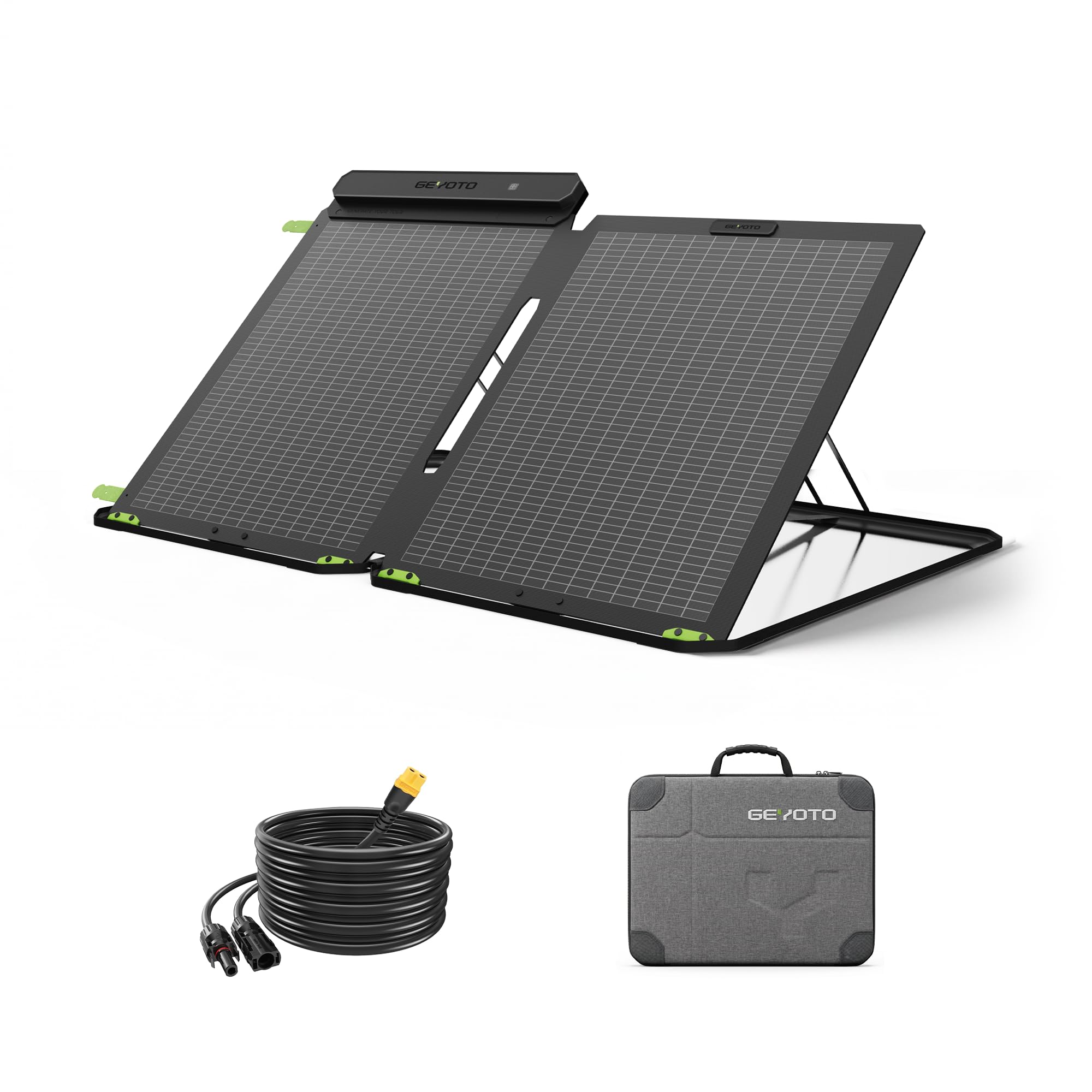
The panel that borrows light from its own back — 26% efficiency when the sun is stingy.
The defining number here is 26% conversion efficiency, the highest in this entire roundup and a notch above the Renogy at 25% and the AFERIY at 23%. That matters most on the days that actually test a survival kit: overcast mornings, low winter sun, the shaded edge of a campsite. More of the light that reaches the panel becomes charge, so a marginal day is less of a write-off.
What makes the efficiency possible is the bifacial design — a panel that collects light on its front face and its rear, with the EVA case’s reflective inner lining bouncing stray light back onto the underside. It pairs 16BB N-Type cells with that dual-face approach, and the 25.2V output is the highest voltage among the 100W options here, running well clear of the DOKIO’s 18V. The two-fold format keeps it portable at 8.4 pounds, and a 9.8-foot MC4-to-XT60 cable lets the power station sit in the shade.
Two practical notes before you commit. First, it is rated IP68 on the panel itself but the junction box is excluded from that, and the maker advises against prolonged rain — so shelter the connections if a storm rolls in. Second, the box includes the cable and kickstands, but DC and USB adapters are not part of the kit. If you want direct device charging from this one, plan for separate adapters.
The number that matters: at 26% it converts more sunlight than any other panel here — the pick for grey skies and low sun angles.
Weather note: the IP68 rating covers the cells, not the junction box; pull it in for a real storm.
Choose it for weak sun: a low-light, high-efficiency panel for the cabin, the trailhead or anywhere the weather is unreliable.
Budget the extras: the DC and USB adapters are not in the box — if you want direct device charging, add them.
7. SOKIOVOLA N-Type 16BB 200W Portable Solar Panel
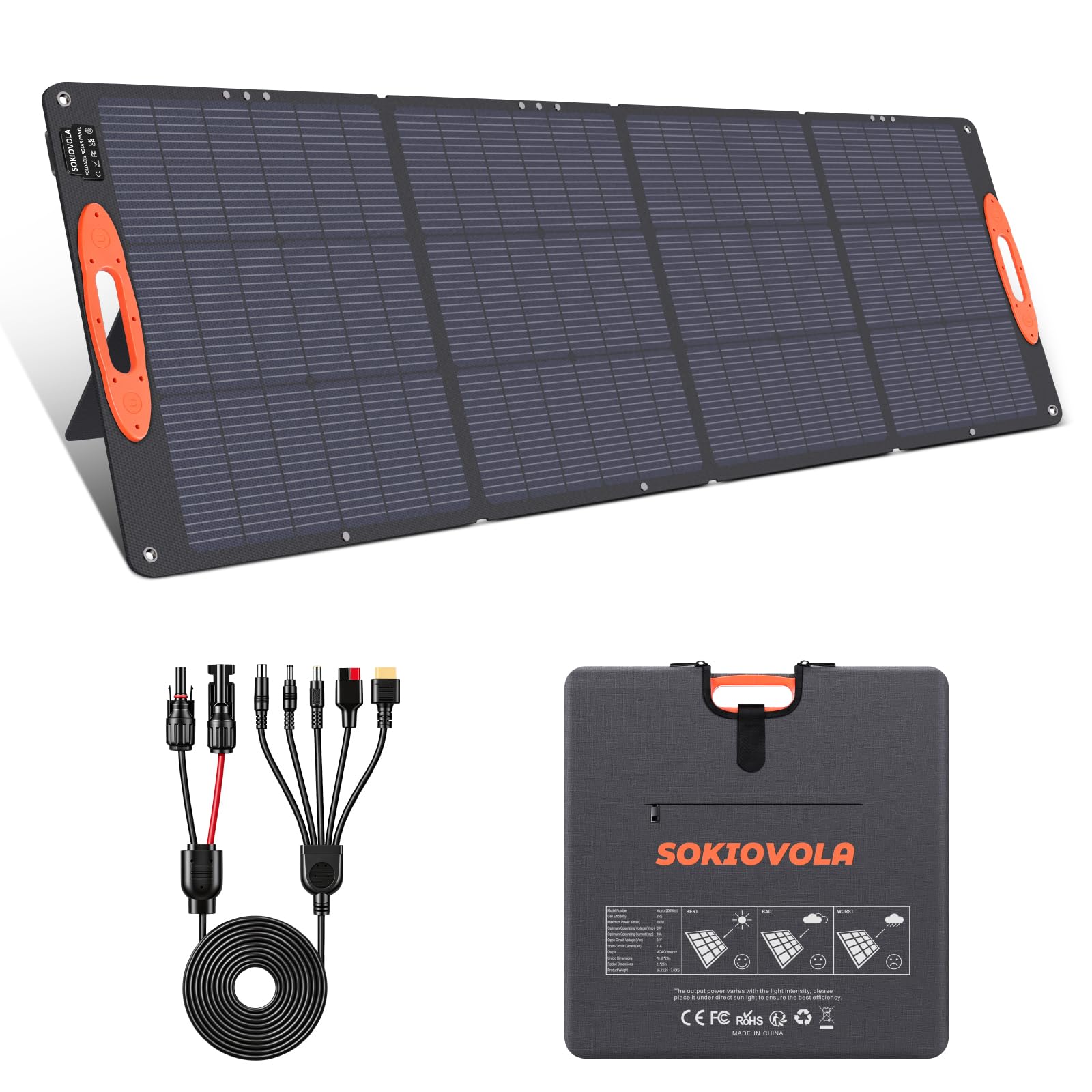
An RV-friendly 200-watt sheet that arrives with every adapter you are likely to need.
For a basecamp or RV setup where the panel stays deployed and you want the whole plug ecosystem handled, this one is hard to argue with. It delivers 200 watts at 25.5% efficiency from A+ grade monocrystalline cells, a fraction under the GEYOTO’s 26% but with double the wattage behind it. The 5-in-1 adapter set lands in the box — XT60, DC5521, DC7909, DC8020 and Anderson — so it plugs into most power stations without a trip to the adapter aisle first.
The practical spec here is how it stays put. Four holes let you bolt it to an RV wall or roof frame, and the magnetic handle makes it manageable to move at 11.57 pounds. It folds to 21 x 23.14 inches, wrapped in an ETFE coating that is IP68 rated for water and dust, so it takes on the weather. Owners mention it running a fridge without issue — a steady feeder for a cabin or vehicle that needs continuous power.
The honest edges: this weight is fine for a vehicle but heavy for long hiking trips, which the maker itself flags. And every panel in this class can be limited by a power station that caps its input — if your station has a maximum input wattage, it will not pull the full 200W no matter how bright the sun. Check your station’s input limit before you blame the panel. Backed by a 12-month warranty and a 30-day refund window.
Where it delivers
- 5-in-1 adapter cable included for XT60, DC5521, DC7909, DC8020 and Anderson
- 200 watts at 25.5% efficiency with an IP68 ETFE coating
- Four mounting holes and a magnetic handle for RV or fixed deployment
Where it needs care
- 11.57 pounds is heavy for backpacking — it is a vehicle partner, not a trail one
- Your power station’s input cap can limit the power it pulls, so check that limit first
Made for the vehicle: a bolt-down 200-watt feeder for RV, cabin or basecamp use where adapter compatibility is the headache to solve.
Leave it off the pack: if your plan is long-distance hiking, the weight is working against you.
Know the Specs
Conversion Efficiency (the %)
This is the share of sunlight that lands on the panel and actually becomes electricity. Higher is better, especially in weak light — a 26% panel turns more of a cloudy sky into charge than a 23% panel under identical conditions. That is why the highest-efficiency pick here is worth considering even at lower wattage: it squeezes more from the grey days that real emergencies tend to happen on. Do not chase this number alone, though — a 200W panel at 23% still produces far more total power than a 100W panel at 26%.
Amperage and Voltage (A and V)
Voltage is the pressure the panel pushes, and amperage is the volume of current it flows. Your power station or charge controller has to accept both. A 20.8V panel feeding an 18V input is over the limit; match the panel’s maximum voltage to your device’s input range before buying. Amperage tells you how briskly it refills — a 10A panel charges roughly twice as fast as a 4.8A one in the same sun, which is the difference between a few hours and most of a day at the battery bank.
IP Ratings (Dust and Water)
The IP number has two digits. The first is dust and solid-object protection, the second is water. IP65 survives rain spray; IP67 tolerates a short dunk; IP68 is the toughest of the everyday ratings. Remember that the rating often covers the panel surface and not the junction box, so the connectors still deserve shelter in a downpour. Read the rating as how much weather the panel can take before you have to step in.
Connectors and Controllers
MC4 is the solar industry’s two-pin connector; XT60, Anderson, DC7909 and DC5525 are the input types common on power stations. A panel that ships the right adapter is one less thing to buy. Separately, a charge controller sits between a panel and a raw 12V battery to stop overcharging and reverse current — power stations have this built in, but bare batteries do not. If you are charging a car or boat battery, a panel with a controller on board is the simpler choice.
Common Questions
Will these panels charge my Jackery or EcoFlow power station?
Can I charge a car battery directly with one of these panels?
What does bifacial mean on a folding panel?
Is IP65 good enough for a panel left out in the rain?
How many watts do I need for a blackout backup plan?
Do these panels work on cloudy days?
Can I link two panels together for more power?
Will a 200W panel overload a small power station?
What is the difference between MC4 and XT60 connectors?
How should I store a folding solar panel between emergencies?
The Bottom Line
For most people building a survival power kit, the survival solar panels winner is the Renogy 100W Portable because 25% efficiency (how much sunlight it turns into power), an IP67 body (sealed against dust and able to survive brief water immersion) and a 7.3-pound carry weight cover the widest range of emergencies without a single weak link. If raw refill speed and a big power station are your priority, grab the Ecosonique 200W for its 10A output in an 11-pound briefcase fold. And for charging a raw 12V battery with no extra gear, the DOKIO 100W Suitcase is the one to reach for.
If the sun is unreliable where you live, the GEYOTO bifacial at 26% efficiency is worth the look — the highest efficiency in the roundup for squeezing charge out of weak light. Whichever you choose, match the connector to your station and keep a charge controller in the loop for bare batteries.
How we choose
We do not accept paid placement. Every pick is matched to a real buyer and a real use-case; we do not hands-on test units.
Sources
Specifications: manufacturer listings and product documentation. Review insights: verified customer reviews, as of November 2026. Pricing: not shown on this page (it changes often); check the current price via the retailer link.
As an Amazon Associate, Tactical Gear Guy earns from qualifying purchases. This does not affect which products we feature.