Specs are compiled from manufacturer listings and verified buyer reviews and can change over time — please confirm the key details on the product page before buying.
Halfway through a rocky descent, the seat under you decides whether you keep riding or cut the loop short. If you buy one upgrade this season, make it the seat: it’s the one contact point that decides whether a two-hour trail ride feels easy or miserable. This guide covers nine seats built for female anatomy, all with wide rear support and a channel to relieve pressure — and points you to the one worth your money first.
This guide is built by comparing the manufacturers’ published specifications and the patterns across verified customer reviews, so you get each pick’s real strengths and trade-offs instead of marketing spin.
A mountain bike seat that matches your sit bones (the two bony points under your pelvis) and keeps pressure off soft tissue is the upgrade most riders notice right away on the trail. Below I break down the real specs and honest trade-offs behind each contender, so you can find the best women’s mountain bike seat without guesswork.
Top Picks

How To Choose The Best Women’s Mountain Bike Seat
A women’s mountain bike seat does three jobs. It holds your sit bones (the bony points under your pelvis), keeps pressure off the soft tissue in front, and stays put while you shift your weight on climbs and descents. Get those right and rough terrain stops hammering your sit bones. Get them wrong and every rock and root registers through the saddle.
Match the seat to your sit-bone width
Your sit bones are the two hard points you feel on the saddle when you sit upright. A seat that is too narrow lets those bones hang off the edge, which pushes pressure onto soft tissue. Women typically have wider sit-bone spacing than men, so women’s-specific saddles tend to run wider at the rear. A rear width of roughly 155mm or more, as on the Terry Butterfly Galactic+, gives you a broader platform.
Look for a real cutout or channel, not a groove
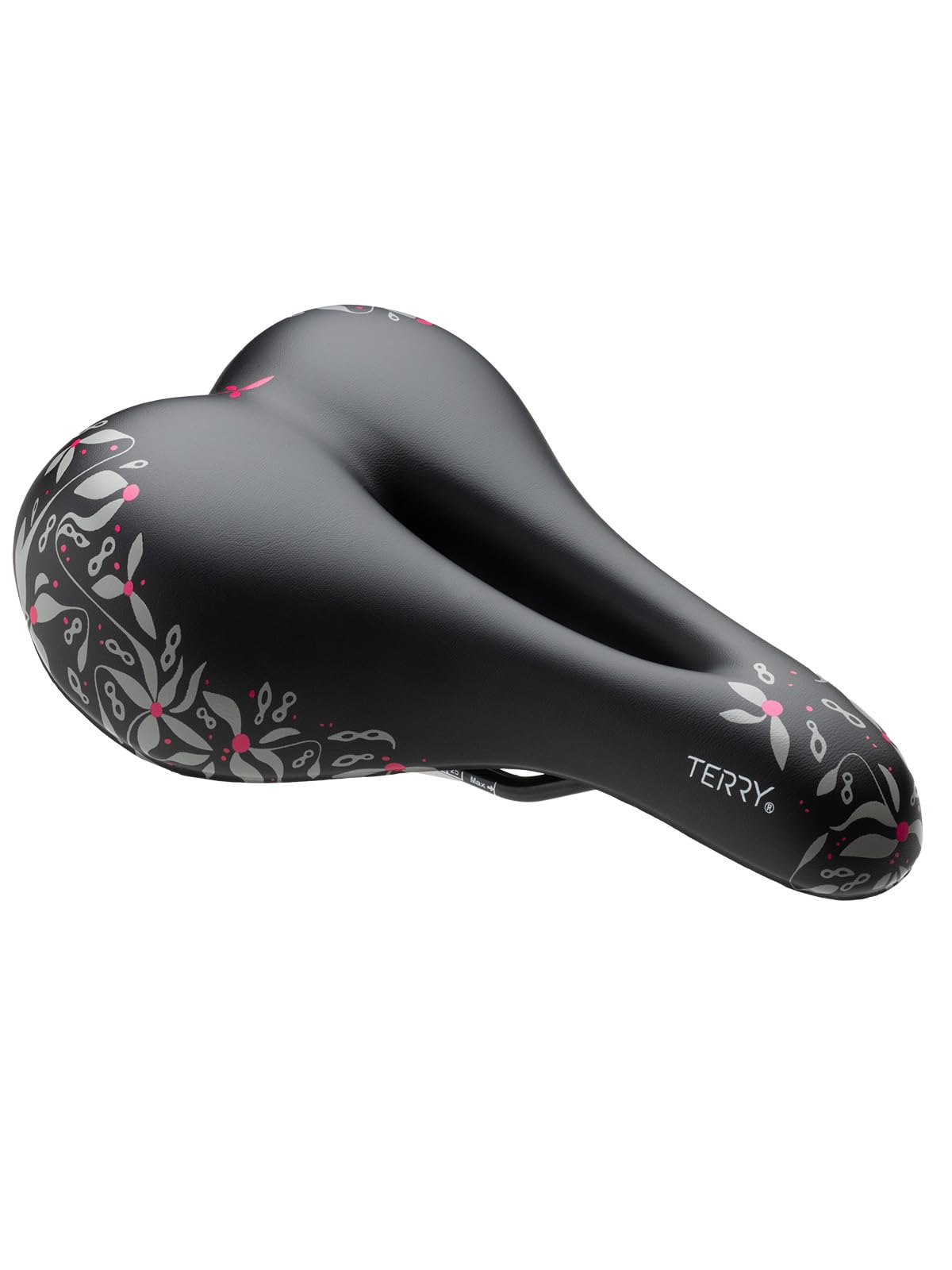
A center cutout is a hole or deep recess running down the middle of the seat. It gives soft tissue somewhere to go instead of being squashed against the shell (the rigid base under the padding). A shallow groove on a soft cover does far less. The Terry Butterfly Cromoly and the Galactic+ both run a cutaway right through the nose and mid-section — the kind of relief you feel on long seated climbs.
Decide how much padding you actually want
More padding is not always better on a mountain bike seat. Too much foam can bunch up and create new pressure points, especially on a mountain bike where you move around on the seat. The best trail seats pair a firm shell with targeted gel pads: the Ergon SMC Sport Gel uses orthopedic comfort foam with gel pads, while the Terry Cite X pairs foam with a thin gel layer for shock absorption.
Rails and weight: trail reality
Rails are the metal bars underneath that clamp into your seat post (the tube your seat slides onto). Steel rails are common and budget-friendly; cromoly (a steel alloy) is stronger for its weight; manganese is lighter still. A lighter seat is easier to throw around on descents, but a few hundred grams of saddle weight hardly matters on a mountain bike. Focus on sit-bone fit and saddle shape first, and treat rail weight as a bonus.
Side-by-Side Comparison
| Model | Best For | Rear Width | Weight | Cutout | Amazon |
|---|---|---|---|---|---|
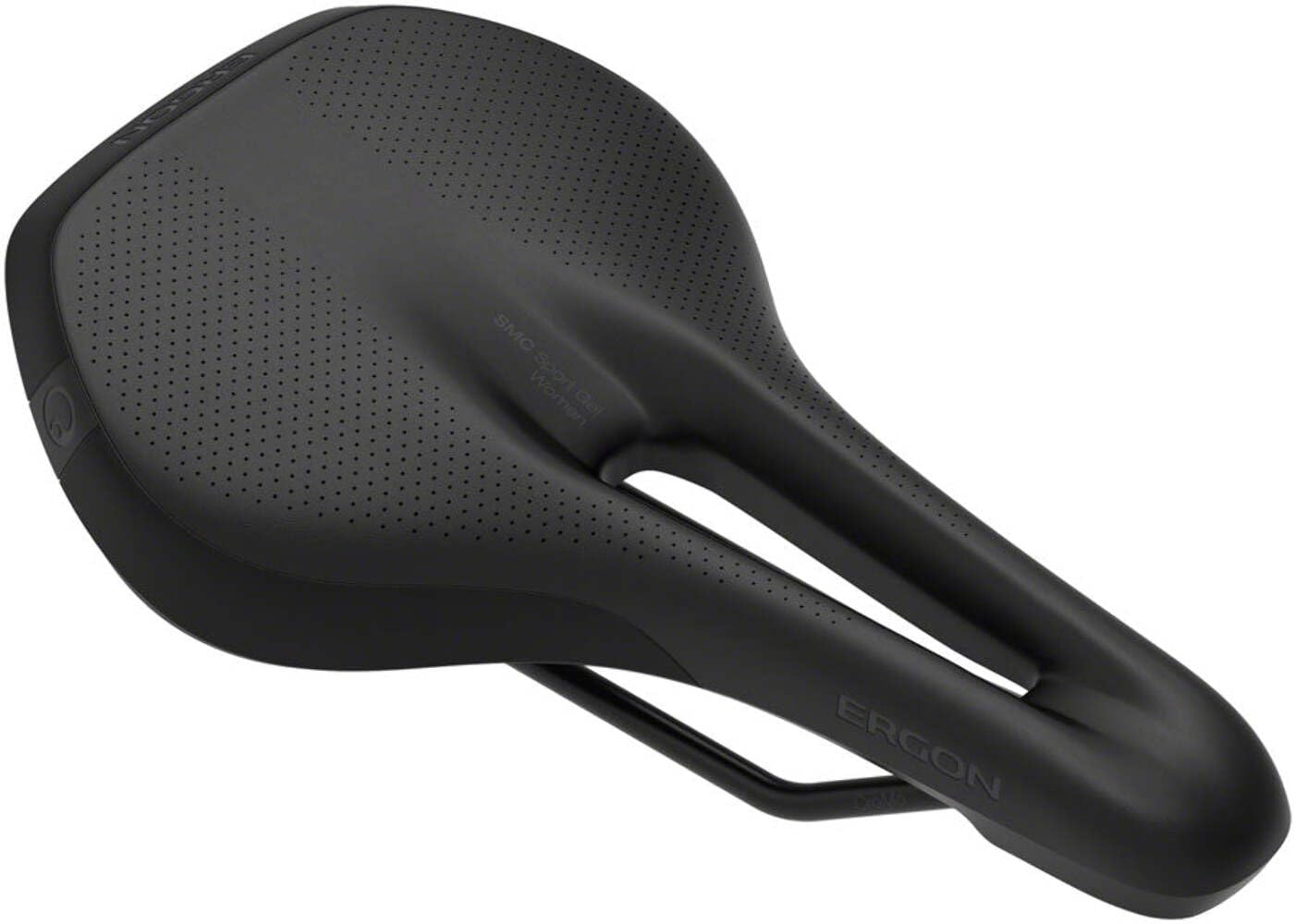
| Ergon Women’s SMC Sport Gel Saddle★ Best Overall | All-round trail comfort | 9 in | 320 g | Pressure-relief channel | Amazon |
| Terry Cite X Gel SaddleBest for Half-Day Rides | Recreational half-day rides | — | — | Center cutaway | Amazon |
| Planet Bike A.R.S. Standard Women’sMost Popular Pick | Value comfort with broad support | — | 407 g | Full-length center recess | Amazon |
| Serfas RX Saddle Women’s RX-922L | Long rides without padded shorts | 6.88 in | 1.2 lb | Pressure-free center channel | Amazon |
| Selle Italia Lady Gel Flow | Indoor trainer and long sessions | 9 in | 310 g | Gel flow relief | Amazon |
| Terry Butterfly Galactic+ | Widest cutaway for wider sit bones | 155 mm | 260 g | Widest cutaway in lineup | Amazon |
| Ergon SM E-MTB Sport Womens | Long seated climbs and steep ascents | 7.48 in | 320 g | Orthocell pressure distribution | Amazon |
Detailed Reviews
1. Ergon Women’s SMC Sport Gel Saddle
Our pick — 4.5+★ from 950+ verified ratings; the strongest balance of quality and price.
Long trail rides stay comfortable without the mushy, over-padded feel.
This seat earns the top spot on its 4.5+ star rating across a strong base of owners. Start with the shape: it measures 9 in wide at the rear and 2.5 in tall, giving you a broad platform where your sit bones land. The shell — the rigid base under the padding — is nylon composite, covered in microfiber so you can slide into a new position smoothly. CroMo rails (a chromoly steel alloy that clamps into your seat post) keep it strong for trail abuse.
Where it wins: the comfort. Orthopedic comfort foam with gel pads spreads pressure, and reviewers describe it as firm enough to ride on but never harsh — like sitting on a bar stool rather than sinking into a couch. It adjusts easily across riding positions too, and one reviewer noted riding 20 miles without padded shorts. At 320 g, it stays light enough to throw into a turn; the Ergon SM is lighter at 295 g, a difference most trail riders won’t notice pushing uphill.
The catch is durability: it’s rated mixed on how it holds up over time, so treat a seat this light with normal care. The width also runs on the larger side — great for wider sit bones, less ideal for a compact build that wants a narrow nose. Riders who put in big trail miles and want proven comfort should start here; if durability is your first priority, look at the Serfas RX below.
What riders feel
- Orthopedic foam with gel pads spread pressure on long rides
- Adjustable across riding positions
- Microfiber cover lets you shift smoothly
- 320 g keeps the trail feel lively
Worth knowing
- Durability reads mixed over the long haul
- Wider rear suits broader sit-bone spacing better
Best overall: The all-rounder for trail riders who want dependable comfort, a pressure-relieving shape, and a 320 g seat.
Think twice if: You have narrow sit bones and want a seat that never crosses your mind near the end of the season.
2. Terry Cite X Gel Saddle
A recreational seat that turns a few hours on the trail into a pleasant cruise.
Terry built this seat for half-day rides — exactly how a lot of weekend trail riders ride. Its foam padding carries an added thin gel layer for shock absorption, and a 300-pound maximum weight capacity covers most riders. Steel rails keep the price down, and the synthetic vinyl top wipes clean and stays looking fresh.
What owners consistently appreciate is the firmness — supportive without feeling like a plank — plus straightforward installation. The screen-printed graphics at the rear add a bit of personality. The one recurring note is sizing: buyers report the seat feels too small for their needs. So check your sit-bone width (the spacing between the bony points under your pelvis) before you commit.
Ride feel: The thin gel layer takes the sting out of rough paths without turning the seat mushy, so you stay connected to the trail.
The honest limit: If you want a wide platform or a long-haul touring seat, this one runs small and is built for shorter sessions.
Reach for this if: You ride recreationally for a few hours and want easy installation plus a low-maintenance cover.
Look elsewhere if: You need a wide seat for broad sit bones or plan all-day epics.
3. Planet Bike A.R.S. Standard Bike Seat Women’s
The seat that convinced a huge crowd a bike can feel comfortable from mile one.
Comfort is the headline here, and buyers talk about it more than any other quality on this seat. Sit-bone gel pads sit under your bony points with foam padding around them, taking pressure off soft tissue. A full-length center recess with a cutout gives relief down the middle. The cover is weather-resistant with abrasion-resistant side material, so scuffs from shorts and trail spray aren’t a big concern. Owners also like the look — it reads cool and aggressive.
Weight comes in at 407 g on steel rails, heavier than most on this list and normal for a comfort-shaped saddle. Here’s the balance: fit, cushioning, firmness, and adjustability all get a mixed read, so some riders find the padding softer or the shape snugger than expected. None of that erases the positive consensus, but it’s the reason you should measure before you buy. Touring riders who go for long, steady hours rate it among the most proven comfort seats here.
Owners praise
- Comfort consensus stretches across 15-25 mile rides
- Full-length center recess eases soft-tissue pressure
- Weather-resistant, abrasion-resistant cover
- Holds up to long, steady hours in the saddle
Weigh the trade-off
- 407 g on steel rails is heavier than several here
- Cushioning and firmness suit some riders more than others
The crowd favorite: A broadly comfortable, durable seat that suits touring and trail riders who value proven comfort.
Skip if: You’re chasing the lightest build or a narrow, firm racing platform.
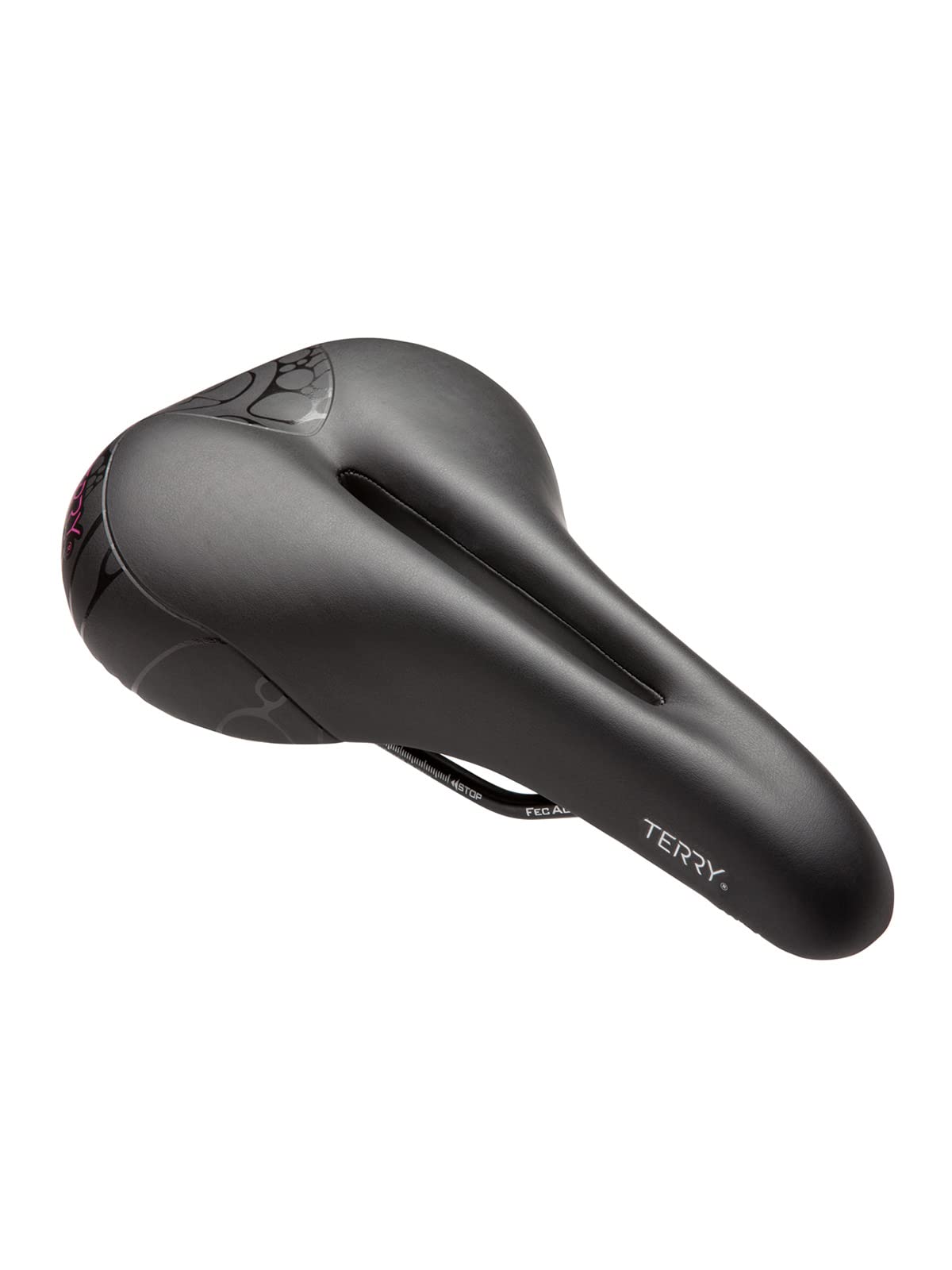
A full center cutaway that gives soft tissue real breathing room on long rides.
Terry’s signature move is the complete cutaway running right through the nose and mid-section — the deepest relief on this list. Multi-density injection-molded foam is firmer toward the rear for better power transfer when you pedal, softer where you need it. The smooth, smooth synthetic Dura-Tek top wipes clean and has screen-printed accents.
Fit is what owners talk about most, and it translates to comfort: the seat is well-made and the cutaway suits riders of many builds. At 13 in long, 7 in wide, and 4 in tall it’s a moderate footprint that sits neatly on hybrid and city bikes, and at 6.08 oz it’s one of the lightest here. Compare it with the Butterfly Galactic+ at 260 g: the Galactic+ gives you a wider 155 mm cutaway, while this one stays the cheaper, narrower city option.
One honest note: durability divides buyers. Some find it very well made; others report it holding up less well than expected. The design also breaks the category rule of thumb — it’s listed for city and hybrid bikes, so trail riders should confirm it matches their ride style.
The real strength: That complete nose-to-mid cutaway is the most generous soft-tissue relief here, and it makes long seated pedaling far more bearable.
The trade-off: Durability gets a split verdict, so treat the synthetic cover with care and expect it to be the part that ages first.
Made for: Riders who want the deepest center relief and a lighter seat on hybrid or city rides.
Maybe not for: Hard trail riders who need the extra build strength of a dedicated MTB platform.
4. Serfas RX Saddle Women’s RX-922L

The one that is designed to make padded shorts optional, even on fifty-kilometer days.
The brand claims this saddle’s gel padding delivers enough cushioning to skip padded shorts and ride in everyday clothes. The pressure-free center channel runs the length of the seat to relieve soft tissue and improve airflow. It’s built for mountain, road, and electric bikes, with a waterproof cover and twin-bar flex plus dual-density support underneath.
On the numbers, it’s the most compact full seat here at 9.44 in long and 6.88 in wide — narrower than the Ergon SMC at 9 in wide and shorter than the Ergon’s 15 in length. Owners mention it’s easy to ride even after a season off, and it holds up over weekend rides with no significant wear. One buyer mentioned covering 50km plus without issues.
The trade-off: appearance, firmness, and adjustability all get a mixed read, so the shape may feel snug or firmer than some expect. At 1.2 lb it’s not the lightest either. If your priority is a durable, well-cushioned seat for long, steady rides, that’s a fair swap.
Ideal for: Long-distance and weekend riders who want strong cushioning and durability over minimum weight.
Less ideal for: Riders wanting a wide platform or a featherweight seat for racing.
5. Selle Italia Lady Gel Flow

A trainer-friendly saddle with a shock absorber to soak up road buzz and drone sessions.
A small elastomer block (a rubbery bumper between the rails and the shell) works like suspension for your seat — it absorbs vibration before it reaches you. Gel padding runs through the shell to reduce pressure, and the Fibrate cover plus tubular manganese rails complete a light 310 g build.
The rear runs 9 in wide across a 2.5 in tall profile, matching the Ergon SMC in width but sitting a touch lighter at 310 g versus 320 g. That width makes it a good seat for riders with wider sit bones. Owners describe hours on the trainer without numbness and a fit that feels right.
The caveat is pressure — it’s rated mixed, with some finding the seat hard. That’s expected on a saddle tuned for support rather than softness. Mounting is universal, so it fits most bikes. Long-session riders on a trainer or steady road miles who like firm support get the best of it.
What stands out: The elastomer between rails and shell is a genuine comfort feature, dampening the constant small kicks of road and trainer riding.
Watch for: Mixed pressure feedback means some will find it firm — good for support, not for everyone’s idea of soft.
Fits best: Riders who spend long sessions on a trainer or steady road miles and like firm support.
Look past it if: You want a plush, deeply cushioned seat for casual cruising.
6. Terry Butterfly Galactic+

A reflective, wide-cutaway saddle that treats soft-tissue relief as the whole point.
At 260 g (or 9.3 oz), this is the lightest seat on the list. The headliner is the widest cutaway in Terry’s Butterfly lineup, opening right through the nose and mid-section for maximum flexibility against soft tissue. It measures 155mm at its widest and 262mm long, so it’s built to support broad sit-bone spacing. Manganese rails hold it steady, and a black Dura-Tek cover carries a constellation screenprint in reflective ink for visibility after dusk.
The size math is worth noting: its 4 in height sits tall against the Ergon SMC’s 2.5 in, giving a more sculpted profile. Customers note no soreness during or after rides, with the cutaway shape doing the heavy lifting for comfort.
Quality and appearance round out the praise, but the small number of total reviews means the sample is younger than the established picks above. Riders with wide sit bones and a preference for deep relief will feel at home; if you want a long track record before you spend, the Planet Bike A.R.S. has far more comfort consensus behind it.
Why riders like it
- Widest cutaway in the Butterfly lineup
- Lightest seat here at 260 g
- Reflective constellation print for low-light visibility
- 155mm width suits broader sit bones
Consider before you buy
- Smaller review base than the established picks
- Wide cutaway shape suits some hips better than others
For you if: Deep soft-tissue relief, light weight, and reflective details matter most.
Look elsewhere if: You want a long track record and a more traditional solid profile.
7. Ergon SM E-MTB Sport Womens

The climbing specialist, shaped for long seated ascents and e-MTB torque.
This seat is tuned for prolonged seated climbing and particularly steep ascents, which is where e-MTB (electric mountain bike) riders spend a lot of time. The ramping tail and flat circumference give you freedom to shift forward and back, while dynamic comfort padding keeps long grinds bearable. Orthocell inlays (firm inserts in the seating area) work to distribute pressure evenly across your sit bones.
It’s a dedicated mountain bike saddle at 320 g with a microfiber cover. Its 13.78 in length, 7.48 in width, and 3.94 in height match the Ergon SM Womens closely — same footprint, different tuning for climbing and e-bike duty. The stealth black finish keeps it understated.
There’s no review summary on file for this listing, so the case rests on its climbing-specific design. If your rides are steep and you stay seated to power up, this is the shape built for exactly that job — but confirm the 7.48 in width matches your sit bones first. Flat, upright cruisers should look at the Terry Cite X instead.
The climbing edge: The ramped tail and Orthocell pressure distribution are made for the long, seated grinds that define steep e-MTB climbs.
The check first: With no owner summary here, measure your sit-bone width before buying — the 7.48 in platform suits many, not all.
Choose it for: Steep, seated climbing and e-MTB torque where you stay planted and push.
Pass if: Your riding is mostly flat and upright and you want a plain cruising seat.
Know the Specs
Sit-Bone Width and Saddle Width
Sit-bone width is the distance between the two bony points under your pelvis; saddle width is the rear measurement of the seat that has to support them. A seat wider than your sit bones lets them rest on the padding; one too narrow pushes them off the edge onto soft tissue. On mountain bikes, a rear width in the 7 to 9 inch range, or around 155mm, is common for women’s-specific designs. Measure your sit bones on a piece of corrugated cardboard from the indentations, then match the rear width.
Center Cutout and Pressure Relief
A center cutout is the gap running down the middle of a saddle that gives soft tissue room instead of pressure. The deeper the cutaway — like a complete nose-to-mid hole — the more relief you tend to feel on long seated climbs. A channel or recess is a shallower version of the same idea. If numbness is your main complaint, prioritize a seat with a full cutaway or deep recess over one with extra foam in the middle.
Padding, Gel, and Rail Materials
Padding is the foam that cushions you; gel is an added layer that spreads pressure more evenly. Gel doesn’t make a seat softer so much as pressure-free in specific spots. Rails are the metal bars that clamp to your seat post: steel is common and budget-friendly, cromoly (a steel alloy) is stronger, manganese is lighter. For trail riding, a weight difference of a few hundred grams matters less than a fit that keeps you comfortable over miles.
Riding Position and Seat Shape
Your riding position changes what shape works. An upright recreational rider puts more weight on the rear of the seat, so a wider rear helps. A trail rider who stands and shifts often benefits from sliding flanks (smooth seat sides your thighs can move along) and a narrower nose. A climber staying seated on steep grades wants a ramped tail and even pressure distribution. Match the seat’s shape to how you actually ride, not to how a spec sheet reads.
Common Questions
How wide should a women’s mountain bike seat be?
Will a center cutout actually stop numbness on long rides?
Can I use a road or city saddle on mountain trails?
Do I need padded shorts with these seats?
What do cromoly, steel, and manganese rails mean?
How much does seat weight really matter on a mountain bike?
How tight should I clamp the saddle to the seat post?
Will a women’s-specific saddle fit a men’s bike?
How long should a mountain bike saddle last?
Should I sit forward or back on a mountain bike seat?
The Bottom Line
For most riders, the best women’s mountain bike seat is the Ergon Women’s SMC Sport Gel because it balances comfort, a pressure-relieving shape, and a