Specs are compiled from manufacturer listings and verified buyer reviews and can change over time — please confirm the key details on the product page before buying.
Your phone in an armband is not a running watch. A real one locks onto satellites in seconds, tells you your pace mid-stride without breaking your rhythm, and keeps going for days between charges. Below are the watches that do exactly that, sorted by what each one is actually good at — the wrist-sized one, the one that lasts weeks, the one that maps your route without a phone in your pocket.
This guide is built by comparing the manufacturers’ published specifications and the patterns across verified customer reviews, so you get each pick’s real strengths and trade-offs instead of marketing spin.
Every pick here tracks distance and pace by satellite, so the difference is how it does it and how long it keeps doing it. Here is how to sort the top running watches by the one spec that actually changes your training.
Top Picks

How To Choose The Best Top Running Watches
Almost every watch here will tell you your distance and pace. What separates them is what happens on mile eighteen, in the rain, under a bridge, or six days after your last charge. Start with those three problems and the shortlist builds itself.
Read the GPS-mode battery, not the marketing number
The headline battery figure is usually the easy one — the watch sitting on your nightstand doing nothing. The number you actually live with is GPS mode, when the satellite receiver is running non-stop. A watch rated at 12 hours in GPS mode covers a couple of long runs before it needs a charge. One rated at 41 hours covers a full training week without you thinking about it.
Dual-band GPS keeps your route honest
Standard GPS locks onto one satellite signal. Dual-band GPS listens on two frequencies at once, which helps when buildings, trees, or canyon walls bounce the signal around. Without it, your route line can wander off the pavement and your pace spikes or dips for no reason. If you train in a city or anywhere with tall cover, this is the spec to check first.
Match the case size to the wrist you actually have
A 47 millimeter case on a slim wrist sits wide and catches on sleeves. A 42 millimeter case sits flat and reads clean. Case diameter and band width — 20 millimeters versus 22 millimeters — decide how the watch feels over 26 miles and whether your existing straps will fit it.
Side-by-Side Comparison
| Model | Best For | GPS Battery | Weight | GPS Type | Amazon |
|---|---|---|---|---|---|
| Garmin Forerunner 570 (42mm)★ Best Overall | Small wrists, full training suite | Up to 18 hours | — | Multi-band with SatIQ | Amazon |
| Amazfit Bip MaxBattery Champion | Long battery on a budget | — | — | 5 satellite systems | Amazon |
| Mibro AeroPaceFeatherweight Pick | Ultralight with offline maps | Up to 12 hours (Performance Mode) | 32 g | Dual-band, five-system GNSS | Amazon |
| SUUNTO Run | Fast charging and textiles | Up to 20 hours | 36 g | Dual-frequency | Amazon |
| Polar Street X | Rugged hybrid training | Up to 43 hours | 48 g | Built-in GPS with route guidance | Amazon |
| COROS PACE 4 | Featherweight racing | Up to 41 hours | 32 g | GPS with breadcrumb navigation | Amazon |
| Garmin Instinct 3 Solar | Rugged outdoor durability | — | — | Multi-band with SatIQ | Amazon |
| Polar Vantage M3 | Mapping and running power | Up to 30 hours (training mode) | 53 g | Dual-frequency with turn-by-turn | Amazon |
| Samsung Galaxy Watch Ultra | Android users who want it all | — | — | Dual-frequency | Amazon |
| Garmin Forerunner 945 LTE | Phone-free race day | Up to 12 hours with music | — | Full-color onboard maps | Amazon |
| Garmin Forerunner 970 | Serious training, titanium build | Up to 26 hours | — | Multi-band with built-in maps | Amazon |
Detailed Reviews
1. Garmin Forerunner® 570, 42mm, Aluminum, Bone/Mango
Our pick — 4.5+★ from 600+ verified ratings; the strongest balance of quality and price.
The full coaching suite shrunk to a 42mm case that fits a slim wrist flat.
Most training watches come in one size and ask your wrist to deal with it. This one comes in at 42 millimeters with a 20 millimeter band — the narrowest strap width on this list — so it sits flush instead of overhanging. The aluminum bezel keeps the weight reasonable while giving the case something to shrug off scuffs with.
Where it earns its place is the coaching depth. Training readiness combines sleep quality, recovery, training load and HRV status (heart rate variability — the small beat-to-beat changes that hint at how recovered you are) into one go-hard-or-back-off number. Daily suggested workouts adapt to that same data, and Garmin Coach builds running and triathlon plans that shift as your performance does. Thirty-plus activity profiles cover track runs, open-water swims and bricks.
Battery is the honest trade-off. You get up to 10 days in smartwatch mode but up to 18 hours in GPS mode — enough for a marathon plus a few training runs, not a multi-day ultra. It also runs a brighter AMOLED touchscreen with button controls, so wet hands or gloves still work the menus. Calls and texts come through a built-in mic and speaker when paired to your phone.
What it gets right
- 42mm case and 20mm band suit smaller wrists without compromise.
- Training readiness blends HRV, sleep, load and recovery into one score.
- Up to 18 hours in GPS mode covers marathon day and then some.
- 30+ activity profiles including track run and open-water swim.
Where it asks something of you
- 18 hours of GPS is short next to the 41 hours the COROS PACE 4 offers.
- The brightest display comes at the cost of that shorter GPS runtime.
The call: This is the one for a runner with a smaller wrist who wants coached workouts, recovery scoring and phone calls on the wrist.
Look elsewhere if: you plan distances past a marathon where 18 hours of GPS tracking would run dry.
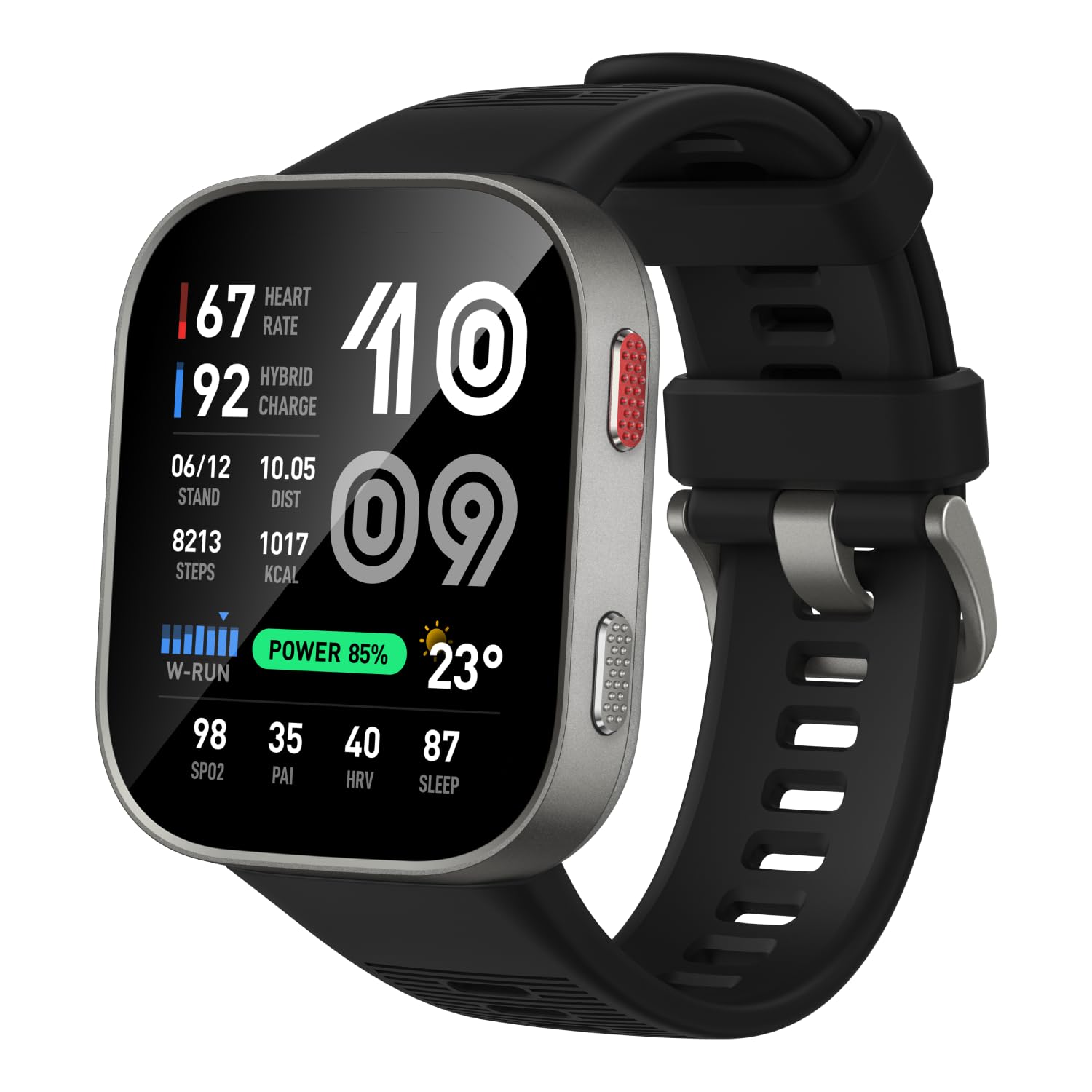
2. Amazfit Bip Max Smart Watch
Up to 20 days of tracking between charges, on a screen big enough to read at arm’s length.
Charging is the chore nobody budgets for. This watch is rated for up to 20 days of typical use, against the Mibro AeroPace’s 8 days. Owners describe topping it up roughly every two weeks as routine, not an emergency. For a watch you wear to sleep for recovery data, that changes the whole routine.
The 2.07-inch AMOLED display is the biggest panel in this lineup, which means pace, heart rate and map turns are legible without squinting mid-run. There is 4GB of onboard storage for offline maps pulled from the Zepp app, plus turn-by-turn directions and off-track alerts. Five satellite systems handle the fix, and the Zepp Coach builds adaptive routines around VO₂ max and training load.
What wins people over is the quality-to-cost equation: a 2.07-inch AMOLED, offline maps and 4GB of storage for a mid-range price. The honest limit is that this is a generalist watch that runs. If you need a barometric altimeter or a full topographic map for trail work, that sits elsewhere on this list. Otherwise the 150+ sport modes and BioCharge recovery scoring cover most training weeks.
The value read: You are getting a large AMOLED screen, offline maps, 4GB of storage and a 20-day battery in one package — and the Zepp app subscription is not required to use the coaching.
Where it sits: Runner-friendly, but built as an everyday smartwatch first. Treat it as a daily driver that also logs your runs well.
Reach for this if: you want long battery, a big readable screen and offline maps without moving into premium territory.
Think twice if: you need serious trail navigation — there is no altimeter or topographic mapping here.
3. Mibro AeroPace GPS Running Watch
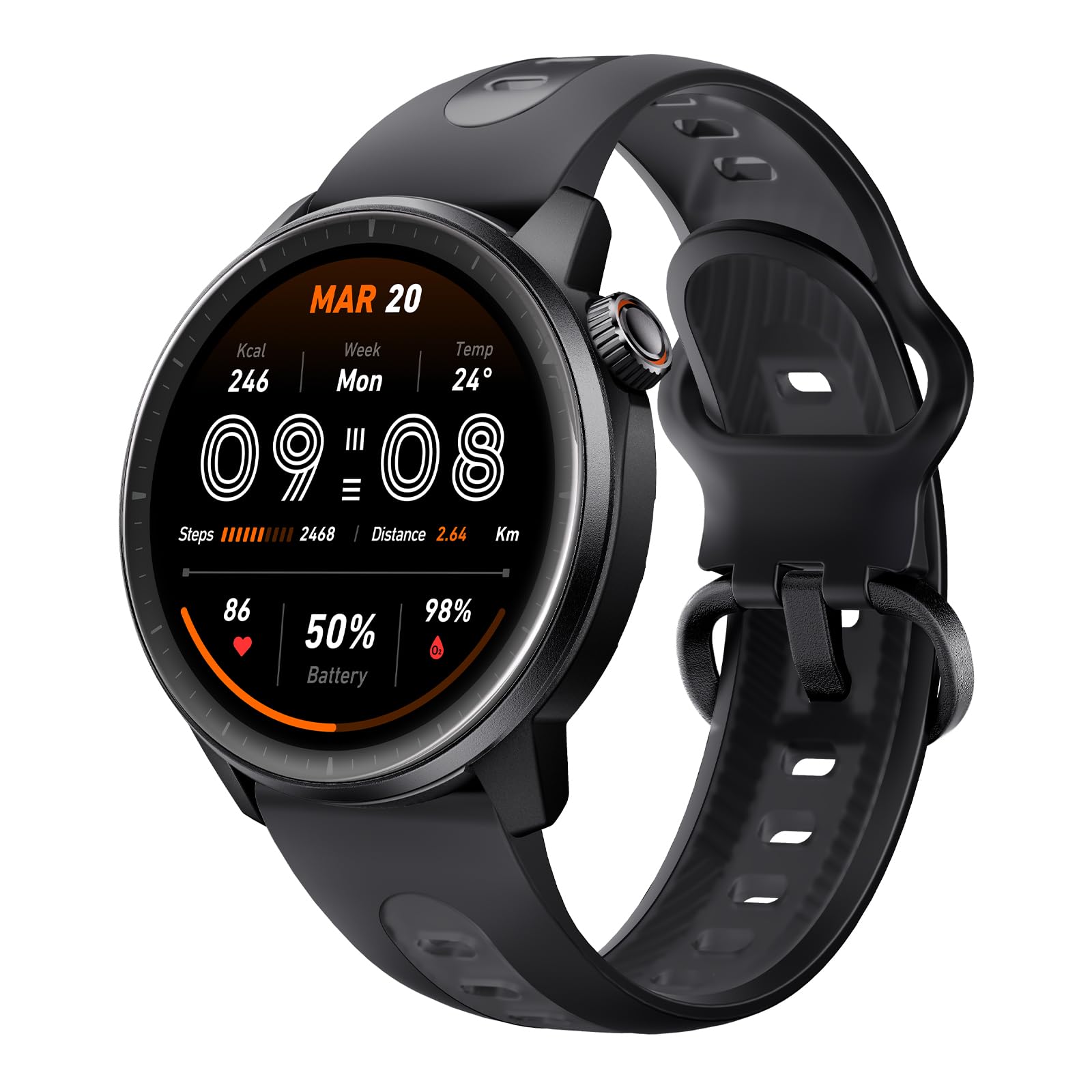
At 32 grams it disappears on the wrist — and it still carries dual-band GPS and offline maps.
Weight is the spec you feel on every stride. This watch comes in at 32 grams with the woven strap, matching the COROS PACE 4 at the same figure and coming in under the SUUNTO Run’s 36 grams. Both a woven and a silicone strap ship in the box, so you can swap between training and daily wear without buying anything else.
The route tools are the surprise here. Dual-band, five-system GNSS tracks you across urban and outdoor terrain, and free global vector maps let you follow a route offline with off-course alerts and return navigation. That means no phone in your pocket on long runs. Pace, cadence, stride length, ground contact time and vertical oscillation all show live, and a VDOT Running Index plus race-time estimates for 5K through the full marathon give you a progress read.
The display punches above its size: a 1.32-inch AMOLED at 2000 nits peak brightness, 466×466 resolution and a 60fps refresh rate, with curved Corning Gorilla Glass for scratch resistance. The catch is the coach. The Mibro Coach builds 4–20 week plans and adjusts as you go, but it is a 30-day free trial that turns into a subscription afterward. Weigh that against the 8-day daily-use battery and up to 12 hours in GPS Performance Mode.
Why runners like the shape
- 32 grams with the woven strap — same figure as the COROS PACE 4.
- Dual-band five-system GNSS plus free offline vector maps.
- 2000-nit AMOLED at 466×466 and 60fps stays readable in daylight.
- Woven and silicone straps both included.
The honest catch
- The personalized coach is a 30-day trial, then a paid subscription.
- Up to 12 hours in GPS Performance Mode trails the 41 hours of the COROS PACE 4.
Worth it for: the runner who wants offline route-following and a bright screen on a 32-gram wrist, and does not mind a subscription for the coach.
Not the fit for: anyone who wants coaching included free forever — the trial expires.
4. SUUNTO Run GPS Sport Running Watch
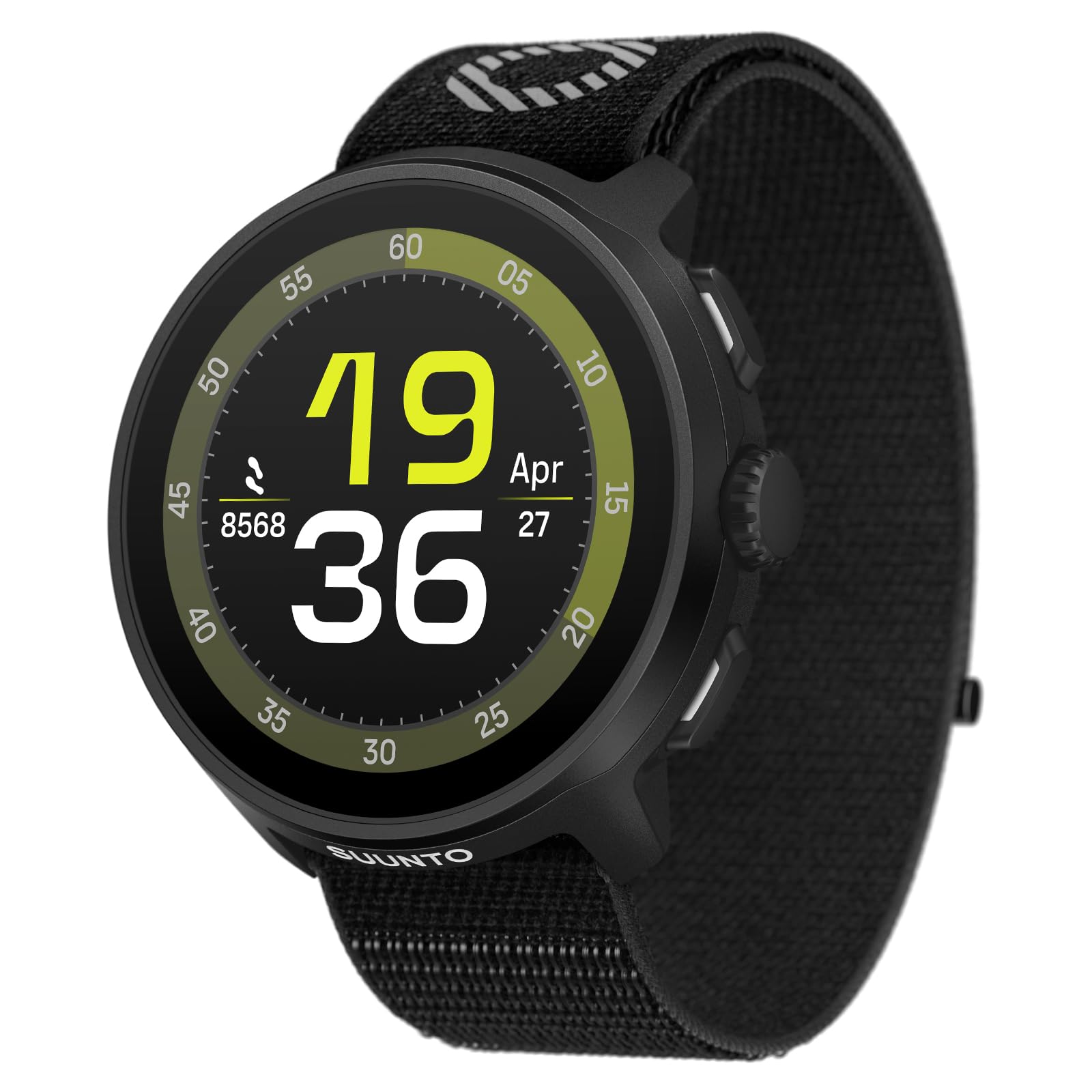
A full recharge in one hour, on a 36-gram textile strap you can cinch tight before a run.
Forgetting to charge is the oldest problem in running watches. This one goes from empty to full in one hour, which turns a pre-run panic into a shower-length wait. It is rated for up to 12 days tracking daily activity and sleep, and up to 20 hours of training with high-precision GPS running.
Dual-frequency GPS tracks your location in real time, and Breadcrumb Trail plus navigation shows your route and key points so you can follow it from your wrist. Training load, post-exercise heart rate and a Training Stress Score all land in the SUUNTO app for the deeper read. The 1.32-inch AMOLED touchscreen with a crown control is quick to glance at mid-run, and the watch face widgets can be rearranged to put what you care about up front.
The design is the lighter story: 36 grams with the textile velcro strap, against the 32-gram Mibro AeroPace and the 48-gram Polar Street X. Note the honest split on owner experience — appearance, battery and ease of use draw praise, while GPS tracking and connectivity come in for mixed feedback. Buyers who need rock-solid city GPS may want to compare before committing.
The quick-charge angle: One hour to full is the standout spec. It removes the nightly charging ritual without asking you to give up a bright AMOLED display.
The fair caveat: GPS tracking and connectivity are the mixed spots in owner feedback, so test it on your usual routes during the return window.
Best matched to: a runner who charges in a hurry and wants a light textile strap plus a bright, crown-controlled screen.
Worth a second thought if: you train in dense urban canyons where GPS consistency is the deciding factor.
5. Polar Street X GPS Running Sports Watch
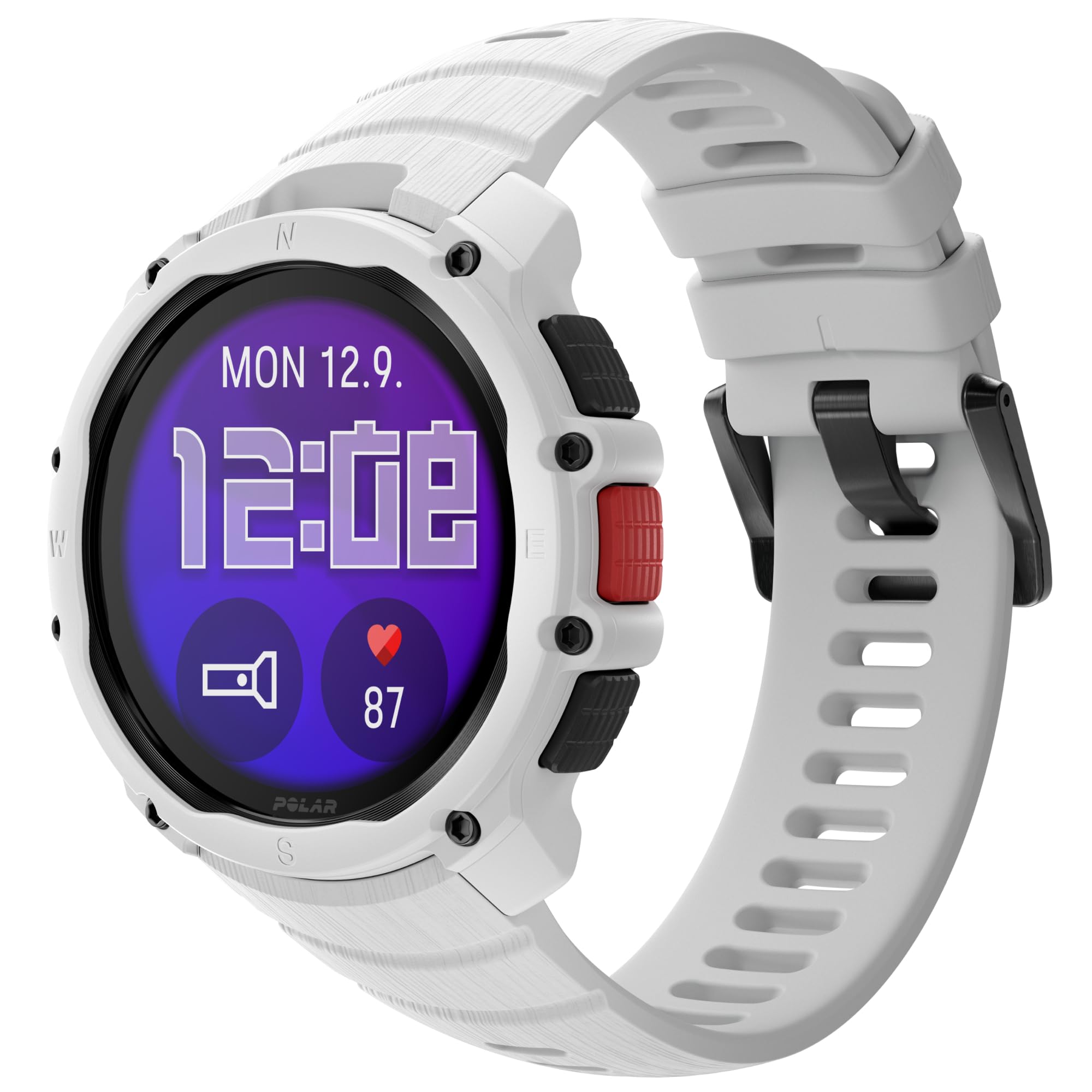
Forty-three hours of GPS in a 48-gram case built to take a knock.
If your training week mixes runs, gym sessions and rain, this is the shape that fits. The case is shock-resistant with 50 meters of water resistance, so a downpour or a pool session is not a problem. It weighs 48 grams, and you feel that on the wrist compared to the 32-gram Mibro AeroPace, but the trade is a case that shrugs off impact.
The battery figure is the real draw: up to 10 days in daily use and up to 43 hours of GPS tracking. That is more satellite time than the Mibro’s 12 hours in Performance Mode or the SUUNTO Run’s 20 hours, and it is what lets you leave the charger at home for a long training block. Built-in GPS handles distance, pace and route guidance with back-to-start navigation for city runs and outdoor sessions.
There are 170+ sport profiles covering strength, HIIT and cycling alongside running, and wrist-based heart rate removes the chest strap from the equation. Note that there is no map type here — 32MB of storage means you get route guidance and back-to-start, not full topographic maps. The built-in flashlight is a small but real plus for late-evening starts.
The strong points
- Up to 43 hours of GPS tracking and 10-day daily battery.
- Shock-resistant case with 50m water resistance.
- 170+ sport profiles for hybrid training weeks.
- Wrist-based heart rate and a built-in flashlight.
The trade-offs
- 48 grams is noticeably heavier on the wrist than the 32g featherweights here.
- No map type and only 32MB of storage — route guidance, not topo maps.
Made for: hybrid athletes who split time between pavement, gym floor and weather, and want long GPS runtime over a featherweight build.
Less suited to: trail runners who need full topographic mapping on the wrist.
6. COROS PACE 4 Ultralight Sport GPS Watch
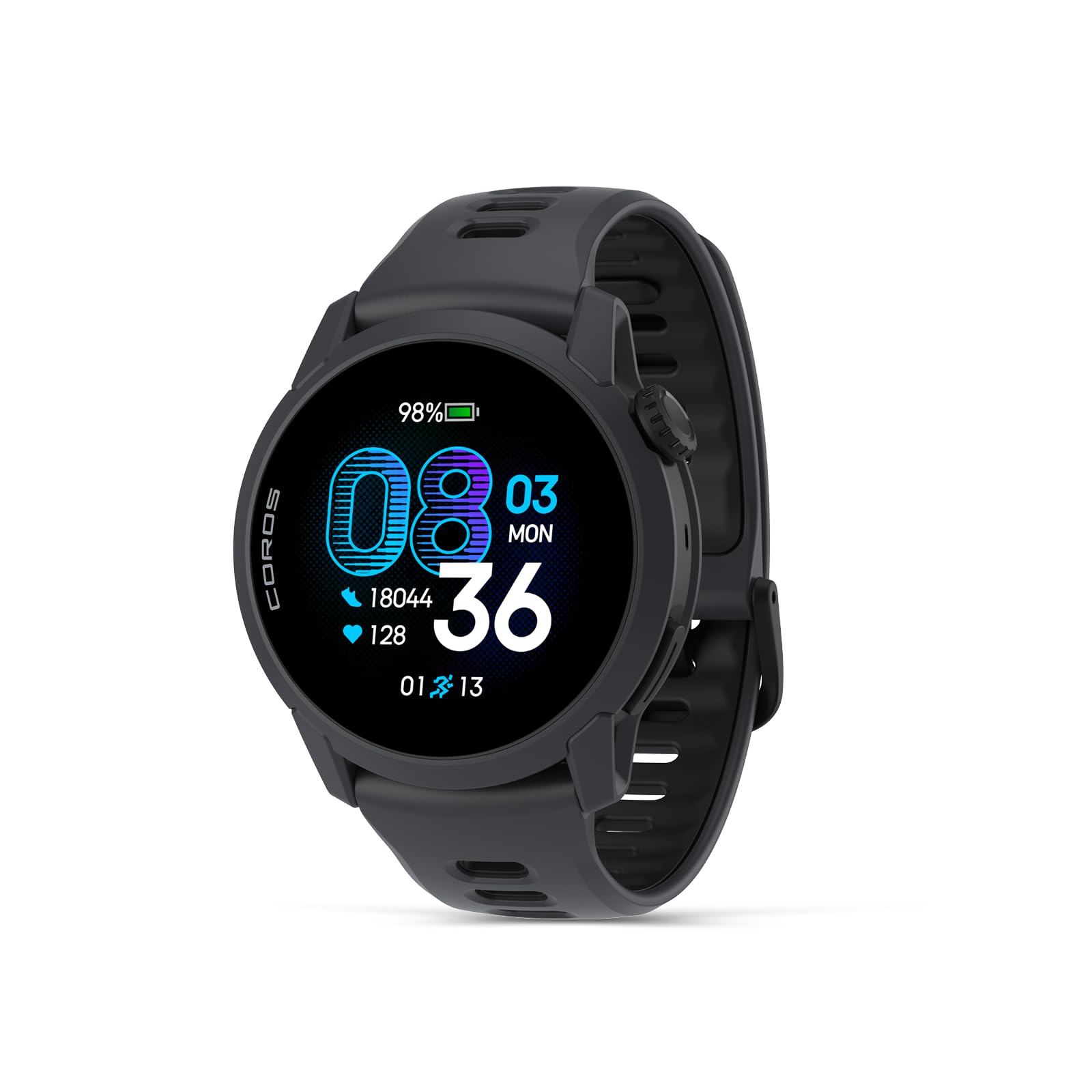
Forty-one hours of GPS on a 32-gram wrist — the endurance math most watches cannot match.
Start with the two numbers that define this watch. COROS rates it for up to 41 hours of continuous GPS tracking and up to 19 days of daily battery life. That 41-hour figure trails only the Polar Street X’s 43 hours in this article, and both are built for runners who do not want charging to interrupt a training block. Either way, both are built for runners who do not want charging to interrupt a training block.
At 32 grams with the nylon band and 11.8mm thin, it wears light enough for 24/7 use. The 1.2-inch AMOLED touchscreen auto-adjusts brightness so the display stays readable in sun and shade, and the resolution is listed as 164% higher than the PACE 3. Controls are split between a tactile digital crown, two buttons and the touchscreen — a combination that works when your hands are wet.
The training side leans on voice. You can record a voice pin mid-run describing where you were and how you felt, and set alarms or target workouts by voice command. The COROS app tracks recovery time, sleep stages, HRV and menstrual cycles, and an Action Button can be mapped to breadcrumb navigation or media controls. The recurring note from the review pages is functionality — voice pins, an Action Button and auto-brightness all work without fuss. Its limit is mapping: breadcrumb navigation guides you back, but there is no full-color onboard map.
Where it wins
- Up to 41 hours of continuous GPS — second only to the Polar Street X’s 43 hours.
- 32 grams with the nylon band and 11.8mm thin for all-day wear.
- Voice pins and voice control for logging runs hands-free.
- Customizable Action Button for breadcrumb navigation.
What you give up
- Breadcrumb navigation only — no full-color onboard maps.
- The 1.2-inch display is smaller than the 2.07-inch Amazfit Bip Max.
Pick this for: marathon and ultra training where 41 hours of GPS and a 32-gram wrist matter more than topographic maps.
Pass if: you navigate off-trail and need a real map on your wrist.
7. Garmin Instinct® 3 Solar, Rugged GPS Smartwatch, 45mm, Black

The only watch here that can charge itself off daylight — and the toughest case in the lineup.
A solar charging lens sits over the 0.9-inch display, and Garmin states the watch reaches unlimited battery life with solar charging under a specific condition: all-day wear with three hours a day outside in 50,000 lux conditions. Without that sun exposure, the rating is 28 days, which is still the longest daily-use figure in this article.
The build is the other half of the pitch. A 45mm fiber-reinforced polymer case with a metal-reinforced bezel, 10 ATM water rating, and testing to MIL-STD-810 for thermal and shock resistance. Multi-band GPS with SatIQ technology picks the positioning mode that saves battery, and a 3-axis compass plus barometric altimeter handle backcountry navigation. Garmin Pay lets you leave cards at home.
There is a built-in LED flashlight with variable intensities and strobe modes — useful for early starts and trail transitions. Health tracking covers wrist-based heart rate, advanced sleep monitoring and Pulse Ox, though Garmin notes Pulse Ox is not available in all countries. This is the pick when durability outranks display size: 0.9 inches is the smallest screen here.
The durability argument: A fiber-reinforced polymer case tested to MIL-STD-810 and rated to 10 ATM is what you want when a watch is going to meet rock, cold and rain.
The size question: 0.9 inches of display is modest for reading pace at a glance. If a big AMOLED panel is a priority, the Amazfit Bip Max or the COROS PACE 4 will suit you better.
Choose it for: trail and outdoor training where solar top-up, a 28-day battery and MIL-STD-810 toughness outweigh a small screen.
Not for you if: you want a big bright panel for glancing at splits.
8. Polar Vantage M3 Multi-Sport Smartwatch

Offline topographic maps with turn-by-turn guidance, for runs that leave the pavement behind.
Getting lost on a long run is a navigation problem before it is a fitness problem. This watch pairs dual-frequency GPS with offline topographic maps, route planning and turn-by-turn guidance powered by Komoot. Plot the route at home, then follow it from your wrist without pulling out a phone at every fork.
The training toolset includes running power, training load and recovery, plus Nightly Recharge, SleepWise and Training Load Pro for the recovery side. Over 150 sport profiles cover most training days. The 1.28-inch AMOLED touchscreen is protected by Gorilla Glass 3 for scratch resistance, and the stainless steel case is rated to 50 meters of water resistance. Both size wristbands, S through L, ship in the box.
Battery splits into up to 30 hours in training mode and up to 7 days in smartwatch mode It also weighs 53 grams, the heaviest figure on this list, against the 48-gram Polar Street X. Reliability is the split point in owner experience: some find it does exactly what they want, others find it a letdown. Quality is what draws the most praise.
What earns the premium: Offline topo maps plus turn-by-turn navigation is a capability the cheaper picks here simply do not have.
The weight you trade: 53 grams on a 7-day battery asks more of your wrist and your charger routine than the 32g COROS PACE 4.
Right for: trail and adventure runners who want offline maps and running power in a stainless steel case.
Wrong for: anyone who wants to charge once a week-ish and forget it — 7 days is the ceiling.
9. Samsung Galaxy Watch Ultra 47mm LTE Smartwatch
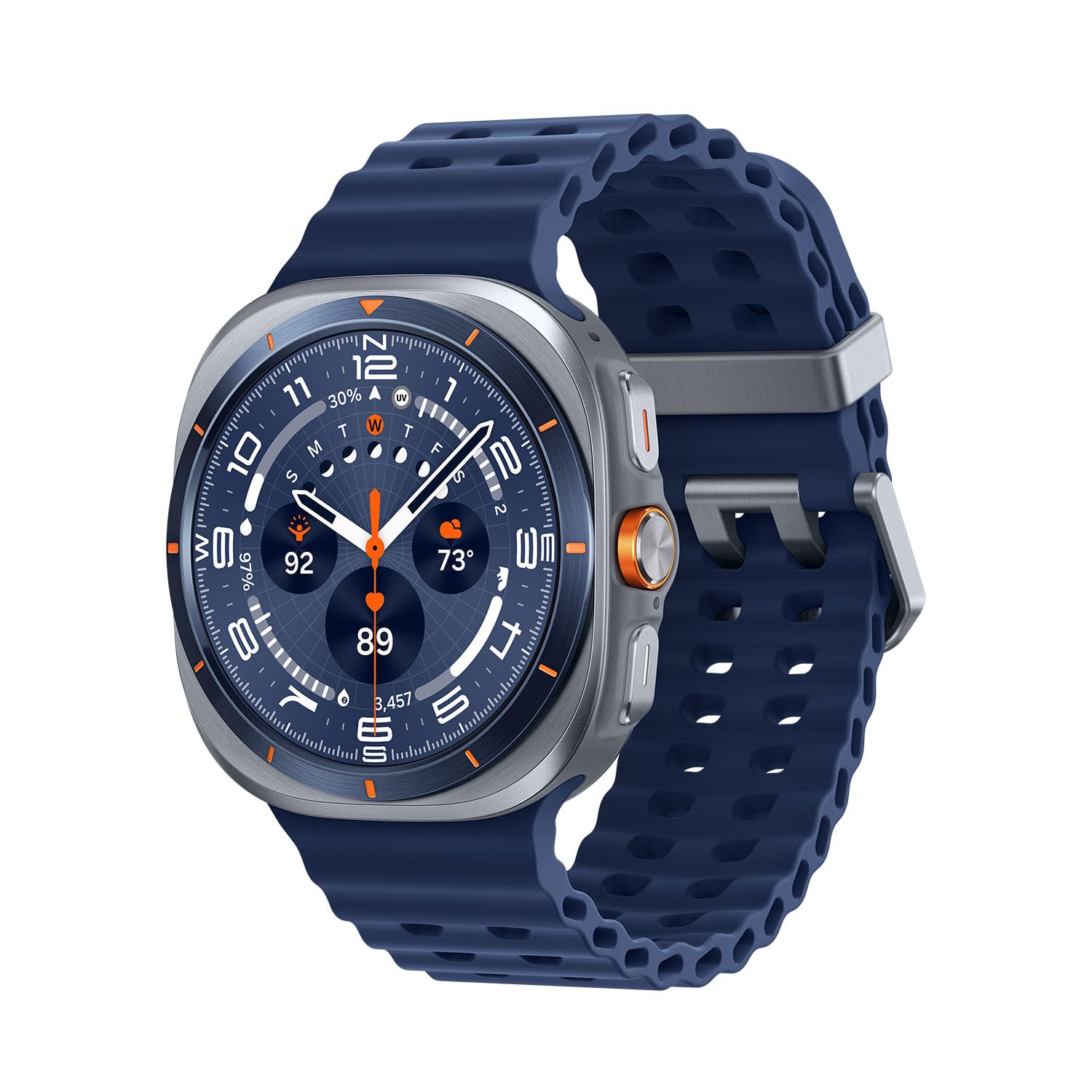
A titanium 47mm case with LTE built in, so you can run without the phone and still take the call.
This is the smartphone companion that happens to be a serious training watch. The titanium casing carries a 10ATM water resistance rating and a 590 mAh battery — the largest capacity here. Dual-frequency GPS keeps your route stable, and Running Coach analyzes factors like your age, weight, oxygen levels and heart rate to guide your runs.
LTE is the standout difference. With a cellular plan you can go out with no phone and still get calls, messages and an AI assistant on the wrist. Health tracking runs deep: Energy Score with Galaxy AI pulls yesterday’s sleep, activity and heart rate into a wellness summary a few times a day, and blood pressure readings are possible after you calibrate against a blood pressure cuff (sold separately). It pairs with Samsung phones and other Android phones.
The honest trade is battery. Owner experience splits here — some find it incredible, others report charging every two days after heavy use. The listed daily figure is 100 hours. Its strongest following comes from the titanium case and LTE connectivity, not from endurance. Note the 47mm case is the largest diameter here; this is a substantial watch on a slim wrist.
What stands out
- 590 mAh battery capacity — the largest on this list.
- Dual-frequency GPS plus Running Coach on a titanium 10ATM case.
- LTE lets you leave the phone home and stay reachable.
- Energy Score and blood pressure tracking (cuff sold separately).
What asks for patience
- Battery life draws mixed owner reports — heavy use can mean charging every two days.
- The 47mm case is the largest diameter in this article.
Fit for: Android and Samsung owners who want a training watch and a do-everything smartwatch in one LTE-connected body.
Consider alternatives if: you prioritize a multi-day battery over connectivity and screen size.
10. Garmin Forerunner 945 LTE Smartwatch

Built for race day without a phone — LTE safety features and a full-color onboard map.
Long-distance racing is where this watch makes its case. LTE connectivity requires an active subscription and coverage on a Category M1 LTE network, and when it is on you get LiveTrack, plus Assistance Plus, which connects you to the Garmin IERCC emergency response center. You can also receive messages from people tracking you during a race.
Battery runs up to 2 weeks in smartwatch mode, 12 hours in GPS mode with music, and 7 hours in GPS mode with music plus LTE LiveTrack. Full-color onboard maps guide you on runs and rides, and a track run activity profile measures laps around a 400-meter track more accurately. Music storage holds up to 1,000 songs from supported services, which may need a premium subscription.
Training metrics adjust for heat and altitude, recovery time is tracked, race finish times are predicted, and daily suggested workouts keep the plan balanced. The reliability and accuracy threads in owner feedback carry mixed notes, including GPS accuracy concerns, so treat this as a pick for racers who value the LTE safety net over everything else. Garmin Pay lets you run without a card or cash.
The safety angle: Assistance Plus routes an emergency signal to a 24/7 response center when your phone is not with you. For solo long runs, that is the whole reason to look at this watch.
Check before you commit: LTE needs a subscription and Category M1 coverage in your area — and Assistance Plus is not available in all markets.
Best used by: triathletes and marathoners who want race-day live tracking, on-wrist maps and an emergency link when they run solo.
Look past it if: you have no LTE coverage or will not pay for the subscription.
11. Garmin Forerunner 970 47mm

Titanium bezel, sapphire lens, 26 hours of GPS — the top of the Forerunner tree.
Two figures show where this sits. It is rated for up to 15 days in smartwatch mode and up to 26 hours in GPS mode — that 26 hours beats the Forerunner 570’s 18 hours while sitting under the COROS PACE 4’s 41. The 560 mAh battery cell backs that up, and the titanium bezel plus sapphire lens keep scratches off a case that would otherwise show every trailside scrape.
Running metrics go deeper than most. Running economy and step speed loss explain how you slow down when your foot hits the ground, but note that step speed loss requires the HRM 600 monitor, sold separately. Running tolerance describes how much your body is absorbing so you can adjust load. Wrist-based running dynamics cover cadence, stride length and ground contact time, and wrist-based running power gives a continuous read on how hard you are pushing.
There is more here than pace. A built-in LED flashlight helps on early and late runs, and full-color built-in maps with multi-band GPS and dynamic round-trip routing will build a new route when you break off the planned one. Multisport auto-transition detects swim, bike and run changes so you do not have to press anything in a triathlon. The ECG app records heart rhythm and checks for atrial fibrillation signs, though it is not available in all countries and is intended for people 22 and older.
The premium case: Sapphire lens and a titanium bezel are the durable materials that justify the top tier — they hold up to daily abuse that scratches softer glass.
Check your kit: the step speed loss metric needs the HRM 600 chest monitor, sold separately. Budget for it if that data is why you are looking here.
Built for: the runner chasing every training metric, who wants maps, a flashlight and a 26-hour GPS session in a titanium case.
Skip if: you just need pace and distance — the Forerunner 570 or COROS PACE 4 cover that for far less.
Know the Specs
GPS Mode vs Smartwatch Battery
Smartwatch mode is the idle figure — the watch on your wrist, checking notifications, not tracking a run. GPS mode is the number that matters, because it is how long the satellite receiver runs before the battery dies. A watch rated at 10 days of smartwatch use might only give 18 hours of GPS. Read the GPS figure first when you compare, since the long figure on the box will not save you on a four-hour trail run.
Dual-Band vs Single-Band GPS
A single-band GPS listens on one frequency, which is usually fine in open sky. Dual-band GPS (also called dual-frequency) listens on two at once, so bounced signals off buildings and canyon walls get rejected instead of confusing the fix. The payoff is a route line that stays on the road and pace readings that do not spike. If you run in a city, a forest, or anywhere with overhead cover, this is the spec to check before anything else.
Super AMOLED Displays and Nits
AMOLED is the screen type that produces deep blacks and vivid color, which makes numbers pop at a glance. Nits measure brightness — the higher the number, the easier the screen reads in direct sun. A display rated at 2000 nits peak is a different experience from a 0.9-inch panel in full daylight. Bigger, brighter screens also draw more power, which is why the brightest watches tend to have the shorter GPS runtimes.
Case Size and Strap Width
Case diameter is measured across the watch body; strap width is the measurement where the band meets the case. A 42 millimeter case on a 20 millimeter band sits flatter on a smaller wrist than a 47 millimeter case on a 22 millimeter band. Strap width also decides whether your existing bands fit a new watch. If you wear it overnight for sleep and recovery data, a lighter case and a narrower band make that more comfortable.
Common Questions
Do I need dual-band GPS if I mostly run in a city?
How many hours of GPS tracking do I actually need?
Will a 47mm running watch fit a slim wrist?
Can I run without my phone and still be tracked?
Does solar charging really mean I never charge the watch?
What is running power and do I need a chest strap for it?
How do I keep the heart rate readings accurate while running?
Which is better for trail running, an AMOLED display or an always-on memory-in-pixel screen?
Do running watches work with iPhones or only Android?
Can I swim with these watches?
Why is the GPS battery figure so much shorter than the daily battery figure?
The Bottom Line
For most runners, the top running watches winner is the Garmin Forerunner 570 — it packs a full coaching suite and training readiness into a 42mm case that suits a smaller wrist, with up to 18 hours of GPS mode for marathon day. If a multi-week battery is your priority, the Amazfit Bip Max runs up to 20 days between charges on a 2.07-inch AMOLED. For ultralight racing, the COROS PACE 4 gives you a 32-gram wrist and up to 41 hours of continuous GPS tracking.
If you want your runs to come with maps and turn-by-turn navigation, the Polar Vantage M3 adds offline topographic mapping to a stainless steel case. And for race day without a phone, the Garmin Forerunner 945 LTE gives you LiveTrack and Assistance Plus as long as you have the LTE subscription and coverage. If trail durability and a 28-day battery are what you need, the Garmin Instinct 3 Solar is built to take a knock.
How we choose
We do not accept paid placement. Every pick is matched to a real buyer and a real use-case; we do not hands-on test units.
Sources
Specifications: manufacturer listings and product documentation. Review insights: verified customer reviews, as of November 2026. Pricing: not shown on this page (it changes often); check the current price via the retailer link.
As an Amazon Associate, Tactical Gear Guy earns from qualifying purchases. This does not affect which products we feature.