Specs are compiled from manufacturer listings and verified buyer reviews and can change over time — please confirm the key details on the product page before buying.
You want to sand a door casing, not spend an afternoon scrubbing it by hand. Most oscillating tools can sand, but only a few sand well enough that you reach for them instead of a palm sander. Three things decide that: how far the head swings (the oscillation angle), how many speed settings you get to tame it, and whether the pad and paper stay flat and gripped. Get those right and trim sanding takes minutes.
This guide is built by comparing the manufacturers’ published specifications and the patterns across verified customer reviews, so you get each pick’s real strengths and trade-offs instead of marketing spin.
A tool that swings wide removes material fast, while a gentle low-speed setting keeps you from gouging veneer when precision matters more than speed. Here is what actually matters when you are shopping for the best sanding oscillating tool.
Top Picks


How To Choose The Best Sanding Oscillating Tool
Buying one of these for sanding is different from buying it for cutting. A tool that rips through pipe and nail is not automatically the one that leaves a flat, swirl-free surface on a cabinet face. So before you compare motors, sort out four things that decide whether the sanding job feels controlled or fights you.
The pad and paper setup is the whole point
For sanding you want a backing pad plus a supply of hook-and-loop sheets in several grits. Grit is just how coarse the abrasive is — 60 and 80 grit are coarse shaping grades that hog off material, while 120, 180 and 240 grit are progressively finer and smooth the surface before finish. A kit that bundles a spread of grits keeps you working instead of ordering paper mid-project. Look at what is literally in the box: a sanding platen, a backing pad, or a hook-and-loop pad, plus the sheets.
Oscillation angle and speed range set the control
The oscillation angle is how far the head swings side to side on each pass — a bigger swing moves more abrasive across the wood and cuts faster, a smaller swing is easier to steer on delicate faces. Speed is measured in OPM, or oscillations per minute. A low bottom speed lets you feather the tool on veneer, while a high top speed clears material on a flat panel.
Tool-free changes save the most time when sanding
Sanding means swapping grits often — coarse to fine, then fine again on a second panel. A tool-free accessory change lets you pop the pad or sheet loose with a lever or button instead of tracking down a hex key. A universal accessory interface also matters, because it lets you run pads and blades from most major brands rather than being locked to one.
Corded versus cordless depends on where you sand
A corded tool runs as long as you have an outlet and never dies mid-panel, which suits a workshop or a long sanding session. A cordless tool lets you reach a stair spindle or an overhead trim without dragging a cord, at the cost of battery runtime. Neither wins outright — match it to the surfaces you actually sand.
Side-by-Side Comparison
| Model | Best For | Power Source | Speed Range | Oscillation Angle | Amazon |
|---|---|---|---|---|---|
| WORKPRO 3.0 Amp Corded Kit★ Best Overall | All-round sanding on a cord | Corded, 3.0 Amp | 15,000–23,000 rpm, 7 settings | 3° | Amazon |
| BLACK + DECKER 20V MAX (BDCOS20B)Tight-Space Pick | Cordless control in tight spaces | Battery powered | 18,500 rpm, 6 speeds | — | Amazon |
| JORGENSEN Corded Multi ToolWidest Swing | Wide swing for fast stock removal | Corded | 8,000–16,000 OPM, 7 settings | 5° | Amazon |
| BLACK+DECKER BD200MTB | Long sanding sessions without a battery | Corded, 2.5 Amp | 10,000–20,000 opm, 6 settings | — | Amazon |
| WORX 20V Sonicrafter WX696L | Cordless reach across a battery platform | Battery powered, 20V | 5,000–20,000 opm, 2 speeds | — | Amazon |
| CRAFTSMAN V20 Kit (CMCE501D1) | Drywall and detail work with LEDs | Battery powered, 20V 2.0Ah | Variable speed dial | — | Amazon |
| Dremel Multi-Max MM35-01 | Precision sanding in tight reaches | Corded, 3.5 Amp | 10,000–21,000 OPM | 3.2° | Amazon |
| PORTER-CABLE PCE606K | Long-reach corded sanding and cutting | Corded, 3.0 Amp | 10,000–22,000 OPM | — | Amazon |
| DEWALT 20V (DCS356SD1) | Brushless cordless runtime | Battery powered, 20V | 3-speed selector | — | Amazon |
Detailed Reviews
1. WORKPRO 3.0 Amp Corded Oscillating Multi-Tool Kit
Our pick — 4.5+★ from 950+ verified ratings; the strongest balance of quality and price.
A corded workhorse that pairs a tight 3° swing with a seven-speed dial for controlled sanding.
The WORKPRO takes the top spot because it covers the sanding job end to end. Its 3.0 Amp motor runs on 7 speed settings from 15,000 RPM to 23,000 rpm (rpm is how fast the head cycles). Drop to the low end to feather a pad across a veneer edge without burning it, then run 23,000 rpm to clear a flat panel fast. That range beats the WORX Sonicrafter, which gives you fewer speeds to dial in.
Where it separates from the pack is the sanding kit in the box. You get 1 sanding pad and 10 sanding sheets ready to go, plus 2 wood/metal blades, 3 wood and plastic saw blades, and a scraper — a full 17-piece set that lives in its own carrying bag. The tool-free accessory change means swapping to a fresh sheet is a three-step flip-button routine, no spanner hunting. Its universal accessory interface also accepts most accessory brands, so you are not married to WORKPRO paper.
The crowd backs that read — 4.5+ stars across 900+ ratings, with buyers finding it well-built and easy to use and comparing its work to far pricier tools. What wins people over most is how quickly the blades and pads change out, which is exactly what matters when you are cycling grits. The honest trade-off is weight: at 5.2 pounds it is a hefty corded unit, versus the 2.8-pound WORX Sonicrafter — a real difference if you are sanding overhead. For bench and floor work, that mass actually steadies the cut.
What makes it the pick
- 7 speeds spanning 15,000–23,000 rpm for both feathering and fast stock removal
- 17-piece kit includes a sanding pad, 10 sheets and a scraper in a storage bag
- Tool-free three-step accessory change saves time across grit swaps
- Universal interface takes most accessory brands
Where it gives ground
- At 5.2 pounds it is the heavier corded option — tiring overhead
- Corded, so you are tied to an outlet
Reach for it if: you sand at a bench or on the floor and want one kit that handles sanding, cutting and scraping without buying extras.
Look elsewhere if: most of your sanding is overhead or in a crawl space — the 5.2-pound body gets old fast.
2. BLACK + DECKER 20V MAX Oscillating Tool (BDCOS20B)
The cordless trim-sander for corners where a cord simply will not follow.
When your sanding target is a cupboard frame or the inside of a stair stringer, a cord is the enemy. This 20V MAX tool runs battery powered at 2.9 pounds, and its compact body is built for confined spaces. An LED worklight illuminates the workpiece, which genuinely helps when you are sanding into a shadowed cabinet interior and need to see whether the surface is flat.
You get a 6-speed dial to dial in control and a one-handed tool-free quick blade change clamp. The sanding kit is already loaded: a sanding platen with 3 sheets of 80 grit, 3 of 100 grit and 2 of 240 grit — a coarse-to-fine spread that covers shaping and smoothing from the start. The motor tops out at 18,500 rpm.
Functionality is the thing owners praise most, with the interchangeable attachments a close second — buyers find it works well on both plastic and wood. Quality follows right behind. The one recurring question mark is battery life, which draws mixed notes; if you plan long sanding sessions you will want a spare pack or to keep the work near a charger. Note it is a tool-only listing, so confirm your battery and charger before checkout.
Why it earns this slot: it is the lightest way here to sand in a corner or overhead, at 2.9 pounds on a 20V battery with a worklight lighting the cut.
The detail to plan around: battery life is the mixed review — this is a short-session sander, not an all-afternoon panel machine.
Best fit: quick trim and detail sanding in tight or overhead spots where a cord will not reach.
Not your tool if: you need to sand large flat panels for hours — the battery will send you back to the charger.
3. JORGENSEN Corded Oscillating Multi Tool
A 5° swing that moves more abrasive per pass than the tighter 3° heads.
The JORGENSEN’s calling card is its 5° oscillating angle — its head swings wider on every pass, so more of the sanding sheet contacts the surface at once. That is a real advantage when you are hogging off old finish or leveling a rough patch. Put it against the WORKPRO’s 3° swing and the difference in material removed per pass is obvious; the JORGENSEN leans toward fast removal, the WORKPRO toward finer control.
It runs 7-speed positions from 8,000 to 16,000 OPM, and the low 8,000 bottom end is gentle enough for detail work. The 16-piece kit is generous: 10 sanding sheets in 60, 80, 120, 180 and 240 grit (two of each), plus a sanding pad, a scraper, and multiple flush-cut wood and bi-metal blades. There is an extra locking bracket on the blade change designed to keep your fingers clear, and the universal fit system takes most brands of blades and pads.
Build quality is the most-praised trait here, with the powerful motor a close second — the tool is described as cutting through 1/2-inch cabinetry cleanly. The one honest caveat is a durability question: the review pages note it can burn up after extended use, so treat marathon sessions with care rather than running it flat out for hours. A slim soft-grip body helps during long work, and at 4.71 pounds it sits below the WORKPRO kit’s 5.2 pounds.
Fast-stock-removal read: the 5° swing plus a 60-grit sheet is the quickest combo in this group for stripping a surface back to bare wood.
Keep in mind: give the motor breaks on long jobs — the durability feedback is mixed, so pace it rather than driving it continuously.
Go here when: a wider 5° swing and a full grit spread in the box suit stripping and leveling work.
Think twice if: you plan to run it flat out for hours at a stretch — pace the motor instead.
4. BLACK+DECKER Oscillating Multi-Tool BD200MTB

The corded sander that never asks for a recharge, tuned for long, steady passes.
A corded design means unlimited runtime, with no battery to die in the middle of a bookcase build. That is the core value of the BD200MTB, and its 2.5 Amp motor with a 10,000 to 20,000 opm variable-speed dial covers the sanding range you need without drama. Six speed settings let you slow it down for a delicate face and open it up for a broad panel.
The sanding kit includes 12 sandpaper sheets, a sanding base, and a universal accessory adapter kit that fits most brands’ accessories, plus a tool-free release and a quick-release lever that removes the hex-key step entirely. Comfort grips aim to reduce muscle fatigue during longer passes. There is a 2 year limited warranty behind it.
Quality is the aspect owners rate highest, and functionality is right there too — it is described as cutting through nails and wood with ease, and doing more than its spec sheet advertises. Durability is the mixed note: some report long service without issue, while the review pages also flag units breaking after a short run. Its 15-inch body needs more benchtop clearance than the compact 5.25-inch-deep WORX — a consideration on a crowded bench.
The case for the cord
- Corded power means unlimited runtime — no battery mid-panel
- 6 speeds from 10,000 to 20,000 opm give fine control
- 12 sandpaper sheets and a sanding base included
- Universal adapter fits most accessory brands
The catch to weigh
- Durability feedback is mixed — a runtime concern on heavy use
- A 15-inch body needs more bench clearance than compact rivals
Right choice for: builders who want corded power and never think about a battery.
Pass if: you need a compact footprint or sand far from an outlet.
5. WORX Cordless Oscillating Multi-Tool WX696L

Featherweight at 2.8 pounds, built to slip into tight spaces a corded unit cannot.
At 2.8 pounds this is the lightest tool in this group, and that pays off the moment you lift it overhead or inside a cabinet. It runs on the Worx Power Share battery system, so the same 20V packs feed your other Worx 20V and 40V tools. For sanding you get a sanding pad and 20 sanding sheets in the box, plus a 2.0Ah battery and 0.4A charger, all in a carry bag.
Its 2-speed switch spans 5,000 to 20,000 opm — drop to 5,000 for a feather-light pass on a delicate edge and open it up to clear a panel. A blade-changing wrench is stored on board so it never goes missing, and the Universal Fit System accepts blades from most major brands. Cordless maneuverability is its whole argument: with no cord, it reaches grout lines and tight corners a corded unit struggles to follow.
What owners like is the quality and power, and it is described as well-suited to remodeling work. Battery life draws positive notes, helped by a pack that swaps in from other Worx tools. Sanding grit spread is the place it asks you to plan — 20 sheets come in the box, but if you are cycling many grits you will want to stock a variety. Its 3-year warranty ties the CRAFTSMAN kit for the longest coverage among the cordless picks here.
Maneuverability score: 2.8 pounds on a swappable 20V battery makes it the easiest tool here to hold into an awkward corner.
Small planning note: confirm your grit assortment — 20 sheets are included, but a full range is worth stocking for varied jobs.
Pick it for: overhead and tight-corner sanding where low weight and no cord matter most.
Choose a corded unit instead if: you need endless runtime on a big flat panel.
6. CRAFTSMAN V20 Cordless Oscillating Tool Kit (CMCE501D1)

A battery-included cordless kit tuned for drywall cuts and fiddly detail sanding.
The CRAFTSMAN comes as a complete cordless package — you get the tool, a 2.0Ah Li-ion battery, a charger, a sanding platen and 4 sheets of sand paper, plus wood and wood/metal blades, all in a storage bag. That means no hunting for a battery before your first sanding pass. An LED worklight illuminates the work area for visibility when you are sanding into a shadowed corner.
Control comes from a variable-speed dial, and a tool-free universal attachment lets you swap pads and blades quickly. It is part of the CRAFTSMAN 20V system, so batteries interchange across their cordless power tools and outdoor equipment, and it is VERSATRACK compatible (clip sold separately). A 3 Year Limited Warranty backs it.
The tool’s strength is quality, with functionality a close second — it handles drywall well and cuts aggressively, and it is called invaluable for DIY tile jobs. Durability is the mixed note: some find it heavy-duty, others say it is not strong enough for their taste. At 5.2 pounds with the battery on versus the 2.8-pound WORX, it is no lightweight, so balance that against its kit completeness.
The complete-kit advantage: battery, charger, platen and paper all ship together, so you sand on day one without a separate trip.
Read the durability split: the power feedback is genuinely divided, so match it to light-to-medium jobs rather than the heaviest tasks.
Suits you if: you want a battery-included cordless kit for drywall and detail work on one system.
Look past it if: you need maximum muscle or a featherweight body for overhead work.
7. Dremel Multi-Max 3.5 Amp Oscillating Tool Kit (MM35-01)

A compact angled head that sneaks sanding into places the big bodies cannot reach.
Dremel’s design choice is the angle and footprint of the front end. The compact front-end helps it reach into tight or difficult spots, and the angled body lets you keep the pad flat where a chunky tool would foul. Its 3.2° oscillation angle sits between the tightest and widest here, with a speed range of 10,000 to 21,000 OPM for control across materials.
The 3.5 Amp motor is the most powerful in this corded group — it will take on the toughest applications. The kit carries 12 accessories: 2 cutting blades, 9 sanding pads and 1 backing pad, in a storage bag. A tool-less quick-change system swaps attachments without a wrench, and a soft-grip housing adds comfort during long passes. A Limited 2 Years warranty covers it.
Quality is the most-praised trait, with versatility close behind — it is described as working well in tight spaces and for fiddly projects, easy to handle and maneuver. One thing to note: the listing labels the minimum speed in rpm while the range is quoted in OPM, so read the spec sheet as the same oscillation figure rather than two different numbers. It is corded, so you trade maneuverability-for-runtime like the other corded picks.
Where the Dremel shines
- Compact angled head reaches tight spots a full-size body cannot
- 3.5 Amp motor — the most powerful corded unit in this group
- 12 accessories including 9 sanding pads and a backing pad
- Tool-less quick-change for fast pad swaps
What to keep in mind
- Corded, so you are tied to an outlet
- Reach is the priority over raw sanding speed here
The maneuver pick: sanding into cabinet interiors, behind trim and other tight spots is exactly its job.
Only a fit issue: if you need cordless freedom, look to the WORX or DEWALT instead.
8. PORTER-CABLE Oscillating Multi-Tool Kit, 3.0-Amp (PCE606K)

An 8-foot cord and a 3-position grip that stands up to long, vibration-heavy sanding.
The PORTER-CABLE is built for endurance. Its 8-foot cord minimizes the need for extension cords, so you can work further from the outlet without a tangle. A 3-position over-mold handle gives grip on the front, middle and rear to reduce vibration — a real benefit during long sanding sessions where hand fatigue creeps in. The 3.0 Amp motor delivers power to finish applications fast, and the variable-speed dial runs 10,000 to 22,000 OPM for control across the range.
A tool-free blade-change system swaps attachments without wrenches or bolts, so changing a pad is quick. Durability is the mixed review note here — the tool is solid, but the review pages flag some durability questions — while functionality is what buyers praise most, with value for money following.
It is described as super versatile for difficult cuts and contour sanding, and a useful addition to a tool supply. At this price it sits in the premium bracket, so you are paying for the 8-foot cord, the vibration-reducing grip and the brand. For most home sanders, a cheaper corded pick like the WORKPRO covers the same jobs; this one makes sense if the 8-foot reach and 3-position handle are what you specifically need.
The endurance angle: an 8-foot cord and a 3-position vibration-reducing handle are the two reasons to pay up here.
Honest sizing: durability feedback is mixed, so it is a solid mid-duty pick rather than a pro-grade lifer.
For you when: cord reach and reduced hand fatigue on long sessions matter more than price.
skip it if: you want the same sanding power for less — the WORKPRO covers it.
9. DEWALT 20V Oscillating Tool (DCS356SD1)
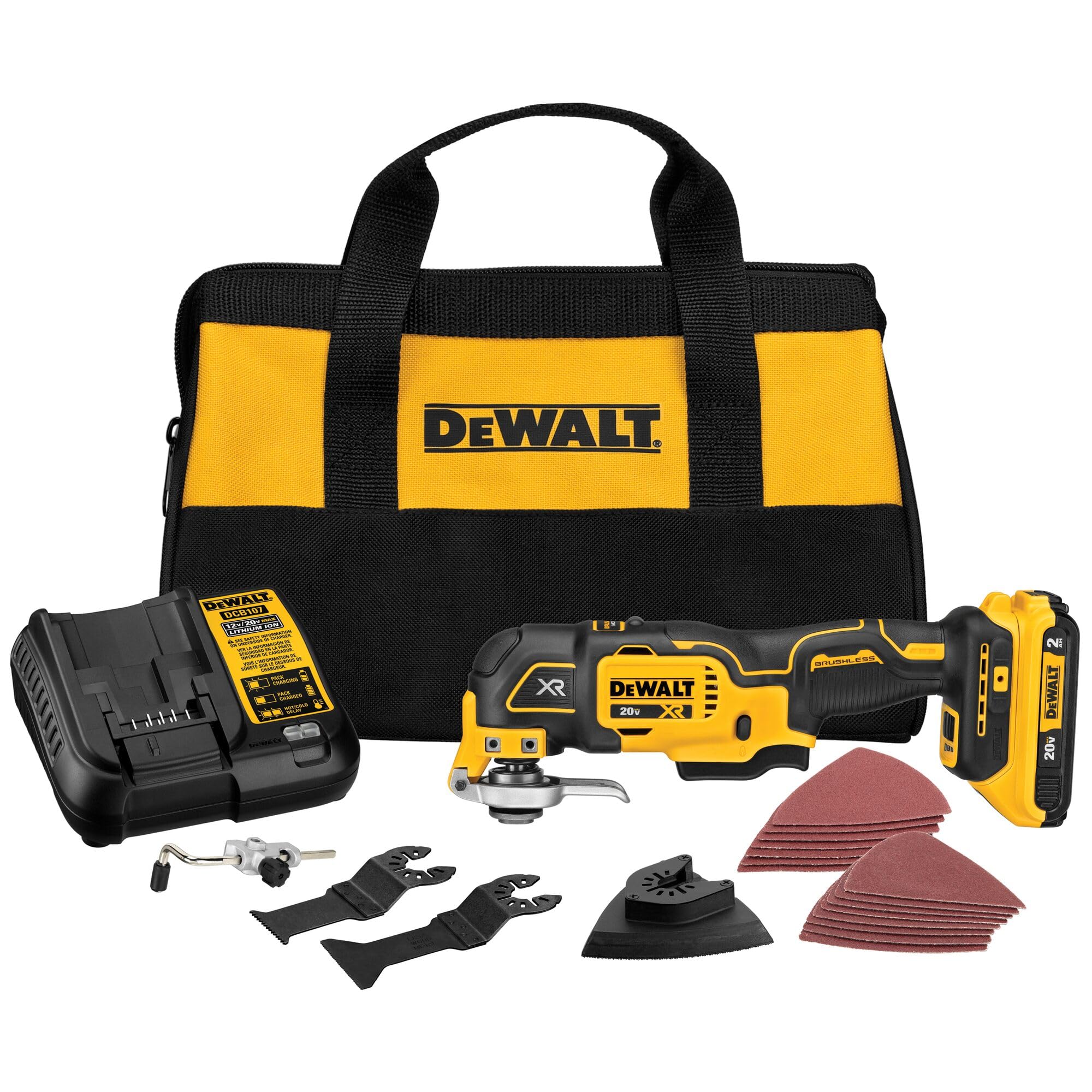
A brushless cordless kit with a three-speed selector and a dual-grip trigger.
DEWALT’s headline is its brushless motor, which the maker claims delivers up to 57% more run time than brushed motors. That matters for sanding because it means fewer interruptions for a charge. The 3-speed selector lets you match speed to the surface, and a dual-grip variable-speed trigger gives you fine control as you feather the pad across an edge. The kit ships complete with a DCB203 battery, a charger, a wood blade, a wood/metal blade, a sanding platen, 15 sheets of sand paper and a bag.
The listed battery average life is 5 hours, so a single charge covers a substantial sanding session. A Universal Accessory Adaptor takes most oscillating tool accessory brands, and a Quick-Change accessory system swaps blades and pads without wrenches. Quality is what buyers praise most, with performance close behind — it is described as making flush, straight cuts in hard-to-reach locations, and it is called a great buy.
At 5.4 pounds with the battery it is the heaviest tool here, so it is a bench-and-floor machine rather than an overhead featherweight. It is also the premium-tier cordless option, so you are paying for the brushless motor and the DEWALT 20V system more than for brand-new sanding geometry.
The runtime case: a brushless motor and a 5-hour battery average make this the cordless you reach for on a long panel job.
The honest weight: at 5.4 pounds it is the heaviest here — great on a bench, less fun overhead.
Pick the DEWALT if: brushless runtime and the DEWALT 20V system suit your bench-and-floor work.
Look to the WORX if: you need featherweight overhead control instead of long runtime.
Know the Specs
Oscillation Angle
This is how far the sanding head swings side to side on each pass. A wider angle — like the JORGENSEN’s 5° — moves more abrasive across the surface per cycle, so it strips and levels faster. A tighter angle, like the WORKPRO’s 3°, keeps the pad more controllable for delicate faces and detail work. Match the angle to the job: wide for fast removal, tight for finesse.
Speed in OPM and Variable Settings
OPM (oscillations per minute) is how many times the head cycles per minute. A low bottom speed lets you feather the tool on veneer, and a high top speed clears material on a flat panel. A tool with more speed settings gives you finer steps between those ends, so you can home in on the right feel instead of jumping between coarse options.
Sanding Paper Grit
Grit numbers tell you how coarse the abrasive is. Lower numbers — 60 and 80 — are coarse grades that remove material fast, while higher numbers like 120, 180 and 240 smooth the surface for finish. A kit that includes a spread of grits means you can move from shaping to smoothing without buying paper separately.
Pad, Platen and Tool-Free Change
The sanding platen is the backing plate the paper attaches to, and a hook-and-loop pad lets you pull sheets off and press new ones on. A tool-free accessory change means you swap that pad with a lever or button instead of a hex key — a big time saver when you are cycling grits repeatedly across a project.
Common Questions
Can an oscillating tool actually sand, or is it only for cutting?
What oscillation angle is best for sanding?
Will the sanding pads and blades from different brands fit my tool?
How often will I change sanding sheets when using one of these?
Is a corded or cordless oscillating tool better for sanding?
How do I sand without gouging the wood?
Do these tools come with a battery and charger?
Can I use these to sand on masonry or tile grout?
How much does a decent sanding oscillating tool weigh?
What is the difference between OPM and RPM on these tools?
The Bottom Line
For most sanding jobs, the best sanding oscillating tool is the WORKPRO 3.0 Amp Corded Kit. Its 7 speeds from 15,000 to 23,000 rpm and a 17-piece kit with a sanding pad and 10 sheets cover a full project without buying extras. Buyers back that with 4.5+ stars across 900+ ratings. If you sand overhead or in tight corners, the WORX Sonicrafter at 2.8 pounds is the maneuverable pick. For drywall and detail work on a battery, the CRAFTSMAN V20 Kit ships complete with battery, charger and paper.
How we choose
We do not accept paid placement. Every pick is matched to a real buyer and a real use-case; we do not hands-on test units.
Sources
Specifications: manufacturer listings and product documentation. Review insights: verified customer reviews, as of November 2026. Pricing: not shown on this page (it changes often); check the current price via the retailer link.
As an Amazon Associate, Tactical Gear Guy earns from qualifying purchases. This does not affect which products we feature.