Specs are compiled from manufacturer listings and verified buyer reviews and can change over time — please confirm the key details on the product page before buying.
You want clear water without hauling a bucket of tablets to the pool every few days. A chlorinator does that job: it holds your chlorine tablets, or makes chlorine from salt, and feeds it into the return line on its own schedule. There are two families. Tablet feeders hold pucks and you plumb them in-line or hang them off-line. Salt cells make chlorine from dissolved salt. Which one fits depends on your pool size, your return-line plumbing and how much weekly maintenance you will accept.
This guide is built by comparing the manufacturers’ published specifications and the patterns across verified customer reviews, so you get each pick’s real strengths and trade-offs instead of marketing spin.
Tablet feeders suit simple above-ground setups, while salt cells cut the tablet runs but need power and a salt level you keep an eye on. Below you will find the full breakdown of the best swimming pool chlorinator for each kind of pool and budget.
Top Picks


How To Choose The Best Swimming Pool Chlorinator
Your first decision is not the brand. It is if you want to keep buying chlorine tablets or stop buying them almost entirely. A tablet feeder holds slow-dissolving pucks and meters them into the water. A salt cell turns ordinary pool salt into fresh chlorine on its own, so you skip tablet runs but you do need electricity and a salt reading to watch.
Match the feeder type to your plumbing
An in-line chlorinator (a feeder spliced directly into your return pipe after the filter and heater) needs a straight run of pipe to sit in. An off-line feeder (one that taps into the piping with small hoses instead) is the practical answer when there is no room in the equipment run. If you are replacing an old unit, measure the space and check the union sizes before you order.
Tablet size and tank capacity
Most tablet feeders here take 3-inch slow-dissolve trichlor or bromine tablets. Tank capacity tells you how long you can go between refills — a bigger tank means fewer trips with a bucket, though the feed dial still decides how fast the tablets are consumed.
Feed rate and flow rate
A dial control valve lets you tune how much chlorine enters the water. Flow rate, measured in gpm (gallons per minute the feeder can handle), tells you whether the unit suits your pump. Too high a flow through a small feeder stresses the body; too low a flow through an in-line unit can starve it.
Salt cells: power, size and salt level
A salt chlorinator needs a power source and a cell sized to your gallon count — always check the pool volume the cell is rated for. Salt cells also need a salt level your unit can read accurately, and that reading is the one thing owners most often find drifts.
Side-by-Side Comparison
| Model | Best For | Type | Tablet / Pool Size | Feed Control | Amazon |
|---|---|---|---|---|---|
| Hayward CL100 Automatic Chlorine Feeder★ Best Overall | Simple above-ground tablet feeding | In-line tablet feeder | 3-inch tablets | Dial control valve | Amazon |
| 4.2lbs in-Line Automatic Pool ChlorinatorSmart Value | Budget in-line install after the heater | In-line tablet feeder | 4.2 lb tank, 3-inch tablets | Dial control valve | Amazon |
| XtremepowerUS Off-Line Automatic ChlorinatorTight-Pad Solution | Tight equipment pads with no pipe room | Off-line tablet feeder | 9 lb tank, 3-inch tablets | Dial control valve | Amazon |
| Pentair R171016 Rainbow 300 Feeder | Sealed, gas-tight tablet feeding | Tablet feeder | Rainbow 300 Series | — | Amazon |
| Hayward CL2002S In-Line Feeder | Higher-flow in-line tablet feeding | In-line tablet feeder | Large or small tablets and sticks | Dial control valve | Amazon |
| INTEX Krystal Clear QS1200 Saltwater System | Above-ground pools up to 15,000 gallons | Saltwater system | Up to 15,000 gallons | Control panel with 24-hour timer | Amazon |
| Rx Clear Hydrosalt Cell | Replacing a Hayward-compatible salt cell | Salt cell | 20,000 gallons | Control panel dependent | Amazon |
| TP30 Salt Chlorine Generator | Large pools wanting app monitoring | Salt cell system | 40,000 gallons | App and panel monitoring | Amazon |
| Universal40 Salt Chlorinator System | Retrofit replacement with a long warranty | Salt cell system | 40,000 gallons, 1.8 lb/day output | LCD controls | Amazon |
Detailed Reviews
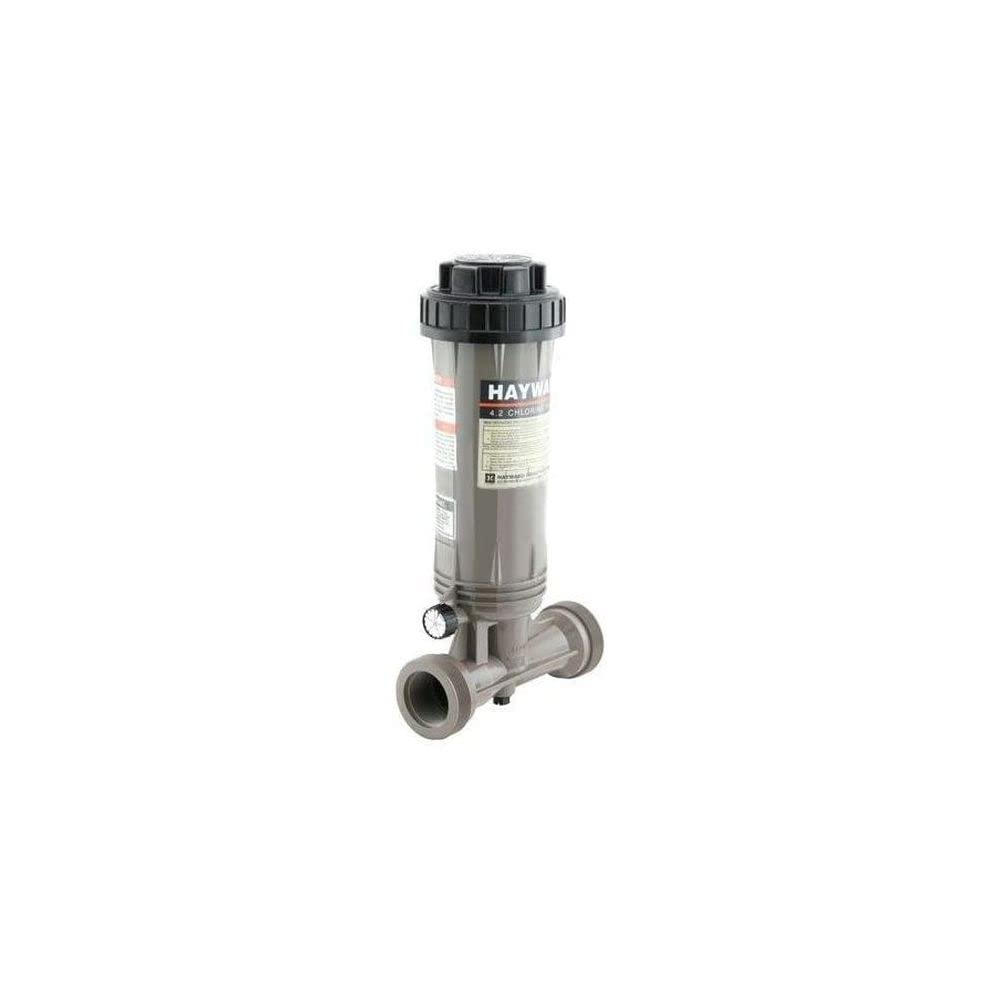
1. Hayward CL100 Automatic Chlorine Feeder
Our pick — 4.5+★ from 400+ verified ratings; the strongest balance of quality and price.
The simplest way to stop hand-feeding chlorine tablets into a above-ground pool.
The CL100 is the one to start with if your pool has an above-ground layout and you are tired of tossing tablets in by hand. It holds 3-inch diameter trichlor tablets and drops them into a simple plastic body that sits in your return line. The 16″L x 8″W x 8″H body takes up modest space at the equipment pad, and the 50 gpm flow rate covers the pump output most above-ground setups run.
Where this earns its keep is the control. A dial valve sets how fast the tablets feed, so you can dial chlorine back in cooler weeks instead of watching it run hot. The Easy-Lok threaded cover opens and seals with a twist, and the finger-release catch adds a second lock — handy if kids poke around the equipment. Owners rate the overall build and day-to-day function highly, and the installation is simple enough that you can do it yourself in an afternoon.
What you will notice over seasons is that the plastic cap does not always last. A share of buyers report the cover or cap cracking within a couple of years, which is the honest trade-off on a plastic feeder — it holds up well but it is still plastic in the sun. Buyers also mention that tablets get used up quicker at a high feed setting, so match the dial to the weather.
The Hayward CL100 Automatic Chlorine Feeder earns its spot as the highest-rated feeder here because it pairs a dial feed valve with a secure Easy-Lok cover. That means you set the chlorine dose with the dial, and the Easy-Lok cover seals with a twist. It fits a standard above-ground setup and installs without a plumber. The trade-off is a plastic cap that may need swapping down the road.
The case for the CL100
- Holds standard 3-inch trichlor tablets, so you feed the same pucks you already buy
- Dial valve lets you set the feed rate instead of guessing at tablet counts
- Easy-Lok cover plus finger-release catch keeps tablets secure and reachable
- 50 gpm flow rate suits typical above-ground pump output
Where it gives ground
- The plastic cap can crack after a couple of seasons
- Feed rate runs the tablet supply down fast on high settings
- Above-ground style and in-line placement is not a fit for every pad
The solid buy: pick it if you have a standard above-ground pool and want a low-fuss in-line feeder with real dial control.
Look elsewhere: if your pad will not take an in-line body, the off-line feeder below avoids the plumbing cut.
2. 4.2lbs in-Line Automatic Pool Chlorinator
A budget in-line feeder that sits after your heater and filter and does the tablet work quietly.
The ProMotus is the plumbing-first choice: it is designed to go in your return line after the heater and filter system, so it doses chlorine on its own as water flows past. A 4.2 lb tank holds slow-dissolve 3-inch chlorine or bromine tablets, and the dial control valve lets you adjust the feed rate to match the season. For a low-outlay in-line install, that combination is hard to argue with.
The build is sturdier than the low price suggests. The valve body is ABS plastic, the seals are described as high quality, and the Easy-Lock threaded cap makes adding tablets or sticks a one-hand job. If you are converting a manual routine into an automatic one, the setup is straightforward for anyone comfortable working on pool plumbing.
The caveat is the tank size and the shallow review base. Fewer people have run it long-term, so durability remains an open question rather than a proven one — a fair caveat, not a dealbreaker.
If you want in-line automation at entry-level money and your plumbing already has a straight run to work with, this is the smart value pick for the job.
The value read: a 4.2 lb in-line feeder with an ABS valve body and Easy-Lock cap at entry-level cost is a sensible first step into automatic dosing.
The honest limit: smaller tank than the off-line unit and a thinner review base, so plan on refilling more often on a big pool.
Reach for it if: you already have pipe after the heater and want in-line dosing without a big spend.
Think twice if: your equipment pad has no spare straight run — the off-line feeder is the better fit.
3. XtremepowerUS Automatic Chlorinator Feeder
The feeder that keeps chlorine in the loop when there is no room in your equipment run.
No straight pipe left on your pad? This is why the XtremepowerUS exists. Off-line feeders tap into your piping with small hoses rather than sitting in the flow, so the unit creates less water flow restriction and you avoid cutting your return line. Its 9 lb tank versus the 4.2 lb tank on the in-line feeder above means you are loading tablets considerably less often on a busy pool.
The tank takes 3-inch slow-dissolve trichlor or bromine tablets, and the dial control knob adjusts both the speed and frequency of water through the feeder. Owners find the setup effective — one said it works better than a floating chlorinator — and the quality earns frequent praise for matching or beating a name brand. The kit ships with the installation bits, and the heavy-duty resin body handles sun exposure and pool water without much fuss.
Value is the divided line here: some buyers find the tally fair for a 9 lb off-line unit, others feel they paid a touch much for the plastic. It is a fit question — if your pad has no straight pipe run for an in-line body, this off-line feeder solves your problem.
For above-ground pools and small in-ground pools with a cramped equipment area, this is the pick that keeps chlorine moving without a plumbing cut.
What wins people over: the 9 lb tank and off-line mounting, which let a tight equipment pad run automatic chlorination without an in-line splice.
The honest caveat: value sits on a split opinion, and the resin body is durable but still plastic.
Best fit: above-ground or small in-ground pools where the pad has no room for an in-line feeder.
Skip if: you have a clean straight run of pipe — the in-line units give you a tidier install.
4. Pentair R171016 Rainbow 300 Automatic Pool and Spa Feeder

A fully enclosed feeder that keeps chlorine gases in and the smell out of your equipment area.
At 3 pounds, the Rainbow 300 is the lightest feeder on this list — the INTEX saltwater system below weighs 17.1 pounds — so it hangs or mounts without stressing a bracket. That matters on a spa or a small in-ground pool where the feeder sits close to the equipment and you want it out of the way.
The standout spec is the sealed design. It is a completely enclosed system with no special venting required and no escaping gases, so the chlorine smell stays inside the unit instead of drifting across the pad. All Rainbow Feeders are NSF Listed (a recognized certification for pool equipment). Owners mention it is simple to install and easy to operate, and that it keeps chlorine levels steady rather than spiking and dipping. Owners treat it as a time and money saver for exactly that reason.
The catch is that unions are not included, so you will buy those separately to complete the plumbing. If you want a feeder that seals tight and needs no venting, the Rainbow 300 delivers that in a compact package.
For spa owners and small in-ground pools where a sealed, gas-tight feeder makes sense, this is the cleaner choice.
The one to pick: spa and small in-ground owners who want a sealed, vent-free feeder that does not leak chlorine fumes.
Keep in mind: the unions are sold separately, so factor those into the plumbing job.
5. Hayward CL2002S In-Line Automatic Chlorine Chemical Feeder

Built for bigger pumps — the in-line feeder that keeps up with a high-flow system.
The CL2002S is the step up in flow: 2-inch inlet and outlet ports let it handle 50 gpm to 90 gpm flow rates, so it keeps pace with a larger in-ground pump without choking the return. That is more headroom than the CL100’s 50 gpm ceiling, which matters if you run a bigger circulation system. It is a 5.2-pound in-line body, and it takes large or small slow-dissolving trichlor or bromine tablets as well as sticks.
The build earns strong marks for quality and effectiveness across a large review base, and customers note it feeds reliably and opens and closes easily. The adjustability is a real selling point — you can set the dial below 1/2 when a full dose runs too hot, and the Easy-Lok cover and finger-release catch make topping up simple. It works on newly built pools and on existing systems when you are replacing an old chlorinator or brominator.
Installation is where opinions split. Some find it easy; others point out the threaded fittings are glued on, so you need to be comfortable with PVC solvent work or bring in a pro. Durability also draws some mixed notes — the recurring theme is a body and cover that want careful handling.
For an in-ground pool running a stronger pump that needs an in-line feeder with real flow headroom and fine-tune control, the CL2002S is the high-flow answer.
The flow advantage: 2-inch ports and a 50 to 90 gpm range let it sit in front of a bigger pump without starving the return.
What to watch: the glued threaded fittings push the install toward a pro, and the body wants careful handling over the seasons.
Suits you if: your in-ground system runs 50 to 90 gpm and you want dial control with fine adjustments.
Better to pass if: you want a bolt-on install with no PVC gluing.
6. INTEX Krystal Clear QS1200
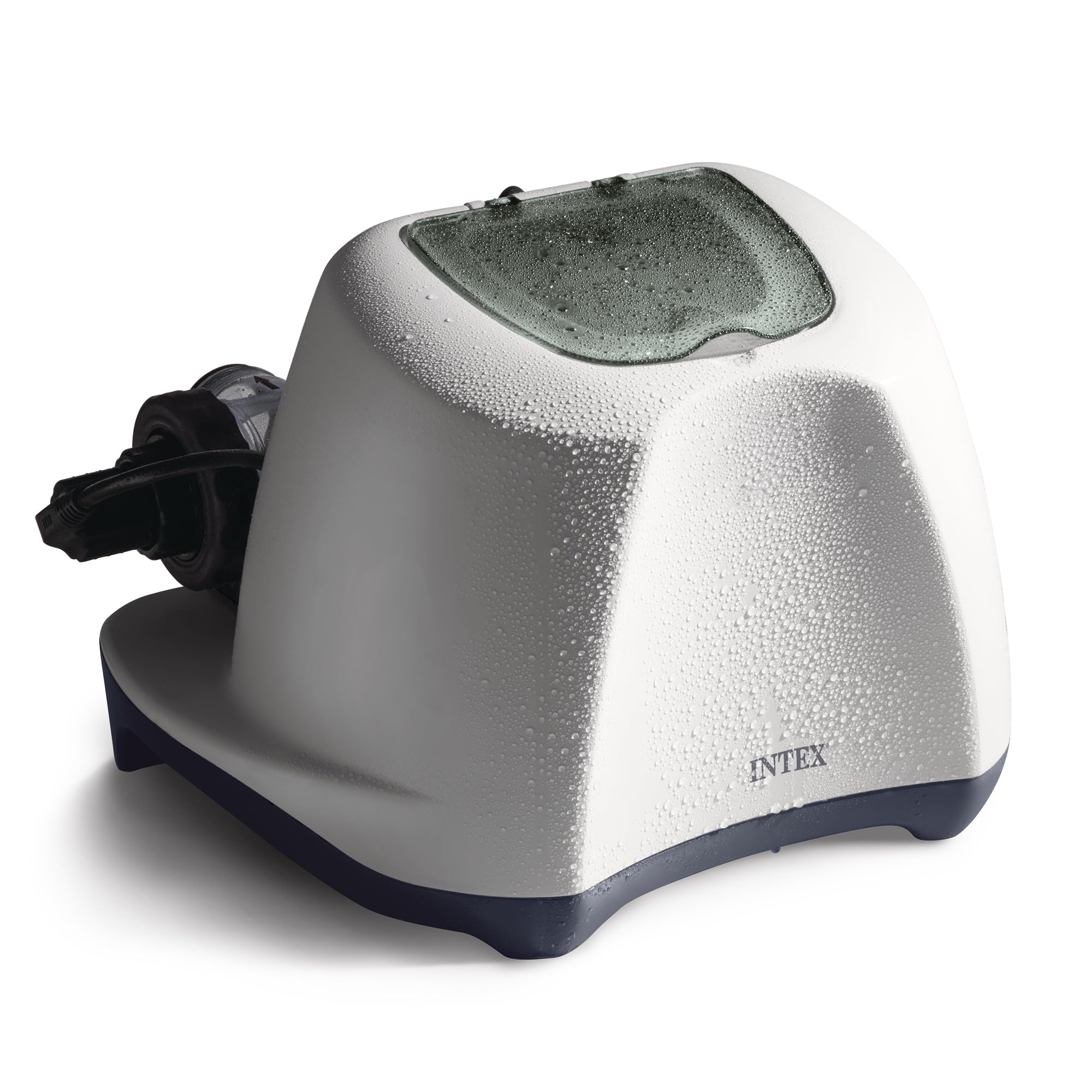
The salt system that turns an ordinary above-ground pool into a softer-water setup up to 15,000 gallons.
If your pool is above-ground and you are tired of tablet refills, the QS1200 is the move into saltwater without rebuilding anything. It is rated for pools up to 15,000 gallons and uses ordinary salt instead of pucks, so maintenance drops to a bag of salt and the occasional dial-in. The unit weighs 17.1 pounds, against 3 pounds for the Rainbow 300, because a salt cell and control housing carry more hardware than a plastic tablet feeder.
The controls are what make it livable. An easy-to-use panel with straightforward buttons runs a built-in 24-hour timer and 3 self-cleaning modes on 6-, 10- or 14-hour cycles, so you set a schedule and let it work. Intex also builds in its hydroaeration aeration feature for circulation and water clarity, and the unit carries a 2-year limited warranty. Reviewers point out setup is easy and the water comes up crisp.
The honest trade-off is durability. Effectiveness and quality get split opinions — for plenty of above-ground owners it hums along, while some units stop working properly over time. It is a fit question as much as a build one: a salt system means watching salt level and power, not just opening a tablet cap.
For an above-ground pool owner who wants to ditch tablets and is fine with a 2-year warranty horizon, the QS1200 is the best-value way into saltwater.
Why above-ground owners like it
- Rated for pools up to 15,000 gallons — a clean fit for most above-ground setups
- Built-in 24-hour timer and 3 self-cleaning modes on 6-, 10- or 14-hour cycles
- Uses ordinary salt instead of tablets, so tablet runs stop
- 2-year limited warranty backs the unit
The reality check
- Some units stop working properly over time, so the warranty window matters
- Heavier install than a plastic tablet feeder
- Saltwater means watching a salt level, not just opening a cap
The value path to saltwater: above-ground owners up to 15,000 gallons who want to stop buying tablets.
Weigh the trade-off: a 2-year limited warranty and mixed long-term durability mean it is a fit buy, not a lifetime one.
7. Rx Clear Hydrosalt Cell 20,000 Gal

A replacement salt cell that swaps into Hayward-style controls for pools up to 20,000 gallons.
The Hydrosalt Cell is the retrofit move: it is a compatible replacement for Hayward AquaRite Pro, SwimPure+, H-40 and Goldline AquaRite, Aqua Rite XL, Aqua Plus, Aqua Logic and Pro Logic controls. If you already have one of those controllers, this cell plugs in and revives the system without a full rebuild. It is rated for 20,000 gallons and comes pre-wired to drop onto the control panel. Union sizes are 1.5-inch and 2-inch, and it is factory set at 220 volts with the ability to convert to 110 volts.
What it does in daily use is simple: it turns ordinary salt into a fresh chlorine supply, so you stop mixing, measuring and storing liquid or tablet chlorine. The pitch is softer water and less of the harsh chlorine feel — and Rx Clear makes a 50% chlorine cost reduction claim with the unit, so treat that as the maker’s claim rather than your guaranteed saving. Effectiveness draws positive notes, including one buyer who says it worked better than a name-brand cell.
Reliability is the honest plot twist. The most-discussed aspect is reliability, and it cuts both ways — some units run for a long time, while others report a cell that quit from day one. That is the risk with retrofit cells, and the 2-year manufacturer’s warranty is the backstop you are buying.
For anyone already running Hayward-style controls who wants a fresh salt cell without changing controllers, this is the practical replacement.
The retrofit upside: plug-and-play compatibility with a long list of Hayward-style controls at a 20,000-gallon rating, with 1.5-inch and 2-inch unions to match your plumbing.
The honest fit note: reliability is the most-discussed point and it splits, so buy within the 2-year warranty and check the cell on arrival.
Made for you if: you already have Hayward-compatible controls and need a replacement cell up to 20,000 gallons.
Not the pick if: you are starting fresh with no existing controller to plug into.
8. TP30 Salt Chlorine Generator
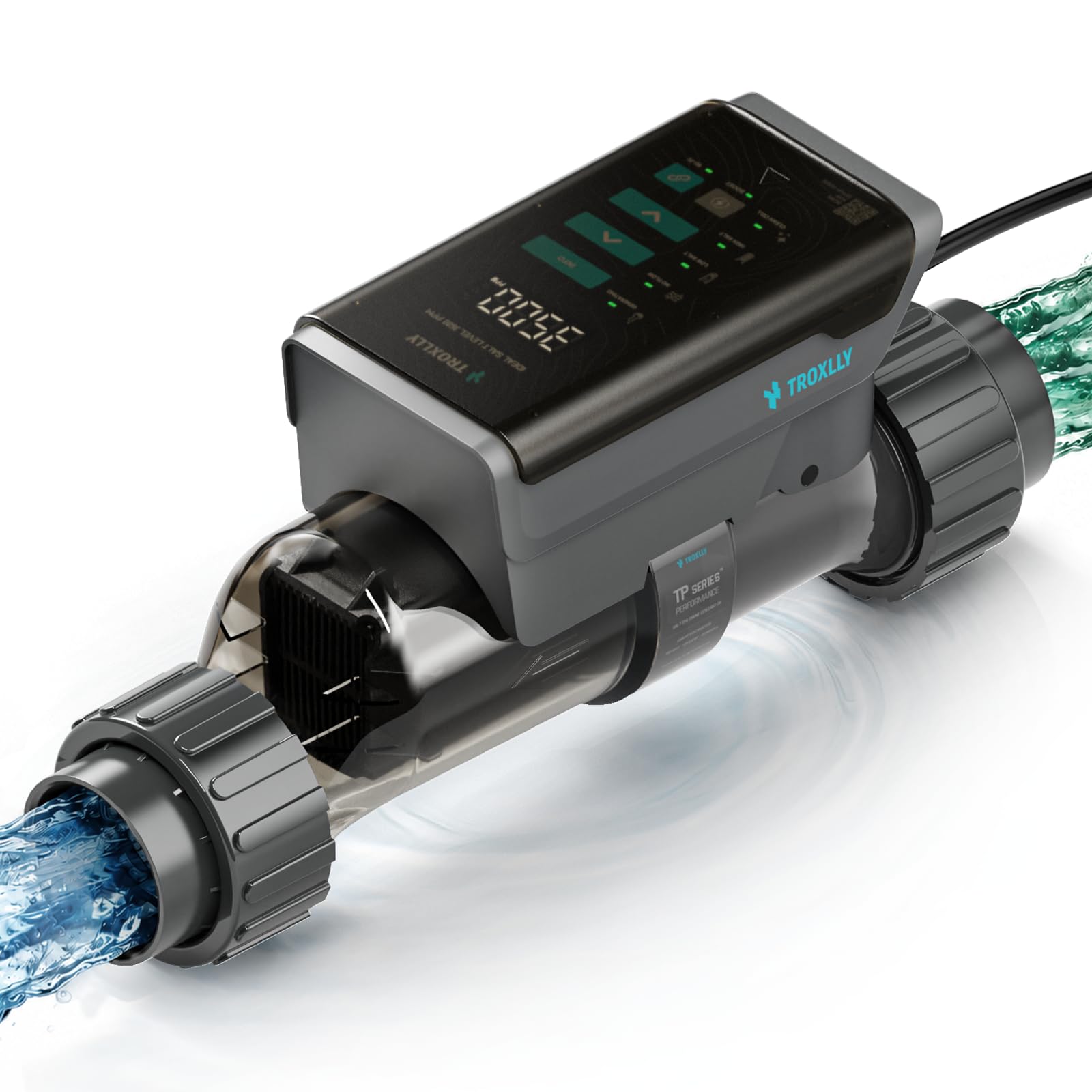
A big-pool salt generator that puts your chlorine output and salt level on your phone.
The TP30 is the one for a large residential pool — it is sized for up to 40,000 gallons, against a 20,000-gallon rating on the Rx Clear cell above. Its edge is visibility: an app and panel let you check output, salinity, flow, water temperature and system alerts without walking out to the pad. The clear cell housing lets you eyeball the cell for scale, and automatic reverse polarity helps reduce scale buildup so chlorine generation stays consistent.
Installation is genuinely retrofit-friendly if you already run Pentair-style plumbing. The unit is designed for standard pool plumbing with matching installed length and threaded unions to cut replumbing in compatible layouts, and it fits compatible Pentair IntelliChlor IC20/40/60 plumbing. It is ETL Listed for applicable safety standards and ships with setup materials to help you plan the install. The manufacturer is clear that the Pentair reference is compatibility only — it is not affiliated with or endorsed by Pentair.
One thing to keep in mind is the salt reading. Ppm (parts per million, the salt concentration) accuracy is where opinions divide, so compare the app reading against a manual test before you trust it as your only salt check. That said, the system clears its core job. Shoppers say it is effective and easy to install, and one says it worked immediately from the start. They see it as good value for the gallon count it covers.
For a large pool where you want to know the status from your phone and enjoy a clear, scale-fighting cell, the TP30 is the monitoring pick.
The monitoring win: app and panel show output, salinity, flow and temperature, and automatic reverse polarity fights scale — useful on a 40,000-gallon pool.
The honest check: ppm readings can drift, so pair the app with a manual test before you rely on salt accuracy.
For you if: you run a large pool and want salt status visible from the app, with retrofit plumbing into Pentair-style layouts.
Think twice if: you would rather trust a hand test than an app reading for salt level.
9. Universal40 Salt Chlorinator System | 40,000 Gallon Pool Max

A replacement-first salt system with the longest warranty here and a 40,000-gallon ceiling.
The Universal40 is built for the job of replacing an old salt chlorinator, not starting from zero. Its plumbing is designed to be compatible with Hayward AquaRite, Goldline, SwimPure Plus, Mineral Springs, NatureSoft, AquaPlus, LeverEdge Guardian and Blue Essence units, so swapping it in needs no cutting or gluing in compatible layouts. It is rated for pools up to 40,000 gallons with a 1.8 lb/day chlorine output, and Circupool recommends oversizing for maximum performance and cell longevity.
What seals the deal for many owners is the warranty: a 4-year limited manufacturer warranty with no penalty for DIY installation, against the 2-year coverage on the Rx Clear and INTEX units here. A premium view-through window lets you read the status lights from across the pad without opening the controller door, and it works with virtually any existing pump and filter on 120V or 240V power. Owners call it a great value that keeps water crisp, and the lift-and-shift install is a common theme.
Salt level accuracy is the honest wrinkle — the readings can drift, so check against a manual test rather than leaning on the display alone. And at 22 pounds it is the heaviest unit on the list, so plan a solid mount and a second pair of hands.
If you are replacing a tired salt system and want a long warranty, a clear status window and retrofit plumbing that drops in without a rebuild, the Universal40 is the one to reach for.
What earns it the retrofit crown
- 4-year limited warranty with no DIY install penalty
- Compatible plumbing for Hayward, Goldline and several other systems
- 1.8 lb/day chlorine output for pools up to 40,000 gallons
- Premium view-through window lets you read status lights from afar
The trade-offs to plan for
- Salt level readings can be inaccurate, so verify with a manual test
- 22-pound body needs a solid mount and a helper
- Oversizing is recommended, so match the gallon rating carefully
The retrofit pick: replacing an aging salt system where a long warranty and drop-in plumbing matter most.
Consider the trade-off: accurate salt readings are not a given, so keep a manual test on hand.
Know the Specs
Feed rate and dial control
A dial control valve sets how much chlorine the feeder releases. On a tablet feeder it controls the water flow past the tablets; on a salt cell it sets the output. Turn it up in hot weather when chlorine burns off fast, turn it down in cool spells so you do not over-chlorinate. On a sunny week, the dial setting burns through tablets faster than tank size decides how often you refill.
Tank capacity and tablet size
Tablet feeders are rated by how many pounds of tablets they hold — the units here range from a 4.2 lb tank to 9 lb. Bigger tanks mean fewer refills, and most take 3-inch slow-dissolve trichlor or bromine tablets. Check the tablet size your feeder accepts before you buy a bucket of pucks.
Flow rate (gpm)
Flow rate tells you how many gallons per minute a feeder can handle. A unit rated at 50 gpm suits a modest above-ground pump; an in-line feeder with 2-inch ports can handle 50 to 90 gpm for a bigger system. Matching flow to your pump keeps the feeder working and avoids starving it.
Salt cell sizing and output
Salt cells are matched to pool volume — from 15,000 gallons up to 40,000 gallons here — and rated by chlorine output per day. Oversizing is often recommended for performance and cell longevity. Confirm your pool volume and your controller compatibility before you order a cell.
Common Questions
Will an in-line chlorinator fit my above-ground pool plumbing?
What size chlorine tablets do these feeders take?
Is a salt chlorinator better than a tablet feeder?
How long will a salt cell last?
Do I need a straight pipe run for an in-line feeder?
What flow rate does my feeder need to handle?
Can I install a salt cell myself, or do I need an electrician?
Why does my salt system give an inaccurate salt reading?
How often do I need to add tablets to a chlorinator?
Will a tablet feeder work on a spa as well as a pool?
The Bottom Line
For most above-ground pool owners, the swimming pool chlorinator that fits best is the Hayward CL100 Automatic Chlorine Feeder. It pairs easy do-it-yourself install with a dial feed valve and a secure Easy-Lok cover, and it is the highest-rated feeder here. If your pad has no room for an in-line body, the XtremepowerUS Off-Line Automatic Chlorinator hangs off-line with a 9 lb tank. And if you want to stop buying tablets altogether, the Universal40 Salt Chlorinator System drops into compatible plumbing with a 4-year limited warranty to back it.
One honest nudge: tablet feeders are the easy, low-cost way to automate chlorine today, but the salt cells are the ones that change your weekly routine. Match the feeder to your return-line plumbing and your tolerance for refills, and you will spend less time chasing chlorine and more time swimming.
How we choose
We do not accept paid placement. Every pick is matched to a real buyer and a real use-case; we do not hands-on test units.
Sources
Specifications: manufacturer listings and product documentation. Review insights: verified customer reviews, as of November 2026. Pricing: not shown on this page (it changes often); check the current price via the retailer link.
As an Amazon Associate, Tactical Gear Guy earns from qualifying purchases. This does not affect which products we feature.