Specs are compiled from manufacturer listings and verified buyer reviews and can change over time — please confirm the key details on the product page before buying.
You want a camera small enough to live in a jacket pocket, but the whole point is getting the pictures onto your phone without hunting for a cable. That single job — wireless transfer — is where most pocket cameras either earn their keep or get left in a drawer. The short answer: prioritize transfer method first, sensor second, zoom third. Everything below is ranked around that one reality.
This guide is built by comparing the manufacturers’ published specifications and the patterns across verified customer reviews, so you get each pick’s real strengths and trade-offs instead of marketing spin.
The pocket-camera shelf splits cleanly in two: app-connected compacts that beam shots straight to your phone, and old-school long-zoom bodies that make you work for it. This guide covers both sides so you can pick the one that fits how you actually shoot, and it names the standout small camera that connects to phone for each job.
Top Picks


How To Choose The Best Small Camera That Connects to Phone
The mistake most first-time buyers make is shopping the megapixel number first. In this category the order is reversed: the connection method decides whether you will actually use the camera, and only then do sensor size, zoom, and autofocus matter. A 20-megapixel body that takes four minutes to hand a photo to your phone loses to a 12-megapixel body that sends it in seconds.
Match the transfer method to your phone habits
Wi-Fi pairing through a free companion app is the most flexible route — you can browse the gallery, pick shots, and pull full-resolution files onto the phone with no cable. Bluetooth is the low-power option: it pairs instantly and can auto-push images to your phone as you shoot, which suits people who never want to think about transferring. NFC is the tap-to-connect shortcut on Canon bodies, and it saves you digging through phone menus to join a network. Decide which of those three you will genuinely use, then filter.
Sensor size beats megapixel count
A 1-inch sensor (the measuring standard for the light-catching chip inside) gathers more light per pixel than a smaller chip, so dim rooms and evening shots stay clean instead of grainy. It also lets you blur the background behind a subject, which is the look most people want from a dedicated camera rather than a phone. On a small sensor, a higher megapixel count mostly buys larger files, not better pictures.
Zoom: optical or nothing
Optical zoom moves real glass to magnify — a 30x optical reach on a pocket body is what gets you a usable frame from the back of a concert hall. Digital zoom simply crops and enlarges the middle of the picture, which softens detail fast. Look for the word optical in the spec line and ignore the digital figure printed beside it.
Autofocus points and burst speed for real life
Autofocus points are the spots across the frame the camera can lock onto. More points generally means a better chance of holding a moving subject — a toddler, a dog, a cyclist. Burst speed, quoted in frames per second, tells you how many shots the camera fires in a row, which is how you catch the one clean frame out of a fast moment.
Pack-ins change the real cost
Some bodies ship bare with just a battery and strap, and you will add a memory card and case on day one. Others arrive as a kit with a memory card, spare battery, and bag included. Compare what is actually in the box before you decide which one is the better deal, because the accessories are not free.
Side-by-Side Comparison
| Model | Best For | Optical Zoom | Autofocus Points | Phone Connection | Amazon |
|---|---|---|---|---|---|
| Sony ZV-1F★ Best Overall | Vlogging and low light | Fixed 20mm wide | 425 | Wi-Fi + Bluetooth | Amazon |
| LeuLix 7X Optical ZoomBest Value | Beginner kit on a budget | 7x | — | Wi-Fi app | Amazon |
| Yatao 6K Flip ScreenBest for Creators | Teen creators and selfies | 16x | — | Wi-Fi app + USB-C webcam | Amazon |
| Canon PowerShot ELPH 360 | Pocket everyday carry | 12x | 99 | Wi-Fi + NFC | Amazon |
| LUMIX ZS99 (body) | Travel reach in a pocket | 30x | 121 | Bluetooth 5.0 + app | Amazon |
| LUMIX ZS99 Bundle (Black) | Ready-to-shoot travel kit | 30x | 19 | Bluetooth + Wi-Fi | Amazon |
| Canon PSSX740HSSL (Silver) | Auto-send to phone while shooting | 40x | 1 | Wi-Fi + Bluetooth auto-send | Amazon |
| Sony RX100 VII | Fast action and premium image quality | 24-200mm | 425 | Wi-Fi + Bluetooth | Amazon |
Detailed Reviews
1. Sony ZV-1F Compact Digital Camera 4K Video Black
Our pick — 4.5+★ from 1,500+ verified ratings; the strongest balance of quality and price.
The pocket camera built for your face, not the landscape behind it.
The first thing you notice is the lens. It stays at a fixed 20mm, which is deliberately wider than most compacts — hold the camera at arm’s length for a selfie or a talking-head video and you still get your shoulders in the frame instead of a close crop of your nose. That single choice is why this body sits at the top of the list for anyone recording themselves.
Behind that lens is a 1-inch sensor paired with an F2 aperture (the low-light opening size, where a smaller F number lets in more light). The practical effect: dim restaurants and evening streets stay usable, and the background behind a subject softens into a blur. Autofocus runs on 425 points — the spots across the frame the camera can lock onto — and adds Eye-AF, which pins focus on a person’s eye. Against the Canon PowerShot ELPH 360 and its 99 autofocus points, that is a much denser focusing net for a moving subject.
The connectivity is the part that makes it a phone-first camera. It pairs over both Wi-Fi and Bluetooth, and the screen is a side-articulating touchscreen that flips out so you can frame a selfie while looking at yourself. The directional 3-capsule mic with a wind screen accessory is aimed squarely at outdoor talking shots. What wins people over most is outright image quality, and the 4K video output follows close behind — this is a body that flatters a beginner without coddling them. A recurring gripe in the review pages is battery life, so plan on a spare cell for a full day out.
What earns its keep
- Fixed 20mm wide lens frames selfie and vlog shots without a step backward
- 1-inch sensor with F2 aperture lifts low-light shots and softens backgrounds
- 425 autofocus points plus Eye-AF hold focus on faces in motion
- Wi-Fi and Bluetooth pairing sends clips straight to your phone
- Side-articulating touchscreen makes solo filming easy to compose
Where it asks for patience
- No optical zoom — the lens stays wide, so distant subjects stay distant
- No built-in flash, which limits pitch-dark shots
- Battery life is the most-discussed shortfall, so carry a second battery
- Value for money splits opinion in the reviews — it is a mid-range body with a premium sensor
Top of the pile: the cleanest match for solo creators, vloggers, and anyone who shoots people more than landscapes.
Think twice: if you need to pull in a faraway subject, the fixed wide lens leaves you cropping.
2. LeuLix 7X Optical Zoom Digital Camera
The starter kit where everything needed to shoot is already in the box.
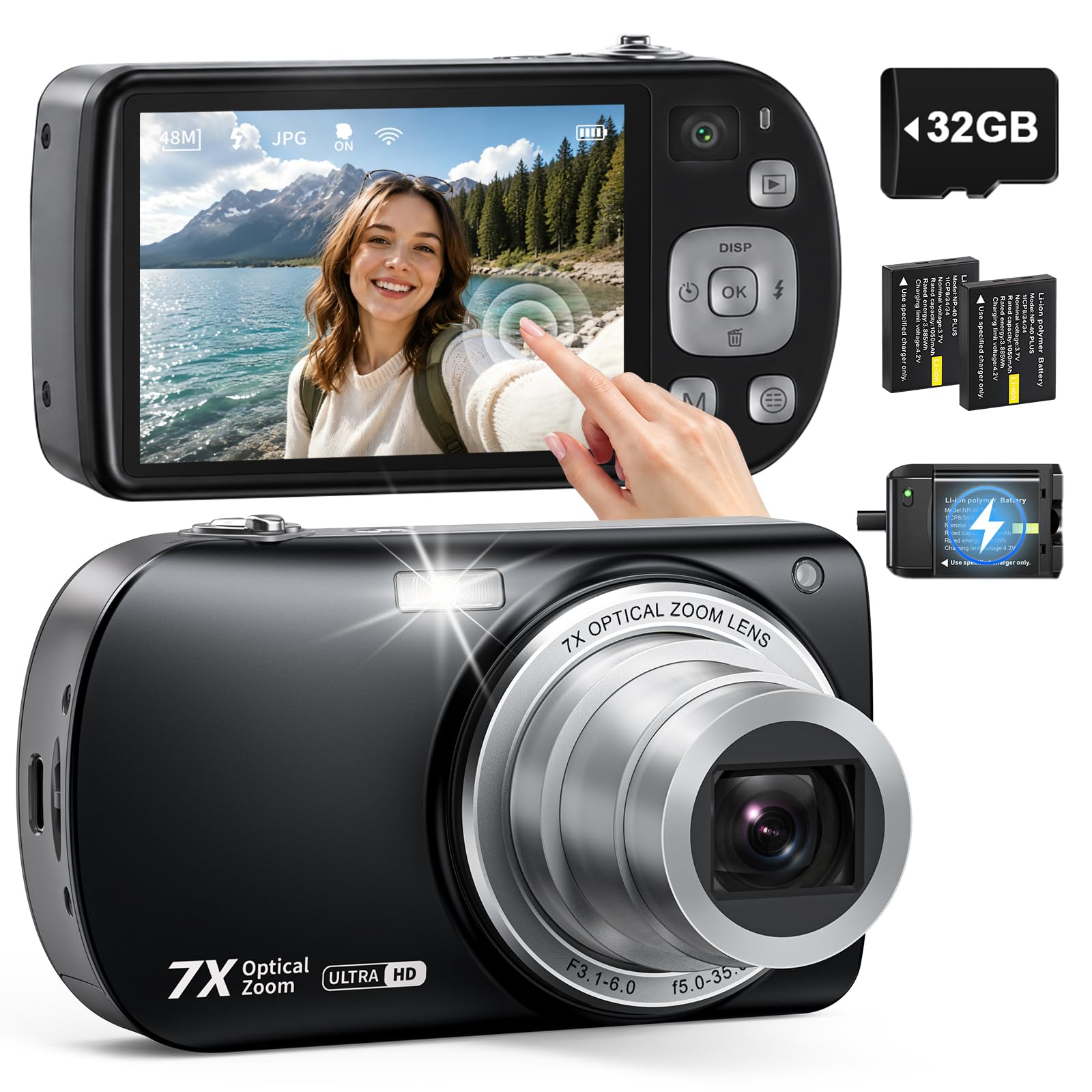
Open the box and you have a 32GB memory card, two rechargeable batteries, a card reader, a charger, a camera bag, a wrist strap, and a cleaning cloth. That is the whole reason this one lands as the value pick: nothing forces a second order before your first shot. For a birthday or graduation gift aimed at a teen, that completeness matters more than any single spec.
The camera itself is built around a 7x optical zoom, so you can genuinely magnify a subject with glass rather than crop it. Shake control comes from a 5-axis gyroscope with EIS (electronic image stabilization), which steadies handheld video and timed group shots. A built-in flash handles dark restaurants and parties without blur. The 2.8-inch touchscreen keeps operation familiar. Its 88-megapixel effective still resolution is a big headline figure, and it beats the 64 megapixels of the Yatao 6K below on paper.
The phone link is the standard app route: pair over Wi-Fi, then remotely trip the shutter, browse the gallery, and download photos and video straight to your device with no cable. It also works as an HD webcam when plugged into a computer, which is a handy second life for online classes. The honest catch is the small sensor behind that 88-megapixel figure: the files are big, low light is not this camera’s strength, and the WiFi transfer runs over USB-based connectivity rather than a premium radio chip.
Who it suits: a first camera, a gift, or a travel body where the accessory bundle saves the day and the zoom does the heavy lifting.
Set expectations: treat the flash as a must in dim spaces, because the sensor is small and gathers limited light.
Good match if: you want a fully equipped starter camera with zoom and phone transfer in one purchase.
Look elsewhere if: clean low-light photos without flash are your priority.
3. Yatao 6K WiFi Flip Screen Digital Camera
A twin-lens creator bundle that turns a first video into a finished post.
Recording 6K Ultra HD video is the headline, but the useful part is the dual-lens setup: a wide-angle lens for scenery and a macro lens for close-ups, backed by 16x zoom. A flip screen makes framing selfies straightforward, which is the whole game for anyone posting to TikTok or Instagram. Its 64-megapixel effective still resolution trails the LeuLix’s 88 megapixels, but resolution is only one axis of a creator camera.
The bundle is where this earns attention. It ships with a 64GB card, two batteries on a charging stand, a microphone, a bi-color fill light for warm or cool tones, and a lens hood to cut glare. The built-in flash covers dark scenes, and the shooting modes include slow motion and continuous shooting. You also get USB-C webcam use for live streaming. The value-for-money thread runs strong through the review pages, and buyers describe the setup as approachable for teens getting into photography.
Pairing runs over Wi-Fi with app control, so clips go from camera to phone to social feed without a cable. What to keep in mind: it rates 4.0+ out of 5, and some owners find the battery and low-light performance want managing. It is the pick for a young creator chasing the accessory bundle, not for someone who needs a large sensor.
The creator angle: flip screen, mic, fill light, and 64GB card all arrive together — everything a first video needs.
The fine print: it runs on a smaller sensor than the Sony or LUMIX bodies here, so dim scenes are the limitation to plan around.
Reach for it if: you are building a social channel and want the accessories and selfie framing in one buy.
Skip the swap if: your output is stills-first in low light.
4. Canon PowerShot ELPH 360 Digital Camera (Silver)

The slip-in-a-purse body that made tap-to-share a habit.
Of everything here, this is the easiest one to forget you are carrying — it fits in a pocket or a purse and disappears until you need it. Owners consistently point to that carrying ease as the reason it comes along on trips. The 12x optical zoom with an optical image stabilizer lets you pull in a distant subject and keep it sharp by reducing hand shake.
Inside is a 20.2-megapixel CMOS sensor with Canon’s DIGIC 4+ processor, capturing 1080p HD video rather than 4K. Sharing is the star: built-in Wi-Fi and NFC let you tap-connect and move images and video to your phone, and it supports direct connection to select Canon printers. There is a 3.0-inch LCD for framing. Against the Sony ZV-1F and its 425 points, this body’s 99 autofocus points mean a less dense focusing net — fine for still subjects, less so for fast movement.
Two honest notes shape the buying decision. Value for money is the most-contested topic in the reviews, and Wi-Fi connectivity draws mixed feedback — the pairing works, but expect to learn the app dance. It is a veteran model, so if you want 4K or advanced autofocus, look to the Sony or the LUMIX. If you want a small, proven, tap-to-share camera for stills and casual video, this is a comfortable choice at 4.0+ out of 5.
Carrying comfort: small enough for a purse or pocket, with 12x optical zoom and an image stabilizer for handheld reach.
Stills-first: 1080p HD video caps the resolution here versus the 4K bodies on this list.
Pick it if: stills, NFC tap-sharing, and pocketability matter more than 4K video or fast-action autofocus.
Move on if: you plan to shoot video primarily.
5. Panasonic LUMIX ZS99

A concert-hall zoom squeezed into a body that rides in a jeans pocket.
Start with the lens, because it is the whole argument: a 24-720mm LEICA zoom covering 30x optical reach. That is the difference between a speck on a stage and a head-and-shoulders frame from the back row, and the camera still drops into a jean pocket. Against the Sony ZV-1F’s fixed 20mm lens, this is 30x of glass where the Sony offers none — two cameras solving completely different problems.
Video runs 4K at 30p, with 4K PHOTO bursts at 30fps and HD slow-motion at 120fps for creative flexibility. A 1,840k-dot tiltable touchscreen lets you frame from low or overhead angles without lying on the ground, and USB Type-C charging keeps it topped up on the road. Autofocus uses a hybrid system with 121 points. The pairing route is Bluetooth v5.0 with a dedicated Send Image button that pushes shots to your phone through the Panasonic Image App — a single press instead of menu-diving.
What comes through in the owner experience is the reach and the portability as a travel pair — the zoom and the small footprint get the most love. The trade-off is honest: video quality, user-friendliness, and value all draw mixed feelings, and there is no built-in flash on this body, so night shots lean on available light. It is a 4.0+ out-of-5 specialist, not an all-rounder.
Why travelers like it: 30x optical reach in a pocket footprint, plus one-button Send Image transfers to your phone over Bluetooth.
The catch: no built-in flash and mixed feedback on video quality, so pair it with good light.
Reach for it if: faraway subjects — concerts, wildlife, travel landmarks — are what you shoot.
Pass if: you need flash-lit indoor shots or the cleanest possible video.
6. Panasonic LUMIX ZS99 Bundle with Bag & 32GB SD Card (Black)
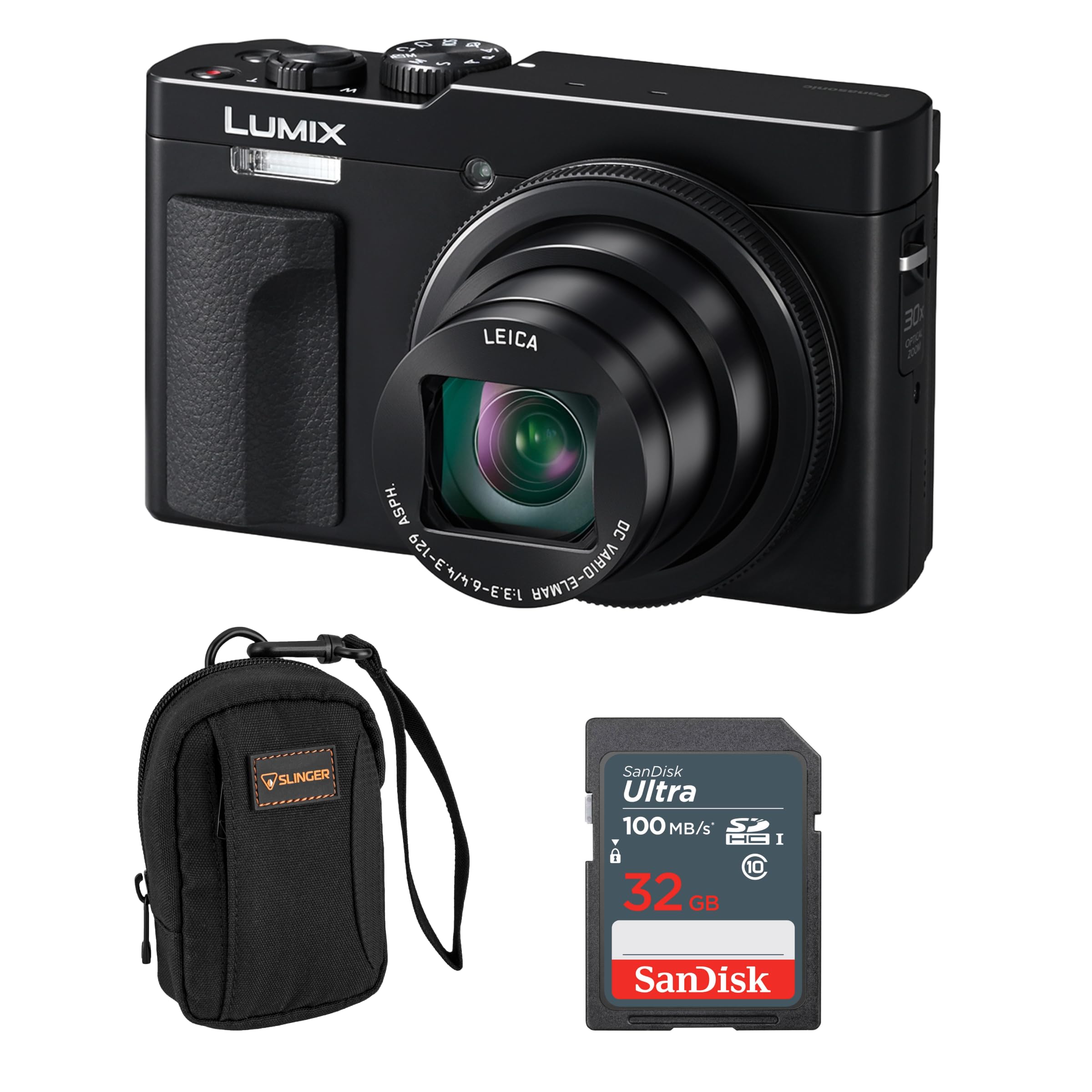
The same 30x zoom, now with the bag and card already sorted.
This is the LUMIX ZS99 with the accessories folded in: a SanDisk 32GB memory card, a Slinger small camera case, a battery, a USB cable, a hand strap, and Panasonic’s 3-year limited warranty. If the body-only version appeals but you dread a second shopping trip, this version closes that gap. The core hardware is unchanged — a 24-720mm LEICA lens with 30x optical zoom and the same pocket-sized body.
Shooting features match the sibling: 4K video at 30p, 4K PHOTO at 30fps, and HD slow-motion at 120fps. The 1,840k-dot tiltable touchscreen handles awkward angles, and USB Type-C charging means one cable for the camera and your phone. Sharing is over Bluetooth v5.0 via the Panasonic Image App, with the dedicated Send Image button doing the transfer.
It carries an exceptional 4.5+ out of 5, but from a small pool of buyers — so treat that number as early enthusiasm rather than a mass verdict. The bundle is the reason to choose this version: fewer loose ends, one order, and the warranty spelled out. Note that there is no flash listed on this configuration and the same mixed reviews around low light apply.
Why the bundle wins
- 32GB card and Slinger case included, so it is shoot-ready from the start
- 30x LEICA zoom in a body that slips into a pocket
- Bluetooth v5.0 with one-button Send Image transfers
- 3-year limited warranty listed with the kit
Worth knowing up front
- Small review base means the rating is early, not settled
- No built-in flash on this listing, so dim rooms need extra light
- Autofocus point count differs from the body-only version — check before buying
Best fit: a traveler who wants the long zoom and every accessory in a single purchase.
Consider instead: the body-only version if you already own a card and bag.
7. Canon Compact Digital Camera 40x

It sends the pictures to your phone while you are still shooting them.
The standout here is the sharing behavior, not the lens. With Wi-Fi and Bluetooth on, this body automatically sends images to your smartphone while you shoot — so by the time you sit down, the photos are already on your phone. Compared with cameras where you manually join a network and pick files afterward, that is a genuinely different daily habit. The lens itself is a 40x optical zoom spanning 24mm-960mm.
A 3.0-inch tilt LCD makes low-angle selfies easier, and the body weighs approximately 299g with dimensions of 110.1×63.8×39.9mm — small enough to carry all day. It captures 4K video and has high-speed continuous shooting of up to approximately 10.0 fps. The sensor is about 21.1 million pixels, paired with the DIGIC 8 processing engine. Autofocus is phase-detection based, though the published spec lists 1 autofocus point — note if tracking movement matters.
The honest framing: this is a Japan import and ships as body only, so plan for a memory card and a charger separate from the box. It rates 4.0+ out of 5. If automatic phone transfers are the reason you are buying a small camera, this is the one where that job happens by itself, and the 40x zoom gives it teeth for travel.
The automatic bit: Wi-Fi and Bluetooth auto-send photos to your smartphone as you shoot — no manual transfer step.
Buyer beware: it is body-only and an import, so budget for a card and charger separately.
Choose it if: frictionless phone transfer and long zoom are the twin priorities.
Not for you if: you want a complete kit in the box, since this one is body only.
8. Sony RX100 VII Compact Camera
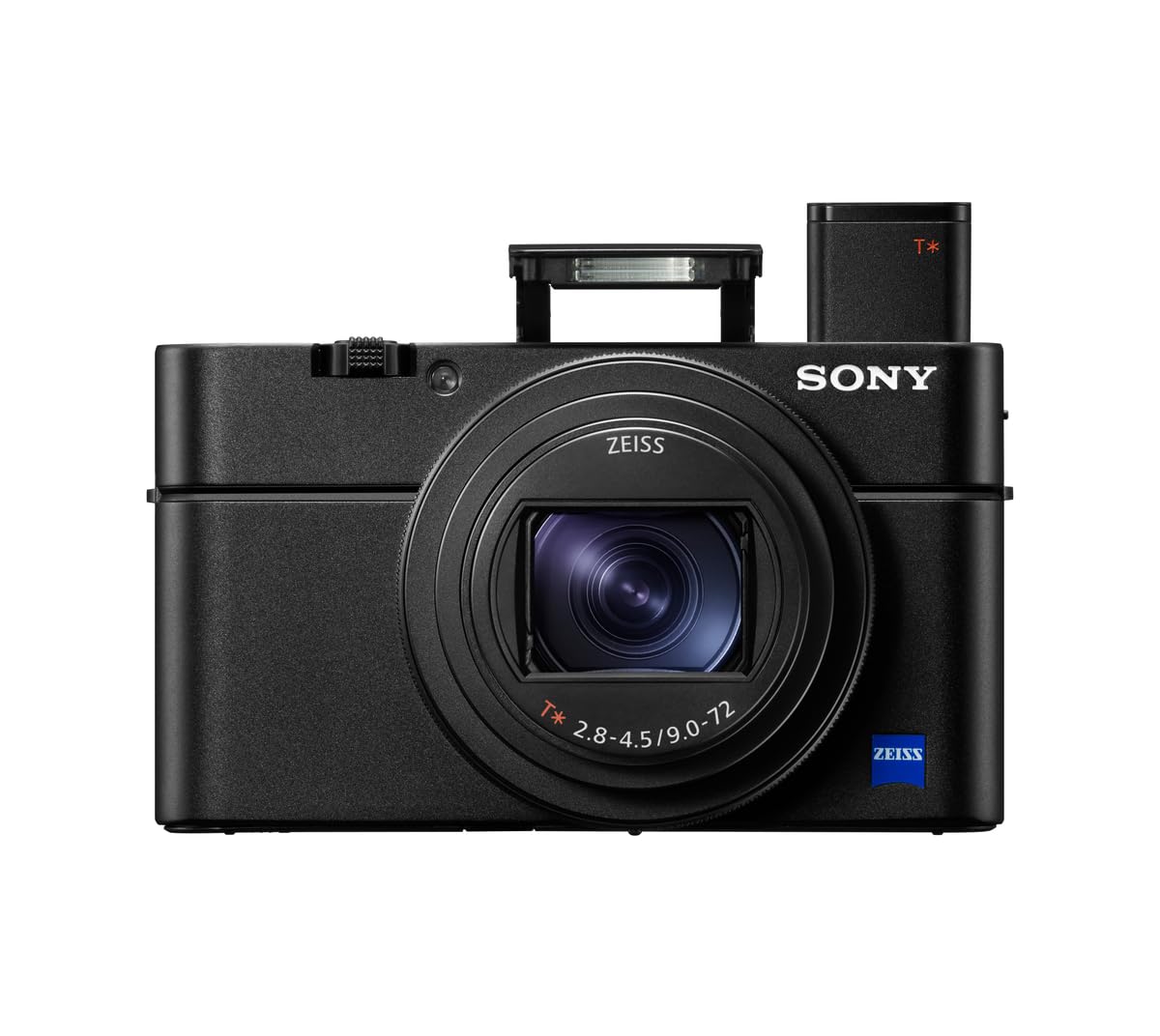
The pocket body built for speed — 20 frames a second and a stacked sensor.
This is the top-of-tier answer for anyone who refuses to miss a moment. It shoots up to 20 frames per second blackout-free, while the autofocus and auto-exposure recalculate up to 60 times per second. A 1.0-type stacked CMOS sensor with a Zeiss Vario-Sonnar T 24-200mm F2.8-F4.5 zoom sits behind the lens. Against the Canon SX740 HS and its 40x, this zoom reaches 24-200mm — less far, but faster and sharper glass across that range.
Autofocus is the sharpest weapon: 357-point focal-plane phase-detection plus 425 contrast-detection points, with a stated 0.02-second high autofocus speed. AI-based real-time tracking follows subjects in stills and movies, and real-time eye autofocus works for people and for animals. Video tops out at 4K with S-Log3, a microphone jack, and active-mode image stabilization. Owners describe image quality as the highlight, with the compact size and rapid autofocus close behind.
The costs are real. Value, reliability, and ease of use all draw mixed feedback, and this is the most expensive pick here by a wide margin. It is the camera for a shooter who wants pro-speed autofocus in a coat pocket and will use it — not for someone who just wants to send photos to their phone now and then. Sony lists Wi-Fi and Bluetooth for that.
The speed story: 20fps blackout-free bursts, 357-point phase-detection AF, and AI real-time tracking cover fast action.
Where it costs you: mixed feedback on value and ease of use, and it carries the highest price of this group.
Pick it if: fast action, 4K video with S-Log3, and top-tier autofocus are worth a premium pocket body.
Skip the swap if: you want long zoom — this reaches 24-200mm, far short of the 40x Canons.
Know the Specs
Optical zoom vs digital zoom
Optical zoom physically moves lens glass to magnify, which preserves detail — a 30x or 40x optical figure is real reach. Digital zoom just crops and enlarges the centre of the frame, softening the image quickly. When a listing touts zoom, check whether the number is optical or digital, and ignore the digital claim for judging reach.
Sensor size (1-inch vs smaller)
A larger sensor, such as the 1-inch chip in the Sony bodies here, catches more light per pixel. That means cleaner shots in dim rooms and a softer background blur. Smaller sensors in budget compacts rely more on the built-in flash to light a scene, so plan your shooting around available light when the sensor is small.
Autofocus points
Autofocus points are the spots across the frame the camera can lock onto. A high count — like the 425 points on the Sony ZV-1F and RX100 VII — gives a denser net for a moving subject. A low count, such as the 9 points on the Canon SX740 HS, makes fast action harder to hold, and is fine for still subjects.
Wireless transfer types
Wi-Fi pairs the camera to your phone through an app so you can browse and pull files. Bluetooth is lower power and can auto-send images as you shoot, as on the Canon silver import here. NFC is a tap-to-pair shortcut for quick setup. Pick the one that fits how often you move photos to your phone.
Common Questions
How does a small camera connect to my phone without a cable?
Will the camera’s app work with both iPhone and Android?
Is 30x optical zoom better than 40x for travel photos?
How many megapixels do I actually need on a pocket camera?
Can these cameras shoot video for social media directly?
Do I need a memory card if the camera comes with one?
Is a 1-inch sensor really better in low light than a small sensor?
What battery life should I expect and should I carry a spare?
Can I use one of these as a webcam for calls and streaming?
Is a compact camera better than my phone for travel photos?
The Bottom Line
For most people, the small camera that connects to phone that gets the job done best is the Sony ZV-1F, because its 1-inch sensor, F2 lens, and 425 autofocus points make clean video and dim-light photos easy, and it pairs over both Wi-Fi and Bluetooth. If you want the whole kit in the box, grab the LUMIX ZS99 for its 30x LEICA zoom, or the bundle version if you would rather have the card and bag included. And for a 40x reach where photos push to your phone while you shoot, the Canon silver import is the one to reach for. Match the transfer method and zoom to how you actually shoot, and any of these earns its place in your pocket.
How we choose
We do not accept paid placement. Every pick is matched to a real buyer and a real use-case; we do not hands-on test units.
Sources
Specifications: manufacturer listings and product documentation. Review insights: verified customer reviews, as of November 2026. Pricing: not shown on this page (it changes often); check the current price via the retailer link.
As an Amazon Associate, Tactical Gear Guy earns from qualifying purchases. This does not affect which products we feature.