Specs are compiled from manufacturer listings and verified buyer reviews and can change over time — please confirm the key details on the product page before buying.
Cutting a hole through a plastered wall is a one-shot job — get the wall thickness wrong and your flap either rattles in a gap or refuses to clamp. So the single figure that decides your purchase is the telescoping tunnel’s compatible wall-thickness range, not the flap size. Buy a wall cat door whose tunnel range covers your measured wall thickness, then compare flap size, seal and lock. Get that range wrong and the frame sits loose or the tunnel won’t reach, leaving a gap you patch with foam.
This guide is built by comparing the manufacturers’ published specifications and the patterns across verified customer reviews, so you get each pick’s real strengths and trade-offs instead of marketing spin.
Below you’ll find eight through-wall units ranked by how well their tunnels, seals and locks handle real homes, followed by the wall-measuring steps that stop a bad cut. The right wall cat door starts with a tape measure against the wall, not a photo of a cat mid-leap.
Top Picks


How To Choose The Best Wall Cat Door
A wall cat door is a tunnel through masonry or studwork, and the tunnel is the whole product. A door-mount flap just screws onto a flat panel; a through-wall unit has to span the empty distance between your two wall faces. That distance varies wildly from house to house, which is why the compatible thickness range on the box matters more than the brand name. Measure your wall properly, then shop tunnel ranges.
Measure the wall before you measure the cat
Measure your wall’s overall thickness at the spot where the door will go. That one number decides which tunnel fits. If you already have a hole, you can slide a tape through the wall cavity instead. A tunnel that starts low — one option here reaches down to 1 3/4 inches — suits thin walls. A thicker masonry wall needs a longer tunnel. Write the number down and check every candidate against it. A tunnel that does not span your wall is the most common reason a return gets processed.
Match flap opening to your cat’s actual weight
The flap is the swinging doorway your pet pushes through, and it is sized for a weight ceiling. Small cutouts here suit cats up to roughly 20 to 22 lbs, while larger medium tunnels climb to 40 lbs. Weigh your cat if you’re unsure — a large-boned tom can top a small opening’s limit even if he looks lean. The frame size follows the opening, so a bigger flap needs a bigger wall cut, and larger cuts are harder to undo.
Decide how much sealing you need
Double flaps and triple flaps mean two or three flexible sheets stacked in the tunnel, each catching air the previous one let through. More flaps usually mean less cold air creeping into a heated room. Magnetic strips along the flap base pull the sheet shut after your cat passes, and stroger magnets hold better in a draught. Brush seals along the frame block insects and fine dust. In a cold climate or a windy exposure, choose two or three flaps over a single sheet.
Weigh the lock panel against daily convenience
Most through-wall doors ship with a sliding lock panel — a solid insert that blocks the opening when you want your cat indoors for the night. Panels that lock from the inside cannot be opened from outside, which matters if the door faces a street. The trade-off is that you have to remember to slide it back. Some models also offer a partial setting that holds a pet in while still letting air move.
Side-by-Side Comparison
| Model | Best For | Wall Thickness Range | Flap / Opening | Pet Weight Limit | Amazon |
|---|---|---|---|---|---|
| Decormax Cat Door for Wall★ Best Overall | Best overall balance | 4″ – 8″ | 9 1/4″ x 6 1/2″ opening | Up to 22 lbs | Amazon |
| Purrfect Portal Meow ManorIndoor Privacy Pick | Indoor litter-box privacy | — | 8.82 x 7.13 inches | Up to 20 lbs | Amazon |
| mestyl Dog Door with Telescoping TunnelWidest Thickness Fit | Widest thickness flexibility | 1 3/4″ – 8 1/4″ | 8 1/4″ x 12 3/16″ opening | Up to 40 lbs | Amazon |
| ClawJaw Steel Cat Door | Metal frame on a mid-range budget | 3.9″ – 7.87″ | 9 1/4″ x 6 1/2″ opening | Up to 22 lbs | Amazon |
| MIAOTONG 3-Flap Steel Dog Door | Cold-climate insulation | 4.17″ – 7.17″ | 9 7/16″W x 13 1/8″H frame | Up to 20 lbs | Amazon |
| Eillion Small Pet Door for Walls | Smallest pets, alloy build | 4.1″ – 7.1″ | 5.1″ x 8″ flap | Up to 15 lbs | Amazon |
| TBC PET Steel Frame Dog Door | Silicone flaps, big opening | 4.75″ – 7.25″ | 8.54″ x 13.42″ opening | Up to 40 lbs | Amazon |
Detailed Reviews
1. Cat Door for Wall, Energy Efficient Pet Entry Door
Our pick — 4.5+★ from 450+ verified ratings; the strongest balance of quality and price.
The widest tunnel span here, wrapped in a steel frame your cat can’t claw apart.
The Decormax is the pick that fits more walls than anything else on this list: its tunnel adjusts from 4 inches to 8 inches thick, and that upper limit is the highest of any cat-sized door here. It also fixes a nagging fear for anyone with a determined scratcher — the frame is rust-proof steel, not plastic, so clawing and chewing meet metal. The white finish keeps it from looking like a piece of industrial hardware bolted to your hallway.
For pet sizing, the frame measures 13 9/10 inches by 9 2/5 inches and the flap opening is 9 1/4 inches by 6 1/2 inches, which the maker rates for cats up to 22 lbs. That is a workable ceiling for most domestic cats. Weather sealing comes from double magnetic flaps plus dual sliding lock panels, giving you three modes — fully open, fully locked, or partial for airflow while your cat stays in. You get a cutting template and a guide with it, and the flaps swap out quickly for cleaning.
What wins people over most is build quality — it is the door’s strongest reputation by a wide margin — followed closely by how straightforward the install turns out. The honest caveat: the flaps and the magnets are the dividing line. Some households find the seal firm and airtight; others find the flaps less securely held than they expected, so check the flap sits flat against the frame after fitting. At 4.5+ stars across 400+ ratings, that is a pocket of feedback, not a verdict on the design.
Where it earns the top spot
- 4-to-8-inch tunnel covers the thickest walls of any cat door here
- Rust-proof steel frame stands up to chewing and clawing
- Double magnetic flaps plus dual sliding lock panels for a real draught seal
- Three modes: open, locked, or partial for airflow
Where it asks patience
- Flap and magnet retention splits feedback — some seals feel firmer than others
- You still need to cut a precise hole, so measure twice
Made for: the household with a thicker-than-average wall and a cat that likes to test the frame.
Measure first: if your wall sits under 4 inches thick, this tunnel won’t clamp down far enough — pick a narrower-spec unit instead.
2. Purrfect Portal Meow Manor Wall Large Cat Door
A portal between rooms, not to the outdoors — the smell stays on the other side.
This is a different job entirely. The Meow Manor is built for interior walls, so your cat can reach a litter box or food station inside a closed room while the human door stays shut. That design quietly solves the biggest daily gripe of cat ownership — the litter smell that spreads through an open-plan home. The opening is no-flap, meaning there’s no swinging sheet to learn, which is why owners describe cats taking to it with no training. It holds cats up to 20 lbs.
Installation is where it shines: it arrives with everything for a DIY fitting and a clear instruction set. The plastic frame measures 8.82 x 7.13 inches, so it’s a tidier cutout than a full exterior tunnel. Because there’s no flap, you trade weather sealing for easy passage — which is exactly right for an interior wall where draughts aren’t the concern. Curiously, the maker also positions it as a small dog passage, so a household with a tiny dog and a cat can get double duty from one cut.
The catch to weigh honestly: no-flap means no barrier, so this is not the unit for an exterior wall where cold air, insects, or rain would pour straight through. It’s for the hallway-versus-utility-room split. For that specific job — and for hiding the litter box in a way that doesn’t look like a cat bathroom — this one earns its place.
Built for the indoor split: a litter room, a utility room, or a closed-off space your cat needs to reach — the no-flap opening keeps things easy and the plastic frame keeps the cut modest.
Reach for this if: the smell and the closed-door standoff are your real problem, and the wall is interior.
Look elsewhere if: you need an exterior door with a weather seal — this one is open by design.
3. mestyl Dog Door for Wall with Telescoping Tunnel
Reaches down to 1 3/4 inches, so thin stud walls finally have a door that fits.
Wall thickness is where this door does something no other pick can match. Its tunnel starts at 1 3/4 inches — thinner than anything else here — and stretches to 8 1/4 inches. That low end is the standout: many homes have thin interior partitions, and most wall doors simply won’t clamp down that far. If your wall is on the slim side, this is often the only option that will seat properly. The opening is 8 1/4 x 12 3/16 inches on a 12 3/4 x 16 15/16 inch frame, rated for dogs up to 40 lbs.
The triple-flap design adds a third layer of weather protection, and the magnetic reinforcement at the flap base pulls it tight against wind, rain, and cold. Sliding lock panels let you close it off when needed. The frame is plastic rather than metal, which keeps weight and cost down but means it won’t shrug off a heavy chewer the way steel does. Installation comes with a cutting template and a step-by-step guide.
Here’s the honest part: the install is genuinely mixed. Some households sail through it, others find it very hard going, so set aside a real afternoon rather than a quick ten minutes. For winter performance, the triple flaps hold up — owners in cold regions specifically like how it handles the season. At 3.5+ stars, it’s the lowest-rated door on this list, but for a thin wall it may be the only one that physically fits, and that alone can decide it.
The thin-wall specialist: a 1 3/4-inch minimum tunnel beats every other pick on tight internal walls. It still reaches 8 1/4 inches for thicker ones — the broadest span here. That one spec can make or break the fit, so measure your wall before you buy.
The one to choose: when your wall is unusually thin or your range is unusually wide, and a plastic frame is acceptable.
Think twice if: you have a heavy chewer or you’re not comfortable with a more demanding install.
4. ClawJaw Small Exterior Wall Steel Cat Door
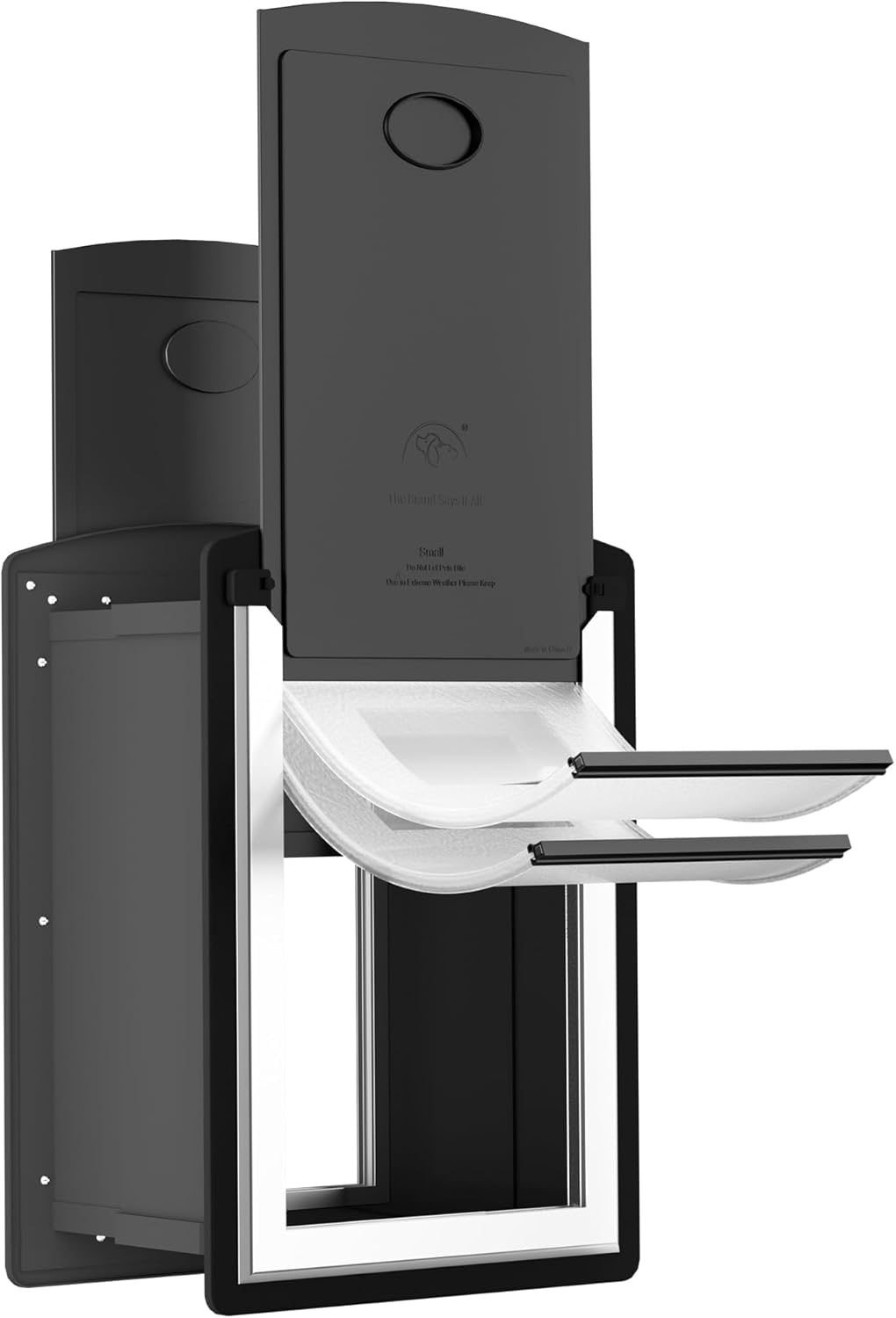
Steel frame and a 22 lb ceiling, aimed squarely at exterior walls.
The ClawJaw brings a metal frame to the mid-range, and it holds up where it counts. Its telescoping tunnel spans 3.9 to 7.87 inches, so it fits most standard exterior walls, interior or exterior. The flap opening is 9 1/4 x 6 1/2 inches on a 13 9/10 x 9 2/5 inch frame, sized for 0 to 22 lbs. Double flaps and sliding lock panels handle the weatherproofing, and the frame’s draft-blocking design is built to keep external air out.
What people respond to here is the way it looks and how much cold air it shuts out — appearance and airflow both land well, with the dual flaps specifically credited for solid wind protection. Install is described as simple, and the included templates make the cut manageable for a first-timer. The finish and the metal build give it a sturdier feel than the plastic-frame options.
Where it wobbles: durability and magnet strength pull in two directions. Some find the magnets hold firmly; others report the flaps detaching too easily. That’s the wear point to watch — check the flap after the first windy week and re-seat it if needed. On the whole this is a strong exterior door for the money, and the metal frame is the reason it stays a fair recommendation despite the flap caveat.
Reasons it holds up
- Metal frame across a 3.9-to-7.87-inch tunnel range
- Dual flaps credited with genuine wind blocking
- Clean appearance that suits an exterior wall
- Template-guided install that first-timers manage
What to watch
- Magnet and flap retention split feedback — inspect after windy days
- Flaps are the part most likely to need attention over time
Fits best: an exterior wall where you want metal construction without paying top-tier prices.
And skip it if: you want zero flap maintenance — this one asks you to keep an eye on the magnets.
5. MIAOTONG 3-Flap Steel Small Dog Door for Wall

Three flaps, brush seals, and a temperature rating built for hard winters.
If your door faces real winter, the MIAOTONG is the one engineered around it. A steel frame with aluminum locks carries an insulated flap layered over a double flap, and the maker rates the assembly for temperatures from -20°F to 120°F. That is the widest stated temperature window on this list. Brush seals run along the frame to block outside air and keep insects out, a detail most rivals skip. The tunnel spans 4.17 to 7.17 inches of wall, sized for petite pets up to 20 lbs with a 9 7/16 x 13 1/8 inch frame.
Construction is the strong suit: users consistently describe it as well-made, sturdy, and a solid value, and installation comes with cut-out templates and a step-by-step guide that works for a first-timer. There’s a design patent behind the appearance, so it’s meant to look integrated rather than bolted on. The sliding panel lock gives you access control on demand.
Two soft spots are worth knowing. The closure mechanism draws mixed feedback — some buyers report the door not closing as cleanly as it should. Durability is the concern the data flags most loudly, with reports of the door giving out within six months for some. At 4.0+ stars across 800+ ratings, most owners are clearly satisfied. But this is not the door to buy if you want to set and forget it. Buy it for the three-flap insulation and the temperature range, and expect to check the closure now and then.
The insulation leader: steel frame, insulated triple flap, and a -20°F to 120°F temperature rating with brush seals — the most weather-focused build in the group, and the reason it earns a premium spot.
Choose it for: cold winters, insect pressure, and a pet under 20 lbs that needs a warm tunnel.
The trade-off: closure and long-term durability draw real complaints, so this is a door to inspect regularly rather than fit and forget.
6. Eillion Small Pet Door for Walls, All-Metal Frame

A laser-welded metal frame and a tight 5.1 x 8 inch flap for the smallest cats.
Eillion’s tunnel spans 4.1 to 7.1 inches and needs only a 6.2 x 10.2 inch cutout, so it suits slimmer cats who’d rattle around in a bigger opening. The flap measures 5.1 x 8 inches and holds pets up to 15 lbs — the lowest ceiling here, which makes it a genuinely small-pet door rather than a one-size compromise. The frame is metal, joined with laser welding, and it ships with one metal closing panel for security. A cutting template and clear instructions are included.
Insulation is the headline: three flaps, magnetic closures, and an iron closing panel, which the maker claims makes it 50% more effective than traditional doors. Treat that number as a manufacturer claim rather than a measured independent figure, but the three-layer setup is a real physical difference from a single-flap door. Users like the sturdiness and how cleanly it seals with three flaps, and installation directions get praise for clarity.
The watch-out is durability — specifically the plastic that holds the flap, which is what the negative feedback centers on. The metal frame itself is sound; it’s the small plastic component that can give trouble over time. At 4.0+ stars across 400+ ratings, this suits a small cat and a careful household that will inspect the flap mounting. If you have a 20 lb bruiser, size up — the 15 lb limit is the deciding constraint.
Where it shines: a 5.1 x 8 inch flap sized for genuinely small cats, set in a laser-welded metal frame with a three-flap insulation stack and a metal closing panel.
Pair it with: a cat under 15 lbs and a wall you can cut to a compact 6.2 x 10.2 inches.
The caveat: the flap’s plastic mounting is the weak point over time, so check it during seasonal cleanings.
7. TBC PET Steel Frame Dog Door with Silicone Flaps

Silicone flaps instead of typical plastic, built for a 40 lb dog or a big cat.
Most wall doors use plastic or vinyl flaps; TBC PET goes with double-layer food-grade silicone that stays flexible and resists warping, cracking, and aging. For an exposed wall that swings between hot and cold, silicone is a smarter material than stiff plastic. The tunnel spans 4.75 to 7.25 inches of wall, and the flap opening is 8.54 x 13.42 inches — a large opening rated for pets up to 40 lbs, well above the cat-only options. The frame is aluminum alloy, chosen for rust resistance and staying true to shape.
The numbers the maker puts on the silicone are note as claims: it describes a gap-free rate over 95% and 30 to 50% better sealing fit than standard flaps. Those are manufacturer figures, not independently verified. What’s clear from owner experience is that the locking mechanism wins people over — the two flaps and magnets keep it shut — and the metal construction earns praise. Pets take to it fast, with Pomeranians up to six months old and similar small breeds going through comfortably, and the size range stretches to small individuals of medium breeds.
You get a one-year warranty and an install kit with template and hardware. The trade-off is simply fit: this is a big opening, so a tiny cat will find it oversized and a 40 lb dog is the intended upper end. For a medium dog or a large cat household, the silicone flaps and the generous opening make this the most durable-feeling build here. At 4.5+ stars, it’s effectively the highest-rated door on the list — just match it to a pet that fits the opening.
Why it stands out
- Food-grade silicone flaps resist warping and cracking better than stiff plastic
- 8.54 x 13.42 inch opening handles pets up to 40 lbs
- Aluminum frame with a locking mechanism owners trust
- 1-year warranty and full install kit included
Where it narrows
- Large cutout is overkill for small cats
- Silicone sealing percentage figures are maker claims, not measured independently
Ideal when: a medium dog or a big cat needs a wide opening, and you value a flexible silicone flap over plastic.
Not the pick for: a 10 lb cat in a small house — the opening is larger than she needs.
Know the Specs
Compatible wall thickness
This is the distance your tunnel must span between the two faces of your wall, stated as a minimum and maximum. A unit rated 4 to 8 inches will clamp down to 4 and open up to 8; anything narrower than the minimum leaves the frame loose, anything thicker than the maximum means the tunnel won’t reach. Measure your wall at the exact spot you plan to cut, because thickness can vary across a single house. This one figure eliminates most wrong purchases before you ever pick a brand.
Flap opening and pet weight limit
The flap opening is the clear space your pet pushes through, and the weight limit is the ceiling the maker rates it for. Small openings suit cats in the 15 to 22 lb range; larger tunnels climb toward 40 lbs for dogs. The frame size follows the opening, so a bigger flap needs a bigger cut. Weigh your pet rather than eyeballing it — a cat at the top of a small door’s range will struggle, and a wall cut is hard to resize once made.
Single, double, and triple flaps
Each flap is a flexible sheet in the tunnel, and stacking two or three catches air the previous layer let through. More layers usually mean less draught in a heated room, and magnetic strips pull the flap back shut after your pet passes. Brush seals on the frame add another barrier against insects and dust. In a cold or exposed spot, choose two or three flaps; in a mild interior wall, a single opening may be enough.
Telescoping tunnel versus fixed sleeve
A telescoping tunnel slides in and out to meet your wall’s thickness, so one product fits a range of walls. A fixed sleeve is built for one thickness. Since most homes have irregular thickness, the telescoping design is the safer choice and the reason the doors here advertise a range rather than a single figure. Check that both ends of the tunnel reach the wall faces so the frame sits flush.
Lock panel and security
The lock panel is a solid insert that slides into the opening to block it, giving you control over when your cat comes and goes. Units with two-sided locks cannot be opened from outside once locked from inside, which matters for a door facing a street. Some models add a partial setting that holds a pet in while still letting air move. If home security is a concern, prioritize the two-sided lock over flap count.
Frame material
Steel and aluminum frames resist chewing, clawing, and rust far better than plastic, which keeps its shape for a while but cracks under a determined chewer. Aluminum resists rust well and stays light; steel is heavier and tougher. Plastic frames are the budget choice and fine for a calm cat on an interior wall. Steel and aluminum hold their shape and finish for years; plastic frames crack and discolour sooner.
Common Questions
How do I measure my wall for a cat door?
Will a cat door work through a brick wall?
What size cat door does my cat need?
Do double or triple flaps really keep the cold out?
Can I lock a wall cat door at night?
Is a metal frame worth it over plastic?
Will a cat door fit an interior wall between rooms?
How long should the flaps last?
Can I install one myself, or do I need a pro?
What happens if my pet is bigger than the weight limit?
The Bottom Line
For most homes, the wall cat door that gets the job done is the Decormax Cat Door for Wall. Its 4-to-8-inch steel-framed tunnel fits more wall thicknesses than any cat-sized rival, at 4.5+ stars across 400+ ratings. The crowd favorite here, the TBC PET, pairs more reviews with a 4.5+ score but only suits a 40 lb opening. If you want a no-flap interior portal to hide the litter box, grab the Purrfect Portal Meow Manor. And for the thinnest stud wall, the mestyl Dog Door reaches down to 1 3/4 inches where nothing else will.
How we choose
We do not accept paid placement. Every pick is matched to a real buyer and a real use-case; we do not hands-on test units.
Sources
Specifications: manufacturer listings and product documentation. Review insights: verified customer reviews, as of November 2026. Pricing: not shown on this page (it changes often); check the current price via the retailer link.
As an Amazon Associate, Tactical Gear Guy earns from qualifying purchases. This does not affect which products we feature.