Specs are compiled from manufacturer listings and verified buyer reviews and can change over time — please confirm the key details on the product page before buying.
Most people buy a cord and then wonder why their console still drops frames or their new TV refuses to show the smoothest setting. The short answer: an HDMI cord is a pipe, and a narrow pipe chokes a fast picture. If your TV or console is rated for 4K at 120Hz or 8K, you need a cord built for that much data — and a plain old high-speed cable will quietly hold you back.
This guide is built by comparing the manufacturers’ published specifications and the patterns across verified customer reviews, so you get each pick’s real strengths and trade-offs instead of marketing spin.
Below are the cords that actually deliver the bandwidth your gear asks for, sorted by what each one does best.
Top Picks


How To Choose The Best HDMI Cord
The HDMI cord is the cheapest part of your setup and the one most likely to cap its performance. Match the Gbps rating and the length to your gear and the rest usually falls into place. Get either wrong and you will spend an evening swapping inputs and blaming the TV.
Match the bandwidth to your screen, not the box art
Bandwidth is how much picture and sound data the cord can push per second, measured in gigabits per second (Gbps). A cord rated for 48Gbps can carry far more than an 18Gbps cable — which is what lets it feed 8K video or 4K at high frame rates. If your console or graphics card can output 4K at 120Hz, an 18Gbps cord may simply not have room to carry it.
Refresh rate is the number of times per second the screen redraws, written in hertz (Hz). A 60Hz cord tops out at 60 redraws a second. A cord rated for 120Hz or 240Hz keeps up when your game or movie asks for smoother motion. Buy the Gbps your console or panel can output, not the lowest rating that lights up the screen.
Length changes everything
Longer runs of copper lose more signal. A 6ft cord inside your TV stand has an easy job. A 15ft run across a room is doing real work, and that is exactly where cheap thin wire starts to fail. If you need a long reach, look for a cord that states a heavier wire gauge and a reinforced jacket.
Certification and in-wall safety
Ultra High Speed HDMI certification means an authorized testing center verified the cord meets the HDMI 2.1 feature set. That matters if you plan to lean on features like Dynamic HDR or eARC (Enhanced Audio Return Channel, which sends full-quality audio from the TV back to a soundbar). If the cord is going inside a wall, look for a CL2 in-wall rating — it tells you the jacket is made for permanent installation.
How many cords do you actually need
Multi-packs solve a different problem than a single premium cable. If you are wiring a game room, a streaming stick, a Blu-ray player and a monitor, a three-pack or ten-pack saves you repeat orders. If one cable is feeding a serious home theater, put that money into 48Gbps bandwidth and a braided build instead.
Side-by-Side Comparison
| Model | Best For | Bandwidth | Max Refresh | Length | Amazon |
|---|---|---|---|---|---|
| UGREEN 8K HDMI 2.1 Cable 48Gbps 10FT★ Best Overall | Most home theater setups | 48Gbps | 240Hz | 10 feet | Amazon |
| JSAUX 8K HDMI 2.1 2 Pack 6ftBest Two-Pack | Two-cord setups on a budget | 48Gbps | 120Hz | 6 feet | Amazon |
| Amazon Basics HDMI 3-Pack 6ft | Basic 4K 60Hz hookups | 18Gbps | 60Hz | 6 feet | Amazon |
| Highwings 8K@60 Long HDMI 15FT | Long runs across a room | 48Gbps | 120Hz | 15 feet | Amazon |
| Monoprice 8K Certified In-Wall 10ft | Inside-the-wall installs | 48Gbps | 8K@60Hz / 4K@120Hz | 10 feet | Amazon |
| UGREEN 16K HDMI 2.2 Cable 96Gbps 6.6FT | Future-proofing a new TV | 96Gbps | 480Hz | 6.6 feet | Amazon |
| OREI 4K UHD HDMI 2.0 6ft 10-Pack | Wiring a whole house of screens | 18Gbps | 340 MHz | 6 feet | Amazon |
Detailed Reviews
1. UGREEN 8K HDMI 2.1 Cable 48Gbps 10FT
Our pick — 4.5+★ from 17,000+ verified ratings; the strongest balance of quality and price.
A certified 48Gbps pipe with enough reach to cross a media console.
This is the cord to buy when you want one cable to handle a modern TV, console and soundbar without second-guessing it. It moves 48 gigabits per second of data, which is the full HDMI 2.1 ceiling — enough to feed 8K at 60Hz or 4K at 240Hz. It has also passed HDMI 2.1 certification, meaning an authorized lab verified the spec, not just the box printer.
Against the Amazon Basics three-pack, the gap is enormous: 48Gbps versus 18Gbps of throughput, and 240Hz versus 60Hz of refresh. In plain terms, the Basics cord can carry a standard 4K picture at 60 frames a second and no more. This UGREEN keeps its headroom when you push a console into a high-frame-rate mode.
Owners consistently point to the build as the thing that makes it feel worth keeping — the aluminum alloy shell, nickel-plated connectors and a braided nylon jacket that flexes without fraying. Plug it into an LG or Samsung 8K panel and the handshake is clean, with no blackout flicker when the source changes modes. The Dynamic HDR support carries 12-bit color, and eARC pushes full-resolution audio like Dolby Atmos to a receiver. At 10 feet, it reaches a wall-mounted TV from a low shelf without a strain.
What earns it the top spot
- 48Gbps bandwidth covers 8K@60Hz and 4K@240Hz without compromise
- HDMI 2.1 certified by an authorized testing center
- eARC and Dynamic HDR for full-quality audio and 12-bit color
- 10ft reach suits wall-mounted TVs and receiver racks
- Braided jacket and metal shell hold up to repeated plugging
Worth knowing before you order
- Overkill if your TV tops out at 4K 60Hz
- 10 feet can be awkwardly long for a short shelf-to-screen run
Buy this one if: you have a 4K 120Hz console, an 8K panel or a soundbar fed by eARC and want the certified ceiling of HDMI 2.1.
Look elsewhere if: your gear is plain 4K 60Hz — you will pay for bandwidth you never use.
2. JSAUX 8K HDMI 2.1 2 Pack 6ft
Two full-bandwidth cords for less than most people spend on one.
Two 6ft cords in one pack is the reason this shows up in so many living rooms. Each one carries 48Gbps, so a pair of devices — say a PS5 and a streaming stick — both get the fast lane instead of one being stuck on an older hand-me-down cable. The wire is 28AWG copper with triple-tin shielding and a double-braided nylon jacket, and the connectors are gold-plated to resist corrosion over years of plugging.
The spec sheet is unusually thorough. It covers 8K at 60Hz, 4K at 144Hz and 4K at 120Hz, plus 1440p at 240Hz and 1080p at 240Hz, and it steps back cleanly to older HDMI 1.4 and 2.0 hardware. HDCP 2.3 and 2.2 mean streaming services will not refuse to play protected content. VRR, ALLM and QFT are listed too, which is what smooths out frame pacing in games.
Picture quality jumps are the recurring story here — the braided build and heavier gauge are doing their job on a decent panel. A few buyers have hit compatibility snags with specific devices and a small number found the cable did not last as long as they hoped, so treat tension at the connector end kindly. For a two-screen house, though, the math is hard to argue with: two 48Gbps cords for roughly what one premium single costs.
The case in one line: if you need two cords and care about bandwidth, this is the most sensible pairing on the list.
Set expectations: the red braid is a bold look on a white media shelf, and a snugger HDMI port can make the gold connectors feel stiff at first.
Reach for this if: you are wiring two devices and want both on HDMI 2.1 bandwidth.
Pass if: you need one long run — 6ft will not reach a ceiling-mounted projector.
3. Amazon Basics HDMI Cable, 3-Pack, 6 ft

Three plain black cords that just handle a standard 4K picture.
Here is the honest math: the Basics cord tops out at 18Gbps and 4K at 60Hz. That is exactly right for a Fire TV stick, a Blu-ray player, a monitor or a basic console in a den. It is the wrong cord for a 120Hz gaming display, and Amazon says so on the listing — if your device outputs past 4K 60Hz, this cable will not function properly. Knowing that upfront saves a lot of frustration.
What you get is a 6ft round cord with Ethernet built into the line, so one cable can still share a network connection between devices without a separate run. It handles 2160p at 48-bit color depth, 3D and Audio Return Channel, and it steps down to older HDMI versions without complaint. Three of them in the box covers a streaming box, a game console and a spare without another order.
The one thing to watch is HDR at full tilt. Some owners get 4K HDR cleanly on a Blu-ray player or projector; others find it drops out and have to dial the picture back. That is the 18Gbps ceiling talking, not a bad unit. Match it to gear that lives at 4K 60Hz and it will quietly do its job for years without a fuss.
Where it fits: the value play for a household with several ordinary 4K screens and no high-refresh gaming rig.
The honest ceiling: 18Gbps is the wall — do not buy this expecting 4K 120Hz or 8K to pass through.
Best fit: a living room with a 4K 60Hz TV, a streaming stick and a console that never pushes past that.
Not for you if: you are chasing 4K 120Hz gameplay or an 8K panel.
4. Highwings 8K@60 Long HDMI Cable 15FT

The run that finally reaches the back of the room at full bandwidth.
Length is the whole reason this cord exists. It carries 48Gbps and 8K at 60Hz across a stated 15 feet, which solves the problem of a projector at the far wall or a PC parked across the room. The 48Gbps figure is the part that matters — a long cheap cord loses signal, so a long cord with real bandwidth behind it is a different animal. This one handles 4K at 120Hz with VRR too, so a PC or console in another corner still gets a smooth feed.
The build is the sales pitch Highwings leans on: an upgraded anti-bending tail design and a military-grade tensile nylon jacket meant to survive being run behind furniture and stepped on. Backward compatibility runs all the way down to HDMI 1.1, so older hardware still works.
Worth flagging honestly: the listing itself notes the cable is relatively short for a 15ft piece, with a total length of 14.76ft and a middle cable length of 14.4ft — so measure your gap before you buy. Durability draws mixed reactions, with the occasional report of a failure inside a couple of months, which is a real caution for anything routed permanently. The OLED owners who get a good unit tend to get a genuinely better picture than their old cord gave them.
Why the long run works
- 48Gbps over a stated 15ft reach — rare at this price tier
- 8K@60Hz and 4K@120Hz with variable refresh rate
- Anti-bending tail and tensile nylon jacket for routed installs
- Backward compatible to HDMI 1.1
Measure twice
- Actual total length is 14.76ft — confirm your distance first
- A minority of buyers have seen early failures
Pick it for: a projector or PC that sits far from the source and still needs full 48Gbps.
Think twice if: your run is under six feet — you are paying for length you do not need.
5. Monoprice 8K Certified In-Wall 10ft

Certified, in-wall rated, and built for the run you will never touch again.
Most cords sit on a shelf where you can swap them in seconds. This one is designed for the space behind drywall, where a mistake means cutting the wall open again. That CL2 in-wall rating is the headline: the jacket is made for permanent installation inside a wall cavity. It also carries 48Gbps, supports 8K at 60Hz and 4K at 120Hz, and can reach up to 10K at 120Hz using VESA Display Stream Compression (DSC) 1.2a — a compression method the standard treats as visually lossless.
Certification is the other reason it earns a slot. Monoprice had it tested at an HDMI authorized testing center under the Ultra High Speed HDMI program, which verifies 8K@60Hz, HDR, VRR and eARC rather than just printing them on the sleeve. eARC matters here — it passes object-based audio like Dolby Atmos and DTS:X cleanly to a receiver. Dynamic HDR tunes each scene, and the 30AWG wire is thin enough to pull through conduit more easily than a fat cord.
The honest split is compatibility at the very top end. Some buyers report flawless results with an Apple TV 4K pushing HDR and Atmos; others run into trouble with 4K 120Hz HDR and Dolby Vision on specific displays. If your panel and source both demand the full feature stack, this is a cord to test before you bury it in a wall. If it works with your gear, the certified build and in-wall safety make it the right permanent choice.
Built for permanence: the CL2 rating and authorized-center certification are the two things that matter when the cable disappears behind plaster.
Test before you commit: run it loose with your display for an evening before the drywall goes back up.
This is your cord if: you are running cable through a wall and want certification plus the CL2 rating.
Bypass it if: the cord stays visible on a shelf — the in-wall premium buys you nothing there.
6. UGREEN 16K HDMI 2.2 Cable 96Gbps 6.6FT
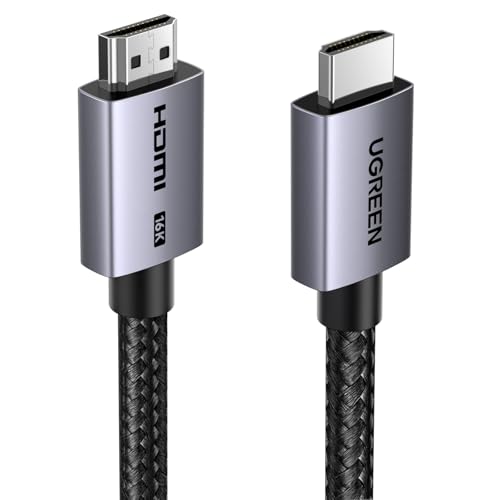
The highest bandwidth number on this list, aimed squarely at what comes next.
Ninety-six gigabits per second is double the 48Gbps cord above, and it is the largest pipe here by a wide margin. That figure lets it carry 16K at 60Hz and 8K at 240Hz, and the maker notes it sits above DisplayPort 2.1b’s 80Gbps limit. If you just bought a flagship TV or you are building a PC you plan to keep for years, this is the cord that will not be the bottleneck when the next resolution lands.
The rest of the feature list is fully loaded. It supports Dynamic HDR at 12-bit color accuracy up to 8K/60Hz in 4:4:4, eARC for Dolby Atmos and DTS:X, HDCP 2.3 and 2.2, and a low-latency mode plus quick media switching to kill the blackout when a source changes modes. A new LIP feature is designed to improve audio-video sync on complex surround setups. Build is the same family recipe as the top pick — aluminum alloy case, nickel-plated connectors, braided nylon jacket.
Here is the catch worth naming: almost nothing you own can use 96Gbps yet. This is a future-proofing buy, not a fix for a current problem. At 6.6ft it also will not cross a large room. But for a new high-end display or a next-gen console purchase, spending on the headroom now means the cord outlasts the rest of the setup.
The headroom argument
- 96Gbps — the highest bandwidth in this lineup
- 16K@60Hz and 8K@240Hz capability
- Dynamic HDR at 12-bit, eARC, HDCP 2.3
- Braided jacket and metal shell for long-term use
The reality check
- Current TVs and consoles cannot max out 96Gbps yet
- 6.6ft is a short reach for a big room
Go here for: a brand-new flagship display or a PC build where you want the cable to stay ahead of the hardware.
Stay with the 48Gbps pick if: you are connecting ordinary current gear and do not want to pay for unused ceiling.
7. OREI 4K UHD HDMI 2.0 Cable 6ft 10-Pack

Ten cords in one box for every screen in the building.
The pitch here is volume, plain and simple. Ten 6ft cords in a single pack turns a nuisance into a one-time order — every TV, monitor, projector and streaming box in the house gets its own cable, plus spares for the drawer. Each one carries 18Gbps and handles 4K UHD, 1080p, 1440p, 3D and Ethernet Channel, with ARC for sending audio back to a soundbar.
The construction targets interference, which is the quiet enemy of a long run behind a crowded media cabinet. Multi-layer shielding plus a PVC jacket keep the signal consistent and the picture stable during fast-motion content. It is a workmanlike build, not a showpiece, but that is the right trade when you are buying ten of them.
Know the ceiling before you commit: 18Gbps and a 340MHz rating mean this is a 4K 60Hz cord, not a high-refresh gaming cable. If your PS5 or Xbox is set to 120Hz, you want a 48Gbps cord instead. For everything else — the bedroom TV, the office monitor, the guest-room streamer — this pack dials down the cost per screen while still giving you a solid, shielded connection.
The value read: buying ten at once drops the per-cord cost to the lowest on this list, which is the whole point of a bulk pack.
Mind the limit: 18Gbps caps it at 4K 60Hz — keep your 120Hz console on a faster cable.
Reach for this if: you are wiring several ordinary 4K screens and want a drawer of spares.
skip it if: even one of your devices needs 4K 120Hz or 8K — buy a 48Gbps cord for that one.
Know the Specs
Bandwidth (Gbps) — the pipe width
Bandwidth is the amount of picture and sound data the cord can carry each second, written in gigabits per second. An 18Gbps cable has enough room for 4K at 60Hz. A 48Gbps cable has room for 8K at 60Hz or 4K at 240Hz, and a 96Gbps cable has room for 16K at 60Hz. Think of it like a road: more lanes, more traffic, no stutter. When a cord runs out of room, the picture may drop frames, refuse a setting, or fail to handshake with the TV at all.
Refresh rate (Hz) — redraws per second
Refresh rate is how often the screen redraws each second, measured in hertz. 60Hz is the standard smoothness most TV content uses. 120Hz and 240Hz are what gaming monitors and high-end panels use for smoother motion. A cord has to be built for that rate, not just the resolution. A 4K 120Hz console fed by a 60Hz cord will run, but it will not deliver the smoother setting you paid for. Higher refresh is where a faster cord earns its keep.
Common Questions
Will a 48Gbps HDMI cord work with my older 4K 60Hz TV?
Why does my picture drop out at 4K 120Hz but work fine at 4K 60Hz?
What does Ultra High Speed HDMI certification actually prove?
Do I need a different cord for eARC and Dolby Atmos?
Does a longer HDMI cord really lose signal?
What does the CL2 in-wall rating mean on the Monoprice cable?
Can I use a 48Gbps HDMI cord on a PS5 or Xbox Series X?
Is a 96Gbps cord worth it if my TV is only 4K?
What wire gauge should I look for on a long run?
Do braided HDMI cords last longer than plain plastic ones?
The Bottom Line
For most rooms, the hdmi cord worth buying first is the UGREEN 8K HDMI 2.1 48Gbps 10FT — certified, full-bandwidth, and long enough to reach a wall-mounted TV. If you are wiring two devices at once, the JSAUX 2-Pack gives you two 48Gbps cords for the price of one premium single. And for a projector at the back of the room, the Highwings 15FT is the run that holds bandwidth over distance. If you only buy one cord this year, make it the certified 48Gbps UGREEN — it covers 8K@60Hz and 4K@240Hz with headroom to spare.
How we choose
We do not accept paid placement. Every pick is matched to a real buyer and a real use-case; we do not hands-on test units.
Sources
Specifications: manufacturer listings and product documentation. Review insights: verified customer reviews, as of November 2026. Pricing: not shown on this page (it changes often); check the current price via the retailer link.
As an Amazon Associate, Tactical Gear Guy earns from qualifying purchases. This does not affect which products we feature.