Specs are compiled from manufacturer listings and verified buyer reviews and can change over time — please confirm the key details on the product page before buying.
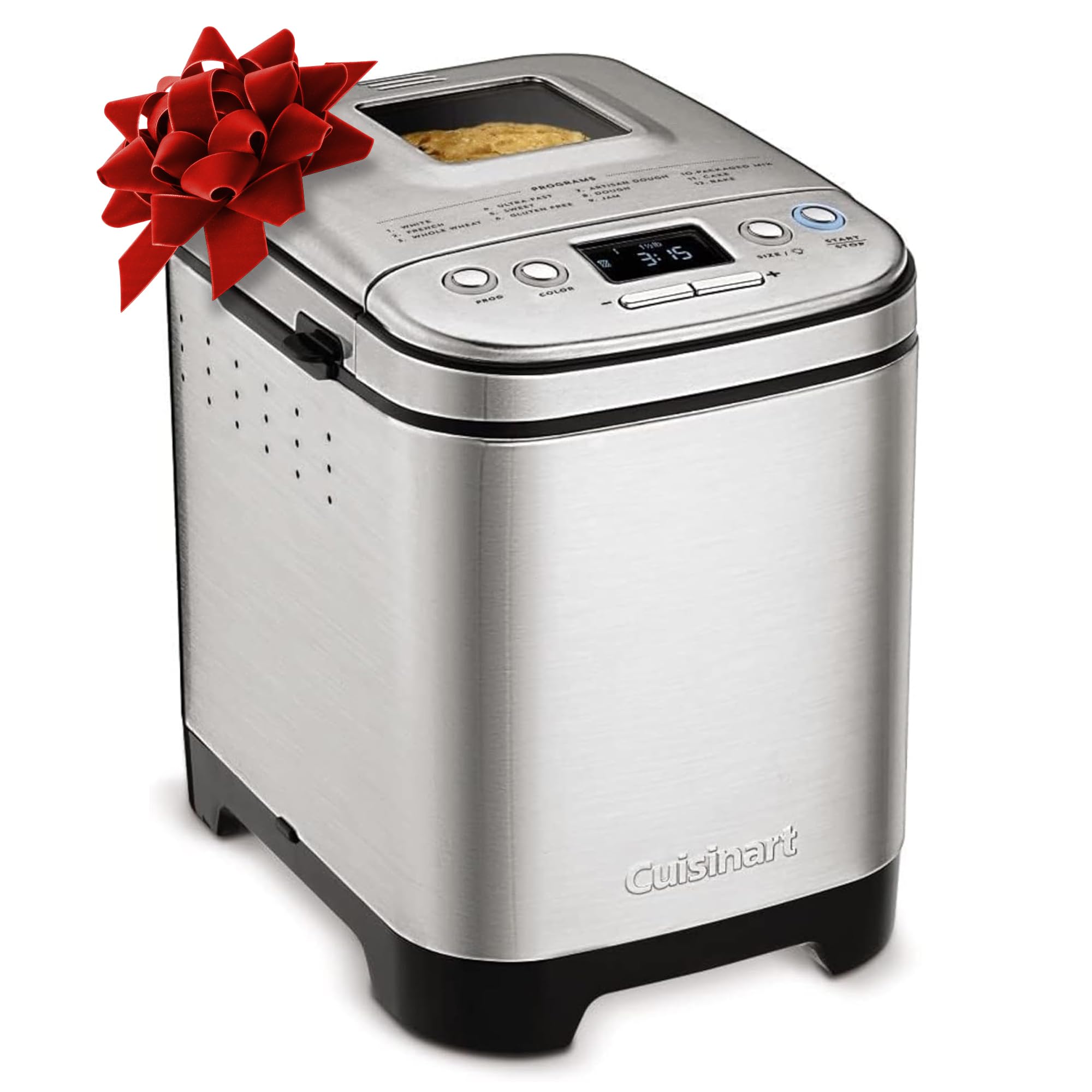
You want fresh bread without standing over a dough hook, and the machine that earns the most confident recommendation here is the Cuisinart Compact 2 Lb. Automatic Programmable. It gives you 12 programs and three loaf sizes in a stainless-and-plastic body measuring 10.25 by 13.25 by 11.25 inches. The rest of this list matters because stainless steel bread makers are not identical. Program count swings from 12 to 25, capacity tops out at 3 lb on one pick, and the pan material ranges from aluminum alloy to ceramic. That spread changes crust browning, motor noise during an overnight knead, and counter footprint.
This guide is built by comparing the manufacturers’ published specifications and the patterns across verified customer reviews, so you get each pick’s real strengths and trade-offs instead of marketing spin.
You will see which machines have a real stainless body, which ones only carry it on the front panel, and where each one cuts corners. Below is the breakdown of every unit worth considering.
Top Picks

How To Choose The Best Stainless Steel Bread Maker
Most people buy the wrong bread machine for one reason: they shop the menu count instead of the loaf size and the pan. A 25-program machine that bakes a loaf your family cannot finish wastes flour. A 12-program unit that nails your everyday white loaf is the smarter buy. Work through the four decisions below in order.
Start with loaf capacity, not program count
Capacity tells you how much bread one bake makes, measured in pounds of finished loaf. A 1 lb loaf is a small round loaf that feeds one or two people for a day. A 1.5 lb loaf is the everyday balance for a couple. A 2 lb loaf covers a family of four, and only one machine here goes beyond that: the KBS 750W bakes up to 3 lb for households of eight to ten. If you regularly throw out half a loaf, drop to the next size down.
Check what the pan is actually made of
The pan touches your food, so its coating matters. Ceramic pans (the VEVOR, Briskind, and both KBS models) skip the Teflon-style coating, and the makers describe them as non-toxic and naturally non-stick. Aluminum alloy pans with a nonstick layer (the KOVIET and the Cuisinart CBK-110) conduct heat well and release cleanly, but the coating is the part that wears first. Either way, hand washing is the norm — the VEVOR and Briskind both list hand wash only.
Look for the delay timer and keep-warm window
A delay timer is what turns a bread machine from a weekend project into a daily habit. Delay timers here run from 13 hours (Cuisinart, KOVIET) up to 15 hours (Rosewill, VEVOR, Briskind, both KBS models). Load the pan before bed, set the timer, and the machine starts on its own so bread is warm when you get up. Keep-warm functions hold the finished loaf for 60 minutes on most units.
Decide how much you care about noise
Kneading is loud. Motors and paddles thump against dough for the first stretch of every cycle. Rosewill publishes a motor noise under 50 dB, and the KBS 750W claims a brushless motor under 25 dB. If your machine lives in an open kitchen or you plan overnight bakes in a small apartment, that 25 dB gap is what keeps you from waking up.
Side-by-Side Comparison
| Model | Best For | Programs | Max Loaf | Delay Timer | Amazon |
|---|---|---|---|---|---|
| Cuisinart Compact CBK-110NAS★ Best Overall | Everyday compact baking | 12 | 2 lb | 13 hours | Amazon |
| Rosewill 25-in-1 RHBM-25001GRMost Programs | Program variety on a budget | 25 | 2 lb | 15 hours | Amazon |
| Hamilton Beach 29987Easiest Start | Simple three-step baking | 14 | 2 lb | — | Amazon |
| KOVIET BM01 Dual Dispenser | Hands-off mix-in loaves | 25 | 2 lb | 13 hours | Amazon |
| VEVOR MBF-016 | Ceramic pan on a modest budget | 19 | 2 lb | 15 hours | Amazon |
| Briskind BM8206 | Touch panel and warranty coverage | 19 | 2 lb | 15 hours | Amazon |
| KBS Pro 710W MBF-010 | Convection crust and auto dispenser | 17 | 2.2 lb | 15 hours | Amazon |
| KBS 750W MBF-060 | Large families and big loaves | 20 | 3 lb | 15 hours | Amazon |
| Cuisinart Convection CBK-210NAS | Convection crust and sourdough starter | 16 | 2 lb | 13 hours | Amazon |
Detailed Reviews
1. Cuisinart CBK-110NAS Bread Maker
Our pick — 4.0+★ from 17,000+ verified ratings; the strongest balance of quality and price.
Twelve programs and a 10.25-inch-deep body that fits a narrow counter slot.
Twelve programs is the first thing to understand here, because it is the fewest on this list and yet it covers the ground most kitchens actually need. You get white, French, whole wheat, sweet, jam, cake, a dedicated gluten-free cycle, and dough plus artisan dough for breads you bake in your own oven. Bake a 1 lb, 1.5 lb, or 2 lb loaf in the vertical metal non-stick pan, and pick from three crust shades so a soft sandwich loaf and a dark crust come out of the same machine.
It saves counter space, and that is the quiet argument for this one. Its body measures 10.25 inches deep by 13.25 inches wide by 11.25 inches high, noticeably tighter than the Hamilton Beach at 13.98 inches deep by 9.13 inches wide by 11.89 inches high, so it tucks into a narrower slot beside the fridge. A 13-hour delay start with a 60-minute keep-warm means you load it at night and pull warm bread in the morning. A viewing window and interior light let you watch the cycle without lifting the lid, and an audible alert tells you when to pull the kneading paddle before the final rise.
What wins people over is performance — how consistently the loaf comes out, which is the thing this machine is known for. Ease of use follows close behind, and owners describe the compact size as one of its best traits, with slices that fit a standard toaster. Honest limit: the Cusinart’s long-term reliability record is split, and value opinions divide too, so expect a well-loved machine rather than an indestructible one. Watch the nonstick pan with metal utensils and it will outlast the warranty conversation.
What buyers keep coming back for
- 12 programs cover gluten-free, artisan dough, jam and cake without menu clutter
- 13-hour delay plus 60-minute keep-warm for overnight bakes
- Smaller counter footprint than the Hamilton Beach by several inches each way
- Paddle-removal alert lets you pull the blade before the final rise
Where it asks for care
- Fewer programs than the Rosewill or KOVIET, both at 25
- Reliability and value sentiment run mixed over the long haul
- Nonstick pan rewards hand washing and plastic utensils
Go here for: a compact everyday machine with a gluten-free cycle and an overnight timer, in a body that fits a tight counter.
Pass if: you want 25 menus or a ceramic pan — the KOVIET and VEVOR cover those instead.
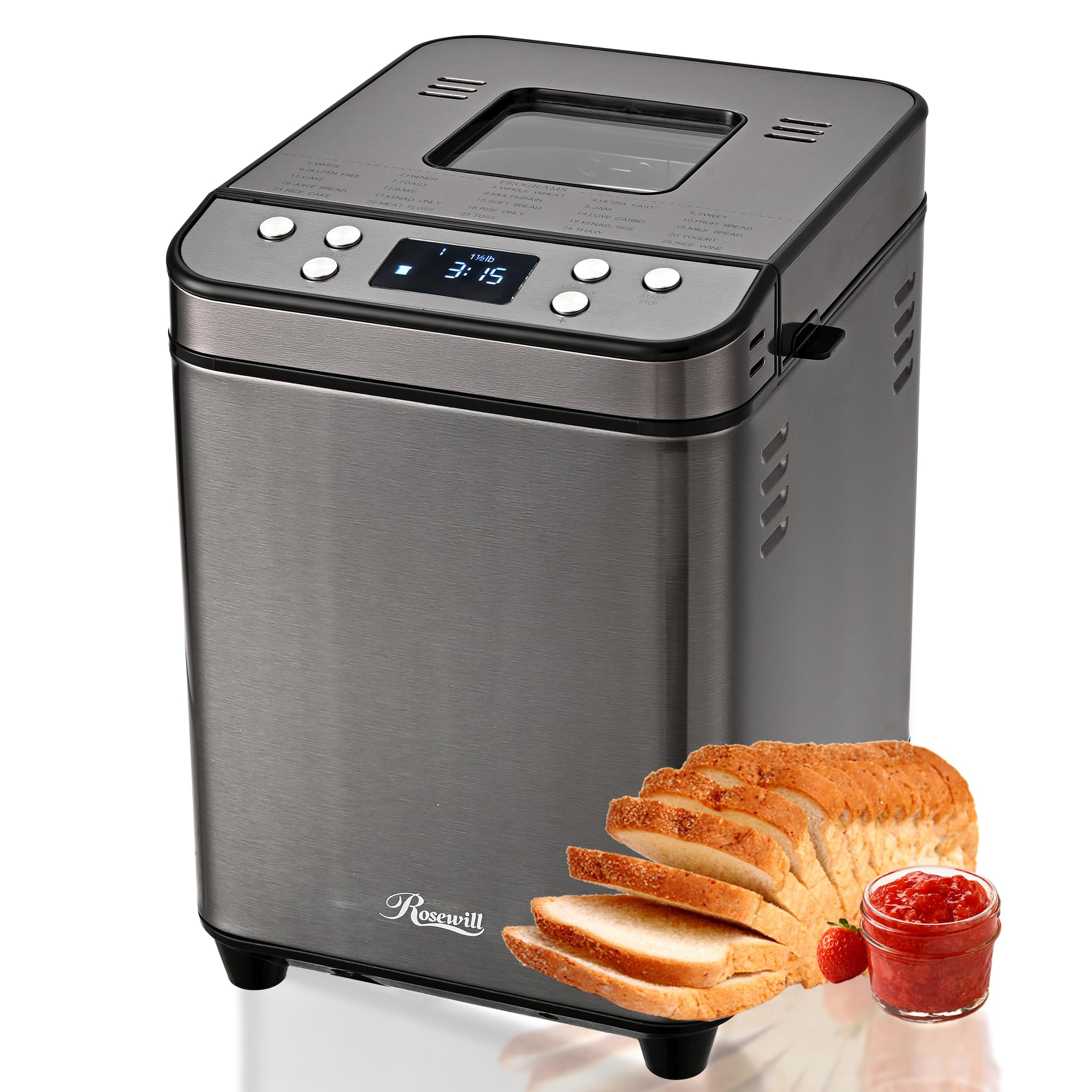
2. Rosewill 25-in-1 Automatic Bread Maker Machine, RHBM-25001GR
Twenty-five menus under one stainless lid — more baking options than any other machine on this page.
Menu count is the headline, and it is a real gap. The Rosewill carries 25 programs against the Cuisinart CBK-110’s 12 — better than double the choices. That wide slate covers gluten-free, cake, yogurt, and jam alongside the usual white and whole wheat, and you get three crust colors plus a 2 lb capacity the maker sizes for five to six people. The recipe book does the beginner hand-holding: add ingredients, pick a program, press start.
Heating is where it earns its keep. Two 700W heaters, one at the top and one at the bottom, spread heat around the loaf for what the maker calls 360-degree surround baking. That dual-heat layout is the reason a crust browns evenly rather than scorching on the bottom. On the convenience side you get a 15-hour delay timer, a 1-hour automatic keep-warm, and a 40-minute power-recovery feature that picks the cycle back up if the outlet trips. Motor noise stays under 50 dB, so an overnight bake is not going to wake the house.
What most impresses people is the plain fact that it works every time, with ease of use a close second. The stainless finish draws its share of happy comments — it reads more expensive than its price tag suggests. Fair caveats: noise, size, and instruction clarity each land as mixed rather than glowing, and at 8.8 pounds this is a lighter build than the 9.9-pound KOVIET. Lighter does not mean flimsy, but do not expect the heft of the premium KBS machines.
The value read: 25 programs from a machine that undercuts most of this list is the strongest feature-per-dollar play here, and the dual 700W heater setup is the spec that makes the crust argument.
Worth knowing: the compact 13.1 x 8.3 x 11.4 inch body saves counter space, though that same tight footprint means the pan takes a careful wiggle to seat.
Reach for this if: you want the widest menu list and a top-and-bottom heater without spending much.
Look elsewhere if: you need a 3 lb loaf or a near-silent motor — the KBS 750W handles both.
3. Hamilton Beach 29987 Bread Maker
Three steps to a loaf, with express cycles for nights you forgot to plan ahead.
You add ingredients, pick a cycle, and press start. That is the whole routine, and for someone who has never owned a bread machine it is the gentlest on-ramp here. The 14 settings span Basic, French, Gluten-Free, Whole Grain, Sweet, Dough, Cake, Jam Bake, and Artisan Dough. There are also dedicated express cycles at each size (1 lb, 1.5 lb, and 2 lb) for when you want bread in a hurry rather than tomorrow. Three crust shades go from light to dark.
The nonstick bread pan and kneading paddle both lift out, so washing up is a sink job rather than a scrubbing job. The delay start lets you load the pan in advance and have hot bread waiting at a set time, which is the feature that turns baking into a breakfast routine instead of an afternoon project.
The consensus is that it delivers excellent results, with the three size options landing as a favorite detail. It is a light machine at 9.3 pounds, so it slides out for cleaning without a fight. One honest note on size: its 13.98 inch depth by 9.13 inch width by 11.89 inch height makes it the deeper of the compact pair here, so measure your counter slot before you commit. It is not a ceramic-pan machine either — the nonstick coating is the standard type, so treat it with plastic utensils.
Why beginners like it: the express cycles at all three loaf sizes mean a forgetful baker still gets bread the same evening, and the removable pan cuts cleanup to a rinse.
Pick this one if: simplicity and an express cycle matter more to you than a long menu list.
Think twice if: you want a gluten-free program alongside sourdough and ceramic — the Briskind covers that spread.
4. KOVIET BM01 Bread Maker

For anyone who ruins a loaf by dumping the raisins in too early — this machine times them for you.
Two ingredient dispensers are the reason to look here. They release nuts, seeds, and dried fruit at the point the machine judges optimal, guided by adaptive temperature control, so your mix-ins land in the dough rather than getting pulverized by the paddle. You get 25 programs — whole wheat, gluten-free, cake, jam and more — plus loaf sizes at 1, 1.5, and 2 lb and three crust colors. That puts it level with the Rosewill on menu count and a step past most of the field.
The body is thickened stainless steel, and the pan is a premium nonstick material chosen for heat conductivity, which the maker ties to even baking and an easier release. A 650W brushless motor runs quiet through the knead. The 13-hour delay timer and 1-hour keep-warm do the overnight trick, and a 10-minute power-off protection feature resumes the bake if the power blinks.
Bread quality is what owners talk about most — homemade loaves that beat the store version — with ease of use and easy cleaning right behind. The honest trade-off is consistency of the electronics: some owners find functionality solid and others hit units that misbehave, and value opinions split the same way. If you get a good one, the dispenser makes it a genuinely hands-off machine. At 9.9 pounds it matches the FQB 25-in-1 for weight, though it is the bulkier chassis of the two at 12.4 inches deep by 15.5 inches wide by 14.6 inches high.
what separates it
- Dual automatic dispensers time your mix-ins instead of leaving it to you
- 25 programs, matching the Rosewill’s count
- Thickened stainless body with a heat-conductive nonstick pan
- 13-hour delay plus 10-minute power recovery for interrupted bakes
What to weigh
- Functionality and value sentiment are mixed across the range of owners
- Bulkiest footprint of the 2 lb group at 15.5 inches wide
- Nonstick pan rather than ceramic, so treat it gently
Best matched to: bakers who load walnuts, seeds, or raisins and want the machine to time the drop.
Avoid if: counter width is tight — this one needs real elbow room.
5. VEVOR MBF-016 Bread Maker

A food-grade ceramic pot for people who would rather skip the Teflon-style coating entirely.
The pan is the pitch. Instead of a nonstick metal liner, VEVOR uses a food-grade ceramic inner pot described as heat-resistant, non-stick, and not prone to peeling, with a mixing blade in food-grade Teflon. If coating wear is your worry with a bread machine, ceramic is the direction you want. Around that pan sit 19 menu functions covering French, whole wheat, quick, sweet, gluten-free, dough, jam, cake, and sandwich bread, all run from one-key intelligent operation that handles kneading through fermenting to the finish.
Capacity flexes to the household: 1 lb for one or two people, 1.5 lb for two to four, and 2 lb for four to six, with three crust textures from soft light to crispy dark. A 0-to-15-hour delay start and 1-hour keep-warm let you schedule a bake, and a power-interruption memory resumes the cycle within 15 minutes of an outage. When it is time for add-ins, the machine beeps to remind you.
Performance is what owners praise most, and reliability ranks right behind it — this machine is described as consistently doing its job. Size lands as a plus too, big enough for a full loaf. The thing to know before you buy is the instructions: clarity is the single most-noted weak spot, and the pan is hand wash only. At 9.7 pounds it is a touch lighter than the KOVIET’s 9.9 pounds, and its 9.8 inch depth by 13.6 inch width by 11.14 inch height keeps it reasonably slim on the counter.
The ceramic argument: a heat-resistant food-grade pot that resists peeling is the reason to choose this over a standard nonstick liner, and the 15-hour timer matches the longest delay on this list.
The honest catch: budget extra time for your first bake, because the manual leaves gaps that a clearer guide would fill.
Go for it when: ceramic matters to you and you want a 15-hour timer without a premium price.
Skip when: you want hand-holding recipes — the Briskind’s instructions read cleaner.
6. Briskind BM8206 Bread Maker

The angled glass touch panel and backlit LCD make this the easiest machine to read in a dim kitchen.
You can read your settings from above instead of crouching to squint at a flat panel, and that is the detail that separates this one. A white-backlit LCD (a lit screen) sits on a slightly angled glass touch surface, so the buttons stay legible in any light. Behind that panel sit 19 programs: basic white, gluten-free, whole wheat, low carb, rapid, French, cake, oatmeal, rye, multigrain, sweet, sugar-free, yeast dough, sourdough starter, jam, and yogurt. There is also a custom menu you can set to your own preferences.
The ceramic non-stick pan skips the harmful-chemical coating and the horizontal design bakes a traditional loaf shape rather than a tall vertical one. Three crust colors and three loaf sizes (1 lb, 1.5 lb, 2 lb) cover the basics. A built-in smart sensor reads the temperature inside the baking chamber during fermentation and adjusts heating to match, which is the kind of closed-loop control you usually only see on pricier machines. The 15-hour delay timer, 1-hour keep-warm, 15-minute power-failure backup, and an audible add-in reminder round out the convenience side.
What earns the trust here is functionality — it just works — with value and quiet operation close behind. The mute alert and low-noise design get noticed. What you should know is that the pan can be stiff to seat and remove, which the stability feedback picks up, and durability is genuinely mixed over time. Briskind backs it with a 2-year warranty and built-in grounding, overload, and overheat protection, and the machine conforms to UL and is certified to CSA standards. Note it is built for 120V US outlets and is not intended for 230V regions.
Readability win: the angled glass panel with a white backlit LCD is the clearest interface on this list, and the 15-hour timer plus custom menu give you room to experiment.
The trade-off: a ceramic pan that resists peeling can still fight you when you seat it, so expect a firm push each time.
Suits you if: you want a ceramic pan, sourdough starter cycle, and a warranty, all with the most legible controls here.
Might not suit: anyone who wants a pan that slides in easily — plan for a snug fit.
7. KBS Pro MBF-010 Bread Maker
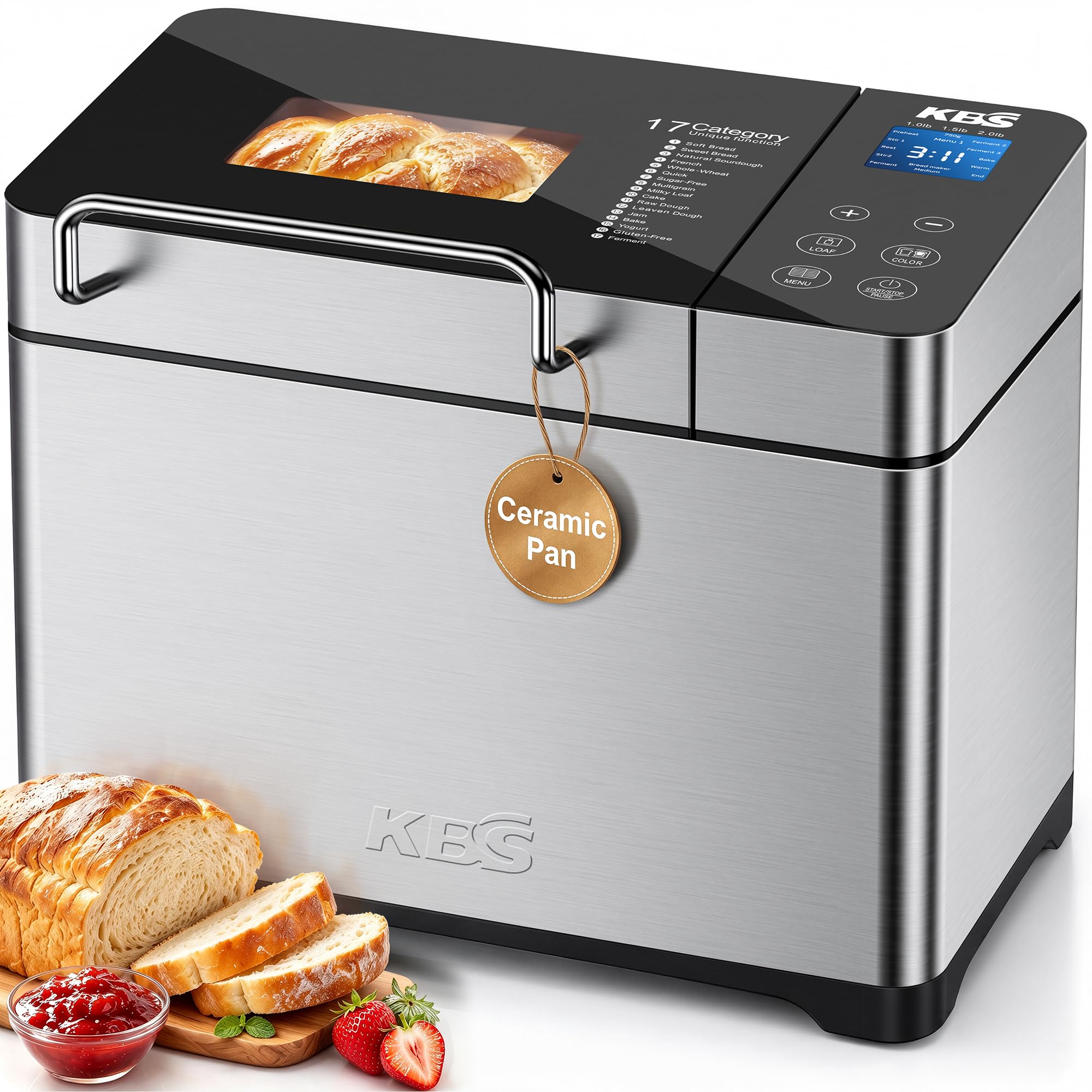
Seventeen programs, a 710W kneading motor, and an automatic dispenser for bakers who want the crust dialed in.
It kneads with more force than most machines here: a 710W motor against the 600W standard, driving a kneading blade with specially placed ribs meant to mimic artisan hand-kneading. Pair that with 360-degree convection heating (a fan that circulates hot air all around the loaf) and you get a golden crust and a soft interior from a machine rather than a stone oven. Capacity tops out at 2.2 lb, larger than the 2 lb ceiling on the Cuisinart and VEVOR, with sizes at 1 lb, 1.5 lb, and 2.2 lb and three crust shades. A custom setting lets you adjust baking time and temperature yourself.
Seventeen fully automatic programs cover basic, gluten-free, sourdough, French, whole wheat, multigrain, cake, jam, yogurt, and dough. The automatic stainless steel dispenser adds nuts and fruit at the right moment without you opening the lid, which is the difference between a streaky loaf and an even one. The ceramic pan and paddle skip the Teflon coating, and the kit is unusually complete — two paddles, a measuring cup and spoon, a paddle hook, a heat-resistant glove, and a 53-recipe book.
Performance is the runaway winner in owner sentiment, with ease of use and bread quality following close. The build is substantial at 14.7 pounds, which is the heftiest machine on this page and the sign of a real stainless body. The candid caveat is longevity: durability feedback is split, with some machines running strong and a few breaking down well inside the first year. Value opinions divide the same way, so buy this for the bake quality and the recipe library, not for a guarantee of decades of service.
The case for the KBS Pro
- 710W motor above the 600W standard, with artisan-style ribbed blade
- 360-degree convection for even crust color
- Automatic stainless dispenser drops mix-ins hands-free
- 53-recipe book with two paddles and a heat glove in the box
- 2.2 lb capacity edges past the 2 lb group
The part to consider
- At 14.7 pounds it is the heaviest machine here to lift for cleaning
- Durability feedback is mixed across the long term
- 17 programs, fewer than the 25-menu Rosewill and KOVIET
- Instruction clarity is the weakest noted area
Right for: the baker chasing a bakery-style crust who wants an auto dispenser and a deep recipe library.
Wrong for: anyone who needs the machine to be light enough to lift one-handed — look at the Rosewill instead.
8. KBS 750W Programmable Bread Maker, 20-in-1, MBF-060
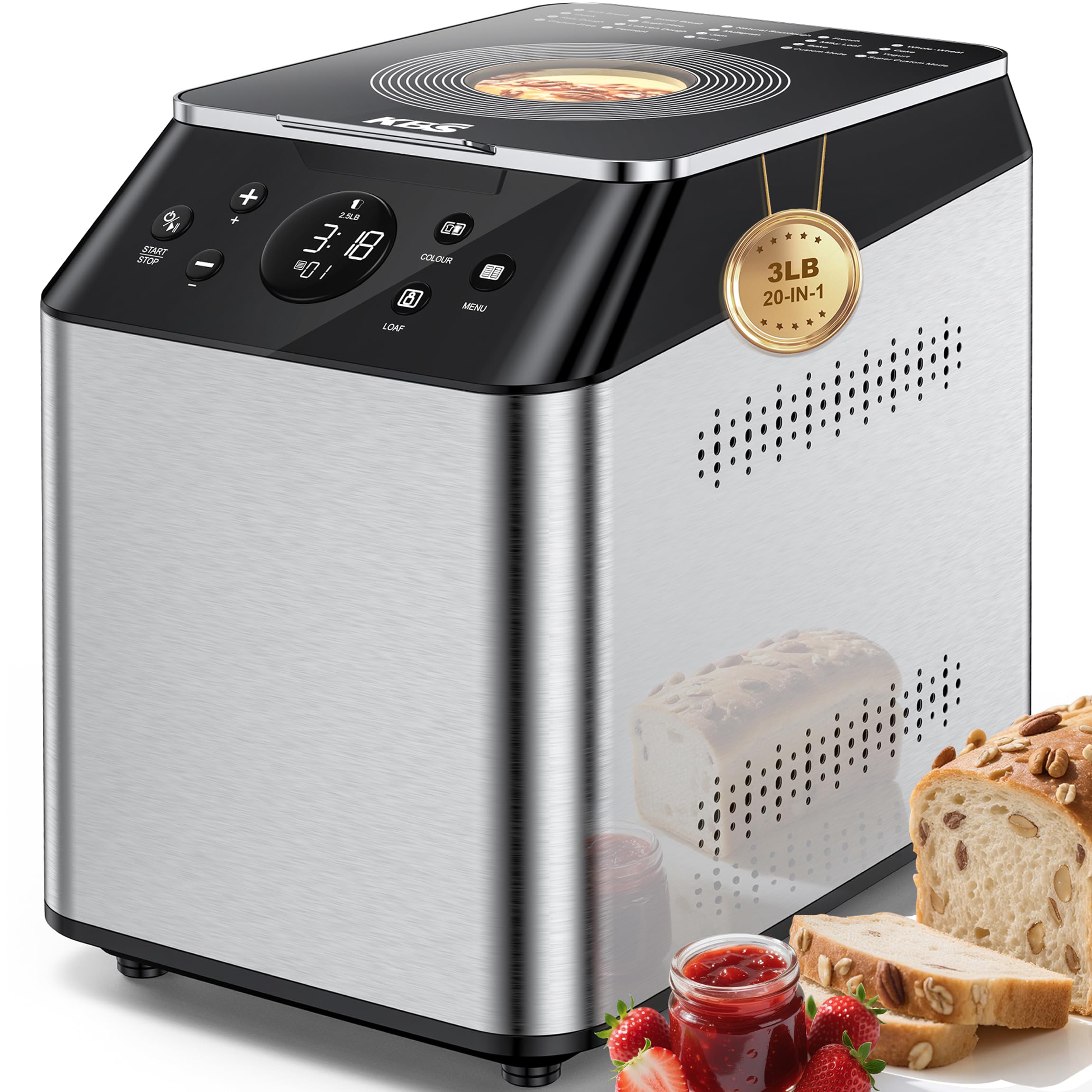
The only 3 lb machine here — built for households that finish a loaf in a single sitting.
Three pounds of loaf is the reason this exists. Every other machine on this list tops out at 2 or 2.2 lb, while this one bakes 2 lb, 2.5 lb, or 3 lb — enough for a family of eight to ten. Twenty program menus cover gluten-free, sourdough, jam, and pizza, and two of them are fully custom, letting you set the time and temperature for every step and save the result to a one-touch shortcut. That is a level of control the fixed-menu machines cannot match.
Power is 750W through dual infrared heaters that wrap heat around the loaf for what KBS calls 360-degree baking with no cold spots, and it is fast enough to finish a quick bread in 1.5 hours. The brushless motor runs quiet — the maker states noise lower than 25 dB, which is far below the Rosewill’s published sub-50 dB figure. A nut-and-fruit dispenser drops additions at the right moment, and the 15-hour delay, 60-minute keep-warm, and 15-minute power-off protection handle unattended bakes.
The interface is built for standing at a counter: a 25-degree angled control panel with a large touch display, plus a 360-degree panoramic window so you can watch the whole process. Owners say it beats store-bought bread and handles fresh-milled flour well, with a crust that comes out golden and crisp. The catch is size and clean-up — at 15.4 pounds it is heavy, and the body spans 12.7 inches deep by 9.29 inches wide by 12.95 inches high, so clear real counter space before it arrives. The ceramic pan is listed as dishwasher safe or hand wash.
The standout number: 3 lb capacity is class-leading on this page, so one bake feeds a household of eight to ten. The sub-25 dB brushless motor (a motor without brushes, measured below 25 decibels) keeps a big overnight bake nearly silent.
Plan around this: the 15.4-pound body and wide footprint make it a keep-it-placed machine rather than one you shuffle in and out of a cupboard.
Built for: big families and anyone who bakes more than one loaf a week and wants custom program control.
Not for: small kitchens or solo bakers — a 3 lb loaf is more bread than you will finish.
9. Cuisinart CBK-210NAS Bread Maker
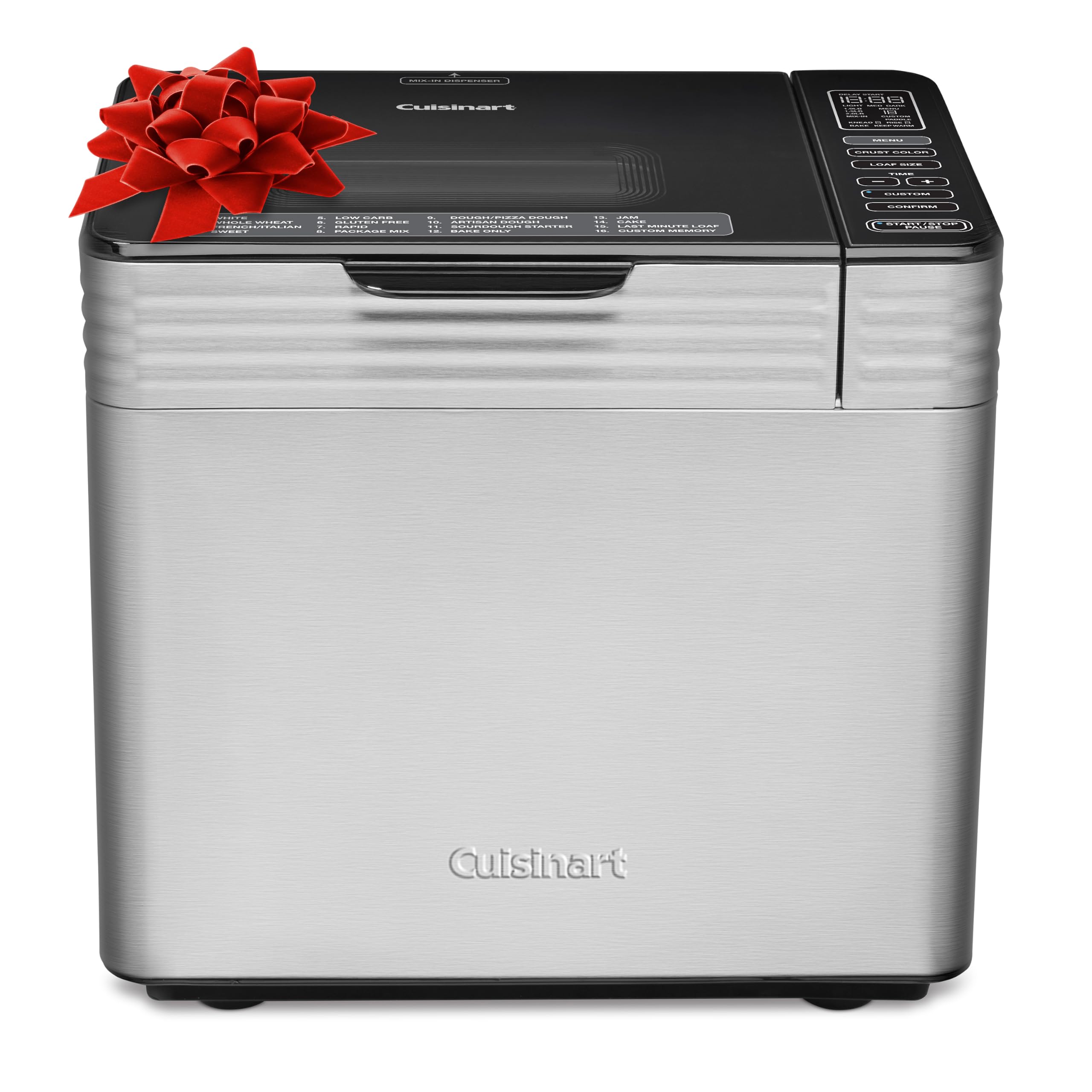
A built-in convection fan chases even crust color — the upgrade for bakers who notice the difference.
Convection is the whole reason to step up. A fan circulates air through the chamber while the loaf bakes, which helps develop consistent crust color and texture across three adjustable crust shades. Sixteen programs run from everyday loaves to Gluten Free and Low Carb, and there is a dedicated Sourdough Starter cycle — a feature only this machine and the Rosewill and Briskind offer. A Custom Memory slot remembers your house recipe’s settings so you do not re-enter them each time.
The mix-in dispenser is the quiet helper: it holds up to three-quarters of a cup of fruit and nuts and drops them at the second knead on compatible programs, so you load once and walk away. Loaf sizes of 1 lb, 1.5 lb, and 2 lb cover the household range, and the kneading paddle comes out before the final rise with the included hook. An edge-to-edge glass top lets you watch the whole rise, and the delay timer schedules fresh bread up to 13 hours ahead with digital touch controls and an LCD.
Performance is what owners value most, followed by ease of use, and the taste reports are strong. Be clear-eyed on the long haul, though: reliability feedback splits between machines that run for years and a minority that fail. Value opinions divide the same way, and this is the most expensive pick here, so buy it for the convection crust and the sourdough cycle, not as a value play. At 10.8 pounds it sits between the lighter 2 lb group and the heavy 14.7-pound KBS Pro.
What you are paying for: a convection fan for even crust color, a dedicated sourdough starter program, and a three-quarter-cup dispenser that drops mix-ins at the second knead.
The honest caveat: reliability and value sentiment both run mixed, so treat the 13-hour delay and convection as the reasons to choose it — not outdoor durability.
Choose this if: convection crust and a sourdough starter cycle are what you came for.
Choose otherwise if: you want pure program count or a bigger pan — the KBS 750W bakes a 3 lb loaf.
Know the Specs
Loaf capacity in pounds
Capacity tells you how much bread each bake yields, measured in pounds of finished loaf. A 1 lb loaf suits one or two people, 1.5 lb is an everyday size for a couple, 2 lb handles a family of four, and 3 lb on the KBS 750W is built for a household of eight to ten. Sizing up beyond what your household eats simply means more half-eaten bread on the counter.
Program count vs. useful programs
A program is a pre-set cycle for a type of bread. More programs (the Rosewill and KOVIET hit 25) mean more variety, but what matters most is whether the menu includes the cycles you will actually run — dedicated gluten-free, sourdough starter, whole wheat, and dough for oven-baking. A shorter list that covers your daily loaf beats a long one full of cycles you skip.
Delay timer and keep-warm
The delay timer lets you load ingredients and have the machine start on its own later, so bread is ready on your schedule. Timers here range from 13 hours (Cuisinart) to 15 hours (Rosewill, ROVIET, VEVOR, Briskind, KBS). The keep-warm function holds the finished loaf warm after baking — 60 minutes on most models — so bread stays fresh if you are not there the moment it finishes.
Pan material: ceramic vs. nonstick
The pan is where the bread sits, and the coating matters for release and wear. Ceramic pans (VEVOR, Briskind, both KBS models) are described as non-toxic and naturally non-stick. Nonstick metal and aluminum alloy pans (the Cuisinart and KOVIET) conduct heat well and release cleanly, but the coating is the part that wears first. Either way, hand wash is common — the VEVOR and Briskind both list hand wash only.
Common Questions
Is a stainless steel bread maker body better than an all-plastic one?
What size loaf is best for a family of two?
Can a bread maker really make gluten-free bread?
How long can I leave ingredients in the pan before the delay timer starts?
Will a bread machine wake me up if it runs overnight?
What does a ceramic bread pan do differently from a nonstick metal pan?
How much counter space does a bread maker need?
Can I add nuts and raisins mid-cycle, or do I need a dispenser?
Does a bigger menu count mean better bread?
How do I keep bread from sticking to the pan?
The Bottom Line
For most kitchens, the stainless steel bread maker to reach for is the Cuisinart Compact CBK-110NAS. It covers the cycles you will actually run (gluten-free, artisan dough, jam, cake) in the tightest footprint on the page. A 13-hour delay and a 60-minute keep-warm make overnight bread a routine rather than a project. If you want the widest menu list and a top-and-bottom heater, the Rosewill 25-in-1 delivers 25 programs at the value end. For a big family that finishes a loaf in a day, the KBS 750W is the only machine here that bakes a 3 lb loaf.
One honest nudge: convection and a sourdough starter cycle are the features that separate a machine you use weekly from one that gathers dust. The Cuisinart CBK-210NAS is the only pick that pairs a circulating fan with that dedicated starter program. Match the machine to the bread you actually bake, and any of these nine will earn its counter space.
How we choose
We do not accept paid placement. Every pick is matched to a real buyer and a real use-case; we do not hands-on test units.
Sources
Specifications: manufacturer listings and product documentation. Review insights: verified customer reviews, as of November 2026. Pricing: not shown on this page (it changes often); check the current price via the retailer link.
As an Amazon Associate, Tactical Gear Guy earns from qualifying purchases. This does not affect which products we feature.