Specs are compiled from manufacturer listings and verified buyer reviews and can change over time — please confirm the key details on the product page before buying.
Buying a studio microphone is mostly about one thing: how little of your room it drags into the recording. A great mic captures your voice and refuses the hum, the laptop fan, and the traffic outside. The picks below are all real XLR condensers and dynamics that working recorders actually use, sorted so you can match one to your interface, your room, and your voice.
This guide is built by comparing the manufacturers’ published specifications and the patterns across verified customer reviews, so you get each pick’s real strengths and trade-offs instead of marketing spin.
The short version: a dynamic mic forgives a bad room, a large-diaphragm condenser rewards a good one, and the noise floor spec tells you which camp a mic belongs in. Every pick here is an XLR mic that needs an audio interface to plug into, so plan for that before you buy any studio quality microphone.
Top Picks


How To Choose The Best Studio Quality Microphone
Most first-time buyers obsess over brand names and ignore the two numbers that decide whether their recording sounds clean or hissy. Get those right and almost any mic on this list will serve you well.
Dynamic vs condenser: pick your room first
A dynamic mic (like the SM7B) is a moving-coil design that shrugs off room reflections and needs lots of gain from your interface. A condenser mic uses a charged, ultra-thin diaphragm and captures far more fine detail — including the sound of your untreated walls. If your recording space is a bedroom with a window and a fan, a dynamic is the forgiving route. If you have treated walls or a closet booth, a large-diaphragm condenser shows off the detail you paid for.
The self-noise number nobody checks until it bites
Self-noise, listed in decibels (dB), is the electrical hiss the mic makes on its own with silence in the room. A mic rated near 7 dB is close to silent and lets you record quiet sources without cranking preamp gain. A mic near 94 dB on the spec sheet demands far more careful gain staging — one of the picks here has exactly that figure, and it’s worth knowing before you buy.
Phantom power and your interface
Condenser microphones need +48V phantom power (a voltage sent up the XLR cable by your interface or mixer) to charge their capsule. Dynamic mics like the SM7B do not. Check your interface before buying: most modern units supply phantom power, and Shure notes the SM81 will run on as little as 11 Vdc but with slightly reduced headroom and sensitivity.
Polar pattern and what it rejects
A cardioid pattern (the most common for vocals) picks up mainly from the front of the mic and rejects the sides and rear. That rejection is why a cardioid condenser in a modest room still beats an omni mic pointed at your laptop. Every microphone here is cardioid, so pattern is one less thing to compare — focus on the capsule size, the noise floor, and the pad or filter switches instead.
Side-by-Side Comparison
| Model | Best For | Noise Floor | Capsule / Type | Polar Pattern | Amazon |
|---|---|---|---|---|---|
| Shure SM7B★ Best Overall | Untreated rooms and podcasting | — | Dynamic | Cardioid | Amazon |
| Behringer B-1Best Value | Budget acoustic instruments | 10 dB | Large-diaphragm condenser | Cardioid | Amazon |
| MXL 990/991 BundleTwo-Mic Kit | Two-mic setups on a budget | — | Large + small condenser pair | Cardioid | Amazon |
| Blue Blackout Spark SL | Streaming and voiceover | 16.4 dB | Large-diaphragm condenser | Cardioid | Amazon |
| LEWITT LCT440PURE | Clean detail on a budget | 7 dB | 1” true condenser | Cardioid | Amazon |
| Aston Origin | Built-in pop filter convenience | 94 dB | Large-diaphragm condenser | Cardioid | Amazon |
| Warm Audio WA47jr | Vintage ’47 character | — | Custom k47-style capsule | Cardioid | Amazon |
| Audio-Technica AT4040 | Versatile vocal and instrument work | — | Large-diaphragm true condenser | Cardioid | Amazon |
| Shure SM81-LC | Instruments and acoustic sources | — | Small-diaphragm condenser | Cardioid | Amazon |
| AKG C214 | High-SPL close-miking | — | Large-diaphragm condenser | Cardioid | Amazon |
| Neumann TLM 102 | Premium vocal clarity | 21 dB | Large-diaphragm condenser | Cardioid | Amazon |
Detailed Reviews
1. Shure SM7B Dynamic Vocal Microphone
Our pick — 4.5+★ from 12,000+ verified ratings; the strongest balance of quality and price.
The dynamic mic that makes a bad room sound like a good one
If your recording space is a bedroom with a noisy laptop and a window to the street, this is the microphone that saves you. The SM7B is a dynamic cartridge (a moving-coil design that needs no phantom power and ignores room reflections far better than a condenser). Its cardioid pickup pattern works alongside air suspension shock isolation to keep handling vibrations and room interference out of your voice. The upshot: you sound front and center even when your walls are bare.
What wins people over is how easy it makes speech and singing sound. Amazon’s own review summary notes buyers regularly praise its all-metal construction and its ability to hold up in noisy settings — including untreated rooms. The built-in pop filtering and the detachable windscreen knock down plosives (the little pops on P and B sounds) and breath noise without extra accessories. Professional XLR output gives you full control over gain, EQ, and tone shaping from your interface. The rugged all-metal body also carries electromagnetic shielding, which helps keep hum out of the signal.
Here’s the catch you need to plan for. The SM7B wants a lot of clean gain, and on a modest interface you may find yourself pushing the preamp hard. It also does not need phantom power, unlike the condensers below, so you never risk sending voltage to a mic that does not want it. One practical note: the hardware platform listing points to a computer with a Shure MVX2U interface sold separately, so confirm your interface first. The impedance sits at 150 ohm, which pairs cleanly with most modern preamps.
What you get
- Dynamic design that shrugs off room reflections and background noise
- Built-in pop filter plus detachable windscreen cut plosives from the start
- All-metal enclosure with electromagnetic shielding against hum
- Cardioid pattern with air suspension shock isolation
What to weigh
- Needs a high-gain preamp or inline booster on modest interfaces
- No phantom power requirement means it is a dynamic, not a detail-capture condenser
Reach for this if: you record podcasts, voiceover, or vocals in an untreated room and want a mic that forgives the space.
Plan around this: a low-gain interface will leave you short on level, so budget for a clean preamp or booster.
2. Behringer B-1 Studio Condenser Microphone
A large-diaphragm condenser that fits almost any entry-level budget
The B-1 delivers the classic large-diaphragm condenser shape — a gold-sputtered capsule (a golden metal coating that holds the charge on the diaphragm) shock-mounted inside an aluminum body. At 6.69 inches tall and 1.77 inches wide, it is a compact mic and takes up almost no desk space. A cardioid pattern keeps source separation tight, which helps when you record an acoustic guitar and vocals in the same room.
What buyers praise most is the quality and value: the B-1 is a genuine condenser at a price that barely leaves the entry tier. Its frequency response reaches 20 KHz, and the -10dB pad (a switch that reduces the signal so loud sources do not distort) is handy for close-miked drums or a loud amp. The metal carrying case and shock-mounted capsule sweeten the deal. Its self-noise is rated 10 dB — far from the quietest on this list, but workable for most home recording.
That noise figure is worth measuring against the LEWITT LCT440PURE above, which rates 7 dB. In a quiet room you will hear the B-1’s own hiss sooner than you would hear a premium condenser’s. It is also a single-diaphragm design, so you sacrifice the multi-pattern flexibility some buyers want. Still, for acoustic instruments, overheads, or a first serious condenser, it covers the basics without complaint.
Where it earns its keep: at 10 dB self-noise and a cardioid capsule, it handles close-miked acoustic work and overhead duties with a metal case to travel in.
Honest limitation: the self-noise is higher than the quietest condensers here, so it is less suited to whisper-quiet sources.
Good match: an entry-tier condenser for acoustic instruments and overheads where you want the large-diaphragm sound without stretching your budget.
Think twice if: you plan to record very quiet sources — the 10 dB noise floor will show up before a premium condenser’s would.
3. MXL 990/991 Condenser Microphone Bundle
Two condensers in one box, so you can track a voice and an instrument
Two mics for the price most people pay for one — that’s the MXL bundle’s whole argument. You get the large-diaphragm 990 for vocals and the small-diaphragm 991 for instruments. The 990 uses a 6-micron gold-sputtered diaphragm and an FET-based design with transformer-balanced output. The small 991 handles acoustic guitar, strings, and detail work. Each carries a cardioid pattern that rejects the sides and rear, so you hear more of your source and less of the room.
Both are designed to suit male or female vocalists alike, with the 990 covering a 20 Hz – 20 kHz response and the 991 covering 30Hz – 18kHz. The bundle ships in a champagne finish and stainless steel body. Buyers reliably praise the quality and the sound, and its functionality with common recording software. This is also the widest of the packages here — the box measures 12.01 x 7.52 x 3.5 inches, compared to the Behringer B-1’s 1.77 x 1.77 x 6.69 inches, so plan a little shelf or case space.
The trade-off to know is power. The 990 requires +48V phantom power, so your interface must supply it — many do, but check before you buy. The bundle’s two-mic flexibility is its real selling point, but if you only need one great vocal mic, a single premium condenser will beat this pair on fine detail. For songwriters who want to track voice and instrument on one session, though, this is the practical choice.
The appeal: a large-diaphragm 990 and small-diaphragm 991 in a single champagne bundle, both cardioid, so one purchase covers vocals and instruments.
Watch the detail: both mics need +48V phantom power, and the bundle leaves less room in a small studio than a single compact mic would.
Fits best: a songwriter or small studio that wants to record a voice and an acoustic instrument without buying two separate mics.
skip it if: you only ever record one source — a single higher-spec condenser will reward you more for the same spend.
4. Blue Blackout Spark SL XLR Condenser Microphone

The condenser built for a desk, with switches that tame a noisy room
Streamers and voiceover artists get two gift switches on this one: a 100Hz high-pass filter that cuts rumble from your desk and a -20dB pad that keeps loud sources from distorting. Those two toggles are the reason a gaming stream can sound clean even with a PC tower humming in the same room. The custom Blue condenser capsule and Class-A JFET electronics (a circuit design that adds rich harmonic detail) give it that broadcast weight. It connects via XLR to a USB audio interface or mixer.
At 11.52 ounces it is light enough to mount on a boom arm without sagging, and the package includes a wooden storage box and a custom shock mount. The cardioid capsule keeps the pickup tight to your voice, and the noise floor sits at 16.4 dB, which is workable for voiced content. It comes in black, and buyers consistently highlight how clearly it captures low and mid tones alongside its handsome look. For podcasting, YouTube, Zoom calls, and gaming streams, the high-pass and pad switches are the practical movers.
The honest limit: 16.4 dB is not the quietest here — the LEWITT LCT440PURE below is rated 7 dB — so on very quiet sources you will notice its own hiss earlier. It also leans on those switches to compensate for an untreated room, which is fine but not the same as a treated space. For a talking-head stream, though, it is a strong step up from a USB desk mic.
Desk-friendly picks: the 100Hz high-pass filter and -20dB pad let you clean up rumble and tame loud sources right at the mic.
Fair warning: a 16.4 dB noise floor is fine for voice but not the quietest option for whisper-quiet capture.
You’ll love it if: you stream, podcast, or do voiceover at a desk and want switches that fix room rumble on the fly.
Look elsewhere if: your main job is ultra-quiet instrument capture — the higher self-noise works against you.
5. LEWITT LCT440PURE Large Diaphragm Condenser Mic

The quiet condenser that makes you wonder what the extra spend buys
Start with the number that turns heads: 7 dB self-noise. That is the mic’s own electrical hiss, and at 7 dB it is near-silent, so a quiet acoustic guitar or a soft vocal comes through without the mic adding a floor of noise underneath. Compare that to the Aston Origin’s 94 dB self-noise and the gap is enormous — 13.4 times over. The 1” true condenser capsule (a single large diaphragm that captures fine detail) reproduces depth and clarity that punches well above its price.
What wins people over is the sound. Owners routinely say it competes with mics costing multiples of its price, and the sound quality is the thing they praise most. The cardioid pattern gives effective rear rejection, which suits studio, stage, and home recording alike. It handles vocals, acoustic instruments, drums, cymbals, amplifiers, and piano without complaint. Your purchase includes a shock mount and a magnetic pop filter, so you are not chasing accessories separately.
Against the Audio-Technica AT4040 above, this is the cleaner-noise option — 7 dB versus the AT4040’s low-noise transformerless design that never publishes a single self-noise figure here. Both are XLR condensers; the LEWITT simply wears its quiet spec on the sleeve. One setup note: with an impedance of 200 ohm, verify the load your interface presents. The metal build feels solid in hand, and the included shock mount means no extra purchase to get started.
Strong points
- 7 dB self-noise makes it one of the quietest mics on this list
- 1” true condenser capsule with depth and clarity
- Shock mount and magnetic pop filter included
- Cardioid capsule with effective rear rejection
Trade-offs
- Needs phantom power from a proper XLR interface
- 200 ohm impedance is worth checking against your preamp
Take this one if: you want a quiet, detailed condenser for vocals and instruments at mid-tier money without a self-noise penalty.
Not for you if: you need filter and pad switches built into the mic for loud close-miking.
6. Aston Microphones Origin Condenser Microphone

The one with the pop filter welded into the grille
Most mics make you buy a separate pop shield and then fiddle with a clamp arm. The Origin builds the pop filter into the mic body using stainless-steel mesh knit, so the wind and plosive control is already there. Its chassis is 2mm solid stainless steel, laser cut and etched, which makes it feel like a piece of studio hardware. A low-cut switch suppresses street noise, and the end caps let it mount directly to a stand.
The sound side is developed with professional artists, engineers, and producers behind it, and buyers describe the detail as fantastic — one note says it delivers the audio performance of a far pricier mic. The cardioid pattern and built-in metal body keep it honest about what it captures. It is also designed and built in the UK, which appeals to buyers who care where the tool comes from.
Now the figure that demands a second look: its audible noise is listed at 94 db. That is a very high self-noise number versus the LEWITT’s 7 dB — 13.4 times higher — so for quiet sources, treat that spec as the reason to look elsewhere. In practice the Origin is a confident vocal mic in a room with some sound already in it. If ultra-quiet tracking is your priority, the noise spec decides against it.
Smart detail: a built-in stainless-steel pop filter and a low-cut switch mean fewer accessories and less rumble on the way in.
Deal-breaker for some: the 94 db noise figure makes it an awkward fit for very quiet sources compared to the LEWITT’s 7 dB.
For hands-on songwriters: you get a sturdy stainless mic with the pop filter built in, so less fiddling and no extra clamp to lose.
Bye if: you record near-silent sources — the high noise spec works against you there.
7. Warm Audio WA47jr Large Diaphragm Condenser Mic

The ’47-style tone without the museum-piece price
The WA47jr is aimed squarely at that classic smooth ’47 sound, with a custom true ’47 capsule reproduction (k47 style) inside a brass body. Inside, it runs a fully discrete signal path with Toshiba FETs, Wima film capacitors, and Panasonic electrolytic capacitors — a parts list that says “character” rather than “clinical.” It runs on 48v phantom power and connects via XLR. The finish is nickel and the look leans vintage.
The sound quality is the headline: owners describe the WA47jr as professional and warm, with voices that sit in the mix without harshness. Value is the other theme — it lands as a warm, characterful mic for the price of a plain one. The transformerless design keeps the tone clean rather than muddy. If you sing and want a vocal sound with vintage weight, this is the pick that leans into that.
The honest caveat is durability, and it is the one aspect buyers are most split on. It is built solidly for most, but more than one report describes one that broke within two months of use, so treat it with care and register the warranty promptly.
What draws people: a custom k47-style capsule and a fully discrete signal path with Toshiba FETs, Wima film, and Panasonic caps — the vintage-tone recipe in a brass body.
The honest note: durability gets mixed signals, with some units reported failing early, so handle it carefully and keep the receipt.
This is your mic if: you want warm, vintage-flavored vocals and enjoy a mic whose parts list is aimed at character.
Look past it if: long-term durability is your top worry — the mixed reports on build warrant careful handling.
8. Audio-Technica AT4040 Cardioid Condenser Microphone

The do-everything condenser for a working home studio
If you cannot predict whether tomorrow’s session is vocals, acoustic guitar, or a snare drum, this is the mic to keep on the stand. The AT4040 uses an externally polarized true condenser design with a technically advanced large diaphragm tuned for smooth, natural sound. Transformerless circuitry virtually eliminates low-frequency distortion. That means it handles high-SPL sources (very loud sounds) without losing its headroom, and fast transients come through cleanly.
Included with the mic: an AT8449 shock mount for 5/8-27 threaded stands, a dust cover, and a protective carrying case. A precision-machined nickel-plated brass baffle gives the acoustic element enhanced stability. The frequency response reaches 20000 hertz, and accuracy is a real theme in how buyers describe it. Capturing everything within its pattern is the compliments this mic keeps receiving, and that makes it a true utility player for voice and instruments.
Compared with the LEWITT LCT440PURE above, the AT4040 does not advertise a self-noise number in this data, while the LEWITT’s 7 dB is spelled out clearly. That is not a knock on the AT4040’s quietness — it is simply the spec Audio-Technica leaves off the sheet here. If a published noise figure matters to you, the LEWITT gives you one; if you want broad source coverage with a shock mount and case in the box, this is the safer all-rounder.
Where it shines
- Handles both vocals and loud instruments with high-SPL capability
- Transformerless circuitry keeps low-frequency distortion down
- Shock mount, dust cover, and carrying case included
Worth knowing
- No published self-noise figure in the spec sheet
- Needs phantom power from a proper XLR interface
Best for the mixed session: a versatile condenser that tracks vocals and instruments with equal composure and ships with its own shock mount.
Look elsewhere if: you need a published quiet-noise number before you commit — this sheet does not carry one.
9. Shure SM81-LC Cardioid Condenser Instrument Microphone

Built for acoustic guitars and cymbals, not podcast chatter
This is an instrument mic, and it says so plainly. The SM81’s 20 Hz to 20 kHz frequency response comes with a flat response curve, so it reproduces a source accurately instead of flattering it. For acoustic guitar, piano, strings, or drum overheads, that accuracy is exactly what you want. The cardioid pattern stays uniform with frequency and symmetric about its axis, which gives maximum rejection of off-axis sound and minimum coloration.
On the control side, you get selectable low-frequency response (flat, 6, or 18 dB/octave rolloff) and a 0 dB/10 dB lockable attenuator switch for loud sources. A swivel adapter, attenuator-switch lock, foam windscreen, and carrying case ship with it. The rugged steel construction is built to survive temperature and humidity swings, and low RF susceptibility keeps it stable near electronics. It needs phantom power and performs best with a 48 Vdc supply, but will run on as low as 11 Vdc with slightly reduced headroom and sensitivity.
Because it is a small-diaphragm instrument microphone, it is the wrong tool for a deep-voiced podcast — the flat response shows off a breathy vocal’s flaws rather than rounding them. Compared to the AT4040’s large-diaphragm versatility, the SM81 is the specialist. That is not a flaw; it is a deliberate design choice for stringed instruments.
The instrument advantage: a flat response curve across 20 Hz to 20 kHz gives you an accurate capture of guitar or cymbals, not a flattered one.
Where it falls short: the small-diaphragm design and flat voicing make it a poor fit for podcast-style vocals.
Pick this for: acoustic guitar, strings, and drum overheads where a flat, accurate response is the whole point.
Not the one for: a solo voice podcast — the flat small-diaphragm sound will expose every breath.
10. AKG Pro Audio C214 Condenser Microphone

Handles a screaming amp as calmly as it handles a whisper
The C214 is built for close-miked sources that would overload lesser mics. Its headline spec is outstanding dynamic range with ultralow noise for close-up recording of high-output sources up to 156dB SPL (a measure of how loud a sound the microphone can take before it distorts). A switchable 20dB attenuator and bass-cut filter let you get right up on a loud guitar amp or a belted vocal without clipping. The integrated suspension reduces mechanical noise and vibration from the stage.
In the review pages, what stands out is how clear and crispy the sound is with acoustic guitar and vocals. Buyers also call it an affordable take on a classic mic and praise its functionality, with one noting it works best for their voice. Durability gets positive nods too, with mentions that it should last years. The body is aluminum, which keeps it reasonably light while staying solid.
Where the C214 differs from the LEWITT LCT440PURE is the high-SPL focus — the C214 leans toward loud, close-miked capture, while the LEWITT leans toward quiet detail. If you record quiet fingerstyle guitar only, the C214’s strengths are partly wasted. For loud amps, drums, or an aggressive vocal, it earns its keep.
The high-SPL advantage: up to 156dB SPL handling plus a 20dB attenuator means you can close-mic a loud source without distortion.
The honest reframe: if you mostly track quiet fingerstyle sources, the C214’s loud-source strengths are partly unused.
Close-miking is its lane: loud amps, drums, and aggressive vocals where the 156dB SPL headroom and attenuator do the heavy lifting.
Look past it if: your sessions are whisper-quiet — the high-SPL focus is not what you are paying for.
11. Neumann TLM 102 Condenser Microphone
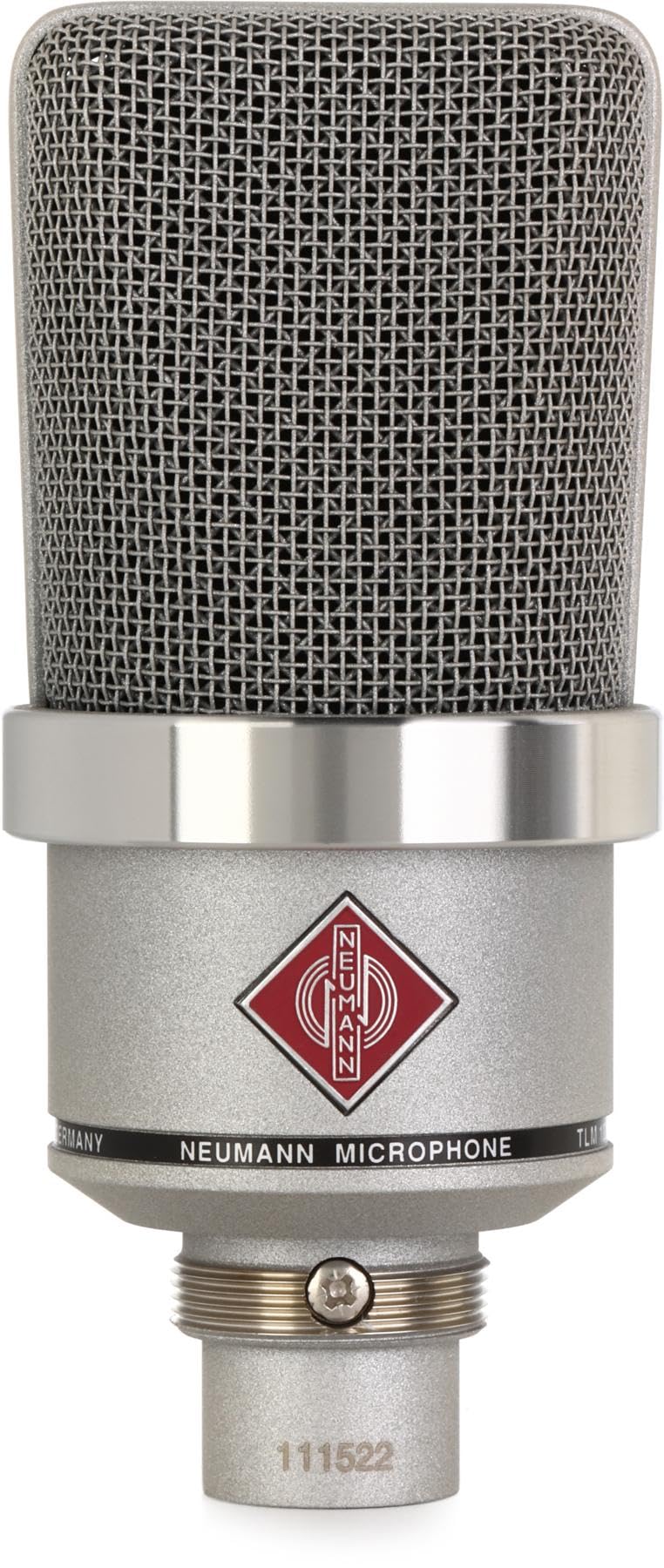
The Neumann badge on the body is the whole reason this one sells
Neumann’s name carries weight in every recording studio, and the TLM 102 is the compact, transformerless way in. The large-diaphragm cardioid capsule and aluminum body keep it relatively light. Its frequency range runs 20 Hz to 20 kHz, and its impedance sits at 50 ohm (a low-load figure that pairs well with most preamps). The sound quality is where buyers land — the TLM 102’s voices come through warm and clear.
Versatility is the secondary theme: it works well on vocals and general instrument duties, and its size is large enough to capture every sound without dominating the stand. Buyers treat the TLM 102 as an affordable high-end option, the kind of mic you keep for years. It connects via XLR to any interface with phantom power. The self-noise figure is 21 dB, which sits well above the LEWITT’s 7 dB but is workable for voiced content.
The one thing to be clear-eyed about is noise. Several buyers report humming issues, and the noise level aspect is the single mixed point in its record. An interface with a clean phantom supply and short, well-shielded XLR cables will usually settle the matter, but if you record ultra-quiet sources in a noisy electrical environment, that 21 dB figure plus the hum reports are the reason to pause.
The premium draw: Neumann’s studio legacy in a compact transformerless large-diaphragm body with a 20 Hz to 20 kHz range.
The fair caveat: a 21 dB self-noise rating and some reports of humming mean it is not for whisper-quiet tracking in an electrically noisy room.
Worth it for: vocalists who want the Neumann badge and warm clarity in a compact mic, and who have a clean interface to feed it.
Hold off if: your room hums electrically — the 21 dB self-noise plus those hum reports is reason to sort the power first.
Know the Specs
Self-noise in decibels (dB)
The electrical hiss a mic generates on its own, listed as a dB figure on the spec sheet. A lower number means the mic adds less noise to a quiet recording. Set a 7 dB mic next to a 94 dB one and the difference decides whether your acoustic guitar track is clean or has a haze underneath it.
Capsule size: large vs small diaphragm
A large-diaphragm capsule (often around an inch across) gives a fuller, more flattering vocal tone and is the default for singers. A small-diaphragm mic captures fast transients with accuracy, which is why instrument mics are usually small. Match the capsule to the source, not to the marketing.
Phantom power and 48V
Condenser mics need +48V phantom power sent up the XLR cable by an interface or mixer. Dynamic mics like the SM7B do not. Check your interface before buying a condenser, because an interface without phantom power will leave it silent. Shure notes the SM81 prefers 48 Vdc but runs on as little as 11 Vdc.
Polar pattern and cardioid rejection
A cardioid pattern picks up from the front and rejects the sides and rear. Every microphone here is cardioid, so pattern is one less thing to worry about. What varies is how much rear and side rejection each design delivers, and how much of your room leaks in despite it.
Common Questions
Do I need an audio interface to use a studio quality microphone?
Is a dynamic mic or a condenser mic better for a bedroom recording?
What does self-noise mean and why does a 7 dB rating matter?
Will a condenser microphone plug straight into my laptop?
Do I need +48V phantom power for every condenser here?
What is the difference between the AKG C214 and the audio-technica AT4040?
How long will a studio condenser last with care?
Can I use a large-diaphragm condenser for acoustic guitar?
Does a studio quality microphone need a pop filter?
Is a higher price always a better sounding studio microphone?
The Bottom Line
For most people, the studio quality microphone winner is the Shure SM7B because its dynamic cartridge and air suspension shrug off room noise that would ruin a condenser in a bedroom. If you record quiet sources and want the lowest self-noise here, grab the LEWITT LCT440PURE with its 7 dB rating. And for recording a loud amp or drums up close, the AKG C214 with its 156dB SPL handling is the one to reach for.
One honest nudge: the SM7B is the crowd favorite for a reason — 4.5+ stars across 12,000+ owners — but if your room is treated and your sources are delicate, the LEWITT’s 7 dB noise floor will serve you better than the SM7B’s dynamic capsule.
How we choose
We do not accept paid placement. Every pick is matched to a real buyer and a real use-case; we do not hands-on test units.
Sources
Specifications: manufacturer listings and product documentation. Review insights: verified customer reviews, as of November 2026. Pricing: not shown on this page (it changes often); check the current price via the retailer link.
As an Amazon Associate, Tactical Gear Guy earns from qualifying purchases. This does not affect which products we feature.