Specs are compiled from manufacturer listings and verified buyer reviews and can change over time — please confirm the key details on the product page before buying.
You can ruin a knife blank or polish a chisel edge clean with the same grinder. What decides which happens is the slow end of the dial. Spinning a wheel fast is easy. Dropping the RPM (revolutions per minute — how many times the wheel turns each minute) down and holding it there with control is the hard part. That control is what separates the nine machines below.
This guide is built by comparing the manufacturers’ published specifications and the patterns across verified customer reviews, so you get each pick’s real strengths and trade-offs instead of marketing spin.
You will see bench grinders, buffer-polisher hybrids, a belt sander, and a wet sharpening system — all of them adjustable, none locked to one speed. Below, each one is matched to the shop it actually fits, so you spend once and stop fighting your tool. This breakdown of the best variable speed grinder keeps the focus on real RPM ranges and what those numbers do to your edge.
Top Picks


How To Choose The Best Variable Speed Grinder
The feature you are paying for is the dial, so judge the dial first. A grinder that runs 2000 to 3400 RPM gives you a slow setting for shaping and a fast setting for hogging metal off. A buffer that creeps down toward 1750 RPM and climbs to 8500 or 10000 RPM spans a much wider swing. Neither is better on its own — they serve different jobs, and you have to know which job is yours before you shop.
Match the machine to the material, not the marketing
A bench grinder with grinding wheels is built to remove steel fast — think lawnmower blades, chisels, and old axe heads. A buffer-polisher with cloth wheels is built to bring a surface up to shine. Those are different jobs and different machines, even when both happen to sit on a bench. If you are working knife bevels, a belt sander with a variable frequency drive (VFD — a control box that lets you dial motor speed smoothly) gives you far more control than a rigid stone wheel.
Watch the wheel size and the bore
Wheel diameter sets how much surface touches your work at once. An 8-inch wheel cuts a flatter, cooler path than a smaller one because the curve is gentler. One spec worth checking is the bore — the center hole size, written like 5/8 inch — because it decides which replacement wheels actually fit your arbor. Buy a machine with an odd bore and you will hunt for wheels forever.
Weight is a feature, not a drawback
A heavy grinder stays put. A light one walks across the bench when you press steel into it. So a bench grinder somewhere in the 40-pound class usually feels steadier than a compact polisher you can lift with one hand. That said, a compact unit with mounting holes and corner brackets can be bolted down and behave itself — weight matters most when you refuse to bolt anything down.
Side-by-Side Comparison
| Model | Best For | Speed Range | Power | Weight | Amazon |
|---|---|---|---|---|---|
| Jewelry Polisher (OPAVIOC SY200)★ Best Overall | Polishing and light metal work | 1750–8500 rpm | 320 W | 2.92 kg | Amazon |
| CIRONBOW 4″ Jewelry PolisherBest Value | Beginners who want a full kit | 1750–10000 rpm | 350 W | — | Amazon |
| LIBAOTML TM-2A PolisherCompact Pick | Bench-top polishing on a budget | up to 10000 rpm | 200 W | 3.8 kg | Amazon |
| WEN BG625V 6-Inch | Reviving old tools and blades | 2000–3400 rpm | 0.4 hp (2.5 A) | 14.22 kg | Amazon |
| Woodskil TDS-G200VLGA 8-Inch | Speed readouts at a glance | 2000–3450 rpm | 0.75 hp (5 A) | — | Amazon |
| WEN BG4280 8-Inch | Long grinding sessions | 2000–3400 rpm | 5 A | 41 lb | Amazon |
| VEVOR 30 x 1-Inch Belt Grinder | Knife making and deburring | 5000–5500 rpm | 550 W (5 A) | 17.4 lb | Amazon |
| BUCKTOOL SCM8103 Wet Sharpener | Chisels and carving tools | 90–160 rpm | 1/5 hp (1.2 A) | 15.6 kg | Amazon |
| Shop Fox W1840 8-Inch | Full-size shop grinding station | 2000–3400 rpm | 0.75 hp | 40 lb | Amazon |
Detailed Reviews
1. OPAVIOC SY200 Jewelry Polisher
Our pick — 4.5+★ from 450+ verified ratings; the strongest balance of quality and price.
The compact buffer that treats your steel gently at 1750 and rips through rust at 8500.
If your work spans both, this is the machine worth locking in first. The OPAVIOC runs a low-noise 320 W motor across a 1750 RPM to 8500 RPM dial, so you get a true crawl for polishing a knife edge and a genuine sprint for stripping rust off a machine component. That spread is why it holds the top spot here — it polishes a knife edge and strips rust with the same machine.
You get real control over that speed range, not just a big number on the box. The speed dial sits separate from the on switch, so you set your speed first and then start the motor. No fumbling for one control while the wheel spins. Mounting holes and corner brackets let you bolt the base down solid, so the machine stays put while you work. All of that comes on a machine that weighs just 2.92 kg — the lightest full feature set in this lineup, and the easiest to carry from bench to bench.
The kit seals it. You get two 4-inch muslin buffs for post-polish shine, two fiber wheels for rust removal, and a polishing compound in the box. That means you are not ordering wheels separately before your first session. As a bonus, the maker positions it as a dental lathe too, which tells you how fine the low end of that dial really goes.
Where this one earns its keep
- Wide 1750–8500 RPM range covers polishing and rust removal in one machine
- Speed dial separated from the power switch for one-handed control
- Bundled muslin and fiber wheels plus compound mean no extra order
- Mounting holes and corner brackets stop bench walk
- Only 2.92 kg, so it moves anywhere you need it
What to weigh before you commit
- It is a buffer-polisher, so it shapes metal slowly compared with a dedicated grinder
- Compact size means you must bolt it down or brace it on heavy work
Grab this one if: you want one compact machine to polish knives, clean up old parts, and shine metal without a full grinding station.
Think again if: your main job is hogging steel off a blade blank — you need a belt sander or bench grinder for that.
2. CIRONBOW 4″ Jewelry Polisher Variable Speed Bench Buffer
Eight wheels and a compound in the box, plus a 10000 RPM ceiling for the price of a bare machine elsewhere.
Stack this CIRONBOW against the OPAVIOC above and the difference is real: the CIRONBOW tops out at 10000 RPM from its 350 W motor, while the OPAVIOC reaches 8500 RPM from 320 W. If you want the fastest refinement pass a 4-inch buffer can give you, its 10000 RPM ceiling leads the buffers here. Both share the same 1750 RPM floor, so the gentle end you need for jewelry is intact.
The accessory haul is where it pulls ahead of most of this list. Six 4-inch cotton wheels sit alongside two surface conditioning wheels and a polishing compound — ten items in total. That is enough cloth to work through shine, cleanup, and surface finishing before you buy anything else. It carries a 110-volt corded motor, so it runs the standard US shop outlet setup, and the 4-inch wheels fit a small bench footprint.
Performance is the thing people talk about most, followed by overall quality — and the pads staying put during a full polishing pass counts for plenty when you are pushing a gem against them. What to keep in mind is that a 4-inch cloth buffer at high RPM demands a light hand on soft material. It will burn a finish faster than a slow wet sharpener ever could, so treat the top of the dial with respect.
The value read: for the money, ten included wheels and compound plus a 10000 RPM ceiling is the best starter package in this lineup.
The honest catch: 4-inch cotton wheels and a high-speed motor reward a careful touch; heavy pressure on soft material will cost you a finish.
Suited to: a beginner who wants every wheel and compound included from day one, or a jeweler who wants a spare buffer for the bench.
Less suited to: heavy steel removal — that is bench grinder work, not cloth wheel work.
3. LIBAOTML TM-2A Polishing Machine
A near-maintenance-free polisher that hides its motor behind a dust-proof housing.
Where the buffers above run hot on RPM, the LIBAOTML leans on low upkeep. Its motor sits behind a dust-proof housing and the shaft rides on pre-lubricated ball bearings, so there is almost nothing to service between sessions. It still climbs to 10000 RPM and runs on a 200 W motor — it just does it with less metal dust chewing at the internals.
The two tapered spindles fit the 1/4-inch motor shafts and take muslin, buffing, polishing, cutting, or grinding wheels up to 4 inches across. That flexibility means one machine can finish jewelry, stone, and glass without a wheel change every five minutes. Want to compare it to the OPAVIOC at the top? The LIBAOTML tops out at 10000 RPM on 200 W, versus the OPAVIOC’s 8500 RPM on 320 W — the LIBAOTML gives you more ceiling but less punch behind it.
Quality draws the praise here, with quiet running close behind. The honest note is that a minority run into functional problems, and missing parts turn up often enough to check the box carefully on arrival. Neither is a pattern, but a five-minute parts count before your first run saves a return. Size lands at a 5.91-inch by 4.92-inch by 4.92-inch footprint, so it tucks into a corner of a cramped bench.
What it does well: low-maintenance running thanks to the dust-proof housing and pre-lubricated bearings, on a small 4-inch-wheel platform.
The trade-off: a 200 W motor means less torque to lean on than the 320 W OPAVIOC — you are buying finesse, not force.
Reach for it when: you want a compact polisher that runs quietly and rarely needs servicing, for jewelry and light stone work.
Look elsewhere when: you plan to push hard into steel — the 200 W motor rewards a light, patient hand instead.
4. WEN BG625V 2.5-Amp 6-Inch Variable Speed Bench Grinder

The 6-inch workhorse that brings old blades back from the dead without scorching them.
This is a true bench grinder, not a buffer, and its job is reviving tired steel. The 2.5-amp variable speed motor walks from 2000 RPM to 3400 RPM, so you drop low to shape a knife edge without blueing it and climb high to knock rust off an old bit. That low-speed control is precisely what a fixed-speed grinder cannot offer.
It arrives with one 80-grit wheel and one 36-grit wheel, plus pivoting tool rests and adjustable eye guards. The flexible work light bends to throw light right where the wheel meets steel — a real help on a dim bench. It sits at 14.22 kg, so it plants itself and stays put while you push. There is a two-year warranty behind it, too.
The praise lands on functionality first, and the speed adjustment is the part people describe as intuitive and simple. The caveats are honest and worth sizing: build quality draws mixed reports, and assembly quality control has let some units through rough. Bolt it down, check the wheel mounting before the first run, and this machine does its job. Compare it to the CIRONBOW above and you see the split — a cloth buffer built for shine versus a stone grinder built for metal removal.
Reasons owners keep it on the bench
- 2000–3400 RPM range gives real low-speed control for shaping edges
- Ships with both an 80-grit and a 36-grit wheel
- Flexible work light aims exactly where you are grinding
- Pivoting tool rests and adjustable eye guards included
- Two-year warranty backs the motor
Where it asks for patience
- Build quality and assembly stand out as the recurring mixed points
- At 14.22 kg it stays put but is a permanent bench fixture, not a portable tool
Built for: the shop that needs a reliable stone grinder for knives, bits, and axes with real low-speed control.
Not the one for: you if you need a polisher for jewelry shine — a cloth buffer like the two picks above serves that better.
5. Woodskil TDS-G200VLGA 8-Inch Digital Display Bench Grinder
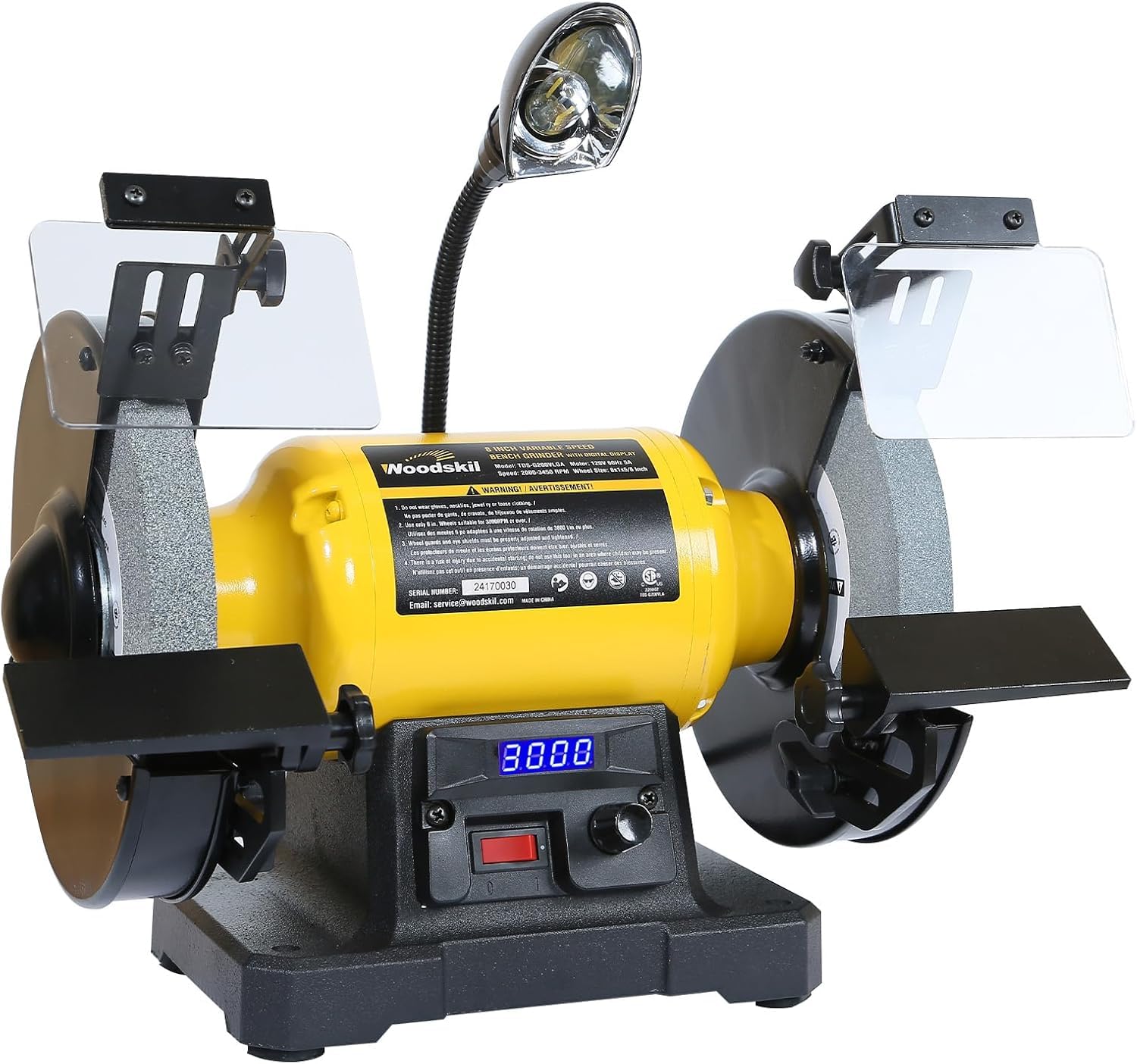
The only grinder here that tells you the exact RPM you are running, on a screen.
Set the dial and the display confirms your speed in real time. That feedback loop changes how you work — you stop guessing whether you are at a gentle 2000 RPM or pushing toward 3450 RPM, because the number is right there. Backed by a 5-amp, 3/4 HP motor, it holds that range across an 8-inch wheel.
Compare the motor to the WEN BG625V above and the gap is plain: 0.75 HP here against 0.4 HP there. More muscle on a bigger 8-inch wheel means it clears steel faster on heavy grinding jobs. The 8 × 1 × 5/8 inch wheel spec is the common bore size, so replacement wheels are easy to source. Non-slip rubber pads sit under a pre-drilled rigid steel base, which cuts the wobble you feel when you lean into a blade.
A built-in 2 W work light throws clear light on the workpiece, so you can see the burr forming instead of shading it with your hand. Quality and adjustable speed are what earn it its place, and the speed setting gets credit for running smooth. Reliability is the point to weigh honestly — a handful report early failure, so register the warranty and run it through a real session early rather than shelving it. The cast iron build and 0.75 HP motor are a lot of grinder for the mid-range tier.
Why the screen matters: real-time RPM readout takes the guesswork out of edge work, letting you repeat a good speed exactly instead of eyeballing it.
Fair warning: reliability is the mixed point — a few units fail early, so test yours thoroughly inside the return window.
Made for: someone who wants to see and repeat exact speeds on an 8-inch wheel with a 3/4 HP motor behind it.
Pass it by if: a live display is not worth the mixed reliability reports to you — the WEN BG625V trades the screen for a longer track record.
6. WEN BG4280 5-Amp 8-Inch Variable Speed Bench Grinder

An 8-inch grinder with an onboard water tray so a long session does not cook your steel.
Heat is the enemy of a good edge, and this WEN answers it directly. It runs a 5-amp motor from 2000 to 3400 RPM, so slow speeds keep precision and high speeds remove material fast.
Two things set it apart from its smaller sibling above. First, the 8-inch wheels: a bigger wheel curves more gently, so you get a flatter grind than a 6-inch can produce. Second, the adjustable eye guards carry built-in LED lights, which keep the work lit without a separate lamp. Add the flexible work light and you have light from two directions.
Build quality is what people rave about, and the value lands right behind it. The honesty sits in the vibration and noise reports — some units run smooth and quiet, others rattle and hum more than you would like. At 41 pounds it is heavy enough to resist walk, so a solid base helps here. Set it on a firm bench, check the wheel balance on arrival, and this becomes the anchor of a serious grinding corner.
What makes it a premium choice
- Onboard quenching tray cools workpieces during long grinding sessions
- Adjustable eye guards with built-in LED lights
- 8-inch wheels cut a flatter grind than smaller wheels
- 2000–3400 RPM range for precision at the low end and fast removal at the high end
- 41-pound base resists bench walk on heavy passes
The fine print
- Vibration and noise vary unit to unit — some are noticeably rougher
- Heavy at 41 pounds, so it is a fixed bench machine, not one to move around
Choose it for: long grinding sessions where you need to cool steel mid-cut and want twin light on the work.
Skip the upgrade if: you grind in short bursts — the 6-inch WEN above covers light jobs with the same speed range.
7. VEVOR 30 x 1-Inch Variable Speed Belt Grinder with VFD

A belt sander that runs flat or circular, built around the 1 x 30 inch belt knife makers live on.
If grinding is only half your job and you also want to shape, deburr, and polish, a belt is the tool that does all three. The VEVOR runs a 550 W pure copper motor at 5500 RPM with a VFD — the variable frequency drive that gives you a smooth speed dial instead of hard steps. You get circular and flat grinding modes, so the same machine handles contour work and flat bevels.
It ships with three sanding belts in 100, 180, and 240 grit, so you can step from coarse material removal to a fine finish without hunting for belts first. The 1 x 30 inch belt size is common, which keeps replacement belts easy to find. A detachable workbench and a reinforced steel body let you use it vertically or horizontally, depending on the angle you need.
Quality is what gets praised most here, with functionality right behind it, and knife making is named again and again as the job it nails. There is a practical edge to the economics too: 1 x 30 belts run far cheaper than the 2 x 72 belts serious grinders use. That keeps your consumable bill down as you learn. Belt tracking and adjustable setups do take some dialing in, so expect an hour of tuning before the first clean pass.
The knife-maker’s case: two grinding modes plus 100/180/240 grit belts give you a full progression from shaping to finishing in one machine.
Where it needs setup: belt tracking and adjustment take patience; plan on tuning it before you trust it with a blade.
Best for: a knife maker or metalworker who shapes, deburrs, and polishes and wants belt economics on their side.
Not for: someone who only needs to touch up a chisel every few months — a compact buffer handles that with less setup.
8. BUCKTOOL 10″ Wet Sharpening System

Slow, wet, and water-cooled — the grinder that sharpens without taking the temper out of steel.
This is the slowest machine on the list by a mile, and that is the point. A 1.2-amp, 1/5 HP motor turns at just 90 to 160 RPM, so the wheel creeps around and the water tray keeps the tool cool the whole time. Steel never overheats, so a high-end chisel keeps its edge and its hardness after a pass. No dry grinder here can match that gentle touch.
The 10-inch aluminum oxide sharpening wheel removes steel, and an 8-inch leather stropping wheel polishes and finishes the edge afterwards. A two-position jig adjusts both horizontal and vertical so you cut tools at the right angle every time. A reverse switch flips rotation by pushing the power switch up or down, which helps on carving gouges and other tools with awkward angles.
Sharpening chisels, axes, gouges, cleavers, scissors, and scythes all fall within its reach — this is the tool for a woodworker with a drawer full of dull edges. Quality and performance draw the praise, and it gets called out for holding up against pricier models. The honest side: wheel wobble and ease of use are the mixed points, so plan a true-up on arrival and give yourself a practice tool before you commit a good chisel to the wheel.
The reason to own it: water cooling at 90–160 RPM protects steel that a fast dry grinder would scorch, which matters most on high-end chisels and carving tools.
The catch: wobble on the wheel and a learning curve on setup mean you should check it carefully before trusting it with a prized blade.
Reserve a spot for it if: you sharpen woodworking chisels, gouges, or knives and care more about a cool, undamaged edge than speed.
Keep looking if: you want to remove lots of steel fast — 90–160 RPM is deliberately slow, not a material hog.
9. Shop Fox W1840 Grinder

A full-size 8-inch induction grinder with dual wheels and adjustable rests, built to run for years.
An induction motor runs quieter and longer than a universal motor, which suits a tool built to stay on the bench. This one carries a 3/4 HP induction motor spinning from 2000 to 3400 RPM, and it comes with dual 8-inch aluminum-oxide grinding wheels. Dual wheels mean a coarse side and a finer side without a swap mid-job.
The 5/8-inch wheel bore is a common size, so replacement wheels are easy to find. Dual adjustable aluminum work rests let you set a stable platform at each end, which makes holding a chisel at a consistent angle far easier than freehand. A work light sits on the machine to keep the wheel and the edge visible while you grind.
Compare it to the Woodskil at 0.75 HP: both run a 3/4-class motor, but the Shop Fox uses an induction design and dual 8-inch wheels instead of a digital screen. The 40-pound weight keeps it steady through heavy passes. Budget and quality get split verdicts, so weigh it on the spec rather than the reviews alone — this is the largest, steadiest station in the lineup, backed by a two-year warranty.
Why it earns a spot: dual 8-inch wheels on an induction motor give you two grits ready at once and a machine built for long shop life.
What to plan for: verdicts on build are mixed and it is a 40-pound fixture, so set it on a dedicated bench rather than a movable one.
Worth a look if: you want a full-size dual-wheel grinding station with an induction motor and adjustable rests, and you have bench space to spare.
The lesser fit: a cramped workshop or a buyer who wants a digital readout — the Woodskil above is smaller and shows the RPM on screen.
Know the Specs
RPM Range and the Low End
RPM (revolutions per minute) is how fast the wheel spins. A wide range — say 2000 to 3400 on a bench grinder, or 1750 to 10000 on a buffer — means you can go slow for precision and fast for removing metal. The low number matters more than buyers expect: a slow wheel is what keeps a knife edge from overheating and losing its temper. Wet sharpeners go even lower, down to 90 to 160 RPM, because water and a slow wheel protect the steel completely.
Motor Power: Watts and Horsepower
Power tells you how much resistance the motor can push through. It shows up two ways — watts on smaller buffers (320 W, 350 W, 550 W) and horsepower on bench grinders (0.4 hp, 0.75 hp). More power spins a bigger wheel without bogging down when you lean into it. A 3/4 HP grinder clears steel faster than a 0.4 HP one, while a compact 200 W polisher relies on a light touch. Match the power to the job, not the biggest number.
Wheel Size and Bore
Wheel diameter sets the contact curve. An 8-inch wheel grinds flatter than a 6-inch, and a 4-inch buffer wheel is made for detail work on jewelry and small parts. The bore is the center hole — written like 5/8 inch on this list — and it must match your arbor or the wheel will not mount. Check the bore before you buy if you plan to swap wheels for different grits.
VFD and Two-Way Rotation
A VFD (variable frequency drive — a control that lets a motor spin smoothly across its whole speed range instead of in fixed steps) makes speed changes smooth on a belt grinder. Two-way rotation, found on a wet sharpener, lets you reverse the wheel direction so you can sharpen from a different angle. That helps on gouges and carving tools where the edge faces an awkward way.
Common Questions
What is the difference between a variable speed grinder and a fixed speed one?
Can a variable speed buffer sharpen a knife, or is it only for polishing?
How slow should a grinder go for knife sharpening?
Will an 8-inch grinder wheel fit the same arbor as a 6-inch one?
Is a belt grinder better than a bench grinder for knife making?
Do I need to bolt a compact polisher down to use it safely?
What does VFD mean on a belt grinder?
Can a wet sharpener handle everyday tool maintenance?
How do I stop my grinder from shaking or walking across the bench?
The Bottom Line
For most buyers, the best variable speed grinder is the OPAVIOC Jewelry Polisher. Its 1750 to 8500 RPM range covers polishing, rust removal, and metal cleanup on one compact machine. It ships with wheels and compound included, so you can start work without buying extras. Buyers back it too: 4.5+ stars across 400+ ratings, the highest score among the picks here. If you want a true bench grinder for reviving knives and blades, reach for the WEN BG625V. And for the woodworker with a drawer full of dull chisels, the slow, water-cooled BUCKTOOL wet sharpener protects steel instead of scorching it.
How we choose
We do not accept paid placement. Every pick is matched to a real buyer and a real use-case; we do not hands-on test units.
Sources
Specifications: manufacturer listings and product documentation. Review insights: verified customer reviews, as of November 2026. Pricing: not shown on this page (it changes often); check the current price via the retailer link.
As an Amazon Associate, Tactical Gear Guy earns from qualifying purchases. This does not affect which products we feature.