Specs are compiled from manufacturer listings and verified buyer reviews and can change over time — please confirm the key details on the product page before buying.
Most boat speakers die the same way: sun bakes the cone, salt spray eats the terminals, and one season later you are listening to a rattle instead of a song. So the real question is not which speaker sounds best on a showroom shelf — it is which one survives a wet, salty, sun-blasted deck and still plays loud enough to beat engine noise. The Polk Audio DB692 has been the crowd favorite here — 4.5+ stars across 900+ ratings — because it pairs a 6×9 woofer with a genuine marine certification rating. Below you get every pick sorted by what actually matters on the water.
This guide is built by comparing the manufacturers’ published specifications and the patterns across verified customer reviews, so you get each pick’s real strengths and trade-offs instead of marketing spin.
You will see how waterproof ratings, driver size, and power handling translate into real life on the water, and we name the fit traps before you cut a hole. This breakdown of the best Speakers for Boats covers salt-fog testing, mounting depth, and cone materials in plain English.
Top Picks


How To Choose The Best Speakers for Boats
Here is the short version: pick a speaker whose waterproof rating, mounting depth, and cone material all match your boat before you worry about wattage. A 500-watt peak number means nothing if salt chews the basket in one summer. Work through these four checks and you will land on the right pair.
Start with the marine rating, not the power number
A marine rating like IP56 or IP66 tells you how well the housing keeps out water and dust. The Polk DB692 and DB402 both carry IP56 certification, which means they are protected against dust and against powerful water jets. The BELVA BBMS8W goes higher at IP66, which adds stronger protection against water ingress. Look also for salt-fog, UV, and humidity testing in the listing — those are the three things that actually kill boat speakers over time.
Match the driver size to your cutout
A 6.5-inch speaker is the most common factory boat size, so it is usually a straight swap. An 8-inch driver like the BELVA BBMS8W or the Pioneer TS-MR2040 moves more air for deeper bass, but it needs a bigger hole — the BELVA calls for a 6.89-inch cutout and a top-mount depth of 3.54 inches. Measure your existing openings and available clearance behind the panel before ordering. A 4-inch speaker such as the Polk DB402 suits tight spots and small pods where a bigger cone simply will not fit.
Read RMS power, not peak power
Peak power is a brief maximum burst. RMS power is what a speaker handles continuously, and it is the number to compare against your amplifier. The JBL unit runs 60 watts RMS (180 peak). The Rockford Fosgate M0-65B handles 65 watts RMS and 250 watts max. The Polk DB692 runs 150 watts RMS with 450 watts peak. Match your amp’s real output to the RMS figure and you get clean sound without cooking the voice coil.
Check the cone and surround materials
Polypropylene cones and rubber surrounds are the marine standard because they resist water absorption and cracking. The BELVA uses a polypropylene cone, a rubber surround, and an injection-molded rust-resistant polymer basket. The Rockford Fosgate M0-65B adds corrosion-resistant and UV-resistant construction on top of its waterproof rating. Stainless steel mounting hardware, which the BELVA and Pioneer both include, saves you from rusted screws a year down the line.
Side-by-Side Comparison
| Model | Best For | Driver Size | Power Handling | Marine Rating | Amazon |
|---|---|---|---|---|---|
| Polk Audio DB692★ Best Overall | Overall sound and durability | 6×9 in | 150W RMS / 450W peak | IP56 | Amazon |
| Polk Audio DB402Compact Pick | Tight spaces and small pods | 4 in | 45W RMS / 135W peak | IP56 | Amazon |
| BELVA BBMS8WMost Powerful | Max volume and bass | 8 in | 250W RMS / 500W peak | IP66 | Amazon |
| Pioneer TS-MR1600 | Factory-fit replacement | 6.5 in | 25W RMS / 100W max | Water resistant | Amazon |
| BOSS Audio MR6B | Covering four positions at once | 6.5 in | 180W per pair (360W per 2 pair) | Waterproof | Amazon |
| Rockford Fosgate M0-65B | Loud, clean output at speed | 6.5 in | 65W RMS / 250W max | Element Ready (water, salt, dust, UV) | Amazon |
| Wet Sounds Recon 6-S | Custom tuning and imaging | 6.5 in | 150W RMS | UV and salt-water resistant | Amazon |
| JBL 6-1/2″ Marine Speaker | Cutting through wind and engine roar | 6.5 in | 60W RMS / 180W peak | IPx5 | Amazon |
| Pioneer TS-MR2040 | Big-cone bass upgrade | 8 in | 40W RMS / 200W max | Water resistant | Amazon |
Detailed Reviews
1. Polk Audio DB692 Coaxial Marine 6×9 Speaker
Our pick — 4.5+★ from 950+ verified ratings; the strongest balance of quality and price.
A 6×9 marine coaxial rated 150W RMS and IP56, with owners reporting years of service.
If you can fit a 6×9 opening, this is the pair to beat. It handles 150 watts RMS and 450 watts peak, which is enough headroom that you are never pushing the driver near its limit at a normal listening volume. The built-in crossover sends highs and lows to the right drivers, so the bass stays loud and the tweeter stays clean.
The marine spec is the part that earns it first place. Polk certifies this speaker to IP56, meaning it is protected against dust and powerful water jets, and the coated steel baskets are tested for salt-fog, UV, and humidity. Polk’s Dynamic Balance process uses laser imaging to match cone materials so the response stays distortion-free across a wide spread. It also runs a 30-22kHz frequency response, a wider low-end reach than the Polk DB402 at 60-22kHz, so kick drums and bass lines come through with more weight.
What wins people over is the sound itself, and the fit is forgiving enough for most custom builds. Owners routinely describe these as sounding like there is a subwoofer aboard. The honest caveat: a small number of buyers hear distortion when they push the volume hard, which usually points to an underpowered amp rather than the speaker. Give it clean RMS power and it behaves.
Why it earns the top slot
- 150W RMS and 450W peak gives you real headroom before distortion
- IP56 certification plus salt-fog, UV, and humidity testing
- Built-in crossover splits highs and lows for cleaner output
- 30-22kHz response reaches lower than the 4-inch Polk model
Where it asks something of you
- Needs a 6×9 opening, so it is not a drop-in swap for round 6.5-inch cutouts
- Underpowered amps can produce audible distortion at high volume
Go this way: You have 6×9 openings and want the best balance of bass, durability, and marine protection on this list.
Think twice: Your boat only accepts round 6.5-inch drivers — the Polk DB402 or Rockford Fosgate fit that hole.
2. Polk Audio DB402 4 Inch Marine Coaxial Speakers
The little Polk that slides into pods and panels a 6.5-inch driver cannot reach.
Small pods, tight console panels, motorcycle fairings — the places where a full-size driver simply will not go are exactly where this 4-inch speaker lives. It handles 45 watts RMS and 135 watts peak at 4-ohm impedance, which is modest but plenty for near-field listening on a small craft.
It shares the Polk marine DNA with the DB692 above: IP56 certification, coated steel baskets, and testing against salt-fog, UV, and humidity. The polypropylene cone and rubber surround resist water the same way. Its frequency response runs 60-22kHz — noticeably narrower at the bottom than the DB692’s 30-22kHz, so expect clear mids and highs rather than deep thump.
The fit is the standout. Buyers report the factory speaker covers on a Goldwing fit straight over these with ease, which is the kind of drop-in match that saves a whole afternoon. Sound comes across as crisp with warm bass and clean highs, and the price-to-performance read is strong for a certified marine driver. Just size your expectations: a 4-inch cone moves less air than a 6×9, so this is a clarity play, not a bass play.
Where it shines: Tight mounting locations and factory-cover swaps — the small frame fits where bigger drivers cannot, without giving up IP56 protection.
Made for: Small boats, pods, and fairings that need clear sound from a compact frame.
Look elsewhere if: You want deep low-end punch — step up to a 6×9 or 8-inch driver.
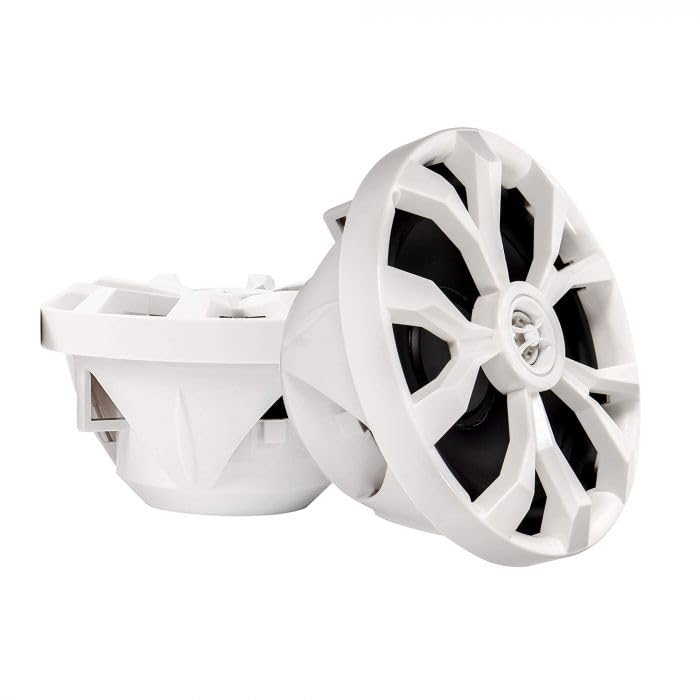
3. BELVA BBMS8W 8″ 2-Way White Coaxial Marine Speakers
Loud enough to be heard across open water, with the highest water rating here.
The number that matters most on this pair is 250 watts RMS — ten times the Pioneer TS-MR1600’s 25 watts RMS. Peak power runs 500 watts against the Pioneer’s 100 watts. If you are running an amplifier and want volume that carries over engine noise and wind, this is the biggest hammer on the list.
Spray and rain stay out of this one better than any other pick here, thanks to its IP66 rating (a water-and-dust protection score where the second 6 means it shrugs off powerful water jets). That beats the IP56 rating on both Polk models. The basket (the frame that holds the speaker) is injection-molded rust-resistant polymer, the cone is polypropylene, and the surround is rubber, so salt and sun have less to attack. It also ships with stainless steel mounting hardware and grilles, so the screws won’t rust in place. The 1-inch PEI balanced dome tweeter (the small dome that handles high notes) and 1.2-inch aluminum voice coil cover a 55-20000 Hz range at 90 dB sensitivity (how loud it plays per watt), so vocals and horns come through clearly over engine noise.
Here is the catch, and it is a sizing one: this is an 8-inch driver that several buyers describe as oversized for 6.5-inch openings. It needs a 6.89-inch cutout and 3.54 inches of top-mount depth, so measure before you commit. The output itself gets loud, crisp, and holds together at high volume — the only question is whether your boat has room for it.
The volume story: At 250 watts RMS it simply out-muscles every other pick, so amplified systems have room to spare.
The measuring tape warning: Confirm a 6.89-inch cutout and 3.54-inch depth before ordering — this cone is bigger than the badge suggests.
Pick it when: You have amplifier power and physical space for a bigger hole.
Pass if: Your cutouts are standard 6.5-inch and you cannot enlarge them.
4. PIONEER TS-MR1600 6.5″ Marine Speakers for Boats 100W Max

Unscrew the old ones, screw these in, done — no cutting required.
For anyone replacing tired factory speakers on a pontoon or runabout, the appeal here is dead simple: these drop into the original openings. Owners mention they fit perfectly in a boat’s existing speaker holes. The install is a screwdriver job — pull the old drivers, seat the new ones, tighten the included stainless steel screws and speed clips.
You get 100 watts max and 25 watts RMS (the continuous power it can take hour after hour), the lowest continuous figure in this guide. That is the honest limit: power these from a head unit or a modest amp, not a big amplifier, and they will do the job. The 6.5-inch two-way coaxial design (a woofer and tweeter built as one unit) is described by Pioneer as delivering fuller sound and more bass than standard boat speakers. Water-resistant materials, UV protection, and corrosion-resistant parts help it handle sun and spray.
Clean mids and crisp highs are the consistent report, and they play well with most marine stereos, amps, and head units. Think of these as the practical, no-drama upgrade rather than a volume monster.
What makes the job easy
- Fits existing 6.5-inch factory openings without modification
- Stainless steel screws and speed clips included
- Works with most marine head units and amplifiers
What to plan around
- 25W RMS is modest — it is not built for a high-power amplified system
- Water-resistant rather than given a published IP number
Right call for: Straight factory replacements driving off a head unit.
Not your match if: You are building a loud amplified system — the BELVA or Polk DB692 carry far more continuous power.
5. BOSS Audio MR6B 6.5″ Marine Speakers 2 Pairs

Four speakers in one box — enough to cover the whole deck in a single order.
Most picks here come as a single pair. This one ships as two pairs, which is the practical answer if you have four positions to fill and do not want to buy twice. Each pair handles 180 watts, with 360 watts across the full set of two pairs. The 6.5-inch full-range driver uses a poly carbon cone and a Kapton voice coil.
Customers note hearing their music clearly over the engine, which is the real test on a boat. The look also lands well — buyers describe them as resembling original factory speakers, so a refit does not shout aftermarket. Installation is straightforward and the value per speaker is strong when you are covering multiple positions at once. The one honest note: durability feedback is split, so treat them as a solid working speaker rather than a buy-once-forever piece.
Why four beats two: Covering the bow, helm, and stern from one order is the whole point — and it costs less per position than buying pair by pair.
Built for: Boats with four speaker positions and a budget that needs to stretch across all of them.
Skip if: You want a single premium pair with long-term durability reports behind it.
6. Rockford Fosgate M0-65B 6.5″ Coaxial Speakers

Music you can still hear clearly at 50 mph with the wind roaring.
Rockford Fosgate built these for off-road and marine abuse, and the Element Ready design is the proof: it is rated to withstand water, salt, dust, and UV rays. That covers all four things that wreck a boat speaker. The grille-integrated LCP balanced dome tweeter handles the highs, while the low-end and mid-range reproduction gets the body of the music right.
It takes 65 watts RMS and 250 watts max at 4-ohm impedance (the electrical load it presents to your amp), with a 6dB/Octave internal crossover (a filter that sends low notes to the woofer and high notes to the tweeter). Its two-year warranty is the longest published coverage in this guide. Reviewers point out hearing them clearly at 50 mph, which is exactly the wind-and-engine condition a boat speaker has to survive.
The fit is where you need to pay attention. Several buyers find them too large for their applications, and the numbers explain why: they need a 5.38-inch mounting hole, a 6.12-inch screw mounting diameter, and 2.52 inches of mounting depth. Measure those three figures before you order and the install goes smoothly.
Warranty confidence: Two years of coverage is the strongest published backing on this list, and Element Ready protection covers water, salt, dust, and UV in one design.
Your pick if: You want clean sound at speed and value a real warranty.
Check first: Confirm 5.38-inch hole and 2.52-inch depth — fit complaints trace straight back to undersized cutouts.
7. Wet Sounds Recon 6-S Marine Coaxial Speakers

A separate tweeter and woofer let you shape the sound, not just play it.
Most coaxial speakers mount the tweeter over the woofer. This one is component style, with the separate tweeter and woofer giving better sound separation and imaging, plus more room to tune. If you care about staging and want to dial in your boat’s audio, that design choice is the whole reason to pick it.
Bass you can feel comes from 150 watts RMS and a 40Hz-22kHz frequency response (how low and high a note it can play). That 40Hz bottom end is a genuinely deep low-end spec for a 6.5-inch marine driver. The composite cone and rubber surround are built for harsh marine environments, and the whole speaker is UV-resistant and salt-water resistant, so sun and salt spray won’t age it fast. A silver grille separates it visually from the black and white options here.
For a buyer who wants customization options and deep bass from a 6.5-inch frame, the spec sheet is compelling.
The imaging edge: Separate tweeter and woofer means real separation between highs and lows — closer to a component system than a stacked coaxial.
Suits you when: Tuning flexibility and sound staging matter more than a long review trail.
Hesitate if: You want plenty of owner history before you commit — the Polk picks have far more of it.
8. JBL 6-1/2″ Two-Way Marine Speaker

Tuned to punch through wind, spray, and a wide-open throttle.
JBL designed this pair specifically to cut through the roar of a boat under way. The sealed polypropylene cones and grille-mounted balanced dome tweeters deliver the smooth highs and deep lows the brand is known for. Power handling is 60 watts RMS and 180 watts peak, with 90 dB sensitivity at 2.83 volts — high sensitivity means it gets loud without demanding a huge amp.
The marine build holds up to sun, spray, salt, and temperature swings. It carries an IPx5 rating, which means protection against water jets, and the one-piece polymer baskets, rubber surrounds, and UV-resistant grilles are all chosen for that job. The frequency response runs 60-20,000 Hz at 4-ohm impedance. A one-year manufacturer warranty backs it.
Sound quality is the clear strength here — the kind of clarity that stays clean even at volume. The trade-off is a shorter review history than the top Polk and Pioneer picks, so you are trusting JBL’s marine engineering rather than hundreds of long-term reports. The included wiring harnesses with tinned wire and stainless hardware make the install cleaner than most.
Sensitivity pays off: At 90 dB the speaker reaches high volume without needing a monster amplifier behind it.
Choose this for: Loud, clear music at speed when you would rather not add a big amp.
Another route: If long-term owner history matters more, the Polk DB692 has far more of it.
9. PIONEER TS-MR2040 8″ Marine Speakers for Boats 200W Max

An 8-inch cone that turns a plain stereo into something with real low end.
This Pioneer is the 8-inch sibling of the TS-MR1600 above, and the bigger cone moves more air for deeper bass. Pioneer describes the 8-inch design as delivering fuller sound and more bass than standard boat speakers. If bass response is the thing your current setup lacks, this is the direct fix.
Power handling runs 200 watts max with 40 watts RMS, a step up from the 100 watts max and 25 watts RMS of the smaller TS-MR1600. It uses the same water-resistant materials, UV protection, and corrosion-resistant components for sun and spray, and it works with most marine stereos, amps, and head units. Stainless steel machine screws and speed clips come in the box.
Owners describe the output as killer sound with crisp highs, and the install is a simple swap. The realistic caveat is the same as any 8-inch driver: it needs a bigger opening than a 6.5-inch, so confirm the cutout before you order. Run it off a modest amp and it is a warm, full upgrade rather than a volume monster.
The bass argument: Bigger cone, more air moved — this is the pick when the low end has been missing from your boat’s sound.
Right for you: Boats with room for an 8-inch cutout that need fuller bass.
Wrong fit if: Your openings are standard 6.5-inch — the TS-MR1600 drops in without modification.
Know the Specs
IP Ratings Explained
An IP rating tells you how well a speaker keeps out solids and liquids, and the two digits mean different things. In IP56, the 5 means protected against dust and the 6 means protected against powerful water jets. In IP66, both digits are 6, which adds stronger protection against water ingress. IPx5, which the JBL carries, means the dust figure is not rated but the water jet protection is a 5. On a boat, any of these is a meaningful bar to clear, and the listing’s salt-fog, UV, and humidity testing matters just as much for long-term survival.
RMS vs Peak Power
Peak power is a brief burst a speaker can survive. RMS power is what it handles continuously, and it is the number that should guide your amplifier match. The BELVA’s 250 watts RMS against the Pioneer TS-MR1600’s 25 watts RMS is a huge gap in how much clean power each one can take all day. Always match your amp’s real output to the RMS figure — that is what keeps the voice coil from overheating at volume.
Driver Size and Mounting Depth
A larger driver moves more air and produces more bass. The trade-off is that it needs a bigger hole and more clearance behind the panel. The BELVA 8-inch wants a 6.89-inch cutout and 3.54 inches of top-mount depth. The Rockford Fosgate 6.5-inch wants a 5.38-inch hole and 2.52 inches of depth. Measure both the cutout diameter and the free space behind the panel before ordering, because a driver that does not fit is a driver you cannot use.
Cone and Surround Materials
Polypropylene cones and rubber surrounds are the marine standard because they resist water absorption and cracking under UV. The BELVA pairs a polypropylene cone with a rubber surround and an injection-molded rust-resistant polymer basket. Stainless steel hardware, which the BELVA and both Pioneers include, saves you from rusted mounting screws a season later.
Common Questions
Will 6.5 inch marine speakers fit my existing boat cutouts?
What is the difference between IP56 and IP66 on boat speakers?
Do I need a separate amplifier for marine speakers?
Can I use car speakers on a boat instead of marine speakers?
How much power do I actually need for boat speakers?
Will an 8 inch speaker fit where a 6.5 inch one was?
What cone material holds up best in saltwater?
Do these marine speakers come with mounting hardware?
Is a 4 inch speaker enough for a small boat?
The Bottom Line
Want the best mix of sound, durability, and marine protection? The Polk Audio DB692 is the smart pick — 150 watts RMS, IP56, and a 30-22kHz response that beats the smaller Polk DB402’s 60-22kHz low end. Need to fill four positions without buying twice? Grab the BOSS Audio MR6B two-pair set. And if volume is the whole goal and you have amplifier power and room for a bigger cutout, the BELVA BBMS8W at 250 watts RMS and IP66 is the one to reach for.
How we choose
We do not accept paid placement. Every pick is matched to a real buyer and a real use-case; we do not hands-on test units.
Sources
Specifications: manufacturer listings and product documentation. Review insights: verified customer reviews, as of November 2026. Pricing: not shown on this page (it changes often); check the current price via the retailer link.
As an Amazon Associate, Tactical Gear Guy earns from qualifying purchases. This does not affect which products we feature.