Specs are compiled from manufacturer listings and verified buyer reviews and can change over time — please confirm the key details on the product page before buying.
You want your bike on the roof without scratches on the frame. That is the real problem with roof bike transport: a fork-mount (a carrier that bolts the bike on with the front wheel removed) makes you pull the front wheel off and stash it somewhere in the car. A clumsy upright rack can scuff a carbon frame or wobble at highway speed. An upright roof bike carrier grips the bike by its wheels and leaves the frame untouched, so loading takes seconds and the paint stays clean. Below are the real differences between the leading picks, so you can match one to your bike, your crossbars, and how often you drive with a bike up top.
This guide is built by comparing the manufacturers’ published specifications and the patterns across verified customer reviews, so you get each pick’s real strengths and trade-offs instead of marketing spin.
One note before you read: this list uses flexible matching for roof-mount carriers that attach to a vehicle roof rack, not a hitch or trunk. So not every pick here is the exact model you typed in, but the nearest same-type carrier serves the same purpose. Check three things: the load limit, the crossbar fit, and your wheel size. Do that, and the right upright roof bike carrier for your setup becomes obvious.
Top Picks


How To Choose The Best Upright Roof Bike Carrier
Buying an upright carrier is mostly about three numbers: your bike’s tire width, your car’s crossbar spread, and the carrier’s load limit. Get one wrong and you end up with a rack that sways, wobbles, or refuses to grab your wheels at speed. Here is what actually matters before you spend.
Fork mount versus upright wheel grip
A fork-mount carrier clamps the bike’s front fork after you remove the wheel, which holds the bike very rigidly but means carrying a loose wheel inside the car. An upright wheel-grip carrier holds the bike by its wheels with ratcheting straps or arms and never touches the frame. Upright designs suit carbon frames and riders who do not want to remove a wheel every trip; fork mounts suit riders who prefer a rock-solid, low-profile hold and do not mind a wheel in the trunk.
Check your crossbar spread and shape
Most upright carriers clamp to existing roof crossbars, so measure the distance between your two bars and match it to the carrier’s stated recommended center distance. Bar shape matters too — round, square, aero, and factory bars each need a different clamp or bolt setup, and some carriers ship with both T-bolts and U-bolts to cover them. A carrier that calls for a wider spread than your bars provide will not sit securely, no matter how good the straps are.
Match the tire width and wheel size
If you ride a mountain bike with wide tires or a fat bike, tire width becomes the deciding spec. Carriers in this class typically cap around 3 inches of tire width, with a few reaching 5 inches for fat bikes from the start or with an adapter. Wheel diameter ranges of 20 to 29 inches cover most road, gravel, and mountain bikes, so confirm your size falls inside the carrier’s listed window before you buy.
Side-by-Side Comparison
| Model | Best For | Load Capacity | Carrier Weight | Mount Style | Amazon |
|---|---|---|---|---|---|
| Yakima FrontLoader★ Best Overall | Sedans and SUVs without a hitch | 40 pounds | 18 pounds | Roof crossbars | Amazon |
| Swagman Standard Fork MountBudget Fork Mount | Budget fork-mount buyers | 35 pounds | 16 ounces | Roof crossbars | Amazon |
| Gathersky Dual-Arm Rooftop RackOne-Hand Loading | One-handed loading | 50 lb | 10.5 kg | U-Bolt / T-bolt | Amazon |
| TOOENJOY Rooftop Bike Rack | Road to mountain bike range | 44 pounds | 20 pounds | U-Bolt | Amazon |
| RockyMounts Tomahawk | Fat bikes up to 5″ tires | 35 lbs | 18 pounds | Roof crossbars | Amazon |
| Kuat Trio Fork Mount | Fork-mount versatility | 45 pounds | 7 pounds | Roof crossbars | Amazon |
| Thule ProRide XT | Frame-claw upright hold | 44 lbs | 11 pounds | Roof crossbars | Amazon |
| INNO Tire Hold II | Locking, frame-free carry | — | 16 pounds | Roof crossbars | Amazon |
| Thule UpRide | Carbon and odd frames | 44 lbs | 18.5 pounds | Roof crossbars | Amazon |
Detailed Reviews
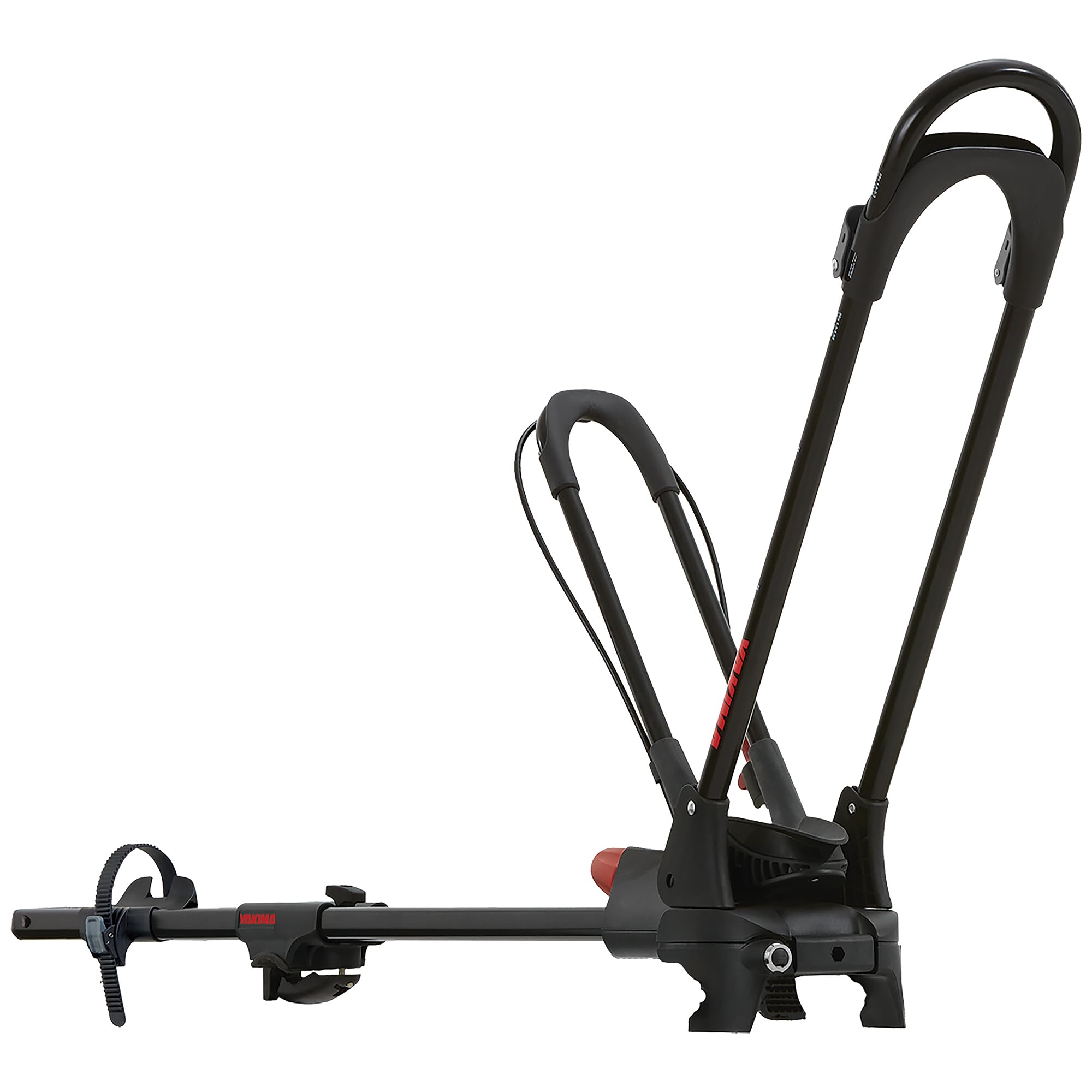
1. Yakima FrontLoader Rooftop Bike Rack
Our pick — 4.0+★ from 800+ verified ratings; the strongest balance of quality and price.
The no-hitch solution that turns a plain sedan or SUV into a bike hauler.
What makes the FrontLoader the pick of this list is simple: it carries your bike on the roof without a hitch and without removing the front wheel. It holds up to 40 pounds, weighs 18 pounds itself, and clamps to your existing roof crossbars. That matters because plenty of people drive a car that has no hitch at all, and a roof carrier sidesteps the whole receiver question. Setup needs no extra tools, and it folds down small when the bikes stay home.
The thing that wins buyers over is how little fuss the load position takes. You set the bike up onto the tray, drop the hook onto the front wheel, and secure it — no fork clamping, no frame contact. Buyers report the hook grips gravel and 29er front wheels firmly, and the clamps sit securely on roof rails with crossbars. A 40-pound limit covers most mountain and fat-tire bikes, and the compact design leaves room to add another carrier later.
The catch to know about is durability over the long haul. Some units have broken after extended use, so treat the moving parts with care and do not overload beyond the 40-pound figure. It is a fair trade for a rack that fits a hitchless car. If you haul a heavy e-bike, this is not the carrier for you. Skim the load math and the fit before you commit.
What earns its keep
- Roof-mounted with no hitch required, so it fits plain sedans and SUVs
- Holds bikes by the wheels with no front-wheel removal
- 40-pound capacity and 18-pound carrier weight for easy handling
- Folds compact for garage storage between trips
Where it asks for care
- Long-term durability of the moving parts is the recurring worry
- Not a match for heavier e-bikes above the 40-pound limit
Best fit: drivers with a hitchless car who want to load a mountain or gravel bike without pulling a wheel.
Look elsewhere if: you haul a heavy e-bike or want a carrier built for relentless abuse.
2. Swagman Standard Fork Mount Roof Bike Rack
A featherweight aluminum fork mount that assembles with no tools and gone in minutes.
Its whole reason to exist is simplicity at the lowest tier. It is a fork-mount design for 9mm quick-release bikes, built from aluminum and weighing just 16 ounces. Assembly needs no tools, and it mounts to most vehicle types and sizes. The 35-pound load limit puts it in the lighter-duty end, so it suits a road or gravel bike rather than a heavy mountain rig.
Versus the TOOENJOY above, the difference is both weight and capacity: this one carries 35 pounds where the TOOENJOY holds 44. One customer reports it kept their bike steady through a 2-hour trip, and its fork mount handles wide tires better than you might expect. A limited lifetime warranty backs it up, which is a reassuring touch at this end of the range.
Here is the honest limit: because it is a fork mount, you remove the front wheel before every ride and find room for it inside the car. That wheel juggling is the price of the low profile and rock-solid hold. If a wheel in the trunk does not bother you, it delivers a lot of carrier for the money. If it does, step up to an upright model.
The value read: the lightest carrier here at 16 ounces, with a 35-pound limit that suits road and gravel bikes and an assembly process that needs no tools.
The wheel catch: it is a fork mount, so the front wheel comes off each trip and rides inside the car.
Reach for this if: you want a lightweight, lower-tier fork mount for a 9mm quick-release bike and do not mind stowing the wheel.
Pass if: you want to keep both wheels on the bike at load time.
3. Upright Dual-Arm Rooftop Bike Carrier
Two pivoting arms grip the wheels and release with a single hand.
Two pivoting upright arms hold the bike firmly by the wheels, so no front wheel comes off and nothing touches the frame. The highest load limit on this list sits here, at 50 pounds. It fits most bikes up to 29-inch wheels with tires up to 3.1 inches wide and a wheelbase up to 48 inches. A ratchet lock releases the bike with one hand, and the arms fold down flat when empty for a lower profile in the garage.
what separates it is how many crossbar setups it fits. It takes a recommended center distance between 19.68 and 47.25 inches, so it spans most roof racks. It also fits crossbars up to 3.15 inches wide by 1.6 inches tall, and it ships with both T-bolts and U-bolts to cover round and square bars. Metal construction with a powder-coated finish helps it shrug off weather. For hauling a child’s bike on a long road trip, it does the job.
The fair caveat is sway. Stability is the mixed note here, with some reporting the bike moves more than they would like while driving. Load within the 50-pound limit, keep the wheelbase inside 48 inches, and take it easy on rough roads. If you want the most rigid possible hold on a heavy bike, a fork mount may suit you better. Otherwise this is a strong one-handed loader.
The arms story: dual pivoting arms grab wheels up to 3.1 inches wide and release with one hand, backed by a 50-pound limit.
The sway note: the mixed feedback lands on stability, so settle the bike firmly and keep speeds sensible.
Who it beats for: riders who want the highest load rating in this lineup and one-hand release at load time.
Skip if: you want the most rock-solid hold on a heavy downhill bike over rough roads.
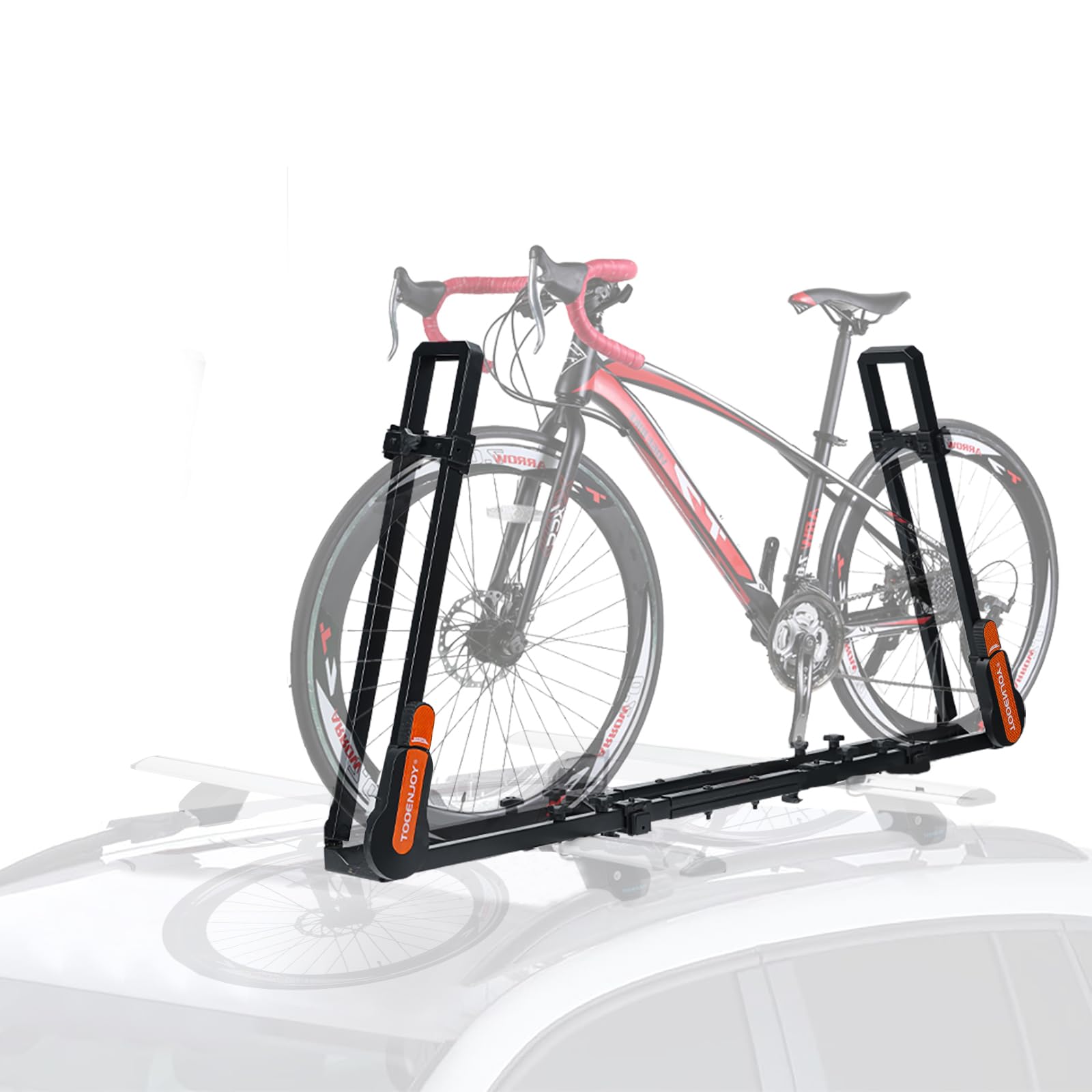
4. TOOENJOY Rooftop Bike Rack
A wide wheel-size window that covers road, gravel, and mountain bikes in one carrier.
Flexibility is the headline. Two rotatable load arms grip the bike by the wheels with zero frame contact, and the fit window reaches wheel sizes from 18 to 29 inches and tire widths up to 3.1 inches. That spread covers road bikes through mountain bikes without buying adapters. Dual ratchet locks hold front and rear wheels, and a single-hand release makes unloading quick. It supports up to 44 pounds per bike and weighs 20 pounds itself.
Installing it is where it earns its keep. The U-bolts mount easily to a roof rack, and the setup calls for a crossbar spacing of 29.76 inches for best performance. The sturdy black-coated metal frame and ABS components give it a solid feel. Driving under 60 miles per hour is advised, and for a double-bike install the maker asks for staggered positioning. Stack that against the Yakima’s 40-pound limit and this one carries 4 more pounds, though the Yakima reaches those racks with a different clamp design.
Functionality is the split point, with buyers divided between those who find it works great and others who hit snags. Pay close attention to the 29.76-inch spacing and the 60-mph guidance, and most of that risk shrinks. For a single bike across mixed wheel sizes, it is a practical mid-range choice. For a two-bike setup, expect to stagger them carefully.
The reasons it works
- Wide 18 to 29-inch wheel and 3.1-inch tire window
- 44-pound load with dual ratchet locks on both wheels
- Zero frame contact protects paint and carbon
What to watch
- Functionality feedback is split, so setup quality matters
- Needs a 29.76-inch crossbar spacing and sub-60mph driving
Go here for: one carrier that spans road to mountain bikes with a generous wheel-size range.
Think twice if: your crossbars sit far from the recommended 29.76-inch spacing.
5. RockyMounts Tomahawk upright roof bike rack

Fat bikes fit right from the start — no adapter purchase required.
Most upright carriers top out around 3 inches of tire width. The Tomahawk takes up to 5-inch tires as standard, and it includes two wheel strap extensions for the job. It holds all bike styles with 20 to 29-inch wheels except those with front fenders. No frame contact — you ratchet the hook over the front wheel and secure front and rear wheel straps. It supports 35 pounds, weighs 18 pounds, and is built from aluminum.
Where it differs from the Gathersky is footprint and mounting. Its dimensions run 3.46 by 37.99 by 12.99 inches, a fraction of the TOOENJOY’s 59 by 6.3 by 5.9-inch span, so it packs into a tighter box. The swingarm adjusts for driver-side or passenger-side install, and it mounts to round, square, factory, and aero crossbars. A limited lifetime warranty covers it. Owners praise how solidly the ratcheting hook holds a bike, with 27.5+ mountain bikes and 2.5-inch tires fitting cleanly.
Stability is the honest caveat, with a mix of feedback on how much movement you feel at speed. A few also note durability concerns over time. Set the straps snug, keep loads within 35 pounds, and it behaves well. For fat-bike riders who do not want to buy a separate adapter, that 5-inch width is the whole reason to pick it.
Fat-bike fit: 5-inch tires from the start, with strap extensions included and a swingarm that flips for either side of the car.
The honest catch: stability splits opinion and durability gets occasional notes, so strap it tight and mind the 35-pound limit.
Made for: fat-bike and plus-tire riders who want a 5-inch-ready upright carrier straight from the box.
Not ideal if: you ride a bike with front fenders, which this rack does not accommodate.
6. Kuat Trio Fork Mount Carrier

A 7-pound fork mount that handles four axle standards and locks the bike down.
The Trio leads on axle adaptability. A 3-way mount system fits 9mm, 12mm, 15mm, and 20mm forks, so it handles road, mountain, and fat bikes with an optional adapter kit. It comes with 9×100, 15×100, and 15×110 adapters in the box. At 7 pounds it is by far the lightest carrier here, which makes lifting it onto the roof a one-person job. It carries up to 45 pounds.
Security earns its place too. An integrated cable lock secures both the frame and the rear wheel, and a sliding rear tire strap holds the back wheel steady to cut wobble. The low-profile aerodynamic shape keeps wind resistance down on the highway. It clamps crossbars up to 3.5 inches wide by 1.5 inches thick, and a limited lifetime warranty handles the long haul. Buyers call the aluminum build well-made and like its low-profile look on the roof.
Stability is the one mixed signal, with reports of the magnetic locking mechanism causing trouble for some. Test the lock engagement before each trip and the risk stays small. Because it is a fork mount, the front wheel still comes off. For a light, versatile carrier across multiple axle types, this one stands out.
Where it shines
- 7 pounds — the lightest carrier in this lineup
- 3-way mount fits 9mm, 12mm, 15mm, and 20mm forks
- Integrated cable lock secures frame and rear wheel
- 45-pound load capacity across crossbars up to 3.5″ wide
The honest trade-offs
- Fork mount means removing the front wheel each trip
- The magnetic locking mechanism is the weak link for some
Worth it for: riders switching between axle standards who want the lightest, easiest-to-lift carrier here.
Checks to make: confirm your fork size and give the integrated lock a firm test each time.
7. Thule ProRide XT Roof Bike Rack

The frame-claw upright that grips the bike’s frame softly but firmly.
The ProRide XT takes a different approach to upright carrying: it holds the bike by the frame with soft claw pads instead of the wheels. A quick-mounting dial controls how much force goes into the frame, so you can dial in grip without crushing the tubes. The frame holder and wheel tray position the bike automatically as you tighten it, and diagonal quick-release straps lock the wheel holders in place. It carries up to 44 pounds and weighs 11 pounds.
Versatility is the draw. It mounts to all Thule rack systems and most factory racks, and the carrier switches easily from one side of the vehicle to the other. Its footprint runs 58 by 13.5 by 4 inches, giving it a long, low profile that keeps wind noise down. Owners mention the claw and wheel tray install easily and hold bikes securely, with the ratcheting wheel straps providing a firm grip. The claw-pad design still touches the frame, so it is not a no-contact carrier like the wheel-grip picks.
You will want locks if security matters, since they are sold separately here. Some customers note a lot of wobble, and ease of use and adjustability split opinion. That makes it a fit for someone who wants frame-held upright support and trusts the pad system. For carbon frames, double-check the pad pressure. The dial helps you keep it gentle.
Why it holds: soft claw pads and a force-control dial grip the frame gently, with a 44-pound limit and automatic wheel-tray positioning.
Not for everyone: the claws touch the frame and locks cost extra, so no-contact purists and security-first buyers should weigh it against the wheel-grip picks.
Best for: riders who like frame-held support with adjustable clamp force on a 44-pound-capable carrier.
Hold off if: you want zero frame contact or need a lock included at purchase.
8. INNO INA389 Roof Rack

The rare upright that ships with a key, a lock, and a locking cable included.
Security is where the Tire Hold II earns attention. A key, lock, and locking bike cable all come in the box, which is unusual in this category where locks often cost extra. It secures the bike without touching the frame or cable brake systems. The rear ratcheting arm locks the bike into position and folds away when empty. A newly improved tire size adjuster means faster adjustments with no tools needed.
Its tire window covers 20, 22 to 24, 26 to 27.5, 700c, and 29-inch sizes with a max tire width of 2.7 inches. That is tighter than the 3-inch carriers, so measure your rubber first. The universal mounting system fits aero, square, round, and most factory crossbars, and it weighs 16 pounds. Buyers call the included key-and-cable lock ingenious, report the ratcheting rear arm holds bikes securely, and find loading and unloading easy.
The one split point is fit, where buyer opinion lands mixed. That usually depends on a crossbar or tire mismatch, so check your bar shape and the 2.7-inch tire limit before you buy. A limited lifetime warranty backs it. If included security and no-contact carrying matter most to you, this is a quietly smart pick. Fat bikes and wide tires, though, will want one of the wider carriers.
The security edge: a key, lock, and locking cable come included, paired with a frame-free hold and a tool-free tire adjuster.
The width check: the 2.7-inch max tire width and fit feedback mean you should confirm your tires and bars match.
For you if: you want a no-contact carrier with locks included from the start and standard-width tires.
Not the one if: you run wide or fat tires beyond 2.7 inches.
9. Thule UpRide Roof Bike Rack

Built for carbon frames and odd bike shapes that hate being clamped.
This one makes a promise the frame-claw racks cannot: no frame contact at all. A ratcheting wheel strap and secure hook hold the bike by its wheels, which suits carbon frames, rear-suspension builds, bottle cages, and non-traditional designs. It fits most bikes with 20 to 29-inch wheels and tires up to 3 inches wide, reaching 5 inches with the Thule UpRide Fat Bike Adapter sold separately. It carries 44 pounds and weighs 18.5 pounds.
Speed of loading is its strength. It switches easily from one side of the vehicle to the other, and it mounts to all Thule rack systems and most factory racks. Its 64 by 13 by 4.3-inch frame keeps the profile low. That no-contact hold is the reason someone with an expensive carbon build picks it over a claw design.
The sticking point is the locking mechanism, where the front lock draws mixed-to-negative feedback. Locks are sold separately, so plan for that if security matters. Set the wheel straps properly and the hold stays firm. For a carbon frame or a bike with unusual geometry, the no-contact design is worth the extra care at load-up.
Where it delivers
- Zero frame contact — ideal for carbon frames and rear suspension
- Fits 20 to 29-inch wheels, up to 3-inch tires, 5-inch with adapter
- 44-pound capacity with quick sub-minute loading
What to plan around
- The front locking mechanism draws mixed reports
- Locks are sold separately, and fat-tire use needs the adapter
Pick it when: your bike is carbon, has rear suspension, or an unusual frame that should never be clamped.
Plan for: adding locks separately and checking the front lock holds firm.
Know the Specs
Load capacity
This is the maximum weight of one bike the carrier can hold, written in pounds. It matters because it decides whether your bike is safe at highway speed — a heavier downhill or e-bike needs a higher figure than a road bike. Carriers here range from 35 to 50 pounds, so weigh your bike and leave headroom. Exceeding the limit is where sway and stress on the parts begin.
Tire width and wheel size
These two numbers decide which bikes physically fit. Tire width caps how fat a tire the straps or trays can hold, and wheel size sets the range of diameters. A carrier built for 3-inch tires will not grip a fat bike’s 5-inch tire without an adapter. Check both numbers against your bike before buying, not after.
Crossbar spread and clamp type
Upright carriers clamp onto your roof crossbars, so the distance between the bars and their shape both matter. Some call for a specific recommended center distance, and the clamps suit round, square, aero, or factory bars. A carrier that ships with both T-bolts and U-bolts covers more bar styles. Measure your spread and note your bar shape to avoid a mismatch.
Fork mount versus upright wheel grip
A fork mount clamps the front fork after removing the wheel and needs the axle standard to match. An upright wheel grip holds the bike by its wheels and keeps the frame untouched. Fork mounts tend to be lighter and more rigid; upright grips are quicker to load and kinder to carbon frames. Choose based on whether you mind stowing a wheel inside the car.
Common Questions
Will an upright roof bike carrier scratch my carbon frame?
Can I carry a fat bike on an upright roof rack?
Do I need to remove the front wheel with an upright carrier?
How do I know if my crossbars will fit the carrier?
Is a fork mount stronger than an upright carrier?
What speed is safe to drive with a roof bike carrier loaded?
Can I mount more than one bike with these carriers?
Are the locks included or sold separately?
Do upright roof carriers work on factory roof rails?
Will a roof carrier fit a bike with front fenders?
The Bottom Line
For the widest range of drivers, start with the upright roof bike carrier that skips the hitch, keeps the front wheel on, and folds away small: the Yakima FrontLoader. That combination suits plain sedans and SUVs alike. If you want the highest load rating in this lineup, the Gathersky dual-arm rack carries 50 pounds and releases one-handed. For carbon frames or fat tires, the Thule UpRide and the RockyMounts Tomahawk each solve a specific fit problem the others cannot. Whatever you choose, match the load limit, tire width, and crossbar spread to your own setup before you buy.
How we choose
We do not accept paid placement. Every pick is matched to a real buyer and a real use-case; we do not hands-on test units.
Sources
Specifications: manufacturer listings and product documentation. Review insights: verified customer reviews, as of November 2026. Pricing: not shown on this page (it changes often); check the current price via the retailer link.
As an Amazon Associate, Tactical Gear Guy earns from qualifying purchases. This does not affect which products we feature.