Specs are compiled from manufacturer listings and verified buyer reviews and can change over time — please confirm the key details on the product page before buying.
Most people buy a jigsaw for one job — a sink cutout, a curved shelf bracket, a mailbox post notch — and then discover the tool fights them on every turn. The fix is not a bigger motor — it is the handle, the orbital setting, and the blade shank. It is matching the handle style, the orbital settings, and the blade shank to the cuts you actually make. Get those three right and a mid-range saw tracks a pencil line through a curve.
This guide is built by comparing the manufacturers’ published specifications and the patterns across verified customer reviews, so you get each pick’s real strengths and trade-offs instead of marketing spin.
Below you will find top-handle and D-handle saws, corded and cordless options, and a clear read on which one suits curved work versus straight bevels. Every pick here is backed by published specs and verified owner reviews, not a marketing badge. These are the Types of Jigsaws that hold a line and hold up.
Top Picks


How To Choose The Best Types of Jigsaws
A jigsaw is the one power saw that cuts a shape instead of a straight line. That is its whole job, and it is why the wrong saw frustrates: a saw that wanders on a curve is usually set up wrong, not underpowered. The list below covers saws built for two very different buyers: the person cutting curves in a garage and the person cutting sheet goods all day on a site.
Start with the handle, not the motor
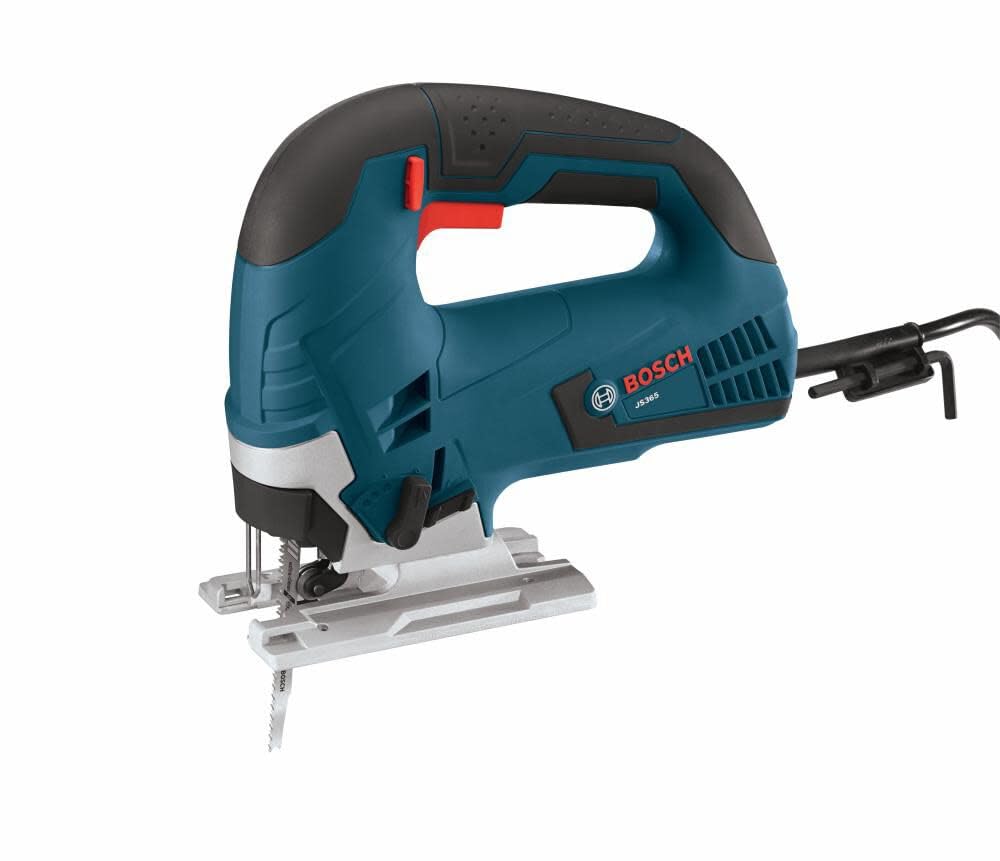
Top-handle saws put the grip directly over the blade, so your hand sits above the cut and you look straight down the line. That layout is what makes tight curves possible, because your wrist steers the blade directly. The BOSCH JS365 and Makita 4329K are both top-handle designs for exactly that reason, and both keep the blade in view for pencil-line work.
A D-handle saw moves your hand back and wraps a loop around it. You get a firmer push in long straight cuts and less hand fatigue during a full afternoon of cutting, but you see the blade from a shallower angle. The Milwaukee M18 FUEL is the D-handle pick here, and that grip is its defining trait rather than an add-on.
Match orbital settings to the material
Orbital action pushes the blade slightly forward as it rises, which scoops chips out faster and speeds up rough cutting. Turn it off and the blade travels straight up and down for a clean edge. Saws with more orbital positions let you dial that in — the BLACK+DECKER offers four curve settings, the SKIL runs a 4-stage orbital function, and the DEWALT gives you 4-position orbital action.
For a finished edge on a cabinet face you want orbital off and a slow pass. For stripping a rough opening in plywood you want it on and the speed up. A saw that covers both ends of that range does rough and finish work without a second tool.
Decide corded or cordless by where you cut
Corded saws run at full power for as long as you hold the trigger and never ask for a battery swap. That is why the BOSCH JS572EK can carry a 7.2 amp motor and why the JS365 draws 6.5 amps — no battery pack limits the draw. If your bench sits within reach of an outlet, a corded saw gives you full amperage on every pass.
Cordless saws trade some of that for freedom from an extension cord. The CRAFTSMAN V20, Milwaukee M18 FUEL, Makita XVJ04Z, and DEWALT 20V MAX all run on battery packs, and three of those share the battery platform you may already own. Check the bevel stops and the blade-change mechanism before you commit — those two details separate a professional cordless saw from a cheap one.
Side-by-Side Comparison
| Model | Best For | Power Source | Speed Range | Bevel Capacity | Amazon |
|---|---|---|---|---|---|
| BLACK+DECKER BDEJS600C★ Best Overall | Garage curves and light jobs | 5 A corded | Up to 3,000 SPM | 45 degrees | Amazon |
| BOSCH JS365Precision Curves | Power and blade changes | 6.5 A corded | Up to 3,000 SPM | 45 degrees | Amazon |
| Makita 4329KCurve Master | Clean curves in thin stock | 3.9 A corded | 500–3,100 SPM | 45 degrees | Amazon |
| SKIL JS313101 | Budget precision with brake | 5 A corded | Variable speed | Bevel adjustable | Amazon |
| CRAFTSMAN V20 CMCS600D1 | Cordless convenience at home | 20V battery | 0–2,500 SPM | 45 degrees | Amazon |
| Milwaukee M18 FUEL 2737-20 | Site work with D-handle control | M18 battery | Brushless variable | — | Amazon |
| Makita XVJ04Z | Curves on cordless power | 18V LXT battery | 0–3,000 SPM | 45 degrees | Amazon |
| BOSCH JS572EK | Heavy loads and low vibration | 7.2 A corded | Variable speed | — | Amazon |
| DEWALT DCS331M1 | Corded performance on battery | 20V MAX battery | 0–3,000 SPM | 45 degrees | Amazon |
Detailed Reviews
1. BLACK+DECKER Jig Saw BDEJS600C
Our pick — 4.5+★ from 11,000+ verified ratings; the strongest balance of quality and price.
Four curve settings and a 3,000 SPM motor at a price that leaves room for blades.
This is the saw that turns a first jigsaw purchase into a usable tool rather than a regret. A 5 amp motor drives the blade at up to 3,000 strokes per minute (SPM — the number of up-and-down blade strokes each minute), which is enough speed to shear through veneered fiberboard and wood spindles cleanly. The four curve settings are the part that matters most in daily use: you dial them to control how aggressively the blade bites into a rounded cut, so a tight radius does not tear out.
What wins people over is the build. The quality of this saw is the thing owners single out far more than any other trait, and it shows up in details like the rubber handle and the 3/4-inch orbital blade action. Owners describe it slicing through 1/2-inch and 1/4-inch cement board without complaint, and it handles light trim and chair-leg repairs the same way. At 4.6 pounds it is a full 4.4 pounds lighter than the BOSCH JS365, which for a saw you hold in one hand over a curve, is a real difference in control. The beveled shoe tilts to 45 degrees, the shoe carries a wire guard, and the blade is high speed steel.
The honest catch is depth of cut on thicker hardwood — this is a small-jobs saw, and it makes no claim to heavy stock. The cord also limits you to work near an outlet. For curves, cutouts, and the sort of trim work that fills a weekend, neither limitation gets in the way.
What earns the top slot
- 4 curve settings give real control over rounded cuts
- Up to 3,000 SPM with a 5 amp motor for fast, clean work
- 4.6 pounds — easy to steer one-handed through a curve
- Beveled shoe tilts to 45 degrees for undercuts
Where it stops short
- Corded only, so you need an outlet within reach
- Built for small and mid-size jobs, not thick hardwood stock
Reach for this if: you want curve control and 45-degree bevels in a saw that stays light in the hand.
Keep looking if: your work is heavy hardwood stock that needs a bigger motor and deeper blade travel.
2. BOSCH JS365 Jigsaw Kit
Tool-less blade changes and a 6.5 amp motor for stock you actually have to push through.
If you ever cut thick hardwood and had the blade wander, this is the saw that answers that problem. It runs a 6.5 amp motor at up to 3,000 SPM and cuts through dense stock straight and true — that is the specific performance owners come back to praise. Four orbital-action settings let you shift between a smooth, straight-up stroke for finish edges and an aggressive forward-pushing stroke for fast rough work.
The blade change is the other standout. A tool-less system lets you swap blades in seconds, and an ejection lever throws the hot blade clear so your fingers never get near it. The speed dial sets your maximum while the trigger controls the actual operating speed, so you can slow for a plunge and open up for a straightaway. A die-cast foot with a steel insert gives the shoe a stable bearing surface, and the bevel Allen key stores on board so it is always with the saw.
Bosch’s version is heavier than the BLACK+DECKER — 9 pounds against 4.6 — and it costs more. If you cut curves in the air with one hand, that weight is a consideration. If you cut on a bench with two hands on the tool, that 9-pound mass keeps the blade planted through dense hardwood.
Where the money goes: 6.5 amps, four orbital positions, and the fastest blade swap in this lineup. Owners rate the quality of this saw higher than any other single trait.
One thing to plan for: at 9 pounds it is the heaviest saw in the top three — bench work suits it better than freehand overhead cuts.
Made for: the woodworker who switches between hardwood, aluminum, and steel and needs a blade change every ten minutes.
Not the fit for: anyone cutting curved trim one-handed for hours at a stretch.
3. Makita 4329K Top Handle Jig Saw
The lightest saw here, with the widest speed spread for feeding soft wood cleanly.
Tight corners and curves are where this saw earns its keep — that is what owners describe it doing well, and the 500–3,100 SPM variable speed dial is the reason. That spread lets you creep at 500 strokes a minute for a delicate inside curve and then open up to 3,100 for a fast straightaway. It tops the BLACK+DECKER and the BOSCH on speed, and it undercuts them both on amperage at 3.9 amps, which is a deliberate trade: lighter motor, lighter saw, less grunt in tough stock.
What people appreciate most is the ability to control how much material comes off with each stroke. Soft and thin woods cut cleanly here, and one recurring description is that it goes through a 2×4 with ease. Ergonomically the rubberized grip does the work — it keeps the saw from skating on a curve. A counterweight balance system reduces the vibration you feel in your hand, which is what makes a long curve session bearable. A sliding dust cover and a through-the-body dust port let you hook up a vacuum, so the cut line stays visible instead of vanishing under a spray of sawdust.
At 1.9 kg (about 4.2 pounds) it is close to the BLACK+DECKER on the scale. The caveat is straightforward: it runs on 3.9 amps, so dense hardwood will challenge it where the 6.5 amp BOSCH shrugs it off. Softwood, plywood, and trim are its home ground.
Why builders keep it around: 500–3,100 SPM covers everything from a crawl to a sprint, and the rubberized grip holds a line through a curve.
The honest limit: 3.9 amps is the smallest motor in this group — great for softer wood, less so for thick hard stock.
Best matched to: homeowners and trim carpenters cutting softwood, plywood, and curves all day.
Look elsewhere if: most of your stock is dense hardwood that needs a bigger motor.
4. CRAFTSMAN V20 Cordless Jig Saw Kit (CMCS600D1)

The starter cordless kit that arrives ready to cut, battery and charger in the box.
For anyone buying a first cordless jigsaw, the most useful thing about this one is what comes in the case. You get a 2.0AH lithium-ion battery and a charger alongside the saw, so there is no separate shopping trip before your first cut. The variable speed trigger runs from 0 to 2,500 SPM, which is slower at the top end than the BOSCH JS365 and Makita 4329K, but easily enough for trim and light sheet work.
The controls are where this saw punches above its slot. Three orbital settings let you shift between clean and aggressive cuts, and a dust blower keeps chips off the line so you can actually see the pencil mark. The contoured over-molded handle stays comfortable over a long afternoon, and the shoe bevels to 45 degrees for angled cuts. It accepts both T-shank and U-shank blades, which frees you to buy whichever blade format is on the shelf rather than hunting down one type.
Owners call the performance good and the cordless freedom the main draw. Battery life splits opinion — some get decent runtime while others want more — so treat it as a saw for a session rather than a full day of cutting, and keep a spare pack charged. That is a fair trade for the freedom of no cord in the driveway or the back yard.
The value case: battery, charger, and saw in one kit, with 3 orbital settings, a 45-degree bevel shoe, and both T-shank and U-shank blade support.
Plan around this: battery life draws mixed feedback — charge the pack and keep a spare on hand for longer sessions.
Exactly right for: a first-time cordless owner who wants to unbox and cut without buying a battery separately.
Rethink it if: you plan to saw all day and need runtime you can count on without swapping packs.
5. Milwaukee M18 FUEL D-Handle 10T Metal Blade Jigsaw (2737-20)
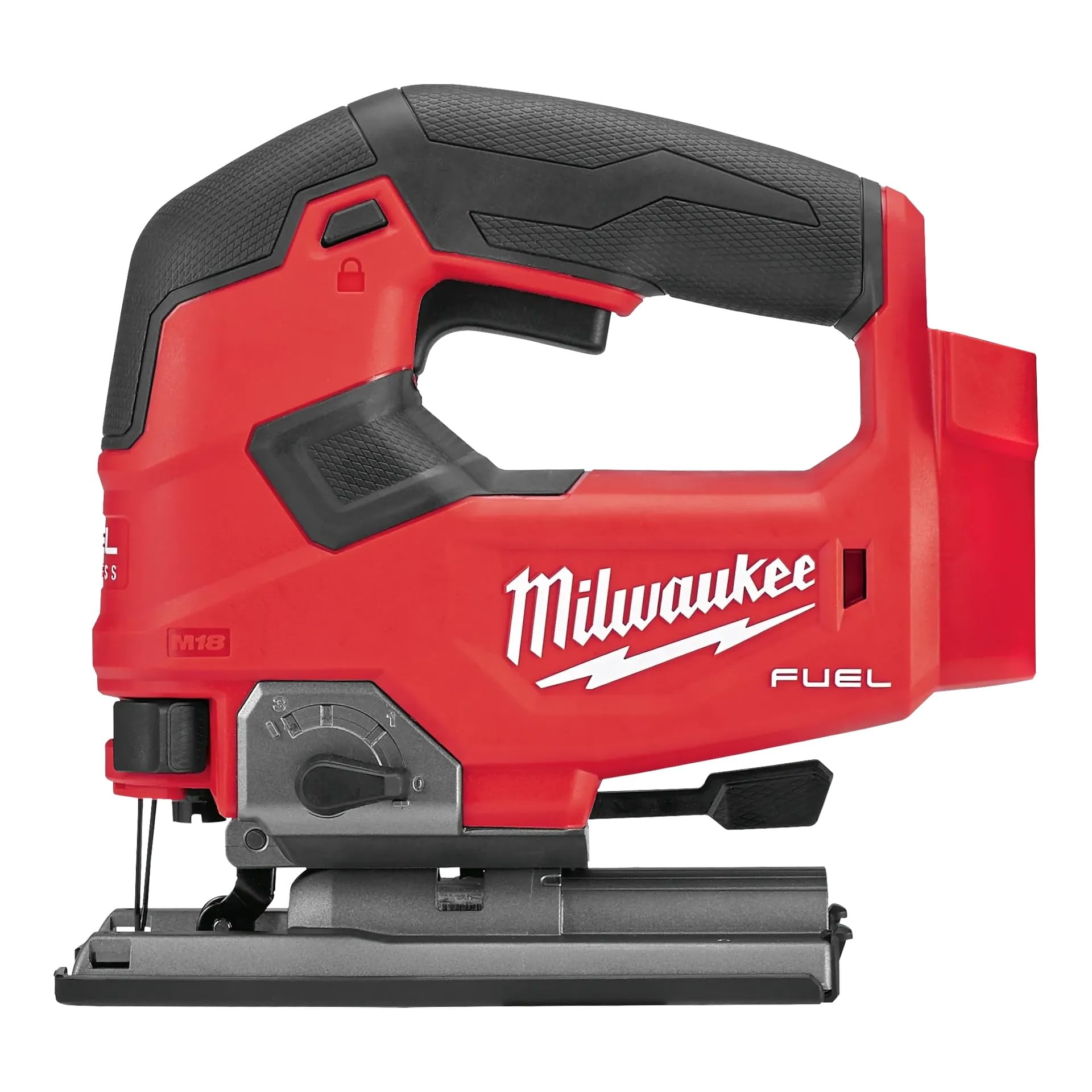
A brushless motor in a D-handle loadout that shares batteries you may already own.
Site workers who are already invested in the M18 platform get the most from this saw. It runs on any M18 battery, so it slots into a toolkit that already exists, and the D-handle grip pushes your hand back and loops around it for a firm, two-handed push through long straight cuts. That layout reduces hand fatigue on extended use, and it gives you more leverage to keep the blade tracking when you are leaned over a bench.
The brushless motor is the engineering headline. With fewer wearing parts than a brushed motor, it is built to stretch runtime and stay consistent under load, which is exactly what a demanding cut needs. The blade is carbon steel and 10 teeth, and the handle is a reinforced thermoplastic elastomer or polypropylene. Owners rate the quality and the get-the-job-done functionality most, with a sense that it does everything asked of it and more.
The trade-off is that this is a bare tool — no battery in the box, by design. If you are not already on M18, factor in the cost of a battery and charger. And a D-handle is not the tool for tight inside curves; the top-handle saws in this list are shaped better for that. This one wants straight runs and thick material.
Its strongest card: a brushless motor plus M18 compatibility — runtime and durability in a body that fits a full workday.
Before you order: the listing is bare tool only, so a battery isn’t included; and the D-handle suits straight cuts better than tight curves.
Built for the M18 owner: a pro or serious DIYer who wants brushless runtime and D-handle control without buying another battery platform.
Wrong tool for: tight decorative curves and anyone starting with no M18 batteries on hand.
6. Makita XVJ04Z 18V LXT Brushless Cordless Jig Saw

A cordless saw with a soft-start mode built for accurate entry into the cut.
Starting a cut cleanly on a cordless saw is harder than it looks, and this is the one feature that separates the XVJ04Z from its battery-powered rivals. The soft no-load mode eases the blade up to speed as it engages the material, so the saw does not jump the line on the first stroke. From there a Makita-built brushless motor carries it to 0–3,000 SPM, matching the top speed of the corded BLACK+DECKER and BOSCH saws while running on an 18V LXT battery.
Three orbital settings plus a straight cut mode cover the full range from clean finish edges to fast rough stock. A large two-finger variable speed trigger with a lock-on button lets you hold a long pass without cramping your hand. A built-in LED light washes the work area so the line stays visible in a dim corner or under a cabinet overhang. At 4.3 pounds it is a light cordless saw, and owners praise the quality of the build more than any other single trait. They describe it cutting curves like a charm and making clean cuts, and some compare its power to a corded tool.
Two things to know before you buy. This is a bare tool — no battery included — so you need the LXT packs on hand. And battery life draws mixed comment, meaning run time depends heavily on which pack you fit and how hard you cut. Neither is a deal-breaker; both are things to sort out before the first cut.
The standout detail: soft no-load start-up brings the blade to speed gradually, so it engages the material without kicking off the line.
The catch: bare tool only — bring your own LXT battery — and battery life depends on which pack you fit.
The pick for: an LXT owner who wants corded-level speed and a gentle start on precise cuts.
Think twice if: you have no LXT batteries or need a saw that arrives ready to run.
7. BOSCH JS572EK 7.2 Amp Corded Jigsaw Kit with Assorted Blades
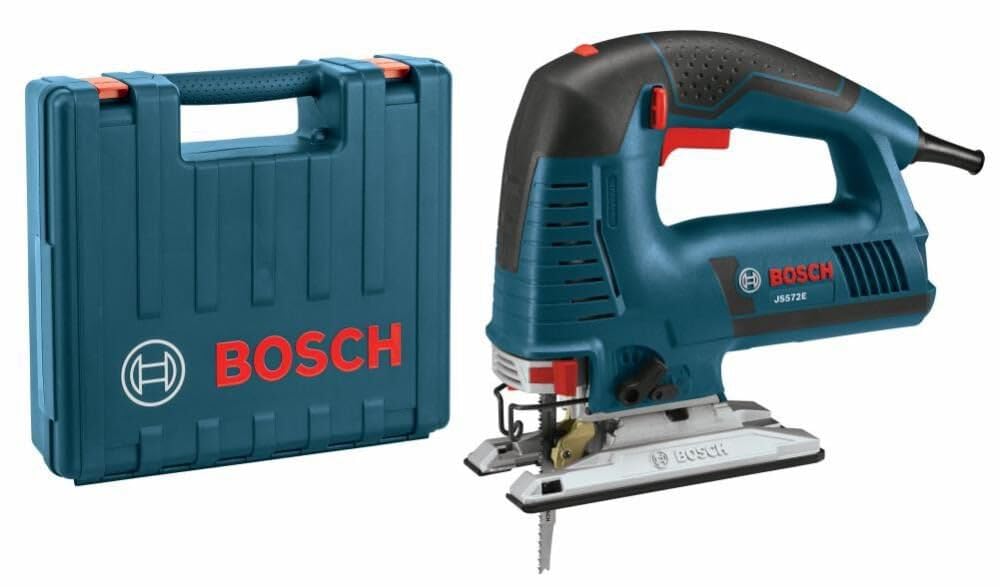
The biggest motor in the group, held steady by a counterbalance system built to kill blade deflection.
Blade deflection is what ruins a cut — the blade bends sideways under load and the edge comes out wavy. This saw attacks that directly. Its counterbalancing mechanism is designed to keep blade deflection to a minimum, so cuts come out true and exact even in heavy stock. Driving that is a 7.2 amp motor, the highest current rating in this entire lineup — the BOSCH JS365 below it draws 6.5 amps and the Makita 4329K just 3.9.
Bosch’s Constant Response circuitry is the sleeper feature. It holds consistent speed and performance under load, so when the blade bites into a knot or a thick plank the saw does not sag and slow. One-touch blade change gives you fast insertion and an ejection lever so the hot blade never touches your fingers. The kit comes with three assorted blades, an anti-splinter insert, and a carrying case, so you have a blade for wood, a blade for finer work, and a place to keep it all. Owners talk most about cut quality and power, and the prevailing description is that it cuts through 1-inch stock with almost no effort.
Worth knowing: the tool has no dust collection space. And durability has drawn some negative notes, with reports of units failing — a real consideration if this is a daily-use tool for you. A one-touch blade change and 7.2 amps make it a serious cutter; treat the durability reports as a reason to weigh the warranty before committing to all-day use.
Why it cuts true
- 7.2 amp motor — the highest rating here — for heavy stock
- Counterbalancing mechanism minimizes blade deflection for exact cuts
- Constant Response circuitry holds speed under load
- Kit includes 3 assorted blades and a carrying case
Where to weigh it
- No dust collection space on the tool
- Durability has drawn some negative notes — consider the warranty for daily use
The choice for: the woodworker who cuts heavy stock and needs speed that stays steady when the blade loads up.
Be sure before you commit: reports of durability issues mean the warranty matters if this is your everyday saw.
8. DEWALT 20V MAX Jig Saw, Cordless (DCS331M1)

Cordless that owners say cuts like a corded saw, with a keyless bevel shoe that clicks into stops.
The 0–3,000 SPM range on this saw is the same top speed as the corded BLACK+DECKER and Makita 4329K, and in practice that is what owners describe — cuts that feel as strong as an electric model. The real tailwind is the keyless, all-metal shoe bevel with positive stops at 0, 15, 30, and 45 degrees. Instead of eyeballing an angle, you click the shoe into detents, which makes repeat bevels fast and accurate. Four-position orbital action then tunes cut quality against speed for the material at hand.
A 4.0Ah 20V MAX XR lithium-ion battery and charger come in the kit, along with a blade and a kit bag, so you are ready on arrival. The all-metal lever-action blade change makes swapping a blade a quick job, and it accepts T-shank blades for secure holding. An adjustable dust blower keeps the line of cut clear. The anti-slip comfort grip helps you hold a line on a curve. On runtime, the sense from owners is generous — the battery handles a run of ordinary jobs before it needs a charge.
You lose nothing on cut quality and only a little on serviceability compared to a corded saw. A corded saw runs at full power for as long as you hold the trigger, while this one depends on the battery pack. The 3-year limited warranty eases that concern. If you work in a yard or on a fence line far from an outlet, this is a natural pick.
Why it stands out: keyless bevel stops at 0/15/30/45 degrees, 4-position orbital action, and a 20V kit with battery, charger, blade, and bag.
What to accept: run time depends on the battery and the cut — no cord means no infinite power like a corded saw offers.
A match for: anyone cutting away from an outlet who needs corded-grade cutting and repeatable bevels.
Less ideal if: you cut all day and count on never stopping to charge.
9. SKIL 5 Amp Corded Jig Saw (JS313101)

A budget corded saw with a brake and a dust-blower switch that gives you a clean line.
Durability is what stands out on this one. Owners describe it lasting through many uses, and it earns praise for cutting real material — one buyer successfully cut through a 2-inch thick butcher block table top with it. A 5 amp motor drives a 4-stage orbital function, so you get smooth cutting across different materials and a blade that can clear chips fast when you rough out a shape.
The useful extras are where a budget saw usually cuts corners, and this one does not. There is a brake function alongside the variable speed control, so when you release the trigger the blade stops instead of coasting — that makes a precise finish easier to land. An on/off dust blowing switch clears the work so you can track the cutting line. A tool-free blade clamp lets you swap blades quickly, and the kit includes both a wood blade and a metal cutting blade. The angled shoe bevels for bevel cuts.
The blade here is 4 inches, the shortest in this lineup — the BOSCH JS365 takes a 6-inch blade — which limits how deep you can cut in thick stock. That is a fair limitation for a budget corded saw aimed at trim and sheet goods. If your work stays under a couple of inches, the brake and the dust control make it money well spent.
The budget win: variable speed, a stopping brake, a dust blower switch, and a tool-free blade clamp — features you often lose on a cheap saw.
The trade-off: a 4-inch blade is the shortest here, so thick stock is out of reach.
Logical for: a trim and sheet-goods cutter on a tight budget who wants a brake and clean sight lines.
skip it if: you routinely cut stock thicker than a couple of inches.
Know the Specs
Strokes per Minute (SPM)
SPM counts how many times the blade travels up and down each minute — it is the saw’s speed, not its strength. A higher top speed like 3,000 SPM means the blade moves fast enough to shear fibers cleanly rather than chew them, so a curve comes out smoother. A wide range matters more than a high ceiling. The Makita 4329K dials from 500 up to 3,100, which lets you crawl through a fine inside curve and open up for a straightaway.
Amperage on a Corded Saw
Amps measure how much electrical current the motor can draw, which is the closest thing to pulling power on a corded saw. Ignore it on cordless models where the battery sets the ceiling. A higher rating like the BOSCH JS572EK’s 7.2 amps keeps the blade turning under heavy load, so it does not bog down in thick hardwood. A lower rating like the Makita 4329K’s 3.9 amps is lighter and easier to steer but has less muscle in dense stock.
Orbital Settings
Orbital action pushes the blade slightly forward on the upstroke, scooping chips out of the cut faster. Turn it off for a straight-up-and-down stroke when you need a clean finish. More positions give you finer control — the BLACK+DECKER offers four curve settings, the DEWALT 4-position orbital action, and the SKIL a 4-stage orbital function. Use the aggressive end for rough openings and the smooth end for a visible edge.
Bevel Capacity
The bevel is the angle the shoe tilts to, letting the blade cut at an angle instead of square. A 45-degree bevel cap, which most saws here have, covers undercutting a countertop edge or scribing a baseboard. The DEWALT adds repeatable stops at 0, 15, 30, and 45 degrees so you do not eyeball the angle. Check whether the bevel stops are there if you cut the same angle repeatedly.
Blade Shank Type
The shank is the top of the blade that locks into the saw. T-shank blades (shaped like a T at the top) hold with more grip and are the more common professional format; U-shank blades use a U-shaped notch. The DEWALT accepts T-shank blades, and the CRAFTSMAN V20 accepts both T and U shanks. Buying a saw that takes the blades you can find locally saves a lot of online ordering.
Corded vs Cordless Power
A corded motor can draw full current continuously, so it can be built bigger — the BOSCH JS572EK carries a 7.2 amp motor that no battery saw here matches on paper. A cordless saw trades that ceiling for freedom from an outlet. On a 20V MAX or 18V LXT platform, runtime depends on the battery pack you fit. If you cut away from power or on a job site without outlets, the freedom usually wins.
Common Questions
What is the difference between a top-handle and a D-handle jigsaw?
Do I need a corded or cordless jigsaw for a garage workshop?
Can a jigsaw make beveled cuts on a countertop?
How deep can a jigsaw cut through wood?
What do the orbital settings on a jigsaw actually do?
Will a T-shank blade fit my jigsaw?
Is a jigsaw good for cutting curves and tight corners?
Can a cordless jigsaw match the power of a corded one?
Why does the blade stop when I release the trigger on some saws?
The Bottom Line
For most people, the types of jigsaws decision lands on the BLACK+DECKER BDEJS600C, and the reason is control you can feel. It gives you four curve settings, a 45-degree bevel shoe, and 3,000 SPM (strokes per minute) on a 4.6-pound body that steers through a tight radius without fighting you. If you cut dense hardwood and need more motor and a faster blade swap, step up to the BOSCH JS365DEWALT DCS331M1 gives you corded-grade cutting on a 20V battery with repeatable bevel stops. One honest nudge: the BLACK+DECKER carries the higher star score of the two 4.7 picks and is the one to grab first if curved trim is your main job.
How we choose
We do not accept paid placement. Every pick is matched to a real buyer and a real use-case; we do not hands-on test units.
Sources
Specifications: manufacturer listings and product documentation. Review insights: verified customer reviews, as of November 2026. Pricing: not shown on this page (it changes often); check the current price via the retailer link.
As an Amazon Associate, Tactical Gear Guy earns from qualifying purchases. This does not affect which products we feature.