Specs are compiled from manufacturer listings and verified buyer reviews and can change over time — please confirm the key details on the product page before buying.
If you carry client files, tax records, or medical scans on a flash drive, you already know the fear: lose the drive, lose everything. The fix is not a password-protected folder on an ordinary stick. It is a drive that encrypts in hardware the moment you unplug it, so the data is scrambled before it ever hits the USB port. This guide covers six drives that do exactly that, from a heavy-duty Apricorn to a budget-friendly 16GB Integral, so you can pick one that fits your daily routine.
This guide is built by comparing the manufacturers’ published specifications and the patterns across verified customer reviews, so you get each pick’s real strengths and trade-offs instead of marketing spin.
You will see why PIN pad locations matter, how failed-attempt wipe limits differ, and which drives need zero software on any machine. Here is the honest breakdown of the best secure USB memory for protecting your files without a subscription.
Top Picks


How To Choose The Best Secure USB Memory
Buying a secure USB drive is different from buying a normal one. You are not just picking a capacity; you are picking how the encryption works, who can open up it, and what happens if someone else tries. Most buyers get this wrong because they assume “password protected” on the listing means the drive is safe. It does not. Without hardware encryption and a locked keypad or built-in open up, a drive can be bypassed.
PIN pad vs. software entry
A keypad on the drive itself, like the Apricorn and iStorage models, means you open up it with a PIN before it touches the operating system. That is the safest option because there is no software to install and nothing runs on the host machine. Software-entry drives, like the Integral, encrypt automatically and lock when removed, but the password is typed through a prompt on the computer. Both work; the keypad version is the one to pick if you use shared or public computers.
What happens after failed attempts
Most secure drives limit how many bad passwords you can try. The Apricorn uses data recovery PINs, the Integral erases everything after 6 failed attempts, and the INNÔPlus wipes after 10. That is a real safety trade-off, not a defect: if you are prone to forgetting a password, set the drive up and write the recovery PIN somewhere you cannot lose. Do not pick a drive with a self-wipe feature if you are the type to forget.
How much speed you actually need
Secure drives are slower than plain flash for a reason: the encryption runs as you copy files. The INNÔPlus lists up to 480MB/s reading and 160MB/s writing, which is the fastest on this list. The rest are USB 3.0 or USB 3.2 Gen 1, which is plenty for documents and photos. If you back up full system images or large video projects, the speed difference will matter; for a folder of PDFs and spreadsheets, it will not.
Side-by-Side Comparison
| Model | Best For | Capacity | open up Method | Validation | Amazon |
|---|---|---|---|---|---|
| Apricorn Aegis Secure Key 3 NX 32GB★ Best Overall | Corporate compliance | 32 GB | PIN keypad | FIPS 140-2 Level 3 | Amazon |
| Integral 16GB Crypto-197Budget Pick | Tight budgets | 16 GB | Software password | FIPS 197 | Amazon |
| INNÔPlus Secure Flash Drive 32GB | Fast transfers | 32 GB | Password | Not listed | Amazon |
| Kingston IronKey Vault Privacy 50 128GB | Large files with security | 128 GB | Multi-password | FIPS 197 | Amazon |
| iStorage datAshur PRO 4GB | Government or military work | 4 GB | PIN keypad | FIPS 140-2 Level 3 | Amazon |
| Kingston IronKey D500S 32GB | Hidden partitions | 32 GB | Multi-PIN | FIPS 140-3 Level 3 (pending) | Amazon |
Detailed Reviews
1. Apricorn Aegis Secure Key 3 NX 32GB
Our pick — 4.5+★ from 700+ verified ratings; the strongest balance of quality and price.
The self-contained lockbox that open up from its own keypad, not the computer.
If your work requires a drive you can plug into a shared or borrowed machine without trusting it, the Apricorn is the one to reach for. The 32GB capacity holds a working folder of contracts, spreadsheets, or scans, and the whole drive is validated to FIPS 140-2 Level 3, the standard government buyers ask for. That means the encryption and tamper protection were checked against a published security benchmark, not just described in marketing copy.
What wins people over is reliability, the thing this drive is praised most for. The separate admin and user modes mean an IT department can set policy while you still open up with your own PIN, and the two read-only modes can lock the drive to view-only when you don’t want anything overwritten. Compatible with Windows, iOS, Linux, Android, and Chrome, it works across just about any machine you encounter. The one recurring gripe is the button size: the keypad keys are small, so entering a PIN on the move takes a little care.
The catch is cost and capacity. This is the premium end of the list, and 32GB fills fast if you hoard video files. The upside is that it is also the most scrutinized drive here: 4.5+ stars across 700+ owners, with data protection the second-most discussed strength after reliability. That records a level of buyer satisfaction that matters for a drive tasked with guarding client information.
What earns the top spot
- FIPS 140-2 Level 3 validated, the level compliance buyers ask for
- Separate admin and user modes keep IT policy separate from daily access
- Lightweight at 0.03 kg, so it disappears in a pocket
- Two read-only modes protect files from accidental editing
Where it asks more of you
- Small keypad buttons take care when entering a PIN quickly
- 32GB is modest if you carry media files
- Premium-tier cost places it at the top of this list
Reach for this if: you need documented FIPS compliant hardware, separate admin control, or a keypad open up on machines you don’t own.
Look elsewhere if: your budget is the deciding factor or you mainly need fast storage for large media files.
2. Integral 16GB Crypto-197
The affordable armored stick that erases itself after six wrong passwords.
For a cheap entry point into hardware encryption, the Integral is the value tier’s best argument. It is certified to FIPS 197, the encryption standard the U.S. Government approved, and it enforces AES 256-bit hardware encryption on everything you copy. The rugged double-layer design pairs a hardened inner case with a rubberized silicone outer shell, so a drop or a splash does not take it out.
The safety behavior is where it differs from the Apricorn: there is no keypad. You type an 8–16 character alphanumeric password through software, and the drive auto-locks whenever you remove it from a PC or Mac. If someone enters six wrong passwords, the data and encryption key are destroyed and the drive resets. Unlike the Apricorn, there is no admin mode or read-only toggle, and no FIPS Level 3 validation, so it suits personal files rather than regulated compliance work.
The trade-off is capacity and speed. At 16 GB, it covers documents and photos but not a video library, and USB 3.0 keeps transfers in the standard range. For the price, though, it delivers certified encryption with zero setup software and no subscription, which is the point of a budget first secure drive.
Honest read: a fair-value starter drive for personal records, with brute-force protection that destroys the key after six failures.
Best fit: one bag, one laptop, one password you won’t forget, and no need for paper trail compliance.
This is the budget entry: compare it to the iStorage — 16GB vs 4GB, and a lower price for more room, if compliance paperwork isn’t required.
One caveat: forget the password and the drive erases itself, so store the hint and password somewhere safe.
3. INNÔPlus Secure Flash Drive 32GB

When your encrypted backups run long, this zinc-shelled drive moves data at speed.
Most secure drives make you wait; this one is built to move files quickly. INNÔPlus lists up to 480MB/s reading and 160MB/s writing over USB 3.0, which is the fastest spec on this list and shortens the wait on large backups. The full-disk 256-bit AES XTS hardware encryption covers everything you copy, and if someone enters ten incorrect passwords the drive resets to factory settings and wipes itself.
The build is a zinc alloy and ABS shell, the housing described as resistant to scratches, rust, and damage, with an orange finish that makes it easy to spot in a bag. What buyers praise most is the quality of the build, with security close behind. The encryption runs without any installed software, and it is compatible with Windows, Mac, Linux, embedded systems, and other devices, so a work laptop or a zero client rarely argues with it.
The honesty note here is the reliability feedback, which reads mixed rather than glowing, so treat it as a drive to back up regularly rather than your only copy. There is also a mention that files can only be 4GB, which points to the FAT32 file size limit common on flash drives; split large videos or format differently if your files run bigger. At 4.2 overall and 32 GB, it earns its place for those who prioritize transfer speed.
Why speed chasers pick it
- 480MB/s reading and 160MB/s writing, the quickest on this list
- Full-disk 256-bit AES XTS encryption with no software required
- Zinc alloy and ABS housing resists scratches and rust
- Ten-failure limit wipes data to factory settings for theft protection
What to weigh before buying
- Reliability feedback is mixed, so keep a second copy of important files
- Some buyers report the 4GB per-file limit, common to FAT32 formatting
- No FIPS validation listed on the drive
The deciding factor: you copy large folders often and want encryption that doesn’t slow you to a crawl.
The limit: it favors speed and build over a formal compliance certificate, so official government work may require a different pick.
4. Kingston IronKey Vault Privacy 50 128GB
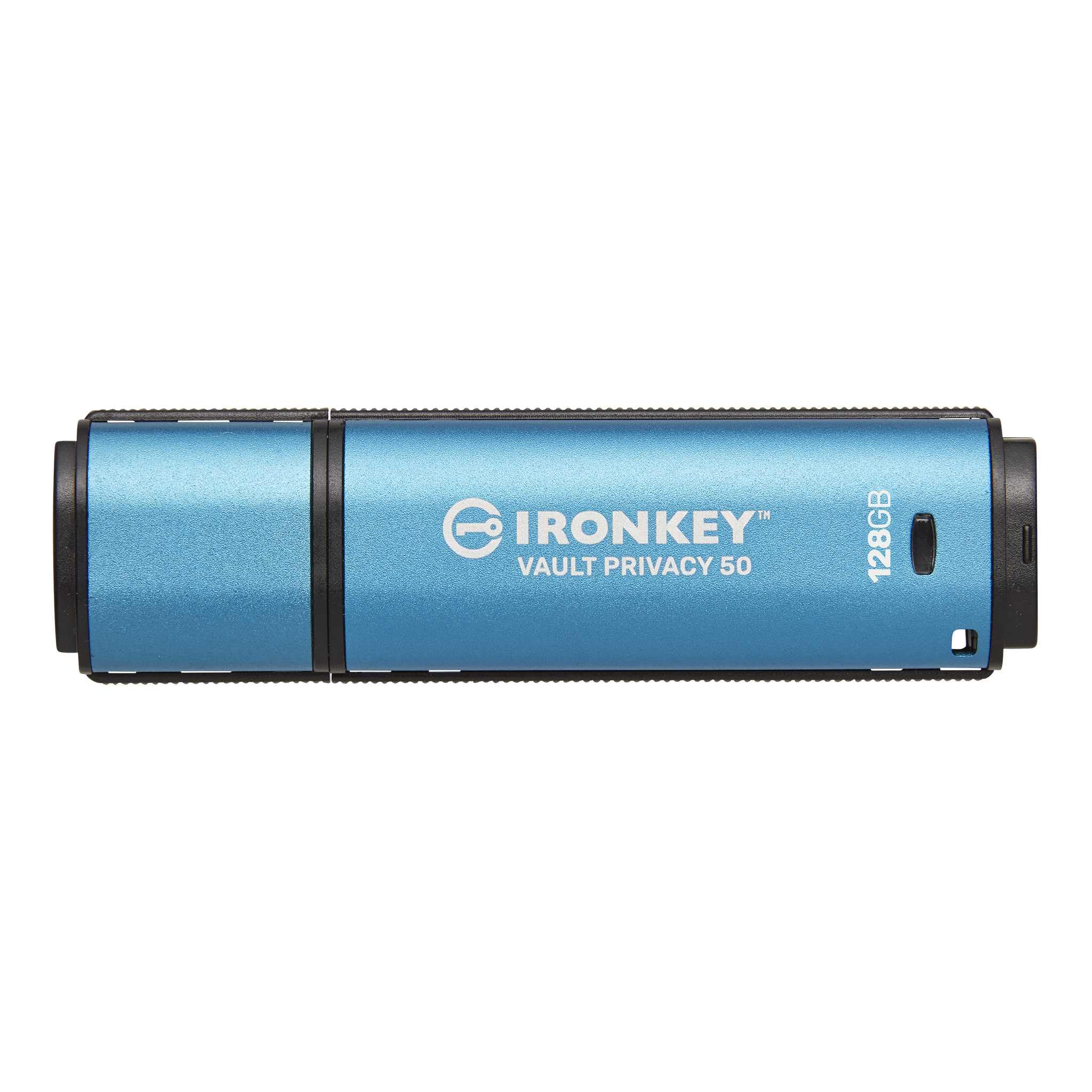
The roomiest drive on the list, with enough space to carry a whole project vault.
Capacity is the headline here, and it is not close. At 128 GB, the IronKey Vault Privacy 50 holds thirty-two times the space of the 4GB iStorage datAshur PRO, so you can carry a full archive of client files without rotating drives. The trade is size in your bag: at 20 g, it sits about 10% heavier than the 18.14 g Integral Crypto-197, though both slip into a pocket without notice.
Behind the capacity sits business-grade security. The drive uses FIPS 197 with XTS-AES 256-bit hardware encryption, and it adds BadUSB attack protection with digitally-signed firmware to block malicious USB exploits. A multi-password option covers complex and passphrase modes, and a new passphrase mode lets you create a longer, more memorable phrase rather than a string of symbols. Dual read-only settings prevent accidental changes when you want to hand someone a copy.
Quality and security are the strengths that carry this drive, and the feedback on value is split: some buyers find it fairly priced for the capacity, others consider it premium. For a 128GB vault that also carries TAA compliance for government procurement, that is a fair trade-off. It is the pick for anyone who needs storage volume without giving up serious encryption.
Standout spec: 128 GB in a 20 g body, with FIPS 197 XTS-AES 256-bit hardware encryption and digitally-signed firmware.
Worth knowing: TAA compliance and BadUSB protection make it a fit for enterprise and government buyers, not just personal use.
Pick this one: you carry large folders, run a small business, or hand files to clients under document-protection policies.
Know the trade: the premium tier of storage pricing, so if 32GB covers your needs the Apricorn offers more compliance for the money.
5. iStorage datAshur PRO 4GB

The drive that survives a drop in a puddle and still demands a PIN.
If your files travel into rough places, this is the one built for it. The datAshur PRO is FIPS 140-2 Level 3 certified, and it also carries NLNCSA DEP-V and NATO Restricted certifications, so it meets the paperwork for GDPR, CCPA, and HIPAA work. It is dust and water resistant to IP57, which means it can be submerged and still work, and the hardened body handles knocks that would end a plastic-cased drive.
The open up method is a 7–15 digit PIN entered directly on the drive, with all data encrypted in real time using AES-XTS 256-bit hardware encryption when disconnected. No software is required, and it works on Windows, macOS, Linux, Chrome, Android, thin clients, zero clients, embedded systems, Citrix, and Vmware. For carrying personal IDs, medical records, or business contracts into a meeting, that breadth of compatibility matters.
The reality check is capacity: 4 GB is the smallest on this list, so it is a focused document drive, not a media vault. For a drive that protects personal ID and business matters, the trade is worth naming clearly: you lose storage volume in exchange for a genuinely rugged, government-certified keypad drive.
Built for: field workers, compliance officers, and anyone carrying records between sites where weather is part of the job.
The honest catch: 4 GB fills fast, so treat it as a secure document carrier, not an archive.
6. Kingston IronKey D500S 32GB

Two hidden partitions let you keep a decoy folder and disappear the real one.
The D500S does something none of the other drives here can: it sets up two hidden partitions. One can act as an everyday, less-sensitive space while the other stays concealed, which is useful when you want to hand the drive to a colleague without exposing what else is on it. Kingston calls the dual hidden partition an industry first, and it pairs with a crypto-erase password that nukes the whole drive in an emergency.
Under the hood is a rugged zinc casing for penetration attack protection, FIPS 140-3 Level 3 validation (pending), XTS-AES 256-bit encryption, and both brute force and BadUSB attack protection. The multi-password option supports complex and passphrase modes, and the interface is built to be configured to your own preferences. This is the drive for someone who wants to tailor how the key behaves, not just accept a fixed setup.
What keeps it performing is reliability, the most-discussed strength, with quality right behind it. It sets up quickly and transfers at adequate speeds, and the security reputation is solid. The split is on price: some buyers see a fair deal, others see a premium ask for a 32GB drive. At 4.5+ stars and a newer listing, it rewards buyers who value the hidden partition trick more than raw storage.
The standout: dual hidden partitions plus crypto-erase, which is a genuinely different security approach from the keypad drives above.
The trade-off: a premium price for 32GB, and the top-tier validation is still pending, so compliance buyers may want to wait for it to finalize.
Who it suits: travelers and business users who want a decoy partition or a one-button erase in a hostile situation.
Who should pass: anyone who just needs straightforward PIN protection and the largest storage for the spend.
Know the Specs
FIPS Validation Levels
FIPS 140-2 and FIPS 140-3 are published security standards: the higher the level, the more tamper resistance and physical protection the drive carries. FIPS 197 is the encryption standard, not the physical tamper level, so a FIPS 197 drive is encrypted but not necessarily validated for Level 3 tamper resistance. If a vendor or compliance officer asks for “FIPS Level 3,” you need a drive like the Apricorn or iStorage, not a standard FIPS 197 model.
Brute-Force Wipe Limits
Failed-attempt protection is the safety net that stops someone guessing your password forever. The Integral wipes after 6 failed attempts; the INNÔPlus resets after 10. The Apricorn instead uses data recovery PINs, so you can recover access without erasing. Pick based on your own memory: a drive that self-wipes is safer against theft but unforgiving if you forget the password yourself.
Read vs. Write Speed
Read speed is how fast you pull files off the drive, and write speed is how fast you save them. The INNÔPlus leads this list at up to 480MB/s reading and 160MB/s writing. For most secure drives, USB 3.0 is adequate for documents, but large video backups will feel the difference. Faster drives shorten your wait; slower drives cost you patience, not data.
IP Ratings Explained
An IP rating, such as IP57 on the iStorage, describes resistance to dust and water. The first digit is solids, the second is liquids, with higher numbers meaning more protection. IP57 means it can survive being submerged in water for a short time. A drive without an IP rating should not be treated as waterproof, even if the case feels sturdy.
Common Questions
Will a secure USB drive work on a work laptop without admin rights?
What happens if I forget the password on a self-wiping drive?
Is FIPS 140-2 Level 3 the same as FIPS 197?
Can I use an encrypted USB drive on both Windows and Mac?
How fast are secure USB drives compared to normal flash drives?
Do these drives need a subscription or app?
What does IP57 mean on a USB drive?
Can I recover files if a secure drive is wiped by wrong passwords?
Is 32 GB enough for regular business files?
Which drive is best for healthcare or legal compliance?
The Bottom Line
For most people, the secure usb memory winner is the Apricorn Aegis Secure Key 3 NX. You open up it with a keypad on the drive itself, so the computer never holds the lock. It also carries FIPS 140-2 Level 3 validation (a US government security standard for encrypted devices), which helps if you need compliance. Carry large folders and want more room? The Kingston IronKey Vault Privacy 50 gives you 128 GB of encrypted storage. Need a drive that survives a drop in a puddle? Reach for the iStorage datAshur PRO, as long as its 4 GB limit suits your files. One last note: the Apricorn leads the list at 4.5+ stars, but the iStorage carries nearly six times the review volume at 4.0+. Both are strong, and the choice depends on if you need more room or a public-sector workhorse.
How we choose
We do not accept paid placement. Every pick is matched to a real buyer and a real use-case; we do not hands-on test units.
Sources
Specifications: manufacturer listings and product documentation. Review insights: verified customer reviews, as of November 2026. Pricing: not shown on this page (it changes often); check the current price via the retailer link.
As an Amazon Associate, Tactical Gear Guy earns from qualifying purchases. This does not affect which products we feature.