Specs are compiled from manufacturer listings and verified buyer reviews and can change over time — please confirm the key details on the product page before buying.
You want the room to feel lit, not just brighter — and the single biggest mistake first-time buyers make is spending their whole budget on one big fixture instead of several small ones placed around the stage. This guide is built around that split-budget approach. Every pick below is a real, currently sold fixture with real control options, and each one is matched to the setup it actually suits.
This guide is built by comparing the manufacturers’ published specifications and the patterns across verified customer reviews, so you get each pick’s real strengths and trade-offs instead of marketing spin.
You will see the difference between a bar, a par can, and a moving head, and why the wiring plan matters as much as the wattage. Here is the practical shortcut to the best stage lighting equipment for your own rig and your own room size.
Top Picks


How To Choose The Best Stage Lighting Equipment
Buying stage lighting is really three decisions stacked on top of each other: how much light you need, how many fixtures you need, and how you want to control them. Get the order wrong and you end up with a bright fixture you cannot program. The short version: buy for the room you actually play, not the biggest stage you can imagine.
Match the fixture type to the job
A par can is a workhorse wash light — it floods a wide area in one color. A pixel bar packs dozens of individually controllable LED zones into a long strip, so you get chasing effects and gradients across its length. A moving head physically pans and tilts, which is the only way to throw a beam that travels across a room during a song. For a small band rig, two or three pars plus one bar covers most sets.
The control decision comes first
Every fixture here can run on its own built-in modes, but DMX (a standard digital control protocol that lets one desk or controller talk to many lights at once) is what makes a rig feel coordinated. Channel count tells you how much control you get per fixture. A 4-channel par lets you set red, green, blue, and overall brightness. A 120-channel bar lets you address nearly every individual LED. Buy more channels than you need only if you plan to pixel-map.
Beam angle decides who sees your show
A narrow beam angle throws a tight, punchy shaft that cuts through haze — great for a single dramatic beam. A wide angle washes the whole stage and the wall behind it. A 65-degree bar fills a room; a 6-degree beam draws a line. Neither is better, but if your venue has no haze machine, narrow beams give you very little to look at.
Power and mounting need a home visit
Check what your venue gives you before you buy. Battery-powered uplights need no circuit at all, which is why they suit weddings and rented rooms. Plug-in bars and pars need a mains outlet and, ideally, the ability to daisy-chain power from one fixture to the next. Tripod stands set up in minutes; truss mounting needs clamps you probably have to buy separately.
Side-by-Side Comparison
| Model | Best For | Wattage | DMX Channels | Beam Angle | Amazon |
|---|---|---|---|---|---|
| LaluceNatz 100W 40LEDs Pixel Bar★ Best Overall | Pixel chases on a standing rig | 100 watts | 5 modes (8/20/40/60/120) | — | Amazon |
| OPPSK 90W 60LED Par 2-PackBest Value | Entry-level wash on a tight setup | 180 watts | DMX512 | 25 degrees | Amazon |
| Telbum 5-in-1 Party BarMost Versatile | One-box party coverage | 10 watts | — | — | Amazon |
| U`King Moving Head 2-Pack | Beams that travel across the room | 70 watts | 9/14 channels | 25 degrees | Amazon |
| BETOPPER 120W Par 4-Pack | Even color across a full stage | 120 watts | 4/8 channels | 15 degrees | Amazon |
| LaluceNatz 240W Wash Bar | Wide wash with white and amber | 240 watts | 5 modes (7/13/82/130/135) | 65 degrees | Amazon |
| OPPSK 120W 36LED Wash Bar | Silent, clean wall washing | 108 watts | RDM-compatible | 6 degrees | Amazon |
| U`King Rechargeable Par 4-Pack | Rooms with no spare sockets | 36 watts | 7 channels | 30 degrees | Amazon |
| U`King 36LED Par 10-Pack | Covering a big room on a budget | 72 watts | 7 channels | — | Amazon |
Detailed Reviews
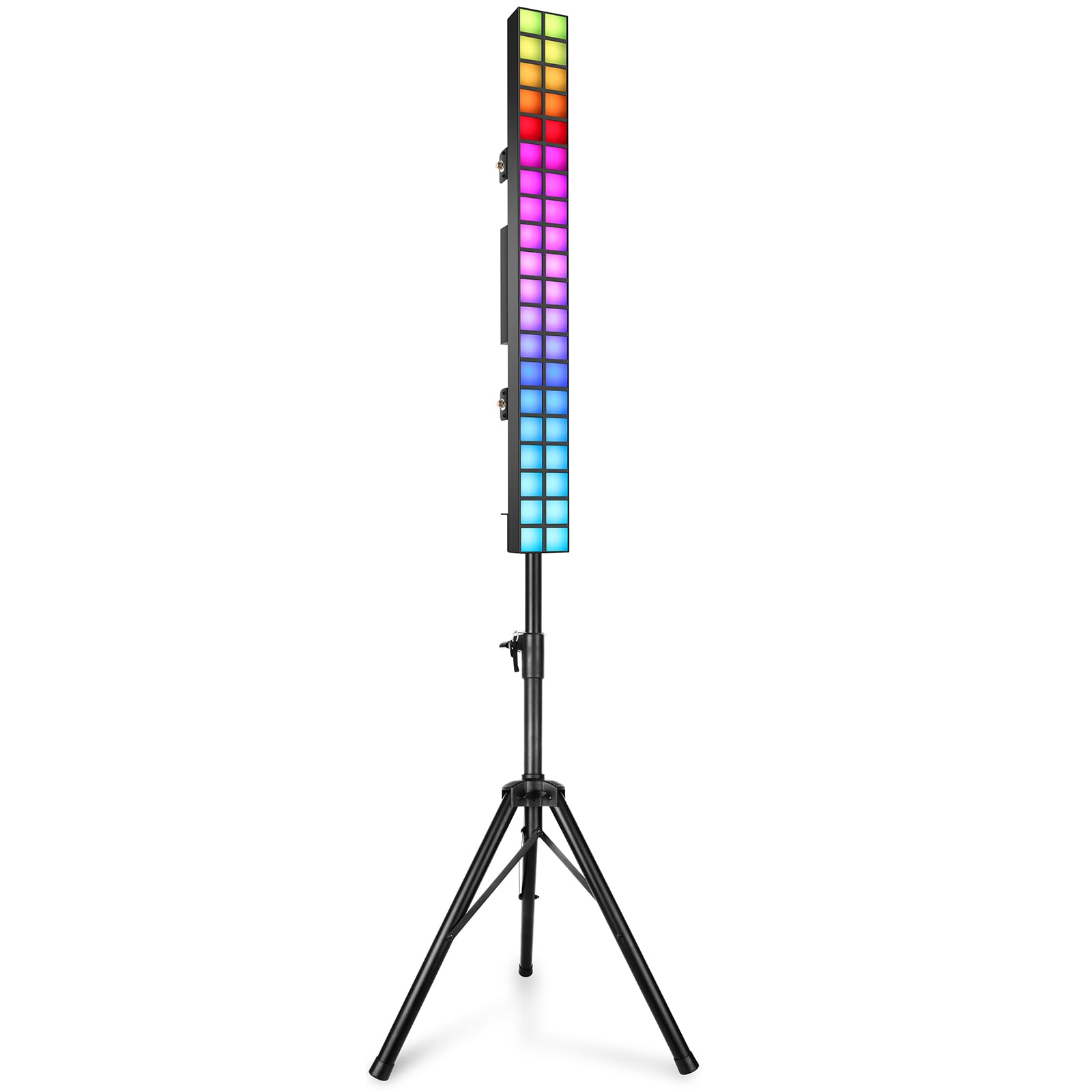
1. LaluceNatz 100W 40LEDs Stage Pixel Lights with Stand For DJ
Our pick — 4.5+★ from 200+ verified ratings; the strongest balance of quality and price.
Forty LEDs you can address one at a time, on a stand that sets up in minutes.
This is the one to buy if you want the stage to look like it was programmed, not just lit. The LaluceNatz bar runs 100 watts through 40 dual-row RGB LEDs, and each SMD 5050 bead (a flat, square light-emitting chip) can be mapped as its own pixel. That means the bar does not just change color — it chases color down its length, one bead at a time. It holds 4.5+ stars across 200+ owners.
The control range is the reason it takes the top slot. You get five DMX modes — 8, 20, 40, 60, and 120 channels — so the same fixture can be a simple four-color wash at 8 channels or a full pixel-mapped display at 120. For plain comparison, that is 120 channels against the U`King moving head’s 14. RDM support (Remote Device Management, a protocol extension that lets you change fixture settings from the controller instead of walking to the back of the bar) saves real time on a multi-fixture rig. The intuitive 4-button LED menu on the rear handles addressing without a manual.
The physical package is built for a working rig. A steel tripod stand is included, with tightening knobs so it goes up and comes down fast, and the bar can also sit on the ground as a wall wash. Its brushed aluminum casing has locking end caps on both sides, so two bars join end to end with no visible gap in the pixel spacing. The included hanging brackets cover truss mounting too. At 42 inches long it is a full-width statement piece — that is roughly four times the length of the OPPSK par’s 10.2 inches, so measure your stage before you commit.
Where the money goes
- 120 DMX channels with 40 individually mappable LEDs for real chase effects
- Tripod stand, hanging brackets, and power cord all in the box
- RDM lets you reconfigure the fixture without touching it
- Locking end caps for smooth bar-to-bar connection
- 95 built-in show effects when you do not want to program anything
Before you click buy
- 42 inches long — it needs a wide stage or a wide wall
- Wired to a mains outlet; there is no battery here
- The pixel depth only pays off if your controller can drive 120 channels
Reach for this if: you are building a rig you intend to program properly and want one fixture that can grow from simple wash to full pixel display.
Look elsewhere if: you have a narrow tabletop setup — this bar will overhang it.
2. OPPSK 90W 60LED Stage Par Light 2Pack
Two wash lights, two remotes, and a cooling fan that keeps them running all night.
If your plan is simply to wash a small stage in color, start here. You get two par cans, each with 60 RGB LEDs, and the pair runs at 180 watts total. What wins people over is how much light that produces for the money — the brightness is the second most-praised trait in the whole listing, and it shows the moment you power them up. A 25-degree beam angle (the cone of light the fixture throws) puts a defined circle on the performer rather than spilling across the entire wall.
The control story is honest about its limits. DMX512 is there for proper programming, and the back-panel buttons let you address each fixture by hand. The supplied IR remote is the convenience option — it works within roughly 3 to 5 meters (about 10 to 16 feet) of clear line of sight. Step behind a curtain or across a large hall and you will want the DMX cable instead. Built-in auto, fade, strobe, jump, and master-slave modes cover a set without a controller at all, and sound activation syncs the color changes to the music.
Two practical details earn these their place on the list. Each housing is ABS plastic with a metal mounting bracket, and each unit weighs 3 pounds — light enough to carry a pair in one hand between gigs. The hardwired power cord removes the plug-in failure point that cheap fixtures are known for. The honest trade-off: the built-in cooling fan keeps the LEDs cool but does make some operating noise, and it varies slightly unit to unit. In a quiet ceremony room you will hear it. Under a band, you will not.
What the pair buys you: two fixtures can light a small stage without tripping a shared circuit, because together they draw just 0.82 A (amps, the measure of electrical current). Each one throws a 25-degree beam (a fairly tight, focused cone of light). If you are counting load, compare that 0.82 A against the U`King moving head’s 0.3 A.
The catch: the remote is a close-range convenience, not a long-throw controller, so plan on DMX once your rig grows past a couple of fixtures.
Start here if: you need two reliable color washers for small rooms, church stages, or a first band rig.
Go bigger if: you already know you want pixel effects — this pair does wash, not chase.
3. Telbum DJ Lights with Stand, 5 in 1 Party Bar Light Set
A disco ball, a par wash, a strobe, a black light, and patterns — all on one tripod.
Rented room, no lighting knowledge, one hour to set up: this is the fixture for that night. The Telbum PartyBar bundles five effects into a single bar — a rotating dome disco ball, a colorful RGB par section, red and green pattern projection, a black light, and a white strobe. In auto mode all of them run at once, which is why owners describe it as instantly party-ready. The build quality is the standout strength of the whole unit, and it shows in the powder-coated finish and the folding tripod.
Setup is the real selling point. The included tripod detaches, folds, and retracts, so the whole bar goes up and comes down in minutes with no truss and no clamps. The 17.7-inch bar weighs 4.7 pounds, light enough to carry in one trip and small enough to leave assembled between events. The dome ball projects single or multi-colored beams floor to ceiling and wall to wall — add a little smoke and the beams really show. Pattern projection throws dozens of red and green patterns at once, enough to cover a spacious living room.
Know what this is and what it is not. It is not a DMX fixture — there is no channel addressing here, so you drive it from the remote or from sound activation rather than a lighting desk. The par section gives you jump, fade, strobe, and static color modes across red, green, blue, purple, amber, cyan, and white. The strobe has four flashing speeds, which makes it a strong Halloween pick. The honest caveat that shows up in owner feedback is long-term reliability — some units have stopped working after a handful of outings. Treat it as a party fixture for occasions, not a touring workhorse you run five nights a week.
What the price covers: five distinct effects plus a stand in one 10-watt bar means you are not buying five separate fixtures, five power cables, and five mounting jobs.
Who it is not for: anyone booking regular paid gigs who needs DMX addressing and predictable fixture life across a season.
Best fit: the wedding, birthday, or holiday host who wants a full-looking light show from one box and one outlet.
Think twice if: your controller-based rig is already built — this bar will not join it on DMX.
4. U`King Moving Head Light RGBW 2 Pack

Two heads that pan and tilt, so the beam travels instead of sitting still.
Static fixtures light a spot. Moving heads throw a beam across the room, sweep the audience, and land on the drummer right when the chorus hits. This pair from U`King does that with seven 10-watt 4-in-1 RGBW LEDs per head — four color chips in each LED, so red, green, blue, and white mix inside the lens rather than overlapping as separate spots. Each light is rated at 4100 lumens with a 25-degree beam angle, and the strobe runs from 1 to 25 HZ for fast cuts.
The movement range is what you are paying for: 540 degrees of pan and 180 degrees of tilt, which covers a full sweep across the stage rather than a narrow arc. Five control modes cover every level of operator — DMX512, sound activated, remote, master-slave, and automatic — all reached through an LCD panel with a 4-button menu on the side. If you are comparing against a bar, note that this offers 9 or 14 DMX channels versus the 120 channels on the LaluceNatz pixel bar. Fewer channels, but each channel moves a motor.
Two details make owning this easier than the spec sheet suggests. It draws only 0.3 A (amps), so it is gentle on your power. The declared service life is 100,000 hours — a long rated figure that reflects the LED source, not a promise about the motors or the housing. Cooling and heat dissipation are built for long sets. A flexible bracket lets you hang it on truss or set the head on a wall or floor. The flip side of a moving head is the motor inside: some owners have seen a color channel dim or a green LED drop out over time, and moving parts are one more thing that can wear. Buy from a seller with a warranty and test both heads the day they arrive.
The moving-head payoff
- 540° pan and 180° tilt put the beam anywhere in the room
- RGBW mixing gives you true white, not a pale blue-white
- 1-25 HZ strobe for tempo-matched effects
- Five control modes plus a 4-button LCD menu
Weigh this honestly
- Motors and color chips are the wear points — test both heads early
- Only 9/14 channels, so no per-LED pixel control
- Same 25-degree angle as the OPPSK pars, so narrow-beam effects only
Pick these if: your show needs motion and you want beams that sweep rather than spots that sit.
Stay with a bar if: you want pixel-level color control instead of physical movement.
5. BETOPPER Stage Lighting 120W Par Light RGBW 4-in-1, 4 Packs

Four pars tuned for faithful color, not just bright color.
Anyone who has lit a subject on camera knows the problem: skin goes orange, white fabric goes blue, and no amount of dimming fixes it. This BETOPPER set is aimed squarely at that. Each light runs 60 RGBW four-in-one LEDs (red, green, blue and white chips in one unit) at 120 watts, with a color rendering index (a score for how faithfully a light shows true colors) rated 95. That means the reds on a drum kit or a wedding dress read the way they should. Four fixtures in the pack also give you even coverage across a stage instead of one hot circle.
The output is not modest either — a 5000-lumen maximum with a 15-degree beam angle gives you a defined, punchy throw. Compared with the OPPSK par’s 25-degree angle, this one concentrates harder, which suits a stage where you want the performer picked out and the background left darker. Four control modes — auto, sound, DMX, and master-slave — over 4 or 8 channels keep the setup simple. Effects include color changing, pulsing, and gradient, and a 3500 Kelvin color temperature gives you a warm white when you need a neutral look.
What makes these worth the step up is consistency. A single metal bracket on each fixture keeps the angle locked where you set it, and the four-pack means you stop shuffling two lights around a wide stage. Note the weight: 4.74 kg for the set means these are not pocket fixtures, so plan your stand or truss for real hardware. The 4/8 channel control is deliberately simple — if you want to program per-LED chases you are looking at the wrong product, and the wide pixel bars above are where that lives.
The trade you are making: a CRI of 95 and 5000 lumens buy you clean color and real throw, in exchange for a narrower 15-degree spread and simple 4/8 channel control.
The practical note: four matched fixtures at 120 watts each want a proper circuit plan, so map your power before the first load-in.
Choose this set if: color fidelity and even stage coverage matter more to you than pixel chases.
Pass if: your show depends on individual LED addressing across a fixture.
6. LaluceNatz 240W Stage Wash Light Bar – 448LEDs RGBWA

Four hundred and forty-eight LEDs at a 65-degree spread — this one floods the room.
When the job is covering a wide stage or a back wall with an even wash, beam spread beats beam punch. This bar runs 240 watts across 448 LEDs — 112 cool white, 112 amber, and 224 RGB — and throws them at 65 degrees. That is the widest angle on this list by a clear margin; the BETOPPER pars sit at 15 degrees. The result is a wall of light rather than a spotlight, with white and amber available alongside the usual RGB for proper bright white and warm-tone looks.
The zone control is what separates it from a plain wash bar. You get 32 independently controllable RGB zones plus 16 white and amber zones, so you can build strobe chases that travel down the bar and chase patterns that change color as they go. Five DMX modes — 7, 13, 82, 130, and 135 channels — let you start simple and scale up. The rounded convex lenses concentrate the output so the beam stays bright and controlled even at this spread. Adjustable strobe speed handles tempo work without extra gear.
Owners consistently call out the brightness and the color richness first, and the independent zone control gets noticed too — running colors separately on one bar is what makes it feel like a real lighting instrument. It measures 41 inches long, so it is a truss or wall piece, not a tabletop ornament. There is a metal finish and a one-year warranty behind it. Factor in that this fixture wants DMX (a standard control signal that lets a desk run each light) to reach its potential — running it on built-in programs leaves most of the zone control unused.
Why it earns its spot: white and amber LEDs in the array mean you no longer have to fake a warm tone out of RGB, and 32 RGB zones deliver chases a basic par cannot touch.
The limit: 65 degrees is a flood, so it will not throw a tight beam across a large hall — pair it with a narrower fixture if you need both.
Right for: church stages, wedding backdrops, and any wide room that needs even, colorful coverage.
Wrong for: tight spotlight moments where you need a defined shaft of light.
7. OPPSK 120W 36LED Stage Wash Light Bar with Detachable Cover

No fan noise, no round LED eyes in your color wash — just one clean bar of light.
Ceremonies, filmed services, and quiet rooms need lighting that does not hum. This OPPSK bar is designed with no fan, which is why it suits wedding venues and church sanctuaries where a cooling fan would be audible on a microphone. The second problem it solves is the look: smooth color mixing means the 36 RGBW LEDs (red, green, blue and white) blend without separation or dimmed lens corners. The bar reads as one continuous line of color rather than a row of glowing circles.
Control is built for people who program. Every three LEDs form a pixel zone, giving 12 independently controllable zones with built-in effect programs that ramp speed from 0 to 100%. That covers 56 built-in shows, so a school concert or a holiday service can run a full light program without a lighting designer — power on, pick a chase, walk away. RDM support (Remote Device Management, the setting-change-over-cable protocol) lets you reconfigure fixtures from the controller. Five DMX modes are not listed here, but the fixture does carry a 6-degree beam angle — the tightest on this list, so treat it as a beam accent rather than a wall flood.
Two hardware details make it genuinely easier to live with. Locking power in and out connections let you daisy chain power from one fixture to the next — a real upgrade over a plain IEC input (the standard push-in power socket) that can work loose. The aluminum housing is lightweight and allows smooth end-to-end pixel spacing when you join bars. At 39.4 inches and 4.4 pounds it hangs easily. Owners describe it as bright enough to read in daylight, and it works smoothly with wireless DMX controllers.
what separates it: fanless operation plus homogenized color — the two things that make a bar usable in front of a camera or a microphone.
Where it falls short: that 6-degree beam is a narrow accent, so do not expect it to wash a wide stage on its own.
The one for film and ceremony work: anywhere a fan, a hum, or visible LED dots would ruin the shot.
Not the one for: full-stage washing — you would need several, given the 6-degree angle.
8. U`King Rechargeable Par Can Lights 4 Pack

Four uplights with no cables to trip over and no socket to hunt for.
The room has two outlets, both behind the bar, and you need light on the dance floor. That is the problem these solve. Each of the four units has a built-in large-capacity battery and a lithium-ion cell, rated for continuous use beyond 12 hours — so a mobile DJ can light a room with no cable runs.. No power cables also means no gaffer tape across a floor and no outlet scramble in a hired venue.
Each lamp bead uses 1 watt, with RGB three-primary mixing (red, green and blue blended to make any color) and smooth blending — so the uplights produce clean color rather than harsh primaries. Control covers every level: a professional 7-channel mode, DMX512 (the standard lighting control signal), automatic, sound activated, master-slave, and remote control. The 0-100% dimming program and six lighting modes (color selection, color shade, color pulse, color transition, strobe, fade) mean you can run them straight off the remote for a simple event or address them properly for a programmed show. A 360-degree adjustable stand lets each unit sit on the ground or clamp to a truss.
Battery life is where you should read carefully. The spec says beyond 12 hours, and plenty of buyers report long runtimes over 10 hours — but some report a much shorter run of about an hour and a half. That spread is worth planning around rather than ignoring. Charge all four the night before, and for a long event keep a mains fixture as backup. At 1.9 pounds per unit in an aluminum housing, the set is easy to distribute around a room and to carry in one bag.
What the set buys you: 4 cordless fixtures, 7-channel DMX, and a 30-degree beam means you can place light where the room needs it, not where the wiring allows.
Plan around this: battery runtime varies across units and outings, so charge ahead of every gig and keep a plug-in fallback.
Made for you if: you shoot events in rented halls where running cable is a hassle or simply not allowed.
Skip these if: your event runs long and you need guaranteed light for the final hour.
9. U`King Stage Lights 10 Packs 36LED RGB LED Par Lights

Ten identical pars means light in every corner, not just the one you aimed at.
Ten fixtures changes the math of a room. Instead of hoping one bar reaches the back, you put a par in each corner, along the back wall, and on the truss — and suddenly the whole space is lit evenly. Each unit carries 36 RGB LEDs (12 red, 12 blue, 12 green) at 72 watts, with six color modes covering color selection, color shade, color pulse, color jump, strobe, and fade. Quality is the trait owners talk about most, and for a fixture bought in tens that matters.
These are plug-in units and the listing is explicit about it: not rechargeable and not battery wireless. That sounds like a downside until you realize the trade — no battery means no charging break and no fading output halfway through the night. For a two-hour performance or an all-night event, mains power keeps the output even from first song to last. The bracket and screws let you mount on a t-truss or a stage bar, or simply stand the light on the floor for an uplight wash.
Control is straightforward. Five working modes cover automatic, sound activated, master-slave, and DMX512 (the standard lighting control signal), and each light supports 7 channels. A DMX controller is part of the package, and a standard DMX cable chains multiple units so one central controller can run the whole set and sync with other moving lights. There are printed and online manuals for both beginners and experienced operators. One owner ran eight of these on a light stand throughout a two-hour performance without issue. Brightness is a fair split between those who find it plenty and those who want more, and durability is a weak spot for a small number of units — so buy from a seller with warranty support and test all ten on arrival.
Ten-fixture advantages
- Coverage no single fixture can match — corners, back wall, and truss
- DMX controller and 7-channel addressing included
- Mains power means steady output all night with no charge break
- Simple bracket and screw mounting for truss, stage bar, or floor
Where it asks more of you
- Ten plug-in lights need ten power points — plan the circuit load
- Output per unit is cozy rather than dramatic
- Test every fixture on arrival so any weak unit is caught early
Best for: a big room, a dance hall, or a school production where you need light everywhere at once.
Not for: anyone who needs one dramatic beam — that is a moving head’s job.
Know the Specs
DMX channels and what they control
DMX is a shared control language that lets one controller run many fixtures over a single cable. Each channel is one adjustable value inside a fixture — for a basic par, that might be red, green, blue, and overall brightness. A fixture listing 4 or 8 channels gives you coarse control. A fixture listing 120 channels can address nearly every individual LED, which is what makes pixel chases possible. Match your channel count to your controller’s capacity: buying a 120-channel bar while your desk handles 16 channels wastes most of the fixture.
Beam angle: flood versus punch
Beam angle is the width of the light cone, measured in degrees. A small number keeps the light tight and bright, throwing a defined shaft that cuts through haze. A large number spreads the light wide and soft, which fills a wall or a whole stage. A 6-degree fixture and a 65-degree fixture are two entirely different tools, not two versions of the same one. Rooms with no haze show very little from a narrow beam; large stages lose a narrow beam entirely. Choose the angle that matches the surface you are lighting.
Wattage and the power plan
Wattage tells you how much electrical power a fixture pulls, and it matters for two reasons: brightness and circuit load. A single 240-watt bar demands more from your mains supply than a 36-watt par, and ten fixtures of any size add up fast. Check the amperage figure where it is listed, and never assume a venue’s single outlet will run your whole rig. Battery fixtures sidestep this entirely, which is why they suit venues with few sockets.
Pixel mapping versus washing
Pixel mapping treats a strip of LEDs as many small lights rather than one, so you can chase color along the bar, build gradients, and create moving patterns. A wash fixture treats all its LEDs as one color at one intensity. Most small stages need wash first — an even, colored field is the foundation of any look. Pixel mapping is the layer you add on top when you want texture and motion within the bar itself.
Common Questions
Do I need a DMX controller to run stage lighting?
What is the difference between a par can, a light bar, and a moving head?
Will a narrow beam angle work in a room without haze?
How long do rechargeable par lights actually run on a charge?
Can I connect several light bars together?
Is a 4-in-1 RGBW LED better than a plain RGB setup?
How many fixtures do I need for a small stage?
Do the built-in cooling fans make noise the audience will hear?
Can these lights be mounted on a wallor truss?
What does RDM mean and do I need it?
Is it better to buy one powerful light or several smaller ones?
The Bottom Line
For most readers the strongest pick on this list is the LaluceNatz 100W 40LEDs Stage Pixel Lights with Stand, because its five DMX modes scale from an 8-channel wash to a full 120-channel pixel display on one fixture, and the included tripod gets it standing in minutes. If clean color and even coverage matter more than chases, the BETOPPER 120W Par 4-Pack delivers a 95 color rendering index across four matched fixtures. And if you are setting up in a rented room with no spare sockets, the U`King Rechargeable 4-Pack cuts every cable out of the equation — just charge all four the night before.
Whichever way you go, buy for the room you actually play and the controller you actually own. A 120-channel bar is wasted on a desk that tops out at 16 channels, and a 6-degree beam (a very narrow spotlight) is wasted in a room with no haze. Start with an even wash, add motion once the stage is lit, and let the venue decide if you need mains power or battery.
How we choose
We do not accept paid placement. Every pick is matched to a real buyer and a real use-case; we do not hands-on test units.
Sources
Specifications: manufacturer listings and product documentation. Review insights: verified customer reviews, as of November 2026. Pricing: not shown on this page (it changes often); check the current price via the retailer link.
As an Amazon Associate, Tactical Gear Guy earns from qualifying purchases. This does not affect which products we feature.