Specs are compiled from manufacturer listings and verified buyer reviews and can change over time — please confirm the key details on the product page before buying.
If the person you are buying for cannot reliably remember a ten-digit number, the phone is the wrong phone — not the person. A speed dial phone fixes that by turning a call into a single press: one button, one familiar face, one connection. The nine phones below all have real programmable speed-dial keys, and they split cleanly into two jobs — simple one-touch dialing for a kitchen counter, and photo-button models built for memory loss or low vision.
This guide is built by comparing the manufacturers’ published specifications and the patterns across verified customer reviews, so you get each pick’s real strengths and trade-offs instead of marketing spin.
You will see where each phone gives up something to gain something else, whether that is a loud ringer traded for a small keypad or photo keys traded for a screen. By the end you will know exactly which handset fits your kitchen wall, your parent’s bedside table, or a relative’s assisted-living room, and that is the whole point of a speed dial phone.
Top Picks


How To Choose The Best Speed Dial Phone
Most buyers get this wrong in the same way: they shop for the biggest buttons and ignore the dialing memory. Big keys help once you are already dialing. Speed-dial keys are what stop the call from happening at all — or worse, going to the wrong person.
Count the memory keys before anything else
Ask how many people actually need a one-press button. Two is enough for a couple of close contacts. Six to ten covers a wider family plus a doctor or caregiver. Every phone here lists its memory capacity in the name or the spec sheet, so match that number to the household rather than guessing.
Photo keys versus numbered keys
A photo key shows a face; a numbered speed-dial key shows a digit you have to remember is “3 equals Dad.” For anyone with memory loss or low vision, the photo version removes a step of recall. Numbered keys are cheaper and fine for a fully lucid user who just wants to skip typing.
Power, ringers and the real-world catch
Line-powered corded phones draw current from the phone line itself, so they keep working when the mains power drops — cordless bases do not. Ringer loudness is quoted in decibels (dB), a measure of sound pressure, and anything at or above 90 dB is genuinely loud in a quiet house. Check whether the model you want supports Caller ID or voicemail before you commit; several here are deliberately stripped of both to stay simple.
Side-by-Side Comparison
| Model | Best For | Speed Dial Keys | Ringer | Power | Amazon |
|---|---|---|---|---|---|
| AT&T Trimline 213★ Best Overall | Wall-mounted kitchen phone | 10-number speed dial | Visual ringer | No AC power needed | Amazon |
| Uvital Big Button PhoneSimplest Setup | Simplest senior setup | 2 one-touch + SOS | 120 dB max | No battery required | Amazon |
| Excelltel EX-LD-858HFWidest Memory | Wide family list plus speakerphone | 9 one-touch + 10 two-button | Adjustable, LED flash | Battery free | Amazon |
| Sacumea Picture Phone | Memory loss and cognitive decline | 9 photo memory keys | 110dB+ ring | No batteries required | Amazon |
| ZAMQIU 9-Photo Phone | Care homes and assisted living | 9 photo + SOS | Amplified, adjustable | No battery or AC power | Amazon |
| Sangyn Wood Grain Wall Phone | Retro style with real dial memory | 3 speed dial keys | 100 dB mechanical | No AC power required | Amazon |
| SWISSVOICE Xtra TMAX10 | Photo dialing with speakerphone volume | 6 photo memory keys | Adjustable, visual indicator | Corded, 3 AAA batteries | Amazon |
| VTech SN1107 | Low vision and talking feedback | 10 speed dial | Visual ringer | Corded with adapter | Amazon |
| VTech SN1127 | Answering machine and amplification | 8 photo speed dial | 90dB loud ringer | Corded with adapter | Amazon |
Detailed Reviews
1. AT&T Trimline Corded Phone 213
Our pick — 4.0+★ from 750+ verified ratings; the strongest balance of quality and price.
The wall-mountable classic that keeps ten names one press away and never needs an outlet.
The AT&T Trimline 213 is the easiest phone here to live with day to day, because it asks nothing of you beyond plugging in the line cord. It holds 10 frequently dialed numbers, each reachable with a single key press, so a spouse, a doctor and four grandchildren all get their own button.
Where it beats the cheaper two-button option above is memory — ten stored numbers instead of two, on a handset that has been a household staple since 1968. It also mounts to a standard wall phone bracket, which clears the counter entirely and lifts the keypad to standing height. Full receiver and ringer volume control plus a mute button round out the call handling.
The recurring gripe across the review pages is not the features but the luck of the draw: some units arrive with a weak ringer or reception that disappoints, while plenty of others work exactly as advertised. What wins people over is the oversized, high-contrast keypad with full backlighting, which stays readable in a dim hallway. The visual ringer flashes when a call comes in even with the ringer switched off, so a deaf or hard-of-hearing user still sees the phone ring. At 8 ounces the handset is light enough to hold through a long call.
What it nails
- Ten-number one-touch memory covers a whole family plus services
- No AC power, no batteries — survives an outage on line power alone
- Mounts to a standard wall bracket, freeing counter space
- Lighted keypad and flashing visual ringer for dim rooms
Where it gives ground
- No photo keys, so the user still has to remember which number lives where
- Ringer strength and reception vary unit to unit
Reach for this if: you want a dependable wall or desk phone for a fully lucid user who just wants to skip typing numbers.
Look elsewhere if: the user has memory loss — the numbered keys require recall that the photo models below remove.
2. Uvital Big Button Phone LD-265
Two buttons and an emergency key — the least confusing phone in the group.
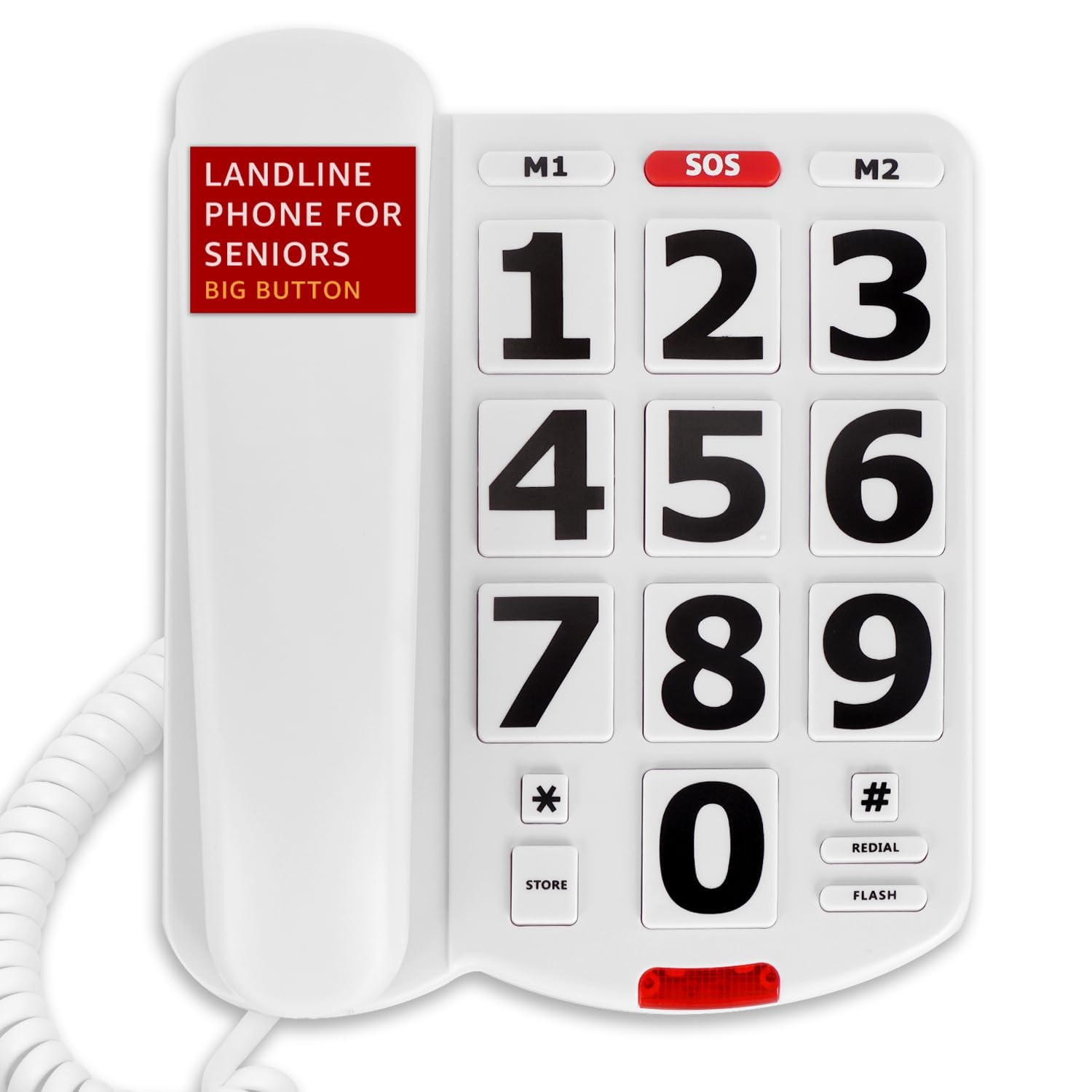
Uvital strips the phone down to the essentials: 2 programmable one-touch speed dial buttons plus a pre-programmed SOS key that dials for help the moment you lift the handset and press it. For someone who panics at a busy keypad, fewer choices is the feature.
The ringer slides between two levels, LO and HI, topping out at a genuinely loud 120dB — that will carry across a house. The handset volume gives you three steps through MED, HI and VHI. A bright flashing LED signals an incoming call in a noisy kitchen or for a hard-of-hearing user, and the whole thing runs off the phone line with no batteries or external power.
The honest limit is what Uvital left out. This is a PSTN landline phone only — no Caller ID, no voicemail, no display, no answering machine and no wall mounting. Some users also report spotty sound on calls even as others find it plenty loud. Program your two numbers and then leave the line plugged in, because unplugging it wipes the stored contacts.
The trade-off in one line: you get the clearest, least cluttered phone here in exchange for two memory slots and no screen.
Best matched to: a one- or two-person household where only a couple of numbers ever get dialed, and a fast SOS dial (an emergency button that calls for help) gives you real confidence.
Think twice if: you need Caller ID, voicemail or a larger contact list — this one gives you none of those.
3. Excelltel EX-LD-858HF Big Button Phone
Nine one-touch faces, ten two-button shortcuts — this is the phone that holds an entire extended family.
If the contact list is long, nothing here touches the Excelltel. It carries 9 one-touch speed dial keys plus 10 groups of two-button memories, so a whole family, a doctor and a neighbour can all get their own slot. Photo one-touch dialing makes the most-remembered names picture-based, which suits seniors with vision trouble or memory decline.
It also gives you hands-free calling for anyone with limited grip, and adjustable handset volume for personal hearing comfort. An emergency SOS function sits alongside the dial memory. When a call lands, the LED flashes in sync with the ring to give a visual alert as well as an audible one. Ringtone volume is adjustable, and the phone needs no batteries at all — just the line cord.
The catch is size. This is a substantial desk unit at 8.2 x 6.7 x 2.75 inches, so it needs real room. Compare it to the AT&T Trimline 213 above at 3 x 8.5 x 3.5 inches, and the Excelltel clearly takes up more surface. Give it a side table or a dedicated counter spot instead of squeezing it onto a narrow shelf.
Where it earns its keep: it pairs one-touch photo memory (press a saved face to call) with a second layer of two-button memories (press two keys to reach more numbers). That gives it more total saved numbers than any other phone in this group.
What to plan around: it wants footprint. Give it room to sit flat and it behaves; wedge it on a narrow wall shelf and it will not fit.
The right call for: a large household with several regular callers and a need for hands-free conversations.
Not the pick for: tight counter space — its larger body needs a real surface to live on.
4. Picture Landline Phone 9 Photo Memory Keys
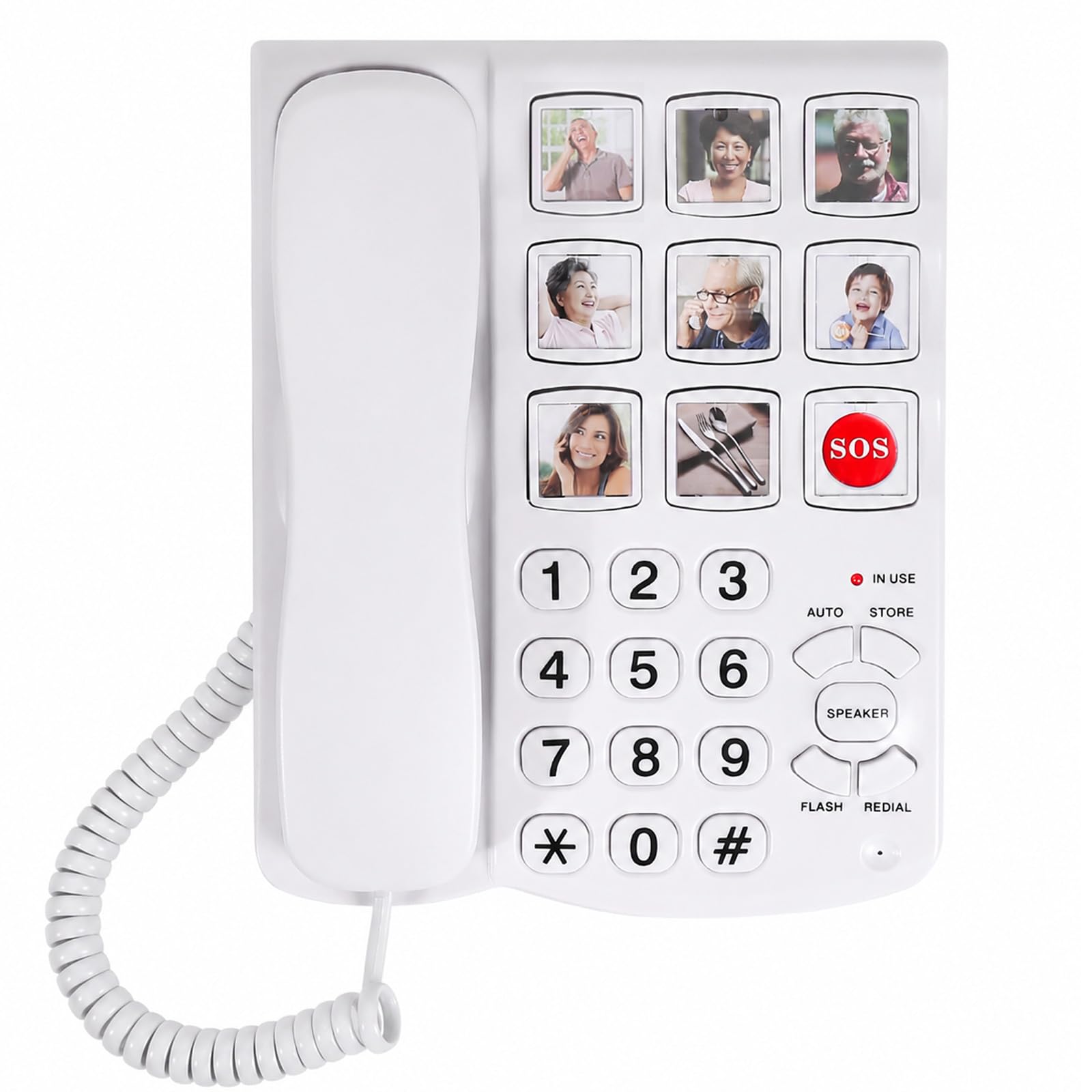
Nine faces on nine keys — you press the photo, the call goes through, and no number ever has to be remembered.
This is the phone you buy when memory loss is the whole problem. It carries 9 photo memory keys: you set a picture of each family member, and the user just presses the face. It is built specifically for poor vision, memory loss or cognitive impairment, and programming a number takes four steps in about twenty seconds.
Hearing gets proper treatment too. Ringtones reach over 110dB while the earpiece pushes past 90 dB, with 3 independent volume settings so the level adapts to the room. Hands-free calling removes the need to hold the receiver, which helps anyone bedridden or with arthritis in the hands. A flashing LED signals incoming calls in a noisy room, and redial and flashback keys handle the wrong-number moment without a menu.
What families discover after a week is that the photo buttons do more work than any spec sheet suggests — the familiar face is the instruction. The limit is honesty about features: no Caller ID, no voicemail, no message recording, and no wall mounting. Keep the phone line connected after you program it, because unplugging wipes the stored photo numbers.
Who it fits: a parent or relative with dementia, Alzheimer’s or poor eyesight who needs a single press to reach a familiar voice.
The honest caveat: it is deliberately stripped of Caller ID and voicemail, so confirm those are not needed before buying.
5. Corded Landline Phones for Seniors – 9 Big Picture Buttons & One-Click Dialing (ZAMQIU)
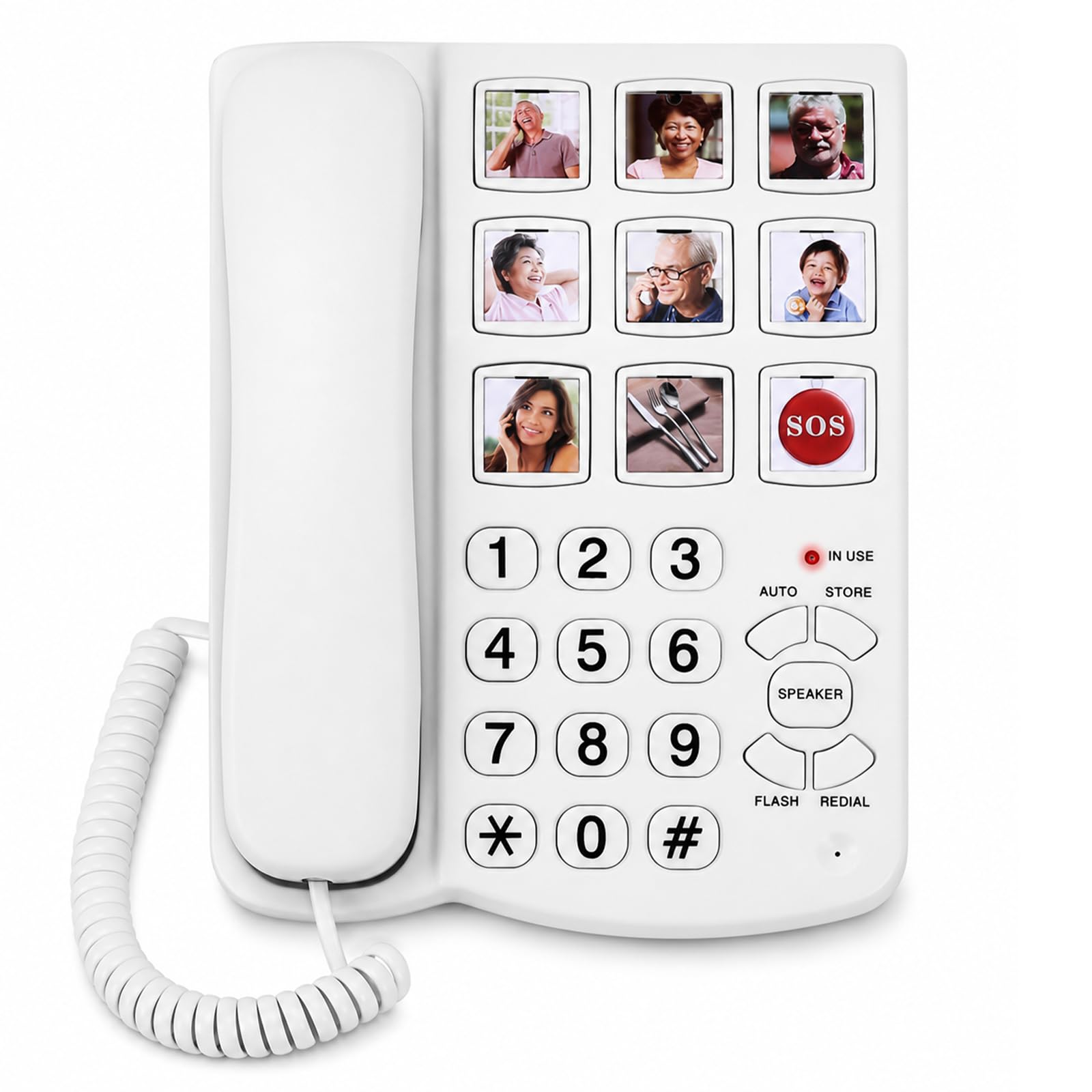
Photo keys the size of a coin, so shaky hands hit the right face the first time.
ZAMQIU’s photo keys are the reason to pick it. Each picture button measures roughly 0.88 x 0.88 inches — about the size of a 25-cent coin — which is a deliberate answer to arthritis, hand tremors and stiff fingers. There are 8 customizable photo speed dial buttons plus a programmable SOS key.
The ringer is amplified and adjustable, with both receiver and ring volume under user control and a flashing visual indicator for call alerts. Hands-free calling lets someone with a weak grip answer without lifting the receiver, and a redial key skips the search when a line is busy. It runs entirely off the standard RJ11 phone line — no batteries, no Wi-Fi, no cellular signal — so it stays live through a storm or power cut. The corded handset also means it never wanders off the way a cordless one does.
The genuine friction is programming. The dial buttons are large and clear once set, but the quick-dial setup itself is fiddly, and the high-pitched ring note wears on some households even when the volume is fine. Budget a patient half hour to program it, then leave it alone. Set up correctly, it suits a nursing home, hospital or assisted-living room as readily as a kitchen.
The case for it
- Coin-sized photo buttons are the easiest to press in this group
- No batteries — survives outages on line power alone
- Hands-free calling and redial built in
- One-touch dial plus SOS for emergencies
Where it asks patience
- Programming the quick-dial buttons can frustrate on first setup
- Ring tone is high-pitched to some ears
The match for: a user with shaky hands or arthritis who needs big, forgiving photo keys in a care-home or home setting.
The single caveat: set it up slowly the first time — the quick-dial programming rewards patience.
6. Sangyn Corded Phone Vintage Wood Grain Wall Phone
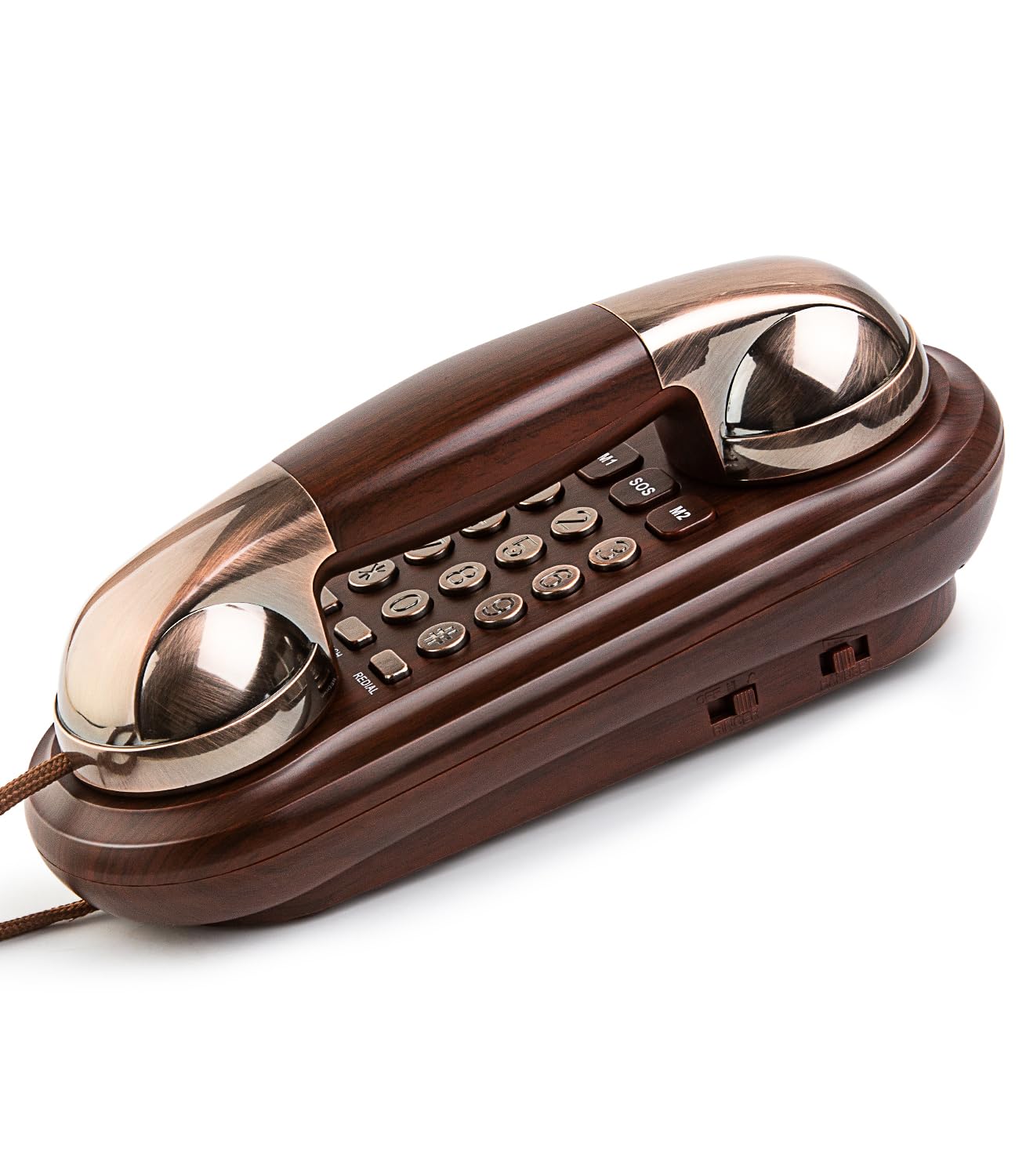
A redwood-grain wall phone that looks like a prop and rings like a fire alarm.
Most people buy this one for the look, but the 100 dB ringer is the spec that earns it a place here. That is loud enough to carry through a home or small business, and you can switch between modern electronic ringtones or a vintage mechanical ring. The ringer can also be turned off at night, and receiver volume adjusts for hearing loss.
Its 3 speed dial keys let you store a parent’s, a partner’s and a friend’s number for one-touch dialing, with a last-number redial alongside. Power comes from the phone line, so there are no batteries and no AC adapter, and it keeps working through an outage. It mounts on a wall or sits on a desktop, and the metal-textured buttons on the redwood grain body feel a step above plain plastic.
The honest read from the review pages is that looks carry this phone further than its build. Some buyers find the body less durable than the styling implies, and a few hit numbers it would not dial. As the gift it clearly wants to be — it arrives in a gift box with the base, handset, 79 inch handset cord, long and short extension lines, screw kit and backplane — it is a crowd-pleaser. Judge it as a statement piece with working speed dial, and it delivers.
What it is really for: a garage, office, hotel desk or kitchen where the retro look is part of the charm and the phone still needs to work.
What to accept: build quality is the recurring niggle — treat it as decor with a dial tone, not a lifetime handset.
The pick for: anyone who wants a conversation-starting wall phone with three working one-touch keys and a genuinely loud ring.
Skip if: you want a plain, tough desk phone for hard daily use — the styling matters more here than the shell.
7. SWISSVOICE Xtra TMAX10 Big Button Corded Landline Phone

Six photo keys you can label with faces, and dedicated volume buttons anyone can find.
Six memory keys suits a lot of households, and the Swissvoice turns each one into a photo button. Save a face for family, friends, caregivers or a regular service, and the user just presses the picture to call. No number entry, and fewer misdials to the wrong person.
Where it stands out is volume control. Dedicated plus and minus buttons give four volume levels for both handset and speakerphone calls, and the ringer adjusts separately. An incoming-call indicator flashes when the phone rings. The oversized number keys are clearly separated for eyesight and dexterity limits, and setup leans on plain operation — pick up, press a photo, talk, with no menus or touchscreen to navigate.
The trade-off is one real-world irritant: the menu and programming side draws gripes for being too involved for a phone that otherwise sells itself on simplicity. It also takes 3 AAA batteries rather than running purely on line power, so factor in battery changes. It comes with a one-year warranty and suits anyone who wants a familiar face to press and not much else.
Fits best when: six contacts cover your household and you want separate, easy volume buttons for handset and speaker.
Keep in mind: the setup menus are more involved than the rest of the phone, and it needs AAA batteries.
8. VTech SN1107 Corded Phone

It speaks each digit back as you dial, so a blind or low-vision user knows every number landed.
The SN1107 answers the problem the other phones here leave alone: dialing without seeing the keypad. It announces each number aloud as you press it and gives clear voice prompts, which lets a user with vision impairment dial accurately by ear. The 1.1-inch buttons sit in high-contrast colors for everyone else.
It stores 10 numbers for one-touch calling, and a bright flashing visual ringer fires even when the ring volume is low. A full-duplex speakerphone keeps a hands-free conversation from cutting in and out, and the phone is hearing-aid compatible with adjustable volume. As a corded unit it keeps working through a power outage — the reliable choice for a senior who wants a plain home phone.
One honest wrinkle from the review pages: a few phones only ring once before going quiet, so check that behavior early in your first week while a return is still easy. Otherwise the audio side is the standout, with owners describing loud, clear signal and easy-to-read large numbers. The package includes the base, handset, line cord, power adapter and a wall-mount bracket.
The standout: talking digits turn a keypad into audio feedback, which is the difference between guessing and knowing for a user who cannot see the keys.
Check early: confirm the ringer repeats properly on arrival — a one-ring cut-out is the fault worth catching in week one.
Made for: a low-vision or blind user who wants spoken confirmation on every digit and ten speed-dial shortcuts.
Worth knowing: it uses a power adapter in the box, so it wants an outlet nearby alongside the line cord.
9. VTech SN1127 Amplified Corded Senior Phone

Photo dialing, an answering machine and a 40dB hearing boost, all in one corded handset.
The SN1127 is the most fully equipped phone in the group. It holds 8 photo speed dial keys, each with a picture for memory support, and pairs them with an integrated digital answering machine — the one here that takes messages when nobody picks up. A 90dB ringer with a flashing visual alert carries through the house.
Hearing gets the most attention of any model here. A one-touch amplification button boosts incoming volume by up to 40dB, which is a serious lift for a user with real hearing loss. Oversized high-contrast buttons and a large display make dialing easier for anyone with low vision. There is a full-duplex speakerphone, spoken Caller ID and hearing-aid compatibility. And it is corded, so it works through a power cut.
The mixed point across the review pages is loudness itself: some houses find it plenty loud, others still struggle to hear clearly or hit dial-tone issues. When it works, the package holds up — reliable, simple to set up, large buttons well suited to elderly users, and quality that feels solid in hand. This is the phone for the household that wants the memory keys, the answering machine and the amplification without buying three separate devices.
Why it earns the top-tier slot
- Answering machine built in — no separate voicemail device needed
- 40dB one-touch amplification for real hearing loss
- 8 photo speed dial keys plus spoken Caller ID
- Corded design keeps working in a power outage
The honest caveat
- Loudness is judged differently home to home; a few report dial-tone trouble
- It is the biggest, most feature-heavy unit here to set up
The complete answer for: a household that needs photo dialing, message-taking and heavy amplification in one device.
Consider a simpler pick if: you want a minimal phone — this one’s answering machine and menus make it the most involved of the group.
Know the Specs
Speed Dial Keys (One-Touch vs Photo)
A speed dial key is a single button wired to a stored number, so a call takes one press instead of ten or eleven. Numbered one-touch keys save the number but still need the user to remember which key is which. Photo keys replace the digit with a face, removing that recall step — the useful choice for memory loss or low vision. Count how many contacts need a button before you pick, because the models here range from 2 to 10.
Ringer Loudness in Decibels (dB)
A decibel rating measures how loud the ring actually is. In a quiet house, a ringer in the 90–120dB range covers other rooms; below that it can get lost behind a TV. Some models pair the audible ring with a flashing visual indicator, which is what makes a call noticeable to a deaf user or in a noisy kitchen. Ringtone volume is often separately adjustable from receiver volume.
Line Power vs Batteries
A line-powered phone draws current from the phone line itself and works when the mains drop. A battery phone needs AAA cells or an adapter, and a cordless handset will not function in a power cut. For a senior or an emergency phone, line power is the safer choice — just confirm the model you want is not the battery type.
Hands-Free Calling and Amplification
Hands-free uses a speakerphone so the user does not hold the receiver, which helps anyone with arthritis or a weak grip. Amplification is a separate boost measured in dB — a one-touch button that lifts incoming volume, often up to 40dB on the senior models. Both are worth having, but they are not the same feature.
Common Questions
Will a speed dial phone work in a power outage?
Do I lose my stored numbers if I unplug the phone line?
Can a dementia phone with photo buttons still dial 911 in an emergency?
Do these phones support Caller ID and voicemail?
How many speed dial numbers should I look for?
Is a photo dial phone better than a numbered one for low vision?
Will my speed dial phone work on a VOIP line or a modem?
Can I wall-mount a speed dial phone?
How loud is loud enough for a hard-of-hearing user?
The Bottom Line
For most homes, the speed dial phone that wins is the AT&T Trimline 213. It gives you ten one-touch numbers, a lighted keypad (keys that glow so you can see them in the dark), a visual ringer (a light that flashes when the phone rings) and line power (it runs off the phone line, so no power adapter to fail). That is everything a lucid user needs, with nothing to go wrong. It is the crowd favourite here at 4.0+ stars across 700+ ratings. If memory loss is the real issue, reach for the Sacumea Picture Phone so a familiar face does the dialing. And for a household that needs photo keys, an answering machine and heavy amplification together, grab the VTech SN1127. Match the phone to the person in front of you and it will earn its place on the wall.
How we choose
We do not accept paid placement. Every pick is matched to a real buyer and a real use-case; we do not hands-on test units.
Sources
Specifications: manufacturer listings and product documentation. Review insights: verified customer reviews, as of November 2026. Pricing: not shown on this page (it changes often); check the current price via the retailer link.
As an Amazon Associate, Tactical Gear Guy earns from qualifying purchases. This does not affect which products we feature.