Specs are compiled from manufacturer listings and verified buyer reviews and can change over time — please confirm the key details on the product page before buying.
You want a real workout in your own pool, not just splashing around. Water drag is the fastest route: a foam dumbbell or a resistance belt turns ordinary laps and arm circles into strength work, with none of the joint pounding of a gym floor. The picks below cover every budget and every style, from a simple pair of foam bells to a full six-piece set that includes a buoyancy belt and ankle cuffs.
This guide is built by comparing the manufacturers’ published specifications and the patterns across verified customer reviews, so you get each pick’s real strengths and trade-offs instead of marketing spin.
You’ll learn which piece actually resists the water, how to match a tool to your joints and your pool, and where a cheap accessory saves you money versus where it falls apart. Here is the honest shortlist of the best swimming pool exercise equipment for a home pool or a lap lane.
Top Picks


How To Choose The Best Swimming Pool Exercise Equipment
Pool exercise gear works on one principle: the harder you push a shaped object through water, the more drag it creates, and drag is your resistance. A tool that floats is not a weight you press above your head — it is a paddle you fight against underwater. Understand that and the shopping gets simple. Pick the tool that matches how you move, then check it will survive chlorine and your grip.
Match the tool to the body of water and the motion
Foam dumbbells and bars are the entry point for arm and shoulder work in waist-deep water. They float, so you push them down and let them fight back on the way up. If you want resistance while you swim laps, you need a tether-style tool: a belt that anchors to a ladder or fixed point, or a parachute that trails behind you. A resistance belt turns a short pool into an endless lane by pulling you back toward the wall. A parachute adds drag behind your legs without tangling your stroke, if the cords behave.
Foam quality and grip decide longevity
Most of these tools are EVA foam — a closed-cell, high-buoyancy foam that resists soaking up water and dries fast. Cheaper foam degrades, cracks, or takes on water and loses buoyancy. Look at the handle: aluminum inner tubes and molded plastic handles hold up better than bare foam that thins out with use. A padded grip keeps the tool in your hand during a wet, sweaty set, and a non-slip texture helps when you’re moving fast.
Fit and adjustability on belts and cuffs
A swim belt or ankle cuff only works when it stays where you put it. Belts list a waist range or a stretchable band; check the upper limit against your body before ordering. Cuffs with a hook-and-loop sticky strap adjust over a wider range and hold tighter than a fixed loop. If you plan to share the gear with family, adjustable buoyancy blocks or interchangeable foam plates let one set work for a child and an adult.
Side-by-Side Comparison
| Model | Best For | Tool Type | Length | Adjustability | Amazon |
|---|---|---|---|---|---|
| Finis Swim Parachute★ Best Overall | Lap swimmers chasing resistance | Parachute | 8″ | Adjustable belt | Amazon |
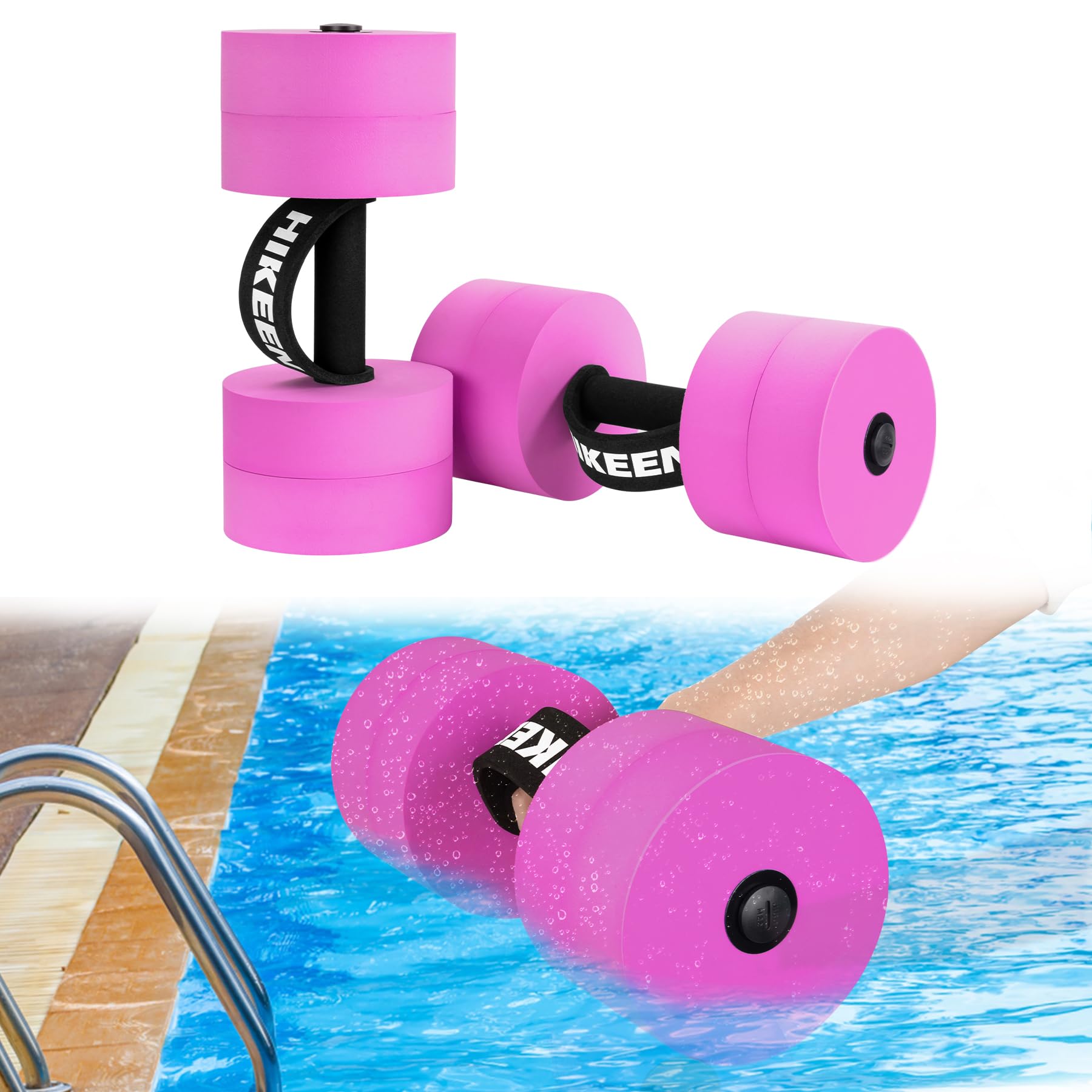
| Hikeen Aquatic DumbbellsMost Adjustable | Water aerobics with tweakable weight | Foam dumbbell | — | 4 foam plates | Amazon |
| Alckijy Swimming Training BeltEndless Lane | Endless-lane training in any pool | Resistance belt | Up to 25FT | Waist to 60″ | Amazon |
| Kemp USA Aquatic Bar Float | Pool lessons and light resistance | Foam bar | 26″ | — | Amazon |
| Water Gear Resistance Bells | Upper-body toning on sore joints | Foam dumbbell | — | — | Amazon |
| THERABAND Kickroller | Aquatic fitness classes | Floating kickroller | 31″ | — | Amazon |
| Aquastrength Pool Weights | Leg and glute drag work | Resistance fins | — | Hook & loop | Amazon |
| Sunlite Sports Combo Set | Full-body starter kit | 6-piece set | — | Belt + cuffs | Amazon |
| Sportneer Aqua Combo Set | All-in-one therapy bundle | 6-piece set | — | Belt 23″–47″ | Amazon |
Detailed Reviews
1. Finis Swim Parachute Resistance Training Equipment
Our pick — 4.5+★ from 800+ verified ratings; the strongest balance of quality and price.
A drag chute for your legs that turns a short lap into a strength session — the 8-inch swimming parachute.
The Finis Swim Parachute solves the problem every lap swimmer hits: a short pool and no way to load your stroke. Trail it behind you and the small red canopy — 8 inches wide — catches water and pulls back against your hips. The harder you sprint, the more it fights. Because it is a parachute (a fabric canopy with cords), it adds tension without a fixed anchor, so you’re not chained to a ladder. The adjustable belt lets you tighten the fit around your waist before each set, and it’s built to work across all four strokes, freestyle through butterfly, without interrupting your flip turns.
What earns it the top spot is the sheer build quality — the foam and canopy hold up session after session without shedding or tearing, and the drag amount stays consistent enough to measure your fitness over weeks. It’s the piece you reach for when you want to swim faster and stronger in a pool too short for distance work. The 0.27 kg (about nine and a half ounces) weight means it rolls into a swim bag without taking space.
The honest caveat is adjustability. The strap and cords can tangle between your legs on the kick during freestyle, pulling the chute off-line mid-lap. Think of it as the tool for the swimmer who wants resistance on the move, not a session of foam curls in the shallow end.
Where the parachute earns its keep
- Build quality is the standout — the canopy and belt hold up to repeated pool use without fraying.
- Works across all four strokes without disrupting your flip turns, so you keep your stroke form intact.
- The drag scales with your effort: sprint and it pulls hard, swim easy and it eases off.
- Light enough at 0.27 kg to live in your swim bag.
The one chore you’ll deal with
- The cords can slip between your legs mid-kick and tangle — check routing each set.
- No fixed anchor means the resistance lives entirely in how hard you swim.
Reach for this if: you swim laps and want to add real drag without buying a tethered belt — the 8-inch chute is the cleanest way to load a short pool.
Look elsewhere if: you want resistance you can set down and forget — a tethered belt holds a steady pull more predictably.
2. Hikeen Aquatic Exercise Dumbbells
One pair of pool bells where you choose how much drag to fight — four foam plates you stack per side.
Most water dumbbells come with a fixed shape, so you live with whatever drag you get. The Hikeen set lets you build the workout: four high-density EVA foam plates (a closed-cell, buoyant plastic foam that resists soaking up water) clip onto an aluminum handle tube, and you slide on as many as you want per side. More plates means more surface to push through the water, so you can make each rep harder or easier. That adjustability is why this pair suits a household where a beginner and a stronger swimmer share the same gear.
The aluminum inner tube is the upgrade note — bare foam handles go soft with use, but the metal core keeps the grip stable and doesn’t snap under a hard press. The foam resists water and dries quickly, so it won’t go musty between sessions. Grip is non-slip, which matters when your hands are wet and you’re driving the bell down against buoyancy.
The catch is durability on the plate joints. Some sets come apart under hard use, and the plates can work loose over time, so check the fit each session and don’t over-load the bell beyond what the handle wants to hold. It’s still the most flexible foam dumbbell here — just treat the assembly with care and it rewards you.
The build that matters: the aluminum handle tube and non-slip grip give you better control under load than a bare foam bar, and the four-plate setup means you dial resistance up or down to match your shoulder on any given day.
Real-world fit: stack fewer plates for gentle water aerobics, add more for a harder press. That range is why it’s the smart pick for a shared pool.
The sweet setup for: anyone who wants adjustable water resistance without buying three fixed pairs — the plate system covers beginner to moderate work.
Skip the over-load: cramming every plate on can strain the joints — build resistance gradually and re-seat the plates each session.
3. Alckijy Swimming Training Belt
Turn any pool into an endless lane — a bungee tether that stretches 25 feet and fits a 60-inch waist.
If you don’t have a counter-current machine, this belt is how you get the same effect for a fraction of the complexity. Anchor the nylon-and-rubber bungee to a ladder or a fixed point, clip it to your waist, and swim forward while the tube pulls you back toward the wall. That’s the endless-pool sensation — you keep swimming in place, and the elasticity gives you resistance on the way out and an assist on the way back. With up to 25FT of extension, it gives you a real forward-acceleration feel instead of a rigid leash.
The comfort details are built in: the band stretches to fit a 60inch waist, and thick inflatable foam on the anchor point cushions the pull so the band isn’t digging into your skin. The natural rubber tube provides the elasticity — it stretches and recovers rather than snapping taut. Fastening straps reinforce the belt so it lasts through repeated sessions. It suits adults and children aged 7 and over, and works across breaststroke, backstroke, crawl, and butterfly.
The trade-off is the setup: you must find a fixed anchor and get the belt snug, or the pull shifts and drags you off-line. Ladder rungs and pool edges work; a smooth wall with nothing to clip to does not. Get the anchor right and this belt trains you harder than a parachute because the resistance never eases regardless of how hard you swim.
The tether that does the work: a natural-rubber bungee stretching up to 25FT gives you genuine counter-current resistance, and the 60inch waist range plus inflatable foam keeps the pull comfortable across body types.
Matches: the swimmer with a small pool and a ladder to clip to — this is the most direct route to laps that go nowhere.
Mismatch: if your pool has no fixed anchor point, the belt has nothing to pull against and you’ll want a parachute instead.
4. Kemp USA Aquatic Bar Float

A long, cushioned foam bar for teaching and light resistance — the buoyant 26-inch workhorse.
This is the tool instructors reach for when a whole class needs something safe and easy in the water. The Kemp bar is a 26-inch cylinder of non-water-absorbing EVA foam, wide enough at 6 inches to grip with both hands or rest under a knee. It floats with plenty of buoyancy, so it does double duty: a light resistance bar for arm and shoulder movement, and a support float for beginners learning to relax in the water. The padded surface cushions your palm, so long sets don’t leave your hands aching.
Compared with the small 8-inch parachute above, this is a completely different animal — this is the teaching and light-movement piece, not a lap-training tool. The buoyancy makes it ideal for pool exercise programs, coordination drills, and general water-fitness classes. Its compact format stows easily after use and holds up to repeated pool sessions.
Durability is the one thing to watch. The foam is sturdy for normal use, but a sharp edge or a rough pool-bottom can nick it over time, so rinse and store it out of the sun. For lessons and gentle conditioning, it’s a dependable, honest float rather than a high-resistance trainer.
Why classes like it
- 26-inch length and 6-inch width give a stable two-hand grip for teaching.
- EVA foam resists water absorption, so it keeps its buoyancy instead of getting waterlogged.
- Padded surface cushions hands during long sets.
Where it stops short
- Light resistance only — not built for athletes chasing a hard load.
- Foam can nick against rough pool edges; store it with care.
Best for: swim instructors and beginners who want a buoyant support bar for lessons and gentle resistance.
Not for: the lap swimmer who wants drag that fights back — you’ll need a belt or parachute for that.
5. Water Gear Resistance Bells
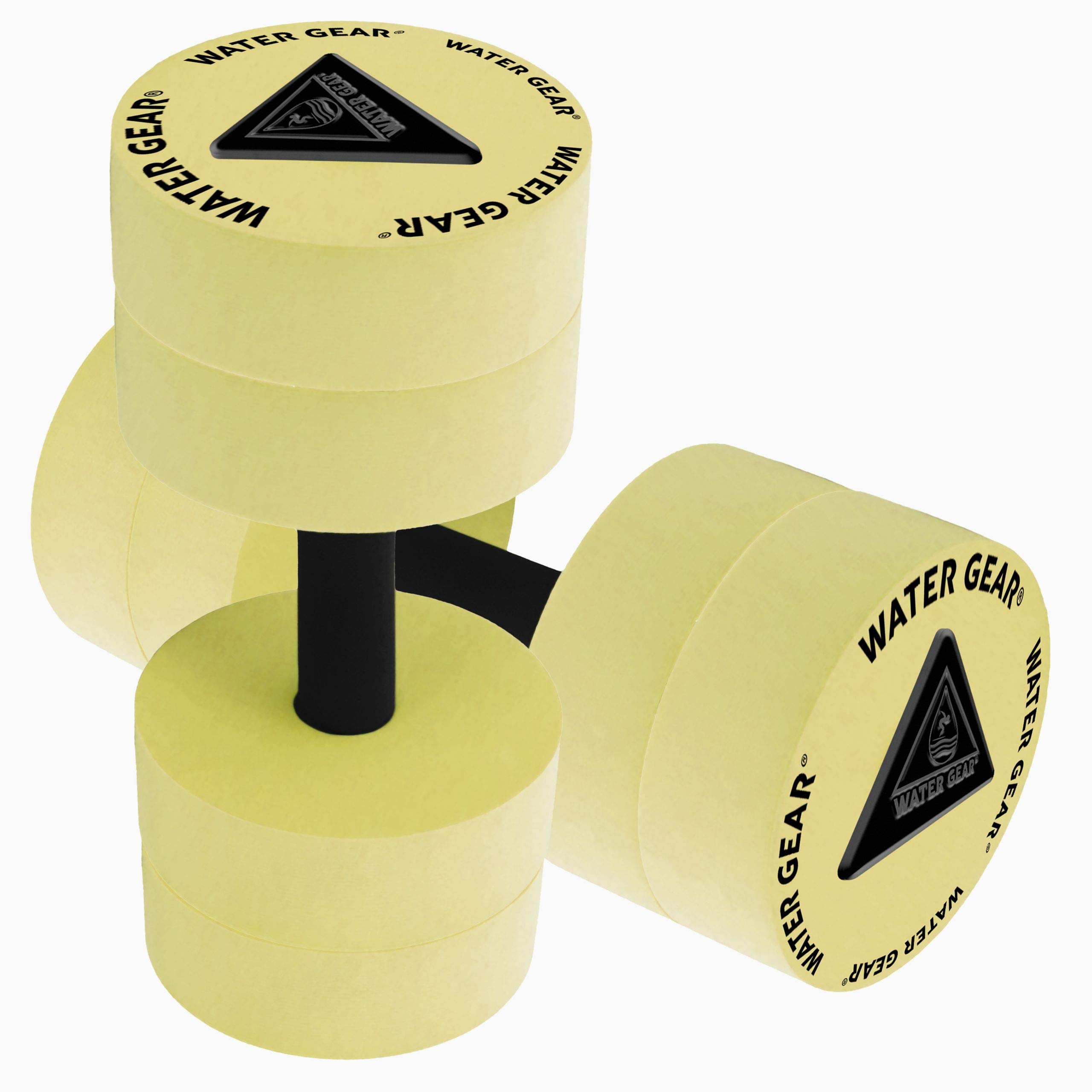
The pair you hand to someone rebuilding an injured shoulder — foam bells with a soft, padded grip.
These Water Gear bells suit anyone coming off an upper-body injury or wanting to move without joint stress. They’re a matching pair of professional-grade EVA foam dumbbells with a soft padded grip, sized for the hand rather than the lap lane. Push them down and they resist on the way up, loading your arms, abs, and lower back without iron’s joint pounding. That control is what makes them work for slow rebuilding sets.
Where the Finis chute above loads your stroke as you swim, these load a standing set — curls, presses, and arm circles in waist-deep water. The foam is chlorine-tolerant and rinses clean, and the padded grip means a long set won’t leave your hands raw. The pair format lets you work both sides evenly, which matters when you’re re-teaching one arm to pull again.
The honest limit is that these are fixed-resistance bells — no stacking, no dialing the drag up over time. When your strength returns, you’ll want the adjustable Hikeen pair or a harder tool to keep progressing. But for the building-back phase and everyday arm toning, they’re a solid, comfortable pick.
The recovery angle: a soft-padded foam grip and a matched pair make slow, even upper-body sets easy on a sore joint.
What you give up: resistance is fixed, so this is a starting tool rather than a long-term progression tool.
For the rebuild: anyone easing an arm or shoulder back into motion wants this soft-gripped pair.
Graduate later: once the fixed drag feels easy, a stackable set lets you keep adding resistance.
6. THERABAND Kickroller
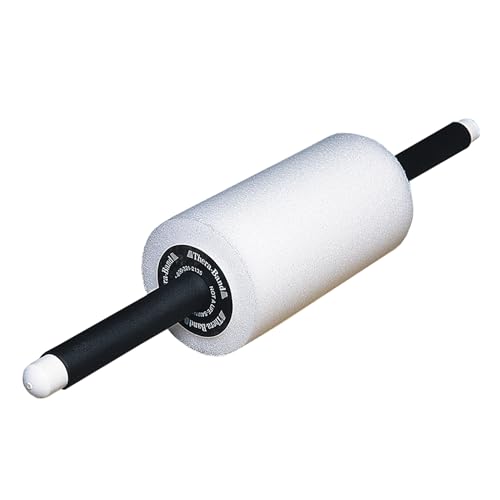
The 31-inch floating roller that gives a whole aqua-aerobics class leverage and balance in one tool.
This is the tool that shows up in aqua-aerobics classes because it solves a specific problem: you need something big enough to rest your arms or legs on, and buoyant enough to hold you up while you work. The 31-inch high-density foam roller floats and provides resistance, with two end handles at a 1-inch diameter. The wide padded grips give you a secure hold and multiple grip positions, so you can switch from a press to a pull to a kick without letting go. It engages upper body, core, legs, and back with one piece of equipment.
The long length is the point — it gives you leverage and balance support during drills, so you can move with control instead of bobbing around. The high-density foam holds up to repeated use in chlorinated pools, and it’s light enough to carry to class and stow after. This is a legitimate exercise device, not a pool toy, which is why fitness classes lean on it for strength-focused routines.
The trade-off: it’s a buoyant support and moderate-resistance tool, so it won’t load a serious strength session like the resistance fins or a stacked dumbbell will. And you have to keep your grip high on the handles for the best control — grip low and the balance shifts. For class work and full-body water movement, it’s a keeper.
The size that sells it: 31 inches of high-density foam with twin 1-inch padded handles lets you rest, press, and kick with the same tool — great for a full aqua-aerobics routine.
Where it lives: class and moderate conditioning, not heavy strength work.
Made for: aqua-aerobics regulars and anyone who wants one buoyant tool for balance, leverage, and full-body movement.
Keep in mind: it’s a support-and-moderate-resistance float — weightlifters will want additional load.
7. Aquastrength Pool Weights Resistance Fins
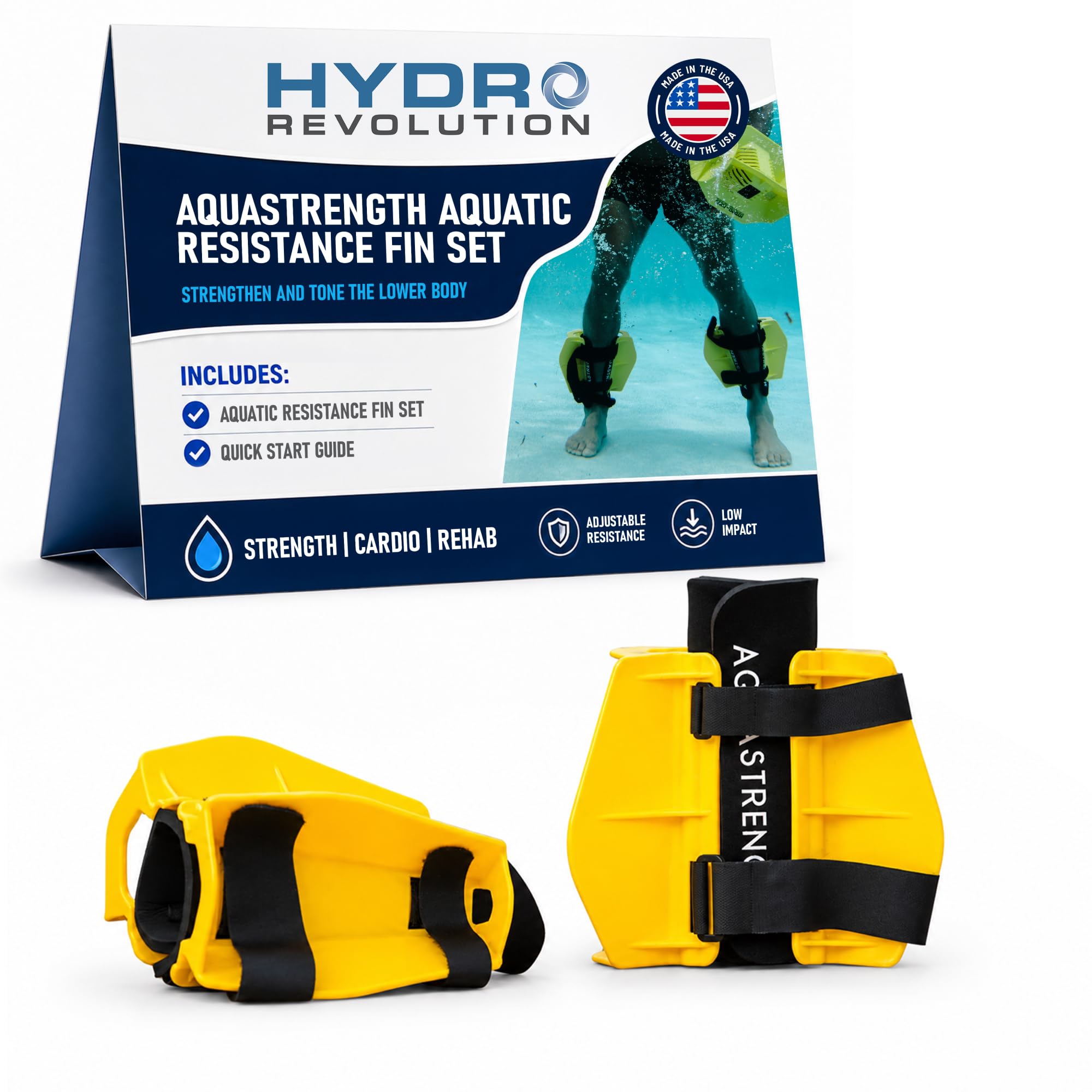
Four-blade fins for your ankles that turn water into leg-day resistance — the catch is feeling the drag.
Here’s a piece with a real job: strap the four-blade fins to your ankles or lower legs and every kick, step, and leg-lift fights the water. The patented four-blade design creates drag across forward, backward, and side-to-side movement, so your hips, glutes, quads, and core all get pulled into the work. Wear them on your forearms instead and you get the same drag for a hands-free upper-body session. It’s a clever alternative to clunky ankle weights for pool walking, aqua aerobics, and low-impact strength.
The fit system is what makes it usable for a group: a cinch-style dual hook-and-loop closure and a neoprene front sleeve give a snug, adjustable fit, and the tapered shape reduces sliding and rotating mid-move. The flexible plastic blades and neoprene pads are replaceable, so worn contact points can be renewed without buying a whole new pair. Made in the USA with U.S. and imported parts.
The catch sits in the resistance itself — it scales entirely with how fast and how hard you move, and the drag can feel light if you don’t drive the fins. Some users find the blades deliver a lot; others find they need to push harder to feel it. Match the speed to your goal, and check the strap tension before every session so the fins stay where you put them.
Why it earns a spot
- Four-blade drag hits legs, hips, and glutes in every direction you move.
- Wears on forearm for hands-free upper-body resistance too.
- Replaceable neoprene pads and straps extend the life of the set.
- Adjustable hook-and-loop fit with a tapered sleeve that resists sliding.
What to know before you buy
- Resistance depends on your own speed — move slowly and the load disappears.
- Strap tension needs checking each session or the fin shifts mid-move.
The pick for: anyone who wants to load the legs — walkers, aqua joggers, and class-goers who want drag without ankle weights.
Push it if: you want to feel the load — the fins reward fast, deliberate movement and go quiet when you coast.
8. Sunlite Sports Water Workout Combo Set

One box that outfits a whole pool workout — two bells, a belt, two cuffs, and a storage bag.
If you’re starting from nothing and don’t want to shop piece by piece, this six-piece set is the practical answer. It bundles a pair of high-density EVA foam dumbbells, an adjustable swim belt, a pair of aqua cuffs, and a storage bag — everything for water aerobics, resistance training, and aqua jogging in one order. The included step-by-step tutorial manual is the quiet advantage: it hands a beginner a routine instead of leaving them to guess how to hold the tools.
The foam is chlorine-resistant and quick-drying, so the set survives a pool season without going soggy. The belt and cuffs are adjustable for a snug fit across body types and fitness levels, and the set arrives pre-assembled, ready to use. The dumbbells and cuffs cover the arm and leg work; the belt stabilizes you for flotation-heavy exercises, so one kit handles a full-body session.
The one thing to check is the belt fit — some find it runs large on a smaller frame, so measure your waist before relying on it. The dumbbells are non-adjustable, which is fine for a starter but limits progression. As a complete beginner’s kit that covers the whole routine, it’s a smart way to start.
The all-in-one appeal: two dumbbells, a swim belt, two aqua cuffs, and a storage bag in one set, with a tutorial manual to get you moving — a full routine without a second order.
The one sizing note: the belt can run large, so check the waist fit before you depend on it.
Start here if: you have no pool gear yet and want a complete six-piece kit with a guide to follow.
Skip if: you already own weights and just need one adjustable piece — the non-adjustable bells cap your progression.
9. Sportneer Aquatic Exercise Equipment Combo Set

A six-piece therapy kit with a buoyancy belt you tune block by block — the full-body all-in-one.
The standout here is the swim belt: six buoyancy blocks that you add or pull off to dial how much float you want. More blocks mean more lift for flotation-heavy drills; fewer mean more work. That block-by-block tuning separates it from a fixed belt, and the hook-and-loop design means you swap blocks in seconds. Around that belt sit two high-density EVA foam water dumbbells with soft foam over durable PC tubes, plus a pair of water ankle weights with a sticky-strap closure.
The dumbbell handles carry two grip strips for a firm hold, and the ankle cuffs use a recessed structure that wraps around the ankle, wrist, or arm for stronger purchase. The whole set weighs 2.6 pounds and covers swimming classes, water therapy, underwater fitness, and aqua aerobics. It’s built as one complete tool kit, which is why it’s the pick for someone who wants every piece in a single box.
Watch the belt sizing: it’s made for waists from 23″ to 47″, so a larger frame will feel it. And six pieces is more to rinse, dry, and store than a single pair of bells. For a full-body routine with tunable buoyancy, though, it’s the most complete set in this group.
The tunable belt: six removable buoyancy blocks let you set the lift you want — more float for stability, fewer for work — backed by foam dumbbells and sticky-strap ankle cuffs.
Size check: the belt fits waists from 23″ to 47″, so confirm it covers your size before ordering.
The all-rounder for: a full-body routine where you want to adjust buoyancy by feel — the six-piece kit covers arms, legs, and flotation.
Consider another if: your waist is beyond the 47″ top of the belt range, or you’d rather manage a single tool.
Know the Specs
Resistance Type: Drag vs. Buoyancy
Pool tools create resistance two ways. Buoyant tools (foam bars, kickrollers, foam dumbbells) float and push back against your downward motion — good for arm and shoulder work, and gentle on joints. Drag tools (parachutes, tethered belts, fins) resist you as you move through the water — better for loading a stroke or a leg. Match the type to the motion: push-down for toning, tether-and-sprint for swim training.
Length and Stretch
Length changes leverage and coverage. A 26-inch bar gives a stable two-hand grip for teaching; a 31-inch kickroller gives full-body leverage; an 8-inch parachute is small enough to trail behind without tangling your stroke. On belts, check the stretch in feet — up to 25FT of extension gives a true endless-lane feel, while a belt that stretches only a few feet feels like a rigid leash.
Waist Fit and Adjustability
A belt that slips is a belt that ruins the set. Belts list either a waist range (like 23″ to 47″) or a maximum (up to 60inch). Check the top of that range against your measurement. Adjustable buoyancy blocks or interchangeable foam plates let one set serve different people and different intensities, and hook-and-loop straps hold tighter than fixed loops.
Foam and Handle Material
EVA foam is the standard for pool tools — a closed-cell, high-buoyancy foam that resists absorbing water and dries fast. Aluminum inner tubes and molded plastic handles add rigidity so the grip doesn’t go soft. Replaceable neoprene pads and straps extend a set’s life. Rinse and store any foam out of direct sun to slow breakdown.
Common Questions
What pool exercise equipment actually builds resistance?
Will a swimming belt fit my pool if I don’t have a current system?
How do I choose between foam dumbbells and resistance fins?
Is EVA foam safe to leave in a chlorinated pool?
What waist size does a swim belt fit?
Can I use pool exercise gear for aqua therapy or rehab?
Which is better for lap training, a parachute or a tether belt?
Do I need a full combo set or just one piece?
How much resistance will a foam dumbbell give me?
Can children use these pool exercise tools?
The Bottom Line
For most people building a pool routine, the swimming pool exercise equipment winner is the Finis Swim Parachute because it turns a short pool into a real strength session without an anchor or a machine. If you want laps that go nowhere with constant drag, grab the Alckijy Swimming Training Belt. And for a joint-friendly full-body start where everything arrives in one box, the Sunlite Sports Combo Set is the one to reach for. The honest nudge: picking the tool that matches your motion — push-down for toning, tether-and-sprint for swim fitness — matters more than any single spec, so start there and the rest falls into place.
How we choose
We do not accept paid placement. Every pick is matched to a real buyer and a real use-case; we do not hands-on test units.
Sources
Specifications: manufacturer listings and product documentation. Review insights: verified customer reviews, as of November 2026. Pricing: not shown on this page (it changes often); check the current price via the retailer link.
As an Amazon Associate, Tactical Gear Guy earns from qualifying purchases. This does not affect which products we feature.