Specs are compiled from manufacturer listings and verified buyer reviews and can change over time — please confirm the key details on the product page before buying.
You already know the hole is the right size. The question is whether the thread inside it will pass inspection, and that is exactly what a thread plug gauge answers. A plug gauge is a threaded, hardened metal plug that screws into a tapped hole to prove the internal thread is cut to spec. If the “go” end enters and the “no-go” end refuses, the thread is good. This guide covers the three gauges worth your money and what each one actually verifies.
This guide is built by comparing the manufacturers’ published specifications and the patterns across verified customer reviews, so you get each pick’s real strengths and trade-offs instead of marketing spin.
Below you’ll find a large NPT assembly for pipe threads, a certified UNF pair for machine work, and a compact Taperlock set for tight benches. Each listing is judged on thread standard, tolerance class, and how the gauge feels in your hand during a real inspection run. Picking the right thread plug gauge starts with matching the thread callout on your print.
Top Picks

How To Choose The Best Thread Plug Gauge
Most people buy the wrong gauge for one simple reason: they match the diameter and ignore the thread family. A 1/2″-20 UNF gauge will not verify a 1/2″ NPT pipe thread, even though both are nominally half an inch. Read the callout on your drawing first, then buy the gauge that names it exactly.
Match the thread standard before anything else
NPT is a tapered pipe thread, so the gauge itself is tapered and seats by wedging into the hole. UNF and UNC are straight machine threads, so those gauges are cylindrical and screw in fully. Getting this wrong means the gauge never gives you a clean reading, no matter how carefully you use it.
Understand what the “no-go” end is for
The go end checks the minimum thread size, meaning it must enter the hole. The no-go end checks the maximum, meaning it must not enter more than a couple of turns. Together they bracket the thread between two limits, which is why a two-piece set tells you far more than a single plug ever could.
Decide if you need certification
If you are inspecting your own work in a home shop, a plain gauge gets the job done. If a customer or an auditor wants paperwork, you need a certificate of accuracy and NIST traceability — a documented chain back to a national standard. Two of the three picks ship with certification documentation, and it is worth knowing before you order.
Side-by-Side Comparison
| Model | Best For | Thread Size | Thread Standard | Weight | Amazon |
|---|---|---|---|---|---|
| 401114520 2″-11 1/2 NPT Basic L-1 Plug Gage Assembly★ Best Overall | Large pipe threads | 2″-11 1/2 | NPT (tapered pipe) | 8 ounces | Amazon |
| 1/4-28 UNF-2B Taperlock GO NOGO Thread Plug Gage | Certified machine work | 1/4-28 | UNF (straight) | — | Amazon |
| 7/16″-20 UNF 3B Taperlock Gage Assembly | Precision shop benches | 7/16″-20 | UNF (straight) | 2.4 ounces | Amazon |
Detailed Reviews
1. 401114520 2″-11 1/2 NPT Basic L-1 Plug Gage Assembly
A two-inch pipe gauge that settles the argument about whether your NPT tapping is done.
If you are threading pipe and need a definitive answer, this is the one to own. It is built to the 2″-11 1/2 NPT callout — a tapered pipe thread where the gauge wedges in rather than screwing down flat. That taper is the whole point: a pipe thread seals by interference, so a straight gauge would tell you nothing useful about it.
You notice the weight first. At 8 ounces versus 2.4 ounces for the small Taperlock set below, the weight is what a plug this diameter should be — you feel the thread engagement through your palm as it goes in. Vermont Gage made it in the United States, and the assembly ships as a basic L-1 set (a standard two-piece set with a go gauge and a no-go gauge).
On a 2-inch tapered thread, the matched go/no-go pair is what makes the reading conclusive — a single plug only confirms one limit. The catch is scale: a 2-inch gauge lives in a 1.35-lb package and suits a bench with real room around the vise. If your work is small-diameter machine threading, the compact UNF sets further down are the smarter fit.
What earns its place
- Built specifically for 2″-11 1/2 NPT tapered pipe threads, the callout most home pipe threading gets wrong
- 8 ounces of solid gauge — heavy enough that you feel thread engagement as it wedges in
- American-made by Vermont Gage, a US metrology manufacturer, and listed on Amazon since 2010
- Sold as a basic L-1 assembly, so you get the matched plug set rather than one loose piece
Where it asks more of you
- Large and heavy next to small UNF gauges — it needs a stable bench and a clear working area
- Dedicated to one pipe size, so it will not help on smaller NPT fittings
Reach for this if: you are cutting 2-inch NPT pipe threads and need a gauge that proves the taper is right, not just the hole diameter.
Look elsewhere if: your threading work is small-diameter straight machine threads — the 1/4-28 set suits that bench better.
2. 1/4-28 UNF-2B Taperlock Thread Plug Gage
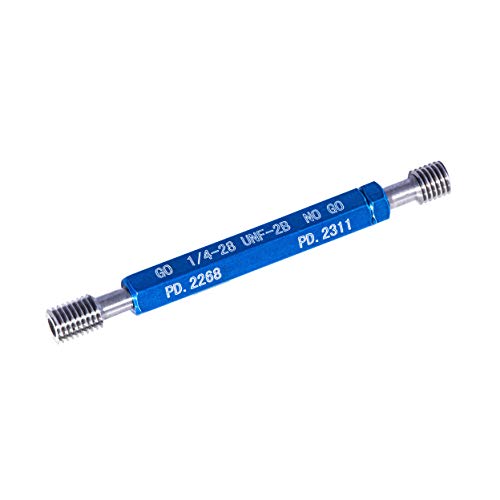
The small-bench workhorse for quarter-inch fine threads, and one of the certified sets here.
Quarter-inch, twenty-eight threads per inch, 2B internal fit — this is the classic fine-thread callout on instrument fittings, small brackets, and machined fixtures. The gauge arrives as a matched go and no-go pair, so one pass into the hole plus one refusal gives you a full thread verdict in a couple of seconds.
The word “Certified” in the title is the reason this set stands apart from the NPT assembly above. Where that gauge is a basic assembly, this one is sold with certification, which is what you want when a job or a customer requires inspection paperwork rather than a verbal yes. Taperlock construction means the plug is held in a tapered arbor, so it sits rigidly and repeats the same reading run after run.
Tanfel manufactures it, and the listing has been live since September 2019 — a long run for a gauge that keeps selling. Compared to the 7/16″-20 Vermont set below, this one covers the smaller fine-thread work that shows up far more often on a hobby or prototype bench. Set your expectations on scale, though — it is a small hand tool, not a bench standard.
Where the money goes: the certification and the matched go/no-go pair. Certification plus a matched pair is what turns this gauge into inspection evidence you can hand to a customer.
The part nobody mentions: a gauge only proves the thread is inside tolerance — it says nothing about surface finish or burrs, so deburr before you gauge or you will chase a result that was never about size.
This one wins on paperwork: a certified 1/4-28 UNF-2B go/no-go pair for anyone who has to document a thread inspection.
The honest limit: it covers exactly one thread callout, so a bench running several fine-thread sizes still needs more than one set.
3. 7/16″-20 UNF 3B Taperlock Gage Assembly

Class X tolerance and a NIST-traceable certificate in a gauge that weighs less than three ounces.
Class X is the tightest callout in this lineup, held to ANSI B1.2, and it is the reason this gauge belongs on a bench where the print actually says class X. The body is chrome plated tool steel hardened to 70/72 Rc — a hardness that keeps the thread form from wearing out of tolerance after repeated use. The pitch diameter is ground to.4050″/.4091″, which is the measurement band a 7/16″-20 thread is checked against.
It comes with a certificate of accuracy and NIST traceability, so the documented chain back to a national standard arrives in the box rather than as a phone call. That paperwork is what lets you hand the gauge’s accuracy to an inspector instead of arguing for it. Vermont Gage made this one too, and like the NPT assembly above it has been listed since February 2010.
Weighing 2.4 ounces, it is the lightest gauge here — easy to hold over a part for a long inspection run without your wrist tiring. That 2.4-ounce body is also a strong argument for keeping it boxed and separate: a hardened gauge this small can pick up a ding if it rolls around a drawer with taps. Keep it cased and separate from taps and drills so the thread form stays in tolerance.
The spec that decides it: class X tolerance per ANSI B1.2, ground to a.4050″/.4091″ pitch diameter band. On a 3B internal thread print, that tightness is what separates a real inspection from a rough check.
Pick this for class X work: a NIST-traceable go/no-go pair for 7/16″-20 UNF 3B threads when the drawing demands the tightest tolerance.
Worth knowing upfront: it verifies one thread size only, and hardened tool steel rewards careful storage over casual drawer life.
Know the Specs
Go and No-Go Ends
A go end is the minimum-size plug and must screw into the hole. A no-go end is the maximum-size plug and must stop within a couple of turns. Running both checks brackets the thread between two limits — one pass alone only tells you half the story, which is why matched pairs are the standard for real inspection.
Tolerance Class
A tolerance class sets how tightly the gauge itself is made, and class X is a tighter grade than the standard classes. On a gauge, a tighter class means less measurement uncertainty — so when the print calls for class X, buying a looser gauge gives you a reading you cannot defend. Match the class on the gauge to the class on the drawing.
NPT Versus UNF
NPT is a tapered pipe thread that seals by wedging into the hole, and the gauge is tapered to match. UNF is a straight machine thread and those gauges are cylindrical. They are not interchangeable: a straight gauge in a tapered hole reads wrong from the first turn, so pick the family named on the print.
Taperlock Construction
Taperlock refers to a plug held in a tapered arbor so it stays rigid while you turn it. A rigidly held plug repeats the same reading from part to part, which matters when you are inspecting a batch rather than a single hole. A rigidly held plug gives you the same reading part after part instead of a wobbly, repeatable-only-by-luck check.
Common Questions
What is a thread plug gauge actually used for?
Can I use an NPT gauge on a UNF thread?
What does class X tolerance mean on a gauge?
Why does certification matter on a thread gauge?
How long does a hardened thread gauge stay accurate?
Do I need both the go and the no-go gauge?
What does 2B or 3B mean in a thread callout?
What is Taperlock construction on a plug gauge?
How should I store a thread plug gauge?
The Bottom Line
For the majority of shoppers, the thread plug gauge winner is the 401114520 2″-11 1/2 NPT assembly because it is the definitive check for tapered pipe threads — the callout most home threading gets wrong and most often needs proving. If you need certification and paperwork, grab the 1/4-28 UNF-2B certified set for small fine-thread work. And for class X precision on a 7/16″-20 print, the 301137550 Taperlock assembly is the one to reach for.
How we choose
We do not accept paid placement. Every pick is matched to a real buyer and a real use-case; we do not hands-on test units.
Sources
Specifications: manufacturer listings and product documentation. Review insights: verified customer reviews, as of November 2026. Pricing: not shown on this page (it changes often); check the current price via the retailer link.
As an Amazon Associate, Tactical Gear Guy earns from qualifying purchases. This does not affect which products we feature.