Specs are compiled from manufacturer listings and verified buyer reviews and can change over time — please confirm the key details on the product page before buying.
Buying a full-face helmet as a woman usually means one of two frustrations: the shell swallows your head, or the “women’s” version is just a graphics package in a pink box. The picks below fix that in different ways — some run true-to-size with a genuinely intermediate-oval interior, some stay light enough that a long ride doesn’t wear your neck out, and one holds the group’s highest rating at 4.5+ stars. Start with the Shoei RF-SR if you want the safest shell here, then work down to your budget.
This guide is built by comparing the manufacturers’ published specifications and the patterns across verified customer reviews, so you get each pick’s real strengths and trade-offs instead of marketing spin.
Every helmet here is a true full-face — no open-face, no 3/4 shell, no modular flip-up pretending to be one. What matters is certification, shell material, interior shape, and whether the visor actually clears in the cold. Here is what separates a great women’s full face motorcycle helmet from one you’ll regret on a rainy commute. women’s full face motorcycle helmets only work when the shell fits your head shape, the certification is real, and the ant-fog setup holds up below freezing.
Top Picks


How To Choose The Best Women’s Full Face Motorcycle Helmets
For most riders the biggest pain is not the sticker shock — it is the fit. Women tend to have narrower a jawline and a rounder crown than men of the same circumference, so a helmet that clamps at the temples and floats at the chin is a bad helmet even if it passes every certification test. Get the shape right first, then worry about certification level.
Understand the Certification Level Before Anything Else
DOT FMVSS 218 is the U.S. federal minimum — every street-legal full-face here meets or exceeds it. ECE 22.06 is the European standard and demands more impact testing, so a helmet with both DOT and ECE 22.06 (like the ScorpionEXO Covert FX and both HAX models) has passed two testing regimes. Snell M2020D is a voluntary U.S. standard with its own test protocol, and it shows up on the Shoei RF-SR and ScorpionEXO R430. Two certifications is better than one, but certification does not compensate for a bad fit.
Pinlock, Fogging, and the Winter Question
Fog is the single most common complaint in every review pile here. A Pinlock insert is a plastic sheet that clips to the inside of the visor and creates a sealed air gap — that gap is what stops condensation. Some helmets ship with a Pinlock 30 insert installed (the ILM 129), one ships with a Pinlock 70 (the ILM MF509), and some are “Pinlock ready,” meaning the visor has the pins but the insert is sold separately. If you ride in a cold morning window, always check which one you’re getting — the pins without the insert stop nothing on their own.
Shell Material and What It Does for Your Neck
ABS and polycarbonate are the budget-tier materials — strong, affordable, and heavier. Fiberglass composites (like the Shoei’s AIM fiberglass-and-organic-fiber shell) and carbon-aramid (like the AGV K6 S) cut weight without giving up impact dispersal. Weight matters more than people realize: a heavy helmet at highway speed slowly loads your neck, and by hour three you’ll feel a composite shell over an ABS one. The trade-off you accept with lighter materials is higher cost, not necessarily less protection.
Interior, Liner, and Eyewear Compatibility
Look for a removable, washable liner — every helmet here has one, and it is the difference between a fresh interior and a stale one after a summer season. Eyewear-compatible cut-outs (ScorpionEXO calls it KwikFit, HAX and ILM both note glasses-friendly interiors) matter if you wear glasses or prescription sunglasses under the visor. Bluetooth speaker pockets are also worth checking — most riders here want to mount a Cardo or Sena without balancing speakers against their ears.
Side-by-Side Comparison
| Model | Best For | Certification | Weight | Interior | Amazon |
|---|---|---|---|---|---|
| Shoei RF-SR★ Best Overall | Best Overall | DOT, FMVSS 218, Snell M2020D | 3.5 lb | 3D Custom, washable, EQRS | Amazon |
| HAX Obsidian ProBest Dual Visor Value | Best Dual Visor Value | DOT, ECE | 2.09 kg | Hypoallergenic, Bluetooth slot | Amazon |
| HAX ForceBest Standout Look | Best Standout Look | DOT, ECE 22.06 | 4.6 lb | Removable hypoallergenic liner | Amazon |
| LS2 Stream II | Best Value KPA Shell | DOT, FMVSS 218, ECE 22.06 (AREM) | 2.16 kg | Washable interior, sun shield | Amazon |
| ILM MF509 | Best Anti-Fog Setup | DOT, ECE | 2.77 kg | Two head shapes, removable liner | Amazon |
| ScorpionEXO R430 | Best Premium Snell Pick | DOT, Snell | 5 lb | KwikWick C, KwikFit, EQRS | Amazon |
| AGV K1 S | Best Track-Inspired Pick | DOT, FMVSS 218 | 1580 g | Removable washable liner, double D | Amazon |
| ScorpionEXO Covert FX | Best All-Rounder Premium | DOT, ECE 22.06 | 4.6 lb | KwikWick C, KwikFit, 2 shields | Amazon |
| AGV K6 S | Best Featherweight Pick | ECE | 1290 g | Dry fabric, reflective neck roll | Amazon |
| HJC C10 Aspa | Best Entry-Level Entry | DOT, FMVSS 218 | 3.5 lb | Hygienic fabric, speaker pockets | Amazon |
| ILM 129 | Best Budget Pinlock | DOT, FMVSS 218 | 2.09 kg | Removable washable liner | Amazon |
Detailed Reviews
1. Shoei RF-SR Full Face Motorcycle Helmet
Our pick — 4.5+★ from 400+ verified ratings; the strongest balance of quality and price.
The shell that earns its price tag on quality, not on the badge.
Most women I hear from about the RF-SR say the same thing: the fit lands on an intermediate-oval head shape and the crown does not float. That is a slightly narrower shape than a pure round oval, and it means the shell compresses at the temples less and cups the jaw better. The 3D Custom Interior is moisture-wicking, removable, washable, and replaceable, so the liner refreshes instead of going stale. The EQRS tabs at the neck roll let emergency medical personnel pull the cheek pads and lift the shell without dragging it over a face.
On protection, this one carries DOT, FMVSS 218, and Snell M2020D — three stamps instead of the one you’ll find on most budget helmets. The AIM shell combines fiberglass and organic fibers in layered construction, which is a stiffer and lighter approach than a plain ABS tub. The 3.5 lb weight is mid-pack rather than light. The Pinlock EVO fog-resistant shield does the actual anti-fog work when you clip in the insert, and the optically correct face shield keeps vision distortion-free during evening rides.
What buyers reward most here is the quality of build — the vents seat cleanly, the visor mechanism feels machined, and the padding holds its shape across seasons. Almost everyone who mentions the fit finds it lands correctly. The honest follow-up question is noise: the collective verdict is mixed there, with highway riders wanting ear plugs while city riders find it fine. Skimp on ear protection and the 3.5 lb weight combine into fatigue on a long trip.
Certifications You Can Point To
- Carries DOT, FMVSS 218, and Snell M2020D — three independent certification stamps
- AIM shell layered in fiberglass and organic fiber for strength without bulk
- 3D Custom Interior is moisture-wicking, removable, washable, and replaceable
- EQRS cheek-pad tabs for emergency removal, plus Pinlock EVO fog-resistant shield
The Honest Catch
- At 3.5 lb it is mid-pack on weight, so long-ride neck load is real
- Highway noise is a genuine mixed bag — ear plugs are not optional for some
Go with the Shoei if: you want three certifications, an intermediate-oval fit, and a liner you can actually wash and replace without sending the whole helmet back.
A fair caution: the noise level is the one aspect that splits opinions, so budget for ear plugs if you do extended highway miles.
2. HAX Obsidian Pro Series Dual Visor Full Face Motorcycle Helmet
A dual-visor urban lid that solves sunrise glare without a visor swap.
Where the Shoei keeps things simple, the Obsidian Pro keeps things convenient. The outer clear visor works for normal riding and the inner tinted sun visor drops down when the sun hits — no fumbling for sunglasses or switching to a tinted shield. Both lenses carry UV-treated coatings that the maker says block about 98% of ultraviolet radiation. The matte finish is deep and the pink accents are legitimately subtle rather than loud.
The certification is DOT plus ECE, so you have passed both test regimes. The shell is ABS, EPS, and polycarbonate — that polycarbonate layer adds stiffness and cuts a little weight versus plain ABS. At 2.09 kg you are not racing the wind on weight, but the aerodynamic shell profile is designed to keep wind noise down at speed. The hypoallergenic liner holds up well for daily use, and the interior Bluetooth slot is standard — your Cardo or Sena speakers drop in without cutting foam.
Two things to know. First, the Pinlock pins are on the visor but the insert sells separately — you will need DKS166 or a compatible Pinlock 30 lens if you want real anti-fog. Second, the glasses-friendly interior is genuinely glasses-friendly because the eye port is wide, so riders with thick frames don’t get pinched. The pink colorway plus the matte shell makes this one of the sharper-looking budget-adjacent helmets in this group.
Best for the daily: The dual-visor system plus eyewear compatibility makes this a strong pick for commuting, and the Bluetooth slot removes the usual frustration of hunting a speaker pocket. It handles the everyday ride cleanly.
One detail to plan for: the Pinlock insert is not included, so add that to your setup cost if you ride through winter mornings. The helmet is ready for it — the pins are already there.
This is your pick if: you want a drop-down sun visor, DOT plus ECE stamps, and a Bluetooth slot without paying premium-tier money.
Worth knowing: anti-fog needs a separately sold Pinlock lens — the visor is ready, but the insert is not in the box.
3. HAX Force Aerodynamic Full Face Motorcycle Helmet
The helmet that marches into the dark and lights you up on the way.
The Force is the one people notice. The luminous Thunder Pink pattern glows on dark roads, which adds visibility at night in a way a reflective sticker can’t match. By day it reads as a sharp glossy or matte shell; after sundown it lights up. The aerodynamic ABS plus polycarbonate shell is built to cut wind noise at speed, and the retractable sun visor means you get shade without swapping shields mid-ride.
Both DOT and ECE 22.06 stamps are here, which is worth flagging — ECE 22.06 is a stricter European standard that tests a wider range of impact scenarios than the previous 22.05 certificate. The dual lens setup pairs a UV-protective outer lens with the retractable inner sun visor, so your eyes get protection without a jacket-pocket full of visor swaps. Pinlock and Bluetooth are both ready, though the accessories are sold separately. A carrying case ships with it, which is a small thing but useful if you store the helmet on a shelf.
Two honest notes. At 4.6 lb this is the heaviest helmet on this list, and combined with the wide XL-to-XXL size ranges, the fit feels more wide than the intermediate-oval picks. The appearance is what buyers praise most, and the fit and comfort come right behind. The recurring mixed verdict is fog — it fogs up when conditions swing — so treat the Pinlock-ready pins as a “buy the insert” note rather than a fix that’s already handled. Noise swings from fine to windy depending on speed. Visibility is the one aspect that splits clean down the middle.
What lands with owners: the glow pattern, the pink colorway, and the aerodynamic shell cut do their job — this helmet earns its place by looking different from every matte-black tub on the same rack. The DOT plus ECE 22.06 pairing backs the style up with real certification rather than just good looks.
The pay-off trade: at 4.6 lb the neck load is real on long rides, and fog is the mixed bag that most riders end up fixing by adding the Pinlock insert and closing the visor all the way. Those are the two costs to weigh against the look.
Reach for the Force if: you ride at night, want to be seen on the dark road, and want a helmet that gets its certification right instead of leaning only on the glow.
Look elsewhere if: you need featherweight neck comfort — 4.6 lb is the top of this list and it feels it on a long day.
4. LS2 Helmets Stream II Full Face Motorcycle Helmet

The sport-styled shell that brings rotational impact tech to the mid-price shelf.
LS2 does not usually get on this list for the paint job — it gets on because of the Kinetic Polymer Alloy shell and the AREM rotational energy management. AREM is the LS2 system that addresses angled impacts, and it meets ECE 22.06 alongside DOT and FMVSS 218. That is three stamps at a mid-price tier, which is why the value verdict on this one is strong. The dynamic flow-through ventilation moves air through rather than around, and the aerodynamic shell is tuned for the sport riding position.
At 2.16 kg it’s on the lighter side of this group. The sun shield is a real functional add — LS2 calls it a SunShield and the helmet ships with a clear shield fitted. The matte America gray-and-black finish reads sharp without pushing into the loud zone. The helmet includes only itself as an included component, so a second tinted shield is a separate purchase if you want one.
Fit is the recurring conversation. Some buyers find it great, others find the cheek pads tighter than expected — that is a cheek-pad volume difference, not a bad shell. The quality verdict is the most mentioned aspect here, followed by value for money, so the build consistency is what holds up. Noise and airflow both split. If you run small-jaw, try one size up if possible and confirm the cheek-pad swap policy.
Where the Stream II Holds Up
- DOT, FMVSS 218, and ECE 22.06 with AREM rotational energy management
- Kinetic Polymer Alloy shell at 2.16 kg — lighter than several premium-tier helmets here
- Ships with a clear shield and sun shield for light management on the road
- Quality and value are the two aspects buyers call out most
Where It Needs a Weight-In
- Cheek pads run snug — the fit verdict is genuinely split between great and tight
- A second tinted shield is not included; you buy it separately if you want it
Try the Stream II if: you want three-way certification with AREM rotational protection at the value end and can size up one step to dial in the cheek fit.
One honest caution: the cheek pads are the recurring snug-fit note — if you know you run a wide jaw, plan a size-up or order the appropriate pad set from the start.
5. ILM Full Face Motorcycle Helmet MF509

A dual-visor lid with a Pinlock 70 that actually wants to work in the cold.
The MF509 brings the most serious anti-fog setup in this group outside the premium names — a Pinlock 70 lens and mask ship in the box, and the Pinlock 70 is ILM’s step up from the Pinlock 30 for better anti-fog performance. If you ride mornings below freezing, that insert is the difference between seeing the road and wiping your visor with one hand at a stoplight. The dual visor pairs a clear outer with an inner tinted visor for strong light and UV. The visor lock seals the shield when it’s down, which also cuts wind noise.
Certification is DOT plus ECE. The shell is ABS with a black EPS liner — lightweight but on the heavier side of light. Two head models are built in for European and American riders, which is a specific recognition that fit is not universal, and the Italian-designer influence shows in the oval shape. The inner shape is specifically stated as oval. If you already know you need an intermediate-oval, the MF509 is a valid candidate but you should check whether the oval shape sits right before committing.
Appearance is what buyers praise most in volume and the fit comes second. The anti-fog verdict is positive and it is the one functional trait the helmet consistently earns credit for. The recurring split is noise — a low-noise crowd versus a wind-noise crowd — and ventilation gets a genuine mixed verdict with some praising the vents and some finding them insufficient. The purple colorway is a real standout in a category that trends conservative.
Best for winter riding: if your commute runs through cold mornings, the Pinlock 70 in the box earns its keep — you get the anti-fog insert installed and a dual visor without paying extra for either. The visor lock keeps the shield seated for less whistle at speed.
One reality check: the helmet is heavier than the composite-shell picks here, and noise is a mixed bag. The oval shape is different from the intermediate-oval fits listed elsewhere, so try before ordering if you can.
Pick the MF509 if: a Pinlock 70 in the box and a dual visor setup are worth more to you than shaving grams off the weight.
Check your head shape first: the shell is cut oval, which is not the same as intermediate-oval — measure and check the interior shape before you commit.
6. ScorpionEXO R430 Full Face Helmet
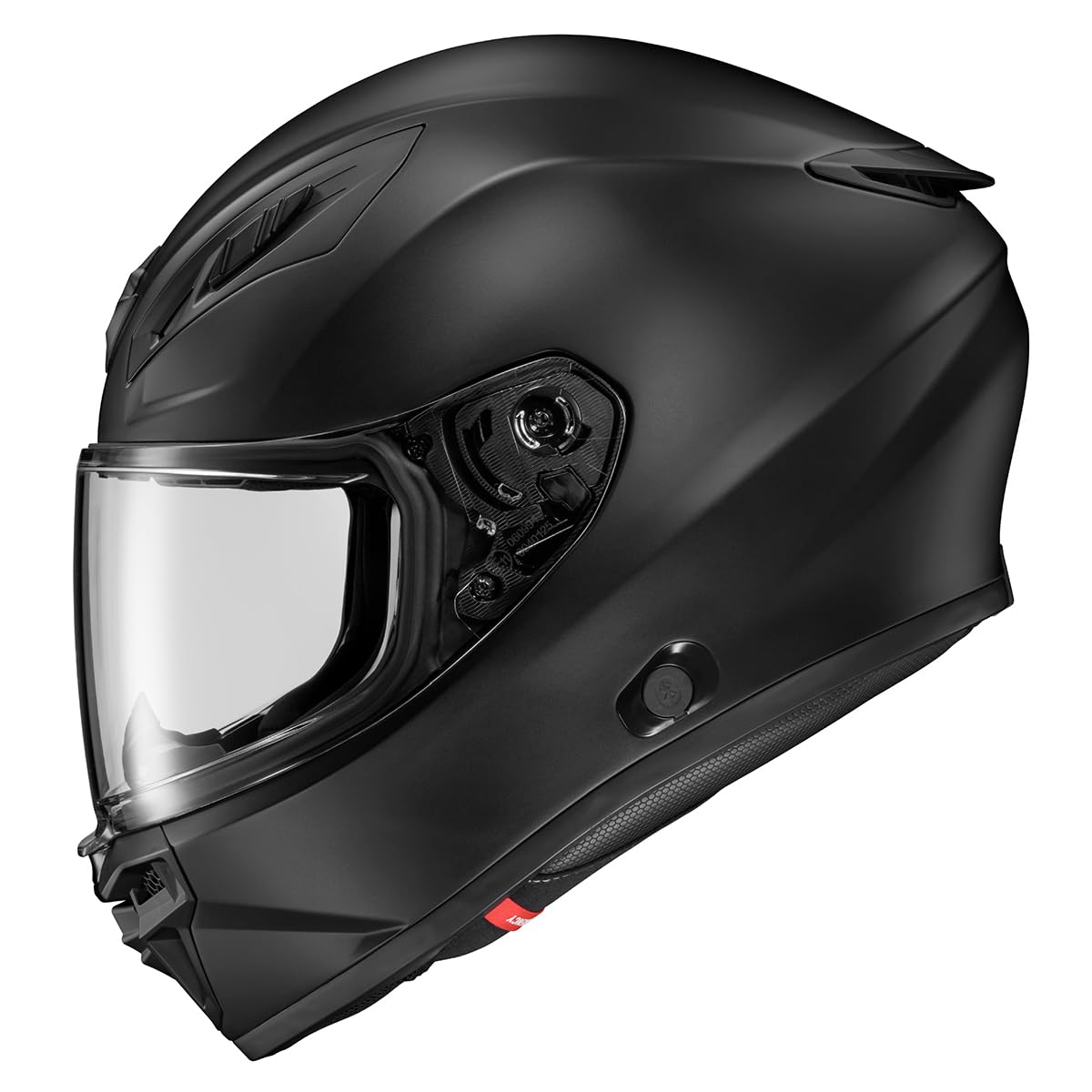
The optical-grade visor pick with Snell certification and a five-year warranty.
The R430’s signature move is its Optical Class 1 Shield — a visor with varied thickness across the lens that enhances visual accuracy and reduces glare without distorts. That is not marketing fluff here: the shield also carries a 99% UV-A and UV-B coating and an anti-scratch hard coat. Preinstalled as clear no-fog, it handles daily light well. The Advanced Polycarbonate shell is CAD-refined for a streamlined profile, and the aero-tuned vents with closeable intake vents on top and exhausts on the rear push warm air out.
Snell certification appears here alongside DOT, and the Emergency Release System tabs on the neck roll let emergency medical personnel pull cheek pads and lift the shell. The KwikWick C liner is moisture wicking, quick drying, removable, and machine washable — that is a big deal for summer riding. KwikFit cheek pads accommodate most eyeglasses. The dual homologation sizes XS to 4XL (3XL and 4XL DOT only) mean one of the widest size runs in this group.
Fit and quality are the two aspects owners land on most. Appearance, design, comfort, and value for money all draw positive mention. The honest mixed notes are the visor mechanism — some riders say you have to fight it to pop the shield off — and sizing, where some find it right and some find it much smaller than anticipated. The size mix means measuring is non-negotiable. The Ellip-Tec III ratchet has a smaller footprint and smooth detents, so the shield function isn’t bad; it just runs a little tight when removing.
Where it earns its premium: Snell plus DOT certification, a five-year warranty, and the Optical Class 1 Shield with varied lens thickness — the visor work here is genuinely unusual at this tier. The KwikWick C washable liner and KwikFit glasses pads round out the daily comfort story.
The honest friction: the shield ratchet needs a firm pull, and sizing runs compact — if you land between S and M, size up and confirm the exchange window before you ride. The 5 lb weight is the other honest note on long rides.
Best for the long-haul rider: Snell certification, a five-year warranty, and an optical-class visor make the R430 the pick for anyone who values clarity and certified protection over shaving weight.
A real caveat: the visor mechanism and sizing both split opinions — plan a size-up or a try-before-you-commit step if you can.
7. AGV K1 S Solid Gloss Full Face Motorcycle Racing Helmet
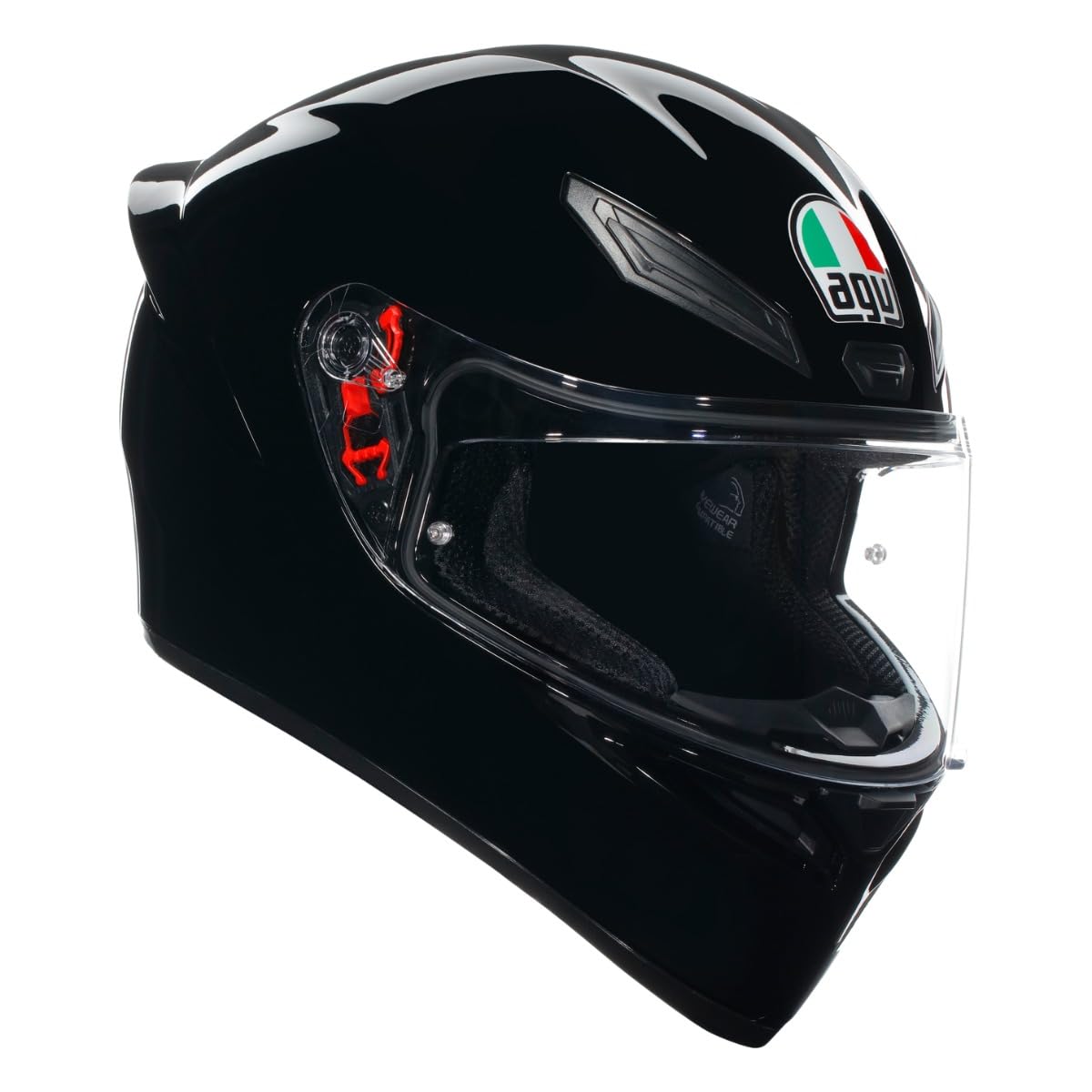
The race-bred lid that comes in two shell sizes instead of one-size compromise.
Two shell sizes is the detail worth leading with. A size small and a size extra-large using the exact same outer shell means the smaller head is carrying extra foam — the AGV K1 S solves that by offering two distinct shells so the fit stays balanced across sizes. The high-resistance thermoplastic shell is on the heavier side of polycarbonate (1580 g), but the two-shell strategy distributes the weight better against the crown. Large front and crown vents with rear extractors keep constant air moving through.
The visor is a Pinlock MaxVision-prepared GT4 with a wide field of view, and the clear visor comes included. If you want the anti-fog insert you buy it separately — MaxVision-prepared means the visor accepts the insert, not that it ships with one. The double-D ring chinstrap closure is race-proven and stays secure on track-day head checks. DOT FMVSS 218 certification and a removable, washable liner mean you can refresh the interior without replacing the helmet.
The quality read on the K1 S is very strong, and the fit comes second. Appearance gets a real mention — one gloss-black finish pairs well with any color visor. Noise level and size both split in mixed verdicts, so try before committing if you can. If your head runs intermediate-oval with a narrower crown, the K1 S sits well; if you have a wider circumference, check the sizing chart carefully.
Why the K1 S Holds Its Ground
- Two distinct shell sizes rather than one shared outer — better balanced fit at both ends
- Double-D ring closure and DOT FMVSS 218 certification
- Pinlock MaxVision-ready GT4 visor with wide field of view and clear shield included
- Removable, washable liner plus large front and crown vents with rear extractors
What You Should Know Going In
- Pinlock insert for anti-fog is sold separately even though the visor is prepared for it
- Noise and size both split in mixed verdicts — measurement check before you commit
Choose the K1 S if: you want a race-shaped lid with a double-D ring, a MaxVision-ready GT4 visor, and two shell sizes that let a smaller head avoid carrying extra foam.
Set expectations: the anti-fog insert is not in the box — add it if you ride through fog-prone mornings.
8. ScorpionEXO Covert FX Full Face Motorcycle Helmet

The featherweight composite that hands you a free fog-free dark smoke shield.
The Covert FX is the light composite pick. The TCT-Ultra shell is built for strength and impact dispersal, and at 4.6 lb it undercuts the heavier Snell-certified pick above. It carries both U.S. DOT and ECE 22.06 certification, and ECE 22.06 means the wider range of testing that comes with the newer standard. The dual position mouth vent is the clever piece: position one acts as a defroster, position two combines defroster and ventilation, and both close from inside the helmet.
A free additional dark smoke EverClear fog-free shield ships in the box. That EverClear shield is fog-free on the inside and carries 95% UV-A and UV-B protection plus an anti-scratch hard coat. The clear shield is also included, so you get two shields in the package and swap per condition. The shield ratchet pulls the visor securely against the eye port for a proper seal. The KwikWick C liner is moisture wicking, and the KwikFit 3D cheek pads accommodate most eyeglasses.
The helmet has speaker pockets for a comm system, reflective material in the cheek pads for night visibility, and a neoprene chin curtain to keep wind out. The liner is removable and washable and the warranty runs five years. What buyers reward most here is quality, then fit, then comfort — a strong all-around stack. Ventilation is the mixed aspect, so it works but is not the helmet’s strongest trait. Noise is the positive stand-out among the smaller aspects, so quiet cruising is genuinely achievable at speed.
Best for the all-day rider: two shields in the box, a dual position mouth vent, and a TCT-Ultra shell that stays light on the neck — the Covert FX is the pick for someone who spends a full day in the saddle and wants to be able to see clearly at both ends of it.
One honest note: ventilation is the mixed bag here, so if you ride in high summer heat you may want more airflow than the one intake vent on top delivers. The rest of the package is strong at this price.
Switch to the Covert FX if: you want a lightweight composite shell, two shields in the box, and DOT plus ECE 22.06 in the same purchase — no add-ons needed for daily light changes.
Consider the trade: the airflow mix is real, so summer riders in stop-and-go traffic should weigh the ventilation verdict before committing.
9. AGV K6 S Full Face Motorcycle Helmet

The carbon-aramid featherweight that makes neck fatigue a non-issue.
The carbon-aramid composite shell is the headline and the 1290 g weight is the payoff. That is the lightest helmet in this group, full stop. For a rider who rides 300 miles in a day, the neck load difference between 1290 g and 4.6 lb is not subtle — it is a difference you feel by hour three. The MotoGP-inspired aerodynamics and integrated rear spoiler keep the shell stable at highway speed in a way that lighter-weight helmets sometimes struggle with. The panoramic 190° visor widens the horizontal field of view to a genuinely usable degree.
The AGV multi-vent system plus rear extractors push cooling air through, and the vents are adjustable even with gloves on — that is a detail AGV has been building into race helmets for a long time. The interior is removable, washable, and uses Dry fabric technology. Reflective inserts on the interior help with night visibility, and the ergonomically designed neck roll is built for long-distance comfort. ECE certification is the stamp on this one, so it does not carry DOT — if you ride in the U.S. and need DOT compliance, verify the specific listing’s certification before ordering.
Fit and finish are what owners land on in reviews — the carbon shell finishes cleanly, the shield and vents feel precise, and the noise level is the positive stand-out among the smaller aspects. The helmet runs on the lighter side, which some riders interpret as “a smaller fit,” but the two-shell-size construction means the weight and volume should hold up across sizes. If you are going to invest in a premium helmet, the lightest option in a class that also carries a 190° visor and glove-friendly vents is a valid target.
The standout spec: 1290 g in a carbon-aramid shell with a 190° panoramic visor. That is the lightest helmet on this list with the widest field of view, and carbon-aramid is a genuinely premium material rather than just a marketing label on polycarbonate.
One thing to verify: the certification stamp here is ECE. If you need DOT for U.S. street riding, verify before you order. That is the one detail that separates a comfortable daily helmet from a compliance question at the roadside.
Go premium with the K6 S if: you do long ride days and want the lightest carbon-aramid shell on this list paired with a panoramic 190° visor and glove-friendly vents.
Verify first: ECE is the certification here — if DOT compliance matters for your state or your insurer, confirm the listing’s stamp before you commit.
10. HJC C10 Aspa Full Face Motorcycle Helmet

A DOT-approved starter lid with an enlarged sight of view.
HJC’s C10 is the entry point that actually gets the fundamentals right. The DOT FMVSS 218 certification here covers the full battery — energy absorption, penetration resistance, and chin-strap securement testing. The polycarbonate composite shell is CAD-designed for a lightweight, secure fit, and the 10mm sight of view expansion is a small but real improvement to your forward vision. The HJ-34P shield carries 99% UV protection and an anti-scratch coating, and it is Pinlock-ready for a separately-sold insert.
The interior uses a hygienic fabric that wicks moisture and dries quickly. Removable and washable crown and cheek pads make maintenance simple. The Advanced Channeling Ventilation System runs air through with two vents and pushes heat and humidity out. The speaker pockets handle a Bluetooth system without crowding your ears.
Because this is a newer listing, the review base is smaller than the established picks — a fair warning that you’ll be making the call more on spec than on hard-earned crowd consensus. The quality verdict so far is positive and appearance gets a mention. Fit is where the picture splits, so if you are between sizes check the size chart carefully. Dark smoke shields and the Pinlock insert for the HJ-34P visor are sold separately — the visor is prepared for the shield, but neither ships in the box.
For the first helmet: DOT FMVSS 218, a hygienic washable interior, and a Bluetooth-ready interior cover the everyday essentials. The Pinlock-ready visor lets you add anti-fog later without buying a new shield.
The starter caveat: both the Pinlock insert and the dark smoke shield are sold separately, so the base purchase is the shell plus a clear visor. Budget those extra pieces if winter riding is on the schedule.
Pick the C10 if: you want DOT-approved core protection, an expanded sight of view, and a straightforward interior that washes clean without extra cost.
Plan for the extras: the anti-fog insert and the dark smoke shield are separate purchases — the visor is ready, the accessories are not in the box.
11. ILM Full Face Motorcycle Helmet 129

The out-of-the-box anti-fog buy that skips the accessory shopping list.
Here is the budget play: the Pinlock 30 insert comes with the helmet, so you don’t pay extra to fight fog. That is the one thing most budget helmets skip — they put pins on the visor and call it “Pinlock ready,” leaving you to buy the insert. ILM ships it in the box along with the outer clear shield and an inner tinted lens, giving you light management and anti-fog in one package.
The shell is ABS with high-density EPS foam at 2.09 kg, and the helmet meets or exceeds FMVSS 218 DOT safety standards. The aerodynamic design is built for speed, and the three vents with a large rear fin move air through the top and back. The quick-release strap and buckle make it easy to take on and off. The liner is removable and washable, and the interior is eyewear friendly — glasses slide in without pinching.
The one size note that actually matters: ILM itself says this shell runs small, so order one size up from your measured head circumference. The size chart runs XS at 53-54 cm through XXL at 63-64 cm, so measure first. That single instruction solves the biggest fit complaint on the listing. Comfort is a strong positive here — the padding verdict is genuinely positive and the function is positive too. Fog resistance and ease of use both split, so a rider who does a lot of stop-and-go may need to tweak the visor seal. If you want the fog defense built in without hunting down the insert, this is the pick.
What Makes This the Budget Standout
- Pinlock 30 insert ships with the helmet — no separate anti-fog purchase
- Dual visor with inner tinted lens and clear outer shield, plus speaker pockets
- Meets or exceeds FMVSS 218 DOT standards; removable washable liner
- Quick release strap and buckle make on-off fast
What to Plan Around
- Runs small by the maker’s own note — order one size up from your measurement
- Fog resistance and ease of use split in mixed verdicts
Go with the ILM 129 if: you want the anti-fog insert already in the box, a dual visor for light changes, and speaker pockets without spending premium-tier money.
Order up a size: ILM says the shell runs small — one size up from your measured circumference is the move.
Know the Specs
You don’t need to be an engineer to read a helmet listing. You do need to know which specs actually change your ride and which ones are filler. Here is what each number and code means in plain terms.
DOT FMVSS 218 and What It Certifies
FMVSS 218 is the U.S. federal helmet standard — a helmet with this stamp has passed energy absorption, penetration resistance, and chin-strap retention testing. DOT alone is the legal minimum. When a helmet also carries Snell M2020D or ECE 22.06, it has passed a second, often stricter regime. Two stamps are better than one, but certification does not compensate for a shell that doesn’t fit your head.
Shell Material and Weight
ABS and polycarbonate are the budget materials — strong, affordable, and heavier. Fiberglass composites and carbon-aramid cut weight while keeping impact dispersal. Weight matters most on long rides: a heavier shell loads your neck hour after hour. The lightest helmet in this group is the 1290 g carbon-aramid AGV K6 S; the heaviest is the 4.6 lb HAX Force in ABS and polycarbonate.
Pinlock, Pins, and Insert Included vs Ready
A Pinlock insert is a plastic sheet that clips to pins on the inside of the visor and creates a sealed air gap — that gap stops condensation. “Pinlock ready” only means the pins are there, so the insert is sold separately. “Pinlock 30 included” or “Pinlock 70 included” means the actual insert ships in the box. Pinlock 70 is ILM’s higher-spec insert for stronger anti-fog than the Pinlock 30.
Closure Type: Buckle, Chin Strap, and Double-D Ring
A double-D ring (as on the Shoei, ScorpionEXO, and AGV K1 S) threads the strap through two D-rings and is the racing-standard closure for a firm set-and-hold fit. Quick-release buckles (on the HAX and ILM models) let you open the strap without threading rings, which is faster on and off. A basic chin strap is the standard minimum. All three work; double-D stays tighter at high speed, buckle is faster in the city.
Common Questions
How do I size a full face helmet when the listing says it runs small?
What is the difference between DOT, ECE 22.06, and Snell certification?
Does “Pinlock ready” mean the anti-fog insert is included?
How do I know if my head is intermediate-oval, oval, or round?
Is a double-D ring harder to use than a quick-release buckle?
Can I install Bluetooth speakers in these helmets?
How much does helmet weight actually matter on a long ride?
What is EQRS or Emergency Quick Release, and do I need it?
How often should I replace the interior liner of a full face helmet?
Do I need to add Pinlock myself if the helmet already ships with a Pinlock insert?
The Bottom Line
If you want the safest single purchase in this group, the Shoei RF-SR is the one — three certifications (DOT, FMVSS 218, Snell M2020D), an intermediate-oval 3D Custom interior, and an EQRS release system that a trained medic can use in an emergency. That is why it takes position 1 even as a mid-tier pick rather than the cheapest one.
If you want a helmet that lights you up on a dark commute without giving up ECE 22.06, the HAX Force glow pattern does that job. If you ride long days and want the lightest shell, the AGV K6 S at 1290 g in carbon-aramid is the pick. And if you ride winter mornings and don’t want to hunt down an insert, the ILM 129 ships with the Pinlock 30 in the box.
One honest note on value: the Shoei holds the highest rating in this group at 4.7 stars, and two of the picks below it also score 4.7 to 4.6 without the Snell certification — the dual visor HAX Obsidian Pro and the top-rated Force are both worth a serious look if you are not committed to Snell-tier protection. Measure your head, match the interior shape to yours, and put anti-fog in the budget no matter which pick you choose. A certified helmet that fogs up is still a helmet with a fogged visor.
How we choose
We do not accept paid placement. Every pick is matched to a real buyer and a real use-case; we do not hands-on test units.
Sources
Specifications: manufacturer listings and product documentation. Review insights: verified customer reviews, as of November 2026. Pricing: not shown on this page (it changes often); check the current price via the retailer link.
As an Amazon Associate, Tactical Gear Guy earns from qualifying purchases. This does not affect which products we feature.