Specs are compiled from manufacturer listings and verified buyer reviews and can change over time — please confirm the key details on the product page before buying.
Getting rear-ended in traffic or sideswiped in a parking lot leaves you with no proof. Every camera here films the road ahead and the road behind, and every one lets you pull that footage onto your phone over Wi-Fi instead of unplugging a memory card. The market is crowded, so the differences that matter are narrower than the marketing suggests: how sharp the rear image stays at night, how fast a four-minute clip lands on your phone, and whether the kit needs extra wiring before parking mode works.
This guide is built by comparing the manufacturers’ published specifications and the patterns across verified customer reviews, so you get each pick’s real strengths and trade-offs instead of marketing spin.
Night driving, rideshare shifts, and tight parking garages each stress a different part of a two-camera setup, so the picks below are grouped by the buyer they fit rather than by list price. Here is how to sort the options and land on the right rig for your windshield with this breakdown of the Best Wireless Dash Cam Front and Rear.
Top Picks
How To Choose The Best Wireless Dash Cam Front and Rear
Start with the rear camera’s resolution, not the front. Almost every dual unit on this list records a 4K front feed, so the front camera is rarely the deciding factor. The rear lens is where the compromises hide — some record a full 4K behind you, others drop to 1080P, and a smaller handful aim that second lens into the cabin instead of out the back window.
Front resolution versus rear resolution
A 4K feed means 3840×2160P, roughly four times the pixel count of 1080P. That headroom matters in motion: when a plate crosses your frame at speed, the sharper sensor keeps the characters legible. If the rear camera records 1080P, you still get usable footage of a rear-end impact, but fine print on a plate at distance is less certain. Check the rear figure before you check the front one.
The wireless link is about the app, not the mount
Every camera here still runs a physical cable from the front unit to the rear camera for power and signal. What makes them wireless is the Wi-Fi link to your phone and, on some models, a 4G connection for remote viewing. Wi-Fi 6 (the newer wireless standard, which handles several streams at once without choking) is the spec to look for if you plan to download clips often. The marketed transfer ceilings run from 20MB/s up to 30MB/s across this list.
Parking mode needs a hardwire kit
Parking surveillance only works if the camera keeps drawing power with the ignition off, and that requires a hardwire kit wired into your fuse box. Several picks here ship without it and sell it separately, which is easy to miss when you are reading the headline specs. A few added low-voltage protection to stop the camera flattening your battery overnight — worth checking if your car sits for days.
Memory cards and heat
A card that ships in the box saves you a trip and guarantees the card is rated for continuous overwriting. Capacities on this list start at 64GB and climb to 128GB, and the maximum supported sizes reach 512GB and even 1TB. Heat is the other silent killer: a supercapacitor handles a sun-baked dashboard better than a lithium battery, so a car that lives outdoors favors one.
Side-by-Side Comparison
| Model | Best For | Front + Rear Resolution | Wi-Fi | Included Card | Amazon |
|---|---|---|---|---|---|
| TERUNSOUl 3-Channel 4K+4K+1080P★ Best Overall | Rideshare and cabin coverage | 4K front / 4K rear / 1080P cabin | Wi-Fi 6 dual-band (5.8GHz + 2.4GHz) | 128GB | Amazon |
| 70mai A800SEBest Value | First-time buyers on a budget | 4K front / 1080P rear | Wi-Fi 6 | 128GB | Amazon |
| 70mai A810 LiteBest for Remote Viewing | Remote monitoring over 4G | 3840×2160P front / 1080P rear | 5GHz Wi-Fi 6 | 64GB | Amazon |
| GKU D600 Pro Max | Low-light plate reading | 4K front / 1080P rear | 5.8GHz + 2.4GHz Wi-Fi 6 | 64GB | Amazon |
| BOTSLAB G300H Plus | Compact silver fit | 4K front / 1080P rear | 5.8GHz | 64GB | Amazon |
| REDTIGER 4K Dual | Card-in-hand setup | 4K front / 1080P rear | 5.8GHz | Not included | Amazon |
| Icesky S03 | Four-way 360° coverage | 4K front / 1080P rear, left, right | 5.8GHz Wi-Fi 6 | 128GB | Amazon |
| Pelsee S1 Pro | Native 4K in both directions | 4K front / 4K rear | Dual-band Wi-Fi 6 (2.4GHz + 5.8GHz) | 128GB | Amazon |
| ROVE R2-4K Dual PRO | Top-tier sensors and clarity | 4K front / 2K rear | Dual-band Wi-Fi 6 (5GHz + 2.4GHz) | 128GB | Amazon |
Detailed Reviews
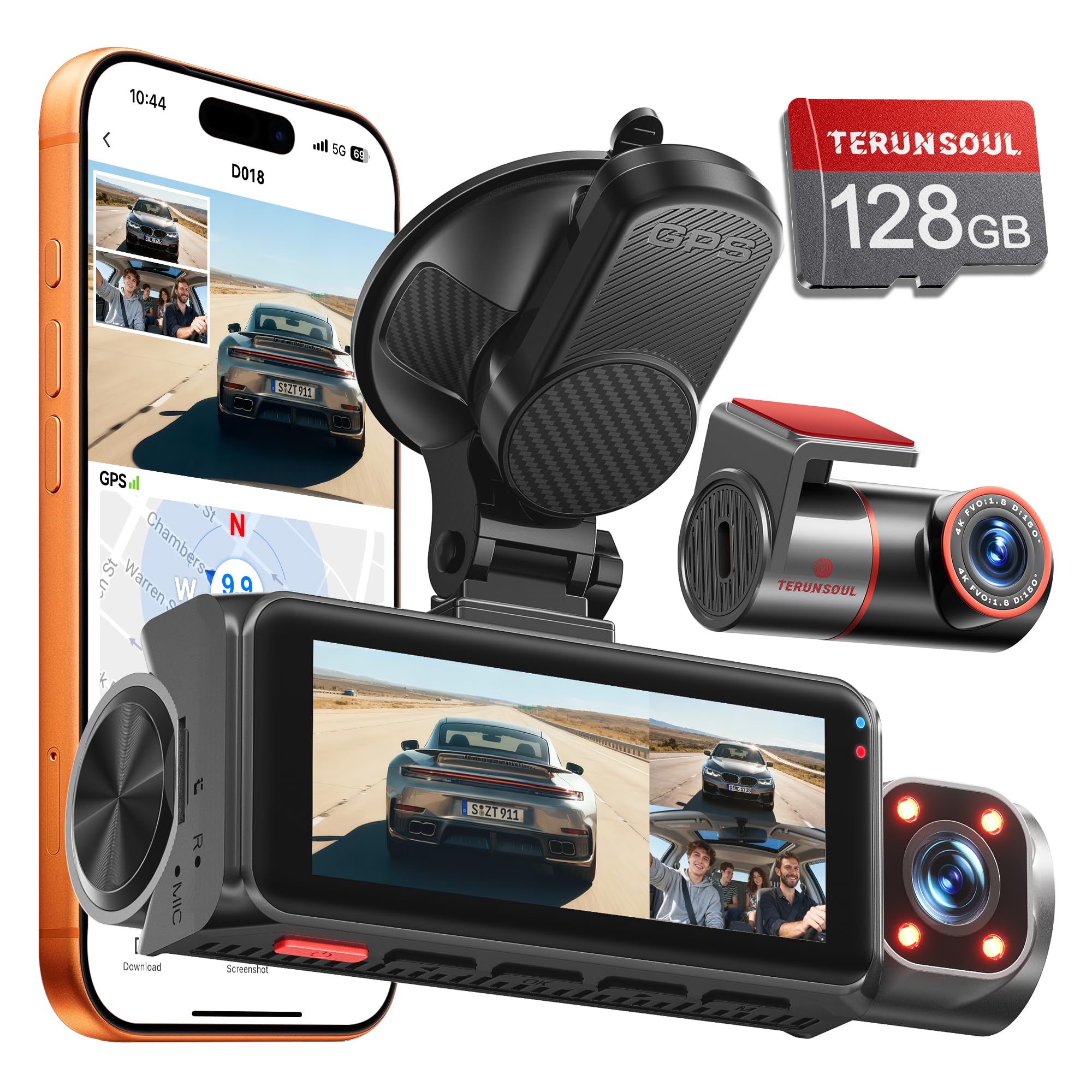
1. 4K+4K+1080P 3 Channel Dash Cam
Our pick — 4.5+★ from 400+ verified ratings; the strongest balance of quality and price.
Three lenses record the road, the tailgater, and the passenger seat at once.
Most dual cameras leave you choosing between covering the road behind you and covering the cabin. This TERUNSOUl sidesteps that trade entirely: a 4K front camera, a 4K rear camera, and a 1080P cabin camera all record together. For a rideshare driver or anyone who carries passengers, that third lens is the difference between a he-said-she-said argument and a clear recording of what happened inside the car.
The field of view runs 170° at the front, 150° at the rear, and 150° in the cabin, which widens each camera’s reach into the blind spots a narrow lens leaves out. Inside, four IR lights (infrared emitters that light up the cabin invisibly in the dark) keep the interior view usable after sunset. The 3.18″ full-laminated screen cuts reflections, so you can read a plate back at the roadside without squinting.
Pulling footage is quick over dual-band Wi-Fi 6 on 5.8GHz and 2.4GHz, rated to move video at up to 20MB/s into the TERUNSOUl app. The 128GB card in the box is twice what the 70mai A810 Lite ships with — 128GB against 64GB — so you are not buying a card on day one. GPS stamps speed and location onto every clip, and the G-sensor (a motion sensor that detects a jolt) locks the file when something hits you.
Where it pulls ahead
- Three-camera coverage at 4K front, 4K rear, and 1080P cabin — no other pick here films all three directions.
- A 170° front lens, wider than the 140° on both 70mai models and the ROVE’s 150° front.
- 128GB card included and room to grow to 512GB.
- Wi-Fi 6 dual-band with app-based OTA firmware updates.
The fine print
- Three feeds at once means more storage turnover than a two-camera setup.
- Wired rear link — the wireless part is the phone connection.
Reach for this if: you drive for a living or carry passengers and want every angle on record in one kit, card included.
Look elsewhere if: you only ever need front and rear, because a two-camera unit keeps more room free on the card.
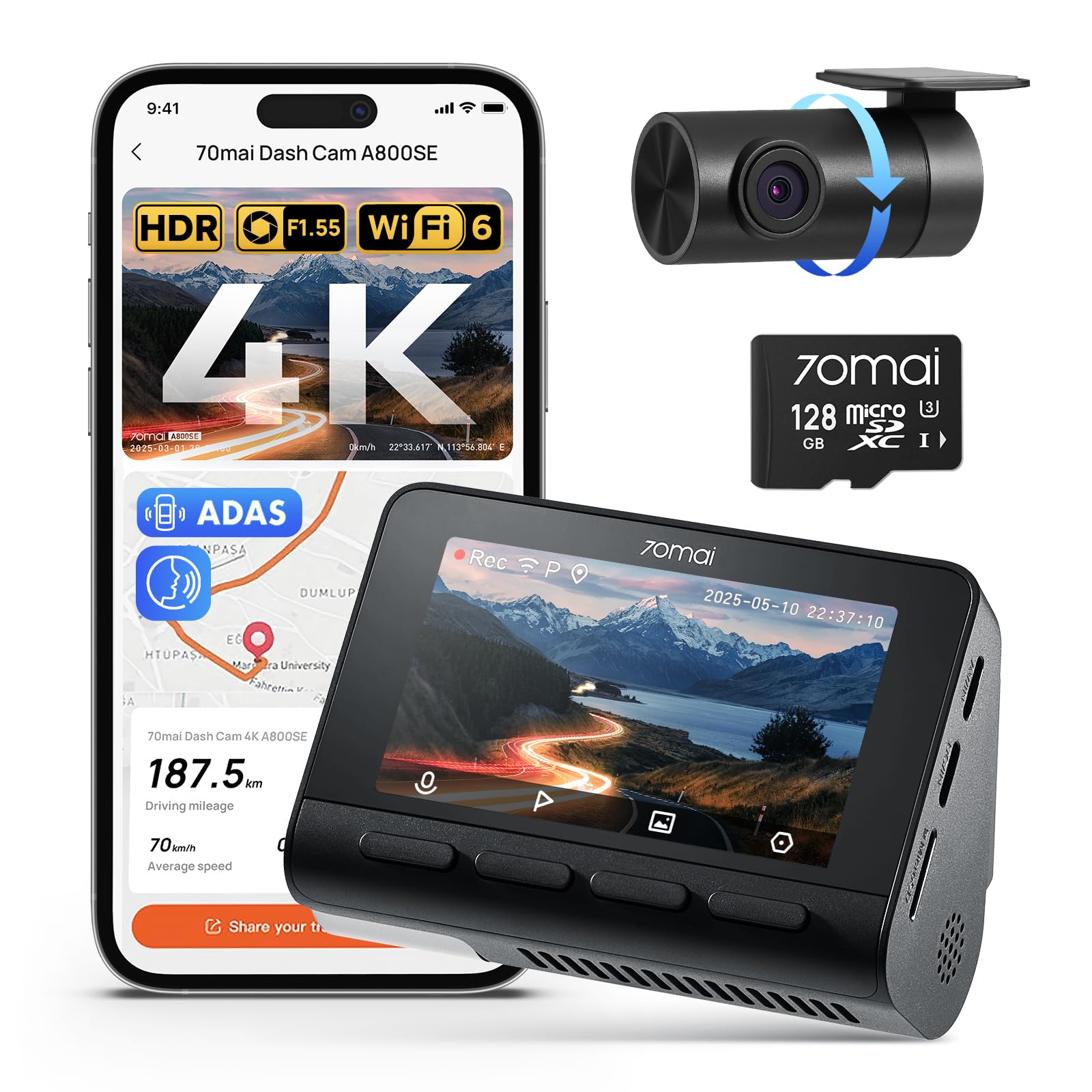
2. 70mai A800SE Dash Cam
The beginner-friendly entry point that still records a genuine 4K front feed.
Where this 70mai earns its place is the near-night-vision spec hidden in the lens: an F1.55 aperture. That number describes how wide the lens opening is — a lower figure lets more light in, so a plate stays readable under streetlights instead of dissolving into grain. Add the 7-layer glass lens and dual HDR (high dynamic range, which evens out bright headlights against dark shadows) and you get footage that holds together on a rainy night, not just at noon.
The rear camera is the clever part. Its adjustable lens can aim either into the cabin or out behind the car, so you choose which direction the second camera watches. The front 4K and rear 1080P run together, and the whole setup mounts in a normal session — buyers report it up and running after about 45 minutes of mounting. Built-in Wi-Fi 6 moves files to the 70mai app, and the 128GB card ships in the box with support up to 512GB.
ADAS (advanced driver-assistance alerts, which chime on lane drift and forward-collision risk) adds a useful second set of eyes on long highway runs. Voice control means you can trigger recording without reaching for a button. The 18-month warranty and optional in-person installation in New York and California soften the first-weekend learning curve. The honest limit: the rear feed caps at 1080P, so it trails the full 4K rear cameras on this list.
What to weigh: the front-and-rear pair here is 4K over 1080P, a step behind the native 4K-rear units from Pelsee and TERUNSOUl — but it also asks less of your memory card and your budget.
Confident starting point: a first-time buyer who wants clear front footage, an adjustable rear lens, and a card already included.
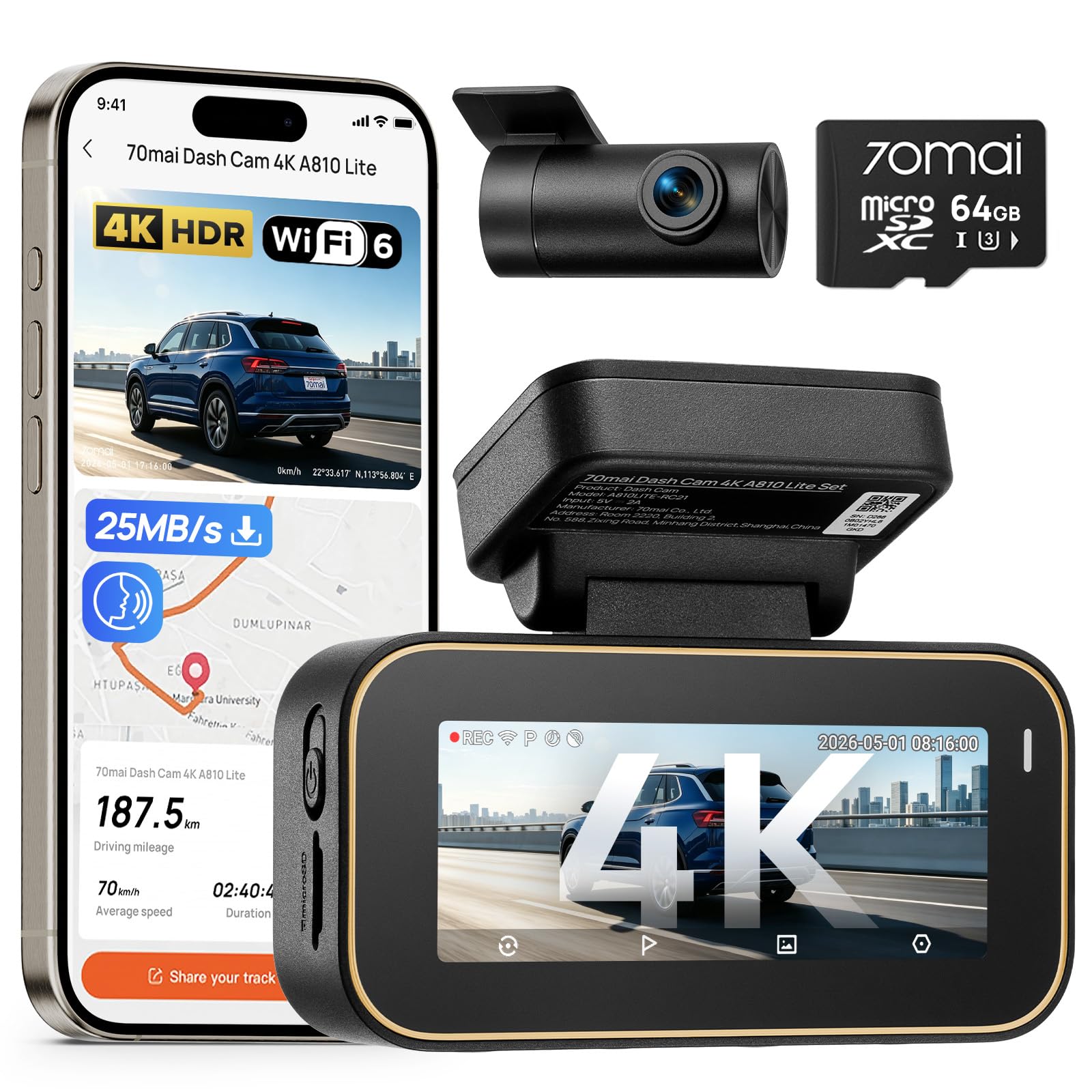
3. 70mai A810 Lite Dash Cam
A credit-card-sized camera that lets you watch your parked car from anywhere.
The reason to pick this over the A800SE beside it is the 4G LTE link. With a hardwire kit fitted, the A810 Lite pushes live footage and vehicle-location alerts to your phone — the kind of check you want when your car is sitting at an airport lot for a week. The camera body itself is compact enough to tuck behind your rearview mirror, so it stays out of your sightline while it works.
Recording is 3840×2160P at the front and 1080P at the rear, with an F1.55 aperture and HDR balancing headlight glare in tunnels and rain. Wi-Fi 6 on 5GHz moves clips at up to 25MB/s, which is quicker than the 20MB/s ceiling on the TERUNSOUl and REDTIGER kits. Buyers single out the 4K front footage as the reason to pick it, and the compact body draws few complaints. GPS runs three satellite systems (GPS, GLONASS, and BDS) so your speed and route log stays accurate between buildings.
A supercapacitor replaces the battery here, which handles a hot windshield far better than lithium cells over years of summer. The recurring gripe, though, is the cabling: some owners find the main camera cable short for longer runs, and connectivity draws mixed feedback when the 4G link is set up. Wire it once with slack and that fades. The included card is 64GB, half the 128GB in the A800SE, with support up to 512GB.
Built for the absent owner: commuters and long-term parkers who want a live look at the car from a phone.
One thing to plan: the remote view needs the hardwire kit, and the main cable can run short on large vehicles.
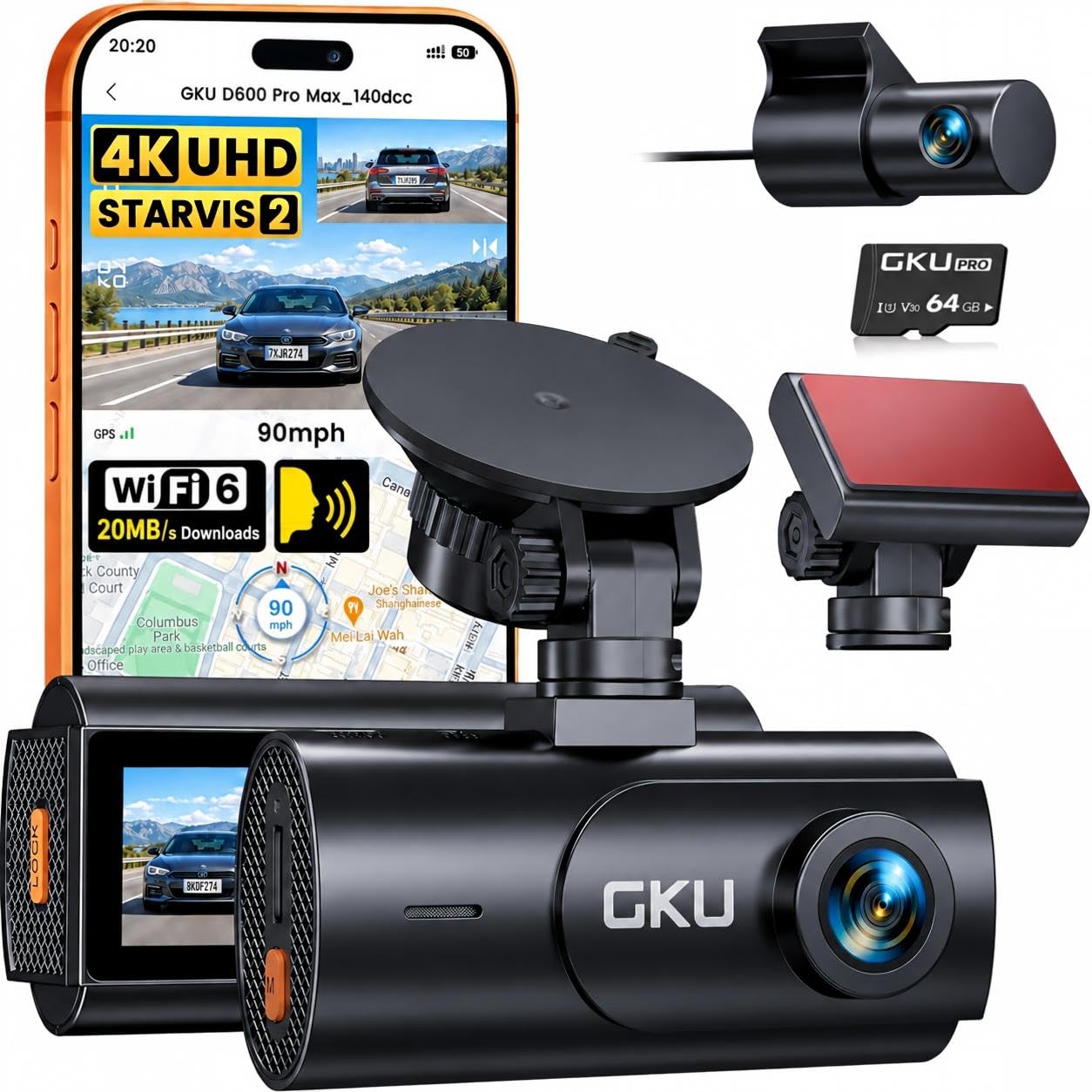
4. GKU 4K Dual Dash Cam
The low-light specialist that keeps plates legible after the sun drops.
A Sony STARVIS 2 sensor sits at the heart of this GKU, and that component is the whole argument. It is built to pull detail out of dim scenes, so the front camera holds brightness and color in unlit parking structures where cheaper sensors turn everything to grey mush. WDR (wide dynamic range, which keeps both bright and dark parts of a frame readable at once) keeps a low-beam headlight from blowing out the plate you are trying to read. It also supports HDR recording in front-only mode.
The dual-camera coverage runs 4K at the front and 1080P at the rear, with a 170° front and 150° rear lens for a wide sweep of both directions. GPS logs your route, speed, and location, and the GKU GO app lets you preview and download over Wi-Fi 6 dual-band on 5.8GHz and 2.4GHz at up to 20MB/s. Image quality is the clear strength here, and mounting is easy — a suction cup and a 3M adhesive mount both ship in the box, so you pick the one your windshield prefers.
Parking mode brings a genuinely useful twist: pre-recording captures 30–60 seconds before and after an incident, so you get the lead-up, not just the moment of impact. The catch is the hardwire kit — sold separately, and it has to be the GKU unit, because third-party kits can stop the camera powering on. The supercapacitor adds heat resistance for cars that live outside.
Sensor-first thinking: if your commute runs through dim streets or covered garages, the STARVIS 2 sensor is the single upgrade worth paying for here.
The compatibility catch: budget for the branded hardwire kit if you want the pre-recording parking feature to work at all.
Choose this for: late shifts, rural roads, and parking garages where light is scarce and plate detail decides the claim.
5. BOTSLAB G300H Plus Dash Cam
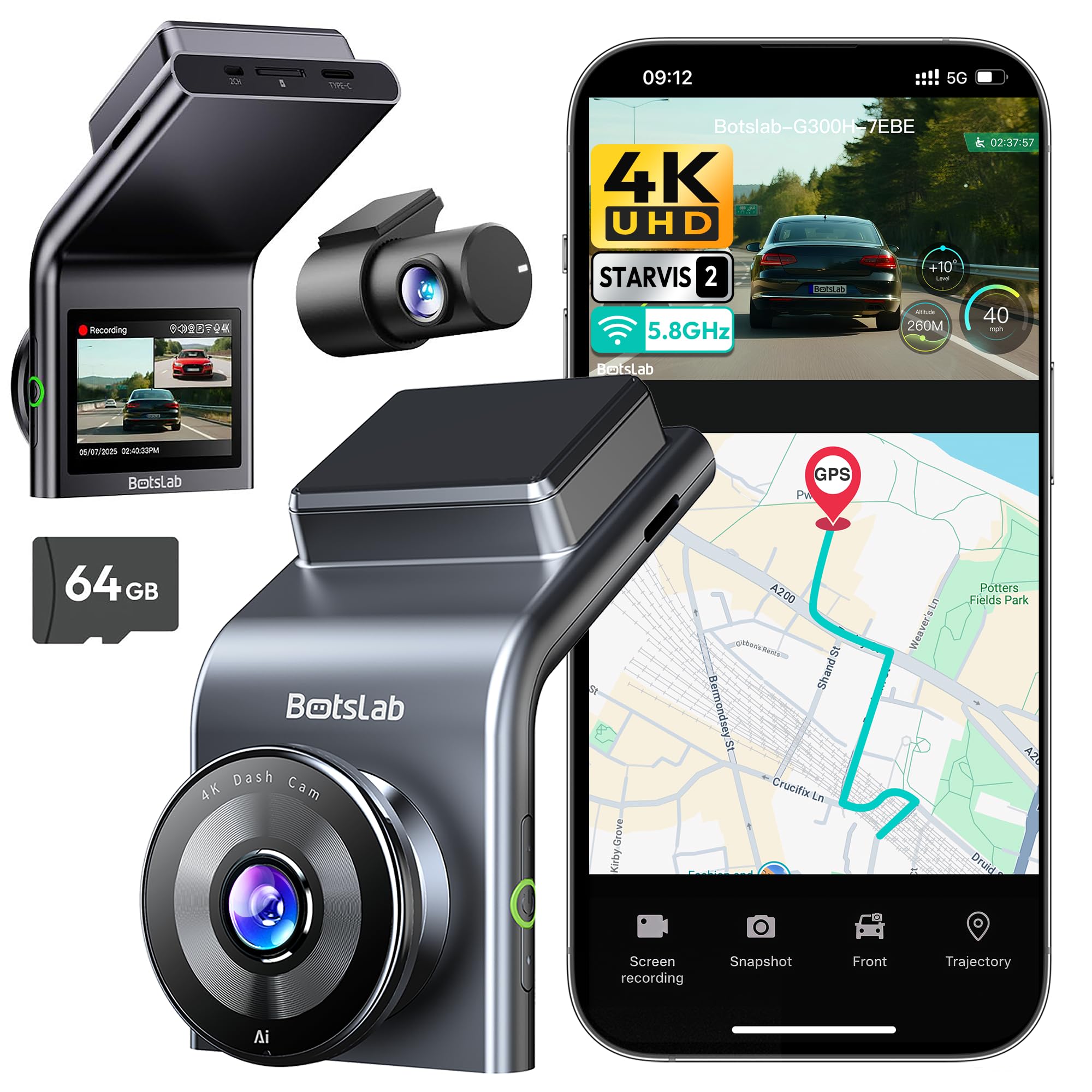
A slim silver body that blends into a light-colored headliner instead of shouting at it.
Most dash cams come in black and read as a dark blob against a pale roof. This BOTSLAB ships in silver, a small choice that makes a surprising difference in how neatly a camera sits in a light interior. What wins people over, though, is how it runs: reviewers rate its ease of use highest in this group, with build quality a close second. It records 4K at the front and 1080P at the rear through a STARVIS 2 sensor and an F1.5 front aperture, with HDR balancing dark roads against bright oncoming lights.
Voice control is simple and useful — say a short command like “take photo” or “video start” and the camera obeys without you lifting a hand off the wheel. The 170° front lens widens coverage past the 140° on both 70mai cameras, so you catch more of the adjacent lane. Wi-Fi runs on 5.8GHz, GPS stamps speed and route onto footage, and the 64GB card comes included with support up to 256GB. The supercapacitor is rated for temperatures from -20℃ to 70℃, which is the kind of range a summer dashboard demands.
Two honest notes. The storage ceiling of 256GB is the lowest on this list — the 512GB and 1TB options elsewhere give you more before the card fills. And the 24-hour parking monitor needs a hardware kit, sold separately. Neither undercuts what the camera does on the road; they just matter if you park for days or plan to record continuously.
Fit and finish: the silver shell and slim profile suit a light interior where a black box would stand out.
Storage limit: at a 256GB maximum, heavy recorders will want a second card on hand.
Match it to: a light-colored cabin and a driver who wants voice commands over button-pressing while moving.
6. REDTIGER Dash Cam 4K Front and 1080P Rear

A sharp 4K front camera that asks you to bring your own memory card.
The footage here is the star. A STARVIS 2 sensor paired with both HDR and WDR records 4K at the front and 1080P at the rear, and buyers describe the result as razor-sharp, with plate characters readable day or night. Video quality is what people come back to praise most on this camera, and the 4K front feed is the sharpest part of it. Both cameras record at 30 FPS, so motion stays smooth rather than jerky.
The 170° front lens is the widest angle in the two-camera group here, matching the GKU and BOTSLAB and beating the ROVE’s 150° front. Wi-Fi on 5.8GHz moves clips at up to 20MB/s into the Redtiger Cam app, where you can replay footage, view GPS route and speed data, and push over-the-air firmware updates. The suction cup mount has the GPS receiver built in, which keeps the cable count down.
Now the catch: there is no SD card in the box, so budget for a high-endurance card before your first drive. Reliability draws mixed notes, with a portion of units giving trouble after a few months, which the 18-month warranty covers — keep your receipt. The supercapacitor design survives heat well, and the G-sensor locks event clips so an impact file cannot be overwritten.
Worth buying when: you already keep a spare microSD card and prioritize the sharpest daytime front footage in this price band.
Factor in: the missing card and the 18-month warranty as your backstop rather than the exception.
7. Icesky 4K Dash Cam Front and Rear Left Right
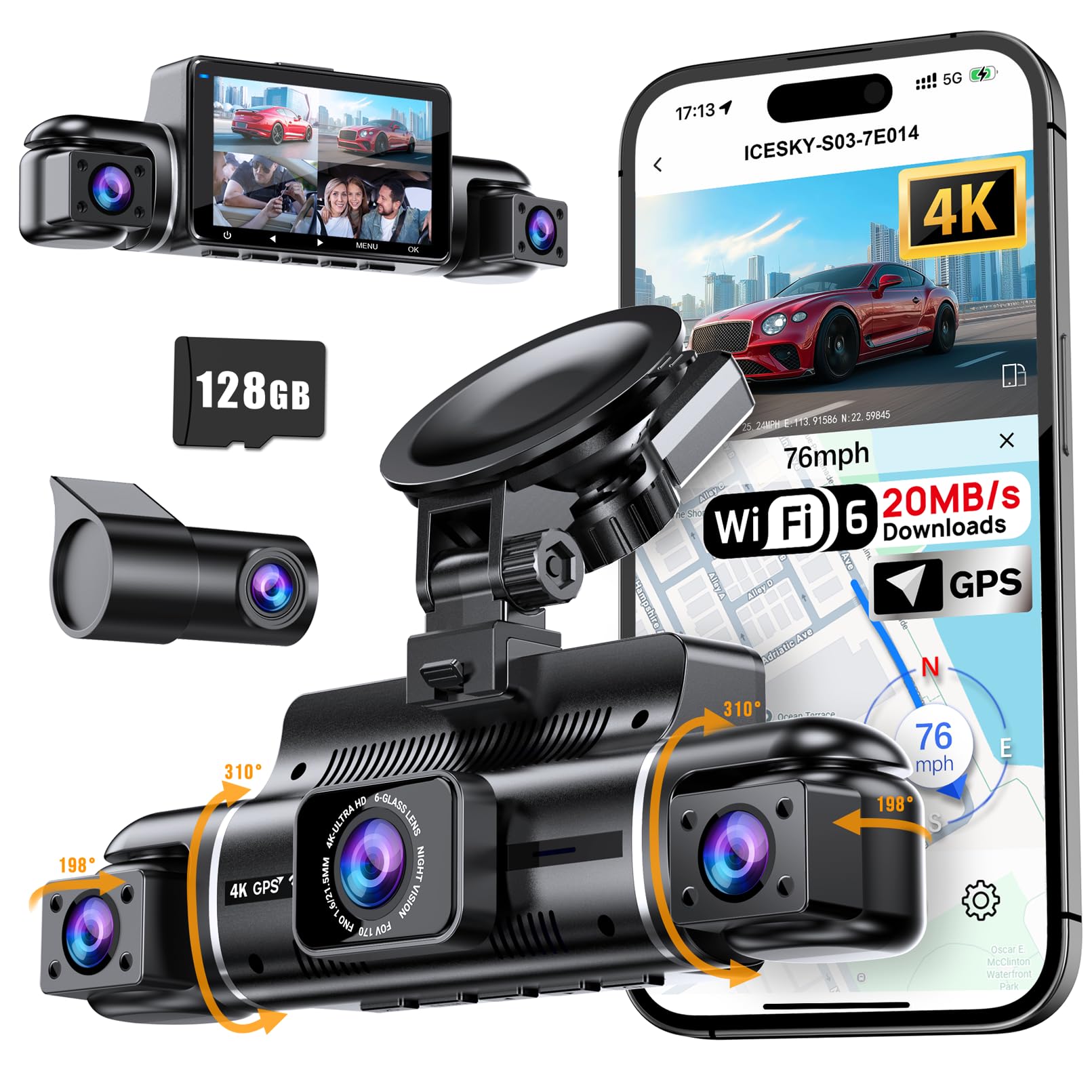
Four cameras sweep a full 360° so the sides of your car stop being blind spots.
Standard dual cameras leave your flanks unwatched, which is exactly where a sideswipe happens in a tight lot. This Icesky records a 4K front feed plus 1080P from the rear, inside, left, and right cameras at the same time — full 360° coverage. The built-in 3-inch screen shows several views at once, so you can glance at the whole picture while you idle. Reviewers praise the four-camera footage first and the straightforward mounting second.
Night coverage is where the side cameras earn their keep. Eight IR lights, split across the left and right units and controllable independently, pull detail out of dark side views without dimming the other cameras. GPS records speed, route, location, and time for a claims-ready log. Wi-Fi 6 on 5.8GHz downloads clips at up to 20MB/s to the app, and the 128GB card in the box takes you a long way before you need more, with support up to 512GB.
The caveat is power draw and wiring: four cameras mean more cable runs, and the 24-hour parking mode needs a hardwire kit sold separately. Set aside a proper afternoon for the install rather than a quick ten minutes. For a rideshare or commercial vehicle, though, seeing all four sides is a coverage level the two-camera picks simply cannot match.
Coverage above all: 170° front, 150° rear, and full side views add up to a 360° view no dual kit here replicates.
Installation cost: extra cameras mean extra wiring time, and the parking feature still wants a hardwire kit.
Pick it when: side impacts are your worry — rideshare, delivery, or tight urban parking.
8. Pelsee S1 Pro Native 4K+4K Dash Cam
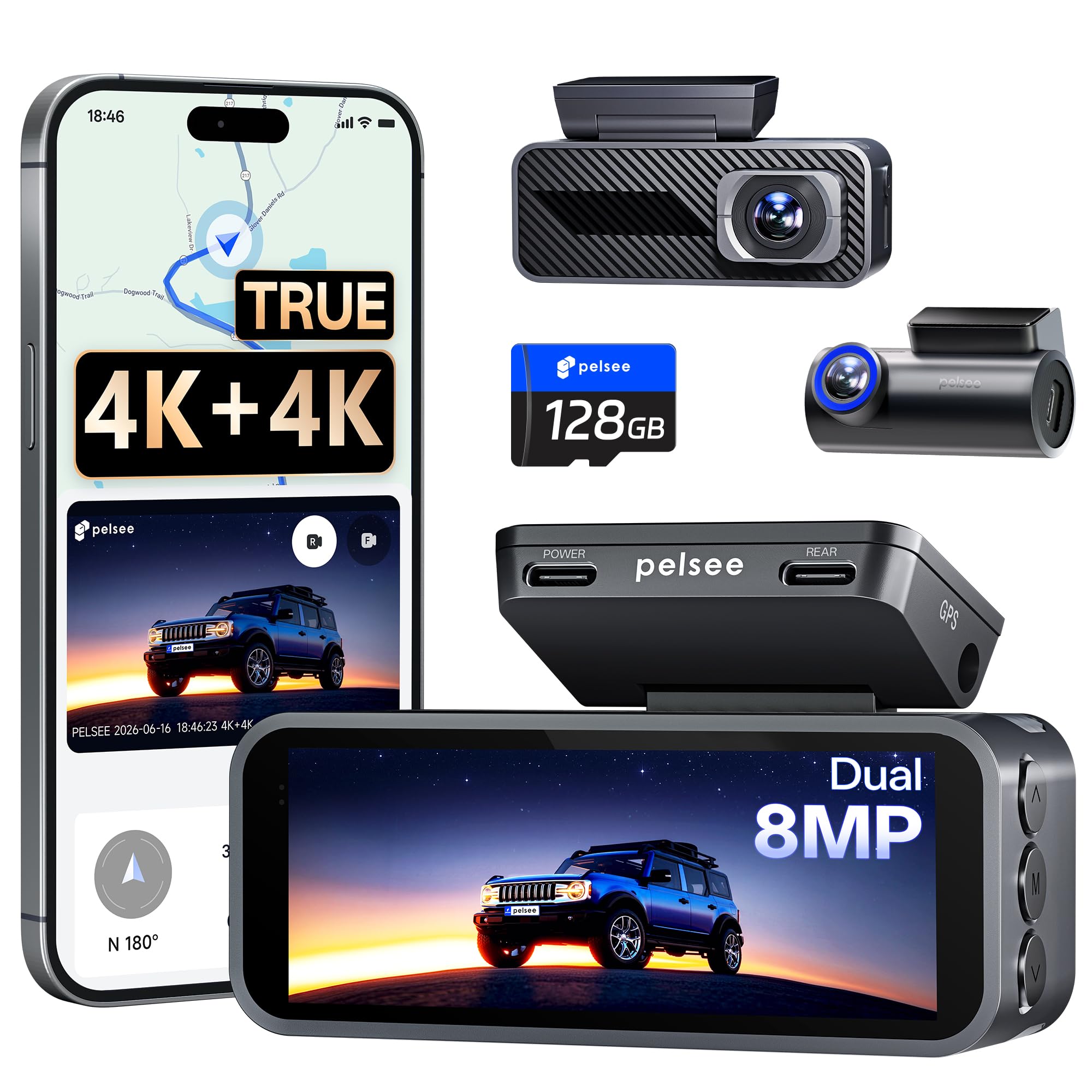
Real 4K at both ends, so the rear camera is no longer the weak link.
Here is the spec that decides this one: a native 4K rear camera, not a 1080P afterthought. Both lenses use 8MP sensors recording 3840×2160P at 30fps, so a plate behind you reads as clearly as one in front. That is the gap over the 70mai A800SE and its 1080P rear — the Pelsee keeps full resolution at the back. The 170° front and 150° rear lenses cut blind spots, and because the footage is native rather than upscaled, nothing is invented to fill the frame.
Night video gets a boost from an F1.4 large-aperture lens and a hybrid glass element: this is full-color starlight footage, with multi-frame noise reduction cleaning up the grain you would otherwise see in a dim garage. Dual-band Wi-Fi 6 on 2.4GHz and 5.8GHz moves clips at up to 30MB/s into the app, matching the ROVE for the fastest transfer here. The 128GB card is included, the 3.39″ IPS screen allows playback on the unit, and the maximum card size stretches to 1TB.
Voice commands switch front/rear view, toggle screen and audio, snap photos, and lock footage without you touching a button. Thermal protection keeps it stable in heat and cold. The one thing to plan for: the 24-hour parking mode needs a specific hardwire kit, sold separately. Otherwise this is the dual-camera pick for anyone who refuses to compromise on the rear image.
Why it earns the rear-cam crown
- Native 4K rear recording at 8MP — the sharpest rear feed on this list alongside the TERUNSOUl.
- Hands-free voice control across view-switching and photo capture.
- 128GB included, expandable to 1TB.
- 30MB/s Wi-Fi 6 transfer for quick downloads.
Plan around this
- Parking mode requires the separately sold hardwire kit.
- True 4K rear files are large, so a big card pays off.
The rear-matters pick: for drivers whose rear window carries the real risk — tailgaters, highway following, tight lot scrapes.
9. ROVE R2-4K Dual PRO Dash Cam

Sony’s two best sensors, one in each camera, in a flagship that maxes out the hardware.
Most dual cameras put the good sensor up front and settle for less behind. The ROVE does not: an IMX678 for the front camera and an IMX675 for the rear, both STARVIS 2. The front records 3840×2160P at 30fps, the rear 2560×1440P at 30fps, with F1.7 front and F1.55 rear apertures and a 150° front and 140° rear view. That rear sensor is the reason the back footage stays usable through headlight glare and tunnel light shifts.
Quad-mode GPS here is broader than the single-system setups elsewhere on this list — GPS, BEIDOU, GALILEO, and GLONASS together keep your speed and route tracking accurate between tall buildings. Dual-band Wi-Fi 6 transfers at up to 30MB/s into the ROVE app, tied with the Pelsee for the quickest here. The box is unusually complete: a 128GB ROVE PRO microSD card, a CPL filter (a polarizing lens that cuts windshield reflections), suction mount, spare sticky mount, and a microfiber cloth all ship together.
Reliability draws mixed feedback: some owners mention the front camera stopping on them, and Wi-Fi connectivity also splits opinion. Buyers praise the dual STARVIS 2 footage again and again. The 24-hour parking mode with three detection options and a voice alert on next start is a nice touch you will not find on every unit. The hardwire kit is sold separately.
The sensor case: dual STARVIS 2 sensors, a 2K rear feed, and a CPL filter make this the most complete hardware package on the list.
The trust question: weigh the mixed reliability reports and lean on the warranty if a rear or front unit ever misbehaves.
For the spec-max buyer: someone who wants the best sensors, the CPL filter, and the top transfer speed in one box.
Weigh carefully if: you have already been burned by a camera that quit early and want a spotless reliability record.
Know the Specs
Front vs rear resolution
A 4K front camera records 3840×2160P, roughly four times the pixels of 1080P, so plate characters stay crisp when a car crosses your frame quickly. A 1080P rear camera still gives you usable evidence of a rear impact, but small print at distance is less certain. When rear footage matters most — tailgaters, highway following — look for a native 4K rear like the TERUNSOUl or Pelsee.
Wi-Fi 6 and transfer speed
Wi-Fi 6 is a newer wireless standard that carries multiple streams without choking. On these cameras, it depends on how fast a clip lands on your phone, and the marketed ceilings run from 20MB/s up to 30MB/s. Double-band means the camera can use 2.4GHz for range or 5.8GHz/5GHz for speed. If you download footage often, the higher figure saves real minutes.
Hardwire kits and parking mode
Parking surveillance needs the camera to keep drawing power with the ignition off, and that means wiring a hardwire kit into your fuse box. Many picks here ship without one, so confirm before you buy. A low-voltage cutoff stops the camera draining your battery overnight, and a supercapacitor handles a hot parked car better than a lithium battery.
STARVIS 2 sensors and night vision
STARVIS 2 is a Sony sensor family built to pull detail out of low light, so plates read in dark garages where cheaper sensors grey out. A wide aperture — a lower F-number like F1.4 or F1.55 — lets more light reach the sensor. HDR and WDR even out bright headlights against dark shadows. All three working together is what makes night footage usable.
Common Questions
Do I still need to run a cable to the rear camera?
Why does parking mode not work without a hardwire kit?
Is a supercapacitor better than a battery in a hot car?
Will I need a bigger microSD card than the one included?
What does a STARVIS 2 sensor actually change?
How do I get footage off the camera without pulling the card?
Should I buy a four-channel camera over a two-camera one?
Why does the REDTIGER not include a memory card?
Does the front camera also record GPS route and speed?
What happens when the memory card fills up?
The Bottom Line
For most drivers, the best wireless dash cam front and rear is the TERUNSOUl 3-Channel, because it covers more than the road: front, rear, and cabin, with a 128GB card and 170° front lens in one kit. If your real concern is the rear window, the Pelsee S1 Pro keeps a full native 4K camera pointed out the back. For remote confidence on a parked car, the 70mai A810 Lite puts live footage on your phone through its 4G link. Every pick records both directions and lets you pull files over Wi-Fi, so the deciding factor is fit, card size, and how you want to watch your parked car.
How we choose
We do not accept paid placement. Every pick is matched to a real buyer and a real use-case; we do not hands-on test units.
Sources
Specifications: manufacturer listings and product documentation. Review insights: verified customer reviews, as of November 2026. Pricing: not shown on this page (it changes often); check the current price via the retailer link.
As an Amazon Associate, Tactical Gear Guy earns from qualifying purchases. This does not affect which products we feature.