Specs are compiled from manufacturer listings and verified buyer reviews and can change over time — please confirm the key details on the product page before buying.
Getting fuel from the can into the tank without lifting, pouring, spilling, or guessing depends on one choice — and the pump you pick decides whether that job takes two minutes or twenty. The most useful thing to know up front is that “transfer fuel pump” covers two very different machines: a small suitcase kit that clips to a battery and moves a few gallons per minute, and a cast-iron bung-mounted unit that bolts onto a truck tank and runs all day. Figure out which one your job needs first, because the wrong type will frustrate you no matter how well it is built.
This guide is built by comparing the manufacturers’ published specifications and the patterns across verified customer reviews, so you get each pick’s real strengths and trade-offs instead of marketing spin.
Flow rate, hose reach, and power source are the three things worth checking before you buy, and this guide lines them up side by side so the choice gets simple. Below you will find the picks I would put in front of a buyer shopping for a transfer fuel pump today.
Top Picks


How To Choose The Best Transfer Fuel Pump
The single biggest mistake buyers make is matching a pump to a price instead of to a tank. A kit that moves 30 gallons per hour is perfect for topping off a mower and painful for filling a truck saddle tank. Start with the job, then work backward to the numbers.
Match the flow rate to how much fuel you actually move
Flow is quoted either in gallons per minute (GPM) — how much moves in sixty seconds — or gallons per hour (GPH), which is the same measurement stretched over an hour. A 15 GPM pump moves far more fuel per minute than a 30 GPH kit, so convert both to the same unit before you compare. If you are emptying five-gallon cans into equipment once a week, a compact kit handles it. If you are fueling a fleet from a trailer tank, you want the higher GPM figure.
Check how deep it can pull and how high it can push
Suction lift is how far below the pump the fuel can sit and still get pulled up; discharge head is how high the pump can push it. Both are quoted in feet, and both shrink your real-world flow rate as the distance grows. A pump rated to pull from 8 ft. down and push 37 ft. up is a different animal from a handheld kit with a short pickup hose — one is built for a bung-mounted tank, the other for a gas can on the ground.
Decide on your power source before anything else
Nearly every pump here runs on 12 volts DC (direct current — the same voltage as a car battery), but they reach that power three ways: a cigarette-lighter plug, alligator clips that clamp straight to a battery, or a rechargeable battery pack built into the pump. A cordless model frees you from a vehicle, which matters at a remote worksite. A corded model never runs flat, which matters when the job is long.
Confirm the fuel type and the seal materials
Gasoline, diesel, kerosene, and biodiesel blends each behave differently on pump seals and motors. Some units are explicitly rated across all of them; others are diesel-and-kerosene only and should never see gasoline. Read the fuel list on the specific pump, not the category, because a unit built for diesel will not thank you for a tank of gas.
Side-by-Side Comparison
Every row uses the same three measures — flow rate, pump body material, and hose length — so you can scan trade-offs in one pass.
| Model | Best For | Flow Rate | Body Material | Hose Length | Amazon |
|---|---|---|---|---|---|
| Fill-Rite FR1210H★ Best Overall | Full kit for truck and trailer tanks | 15 GPM | Cast Iron | 12 feet | Amazon |
| MILADO 12V Fuel Transfer Pump SetBudget Champion | Budget-friendly can-to-equipment duty | 30 GPH | Stainless Steel | — | Amazon |
| 12V 75W 110GPH KitTop Performer | Fast fills from a compact case | 110 GPH | Metal | — | Amazon |
| Steauty 85GPH Set | Two power modes and a bigger case | 80-85 GPH | Stainless Steel | — | Amazon |
| TaskStar Battery Powered | Diesel-only cordless jobsites | 12 GPM | Metal | 6.6 feet | Amazon |
| PRUNkuar 10GPM Cast Iron | Rigid mounted setups on a budget | 10 GPM | Cast Iron | — | Amazon |
| Fill-Rite FR1204H | Pump-only replacement on a big tank | 15 GPM | Cast Iron | — | Amazon |
| GPI M-150 Series | Premium filtration and theft deterrence | 15 GPM | Aluminum | 12 feet | Amazon |
Detailed Reviews
1. Fill-Rite FR1210H Fuel Transfer Pump
Our pick — 4.5+★ from 700+ verified ratings; the strongest balance of quality and price.
The complete bung-mounted workhorse — cast iron body, real nozzle, and everything you need in the box.
Buy this one if your fuel lives in a trailer tank or a truck bed and you are tired of handing cans up and down. The FR1210H arrives as a full working system: the 12V 15 GPM pump (gallons per minute — how fast fuel moves), a 3/4-inch by 12-foot discharge hose, a 3/4-inch manual nozzle, a 34-inch telescoping steel suction pipe, an 18-foot 12-gauge power cable, a ground wire, and even a roll of PTFE tape. Nothing else to buy before your first fill. The 1-inch female NPT inlet (a standard threaded pipe fitting) threads onto a standard bung, and the junction box rotates 180 degrees so you can wire it in a cramped spot without cursing.
The body is cast iron, and the pump uses rotary vane technology — a design where internal vanes sweep fuel through the chamber — which the maker says keeps flow steady as the parts wear. It will pull fuel from a tank depth of 8 ft. and push it up to a discharge height of 37 ft., so a below-bed tank feeding a raised nozzle is well inside its comfort zone. Thermal overload protection shuts the motor down if it starts to cook, and the pump carries a limit lifetime warranty. For a barn or fleet setup, that 8 ft. suction and 37 ft. discharge is what makes it a working pump rather than a weekend gadget.
The catch is cost and weight, not capability. This is a premium unit, and at 10 x 17 x 18 inches it takes up real space in a toolbox — budget-conscious buyers who only fill a mower twice a season will be paying for capacity they never use. A small number of long-term owners mention the finish flaking and rust appearing after about eight months of outdoor exposure, so mounting it under cover rather than leaving it in the weather is a fair precaution. What wins people over most is the cast-iron heft and steady rotary-vane output, which reviewers credit with staying reliable season after season.
What earns its place
- Everything in the box — pump, 12-foot hose, nozzle, suction pipe, cable, ground wire, and PTFE tape.
- 15 GPM flow with rotary vane internals that hold output as components wear.
- Pulls from 8 ft. of tank depth and discharges up to 37 ft. of height.
- Thermal overload protection and a limit lifetime warranty back the cast-iron build.
Where it asks more of you
- Premium-tier spend for a unit most casual users will never push hard.
- Some buyers report the finish coming off and rust after roughly eight months outdoors.
- Cast iron is heavy, and the pump does not tuck into a small toolbox.
Reach for this if: you fuel from a truck or trailer tank regularly and want a complete, permanent-mounted system rather than a suitcase kit.
Think twice if: your fueling is a few cans a year — the capacity and the price both overshoot that job.
2. MILADO 12V Fuel Transfer Pump Set
Small, sealed, and self-priming — the kit you grab to drain a mower before winter storage.
This is the entry point into the category, and it earns that spot honestly. The MILADO moves 30 gallons per hour (GPH — half a gallon a minute), which is a fraction of what the bigger kits manage — the 12V 75W kit further down this list delivers 110 GPH, and the gap between the two numbers is the whole story of where each pump belongs. Thirty gallons an hour is fine for draining a lawn mower, a boat, or a generator before you store it. It is slow for filling anything large, and the pumping speed is exactly what the mixed feedback centers on. Go in expecting a trickle-suited tool, not a fast-fill machine.
Where it shines is the packaging and the build. The copper motor and steel housing feel sturdier than the tier suggests, the pump is self-priming (it pulls fuel up without you pre-filling a line), and the stainless steel lead pipe with a roller tip reaches down to the bottom of a tank. The high-elastic fuel hose and inline fuel filter come in the case, so the whole job is contained. It is rated across gasoline and diesel, with listed compatibility spanning cars, trucks, boats, carburetors, lawn mowers, generators, small aircraft, farm equipment, RVs, and UTVs — the versatility is genuinely broad.
The honest trade-off is the same one any small kit carries: this is a light-duty pump, and trying to push it through a long hose run into a high tank will show you its limits quickly. What buyers praise most is that it self-primes and moves the fuel it claims, which is the whole promise at 30 GPH and this price. If you want a spare-vehicle drain-and-fill tool that lives under a bench and gets pulled out a few times a year, this does that job cleanly.
The case for it: self-priming operation, a copper motor in a steel shell, a stainless pickup pipe with a roller tip, and a complete cased kit for a low outlay.
The honest limit: 30 GPH is the slowest flow in this lineup, so it suits draining and small fills rather than bulk refueling.
Best suited to: the home mechanic emptying seasonal equipment without spending much.
Look elsewhere if: you need to move more than a few cans at a time — the flow ceiling will be the thing you notice first.
3. 12V 75W Fuel Transfer Pump Kit, 110GPH
The fast lane of the case kits — 110 gallons an hour that empties cans in a couple of minutes.
If speed is your obsession, start here. The 75W motor pushes 110 gallons per hour and the suction can reach 39 inches down, which is the kind of delivery that turns a five-gallon top-up into a two-minute errand instead of a five-minute chore. Against the MILADO’s 30 GPH, this is the difference between a trickle and a stream, and anyone moving real volume will feel it. The unit arrives fully assembled — connect it to power, drop the pickup in, and you are moving fuel.
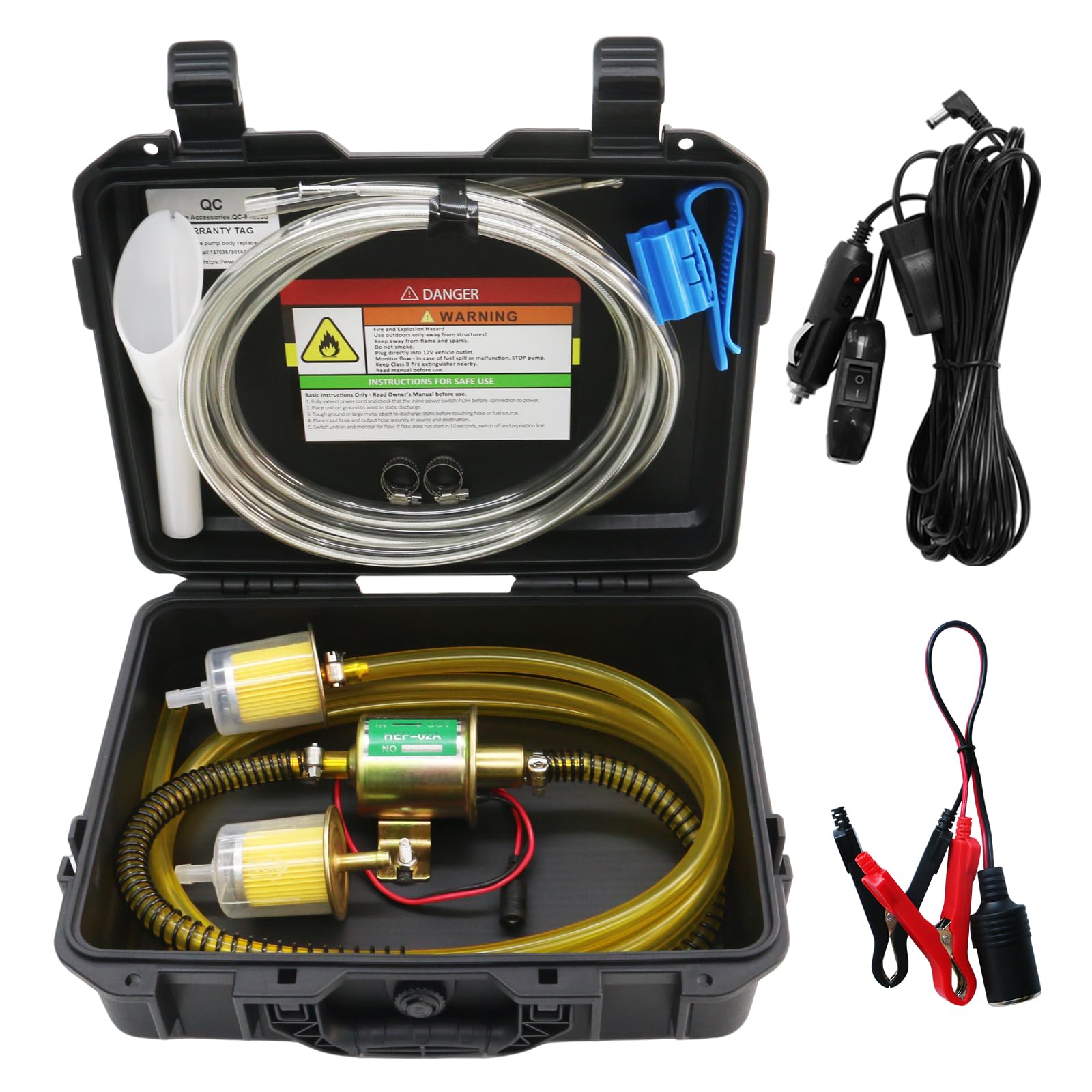
The whole kit packs into a hard suitcase, so storage is tidy and transport is easy. It ships with an 11.5-foot cigarette lighter power cord and an 11.8-inch alligator clip conversion cable, giving you two ways to power it from a vehicle. The built-in filter and gasket keep debris out of the fuel stream, and cleanup is straightforward once the job is done. It handles gasoline, diesel, kerosene, and other low-viscosity liquids, and the maker explicitly says not to pump water or leave water in the pump after use.
That last point is the one caveat worth taking seriously: the pump is rated for fuel, and the maker suggests flushing with kerosene or diesel after any water exposure to extend pump life. It is also a dedicated gasoline and diesel tool, so it will not solve every fluid transfer in the garage. Owners who put it to work rate the performance highly — one buyer reports pumping 100 gallons without incident, and notes the easy electrical connection to a boat battery and the speed with which it empties five-gallon cans. Reviewers repeatedly call out the 110 GPH output and the included filter as good value for the money.
Strengths that show up on the job
- 110 GPH flow with 39-inch suction reach — the fastest of the suitcase kits here.
- No assembly needed; connect power and go.
- Two power cords included: cigarette lighter and alligator clips for battery hookup.
- Built-in filter keeps debris out of the fuel and the pump.
- Hard suitcase storage keeps everything together.
What to keep in mind
- Not rated for water; needs a kerosene or diesel flush if water gets in.
- Performance depends on delivery height and fluid viscosity.
- A few owners find the flow slower than the rating suggests in real setups.
Choose it when: you want the fastest can-count turnaround in a portable kit that lives in a case.
Pass on it if: you need a permanent mounted pump or a tool for water and non-fuel liquids.
4. Steauty 12V Fuel Transfer Pump 85GPH Set

Eighty-five gallons an hour with a patented pickup pipe that glides around a curved tank.
The defining feature here is not the flow number — it is the 95% pre-assembled build and the reinforced pulley-tip lead pipe designed to slide through curved tank structures and find the bottom. The 70W motor delivers 80 to 85 gallons per hour, and the spec sheet notes that delivery speed depends on lift height and fluid viscosity, with the fuel filter potentially slowing things slightly.
Note the wattage gap against the kit above: the 75W unit outdrives this 70W motor, and the flow numbers track that difference. What the Steauty gives you back is flexibility. It ships with both an 11.5-foot cigarette lighter connector and an 11.8-inch alligator clip cable. The case is 20% enlarged over the earlier version, so all the accessories — filter, funnel, adjustable hose clamp, and the 2mm thickened anti-kink hose — stow neatly without tangling. The ID 8 mm, OD 12 mm hose is sized to fit most fuel tank openings.
The transfer rate is the divisive part. Some owners find it brisk, filling a five-gallon container in about six minutes; others report it stretching to eight or ten minutes for the same volume. Both are honest outcomes depending on lift and hose run, so temper your expectation to somewhere in that band. Beyond the flow debate, feedback is consistent: the pump works, the enlarged case is appreciated, and the value reads well. It is backed by a 3-year warranty and 24/7 online support, and it runs only on 12V DC, not through a 110V AC-to-DC converter.
Why it earns a mid-slot: a 20% larger case, two included power cables, a 3-year warranty, and a pickup pipe built specifically for curved tanks make it the flexible all-rounder of the suitcase kits.
Set your expectation: five gallons can take six minutes or closer to ten depending on your setup, so the 85 GPH rating is a ceiling, not a guarantee.
Worth it for: owners with awkward tank shapes who want room in the case and a longer warranty.
Not the pick for: anyone who needs a fixed, permanently mounted pump or AC power operation.
5. TaskStar Fuel Transfer Pump Battery Powered, 12GPM
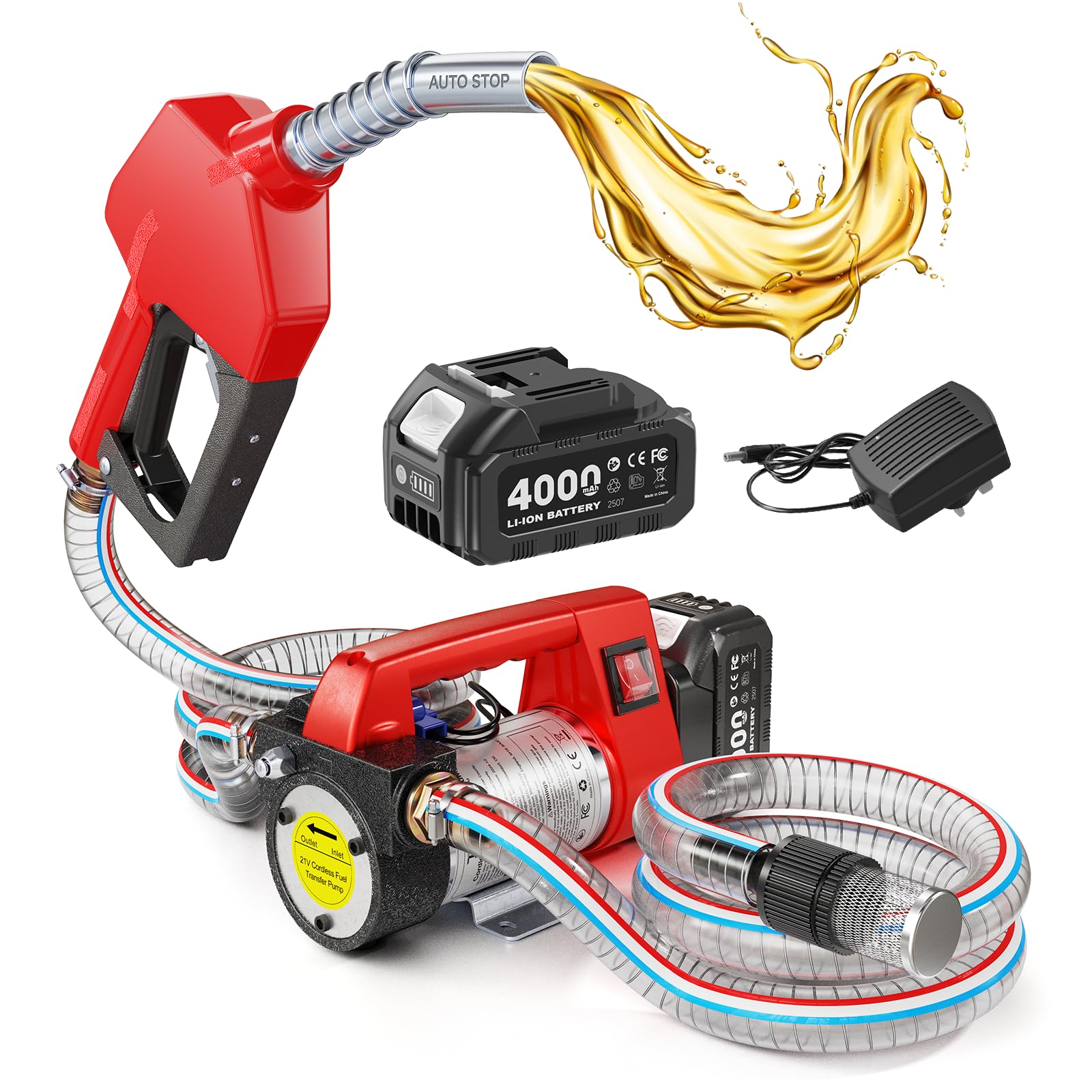
No cord, no vehicle, no tether — 12 gallons a minute from a battery pack you charge beforehand.
This is the one to consider if your fueling happens where there is no convenient 12V outlet — a field, a remote tank, the back of a paddock. A 4000mAh rechargeable battery (that is 4.0Ah of stored charge) gives up to 30 minutes of continuous use per charge, which at 12 gallons per minute is meaningful volume before you have to plug in again. The motor is copper, the kit includes a nozzle that pops out automatically when the tank is full, and a pressure switch cuts power when it reads full — a genuinely useful safety detail when you are handling expensive diesel.
Reach is the standout spec. The pump draws fuel from up to 16.4 feet below the surface and can push it to a height of 32.8 feet, which covers deep storage tanks and buried containers that a short-hose kit simply cannot touch. The kit is complete: 6.6-foot inlet and outlet hoses, a filter, hose clamps, connectors, spare impellers, safety gloves, the battery, and charger. Assembly is straightforward — install the battery, connect the hoses, and go.
Now the firm exclusion: this pump is for diesel, kerosene, and biodiesel only. It is explicitly not for gasoline, water, or alcohol. If you were hoping for one tool to handle every fuel in the shed, this is not it — gasoline duty is ruled out. The quality reading is more mixed than the specs imply, with some owners impressed and others less so, and one report of a unit that would not pull fuel from a gas can into a boat. What the reliability-focused feedback does support is that, set up correctly, it pulls and delivers diesel as rated — and the auto-shutoff nozzle is a recurring point of appreciation.
The real advantages
- Cordless operation with a 4.0Ah battery and up to 30 minutes of continuous use.
- 12 GPM from a copper motor — the highest per-minute rate among the portables here.
- Draws from 16.4 ft. down and pushes to 32.8 ft. up.
- Auto-stop nozzle plus a pressure switch that cuts power when full.
- Complete kit including hoses, filter, clamps, spare impellers, and gloves.
The limits to plan around
- Diesel, kerosene, and biodiesel only — never gasoline or water.
- Runs for up to 30 minutes per charge, so large jobs need a spare charge.
- Quality feedback is split, and at least one owner reported a unit that failed to pull fuel.
- At 7.58 kg it is not a one-hand grab.
The right tool for: diesel-only refueling jobs far from any power outlet, where automatic shutoff earns its keep.
Steer clear if: you also need to move gasoline, or if your fueling session runs well past half an hour.
6. PRUNkuar 10GPM 12V Cast Iron Fuel Transfer Pump
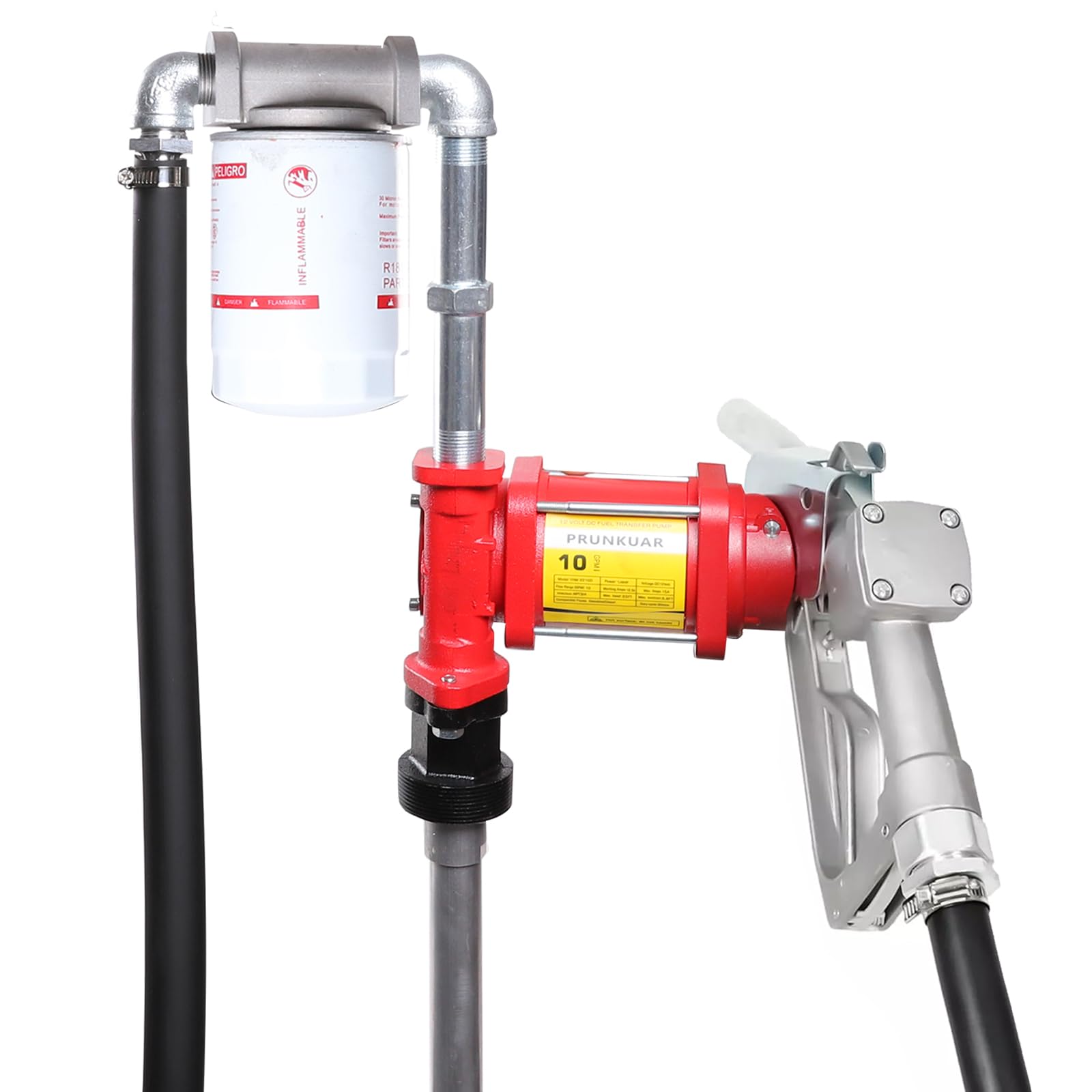
A cast-iron, bolt-down pump for buyers who want a fixed station without premium spend.
Ten gallons per minute, a 1/4HP motor, 12.5 working amps, and a 15-amp max ceiling — the numbers here are modest but the intent is clear. This is a pump you mount. It has an installable base to bolt it down, a strong cast iron sealed pump chamber, thermal protection that stops the motor automatically, and up to 3 minutes of built-in bypass. The explosion-proof design and spark-free components matter when you are moving gasoline, and that safety framing is where the rig earns its keep.
The size is a real advantage for tight spaces — it can be placed almost anywhere without eating room, which is the opposite of the bulky Fill-Rite boxes. It runs off a 12V battery and ships in a simple package: the pump and a filter. Note the inlet is quick-connect rather than threaded NPT, so check your hose ends before you plan the install.
Here is the part you need to hear straight: owner feedback on this one is genuinely mixed, and reliability and durability are the recurring themes. Some report the unit stops working, some report the nozzle handle breaking by the third use, and several note the nozzle will not shut off completely. That is a fair warning about the included nozzle rather than the pump body itself, and it points to a buyer who wants a mounted pump but pairs it with a better nozzle. It is still a cast-iron gasoline-rated unit at a budget-adjacent price, so it fits a specific shopper — just not the one who expects set-and-forget durability from the start.
Where it fits: a low-cost way to set up a fixed cast-iron transfer station with explosion-proof, spark-free construction and automatic thermal stop.
The part to know: nozzle reliability and overall durability draw divided feedback, so budget for the possibility of swapping the nozzle and treat this as a value mount rather than a lifetime unit.
A fit for: garage and shop setups that want a bolted-down pump at an accessible price point.
Reconsider if: you need proven long-term reliability or plan to lean on the included nozzle heavily.
7. Fill-Rite FR1204H 12V 15 GPM Fuel Transfer Pump (Pump Only)

The same 15 GPM cast-iron core as the top pick, sold bare for the buyer who already owns the hose and nozzle.
This is the replacement and upgrade pump for the person whose hoses, nozzle, and wiring are already in place. You get the 12V 15 GPM pump body, a 3/4-inch elbow, a 5-foot 12-gauge ground wire, two wire nuts, and PTFE tape — no discharge hose, no nozzle. That makes it notably more compact than the full FR1210H kit at the top of this list, 6.5 x 13 x 9.48 inches versus the kit’s 10 x 17 x 18 inches, so it tucks into tighter mounting spots. It weighs 21 pounds, which is the cast-iron weight you feel but not the full-system bulk.
Under the hood it is the same dependable architecture: cast iron body, rotary vane internals for consistent flow as parts wear, 180-degree rotatable junction box, thermal overload protection, and the limit lifetime warranty. It handles gasoline, diesel, kerosene, ethanol blends, methanol blends, and biodiesel. It pulls from 8 ft. of tank depth and discharges up to 37 ft. of height, and the 1-inch female NPT inlet is the standard bung thread. If truck or trailer tank fueling is your job, the reliability and build quality here are what buyers come back to praise.
The honest read is that you are paying for the pump, not a starter kit, and a few owners find the installation less plug-and-play than the marketing implies. Others say it is not as fast as a 20 GPM unit (the FR4204H elsewhere on this list is that faster option) and that it runs noisy. Neither undercuts it for someone who wants a proven bung-mounted pump that is already compatible with their existing plumbing — but if your goal is one-box simplicity, the FR1210H kit is the easier buy.
Built to be relied on
- 15 GPM cast-iron pump with rotary vane internals and a limit lifetime warranty.
- Compact pump-only footprint — 6.5 x 13 x 9.48 inches versus the full-kit body.
- 180-degree rotatable junction box for tight wiring spaces.
- Rated for gasoline, diesel, kerosene, ethanol and methanol blends, and biodiesel.
What to factor in
- Pump only — hose, nozzle, and suction pipe are yours to supply.
- 21 pounds of cast iron; it is not a grab-and-go unit.
- Some find it noisy, and it is not as fast as the 20 GPM FR4204H.
Pick it if: your hose and nozzle already exist and you just need the proven cast-iron core.
Skip the copy if: you want a ready-to-run system — buy the FR1210H kit instead.
8. GPI M-150 Series Fuel Transfer Pump
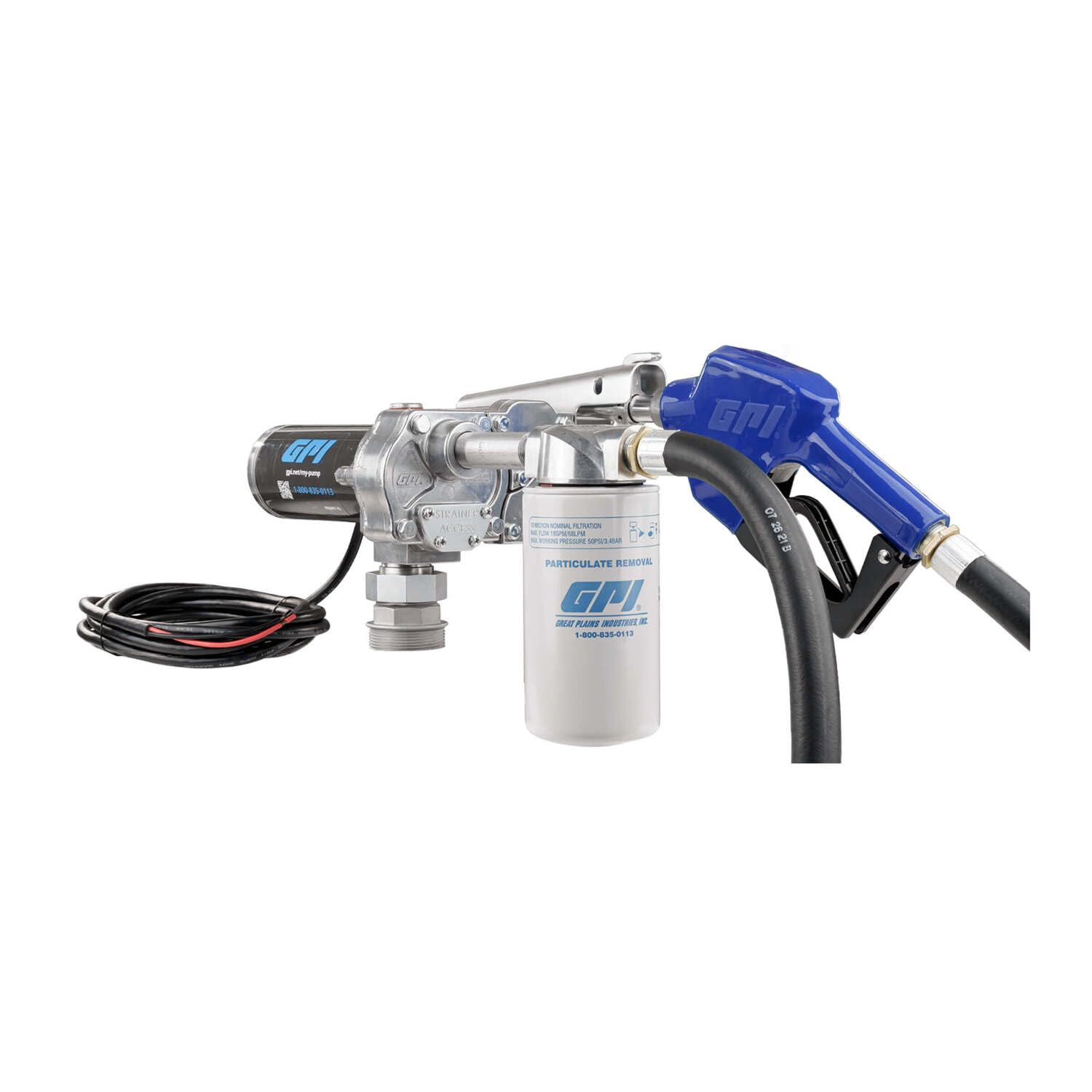
The kit with the filter, the auto-stop nozzle, and a lockable holder that deters theft.
Premium buyers here get two things the cast-iron units do not hand you from the start: filtration and a locking point. The M-150S is a 15 GPM pump with a 10 micron, 1-12 UNF particulate filter and adapter (a fine mesh that traps tiny particles) that strips debris from the fuel before it reaches your equipment — that is filtration fine enough to catch particles that would otherwise reach injectors or carburetors. The automatic unleaded nozzle shuts off when the tank is full, and the lockable nozzle holder protects the setup and discourages theft on an open trailer.
The build is diecast aluminum, so the housing is lighter than cast iron and puts less stress on the tank bung. Inside, a rotary gear design — fewer moving parts than a vane pump, which means less friction and wear — is aimed at a longer service life with minimal maintenance. A circuit breaker guards the motor, the strainer and poppet design make maintenance accessible, and the factory-installed power cord and spin collar make installation straightforward. The box includes the pump, automatic nozzle, dispensing hose, 12-foot hose length, filter with adapter, telescoping suction pipe, tank adapter, fuse assembly, and owners manual.
The fuel rating is specific: gasoline blends up to E15, diesel blends up to B20, and kerosene. That is narrower than the Fill-Rite units, which stretch to ethanol and methanol blends and biodiesel. At 29 pounds it is heavy, and the divided quality feedback is worth knowing — some owners are very satisfied, others less so. What the reliability-focused feedback supports is that it delivers fuel as rated, and the 10 micron filtration plus lockable nozzle holder are what set it apart from the bare-pump premium options.
What the premium buys
- 10 micron filter with adapter removes debris before it reaches your engine.
- Automatic shut-off nozzle plus circuit breaker motor protection.
- Lockable nozzle holder deters theft on an open trailer.
- Diecast aluminum housing cuts weight and stress on the tank bung.
- Rotary gear design means fewer moving parts and less wear.
Where the trade-offs sit
- Rated only to E15 gasoline and B20 diesel blends — narrower than the multi-fuel Fill-Rite units.
- 29 pounds is heavy for a pump-only body.
- Quality feedback is divided, so inspect on arrival.
Worth it when: clean fuel and theft deterrence matter as much as flow rate.
Not ideal if: you run high-ethanol or high-biodiesel blends, where the Fill-Rite lineup casts a wider net.
Know the Specs
Flow rate: GPM and GPH
Flow is how much fuel moves through the pump, measured either in gallons per minute (GPM) or gallons per hour (GPH). They describe the same thing at different scales, so a 15 GPM pump and a 30 GPH kit are not close in output — you have to put both on the same unit before comparing. The number matters because it sets how long a fill takes: a fast unit empties a five-gallon can in a couple of minutes, while a slow one can stretch that toward ten. Flow also drops as lift height and hose length grow, so the rating is a ceiling rather than a promise in every setup.
Suction lift and discharge head
Suction lift is how far below the pump’s intake the fuel can sit and still be pulled up; discharge head is how high the pump can push it. Both are quoted in feet. A pump that pulls from 16.4 feet down and pushes to 32.8 feet up handles deep storage tanks and raised nozzles that a short-reach kit cannot. When your tank is below the pump or your nozzle sits high, check both numbers before buying — the pump that clears your height difference is the one that will actually flow at its rated speed.
Common Questions
Can a transfer fuel pump pull fuel up from a buried or below-ground tank?
Will a 12V transfer pump run off my car’s cigarette lighter?
Is a 20 GPM pump actually faster than a 15 GPM pump in real use?
Can I use a diesel transfer pump for gasoline?
Do I need a fuel filter on a transfer pump?
What is the difference between a suitcase kit and a bung-mounted pump?
Can I leave a fuel transfer pump mounted outside in the rain?
How long does a rechargeable fuel transfer pump run on a single charge?
How do I stop fuel from spilling when the tank gets full?
Do transfer fuel pumps work with ethanol or biodiesel blends?
The Bottom Line
The safest bet for most buyers is the Fill-Rite FR1210H. It is the one pick that arrives ready to run — pump, 12-foot hose, manual nozzle, 34-inch suction pipe, both power cables, and ground wire all in the box — with the cast-iron build and 15 GPM flow that cover everything from a mower to a trailer tank. It carries the highest rating and owner count of any pump here, and reviewers keep returning to the cast-iron build. If you already own a hose and nozzle, the pump-only Fill-Rite FR1204H gives you the same core in a tighter footprint. For the diesel-only crowd working off-grid, the TaskStar cordless earns its spot with a 4.0Ah battery and an auto-stop nozzle. And if clean fuel and theft deterrence matter as much as flow, the GPI M-150 is the filtered premium answer.
How we choose
We do not accept paid placement. Every pick is matched to a real buyer and a real use-case; we do not hands-on test units.
Sources
Specifications: manufacturer listings and product documentation. Review insights: verified customer reviews, as of November 2026. Pricing: not shown on this page (it changes often); check the current price via the retailer link.
As an Amazon Associate, Tactical Gear Guy earns from qualifying purchases. This does not affect which products we feature.