Specs are compiled from manufacturer listings and verified buyer reviews and can change over time — please confirm the key details on the product page before buying.
Dirty water kills a pump fast. Sand, silt or garden grit hits the intake of a clean-water pump and it stalls, leaving you bailing by hand with a dead machine in the puddle. So buy for one thing above all: debris tolerance. The picks below split into two camps. Trash pumps use an agitator (a small stirrer that keeps settled grit swirling in the water) to handle debris. Utility pumps are built for clean or lightly dirty water. Which one fits you depends almost entirely on what is actually floating in your basement or pit.
This guide is built by comparing the manufacturers’ published specifications and the patterns across verified customer reviews, so you get each pick’s real strengths and trade-offs instead of marketing spin.
Head height and flow rate are the two numbers that decide whether a pump can do your job, and both are covered below alongside the cord lengths, discharge sizes and solids limits that actually matter on site. What follows is a straight, plain-English read on the submersible dewatering pump options worth putting in your truck or basement.
Top Picks


How To Choose The Best Submersible Dewatering Pump
The single biggest mistake buyers make is shopping on flow rate alone. That big gallons-per-hour number on the box is measured at zero lift, with the pump sitting in a bucket and the hose running flat on the ground. The moment you start pushing water up a slope or out of a deep pit, that number falls away fast. The honest first question is not “how fast” but “how high and how dirty.”
Match the pump to what is in the water
Sand, gravel and silt are what kill ordinary pumps. A trash pump with an agitator stirs the settled debris back into suspension so it can pass through the impeller instead of packing around it. If your flooded area is a clean basement or a pool cover, a standard utility pump is fine and cheaper to run. If you are draining a construction pit, a pond bottom or a storm sump full of grit, only a pump rated to pass solids will keep going.
Read maximum head before you buy
Maximum head is the tallest vertical lift a pump can push water against — think of it as the height of the column it can climb, measured in feet. A pump reaching 39 feet can clear a deep excavation; one at 25 feet is a basement tool. Always leave headroom: if your discharge rises 15 feet, do not buy a pump rated at 16, because actual flow at that near-limit height is a trickle.
Decide if you want automatic or manual
A float switch turns the pump on when water rises and off when it drops, which is what you want in a sump basin that refills on its own. Manual pumps run only while plugged in, giving you direct control. Automatic matters most where water arrives without warning; manual matters most where you want to drain down to the last fraction of an inch and then stop.
Side-by-Side Comparison
| Model | Best For | Flow Rate | Max Head | Motor | Amazon |
|---|---|---|---|---|---|
| Tsurumi HS2.4S★ Best Overall | Gritty water and debris | 39 GPM / 2340 GPH | 39 feet | 1/2 HP | Amazon |
| Acquaer 1/2HP 2906GPHBest Value | Fast bulk draining | 48.4 gpm / 2906 GPH | 26 feet | 1/2 HP | Amazon |
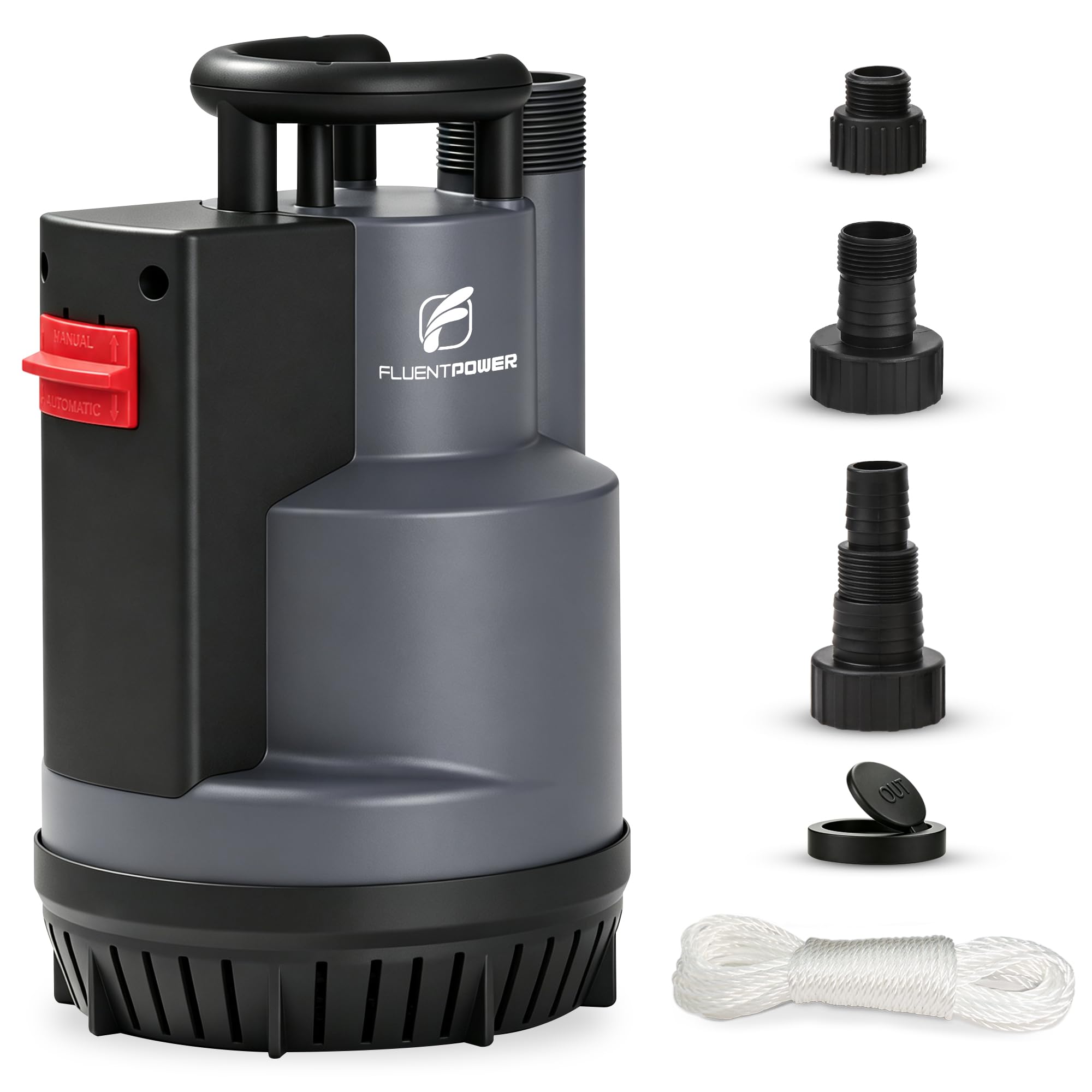
| FLUENTPOWER 3/4 HP 3300 GPHMost Automatic | Hands-off sump duty | 55 gpm / 3300 GPH | 29 feet | 3/4 HP | Amazon |
| BOMGIE 1/3 HP 2250GPH | Everyday home flooding | 30.8 gallons per minute / 2250 GPH | 37.5 feet | 1/3 HP | Amazon |
| Wayne RUP160 | Grab-and-go basement floods | 3,100 GPH | — | 1/6 HP | Amazon |
| Wayne TSC130 | Draining water down to 1/16 inch | 1,350 GPH | 25 feet | 1/6 HP | Amazon |
| Simer 2300-04 Geyser Classic | Cast-aluminum longevity | 22 gpm / 1320 GPH | 25 feet | 1/4 HP | Amazon |
| Tsurumi HSZ2.4S | Automatic grit pumping | 53 gpm / 3180 GPH | — | 1/2 HP | Amazon |
Detailed Reviews
1. Tsurumi Pump HS2.4S Submersible Trash Pump
Our pick — 4.5+★ from 600+ verified ratings; the strongest balance of quality and price.
A trash pump that stirs the sand back up so it can swallow it.
This pump takes the top spot because it swallows grit instead of choking on it. A semi-vortex impeller (a spinning wheel that lets debris pass through a wide gap instead of grinding it against a tight edge) is fed by a built-in agitator (a small stirrer that keeps settled sand and grit swirling in the water). Together they let this 1/2 HP unit pass solids up to 0.3 inch — roughly a thick grain of gravel — without clogging. That is a completely different job than pumping clean water.
It pushes water to a maximum lifting height of 39 feet, the tallest head on this list, so it will clear a deep excavation or push water well up a slope. The angled 2 inch discharge port makes hose and fitting selection easier, and the 20 ft cord gives you reach without an extension lead for most jobs. The body is die-cast aluminum, weighing 29.1 pounds — substantial, and meant to be set down and left in place rather than carried around one-handed.
What wins people over is durability under constant load. Buyers report running it around the clock in muddy water for years, and one customer moved 125 gallons in under five minutes. One buyer reports it “runs 24/7 for about 4-5 years” — a construction-grade duty cycle. It is also backed by a 2-year warranty and carries UL and CSA certification.
What earns the top spot
- Agitator plus semi-vortex impeller clear sand and solids up to 0.3 inch
- 39 feet of maximum lift — the highest head in this group
- 20 ft cord and angled 2 inch discharge simplify setup
- 2-year warranty with UL and CSA certification
Where it asks for patience
- At 29.1 pounds it is the heaviest pump here bar one, versus the 8.1-pound BOMGIE
- It is a manual pump — you plug in to start and unplug to stop, with no float switch
- Premium-tier build means premium-tier spend
Buy this one when: the water carries sand, silt or debris and you need a machine that shrugs it off for years.
Think twice if: you want a pump that starts itself when the sump fills — the HSZ2.4S below adds the float switch.
2. 1/2HP Sump Pump, 2906GPH Submersible Water Pump
Half a horsepower that empties a flooded basement fast, without the trash-pump weight.
Here is the number that matters for a fast cleanup: 2906 gallons per hour at zero lift, or 48.4 gallons per minute. That is moving serious volume, and it is why this pump turns a flooded basement or a drained hot tub into an afternoon job rather than a weekend one. The 1/2 HP capacitor motor runs efficiently and quietly, and the whole thing weighs in far below the cast-aluminum trash pumps — portable enough to carry up from the basement shelf and set down in the water.
It swallows solids up to 1/5 inch, so it will handle the sediment and muck that a clean-water pump chokes on. A low suction base drains water down to 1/5 inch from the surface, which means less sweeping and mopping afterward. The 19.7 ft UL power cord gives you real reach from the outlet, and the maximum immersion depth is 13 ft. Reinforced engineering thermoplastic resists corrosion, and a built-in thermal overload protector cuts the motor if it starts running dry so it does not burn out.
You can likely hook up a hose you already own. The outlet side is flexible: a 1-1/4 inch NPT discharge (NPT is the standard threaded pipe fitting) with a 1-1/2 inch elbow adapter, plus snap coupling adapters for 3/4 inch, 1 inch or 1-1/4 inch hose. Owners mention pumping out 10,000 gallons and praise how it handles thick sediment. It is a real value pick for water that is dirty but not debris-laden.
Why it lands here: fast bulk flow, a low-suction base and an overload protector that saves the motor from dry-run damage, all for an entry-tier outlay. The 26 ft maximum head is shallower than the BOMGIE’s 37.5 ft, so this is a pump for flat basements and pool covers, not deep pits.
The honest limit: 1/5 inch solids are fine for silt, but gravel or construction rubble will jam it. And like every manual pump here, it only runs while plugged in — no float switch to start it for you.
Reach for this if: you are draining a basement, a hot tub or a pool cover and want maximum flow for minimum fuss.
Look elsewhere if: your water is full of sand and gravel, or you want the pump to switch itself on.
3. 3/4 HP Automatic Submersible Sump and Utility Pump, 3300 GPH
The sump pump that wakes up when water rises and shuts itself off when it is gone.
This is the one to buy when you want the pump to think for itself. The built-in float switch starts the motor automatically once water rises above roughly 4 inches and shuts it down near 2 inches, so a refilling sump basin gets emptied without you standing over it. Flip to manual and it will drain down to about 1/2 inch for supervised cleanup — disconnect power before the pump runs dry, as the manual states.
The 3/4 HP motor delivers up to 3300 GPH, the highest flow of the automatic picks, and 55 gallons per minute. That edges out the 1/2 HP Tsurumi’s 39 GPM by a wide margin — the Tsurumi leads on grit handling, but this one leads on raw volume. Maximum head is 29 feet, so it clears a basement and a moderate lift comfortably. The housing is corrosion-resistant PP plastic, small enough for a tight basin, and a bottom intake passes particles up to 1/5 inch.
Owners call it quiet, well built and good value, and one reports it still running after a year. The 16.4 ft cord and 26 ft nylon rope help you position and retrieve it — use the rope, never the cord, to lift. The kit includes GHT 3/4 inch, NPT 1 inch and G1.5 inch connectors plus a check valve to cut backflow. Some report a unit failing after several hours of use, so this is the option to treat as a home-duty sump pump rather than a continuous construction tool.
The case for the auto switch
- Float switch starts above about 4 inches and stops near 2 inches, hands-free
- 3300 GPH and 55 gpm — the fastest of the automatic pumps here
- Manual mode drains down to about 1/2 inch
- Check valve and multiple hose connectors included
Worth knowing up front
- Thermal overload protection stops the motor if it overheats and it restarts after cooling — not a substitute for watching manual runs
- Built for clean water and small debris only, not sewage or corrosive liquids
- A few units have quit after several hours, so heavy continuous duty is not its strength
Pick this for: a sump basin or low area that refills and needs draining on its own schedule.
Pass on it if: you are pumping grit and rubble — that is Tsurumi territory.
4. 1/3 HP Submersible Water Pump, 2250GPH Sump Pump, 10ft Cord

A small-motor pump that climbs further than most of the bigger machines here.
Forget horsepower for a second and look at the lift. This 1/3 HP pump reaches a maximum of 37.5 feet of vertical height — taller than the 3/4 HP FLUENTPOWER’s 29 feet and the 1/2 HP Acquaer’s 26 feet, even though both out-muscle it on flow. If your discharge has to climb a steep slope or rise out of a deep window well, that head figure is the one that decides whether the job gets done.
Flow is a solid 2250 gallons per hour, or 30.8 gallons per minute, at zero lift. The removable suction screen filters debris and protects the pump from damage while handling solids up to 1/8 inch. A 3/4 inch garden hose adapter means you can run it off a standard hose, and the 1-1/4 inch NPT discharge gives you a higher-flow option when you need it. The 10 ft cord is shorter than most here, so check your outlet distance before committing.
Customers note it keeping basements dry and draining pools, and one notes it handled downpours of 2 inches per hour. The pure copper wire motor is built for efficiency, the thermoplastic body resists corrosion, and a built-in automatic thermal overload protector guards the motor from overheating. It is compact and light enough to store on a shelf between floods.
The lift advantage: 37.5 feet of maximum head on a 1/3 HP motor is the standout spec, and it lets this pump handle vertical climbs that sideline shorter-head pumps.
Size the cord first: at 10 ft it is the shortest power lead in this group, so a distant outlet may need an extension. Solids are capped at 1/8 inch, so keep gravel out of the intake.
Made for: window wells, steep discharge runs and deep pits where lifting height beats raw gallons.
Not the one for: a run where the outlet is far from the water, or a load full of chunky debris.
5. WAYNE RUP160 Submersible Utility Water Pump

The shelf pump you forget about until the washing machine overflows.
This is the emergency tool — the one that sits on a shelf until a burst pipe or a storm floods your basement, then clears water down to 3/8 inch from the surface. It moves up to 3,100 gallons per hour, which for a 1/6 HP motor is remarkable. Expect flow to taper as the hose climbs, though: the spec sheet also lists 1850 GPH at 10 ft of discharge lift (the height the water must be pushed). Plug in to start, unplug when the water is gone.
The build is a corrosion-resistant reinforced thermoplastic housing with an oil-free sealed motor and bottom suction, assembled in the USA and covered by a 1-year warranty. A 1-1/4 inch discharge handles high volume, and the included 3/4 inch garden hose adapter fits a standard hose. Never let it run dry — that oil-free motor is sealed for water duty, not for spinning in air.
Reliability is what carries this one: it is the most-praised trait in its owner feedback, well ahead of every other measure, with quality close behind. Owners use it for rain-barrel watering and report it moves a tremendous amount of water quietly. Durability draws a split verdict — plenty of units run for years, while a few fail early — so treat this as an occasional-use flood tool rather than a daily driver.
The value read: a 3,100 GPH 1/6 HP pump that drains to 3/8 inch, made in the USA with a garden-hose adapter in the box. It is the backup you buy so a flooded basement never means bailing by hand.
Where it ends: manual operation only, and the mixed durability signals mean it suits emergencies and seasonal cleanup better than 24/7 running.
Right choice for: homeowners and renters who want a quiet, reliable backup for basement floods and rain barrels.
Wrong choice for: a permanent sump pit that needs an automatic switch — Wayne offers the EEAUP250 for that.
6. WAYNE TSC130 Submersible Utility Pump, 1/6 HP, 1,350 GPH
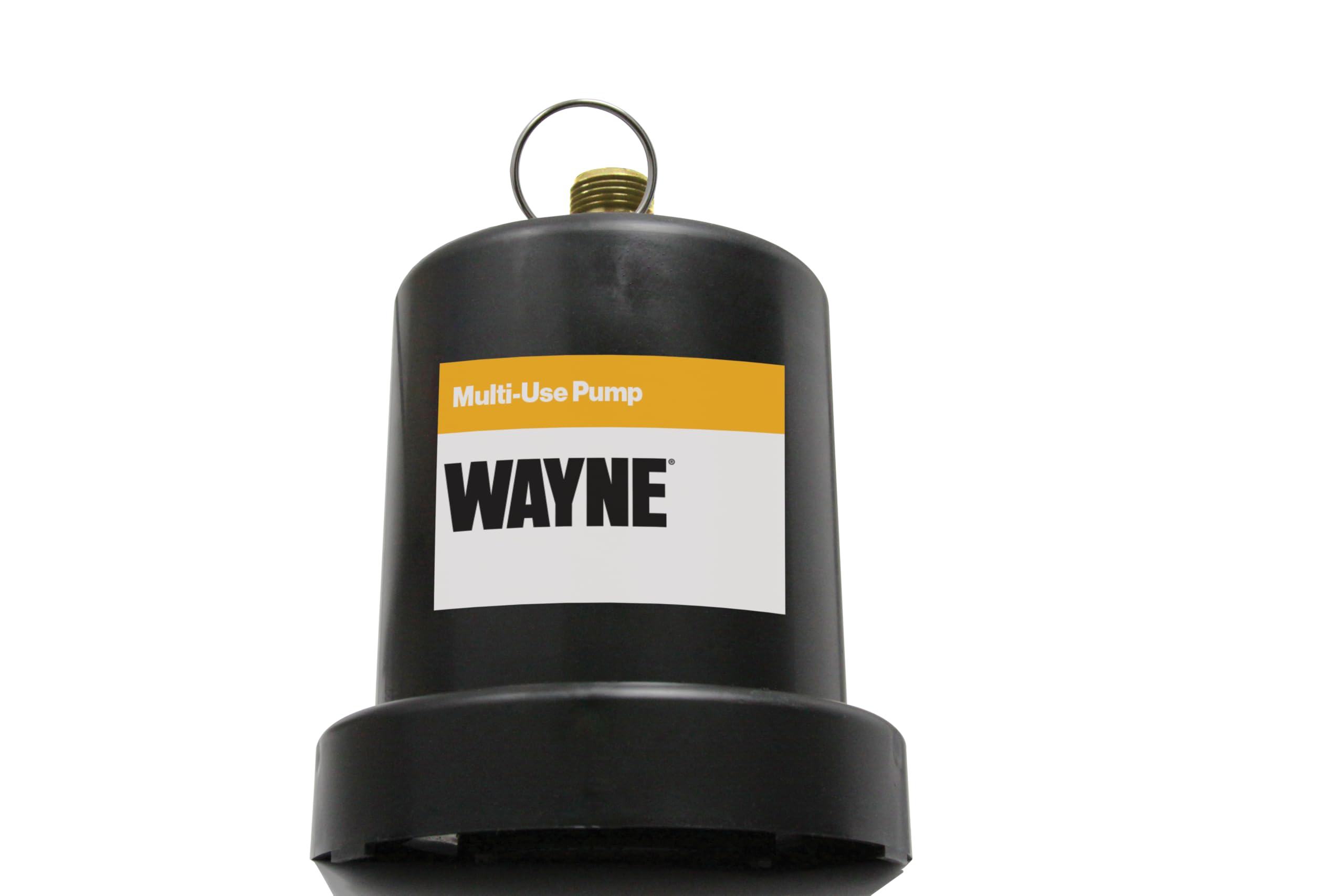
Leaves the floor nearly dry — 1/16 inch is the lowest finish on this list.
When the goal is not speed but a genuinely dry surface, this is the pump to reach for. It drains water down to just 1/16 inch, which is a thin film rather than a puddle, and that is the whole reason it exists. If you have ruined flooring or belongings to protect from lingering moisture, that last fraction of an inch is where the real cleanup happens.
It pumps up to 1,350 gallons per hour with 25 feet of lift, powered by a 1/6 HP motor in corrosion-resistant reinforced thermoplastic. The outlet is a 3/4 inch brass discharge with an included garden hose adapter for a quick connection to a standard hose. The 3/4 inch top-center discharge design keeps the pump balanced and easy to place. It weighs 6 pounds, assembled in the USA and backed by a 1-year limited warranty.
Performance and build quality are the two things owners value most here, and it earns praise for above-ground pool draining and moving water quickly. Durability draws mixed signals — some pumps keep going, while rust has shown up after minimal use on a few. Pumping power is similarly split, so this favours careful, occasional indoor jobs over rough outdoor duty.
Where it shines
- 1/16 inch residual finish — the lowest of any pump in this article
- Brass 3/4 inch discharge with garden hose adapter included
- Just 6 pounds, easy to set and reposition
- Top-center discharge keeps it stable during operation
Set expectations here
- 1,350 GPH is on the low end among the utility pumps here
- Rust has been reported on a few units after minimal use
- 25 feet of head suits basements, not deep excavations
Choose it for: the cleanest possible finish — basements, utility rooms and pool-side cleanup where a dry floor matters.
Skip it for: high-volume draining or gritty outdoor pits, where flow and debris tolerance count more.
7. Simer 2300-04 Submersible Utility Pump

A cast-aluminum classic built for owners who want one pump, not three.
Cast aluminum is the story with this Geyser Classic. Where the other pumps here use thermoplastic shells, this one is built from aluminum — a heavier, denser material that gives it a sturdy, solid feel and a reputation among owners for holding up over the long haul.
It moves 1320 gallons per hour, or 22 gallons per minute, on a 1/4 HP motor, with a maximum lifting height of 25 feet. The 1-1/4 inch male NPT discharge comes with a garden hose adapter, so a standard hose connects without hunting for fittings. The 8 ft power cord is the shortest on this list, though — measure the run to your outlet before you commit. A 2-year warranty is a longer cover than either Wayne pump offers.
Functionality and quality are what owners rate most highly, and it earns praise as efficient and easy to set up and connect. Drainage draws a split response — it handles heavy rainwater well for some, while others find it leaves water behind. Durability is similarly divided, with reports of many years of service alongside a few that quit early. Go in expecting an occasional-use tool and it will do right by you.
The material argument: cast aluminum construction and a 2-year warranty are what set this apart from the plastic-bodied utility pumps, and the garden hose adapter keeps setup simple.
Watch the edges: an 8 ft cord demands a nearby outlet, and the drainage and durability signals are mixed enough that it suits burst-pipe and storm cleanup rather than critical daily duty.
Best fit: someone who prefers durable cast-aluminum construction and a two-year warranty for occasional home water removal.
Less ideal: anyone needing to drain to the last fraction of an inch or reach an outlet across a room.
8. Tsurumi Pump HSZ2.4S Submersible Trash Pump

Trash-pump grit handling plus a float switch, so it runs without you standing over it.
You get the grit handling of the top pick, but it runs itself. A built-in ball float switch (a floating ball that trips the pump on and off) starts the pump when water rises and shuts it off when the level drops, so you do not have to monitor it. That suits a fixed dewatering spot where water arrives on its own. The 1/2 HP motor and 2 inch angled discharge are the same grit-ready design as the HS2.4S, passing solids up to 0.3 inch with minimal wear and clogging.
Flow here is 53 gallons per minute, or 3180 GPH, which actually tops the manual HS2.4S’s 39 GPM — the switch-equipped version moves more water per minute while keeping the same sand-and-solids tolerance. It runs on a standard 115V supply and comes with a 20 ft cord. The die-cast aluminum, silicone carbide, PVC and urethane rubber build is a heavy-duty mix intended for construction-site and remediation work, and it carries a 2-year warranty with UL and CSA certification.
Performance is what owners value most, with the water capacity coming in second. One report has a unit running around the clock for three months — endurance for a pump you set and walk away from. At 26.5 pounds it is a heavy, permanent-fixed-position machine rather than a grab-and-go tool. If you need grit handling and automatic operation together, this is the answer.
The combination play: float switch plus 0.3 inch solids handling plus 53 GPM is a package you cannot assemble from any other single pump here.
Weight and cost: at 26.5 pounds it stays where you put it, and the premium build is reflected in the higher outlay. Confirm your water level triggers the float before relying on it unattended.
The right buy for: a permanent dewatering point with gritty water that refills on its own, where you want it to cycle without supervision.
Overkill for: a one-time clean-water basement drain where a lighter manual pump will do.
Know the Specs
Flow Rate and Maximum Head
Flow rate is gallons per hour or per minute at zero lift — how much water the pump moves when the hose runs flat. Maximum head is the tallest vertical climb it can push against, in feet. These two numbers pull against each other: the higher you lift water, the less flow you get. So a pump rated 3,100 GPH may only reach 1850 GPH at 10 ft of lift, as the Wayne RUP160’s spec sheet shows. Always compare flow at a realistic lift for your job, not the headline figure.
Solids Handling and Agitators
Solids size is the largest particle a pump passes without clogging, measured in fractions of an inch — 0.3 inch for the Tsurumi trash pumps, 1/5 inch for the Acquaer and FLUENTPOWER, 1/8 inch for the BOMGIE. An agitator is a small stirrer that keeps settled sand swirling so it flows through the semi-vortex impeller instead of packing tight. Clean-water utility pumps have no agitator and smaller intakes, which is why they are cheaper but stall on grit. Match the solids rating to what is actually in your water.
Common Questions
Can I use a dewatering pump in a basement that keeps flooding?
What does maximum head mean on a pump?
Will a dewatering pump handle sand and mud without clogging?
What is the difference between a sump pump and a utility pump?
How low can a dewatering pump drain the water?
Do I need a check valve on my dewatering pump?
Can these pumps run dry without damage?
What size discharge hose fits these pumps?
Is a bigger horsepower pump always better?
The Bottom Line
For most people with gritty, unpredictable water, the submersible dewatering pump winner is the Tsurumi HS2.4S. Its agitator and semi-vortex impeller swallow solids up to 0.3 inch, and its 39 feet of lift is the tallest here. If you want that grit handling to run itself, grab the Tsurumi HSZ2.4S with its built-in float switch. And for a fast, budget-friendly basement drain, the Acquaer 1/2HP 2906GPH moves serious volume at entry-level value. Match the pump to your water and your lift, and any of the eight above will earn its place on the shelf.
How we choose
We do not accept paid placement. Every pick is matched to a real buyer and a real use-case; we do not hands-on test units.
Sources
Specifications: manufacturer listings and product documentation. Review insights: verified customer reviews, as of November 2026. Pricing: not shown on this page (it changes often); check the current price via the retailer link.
As an Amazon Associate, Tactical Gear Guy earns from qualifying purchases. This does not affect which products we feature.