Specs are compiled from manufacturer listings and verified buyer reviews and can change over time — please confirm the key details on the product page before buying.
Charging an e-bike from the sun depends on one question: which panel puts usable energy into your battery without leaving you stranded or hauling a slab of glass. The short answer is that a foldable 100W to 120W panel is the practical match for most e-bike packs. A big 400W kit makes more sense if you are also running a power station or an off-grid cabin. Everything below is organized around that one trade-off: watts you can carry versus watts you can store.
This guide is built by comparing the manufacturers’ published specifications and the patterns across verified customer reviews, so you get each pick’s real strengths and trade-offs instead of marketing spin.
Panel wattage, voltage, connector type, and folded weight decide whether a solar setup actually works for an e-bike, so this breakdown sticks to those numbers. Here are the solar charger for e-bike picks worth your time.
Top Picks

How To Choose The Best Solar Charger for E-Bike
An e-bike battery does not care how impressive a panel looks on a spec sheet. It cares about voltage, amperage, and whether the connector matches what your bike or charge controller accepts. Get those three right and the panel will do its job.
Match the panel voltage to your battery
Most e-bike packs run at a nominal voltage that your charge controller or the panel’s own controller has to handle. A panel rated at 18 volts is the common working voltage for portable folding setups, while a 24-volt panel pushes more potential through the same cable. If a panel’s maximum voltage is far above what your controller can accept, you add a converter or a controller that steps it down. Check the max battery voltage on your bike’s charger before you buy anything.
Connector type is the deal you cannot fake
MC4 is the round, locking solar connector used between panels and charge controllers. Your e-bike may want an XT60, a DC7909 barrel plug, an Anderson plug, or a raw DC5521. A panel that ships with a 4-in-1 adapter cable covers those in one box, which saves you from hunting down a converter after the panel arrives. A panel with MC4 output only means you buy the adapter separately.
Folded weight and packed size decide whether it rides along
A panel that weighs 5.2 pounds and folds to roughly 11.82 by 11.23 inches slips into a pannier or on a rear rack. One that weighs 56.4 pounds and spans 41.8 inches long is a vehicle-mounted or base-camp piece. Neither is wrong, but only one of them is coming with you on a ride.
Weather resistance and cell type matter over time
Water resistance ratings like IPX4 handle splashes and light rain, not submersion. Monocrystalline cells are the standard for portable panels because they pack more output into a smaller area. ETFE surface material is more resistant to scratching and UV than the older PET film, which affects how long the panel keeps its output.
Side-by-Side Comparison
| Model | Best For | Max Power | Weight | Connector | Amazon |
|---|---|---|---|---|---|
| Renogy 400W Premium Solar Kit★ Best Overall | Fixed base-camp charging rig | 100 watts | 56.4 pounds | MC4 | Amazon |
| Mesuvida 100W Foldable Panel ChargerMost Versatile | Charging multiple devices on the trail | 100 watts | 7.5 pounds | MC4, DC, USB-C, USB-A | Amazon |
| SOKIOVOLA 120W Foldable Panel | Packable power for power stations | 120 watts | 5.2 pounds | MC4 4-in-1 | Amazon |
| Renogy 400W Solar Blanket | High-output charging in a small bag | 400 watts | 16.1 pounds | MC4 (IP68) | Amazon |
| DOKIO 400W Foldable Suitcase Kit | RV and cabin battery charging | 400 watts | 36.2 pounds | Multi-port with MPPT controller | Amazon |
Detailed Reviews
1. Renogy 400Watt Premium Solar Kit
Our pick — 4.5+★ from 550+ verified ratings; the strongest balance of quality and price.
A four-panel array that turns a sunny wall into a slow, steady e-bike filling station.
If your e-bike lives at a cabin, a workshop, or a garage with no outlet, this is the setup that actually keeps the battery topped up over days rather than hours. It ships as four 100W monocrystalline panels, a 40A MPPT Rover controller, Z-brackets, an adaptor kit, tray cables, and a Bluetooth module — the whole chain from sunlight to battery in one box. The MPPT part matters because it tracks the panel’s best operating point instead of wasting the difference as heat.
That output costs you mobility. At 56.4 pounds and 41.8 inches long, it is roughly 10.8 times the weight of the 120W SOKIOVOLA foldable and about 3.5 times its packed footprint. This is a mount-it-once piece, not something you fold into a bag. Before you commit, check the 32V max battery voltage against your bike’s charge controller. It handles a wide range of 12V systems, but it is not a universal drop-in for every e-bike on the road.
The owners who stick with it are the ones treating it as a learning rig as much as a charger. Owners praise its early-morning output — it starts pulling current at dawn rather than waiting for peak sun — and the kit ships complete, with no missing cable to hunt down. The recurring gripe is cable length: plan on a longer run if your panels and battery sit far apart. The panel carries a 5-year material and workmanship warranty.
Where this setup earns its keep
- Four 100W monocrystalline panels plus a 40A MPPT controller in one purchase
- Bluetooth module lets you watch charge data from your phone
- Z-brackets and adaptor kit mean a real roof or wall mount is possible
- Starts charging early in the day rather than waiting for peak sun
What you should plan around
- 56.4 pounds and 41.8 inches long — a permanent installation, not a travel panel
- Included cable length runs short of far-apart mounting spots
- Check the 32V max battery voltage against your bike’s controller first
Built for: a rider with a fixed charging spot and the patience to let the sun do the work over an afternoon or a full day.
Pass on it: if you need to carry the panel on the bike itself — this one stays where you bolt it.
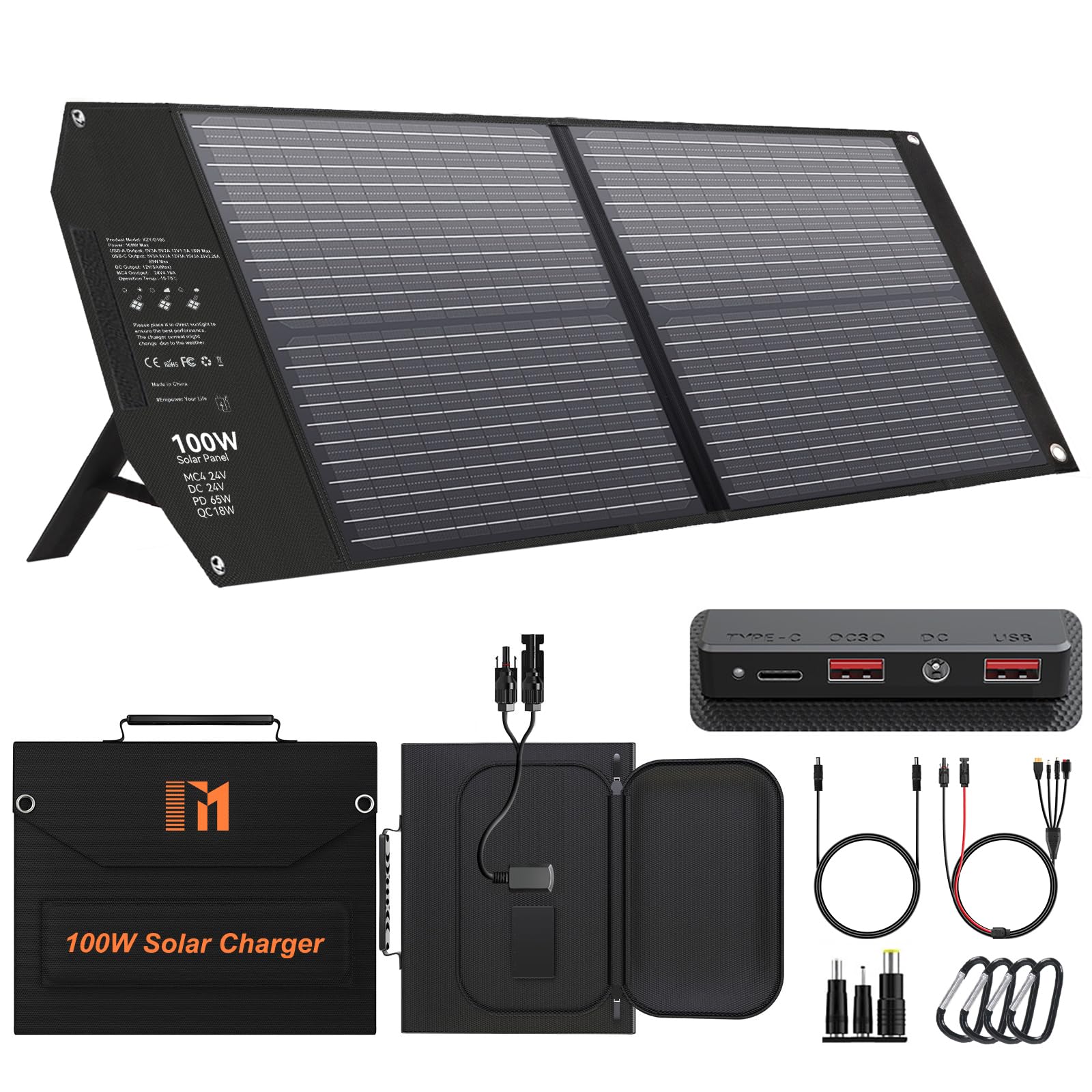
2. 100W Portable Foldable Solar Panel Charger
Five ports on one folding panel, so bike battery and phone charge from the same sun.
Pick this one if you want a single panel that handles the e-bike and everything else. The MC4 24V output (a standard solar connector) is your route into a bike charge controller. Alongside it sit a DC port, two USB-A ports, and a USB-C port. That spread is what makes it useful on a ride: the USB-C port pushes PD 65W (a fast-charging standard many laptops and power stations accept), and buyers report getting up to 65w of constant power out of the panel itself. The USB-A and USB-C ports also support QC 3.0, a fast-charge protocol for phones and tablets.
For carrying, it weighs 7.5 pounds and folds to a 22.8 by 19.7 inch package with a built-in handle — no separate case needed. The adjustable kickstand tilts the panel toward the sun, which matters because a flat panel at the wrong angle can lose a big share of its rated output. Its A+ monocrystalline cells are rated at 24% conversion, wrapped in waterproof Oxford fabric with IPX4 resistance to splashes and light rain.
Owners keep coming back to the port spread — the bundled adapters cover power stations and small devices without extra shopping, and it keeps charging on cloudy days. The catch is that it is a 4.2 A panel against the DOKIO’s 22.47 A, so it feeds a battery slowly and is better suited to topping up than bulk charging. Some buyers weigh the value question against that slower pace, which is fair for a panel this port-heavy.
Trade-off to weigh: you are paying for ports and portability, not raw amperage — 4.2 A will trickle into an e-bike pack rather than filling it fast.
Reach for this if: your day involves an e-bike, a laptop, and a phone all needing juice from one folding panel.
Look elsewhere if: your only job is fast bulk charging — the higher-amperage picks do that better.
3. 120W Foldable Solar Panel

The lightest 120W here, and it folds small enough for a bike pannier.
Where the Mesuvida leans on ports, this SOKIOVOLA leans on packability. It weighs 5.2 pounds and folds to 11.82 by 11.23 by 2.17 inches — small enough to drop into the included storage bag and strap to a rear rack. The 120W rating is 20 watts above the 100W panels in this group, and the 18-volt maximum output is the working voltage most portable power stations expect. That combination makes it a natural bridge between an e-bike pack and a small power station.
The 4-in-1 MC4 cable is the detail that saves you a second order. It splits into XT60, DC5521, DC7909 (8mm), and Anderson ends, which covers the common e-bike and power-station inputs without an adapter hunt. The panel surface uses ETFE (a tough clear outer film) with UV-resistant EVA and advanced integral lamination. The ETFE surface is rated at up to 95% light transmittance — higher than older PET film panels, which the brand credits for holding output over time.
Owners describe the 5.2-pound panel as well-built and genuinely packable, and it keeps producing in overcast conditions rather than shutting down. A fridge running off it is a real-world load no small panel handles by accident. The honest limit is on the power-station side: if your station caps its input power, the panel will not push past that ceiling no matter how bright the sun. Check your station’s input limit before you assume you are getting the full 120W.
Why it earns its slot: lightest packed weight in the group at 5.2 pounds, with the 4-in-1 cable covering XT60, DC5521, DC7909, and Anderson in one bag.
The honest catch: a power station with a low maximum input will bottleneck the panel — the 120W is a ceiling, not a guarantee.
Pick it for: bikepacking and camping where every pound on the rack counts.
Know before you buy: your power station’s input cap decides how much of that 120W you actually see.
4. Renogy 400W Portable Solar Panel
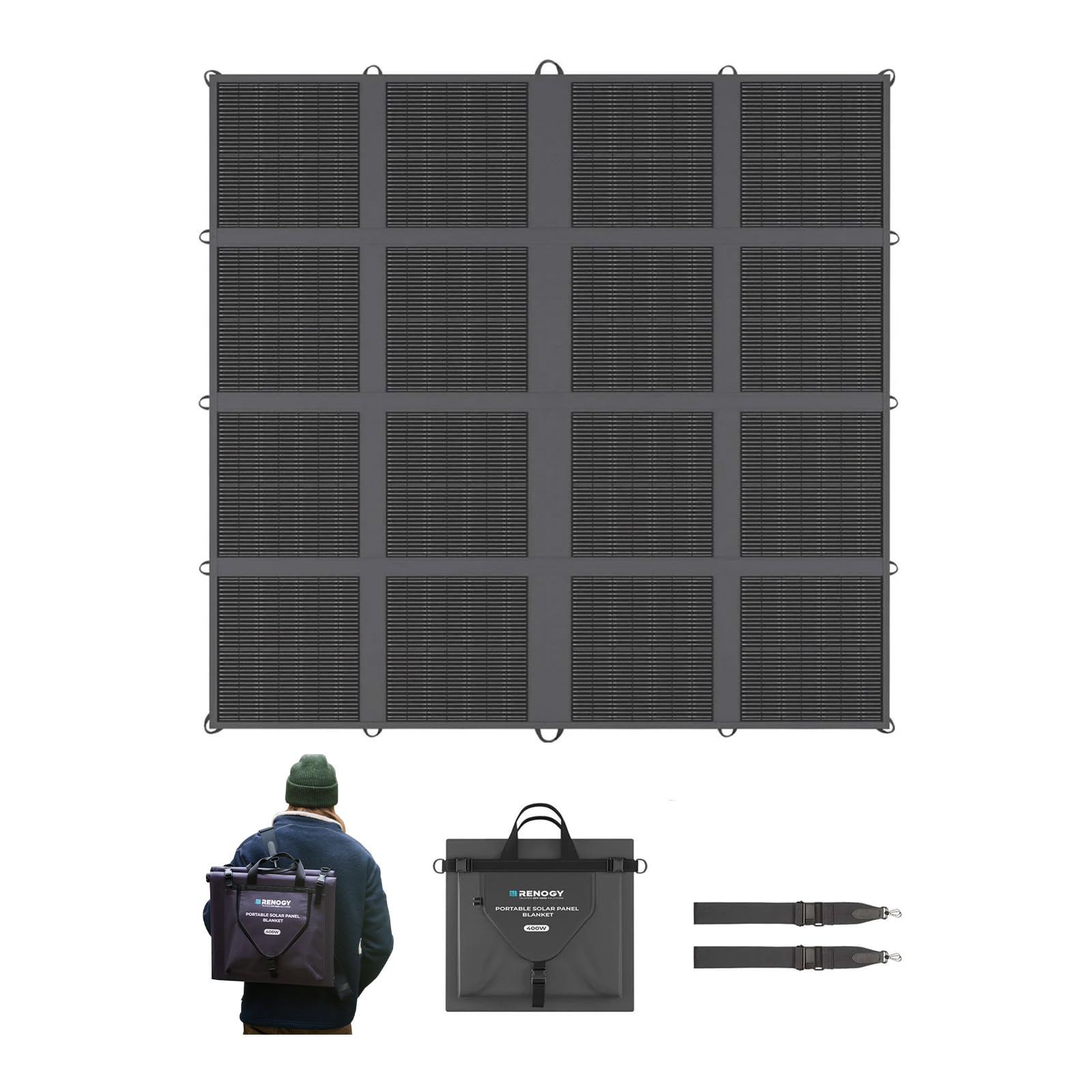
Four hundred watts in a 16.1-pound blanket that folds smaller than a duffel.
This is the panel for the rider who wants real wattage but refuses to give up trunk space. The 16-fold design packs down to 16.54 by 15.83 by 4.13 inches at 16.1 pounds, which is roughly a tenth of the weight of the 56.4-pound Renogy kit while still rated at 400W. You can spread it across a windshield, lay it on sunny ground, or hang it between trees and racks, and tie-downs, stakes, or weights hold it in a windy campsite.
The 16BB N-Type cells are rated at 25% efficiency, the highest figure in this group, meaning more of the sunlight hitting the blanket turns into usable power. It is tested to UL 61730 and carries listed CE, RoHS, FCC, CA65, PSE, and ISO 9001 claims. The MC4 output is the connection, and the IP68 solar connector is the highest water-and-dust rating here. One caveat the maker is upfront about: the 4-in-1 adapter is sold separately, so confirm your bike’s connector before ordering.
Owners mention taking a power station from 73% to 100% in 2 hours 40 minutes, and the 16-fold blanket packs into a backpack. Output is the honest variable: some buyers see 356 watts, others see only 40 to 50 watts, which depends on sun angle, shade, and cable length. That spread is normal for any large blanket, so plan around it with a clear, angled setup.
What you are paying for
- 400W in a 16.1-pound blanket that folds to 16.54 x 15.83 x 4.13 inches
- 25% cell efficiency — the top figure in this lineup
- IP68 connector rating, the highest water-and-dust protection here
- UL 61730 tested with listed CE, RoHS, FCC, CA65, PSE, and ISO 9001 claims
Set expectations honestly
- The 4-in-1 adapter is separate — MC4 output only from the start
- Output swings with sun angle, temperature, and shade — plan an angled setup
- 2-year material and workmanship warranty, shorter than the panel kits
Match this to: van and camper setups where you want 400W but storage space is tight.
Sort out first: your connector type and adapter, since the blanket ships with MC4 only.
5. DOKIO 400W 18V Portable Foldable Solar Panel Suitcase Kit
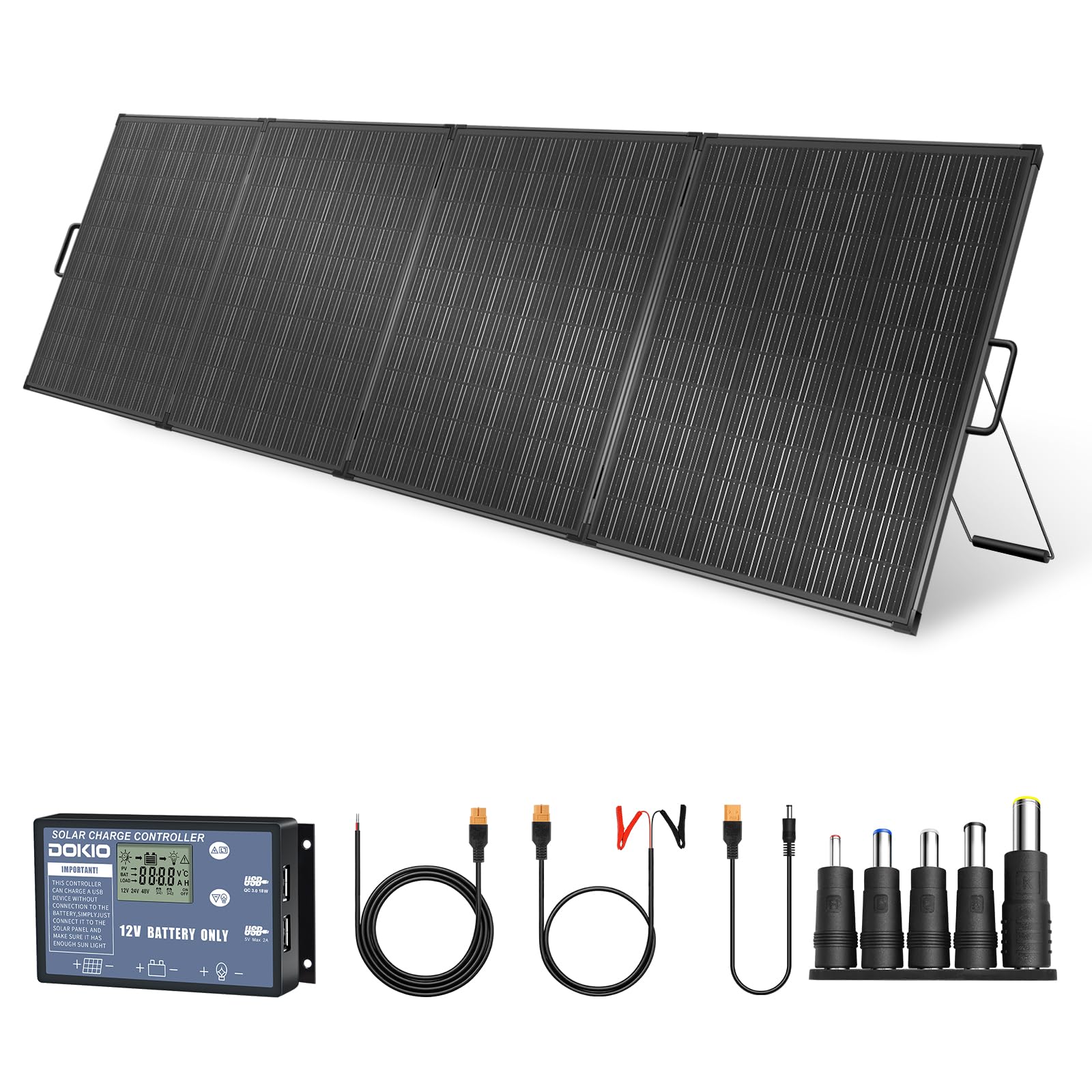
A suitcase of a panel with 22.47 A of grunt and a controller bolted on.
Raw amperage is the reason this one is on the list. At 22.47 A it is about 5.3 times the current of the 4.2 A Mesuvida panel, and the 400W rating is four times the maximum power of the Renogy kit’s per-panel 100W. That current is what lets it push a larger battery — RV packs, cabin banks, and big power stations — rather than trickling into a phone. The 18V output voltage matches the common portable working voltage, and the detachable LCD MPPT controller handles reverse polarity, overcharge, short circuit, and reverse current protection.
It is built for the outdoors in a serious way. N-type cells sit in a corrosion-resistant aluminum frame with reinforced corner guards, rated from -40°F to 185°F, with resistance to 5400Pa snow load and 2400Pa strong wind. The 9.8ft (3m) extended cable lets you chase the sun without moving the panel, and the 30° adjustable bracket helps angle it. Folded, it is 3.9 inches thick with a heavy-duty metal grip for carrying, and it is backed by a 10-year power output warranty.
Buyers single out its cloudy-day output and effective RV battery charging, and the alligator clips get it set up in minutes. The fair warning is build feel: several describe it as flimsy, and some question the value against that. Treat the 36.2-pound frame as something to set down carefully rather than toss into a truck bed, and the adjustable bracket as a piece to move gently.
Standout number: 22.47 A is the highest amperage in this group and the reason it can move real charge into a big battery bank.
Handle with care: the frame draws flimsy feedback, so bracket adjustment and transport need a light touch.
Best for: RV, cabin, and boat owners who need high current to a large battery and a long 9.8ft cable to chase the sun.
Skip if: you want something to sling in a backpack — 36.2 pounds is a two-hand carry.
Know the Specs
Maximum Power and Amperage
Maximum power in watts is the panel’s rated ceiling under ideal sun, while amperage in A is the current it can push into a battery. A 400W panel rated at 22.47 A moves far more charge per hour than a 100W panel at 4.2 A, which is why big batteries want big amperage. For an e-bike pack, the smaller panels top up between rides; the larger ones bulk charge over a full day.
Voltage and Connector Type
Voltage is the electrical pressure the panel delivers, and it has to line up with what your charge controller or power station accepts. MC4 is the standard round solar connector, while XT60, DC7909, DC5521, and Anderson are the plug shapes bikes and power stations commonly use. A panel with a 4-in-1 cable covers several of those at once, saving an adapter order later.
Weight and Folded Size
Weight decides whether a panel travels with you. Anything around 5 to 8 pounds folds into a bag or pannier; anything over 30 pounds is a vehicle or base-camp piece. Folded dimensions tell you if it fits a rack, a trunk, or a storage compartment.
Efficiency and Weather Rating
Efficiency is the share of sunlight a panel converts to power — higher numbers squeeze more watts from the same footprint. An IPX4 rating handles splashes and light rain, while an IP68 connector is rated for dust and water immersion at the plug. Neither rating means the fabric or frame survives a dunking, so treat weather specs as guards against rain, not swimming.
Common Questions
Can I charge my e-bike battery directly from a folding solar panel?
What wattage panel do I need for an e-bike battery?
Do I need an MC4 to XT60 adapter for my e-bike?
Will these solar panels work on a cloudy day?
Why does my 400W panel only show 40 to 50 watts?
How much does a portable solar panel weigh?
Is a foldable solar panel waterproof enough for camping?
What does MPPT mean on a solar charge controller?
Can I connect two solar panels together for faster charging?
How do I know if my e-bike’s charge controller can handle these panels?
The Bottom Line
If you charge in a fixed spot, the solar charger for e-bike winner is the Renogy 400Watt Premium Solar Kit. Its four 100W monocrystalline panels and 40A MPPT controller (a tracker that squeezes more power from the panels) form a complete sun-to-battery chain in one box. If you want a panel that rides with you and charges a laptop and phone alongside the bike, grab the Mesuvida 100W Foldable Panel. For high-current charging into a large battery bank with a long 9.8ft cable, reach for the DOKIO 400W Suitcase Kit. The Renogy 400W blanket is the sleeper of the list — 400 watts at 16.1 pounds with 25% cell efficiency is a combination worth a serious look if trunk space is your constraint.
How we choose
We do not accept paid placement. Every pick is matched to a real buyer and a real use-case; we do not hands-on test units.
Sources
Specifications: manufacturer listings and product documentation. Review insights: verified customer reviews, as of November 2026. Pricing: not shown on this page (it changes often); check the current price via the retailer link.
As an Amazon Associate, Tactical Gear Guy earns from qualifying purchases. This does not affect which products we feature.