Specs are compiled from manufacturer listings and verified buyer reviews and can change over time — please confirm the key details on the product page before buying.
You want a sensor that talks to your SmartThings hub without a fight, and most of them do. What actually separates them is how often they drop offline, how fast the readings update, and whether the batteries die while you are away. Below are eight Zigbee and Z-Wave sensors that genuinely pair with SmartThings, sorted by what each one is actually good at.
This guide is built by comparing the manufacturers’ published specifications and the patterns across verified customer reviews, so you get each pick’s real strengths and trade-offs instead of marketing spin.
Every pick here was checked for protocol, accuracy, and battery claims.
Top Picks


How To Choose The Best SmartThings Temperature Sensor
Start with your hub, not the sensor. A Zigbee sensor needs a Zigbee radio in your setup — a SmartThings hub, or an Echo speaker with a Zigbee hub built in. A Z-Wave sensor needs a Z-Wave radio instead. Buy the wrong protocol and the device simply will not show up, no matter how good the hardware is.
Match the protocol to the hub you already own
Zigbee models dominate this list because they pair easily with SmartThings and with Echo devices that have a Zigbee hub built in, like the Echo (4th Gen) and Echo Studio. Z-Wave picks here — the Zooz pair and the Aeotec — work with SmartThings too, but they need a Z-Wave radio and, on some models, a custom driver before all the readings display correctly.
Read the accuracy figure, then read the range
Accuracy is written as a plus-or-minus number, meaning the reading can drift that far either way. A ±0.2°C sensor keeps a tighter leash on the true temperature than a ±0.3°C or ±1°C one. That matters when you are triggering a fan or a heater at a set threshold, because a loose reading means the routine fires early or late. Check the operating range too, so the sensor still reads correctly in a freezer or an attic.
Decide if you want a screen or silence
Some sensors carry an LCD that shows temperature, humidity, and battery level right on the device. Others are pure black boxes that only report to the app. A display helps in a wine cellar or greenhouse, where you want a glance without the app. A screenless unit blends into a wall and often costs less per room.
Think about where it will actually sit
Adhesive backing sticks a sensor to a wall or shelf; a freestanding body sits on a countertop; a mounting bracket lets you aim a motion sensor’s field of view. For a freezer or a basement corner, adhesive mounting plus a long battery claim is the right pairing. For a nursery or living room, a display readable from across the room saves a phone check.
Side-by-Side Comparison
| Model | Best For | Protocol | Temperature Accuracy | Battery | Amazon |
|---|---|---|---|---|---|
| THIRDREALITY Zigbee Sensor Lite 3-Pack★ Best Overall | Covering several rooms at once | Zigbee | ±0.3°C | 2 AAA, at least 2 years | Amazon |
| SONOFF SNZB-02M AirGuard THMost Data Per Sensor | Pressure, dew point and VPD tracking | Zigbee 3.0 | ±0.2°C | CR2477, 2+ years | Amazon |
| THIRDREALITY LCD Sensor 2-PackBest Screen | Reading temp at a glance | Zigbee 3.0 | ±1°C | 2 AAA, 1 year | Amazon |
| Aqara Smart Climate Sensor W100 | Tight accuracy with smart buttons | Zigbee / Thread | ±0.2°C | 2 CR2450, up to 2.4 years | Amazon |
| Aeotec aërQ | Dew point on a Z-Wave hub | Z-Wave | — | Up to 1 year + | Amazon |
| SONOFF SNZB-02B AirGuard TH Lite 4-Pack | Fast 5-second updates in bulk | Zigbee 3.0 | ±0.2°C | Not stated | Amazon |
| Zooz 800 Series ZSE44 | Long-range Z-Wave coverage | Z-Wave 800LR | — | Longer life claim | Amazon |
| Zooz Q Sensor ZSE11 | Motion plus climate in one | Z-Wave 800LR | — | Batteries or micro USB | Amazon |
Detailed Reviews
1. THIRDREALITY Zigbee Temperature and Humidity Sensor Lite 3Pack
Our pick — 4.0+★ from 500+ verified ratings; the strongest balance of quality and price.
Three rooms, one box, and a sensor that pairs with SmartThings without a fight.
Three sensors for the price of what many rivals charge for one is the headline, and the numbers back it up. This is a Zigbee sensor, so it needs a Zigbee radio in your setup — a SmartThings hub or an Echo device with a Zigbee hub built in, like the Echo (4th Gen), Echo Studio, or Eero 6. Once paired, each unit reads temperature to ±0.3°C across a -15°C to 50°C (5°F to 122°F) span and humidity to ±2% from 0% to 100%.
The sensor inside comes from Sensirion, a name that carries real weight in industrial measurement, and it shows in how steady the readings stay. What wins people over most is how easily these pair and hold a connection — that is the single thing owners talk about above everything else. Reliability sits right behind it. Set a threshold in SmartThings or Home Assistant and the sensor will fire a routine, so a humidifier can start when humidity drops below 40% or a fan can kick on when a room gets hot.
Battery life runs on just 2 AAA cells and the maker claims at least 2 years of normal use. The 3M-rated adhesive backing means you can stick one in a basement, a wine cellar, a greenhouse, or a nursery without drilling anything. The honest catch: accuracy is the one point owners push back on, with the ±0.3°C figure drawing mixed reactions from people comparing readings side by side against a reference. If you need lab-grade precision, look at the Aqara below. For everyday climate routines across a whole home, this is the pick that covers the most ground.
Where it wins
- Three sensors in one box covers multiple rooms from the start
- ±0.3°C and ±2% readings from a Sensirion sensor
- At least 2 years of runtime on 2 AAA batteries
- 3M-rated adhesive sticks to shelves and walls without drilling
Worth knowing
- Zigbee hub is required and sold separately
- Accuracy draws mixed feedback from owners comparing against reference units
Reach for this if: you want climate monitoring across several rooms and your hub already speaks Zigbee.
Look elsewhere if: you need a display on the device — these report to the app only.
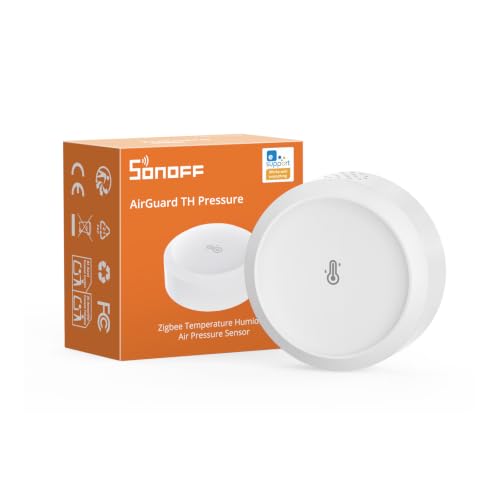
2. SONOFF SNZB-02M AirGuard TH Pressure Zigbee Sensor
A sensor that reads the air, not just the temperature.
Most sensors on this list give you two numbers. This one gives you five: temperature, humidity, air pressure, plus calculated dew point and VPD (vapour pressure deficit — the gap between how much moisture the air holds and how much it could hold, a figure growers watch closely). The accuracy figures are genuinely tight at ±0.2°C, ±2% RH, and ±0.1 hPa. That ±0.2°C beats the ±0.3°C on the THIRDREALITY Lite 3-Pack above — a small gap on paper, but it shows up when you are chasing subtle shifts.
The air pressure tracking is the piece that separates it. Watching the trend helps you spot a weather shift coming, which is useful in a greenhouse or a wine cellar where pressure and humidity together shape conditions. You can set custom thresholds on temperature, humidity, and pressure and get an app alert when readings cross them. It pairs with SmartThings, Echo (4th Gen), and Home Assistant through Zigbee2MQTT or ZHA (two open-source tools that connect Zigbee devices to Home Assistant). A CR2477 battery and low-power design give it 2+ years of runtime, which suits attics, cabinets, and basements you rarely reach into.
Here is the honest part. Reliability and sensor quality are the two areas where owner feedback is genuinely split — some units work exactly as advertised, others draw complaints. If you want the set-and-forget option, the 3-Pack above is the safer bet.
The pressure edge: ±0.1 hPa barometric tracking and calculated VPD put this in a class the plain temp-and-humidity sensors here do not reach, and the 1.78-inch body is 0.43 inches shorter than the 2.21-inch THIRDREALITY Lite.
What to expect: mixed reliability feedback means you should confirm it is reporting correctly in the first week rather than assume it.
Built for: greenhouse and wine cellar owners who want pressure trends and dew point from one unit.
Think twice if: you want the simplest possible pair-and-forget sensor — this one asks you to check it works.
3. THIRDREALITY Zigbee Temperature and Humidity Sensor 2 Pack with LCD
Walk past it and read the room without opening an app.
The high-definition LCD is the reason to pick this pair. It shows temperature, humidity, and battery level right on the device, and it refreshes every 20 seconds so the number in front of you is current. Two sensors come in the box, both Zigbee 3.0, both pairing with SmartThings 2015/2018, Home Assistant, Hubitat, Homey, and Echo devices with a Zigbee hub built in.
What owners praise most is simply how well it works day to day — functionality is the thing that comes up again and again, and compatibility sits right behind it. The app side is solid: you can check history records and battery life remotely, which is the whole point when you have plants or pets at home and want to know the room is holding its climate. As owners put it, the battery indicator still showed full after three months of use.
The trade-off is accuracy. This model is rated ±1°C from -10°C to 50°C (14°F to 122°F) and ±2% humidity from 0-95%, which is a looser band than the ±0.3°C on the Lite 3-Pack above. For glancing at a room and building simple routines like “turn on the fan above 27°C,” that is fine. For precision work, it is not the tool. Battery life is 1 year on 2 AAA cells, which is shorter than several picks here. Note too that the Alexa app shows temperature only, with no humidity.
What you get: a readable screen on two sensors, 20-second refresh, and remote history in the app.
The accuracy catch: ±1°C is a wider tolerance than the tighter sensors here, so treat the number as a guide rather than a precision reading.
Best fit for: a kitchen counter or living room where you want to glance at the temperature without pulling out your phone.
Not the one for: freezer or greenhouse monitoring, where the ±1°C tolerance leaves too much room for error.
4. Aqara Thread/Zigbee Smart Climate Sensor W100

The widest, most readable screen here — and the sharpest temperature reading on the list.
Start with the number that matters: ±0.2°C for temperature and ±2%RH for humidity. Set that against the ±1°C on the THIRDREALITY LCD 2-Pack and you are looking at the difference between a ballpark figure and a precise one. A 3.4-inch LCD shows that data in real time, which is large enough to read from across a room. It supports both Zigbee and Thread (a low-power wireless standard for smart-home devices), so it can slot into SmartThings, Apple Home, Amazon Alexa, Google Home, Home Assistant, and Homey — though Thread mode needs a Matter controller and a Thread border router (the hub that links Thread devices to your network), while Zigbee mode needs an Aqara Zigbee hub.
Then there are the three programmable buttons. Each one handles single, double, and long presses for 9 customizable actions in total, so you can trigger lights, run scenes, or fire routines without reaching for a phone. There is a secondary screen area that can display a linked Aqara temperature and humidity sensor, or fall back to a local weather report. On Zigbee mode with an Aqara Hub M3, it can pair with a third-party IR air-conditioner for wireless HVAC control, letting you adjust temperature and mode from the device itself.
Battery life runs up to 2.4 years on Zigbee and 2.3 years on Thread from 2 CR2450 cells, and you can tune reporting frequency to stretch that further. The honest caveat sits on the software side: the secondary screen and external sensor linking only work through the Aqara Home app on Zigbee mode. Connect it to Home Assistant or another self-hosted setup and owner reports point to compatibility friction — it works, but not with every feature intact. If HomeKit or Google Home is your world, it is a strong pick. If you run everything through Home Assistant, expect to give something up.
Reasons it earns the spot
- ±0.2°C and ±2%RH — the tightest temperature accuracy on this list
- 3.4-inch LCD readable from across a room
- 9 programmable actions across 3 buttons
- Up to 2.4 years on Zigbee, 2.3 years on Thread
Where it asks for patience
- Zigbee mode needs an Aqara hub; Thread mode needs a Matter controller and border router
- Secondary screen and external sensor features are Aqara-app and Aqara-hub only
- Some features fall short in Home Assistant and self-hosted setups
Top choice for: HomeKit or Google Home homes that want a big screen and near-reference temperature accuracy.
Skip the splurge if: you are locked into Home Assistant — the extra screen features will not follow you there.
5. Aeotec aërQ Temperature, Humidity, Dew Point Sensor

A 1.38-inch square that disappears into the wall but still reads dew point.
If you run a Z-Wave network rather than Zigbee, this is the small one. At 1.38 inches square and 21 g it will sit on a shelf or stick to a wall without drawing a glance, and it measures temperature, humidity, and dew point with configurable alerts. It pairs with Z-Wave hubs and controllers that carry S2 and SmartStart capability, and it is broadly compatible with SmartThings.
Dew point is the underrated part. That figure tells you when moisture is about to condense on a surface — the point at which condensation forms — which is why it shows up in basements, bathrooms, and anywhere damp air causes trouble. The battery claim is up to 1 year or more on the single included lithium metal cell, so plan on a yearly swap.
Where it needs honesty: owner feedback on reliability and accuracy is genuinely mixed, with some setups running clean and others reporting drift. This is a device that rewards a quick check after pairing. As a small, dew-point-capable Z-Wave sensor for a SmartThings system, it does a specific job well. As a precision instrument, it is not the pick — the Aqara above holds a far tighter accuracy band. Buy it for the size and the dew point reading, not for reference-grade numbers.
Why the size matters: a 1.38-inch square at 21 g fits into tight spots where a display unit or a bracket would look out of place.
The real limitation: mixed accuracy feedback means you should sanity-check readings against a known reference before trusting a routine to it.
Worth it when: you are on Z-Wave, want dew point data, and need something small enough to forget about.
Look past it if: precision is the whole point of your build — the tighter sensors here will serve you better.
6. SONOFF SNZB-02B AirGuard TH Lite Zigbee Sensor 4-Pack
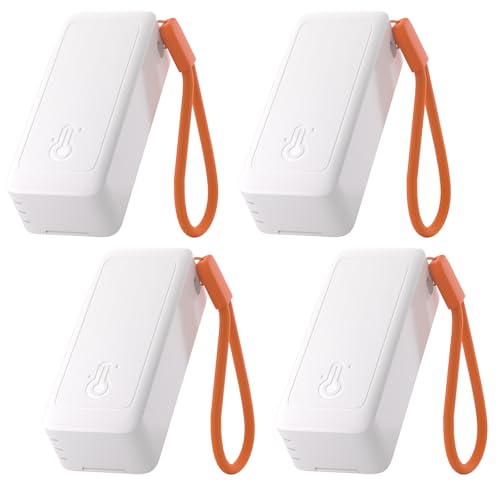
Four sensors that refresh every five seconds, for rooms where fast numbers matter.
A 5-second update interval is quick for this category, and it is the reason to look here. Four sensors ship in the box, each with a Swiss professional-grade sensor inside, delivering ±0.4°F temperature accuracy and ±2% RH humidity accuracy. Set custom thresholds and you get instant app alerts when values cross them, plus scene automation through smart plugs to drive fans or humidifiers. It pairs with SmartThings, Echo (4th Gen), SONOFF gateways, and Home Assistant via Zigbee2MQTT or ZHA.
The 2.61-inch body is 0.4 inches longer than the 2.21-inch THIRDREALITY Lite, so it takes a touch more shelf space, but four of them spread across a house is real coverage. Accuracy is the strongest point in owner feedback, with compatibility close behind. Set against the SONOFF SNZB-02M above, this model holds a slightly tighter ±0.2°C figure than that unit’s 0.4°F.
Now the part you need to plan around. Quality and reliability feedback is mixed, with some units running for months and others stopping their reporting after a few days. Connectivity draws the sharpest notes, with disconnections reported. One concrete step helps: after pairing, update the firmware to V1.0.7 or later. That is worth doing on day one. Buy this for the fast refresh and the four-pack value across a large home, and go in knowing you may need to swap or re-pair a unit.
The refresh advantage: a 5-second interval beats the slower reporting on display models here, so alerts land closer to real time.
What to do on arrival: update to firmware V1.0.7 or later, then confirm each of the four sensors is reporting before you trust a routine to it.
Pick it for: a large home that needs four fast-reporting sensors on one Zigbee network.
Pass if: you want the most stable single connection — the disconnection reports make this the riskier of the bulk options.
7. Zooz 800 Series Z-Wave Long Range Temperature / Humidity XS Sensor ZSE44

Built for the outbuilding your Wi-Fi forgot, with Z-Wave Long Range behind it.
Coverage is the whole story here. The 800 series Z-Wave chip is Z-Wave Long Range ready, offering coverage up to 1300 feet if your hub supports it, along with longer battery life and the highest level of S2 security with SmartStart. That reach is what lets it monitor an outbuilding, a detached garage, or a far corner of a large property that ordinary Z-Wave cannot reliably hit.
For everyday use it tracks air temperature and humidity in a room, with readings you can feed into a smart thermostat or use to trigger a smart humidifier — both sold separately. The XS body is 9.07 g in the sibling Q Sensor’s case, and the minimal design helps it blend into any interior. It measures from 40°F to 104°F, so it is an indoor-temperature tool, not a freezer monitor.
The catch is hub compatibility, and it is not subtle. This works with open Z-Wave systems — Home Assistant via Z-WaveJS, HomeSeer, Hubitat, Z-Box, and SmartThings — but Ring Alarm supports temperature monitoring only, with no settings or humidity reports, and it is not supported by alarm panels like Vivint, Qolsys, 2GIG, or ADT. If it will not work for you, the likely reason is that your hub does not support the new 800 series Z-Wave (the latest chip generation for Z-Wave devices). Owner feedback also notes mixed longevity, with some units going strong and others lasting around three months. Check your hub against the list before you buy, because this one will not bend to fit.
Why it stands out
- Coverage up to 1300 feet with a Long Range hub
- 800 series chip with S2 security and SmartStart
- Extra-small body blends into any interior
The compatibility math
- Needs an 800 series-capable Z-Wave hub — older hubs will not recognize it
- Ring Alarm shows temperature only, with no humidity or settings
- Not supported by Vivint, Qolsys, 2GIG, or ADT alarm panels
- Longevity feedback is mixed, with some units reported failing around three months
Made for: properties with detached rooms or long distances that a standard Z-Wave signal cannot cross.
Only if your hub qualifies: an 800 series-capable Z-Wave controller is mandatory here, not optional.
8. Zooz Z-Wave Long Range Q Sensor ZSE11 800LR

Four sensors in one puck — motion, temperature, humidity, and light.
One device, four jobs. The ZSE11 reads motion up to 20 feet, plus temperature, humidity, and light, so a single puck can trigger lighting automations, fire a security alert, or drive climate control. On USB power it also acts as a Z-Wave repeater, extending the network for other devices — and you can run it on batteries instead, as long as you use one power source only.
The included mounting bracket lets you angle the sensor’s field of view, which matters for motion coverage in a hallway or corner. The 800LR hardware brings Z-Wave Long Range with your hub’s support, S2 Authenticated security, and SmartStart pairing. It is small enough at 2.3 by 2.3 by 2.2 inches to disappear on a wall, and it measures from 32°F. The maker lists a 1-year warranty plus lifetime tech support.
This is the pick with the firmest hub requirement. It works with Z-Box, SmartThings with a custom edge driver (a small add-on that teaches your hub to recognize the device; instructions come in the box), Hubitat, Home Assistant, Indigo, and HomeSeer — and Zooz explicitly warns that if your hub is not on that list, the device will not be recognized. Pair that with the battery note: owner reports say it runs through batteries at an alarming rate. Run it on USB power and both problems soften. Buy it for the four-in-one coverage and the repeater function (it passes the signal along to extend your network), not as a standalone temperature monitor.
Best used plugged in: micro USB power kills the battery-drain concern and turns the sensor into a network repeater at the same time.
Check the list first: a hub that is not explicitly supported will not see this device at all, so confirm before ordering.
The right call for: hallways and rooms where you want motion and climate data from one wall-mounted unit.
Wrong turn if: you want a simple battery sensor — this one drinks power unless you plug it in.
Know the Specs
Temperature accuracy (± bands)
A ± number tells you how far the reading can drift from the true temperature. A ±0.2°C sensor is tighter than a ±0.3°C one, which is tighter than ±1°C. Tighter is better when you automate heating or cooling at a set threshold, because the routine fires at the temperature you actually intended. A wider band is fine for a glance-and-go display, less so for a freezer or a fermentation space.
Zigbee versus Z-Wave
These are two radio languages. Zigbee sensors pair with SmartThings hubs and with Echo devices that have a Zigbee hub built in. Z-Wave sensors need a Z-Wave radio, and 800 series models need a hub new enough to speak that generation. Neither protocol is better — each matches a different hub. Read which one your setup supports before anything else, because the wrong pick simply will not connect.
Refresh interval and battery life
Faster refresh means fresher numbers but more radio traffic and quicker battery drain. A 5-second interval keeps alerts close to real time; a 20-second interval is plenty for room comfort. Battery claims here range from 1 year on 2 AAA cells up to 2.4 years on 2 CR2450 cells. Longer battery matters most in hard-to-reach spots like attics and basements.
Humidity, dew point, and pressure
Humidity tells you how much moisture the air holds. Dew point tells you when that moisture will condense on a cold surface — useful in basements and wine cellars. Air pressure trends hint at weather shifts. Not every sensor reads all three, so decide which figure your routine actually depends on before you buy.
Common Questions
Will these sensors pair directly with a SmartThings hub?
Do I need a separate hub if I already own an Echo speaker?
Can a SmartThings temperature sensor work inside a freezer?
How often should I replace the batteries in a temperature sensor?
Is a tighter accuracy band worth paying more for?
What is the difference between a Zigbee sensor and a Z-Wave sensor?
Can I monitor the temperature when I am away from home?
Do I need to update firmware after pairing a SONOFF sensor?
Will a temperature sensor trigger a fan or humidifier automatically?
Can I use a Zooz Z-Wave sensor on an alarm panel like ADT or Vivint?
The Bottom Line
For most people building climate routines on SmartThings, the THIRDREALITY Zigbee Sensor Lite 3-Pack is the one to buy — three Sensirion-sensor units, at least 2 years on 2 AAA cells, and pairing that owners describe as straightforward, all in one box. If you want the sharpest temperature reading and a screen big enough to read across a room, the Aqara W100 holds ±0.2°C and up to 2.4 years on Zigbee. And for a greenhouse or wine cellar where pressure and dew point matter, the SONOFF SNZB-02M packs five readings into one small sensor. One nudge before you click: pay close attention to protocol, because the single biggest mistake in this category is buying a Z-Wave sensor for a Zigbee-only hub, and no amount of good hardware will fix that.
How we choose
We do not accept paid placement. Every pick is matched to a real buyer and a real use-case; we do not hands-on test units.
Sources
Specifications: manufacturer listings and product documentation. Review insights: verified customer reviews, as of November 2026. Pricing: not shown on this page (it changes often); check the current price via the retailer link.
As an Amazon Associate, Tactical Gear Guy earns from qualifying purchases. This does not affect which products we feature.