Specs are compiled from manufacturer listings and verified buyer reviews and can change over time — please confirm the key details on the product page before buying.
A little water in your diesel does more damage than a lot of dirt ever will. Modern high-pressure injectors run clearances measured in microns, and water strips the lubricity off your fuel and starts pitting metal the moment it reaches the pump. For most buyers, a see-through bowl and a 17-micron element beat a bigger housing you can’t inspect. Below you’ll find seven separators that are actually rated for diesel, sorted by what each one is genuinely good at.
This guide is built by comparing the manufacturers’ published specifications and the patterns across verified customer reviews, so you get each pick’s real strengths and trade-offs instead of marketing spin.
Flow rate and micron rating tell you how a separator behaves, but bowl visibility tells you whether you’ll actually catch a bad tank of fuel before it costs you a pump. Here is how each of these separators earns its place on the list of the best water separator for diesel fuel.
Top Picks


How To Choose The Best Water Separator for Diesel Fuel
Picking a separator is three questions stacked on top of each other: what size junk has to come out, how fast fuel has to move, and how it bolts on. Get the order right and the choice usually makes itself.
Micron rating sets the job
A micron is one thousandth of a millimeter, and the rating printed on a filter is the size of particle it is built to stop. A 30-micron element is coarse protection, the kind that keeps sand and rust scale out of a transfer pump. A 10-micron element is finer and suits fuel that feeds a high-pressure injection system. Go finer than your lift pump can pull through and you trade protection for a starved engine, so match the number to the machine, not to the catalogue’s best-sounding figure.
Water-block chemistry versus plain separation
Some elements are built around water-absorbing polymers that trap moisture inside the media. When that media is full, it chokes fuel flow — which sounds alarming and is exactly the point, because a restricted flow is your signal to change the element before water gets further downstream. Other designs let water fall out of suspension and collect in a bowl for you to drain. Both work; the polymer type just refuses to let you ignore maintenance.
Flow rate has to clear your pump
Flow is quoted two ways — gallons per minute for high-volume transfer setups and gallons per hour for marine and truck systems. A separator rated well above what your pump moves is not wasteful; it means the element is not adding restriction at full demand. Undersize it and the engine feels flat under load long before the filter looks dirty.
Fittings and threads are where kits fail
Thread standards are not interchangeable. NPT is a tapered pipe thread that seals on the threads themselves, M14 x 1.5 is a metric straight thread, and 1/4 inch ports belong to a different family again. A buyer who orders the wrong one gets a beautifully made separator that will not connect to anything in the engine bay. Confirm the thread callout on your existing head before you order anything.
Side-by-Side Comparison
| Model | Best For | Filtration | Flow / Pressure | Connection | Amazon |
|---|---|---|---|---|---|
| Goldenrod 496-3/4 Water Block★ Best Overall | Farm and transfer tanks | 17 microns | 25 GPM / 150 psi | 3/4″ NPT top cap | Amazon |
| caqeg 500FG / 500FH SeparatorBest for Marine | Marine diesel installs | 2, 10, and 30 micron | 60 GPH / 15 psi | M14 x 1.5 | Amazon |
| Sierra 18-7982-1 Kit | Complete marine kit | 10 micron | — | 1/4″ threaded ports | Amazon |
| WIX 33617 | Truck and bus service | — | — | Drain + 7/16-20 sensor port | Amazon |
| Goldenrod 496 (1″ NPT) | Existing Goldenrod bowls | 17 microns | — | 1″ NPT top cap | Amazon |
| Mopar 68197867AB Kit | OEM truck replacement | — | — | Vehicle specific | Amazon |
| Doc’s Diesel DGF401/DGF410 | 6.7L Cummins RAM | 98.49% to 4 microns (DGF410); 93.48% to 3 microns (DGF401) | — | Vehicle specific, two-filter kit | Amazon |
Detailed Reviews
1. Goldenrod 496-3/4 Water Block Fuel Filter
Our pick — 4.5+★ from 650+ verified ratings; the strongest balance of quality and price.
The clear-bowl separator that shows you the water before your injectors do.
This is the separator you buy when your diesel lives in a tank you can’t fully trust — a farm tank, a transfer drum, a slip tank on the back of a truck. It traps moisture with water-absorbing polymers (a media inside the filter that soaks up water and swells), and once that media is saturated it deliberately restricts fuel flow so you know it is time for a new element. That cut in flow is the feature, not a fault: it forces the change before water travels any further downstream.
The see-through bowl is the part that earns its keep day to day. You glance at it and see how much fuel is moving and how much contamination has collected, so you drain and swap on evidence rather than on a calendar guess. Filtration is rated to 17 microns — fine enough to pull out rust, sand, dirt, scale, and lint that would otherwise chew up injectors. The zinc die-cast top cap carries standard 3/4″ NPT pipe fittings (a tapered thread that seals on the threads themselves), so it threads onto common transfer plumbing without adapters.
It moves a lot of fuel. A 25 GPM maximum recommended flow rate (gallons per minute) and working pressure up to 150 psi mean it handles fast-fill transfer pumping without becoming the bottleneck. If you are comparing it with the 1″ NPT Goldenrod further down the list, that version is the same element built for a different bowl — the fittings, not the filtration, are what separate them. Buyers praise the build quality of the whole assembly and its pump-side performance on farm transfer setups.
The honest catch is sealing. Some of these units go on dry and stay dry; others need careful torque and thread sealant or they weep at the cap. Treat the install as the important part and check for dampness after the first few fills. Durability gets a mixed read too — it is a good unit treated well, not an indestructible one.
What it does well
- 17-micron element pulls rust, sand, scale, and lint out of the fuel
- 25 GPM maximum recommended flow handles fast transfer pumping
- Working pressure up to 150 psi suits demanding fuel systems
- See-through bowl lets you read contamination without opening anything
- Zinc die-cast top cap with standard 3/4″ NPT fittings
Where it needs care
- Sealing is installation-sensitive — thread sealant and correct torque matter
- Water-block media restricts flow when saturated, so element changes are not optional
Best for: Anyone pumping diesel from a storage tank or transfer drum who wants to see the contamination with their own eyes.
Look elsewhere if: You need a vehicle-specific spin-on with a sensor port — this is a transfer-side unit with pipe threads.
2. caqeg 500FG / 500FH Diesel Fuel Filter Water Separator
Boat-tank protection with three micron grades and a water-detecting float.
Marine diesel is the hardest fuel in the world to keep dry — condensation builds in a vented tank every time the temperature swings. This separator is built for exactly that fight. It runs a maximum flow rate of 60 GPH (gallons per hour, or 227 LPH) and carries a 15 psi maximum pressure rating, which lines up with the modest lift pumps on most marine installations rather than a fast-fill transfer setup.
The useful trick is inside: a red ring that sinks in diesel and floats on water. That gives you a visual water line rather than a guess about whether the bowl is holding fuel or moisture. Filtration comes in three grades — 2, 10, and 30 micron — so you can run coarse first and fine later, or match the element to how clean your marina’s fuel tends to be. Ports are M14 x 1.5, a metric straight thread, so check your existing fittings before ordering.
It outperforms its price tier, behaving like hardware from a more expensive shelf. Buyers like most that it simply works, with the overall build a close second. The thread standard is the one thing to verify: standard NPT fittings will not thread onto an M14 x 1.5 port, and that mismatch is the compatibility note that shows up in the feedback.
The practical read: For a boat owner who wants a visible water indicator and element flexibility without paying premium marine-counter pricing, this delivers the function that matters.
The one check first: Confirm your fuel line fittings are M14 x 1.5 — not NPT — before you commit.
Reach for this if: Your boat sits on a vented tank and you want to see the water line instead of guessing at it.
Think twice if: Your existing plumbing is NPT-threaded — the metric ports will not marry up.
3. Sierra 18-7982-1 Fuel Water Separator Kit

Head and element in one box, so there is nothing else to source.
Most separators on this list are elements or filters that assume you already own the mounting head. This one is the whole assembly: an aluminum filter head plus a 10-micron spin-on fuel water separating filter, bundled together. That matters most for the buyer upgrading an older boat that never had a separator, or replacing a tired one where the head is as worn as the element.
Ten microns is the right grade for protecting a marine engine’s fuel system — it separates water and particulates before either reaches the injection side. The ports are 1/4 inch threaded, which suits marine fuel system installation, and Sierra builds it to meet or exceed OEM specifications. It is a direct equivalent for the Moeller 033320-10 kit, so if that is the part number written in your engine manual, this drops straight in.
People settle on this kit for the install: it goes on cleanly, and owners of older inboards report it fitting their engine bay without bracket work. Reviewers talk about quality most, with function close behind. A limited lifetime warranty backs the head, which is not something every marine kit offers.
Why it earns the spot: The aluminum head is the real value here — a spin-on element alone cannot help you if your original head is corroded or wrong-threaded.
Worth knowing: At 10 microns it is fine filtration, so keep an eye on element life if your marina’s fuel runs dirty.
Suits: Marine owners replacing a full separator or adding one for the first time on an older engine.
Not the pick for: High-flow transfer pumping — this is engine-side filtration on 1/4 inch ports.
4. WIX 33617 Fuel Filter with Drain and Sensor Port

The spin-on built for drain-and-swap service on a working truck.
Truck and bus duty means one thing above all: the filter has to come off easily and go back on without drama. This WIX spin-on is designed around exactly that, with a drain and a 7/16-20 sensor port on the housing. The drain lets you empty the can before you spin it off — no armful of diesel, no tray under the chassis. The sensor port is where a water-in-fuel sensor threads in on vehicles that came with one, so the dashboard warning keeps working after the swap.
Filtration targets dirt, rust, scale, and water, and WIX builds the media for extended service intervals — long gaps between changes rather than frequent short ones. At 1.9 pounds it is a compact can, against the 2-pound Goldenrod 496 further down, though the two are built for entirely different mounting situations. Buyers praise the overall build most, and the recurring report is a truck that runs right straight after installation.
Value splits opinion more than anything else about it. Some see a fair price for the quality; others find it on the steep side compared with generic cans. That is the honest tension — you are paying for the drain and sensor configuration as much as the media.
The argument for it: Drain plus sensor port turns a messy chore into a ten-minute job and keeps your water warning functional.
The honest caveat: Verify fitment against your exact engine before ordering — this is a vehicle-specific can, not a universal one.
Buy it for: Trucks and buses that need a clean, drained service and a working water sensor afterward.
Pass on it if: You are shopping for a transfer-tank separator — this mounts on an engine, not a pump line.
5. Goldenrod 496 Dutton-Lainson Water Block Fuel Filter
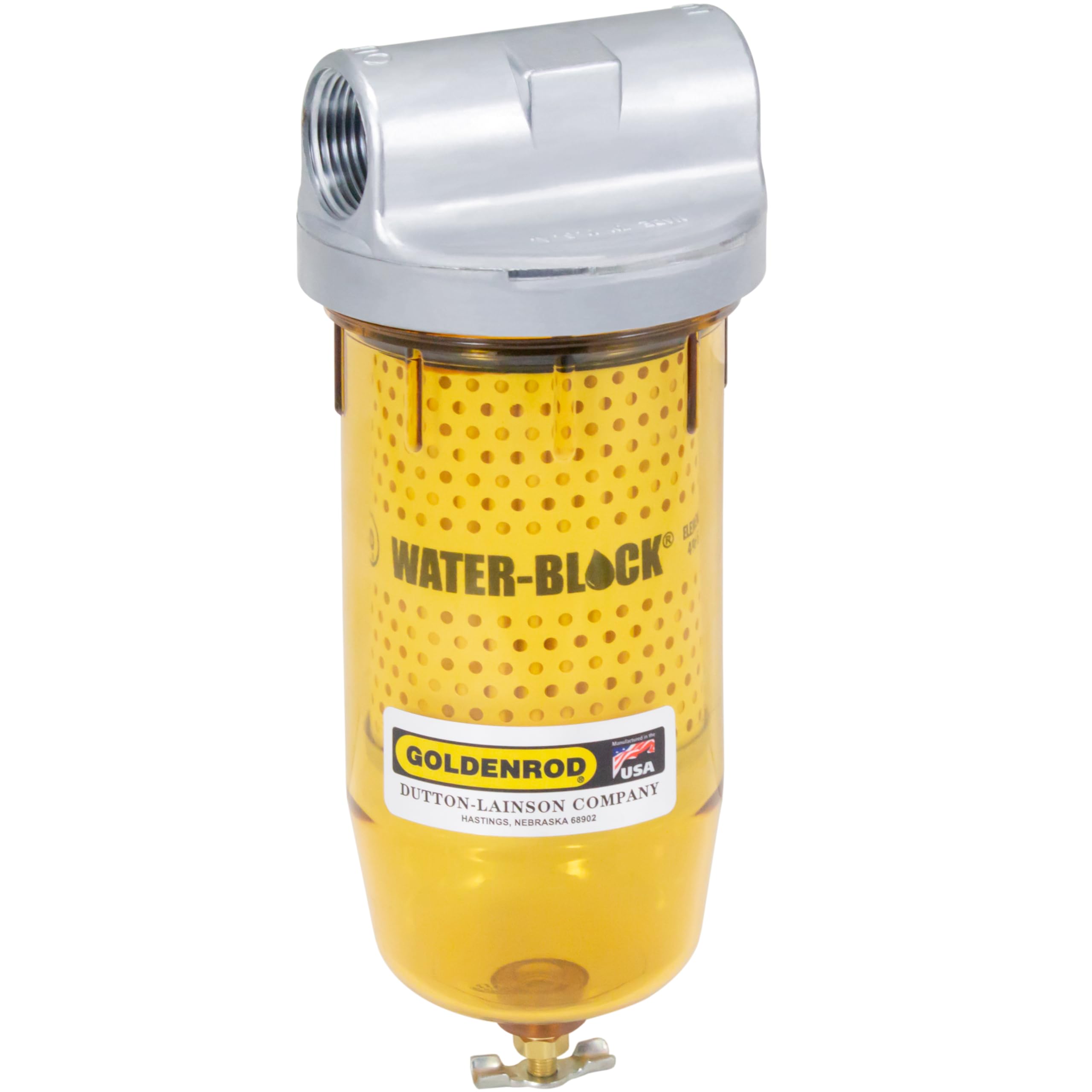
The element-only swap for owners who already run a Goldenrod bowl.
Read the fitment note before anything else, because it decides whether this product is even in play for you. This element is for use with GOLDENROD See Thru bowl fuel tank filter models 495, 495-1, 496, and 496-1 only. It carries a zinc die-cast top cap with 1″ NPT pipe fittings (a tapered thread that seals on the threads). It is not for GOLDENROD bowl models 497 or 497-1, and it is not for biodiesel blends over 20 percent.
If your bowl is on that list, the rest is straightforward. The water-block media traps moisture with water-absorbing polymers and restricts flow once saturated, so a sluggish pump is your change signal rather than a surprise. At 2 pounds it sits against the 1.9-pound WIX can, a weight difference that means nothing in service and everything about how much metal is in the housing.
It earns the recommendation on filter quality and on transfer pumps, where buyers report it working well with their diesel transfer setups. Visibility is another quiet win: with a see-through bowl you can watch contamination collect instead of trusting a schedule. Made in the United States, which some buyers care about for a part that sits between them and a fuel system repair.
The recurring gripe is leakage and long-term durability, both of which come down to how carefully the cap is seated. Once it is sealed correctly it stays sealed; rushed, it weeps. Keep a spare element on the shelf and this is a low-drama part of your fuel routine.
Strengths worth noting
- Same water-block polymer media as the 3/4″ unit
- 1″ NPT top cap for larger transfer plumbing
- See-through bowl shows contamination without disassembly
- Proven on diesel transfer pump duty
Fitment limits to respect
- Only for GOLDENROD 495, 495-1, 496, and 496-1 bowls
- Not rated for biodiesel blends over 20 percent
- Cap sealing is fussy if you rush the install
Right answer if: You already own a compatible Goldenrod bowl and just need the element refreshed.
Wrong answer if: Your bowl is a 497 series or you run high-biodiesel blends — the maker rules both out.
6. Mopar Fuel/Water Separator Filter Kit (68197867AB)
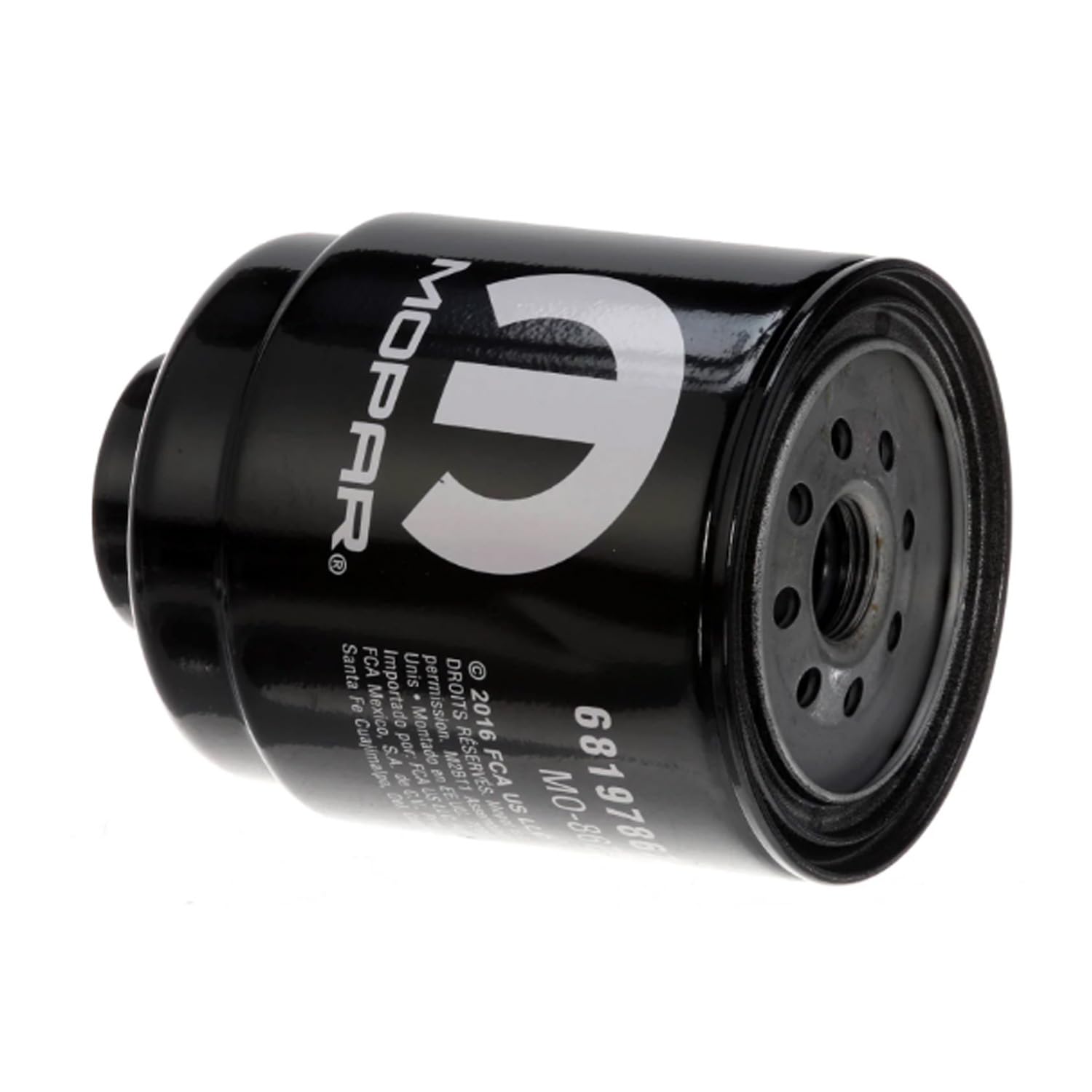
The factory part number, so there is no argument about what fits.
Some buyers do not want to research cross-references — they want the part stamped with the number their truck was built around. This is that part: Mopar 68197867AB, a fuel water separator filter for truck applications, carrying the OEM equivalent part number on the box. The 2 year warranty is a manufacturer description on the listing, and the Chrysler name behind it is the whole appeal.
Physically it is a light piece — about 1.3 pounds, 5.2 inches across the diameter — which tells you it is built as a direct drop-in for an existing housing rather than a standalone assembly. Fit is the strength: it goes where the original went, and that is what the strongest feedback is about.
Installation is where opinions divide. Plenty of owners find it straightforward; there are also reports of internal components arriving assembled the wrong way round, which turns a simple change into a return. That is not a design fault so much as a quality-control miss on an individual unit, and it is worth opening the box and checking the internals before you start draining anything.
Value holds up well against dealer-counter pricing on the same number, which is exactly why the OEM route appeals here — genuine part, no guesswork, and a warranty to lean on.
The case: A stamped Mopar number removes fitment doubt entirely, and the 2-year manufacturer warranty backs it.
Do this first: Inspect the internal assembly as soon as it arrives — a misassembled unit is the defect that turns up in the feedback.
Choose this if: You want the exact factory part number with no cross-reference hunting.
Skip the hassle if: You prefer to verify an equivalent part against a cross-reference list instead.
7. Doc’s Diesel Fuel Water Separator for 6.7L Cummins RAM
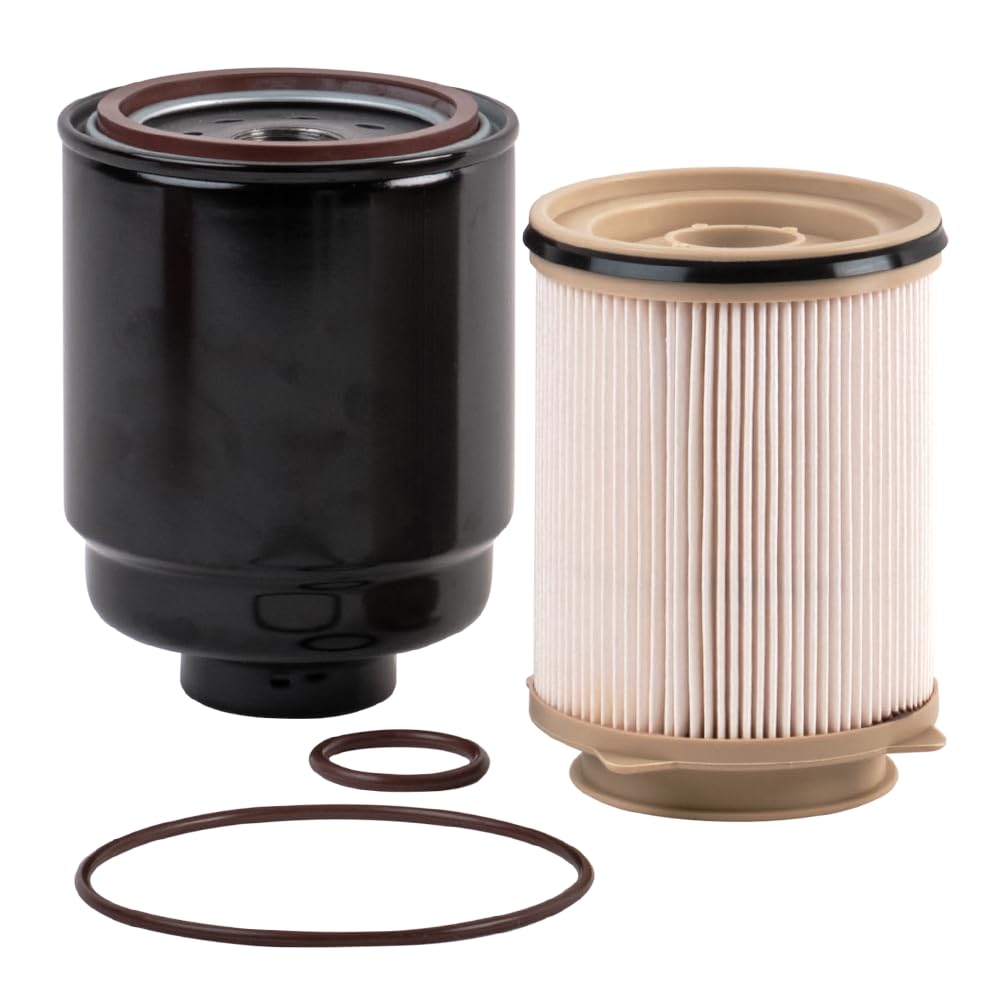
Two matched filters with published efficiency numbers and a fitment card.
If you drive a 2013-2018 Ram with the 6.7L Cummins — 2500, 3500, 4500, or 5500 — this is the complete service in one box. It ships as two matched separators, SKU DGF410 and DGF401, so both stages of the factory system get replaced at the same time rather than one now and one next month.
The numbers are the headline. Independent testing rates the DGF410 at 98.49 percent efficiency down to 4 microns, and the DGF401 at 93.48 percent efficiency down to 3 microns. Those are published, testable figures rather than a vague claim, and they are the reason this kit sits at the top of the Cummins-specific options. Change interval guidance is every 5,000 to 10,000 miles, 15,000 maximum — though the maker’s own advice is to follow your vehicle manufacturer’s warranty schedule above all.
Fit is the other half of the story. It goes in like the stock parts, uses exact OEM sizing, and the install runs about 30 minutes in most reports. It cross-references a long list of numbers — Mopar 68157291AA, Wix 33255, Fram CS11037, Baldwin PF9870, Premium Guard DF8606, Purolator F36294 — so if your manual quotes any of those, this covers it. Function holds steady with no change in how the truck performs, and it looks identical to the stock filters on the engine.
The one recurring annoyance is the o-rings. The kit is supposed to include new ones and some owners mention them missing, so open the box and count before you start. That single issue is the flaw in an otherwise OEM-grade package — and it is the difference between a 30-minute job and a second trip.
Where it leads
- 98.49 percent efficiency to 4 microns on the DGF410, 93.48 percent to 3 microns on the DGF401
- Two matched filters cover the full service in one box
- Cross-references Mopar, Wix, Fram, Baldwin, Premium Guard, and Purolator equivalents
- About a 30-minute install with exact OEM sizing
Watch points
- Fits 2013-2018 Ram 6.7L Cummins only — confirm year and configuration first
- New o-rings should be in the box; verify before draining anything
Made for: 2013-2018 Ram 6.7L Cummins owners who want both filters in one box with a published efficiency rating.
Not for: Any other engine — this kit is locked to that specific year range and configuration.
Know the Specs
Micron Rating
A micron is one thousandth of a millimeter — the unit that describes how small a particle a filter will stop. A 30-micron element catches coarser debris and suits transfer pumps; a 10-micron element goes finer for engine-side protection; a 2-micron element is very fine indeed and restricts flow more. The right number is the one matched to what sits downstream of the filter, not the smallest number on the page.
GPH, GPM, and PSI
Flow is quoted as gallons per hour for marine and truck systems and gallons per minute for high-volume transfer. PSI, or pounds per square inch, is the working pressure the housing is rated to hold. Both numbers describe headroom: a separator rated above your pump’s demand adds no restriction at full load, while a marginal one makes the engine feel flat before the filter looks dirty.
Thread Standards
NPT is a tapered pipe thread that seals on the threads; M14 x 1.5 is a metric straight thread; 1/4 inch ports are their own family. These do not interchange. Measure or read the thread callout on your existing head first, because no amount of careful installation will marry an M14 port to an NPT fitting.
Bowl Visibility and Drains
A see-through bowl lets you see both fuel level and contamination, so you service on evidence. A drain port lets you empty the can before removal, keeping diesel off the chassis. Both features shorten the job and reduce the chance you put off a change that should have happened a tank ago.
Common Questions
Will a diesel water separator also work on gasoline?
How fast should water be drained from the bowl?
What is the difference between a 10 micron and a 30 micron element?
How often should I change a diesel fuel water separator?
Will the Sierra 18-7982-1 fit my boat engine?
Can I use the Goldenrod 496 with biodiesel?
Why does my separator leak after installation?
Is the Mopar 68197867AB the same as the filter already on my truck?
What does 98.49 percent efficiency at 4 microns actually mean?
Do I need a water-in-fuel sensor port on a replacement filter?
The Bottom Line
For most people searching out the best water separator for diesel fuel, the Goldenrod 496-3/4 Water Block is the pick because it combines 17-micron filtration, a 25 GPM flow rating, and a see-through bowl you can actually read. If you are working on a boat, the Sierra 18-7982-1 kit gives you the head and element together at 10 microns with a limited lifetime warranty. And for a 2013-2018 Ram 6.7L Cummins, the Doc’s Diesel two-filter kit is the one to reach for, with published efficiency of 98.49 percent to 4 microns. Whichever you land on, confirm the thread spec before the box arrives — that single check prevents most of the returns in this category.
How we choose
We do not accept paid placement. Every pick is matched to a real buyer and a real use-case; we do not hands-on test units.
Sources
Specifications: manufacturer listings and product documentation. Review insights: verified customer reviews, as of November 2026. Pricing: not shown on this page (it changes often); check the current price via the retailer link.
As an Amazon Associate, Tactical Gear Guy earns from qualifying purchases. This does not affect which products we feature.