Specs are compiled from manufacturer listings and verified buyer reviews and can change over time — please confirm the key details on the product page before buying.
You keep reaching for the volume during quiet scenes, then grab the remote when an explosion hits — that is your TV’s built-in speakers failing you. A soundbar connected over your TV’s HDMI port fixes this in about five minutes. One cable carries both the picture-synced audio and the volume commands from your existing remote. What to buy: the Sonos Arc Ultra is the strongest all-round pick here for spatial sound (sound that seems to come from around you) and speech clarity. But if dialogue is your whole complaint, a cheaper bar with a dedicated dialogue mode covers it.
This guide is built by comparing the manufacturers’ published specifications and the patterns across verified customer reviews, so you get each pick’s real strengths and trade-offs instead of marketing spin.
You will see exactly which bars carry HDMI eARC, how many channels of sound each one pushes, and where the bass comes from. Below is a straight comparison of the best hdmi tv sound bar options for real living rooms.
Top Picks


How To Choose The Best HDMI TV Sound Bar
Buying on wattage (the power rating printed on the box) alone is the mistake most people make. A bar pushing a big watt number into a thin cabinet can still mumble dialogue. A modest 100-watt bar in a bedroom often sounds better than a loud one fighting a hard floor. Three things actually decide whether you are happy: how it connects, how many separate channels of sound it can steer, and whether the bass comes from its own box.
Check the HDMI port type before anything else
You want HDMI eARC (Enhanced Audio Return Channel — the newer HDMI handshake that lets the TV send full-quality surround sound down one cable to the bar). Plain HDMI ARC works too and carries most formats, but eARC has the headroom for uncompressed Dolby Atmos. Every bar on this list has an HDMI connection of some kind, which is why they made the cut — an optical-only or Bluetooth-only bar cannot pass the height channels that make Atmos feel overhead.
Match the channel count to your room size
A 2.0 bar (two speakers, no separate bass box) suits a bedroom or a small flat where a sub would annoy the neighbours. A 2.1 or 3.1 adds a subwoofer for the low rumble, and the “3” means a dedicated centre channel aimed at speech — genuinely useful if you struggle to catch quiet lines. A 5.1.2 like the ULTIMEA goes further, adding rear surround speakers and two up-firing drivers that bounce sound off your ceiling for the overhead effect.
Look for a dialogue mode if speech is your gripe
Almost every modern bar ships some form of voice enhancement, and it matters more than the spec sheet suggests. Bose calls it Dialogue Mode on its TV Speaker and A.I. Dialogue Mode on the Smart Ultra, Samsung has Voice Enhance, and Sonos runs AI-powered Speech Enhancement. These lift the vocal frequencies above the background score, so you stop riding the volume button during quiet scenes.
Side-by-Side Comparison
| Model | Best For | Channels | Power | Key Connection | Amazon |
|---|---|---|---|---|---|
| Sonos Arc Ultra★ Best Overall | Whole-room spatial sound | 9.1.4 | — | HDMI eARC | Amazon |
| TCL S45HBest Value | Bedrooms and small flats | 2.0 | 100 W | HDMI eARC/ARC | Amazon |
| TCL S55HBass Bargain | Bass on a budget | 2.1 | 220 W | HDMI eARC/ARC | Amazon |
| Hisense HS2100 | EQ tweakers | 2.1 | 240 W | HDMI ARC | Amazon |
| Samsung HW-B550F | Samsung TV owners | 2.1 | — | HDMI | Amazon |
| LG S60T | LG OLED pairings | 3.1 | — | HDMI | Amazon |
| ULTIMEA 5.1.2ch | True surround on a budget | 5.1.2 | — | HDMI eARC | Amazon |
| Bose TV Speaker (2nd Gen) | Cramped TV stands | 2.0 | — | HDMI-ARC | Amazon |
| Bose Smart Ultra | Voice-controlled home theater | Dolby Atmos | — | HDMI eARC | Amazon |
Detailed Reviews
1. Sonos Arc Ultra Soundbar with Dolby Atmos – Black
Our pick — 4.5+★ from 750+ verified ratings; the strongest balance of quality and price.
Nine channels and four height drivers doing the work of a full surround rig from one slim bar.
If you want the room to disappear, this is the bar that does it. The 9.1.4 layout — nine ear-level channels, one subwoofer channel and four height channels — places effects above and behind you without a single rear speaker on the floor. Sonos builds that with Sound Motion acoustic architecture, and the included microphone and AI-driven Speech Enhancement hunt down the human voice in a mix so whispered dialogue stays readable.
Setup is honestly the easiest part: one HDMI eARC cable to the TV, then the Sonos app walks you through the rest step by step. Trueplay then tunes the output to your actual room, which matters in a space with hard floors or a lot of glass. It streams over WiFi, Bluetooth, Apple AirPlay 2 and Spotify Connect, and you can add a Sonos Sub and Era 300 rear speakers later for a fuller Atmos bubble. It holds 4.5+ stars across 700+ owners, and buyers report the white version blends into pale cabinetry rather than shouting for attention.
The honest catch sits on the value question. Owners are split on whether it justifies its premium price, and you are paying for the ecosystem as much as the sound. Speech and spatial placement are where it wins; raw bass thump from a single slim cabinet will not satisfy someone chasing a dedicated sub. For a large, awkward room that needs one bar to fill it, this is the pick.
Where the Arc Ultra pulls ahead
- 9.1.4 spatial layout places sound overhead and around you with no rear speakers needed
- AI-powered Speech Enhancement digs out dialogue from busy action mixes
- Single HDMI eARC cable plus app guidance makes the physical install trivial
- Trueplay tunes output to your room’s actual shape and furniture
Where it asks more of you
- Premium-tier price is the most debated point in owner feedback
- Adding a Sonos Sub for deeper rumble means another purchase
Reach for it if: you have one large room, want Atmos height effects without wires behind the sofa, and value a voice-first remote experience.
Think twice if: chest-thumping bass is your priority — a bar with an included subwoofer delivers more rumble for a fraction of the layout.
2. TCL S45H 2.0 Sound Bar
A 31.89-inch bar that slips under a small TV and punches well past its 100-watt rating.
Bedroom and apartment buyers should start here. At 100 watts total from a two-speaker 2.0 design, it has no separate subwoofer to place, which keeps the footprint clean. Yet it still decodes Dolby Atmos and DTS Virtual:X, simulating height and surround effects so a movie feels bigger than the box. The physical bar measures 31.89 inches wide and 2.36 inches tall, low enough to sit under most TVs without blocking the screen.
Sound quality is what wins people over — it is the most-praised thing about this bar by a wide margin, and owners routinely say it beats what they expected at this level. Setup is a genuine one-and-done: owners mention “The product is easy to set up, taking only 1-2 minutes to download and install, and connects easily to LG Smart TVs.” AI Sonic auto room calibration (it tunes the sound to your room’s layout) runs once through the TCL app. In the box you get an HDMI cable, a remote and a wall-mount kit, and it also connects over optical, Bluetooth or AUX (three other cable and wireless options).
The trade-off is what 100 watts in a 2.0 cabinet cannot do: subwoofer-grade bass is simply not there. Volume is the one aspect owners are split on, so a big open-plan room will test it. In a bedroom or modest living space, that volume ceiling rarely shows up.
The room-match read: this is the bar for someone who wants clearer voices and a bigger soundstage without a second box on the floor, and the Atmos decoding plus auto calibration do real work for the money.
Fair warning: expect crisp dialogue and decent virtual height, not a floor-shaking rumble — pair it with a proper sub if bass is your thing.
Suits: a small-to-medium room, a projector setup, or anyone who refuses to hunt for a power outlet for a subwoofer.
Not for: a large open living room where you want movie-theatre low end.
3. TCL S55H 2.1 Sound Bar with Wireless Subwoofer
The 220-watt step up that adds a wireless subwoofer without doubling the footprint of your setup.
If you are eyeing the S45H but craving more low end, this is the natural upgrade. It is rated up to 220 watts, and the wireless subwoofer (a separate bass box with a 5.5-inch driver, in a cabinet measuring 7.68 inches wide, 12.60 inches tall and 7.68 inches deep) handles the engine rumbles and helicopter thwacks. The 31.89-inch bar keeps dialogue crisp. Dolby Atmos and DTS Virtual:X (two surround formats that simulate height and rear sound) add the overhead and wraparound effect.
Owner consensus is loud and clear on two fronts: it is a huge jump over built-in TV speakers, and it is superb value for what it does. Sound quality draws the most praise by a wide margin, with value for money close behind. It pairs naturally with TCL Roku TVs, and setup is quick through HDMI eARC/ARC. The TCL app runs AI Sonic auto room calibration once, and Bluetooth reaches about 10 meters across the room.
The one thing to go in aware of: performance feedback is split, with some loving how it runs and a smaller group hitting repeated working issues. Volume control also draws scattered grumbles. Buy it from a seller with a clean return path in case you hit those working issues.
Why it earns its spot: for a small-to-medium room it stacks a real subwoofer, Atmos decoding and auto calibration into one box, and the bass upgrade over the S45H is the whole reason to choose it.
The honest wrinkle: the sub cabinet is compact, so the deepest cinematic rumble is present but not cavernous, and reliability is the watch point.
Pick it when: you want visible, separate bass in a flat where a wired surround system is off the table.
Look elsewhere if: you need rock-solid long-term dependability above all else.
4. Hisense HS2100 2.1ch Soundbar with Wireless Subwoofer
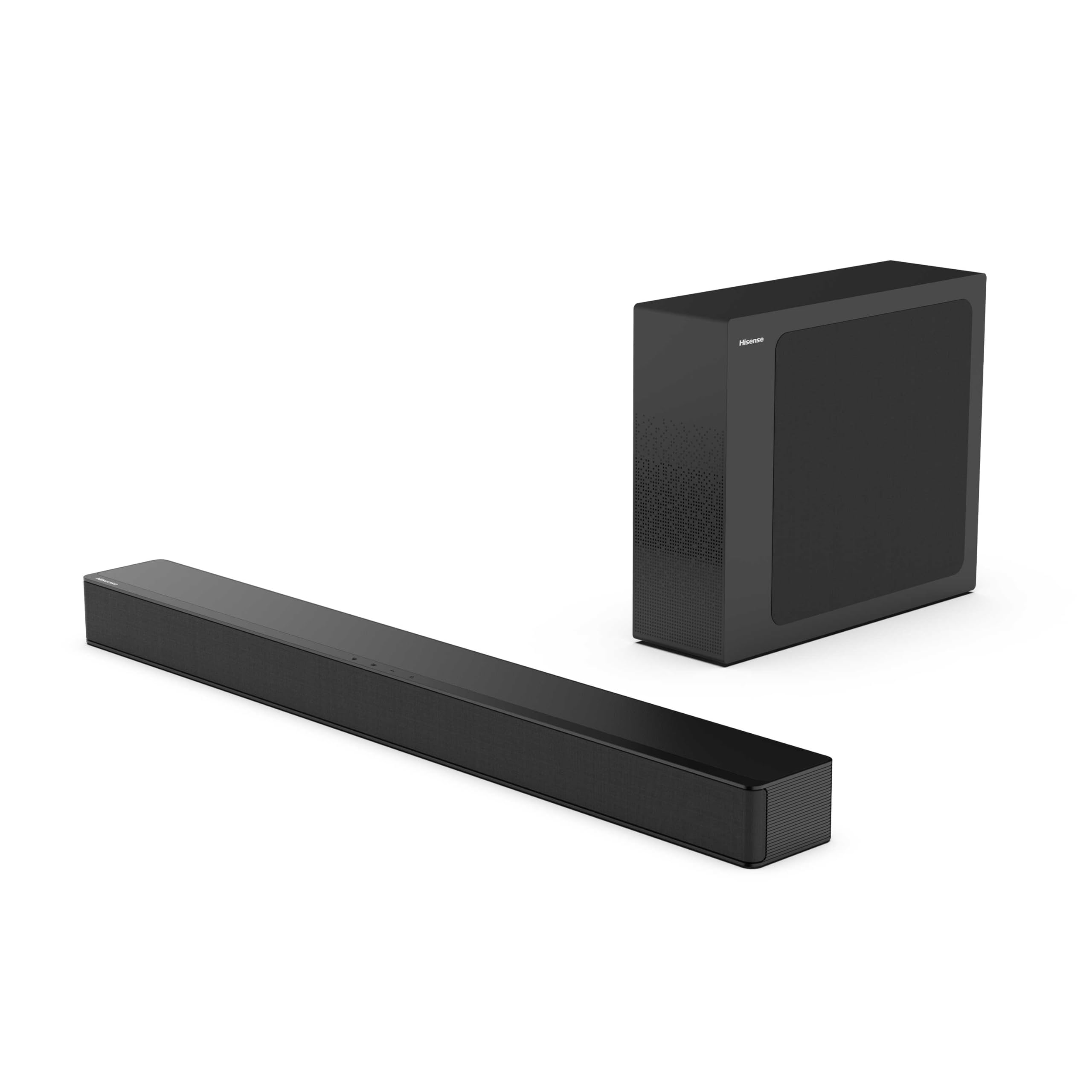
240 watts, a wireless sub and six preset sound modes for people who like to pick their own mix.
Hisense puts more raw power on the spec sheet here — 240 watts max from a 2.1-channel layout with a wireless subwoofer and two front-facing speakers. That sits above the TCL S45H’s 100 watts, and the difference shows on explosion-heavy action scenes. DTS Virtual:X adds the spatial dimension, and Bluetooth 5.3 lets you stream from a phone without a cable.
Control is what separates it from the two TCL bars. Six preset EQ modes (sound settings) cover movies, music, sports, games and more, all reachable from the remote. EZ Play lets you adjust the bar’s settings using just your TV remote. HDMI ARC (the audio-return channel, one cable that sends sound both ways) handles the main connection with the included cable. Sound quality relative to what it costs is what wins owners over — the value story is the second most-praised thing about this bar.
Here is the honest caveat: reliability is the loudest complaint, with some units failing after weeks of use and a share of Bluetooth pairing complaints. This is a bar to buy if you want maximum watts and EQ flexibility, and to buy with a solid return policy behind it.
The control angle: six EQ presets and one-remote operation put real tuning power in your hands, and 240 watts gives the front speakers headroom the smaller bars lack.
The thing to weigh: long-term dependability is the recurring theme in owner feedback, so it is best treated as a value play rather than a buy-once-forever bar.
Best fit: the buyer who wants the most watts and preset flexibility in the budget tier and does not mind a return window as insurance.
Pass if: you want a bar to install and forget with zero drama.
5. Samsung B-Series HW-B550F 2.1 ch Soundbar with Subwoofer

An included subwoofer plus Voice Enhance and Adaptive Sound for people who hate touching a remote mid-scene.
Own a Samsung TV and this is the obvious first stop. It is a 2.1-channel bar with a wireless subwoofer in the box, and it layers DTS Virtual:X for the wide-separation spatial effect. Adaptive Sound is the sleeper feature: it recognises the type of content you are watching and re-tunes the audio automatically, so a quiet drama and a loud action film both arrive balanced without you intervening.
Voice Enhance works the same way for dialogue — it automatically lifts the vocal range so you catch every line. Bass Boost adds a separate deeper mode for beat-heavy music and action. Movie-theatre sound is the phrase that sums up owner reaction, and setup draws almost no complaints. The system also expands to true surround with optional rear speakers that connect wirelessly, adding modes like Private Rear Sound and Sound Grouping.
Pairing is where the split shows up. With Samsung TVs it is smooth for most, but a portion of owners hit frequent disconnections. Its companion model above pairs naturally with other brands, while this one rewards staying inside the Samsung family. Bass from the included sub will not rival a bigger cabinet in raw volume, but it fills a normal living room.
Why Samsung owners gravitate here
- Wireless subwoofer ships in the box for real low-end depth
- Adaptive Sound auto-tunes per scene so you stop tweaking levels
- Voice Enhance lifts dialogue without you digging into menus
- Optional wireless rear speakers expand it to true surround
What to keep in mind
- Connections are smoothest with Samsung TVs, less certain elsewhere
- Rear speakers for full surround are a separate purchase
Go for it if: a Samsung TV already sits in your living room and you want the deepest, most hands-off match in this list.
Hold off if: your TV is a different brand and you have seen reports of pairing dropouts that would drive you up the wall.
6. LG S60T 3.1 ch. Soundbar with Wireless Subwoofer

A dedicated centre channel aimed squarely at dialogue — right, left, centre and sub, all accounted for.
Three-point-one channels is the quiet hero move here. Where a 2.1 bar splits sound into left and right, this LG adds a centre channel whose only job is voices, so speech stays locked to the screen even when the effects swirl. AI Sound Pro reinforces that, pushing clear vocals in live sports and dynamic punch in action. A wireless subwoofer handles the deep end, and the metal grill keeps dust out of the drivers.
Owners rate the audio clarity highly — sound quality is the most-referenced strength by a distance, with installation as the second. Setup is genuinely easy. For LG owners the bigger draw is the ecosystem: WOW Orchestra widens the soundstage (the spread of sound left to right) when paired with an LG TV. WOW Interface lets one remote drive both bar and TV, and the LG Soundbar App customises the three-band equalizer (bass, mid and treble controls).
Two real snags live in the feedback. It pairs beautifully with LG OLED sets but works best with its own special remote, which limits third-party remotes. And there are reports of the subwoofer cutting out over time. Both are worth knowing, not dealbreakers — this remains a strong clarity-first bar.
The dialogue case: the 3.1 layout gives speech its own channel, and AI Sound Pro plus a metal-grilled cabinet make this one feel more considered than a bare 2.1 bar.
The compatibility caveat: the best experience is reserved for LG TVs and the supplied remote, and a few owners see the subwoofer drop out.
It is the right call when: you own an LG TV and speech clarity in dramas is your number-one reason for buying a bar.
Look past it if: you want universal remote harmony across mixed brands in the house.
7. ULTIMEA 5.1.2ch Sound Bar with Dolby Atmos
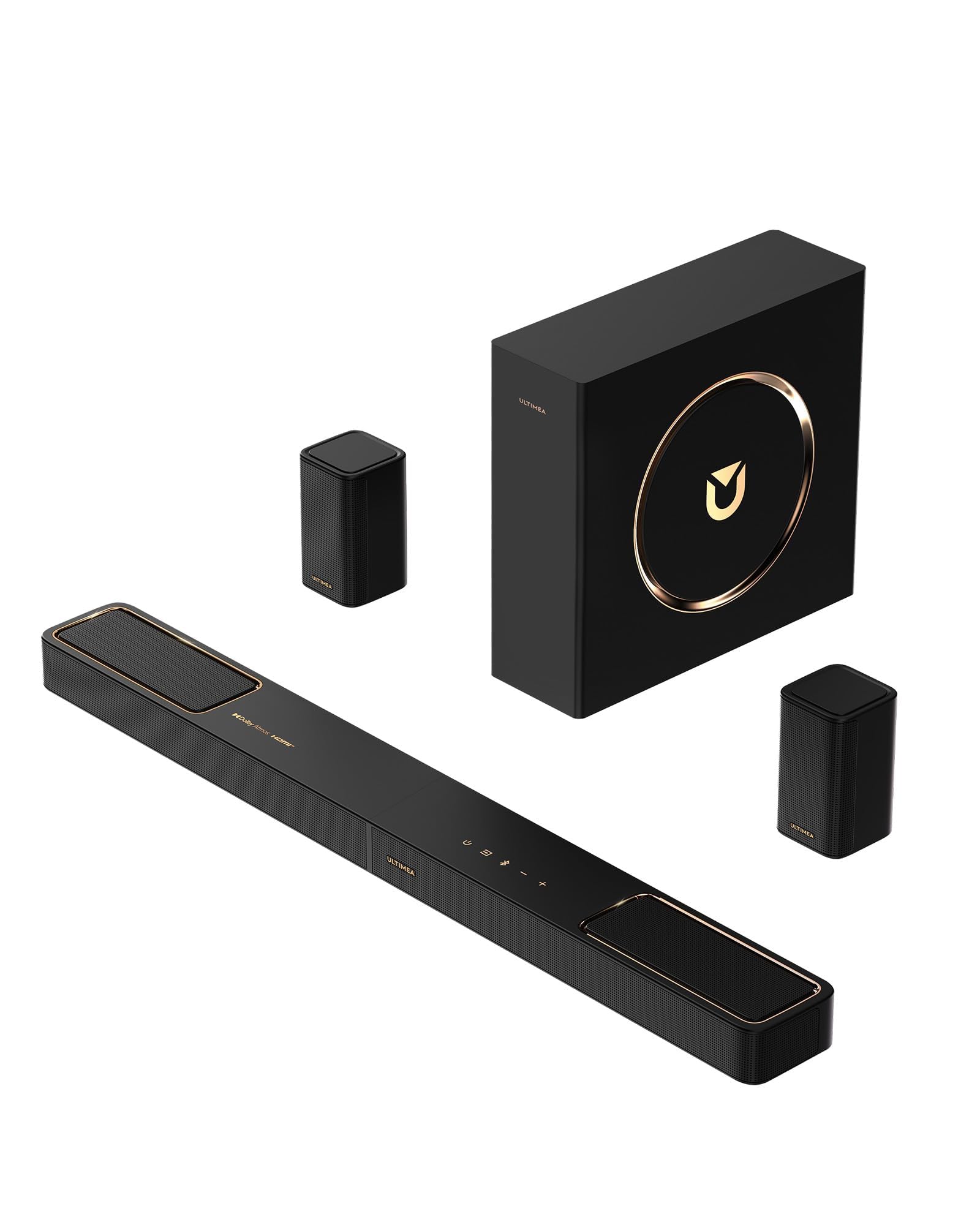
Rear speakers and two ceiling-bouncing drivers in one box — true 360-degree Atmos without the boutique price.
This is the only bar on the list that ships rear surround speakers in the box, which is why it earns the surround label. The 5.1.2 layout pairs two rear speakers with dual up-firing Atmos drivers, so rain falls overhead and helicopters circle behind you. The up-firing drivers use neodymium magnets and 18-core voice coils to keep the height effect precise, and SurroundX algorithms position the effects around and above.
HDMI eARC is the headline connection, carrying up to 37Mbps of bandwidth for lossless 5.1.2 audio — more headroom than plain ARC, so you hear the full uncompressed Atmos mix. CEC syncs power, volume and input, so the bar and TV act as one. Everything in the box is genuinely complete: a 6m rear surround cable, a 1.5m HDMI eARC cable, a digital optical cable and a full wall-mount kit. The app offers 13-step level adjustment, a 10-band EQ and 121 presets.
The subwoofer is a 5.25-inch wired unit, and owners do note it is on the smaller side, so the deepest rumble is present but not room-shaking. Bluetooth reaches 15 meters, and DTS is not supported — Atmos is the whole point here. For the money, no other bar here delivers a complete rear-and-height surround package.
what separates it: rear speakers plus up-firing height drivers (speakers angled at the ceiling) make this the only true surround package in the group. The 37Mbps eARC link (enhanced audio-return channel, a faster HDMI connection) carries the uncompressed Atmos mix.
The subwoofer note: a 5.25-inch cabinet keeps the deep end tidy but smaller than a dedicated floor sub, and DTS playback needs to come from another source.
Choose this if: you want real speakers behind you and above you, and the app-based 10-band EQ appeals to your inner tinkerer.
Steer clear if: you cannot run or mount rear speakers in your room, or your library leans on DTS soundtracks.
8. Bose TV Speaker (2nd Gen)
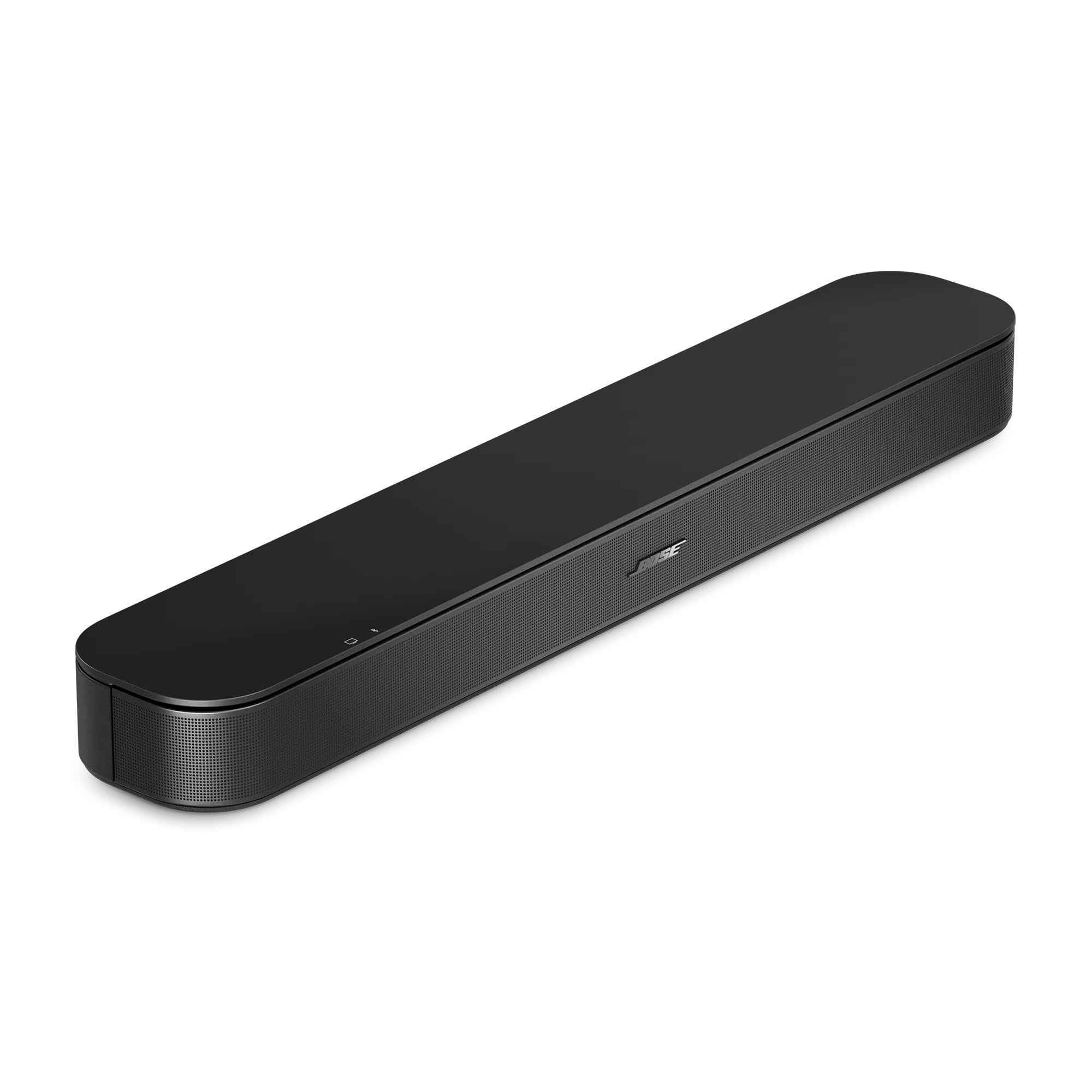
Just over 2 inches tall, so it tucks under a low TV where bigger bars will not fit.
Tight TV stands and open-shelf consoles are where this bar wins. It stands just over 2 inches tall, and the refreshed rounded cabinet slides in front of a screen without blocking the picture. Inside, a centre tweeter is dedicated to speech while angled left and right drivers build a wide soundstage with deeper bass than the previous generation. Bose proprietary Dialogue Mode raises vocals over background sound, so every line lands.
The setup story is the simplest here: plug the included HDMI cable into the TV and you are running in seconds, or switch to an optical cable if you prefer. Bluetooth streams music and podcasts from your phone, and the included remote handles volume, Dialogue Mode and a bass-boost button. Buyers single out the clear-voice option and improved movie dialogue as the standout gains, with easy setup close behind. It also works across both older and newer TVs.
The catch is expansion. There is no subwoofer in the box, and adding real low end means the Bose Bass Module 700 or Lifestyle Ultra Subwoofer with the required connection cable, sold separately. So this is a clarity-and-size play, not a bass play.
Worth it when: space under your TV is measured in inches and speech clarity is the goal.
Look at a 2.1 bar instead if: you want a subwoofer included rather than bought later as an add-on.
9. Bose Smart Ultra Dolby Atmos Soundbar

Six transducers, two of them upward-firing dipoles, and Alexa listening so you never hunt for the remote.
For the household that already talks to a smart speaker, this Bose answers back. It packs six transducers, including two custom-engineered upward-firing dipole speakers, which push sound overhead as well as around you. Dolby Atmos and Bose TrueSpace separate and place different sounds in different parts of the room, and A.I. Dialogue Mode balances voice against surround so dialogue stays crisp.
Amazon Alexa is built in, and Bose Voice4Video extends that to controlling your TV and cable or satellite box by voice. The included ADAPTiQ headset calibrates the audio to your room, and the bar connects via the bundled HDMI eARC cable or the optical cable. Design earns consistent praise for blending with decor, and setup is quick.
Value is the loudest debate — some love the sound, some feel it sits above what they expected to pay. Unlike the entry-level Bose above, this one wants to be the whole home theater rather than a compact fix, and it costs accordingly. Buy it for the Alexa voice control and Atmos imaging, not for value.
The voice-and-Atmos pitch: six transducers with two upward-firing dipoles plus Alexa control make this the most conversational bar here, and ADAPTiQ tunes it to the room.
The value question: sound quality and price draw mixed reactions, so the smart move is only if voice control and spatial imaging top your list.
Made for: a voice-controlled smart home where watching a film without hunting for a remote matters.
Think it over if: raw value-per-watt is your scorecard — the sub- bars win that fight.
Know the Specs
Channels: 2.0, 2.1, 3.1 and 5.1.2
The first number is how many ear-level speakers fire at you; the digit after the dot is the subwoofer. So a 2.1 bar has two front speakers plus a subwoofer, while a 3.1 adds a dedicated centre speaker for voices. A 5.1.2 takes it further with two rear speakers and two height channels, which is what the ULTIMEA delivers for overhead Atmos effects.
HDMI ARC vs HDMI eARC
ARC (Audio Return Channel) lets one HDMI cable send TV audio down to the bar. eARC is the newer version with more bandwidth — the ULTIMEA uses it to pass up to 37Mbps of lossless Dolby Atmos without compression. Both work with a single cable, but eARC is the one to want if uncompressed Atmos matters to you.
Wattage: what 100 W and 240 W actually mean
Watts measure how much power the bar can push, not how good it sounds. A 100-watt bar like the TCL S45H fills a bedroom nicely, while the Hisense at 240 watts max has more headroom for loud action in a bigger room. Match the wattage to the room size rather than chasing the biggest number.
Dialogue enhancement and room calibration
Dialogue modes lift the vocal range above background music so quiet lines stay clear — Bose’s Dialogue Mode and Samsung’s Voice Enhance both do this. Room calibration is different: it listens to your space and adjusts the output. Sonos Trueplay, TCL’s AI Sonic and Bose ADAPTiQ all tune the bar to the room’s shape so the sound lands balanced at your seat.
Common Questions
Will an HDMI sound bar work with my older TV?
Do I need Dolby Atmos, or is a 2.1 bar enough?
Can I add rear speakers to these bars later?
How big is a wireless subwoofer and where do I put it?
Will a sound bar make dialogue easier to hear?
Does a sound bar replace my TV remote?
Can I stream music through these sound bars from my phone?
What is the difference between DTS Virtual:X and Dolby Atmos?
How tall should a sound bar be to fit under my TV?
Do I need to run calibration after setting up the bar?
The Bottom Line
The hdmi tv sound bar that earns the top spot is the Sonos Arc Ultra, because its 9.1.4 layout puts height and rear effects in the room without a single extra speaker on the floor. If your budget is tighter and bass is the goal, grab the TCL S55H — its 220 watts and included wireless subwoofer make it the smartest value in the middle of this list. And for anyone who wants real speakers behind and above them in one box, the ULTIMEA 5.1.2ch is the one to reach for.
One last nudge: the Sonos Arc Ultra pairs its 4.5+ star reputation with a genuine upgrade path, so if you plan to grow the system over the years, buying once at the top saves you re-buying later.
How we choose
We do not accept paid placement. Every pick is matched to a real buyer and a real use-case; we do not hands-on test units.
Sources
Specifications: manufacturer listings and product documentation. Review insights: verified customer reviews, as of November 2026. Pricing: not shown on this page (it changes often); check the current price via the retailer link.
As an Amazon Associate, Tactical Gear Guy earns from qualifying purchases. This does not affect which products we feature.