Specs are compiled from manufacturer listings and verified buyer reviews and can change over time — please confirm the key details on the product page before buying.
If your bread comes out flattened, torn, or crushed under a straight-edged blade, the fix is a serrated knife — one with a toothed edge that saws through a hard crust without pressing down on the soft middle. Below you will find nine real options, sorted by what each one actually does well, so you can match a knife to the loaves you bake or buy.
This guide is built by comparing the manufacturers’ published specifications and the patterns across verified customer reviews, so you get each pick’s real strengths and trade-offs instead of marketing spin.
A serrated edge saws through a hard crust without pressing the soft crumb flat, which is why it slices a loaf cleanly where a straight edge tears it. Read on for the picks that make the most of a serrated kitchen knife.
Top Picks


How To Choose The Best Serrated Kitchen Knife
The mistake most first-time buyers make is grabbing the longest, heaviest serrated blade in the store. Length helps on a big sourdough loaf, but it works against you on a tomato or a roll. The useful move is to decide what you slice most often, then size the blade to that job.
Match blade length to the loaf
A full 8-inch blade runs the whole width of a standard sandwich loaf in one pass. That is the size to buy if homemade sourdough or wide boules are your routine. A 5-inch serrated utility knife is the better tool for rolls, tomatoes, and dry sausage, because you can steer a short blade with your fingertips.
Scallops versus a wavy edge
Both teeth patterns saw through crust, but they behave differently. A wavy or scalloped edge with rounded notches glides through a tough rind without snagging, which is why produce knives favor it. Wide, deeper teeth bite harder into a crackling crust and are more common on dedicated bread knives.
Steel and edge hardness
Harder steel holds an edge longer but demands more care. High-carbon stainless is the common middle ground — it resists rust and keeps its bite through regular use. Anything sold as high-carbon will want hand washing and a dry-off, so factor that into your routine before you buy.
Handle and grip
Serrated knives get used with wet hands, whether from dough, fruit, or washing up. A textured rubber or a pakkawood handle is more forgiving than smooth polished metal. If the same knife will pass between several cooks, a non-slip grip matters more than a decorative finish.
Side-by-Side Comparison
| Model | Best For | Blade Length | Construction | Handle Material | Amazon |
|---|---|---|---|---|---|
| HENCKELS Forged Premio 8-inch Bread Knife★ Best Overall | Everyday loaves and crusty boules | 8 inches | Forged | Stainless Steel | Amazon |
| Dexter-Russell 24303 SofGrip 5½” Utility KnifeMost Versatile | Produce, rinds, and heavy prep | 5.5 inches | Stamped | Rubber | Amazon |
| MOSFiATA Bread Knife 8” Serrated KnifeBaker’s Pick | Bakers who also score sourdough | 8.9 inches | Forged | Micarta | Amazon |
| PAUDIN 8″ Serrated Bread Knife | Gifting and wet-hand slicing | 8 inches | Forged | Pakkawood | Amazon |
| Mercer Culinary M20508 Genesis 8-Inch Bread Knife | Cake, meatloaf, and tomato work | 8 inches | Forged | Santoprene | Amazon |
| Wüsthof Gourmet 5″ Serrated Utility Knife | Packed lunches and brunch spreads | 5 inches | Stamped | Polypropylene | Amazon |
| Victorinox Swiss Classic 8.25 Inch Bread Knife | Heavy crusts and dishwasher duty | 8.25 inches | Stamped | Polypropylene | Amazon |
| Global G-9 8-3/4 inch Bread Knife | Sourdough without squashing | 8.5 inches | Stamped | Stainless Steel | Amazon |
| Shun Classic 9″ Bread Knife | Soft and crusty bread alike | 9 inches | Forged | Pakkawood | Amazon |
Detailed Reviews
1. HENCKELS Forged Premio 8-inch Bread Knife
Our pick — 4.5+★ from 850+ verified ratings; the strongest balance of quality and price.
The forged-blade workhorse that saws a whole loaf without crushing the crumb.
If you bake or buy wide loaves and want one knife to handle all of them, this is the pick to beat. The full tang runs the length of the handle, which gives the knife a solid balance in the hand rather than a blade-heavy tip. That weight distribution matters at 6.4 ounces — heavy enough to carry its own momentum through a tough crust, light enough to steer.
No gap between blade and handle means dough and water have nowhere to collect. That smooth joint comes from the forged bolster (the thick metal collar where the blade meets the handle). Henckels hones the blade to a satin finish and describes it as finely sharpened for long-lasting edge life. An 8-inch blade covers the full width of a standard sandwich loaf, so you get one clean pass instead of a back-and-forth saw. The metal end cap carries the JA Henckels International logo, which is the visual tell of the forged line.
Reviewers single out the forged build first — quality is the most-praised trait in the feedback, with slicing a close second. Slicing is the runner-up, which tracks: crusty boules and thick crusts come apart without a fight. Dishwasher-safe construction makes cleanup easy, though hand washing will protect the edge over time.
Where the Premio Delivers
- Full tang and forged bolster give a balanced, solid feel at 6.4 ounces
- 8-inch serrated blade handles a full-width loaf in one stroke
- Dishwasher safe, which is rare for a forged knife
- Satin-finished stainless steel resists rust and discoloration
Weigh Before You Buy
- The hefty forged body may feel like a lot if you prefer a light, thin blade
- Far longer than the short utility picks, so it needs drawer or block space
- Hand washing still protects the edge better than the machine
Go-to for loaves: Buy this if sourdough, boules, or thick-crust bread is your daily routine.
Think again if: You mostly slice rolls and tomatoes — a 5-inch serrated utility handles those better.
2. Dexter-Russell SofGrip 5½” Utility Knife
A 5.5-inch scalloped slicer built for produce, rinds, and hands that never stop moving.
This is the opposite tool to a big bread blade. At 5.5 inches the narrow scalloped edge slides through a melon rind, a lettuce head, or an orange with real control — you can follow a curve with your fingertips because the blade is short enough to steer. It weighs just 2.56 ounces, a world apart from the 6.72-ounce PAUDIN bread knife, so long prep sessions do not tire your wrist out.
The high-carbon DEXSTEEL blade is stainless and built for repeated commercial use, and the SoftGrip rubber handle is shaped to cut wrist fatigue during high-volume work. The 10-inch overall length keeps a good working balance despite the compact blade. NSF certification means it meets a public food-safety standard, which is the reason so many professional kitchens stock it.
Buyers report these lasting 20-plus years of daily prep, and the thin 5.5-inch blade stays easy to steer through a rind. It is the most versatile knife on this list for anything other than a full loaf. A stamped construction rather than forged keeps it light and affordable, and that is the trade you are making.
The pro-kitchen value play: NSF certification, a non-slip rubber grip, and a narrow scalloped edge that glides through tough rinds and skins — this is the one that lives on a cutting board all day.
Its honest ceiling: At 5.5 inches the blade is too short to run the width of a standard loaf, so treat it as a prep companion rather than your bread knife.
Reach for this if: You slice produce daily and want a light, grippy scalloped knife that shrugs off wet hands.
Look elsewhere if: A whole boule is your target — you need a full-length blade for that.
3. MOSFiATA Bread Knife 8”
A bread knife that arrives with a scoring lame, aimed squarely at sourdough bakers.
The blade here is longer than most — 8.9 inches against the 5.5-inch Dexter-Russell, which gives you a much wider slice path across a big round boule. German EN1.4116 high-carbon stainless steel handles the body, with a Rockwell hardness of 56 ± 2 HRC. In plain terms, that is a moderately hard edge that resists rolling over on a hard crust while staying serviceable.
The rounded serrations are the real story. They bite through crusty bread, cake, cheese, and pizza while throwing off minimal crumbs — the cut is fast and clean rather than torn. The solid Micarta handle is built to keep your wrist neutral whether your hand is large or small, and the triple-rivet attachment holds the handle firmly to the blade. A finger guard and a leather protective cover ship in the box.
Buyers are surprised by how long the 8.9-inch edge keeps biting, and the balance comes up repeatedly — a blade this long often feels tip-heavy, and this one does not. The scoring lame with five blades is a genuine bonus if you bake at home; it lets you slash the top of a sourdough loaf cleanly. The wavy etched finish on the steel reads as decorative rather than functional, but it looks good in the hand.
Complete baker’s bundle: The 8.9-inch blade, bread lame with five blades, finger guard, and leather cover make this the most complete sourdough setup here.
Worth knowing: The 1.2-pound weight is on the heavy side — manageable for slicing, but noticeable if you switch to it from a light stamped knife.
Best for the home baker: Buy this if you score and bake sourdough and want the knife and the lame in one box.
Skip if: You only ever slice store-bought sandwich bread and would never touch the scoring tool.
4. PAUDIN 8″ Serrated Bread Knife for Homemade Bread, Gift Box
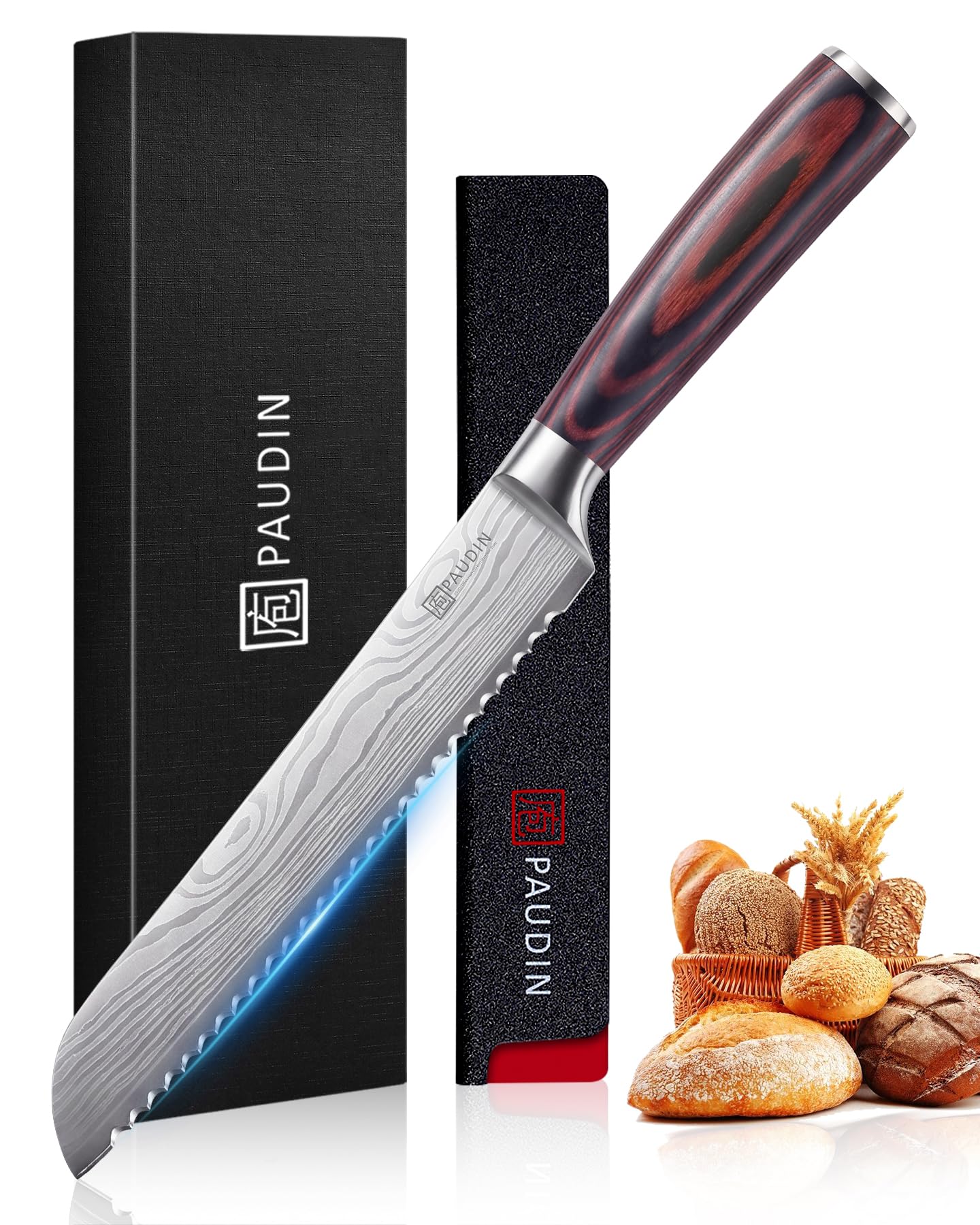
The wet-hand specialist — a pakkawood grip and a blade thick enough to trust.
Here is a detail worth pausing on: the blade is 0.08 inches thick, which the maker says makes it harder to break and easier to trust under a heavy crust. The serrated edge is designed to slice soft bread and soft-skinned fruit without crushing them — the exact problem a straight edge creates. High-carbon German stainless runs the blade, adding corrosion resistance to the package.
Your grip stays surer when your hands are wet, thanks to the pakkawood handle (real wood layers set in resin). It is more non-slip than a fibrox handle (a textured plastic grip) and needs less upkeep than plain wood because it resists cracking and fading. The forged build creates a smooth blade-to-handle transition. A sheath and gift box are included, which makes it an easy present for someone who bakes.
Owners mention it cuts bagels and bread like butter, and the wavy Damascus-style pattern looks far above its price. The 6.72-ounce weight is the heaviest on this list — more than two and a half times the Dexter-Russell’s 2.56 ounces. That heft is reassuring for slicing but something to feel before you commit. At 13 inches overall it is a substantial knife in the drawer.
Reasons It Earns a Place
- Pakkawood handle stays grippy with wet hands and resists cracking
- 0.08-inch thickened blade adds durability
- Sheath and gift box make it ready to give
- Wavy pattern gives it a premium look
The Trade-Offs
- At 6.72 ounces it is the heaviest knife here, which some hands notice
- Pakkawood rewards occasional oiling to keep its finish
- Long overall length means it needs a proper block or drawer slot
Ideal for gifting: An easy choice if you want a presentable knife that also handles wet prep without slipping.
Pass on it if: You want the lightest blade possible — the heft here is a real part of the feel.
5. Mercer Culinary M20508 Genesis 8-Inch Bread Knife, Black

At 4 ounces, the lightest full-size bread knife here — and it still bites through crust.
Most 8-inch forged bread knives carry more weight than this. The Genesis comes in at 4 ounces thanks to a taper-ground edge and a precision-forged high-carbon German steel blade. That light spec means you can slice a whole loaf without your forearm reminding you about it afterward.
The wavy edge is versatile by design. The teeth slice through a crust or a skin without tearing the soft inside, which is why this knife is listed for angel food cake, meatloaf, fruit, and tomatoes as well as bread. The Santoprene handle is textured for a non-slip grip when wet. Care is hand-wash only — warm water and mild soap, then dry with a soft towel.
Feedback keeps praising the textured Santoprene grip and how cleanly the 4-ounce blade glides through a loaf, leaving almost no crumbs. The balance is a repeated point too, and a light knife that stays balanced is harder to build than it sounds. The one thing to plan for: it is not dishwasher safe, so it will not tolerate a lazy soak. Hand wash this one and it will keep its edge.
Why it suits most kitchens: A 4-ounce forged blade, German high-carbon steel, and a grippy Santoprene handle cover bread, cake, meatloaf, and tomatoes in one tool.
The one rule: Hand wash only, with a full dry afterward — the dishwasher is off-limits.
Pick it if: You want one light, grippy serrated knife that earns its keep across the whole kitchen.
Not for you if: You refuse to hand wash — a dishwasher-safe knife serves you better.
6. Wüsthof Gourmet 5″ Serrated Utility Knife, Silver

A 2.08-ounce brunch knife that cuts a roll without tearing the soft middle.
Think of this as the lunchbox knife. The fine serrated edge slices cleanly through a crusty roll without pulling the interior apart, and it manages firm tomatoes, fruit, and dry sausage with the same control. At 5 inches the blade is precise for small work — nowhere near the reach of the 9-inch Shun, but far easier to guide along a ripe tomato’s skin.
It is a laser-cut stamped blade in high-carbon stainless, which keeps it light and keeps the price sensible. The triple-riveted polypropylene handle resists fading, discoloration, heat, and impact. Wüsthof backs the Gourmet line with a limited lifetime warranty and asks for hand wash only. The knife is made in Germany, in a family company that has been producing cutlery in Solingen for generations.
Reviewers praise the fine serrated edge for staying sharp and slicing tomatoes without resistance. Where feedback splits is on the feel: some find it extremely light in a good way, while others read the same 2.08 ounces as flimsy. That is a genuine preference call, and it is the one thing to weigh before buying. If you want a stout, weighty blade, this is not it.
Buy it for lunch and brunch: Ideal if rolls, tomatoes, and dry sausage are your regular cutting jobs.
Know the catch: At 2.08 ounces the feel is very light, which some hands read as insubstantial.
7. Victorinox Swiss Classic 8.25 Inch Bread Knife

Swiss steel and a wavy edge built to take a heavy crust — and the dishwasher.
Here is the practical pick for a busy household. The 8.25-inch wavy edge is shaped to grab a hard crust and keep sawing without pressing the loaf flat. The blade is a professional-grade stainless made in Switzerland, and the ergonomically shaped polypropylene handle is built to stay secure in the hand through a full loaf.
The detail that matters most for real-life use: this knife is dishwasher safe. Most serrated blades ask for hand washing, and that line is where busy kitchens fall down. If the knife is going to be cleaned alongside the plates, this is the one that will not punish you for it. At 13.43 inches overall it has a full-size reach on the board.
The Swiss-made stainless blade backs up the Victorinox name on heavy crusts, and the 8.25-inch wavy edge saws through without flattening the loaf. It is a stamped blade rather than forged, which keeps it light and keeps the value strong. The trade you are accepting is a lighter, simpler feel than a forged knife like the HENCKELS — no full tang, no heavy bolster. For a working household knife, that trade lands well.
Where It Shines
- Dishwasher safe, unlike most serrated knives
- 8.25-inch wavy edge handles heavy crusts
- Swiss-made professional stainless blade
- Ergonomic polypropylene handle keeps a secure grip
Where It’s Modest
- Stamped construction lacks the heft of a forged blade
- No full tang, so it feels lighter than premium picks
- The plain black handle is less decorative than pakkawood or Damascus finishes
Made for a working kitchen: Choose this if crusty bread is a staple and you want a knife you can toss in the dishwasher.
Look elsewhere if: You want a heavy, forged feel in the hand — this is a lighter stamped knife.
8. Global G-9 8-3/4 inch, 22cm Bread Knife, Stainless Steel

A dimpled steel handle and molybdenum/vanadium blade that slices sourdough flat-free.
Global’s signature look is all here — a single stainless-steel handle, dimpled for grip, with the blade continuing into it as one continuous piece. That design means no rivets to loosen and no seam for dough to wedge into. The 166-gram weight keeps it light in hand at 12 inches overall, and the balance is precise thanks to the all-steel build.
The blade is high-tech molybdenum/vanadium stainless steel, an alloy chosen for edge retention — it holds a razor edge exceptionally well through repeated crusty slicing. The 8.5-inch blade is long enough to run a wide boule, and the serrations are shaped for hard crusts. A lifetime guarantee against defects and breakage backs the build.
Sourdough comes apart without squishing, and hard-crusted loaves keep their shape instead of collapsing under the blade — that is the exact problem a bread knife exists to solve, and this one delivers. The one honest point: value is a split question. Some find the knife worth the outlay, while others think the price runs high for what is a single-purpose tool. Weigh that against the edge retention and the all-steel construction.
The steel-first choice: Molybdenum/vanadium blade, one-piece dimpled handle, and a lifetime guarantee against defects put the engineering front and center.
The value question: This is a premium-priced knife for slicing. Choose it when edge retention (how long the sharp edge lasts) and the smooth handle matter more to you than keeping costs low.
For the sourdough obsessive: Pick this if hard-crusted boules are your bread and you want a blade that keeps its edge.
Second thoughts if: Budget matters more than edge retention — this is a serious spend for a bread knife.
9. Shun Classic 9″ Bread Knife
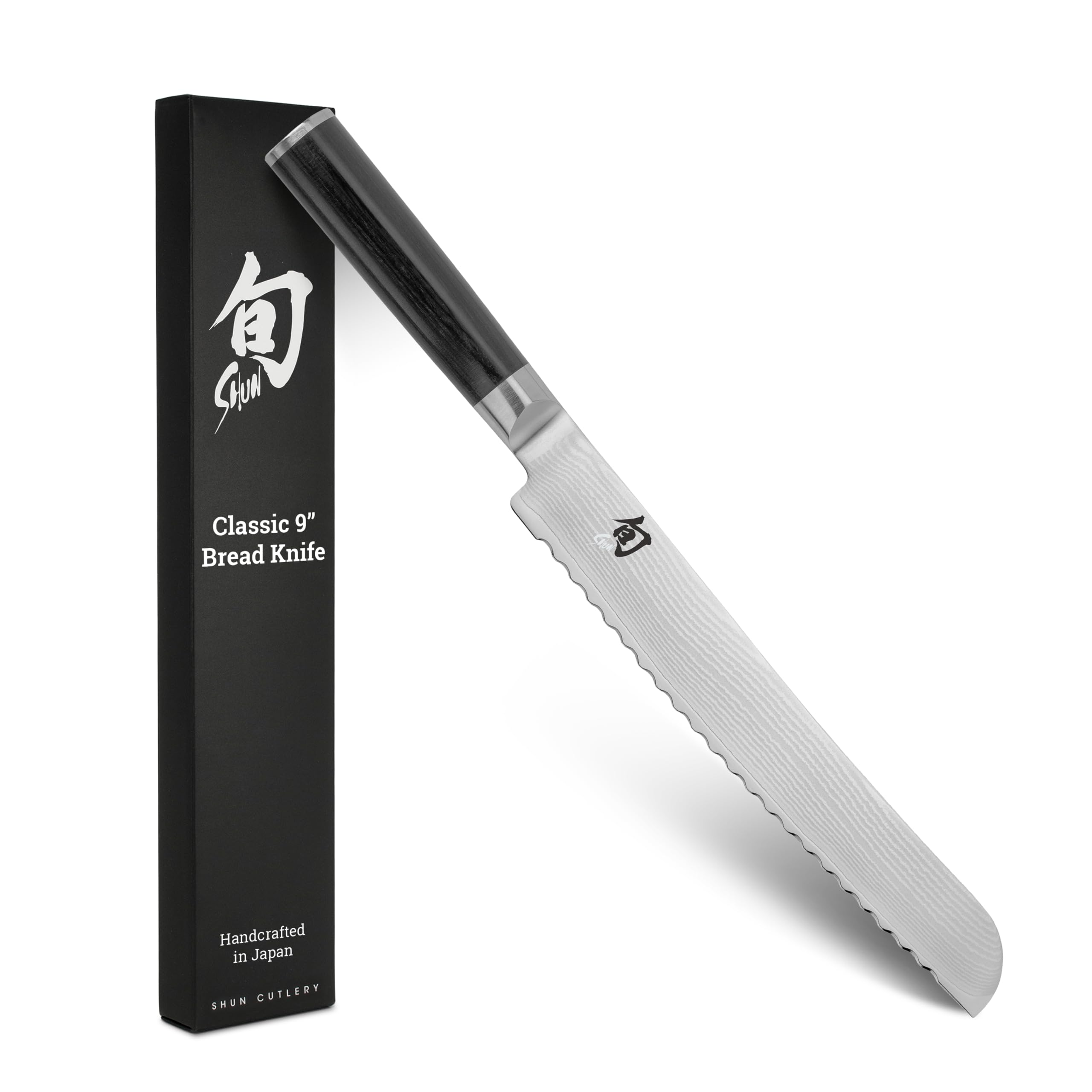
Japanese VG-MAX steel and wide teeth that slice soft or crusty bread with no tearing.
This is the top of the tier, and the spec sheet explains why. The 9-inch blade is built from VG-MAX steel wrapped in 68 layers of Damascus cladding, honed to a 16-degree edge. In everyday terms, that is a very thin, very hard cutting edge that slices through a crackling crust without squashing the tender crumb underneath.
The wide teeth are designed to handle both extremes — soft sandwich bread and hard-crusted boules — without ripping or tearing either. A D-shaped pakkawood handle is shaped for a secure grip and works for left- and right-handed cooks alike. Each knife is handcrafted in Japan, and free honing supports the blade over its long life. At 210 grams it carries real authority on the board.
The quality is the thing everyone raves about, and slice quality is the runner-up — this is a knife that cuts both ways. Bread comes apart cleanly whether it is a fluffy milk loaf or a dense rye. The one honest note: value is the most-discussed question in the feedback, and the split is real. This is a serious outlay for a single blade, and it is the most expensive knife on this list. Whether that matters depends on how much you bake.
Luxury cut quality: VG-MAX steel with 68 layers of Damascus cladding, a 16-degree edge, and wide teeth that handle soft and crusty bread without tearing.
Who this is for: Buy it if you treat a bread knife as a long-term tool and want the finest cut here.
For the serious baker: The knife to own if you slice bread daily and want Japanese steel that holds its edge.
One caution: It is the premium pick here, so only choose it if the cut quality justifies the spend for you.
Know the Specs
Blade length
A serrated blade’s length decides what it can handle in one pass. An 8-inch blade runs the full width of a standard loaf; a 5-inch blade steers better for rolls and tomatoes. Longer blades like the 9-inch Shun or 8.9-inch MOSFiATA cover a wide boule, while a 5.5-inch Dexter-Russell is a produce tool. Match the length to your most common cut.
Steel and edge hardness
High-carbon stainless, German EN1.4116, VG-MAX, and molybdenum/vanadium are the steel names you will see. Harder steel holds an edge longer but is more demanding to maintain. Rockwell hardness, measured on the HRC scale like the MOSFiATA’s 56 ± 2 HRC, tells you how hard the steel is. Higher numbers keep their bite longer; lower numbers sharpen more easily.
Construction: forged versus stamped
A forged knife is shaped from a single heated steel piece, which gives it a heavier, more balanced feel — the HENCKELS and Mercer are forged. A stamped knife is cut from a steel sheet, making it lighter and often more affordable — the Victorinox and Wüsthof Gourmet are stamped. Neither is better outright; forged suits heavy slicing and stamped suits precise, light work.
Handle materials
The handle decides how safe the knife feels with wet hands. Rubber and Santoprene stay grippy under moisture, pakkawood and Micarta resist cracking and fading, and plain stainless or polypropylene are easy to clean. For dough and fruit prep, a textured non-slip grip is the practical choice.
Common Questions
What is a serrated kitchen knife actually used for?
Is an 8-inch bread knife long enough for a large loaf?
Should I buy a forged or stamped serrated knife?
Can a serrated bread knife go in the dishwasher?
Why does my bread knife crush the bread instead of slicing it?
What is the difference between a serrated utility knife and a bread knife?
How do I keep a serrated edge sharp?
Is a lightweight serrated knife a good thing or a bad thing?
Will a serrated knife work on soft bread like white sandwich loaves?
What does NSF certified mean on a kitchen knife?
The Bottom Line
For most kitchens, the serrated kitchen knife winner is the HENCKELS Forged Premio 8-inch Bread Knife. Its full-tang, forged build (one piece of steel running from tip to end cap) gives you a balanced, durable blade that runs a whole loaf in one clean pass — and the crowd of owners who rate it 4.5+ stars backs that up.
If you want a knife that doubles as a sourdough baker’s kit, grab the MOSFiATA Bread Knife with its 8.9-inch blade and included scoring lame. And for a light, grippy scalloped tool that handles produce and wet hands all day, the Dexter-Russell 24303 SofGrip is the one to reach for. The one honest nudge: the top pick carries a smaller review pool than some other knives here, but it holds the highest score at 4.5+ stars — a strong signal it earns its spot.
How we choose
We do not accept paid placement. Every pick is matched to a real buyer and a real use-case; we do not hands-on test units.
Sources
Specifications: manufacturer listings and product documentation. Review insights: verified customer reviews, as of November 2026. Pricing: not shown on this page (it changes often); check the current price via the retailer link.
As an Amazon Associate, Tactical Gear Guy earns from qualifying purchases. This does not affect which products we feature.