Specs are compiled from manufacturer listings and verified buyer reviews and can change over time — please confirm the key details on the product page before buying.
You want a cold drink within arm’s reach, but you do not want a humming box rattling through your night or eating a hole in your desk space. A top of counter fridge has one job: stay small, stay cold, stay quiet. The picks below are sorted by what each does best, so you can match one to your room instead of guessing from a spec sheet.
This guide is built by comparing the manufacturers’ published specifications and the patterns across verified customer reviews, so you get each pick’s real strengths and trade-offs instead of marketing spin.
Cooling method matters more than capacity here, because a compressor unit holds temperature far steadier than a thermoelectric one. Size and noise come next, and both decide whether you will actually keep the unit where you planned. Every pick below was checked against those three points before it earned a spot on this list of the top of counter fridge options.
Top Picks


How To Choose The Best Top of Counter Fridge
A countertop fridge sits in the room you actually use, so the wrong one becomes an annoyance fast. Three things decide whether you keep it or move it to the garage: cooling method, noise level, and whether its footprint fits where you pictured it.
Compressor versus thermoelectric cooling
A compressor works like a full-size fridge shrunk down — a pump moves refrigerant and the cold stays steady even on a hot afternoon. A thermoelectric unit (often called Peltier) uses a plate that gets cold when current passes through it, and it tends to struggle when the room warms up. Every pick here uses a compressor, which is why they can hold a set temperature instead of drifting.
Decibels and where you will put it
A decibel (dB) is the unit used to measure sound, and normal conversation sits around 60 dB. The quiet units here run in the 37–38 dB range, which is closer to a soft library than a kitchen appliance. If the fridge goes in a bedroom or a shared office, treat that number as a hard requirement rather than a nice-to-have.
Can counts versus bottle storage
Can counts assume standard 330ml cans packed tight, so the same cabinet may hold fewer wine bottles once the shelf comes out. If you mostly store bottles, check that the shelves are removable and that the interior height clears a standing bottle. If you mostly store cans, the advertised count is a fair guide.
Side-by-Side Comparison
| Model | Best For | Capacity | Noise | Temperature Range | Amazon |
|---|---|---|---|---|---|
| EUHOMY 18L Wine Fridge★ Best Overall | Wine and mixed drinks | 18 liters | 38 dB | 40°F to 61°F | Amazon |
| Antarctic Star 18L Beverage RefrigeratorCrowd Favorite | Big-volume chilled cans | 0.6 cubic feet | — | 40°F to 61°F | Amazon |
| Frigidaire Retro Compact FridgeMost Spacious | Speaking-piece retro look | 3.2 cubic feet | — | — | Amazon |
| Frestec 1.7 Cu.Ft Mini Fridge | Food plus ice cubes | 1.7 cubic feet | 37 dB | 28.4°F to 50°F | Amazon |
| Erivess 76 Can Beverage Refrigerator | Showing off a stocked bar | 1.7 cubic feet | — | 37°F to 61°F | Amazon |
| Icyglee 24 Can Mini Fridge | Desk-side soda supply | 18 liters | ≤38 dB | 40°F to 61°F | Amazon |
| Feelfunn 24 Can Beverage Refrigerator | Offices and dorm rooms | 0.6 cubic feet | ≤38 dB | 40°F to 61°F | Amazon |
| ROVSUN 46 Can Beverage Cooler | Sunny rooms and bars | 1.0 cubic feet | — | 43°F to 64°F | Amazon |
Detailed Reviews
1. EUHOMY 18L Wine Fridge Mini Fridge
Our pick — 4.0+★ from 850+ verified ratings; the strongest balance of quality and price.
The wine-first cooler that lets you set 40°F without ever opening the door.
This is the pick for anyone whose countertop fridge is really a wine fridge that happens to hold cans too. It runs a 40°F to 61°F range you adjust on a digital touchscreen — a small display panel on the front that lets you change temperature without pulling the door open and letting the cold air out. Set it to 40°F for white and sparkling, nudge it up toward 61°F for red, and your bottles sit at serving temperature instead of room temperature.
The door is double pane glass that blocks UV rays — the light that fades wine and skips the protective work your bottle glass does. A door seal holds both temperature and humidity in, which is what keeps corks from drying out on long-stored bottles. Soft LED lighting inside lights the collection without adding heat, so the fridge doubles as a display piece in a home bar or kitchen corner.
Capacity is 18 liters, laid out as up to 4 wine bottles (750ml) plus 6 cans (330ml), or up to 24 cans if you pull the shelves and go all-beverage. Removable shelves let you reshape the interior for fatter bottles or a can-only load. At 38 dB it runs among the quieter units here — for reference, the Frestec below comes in at 37 dB, so the two sit essentially level on sound.
Frost builds up manually here rather than self-clearing, so you will scrape it down occasionally — a normal chore on manual-defrost coolers and not a sign of trouble. Energy use is listed at 165 kilowatt hours per year, which is lower than the Feelfunn’s 208 kilowatt hours per year. If you want the lowest running cost of the glass-door group, that gap is worth knowing.
Serving-temperature control
- 40°F to 61°F range covers white, red and sparkling without moving bottles
- Double pane UV-blocking glass door protects wine from light
- 38 dB keeps it quiet enough for a bedroom or a bar in the next room
- Touchscreen lets you adjust temperature without opening the door
Where it asks a little of you
- Manual defrost means occasional scraping
- Sized for bottles first — a can-heavy household will want more interior room
The right buyer: a wine drinker who wants bottles at serving temperature on the counter, not in the kitchen fridge.
Think twice if: you store mostly cans and want maximum count — the Erivess below holds up to 76.
2. Antarctic Star 18L Beverage Refrigerator Cooler
The one with the biggest following — a 0.6 cu.ft. cooler that has been in a lot of living rooms.
If you want a safe bet rather than an experiment, this is the most-reviewed fridge in the group: 4.0+ stars across thousands of owners. What it sells on is footprint and looks: 14.88″D x 11.02″W x 16.73″H, a slim cabinet you can tuck beside a couch or set on a bar cart without it swallowing the surface. It holds 24 standard-sized cans.
Cooling comes from a compressor that the maker positions against electronic (thermoelectric) units for holding steady temperature on hot days — a claim that matters most in a sunny apartment. The 40°F to 61°F range covers beer and wine alike. A reinforced door with an air-tight seal helps hold humidity, and blue soft LED interior lighting makes the drinks easy to find in a dark room.
Size is the aspect people praise most by a wide margin, followed by appearance — owners tend to describe it as looking smart in a living room, dorm or home bar rather than like utility equipment. Horizontal racking keeps bottles tidy and lets you see what you have at a glance. Movable shelves open up room for taller drinks when you need it.
The honest catch: cooling performance and noise come in as mixed in owner feedback — plenty of units hold drinks cold and run quiet, and some run warmer or louder than expected. Treat it as a good bet rather than a guaranteed outcome, and let it stand upright before first plug-in.
Why it leads on experience: the size and the look are what carry this one — a space-thrifty 14.88″D x 11.02″W x 16.73″H cabinet in a living-room-friendly finish, at a scale of popularity nothing else here approaches.
What to plan for: mixed reports on both cooling strength and sound mean you should test it in the spot you intend to keep it during the return window.
Best fit: buyers who want the most established option in a compact 0.6 cu.ft. body and care about how it looks in the room.
Less ideal if: you need a guaranteed near-silent unit in a bedroom — the mixed noise feedback makes that a gamble.
3. Frigidaire Retro Compact Fridge with Chiller
Moonbeam finish, a built-in bottle opener, and more cold storage than anything else here.
You buy this countertop fridge because it looks like furniture. The retro body comes in a Moonbeam colorway with an easy-open pull handle. It also holds more than the rest of the group: 3.2 cubic feet, against the 1.7 cubic feet mini fridge further down and well past the 0.6 cubic feet models that dominate this list. That extra space is the difference between a few days of drinks and a proper snack-and-bottle stock.
Inside you get two glass shelves, a 2L door basket for large bottles, and a built-in can dispenser that keeps cans stacked and reachable. A chiller compartment with an ice cube tray sits up top for ice and quick-cold items. Since it is compressor cooled, it behaves like a small full-size fridge rather than a drinks-only box.
For a dorm room or home office, that mix — snacks plus cans plus ice — is what separates it from a pure beverage cooler. Performance and appearance are the two things it is known for, and it reads as the room’s talking point rather than a hidden appliance.
Two things to weigh: the 16.5″D x 19″W x 31″H measurements make it the tallest and widest here, so measure your counter or corner before you commit. Manual defrost applies, and some owners mention durability as a concern over the long haul — treat it with care rather than expecting it to survive rough handling.
The draw is the whole package: retro styling, a built-in bottle opener and 3.2 cubic feet of chilled space in one compact cabinet that earns compliments.
Measure first: 31 inches tall is a full head above the other picks here — it wants a floor corner or a deep counter, not a shallow shelf.
Reach for this if: you want the look and want to store food, cans and ice in the same compact unit.
Look elsewhere if: you only need a can cooler — the smaller 0.6 cu.ft. models do that job with far less footprint.
4. Frestec 1.7 Cu.Ft Mini Fridge
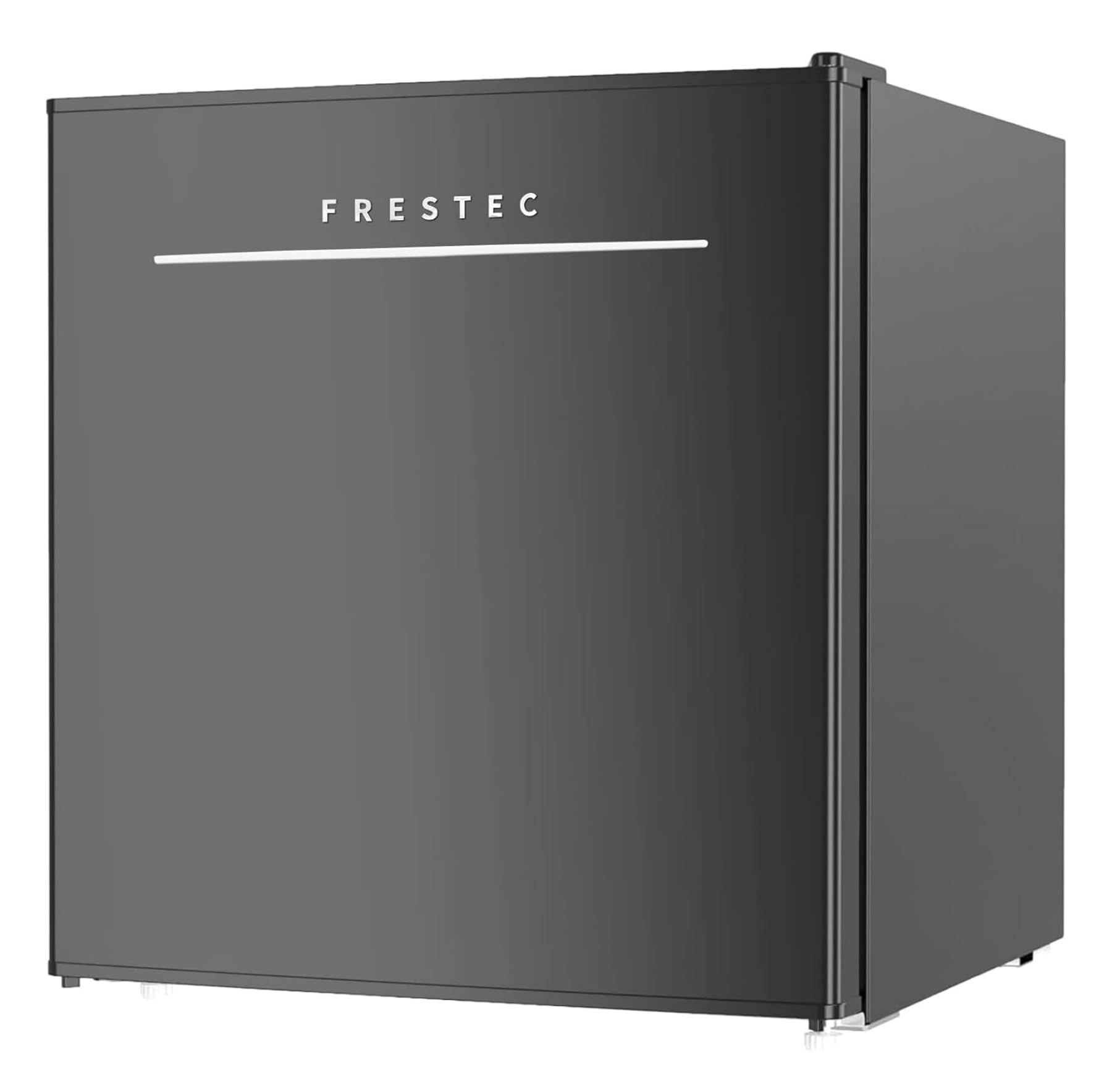
A real freezer pocket, a reversible door, and one-button defrost on a 37 dB motor.
Most small coolers here are drinks-only. This one splits its 1.7 cubic feet into 1.5 cubic feet of fridge and a 0.2 cubic feet freezer section — enough for an ice cube tray or a small frozen item. That is the spec that decides it for anyone who wants snacks and ice, not just cold cans.
Temperature runs on a six-mode dial styled as 0 to 6, or 28.4°F to 50°F, so the low end goes colder than most — cold enough for light freezing storage. Defrosting takes one press of the button in the middle of the control knob instead of scraping by hand, and the door seal is detachable for cleaning. The motor is rated at 37 dB, which makes it 1 dB quieter than the EUHOMY’s 38 dB, and its 0.55 kWh per day figure keeps running costs modest.
Footprint is 17.83″W x 18.05″D x 19.8″H, sized to tuck under a desk, and the door can hinge from either side so you can open it in a tight corner. Adjustable feet keep it level on an uneven floor. Where the extra room and the cold all work together is everyday use — it keeps a week of drinks and snacks genuinely cold.
Sound is where reports split — some units run nearly silent, others come across as louder than the 37 dB rating suggests. If it goes beside your bed, give it a listen during the first days.
What stands out on the spec sheet
- 1.7 cubic feet split into 1.5 fresh plus 0.2 freezer for ice cubes
- 37 dB rating — the quietest number in this comparison
- Reversible door fits a corner or an under-desk spot
- Push-button defrost instead of manual scraping
The trade-offs to know
- No glass door, so it does not showcase drinks
- Noise reports are split rather than uniform
Best matched to: a desk or dorm room where food, drinks and ice all need to fit in one unit.
Second thoughts if: you want to display your bottles — a glass-door model suits that better.
5. Erivess 76 Can Mini Fridge

Seventy-six cans behind a lit glass door, and it never asks you to defrost it.
The number that sells this one is 76 — cans, in a 1.7 cubic feet cabinet that also fits several bottles of wine. Two removable shelves let you size the layout to the load. If your idea of a countertop fridge is a stocked, visible bar, this is the one that fits the picture.
It is frost-free via an air-cooled system, so there is no manual defrost cycle to schedule — you just restock. Temperature is set on a digital display across 37°F to 61°F, and you can watch the reading without opening the door. A sleek glass door with three-layer thermal insulation helps hold the cold while showing off what is inside.
What wins people over here is build quality first and compact size second — the cabinet reads as solid rather than flimsy, and the 16.3″D x 16.9″W x 22.4″H body still plays small. The soft blue LED interior light makes the cans pop in a dim room. The door hinges reverse, so you can swing it the way your counter allows.
Worth knowing: temperature retention and noise run mixed rather than uniform, and durability shows up as a concern in a slice of feedback. That does not make it a bad unit — it means you should plug it in and test both cooling and sound early, while you can still swap it.
Why it earns the display label: 76 cans, three-layer insulated glass and a frost-free cooling system in a 16.3″D x 16.9″W x 22.4″H footprint — no other pick here hides that much while showing it off.
The follow-up question: whether those 76 cans stay properly cold varies by unit, so verify on arrival rather than assuming the spec holds.
Made for: a home bar or entertainment corner where the stocking matters as much as the look.
Not the pick if: you need uniform, predictable cooling above all else.
6. Icyglee 24 Can Mini Fridge
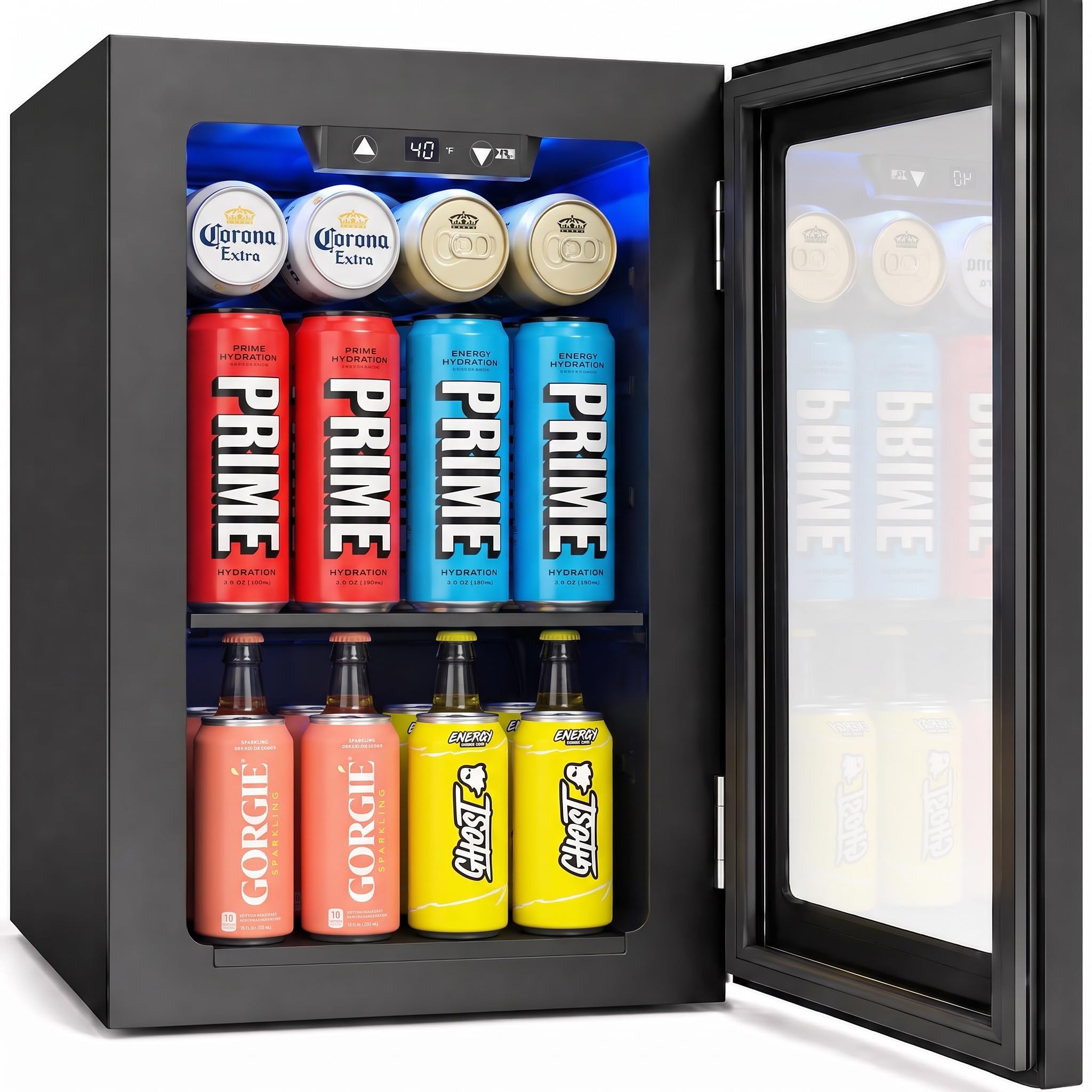
Built to sit quietly beside a keyboard without taking over the desk.
This is the small cooler for someone who wants cold cans within reach of a chair and nothing more. The cabinet measures 11.2″W × 14.9″D × 16.7″H, which is compact enough to slide onto a desk or tuck under it. It holds up to 24 cans (330ml) or 4–6 wine bottles, depending on how you arrange the removable shelf.
A compressor plus 360° air circulation pushes cold air around the whole interior instead of letting one corner freeze and another go warm. The 40°F to 61°F range covers soda, beer and wine. Touch controls on the front let you set temperature with a light press, and a long-press turns on the interior LED for grabbing a drink in a dark room.
Sound is rated at ≤38 dB, so it is meant to disappear into a study, gaming room or shared workspace. The sealing strip on the door helps hold the cold in and cuts frost buildup. It comes with a one-year accessory maintenance service, and the maker asks you to let it stand upright for 24 hours before first use — skip that step and you risk a rough start.
Cooling does not push below 40°F on some units, according to owner reports — fine for drinks, not a freezer. If you need ice cubes, the Frestec’s 28.4°F low end is the better fit.
What you are buying: a 11.2″W × 14.9″D × 16.7″H compressor cooler that fits a desk and holds 24 cans at ≤38 dB.
Where it lands short: the 40°F floor is a drinks-only limit — no ice, no freezing.
Suits: a home-office worker who wants cans cold beside the monitor without a loud hum.
Skip if: you expect frozen storage or a glass display front.
7. Feelfunn 24 Can Beverage Refrigerator
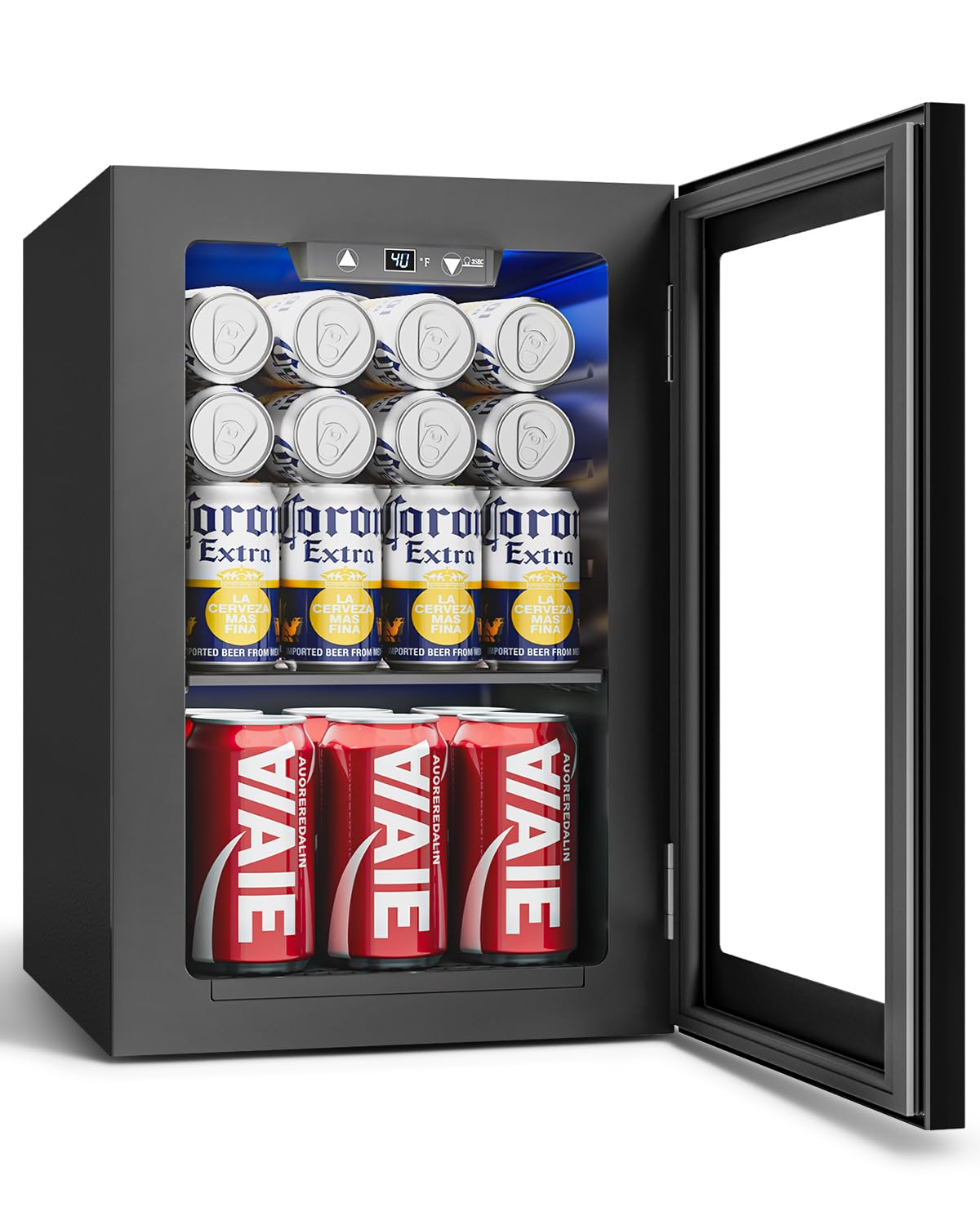
Twenty-four cans, a 38 dB hum, and a footprint small enough for a dorm desk.
The Feelfunn is the value option for anyone who wants a compressor beverage cooler without paying premium-tier money. It holds 24 cans (330ml), or 22–24 cans at 200ml, or 4–6 wine bottles depending on container type. The 0.6 cubic feet interior lets you reshuffle the removable shelf for different drink sizes.
What it does well is the basics — the performance and functionality are the standouts in owner experience, and it is sized to disappear into small rooms. It measures 11.2″W × 14.9″D × 16.7″H, so it fits on a counter, a desk or under-desk space. A touch control panel with an LED display sets the 40°F–61°F range, and a long-press turns on the interior LED for low-light grabbing.
Air moves via a 3D air circulation system (a fan layout that pushes cold air through the cabinet) which cuts frost buildup, and a sealing strip on the door helps hold temperature. At ≤38 dB it is meant for bedrooms, study areas and gaming rooms. The maker asks you to keep it upright for 24 hours before first use — worth respecting.
Temperature retention and noise both come in mixed in the feedback, so test it in place during the return window.
The bargain angle: a compressor 24-can cooler with a digital display and a 0.6 cubic feet interior at a lower outlay than the glass-door models.
Where you feel the savings: the higher annual energy draw and manual defrost add up over time if this runs as a daily appliance.
Good for: a first countertop fridge for a dorm or rented room where budget matters.
Worth reconsidering if: you want a glass door, UV protection, or a wine-first interior.
8. ROVSUN 46 Can Beverage Refrigerator Cooler
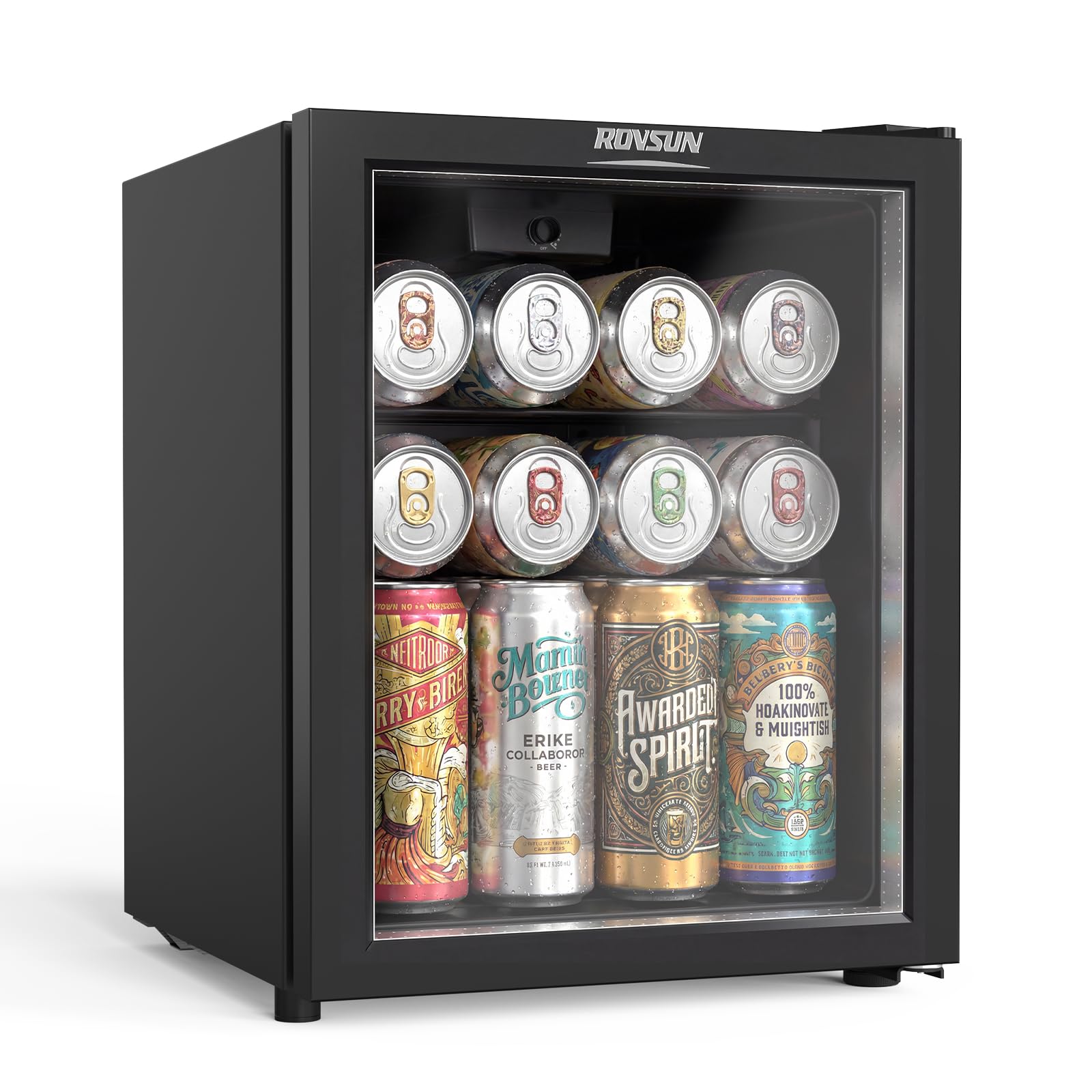
Double-layered Low-E glass that bounces heat, built for a bright bar corner.
Low-E glass is a coated pane that reflects heat back out instead of letting it pour through — which is exactly the problem with putting a glass-door fridge in a sunny spot. ROVSUN wraps its cabinet in double-layered Low-E glass that reflects heat and protects the contents while still showing them off. If your counter sits near a window that catches afternoon sun, this is the design that addresses it directly.
Capacity is 1.0 cubic feet, holding 46 cans, and the removable rack accommodates everything from craft beers to wine bottles to soda. Auto defrost clears frost on its own — no scraping chore. The 43°F to 64°F range is a touch warmer at the bottom end than the 40°F floors elsewhere here, so it leans toward drinks that taste best well chilled rather than ice-cold.
What it is known for is how it looks — the appearance earns the second-largest share of owner praise after size, and it reads well sitting in a coffee bar or kitchen corner. The compressor keeps cooling consistent rather than slipping like a thermoelectric unit would. Size fits 15.75″D x 15″W x 19.3″H — slightly roomier than the Antarctic Star’s 14.88″D x 11.02″W x 16.73″H, so give it a little more clearance.
The honest catch is temperature retention and noise both land mixed in feedback — some units freeze drinks properly and run quiet, others fall short on cooling or hum louder. On a warm counter, that is the risk to check on arrival.
Where it pays off
- Double-layered Low-E glass reflects heat in a sunny spot
- Auto defrost keeps you out of the scraping routine
- 46 cans and a removable rack fit beer, wine and cans
- Appearance ranks second in owner praise — a coffee-bar look
Where it varies
- 43°F floor is warmer than the 40°F units in this group
- Cooling strength and noise vary between units
Built for: a bright room with a counter that catches sun, and a household happy with well-chilled rather than ice-cold drinks.
Not your match if: you want the coldest floor available or need proven consistent cooling.
Know the Specs
Cubic feet versus can counts
Interior volume is measured in cubic feet, and can counts assume tight packing of standard 330ml cans. The two do not always line up — a 0.6 cubic feet cabinet can hold 24 cans, while a 1.7 cubic feet cabinet can hold 76. The rule of thumb: trust the cubic-feet number when you store bottles, and the can count when you only store cans.
Decibels in a real room
A decibel is the unit for sound level, and each additional 3 dB roughly doubles the perceived loudness — so a 40 dB unit sounds noticeably louder than a 37 dB one. Quiet here means 37–38 dB, about the level of a soft fan on low. If your fridge will sit on a nightstand side of the room, this is the number to lock in first.
Compressor versus thermoelectric
A compressor pumps refrigerant and holds a steady temperature the way a kitchen fridge does. A thermoelectric cooler uses a current-driven plate and tends to warm up alongside the room. Compressor units cost more but behave more predictably, which is why every pick here uses one.
Annual energy and kilowatt hours
A kilowatt hour (kWh) is one unit of electricity — a single 100-watt bulb burning for ten hours. Annual figures here range from 165 kilowatt hours per year to 208 kilowatt hours per year, which reflects how hard the compressor works. A lower figure saves on running cost over a full year of daily use.
Common Questions
How loud is a countertop fridge at 38 dB in a bedroom?
What does 40°F to 61°F actually mean for wine vs. beer?
Can a countertop fridge hold bottles as well as cans?
Why does one unit use 165 kWh/year and another use 208?
Why does a manual-defrost mini fridge build frost?
How upright do I need to keep the fridge before plugging it in?
Is a glass door worth it — will my drinks go warm?
Can a countertop fridge cool down to freezing for ice cubes?
How does a compressor unit compare to a thermoelectric one for hot rooms?
Do I need clearance around the fridge for the compressor to work?
The Bottom Line
For most people, the top of counter fridge that wins is the EUHOMY 18L Wine Fridge. It holds serving temperature from 40°F to 61°F behind a UV-blocking glass door (glass that filters out ultraviolet light, which can spoil wine) at 38 dB (about as quiet as a soft conversation). So it works as a display and a real wine fridge, not just a box that keeps things cold.
If what you actually need is a well-loved, slim 0.6 cubic feet cooler, the Antarctic Star is the crowd favorite. For sheer storage, the Frigidaire Retro brings 3.2 cubic feet and a built-in bottle opener. And when you want to see the stock through the glass with 76 cans behind it, the Erivess earns its spot.
What separates the useful picks here is a steady compressor, an honest noise rating, and a footprint that fits the spot you measured before you bought. Get those three right and the fridge fades into the background, which is what you want from an appliance on your counter.
How we choose
We do not accept paid placement. Every pick is matched to a real buyer and a real use-case; we do not hands-on test units.
Sources
Specifications: manufacturer listings and product documentation. Review insights: verified customer reviews, as of November 2026. Pricing: not shown on this page (it changes often); check the current price via the retailer link.
As an Amazon Associate, Tactical Gear Guy earns from qualifying purchases. This does not affect which products we feature.