Specs are compiled from manufacturer listings and verified buyer reviews and can change over time — please confirm the key details on the product page before buying.
Most people buy a ratchet by brand and end up with a tool that cannot reach the bolt that matters. Tooth count decides whether you get the nut off: a 90-tooth gear needs only 4 degrees of swing, a 72-tooth gear about 5, and in a cramped engine bay that spare degree is the difference between turning a fastener and rounding it. This guide covers nine socket wrench ratchets that each solve a different version of that problem.
This guide is built by comparing the manufacturers’ published specifications and the patterns across verified customer reviews, so you get each pick’s real strengths and trade-offs instead of marketing spin.
You will see which handles give you leverage on seized bolts, which stubby sets fit where nothing else does, and where each ratchet honestly gives up ground. Here is the practical read on the socket wrench ratchet that earns its place in your toolbox.
Top Picks

How To Choose The Best Socket Wrench Ratchet
A ratchet is three decisions wrapped in one handle: how fine the gear is, how big the drive is, and how long the handle runs. Match those three to the jobs you actually do and the ratchet will last for years. Get them wrong and you will be fighting clearance on every bolt.
Tooth count and swing arc come first
The tooth count is how many teeth the internal gear has, and it sets the swing arc — the smallest angle the handle needs to move before the gear clicks to the next tooth. A 90-tooth ratchet needs a 4-degree swing arc, which is what lets you work in a gap too narrow for a coarser tool. A 72-tooth ratchet needs a 5-degree swing arc. More teeth also means smoother ratcheting action, because each click is smaller.
Match the drive size to the socket you reach for
The drive size is the square peg on the head that your sockets snap onto. A 1/4-inch drive handles small fasteners in furniture and appliances. A 3/8-inch drive is the everyday middle — automotive work, motorcycles. A 1/2-inch drive is for the bigger bolts and the torque they demand. If you work across all three drive sizes, a matched set saves you hunting for an adapter.
Handle length is a leverage decision
A longer handle gives you more leverage on a stubborn bolt, so you push less. The trade-off is reach: a long handle will not fit between a firewall and a block. Stubby ratchets run the other direction — short handles that get into spaces a standard tool cannot enter, at the cost of leverage. Most buyers are better off owning one long-handled ratchet and one stubby than a single mid-length compromise.
Quick release and reversible switches
A quick-release button locks the socket onto the head and pops it off with a press, so you can swap sockets one-handed instead of prying them loose. A reversible switch flips the ratcheting direction so you can loosen and tighten without pulling the socket off the fastener. Both save time on long jobs, and both are moving parts to keep clean.
Side-by-Side Comparison
| Model | Best For | Drive Size | Tooth Count | Length | Amazon |
|---|---|---|---|---|---|
| Klein Tools 65720★ Best Overall | Everyday 3/8-inch work | 3/8 in | 72 | 7 in | Amazon |
| DURATECH Extra Long Handle 1/2-InchMost Leverage | Stubborn bolts needing leverage | 1/2 in | 90 | 15 in | Amazon |
| DURATECH 1/2-Inch ExtendableBest Adjustable Reach | Adjustable reach on one tool | 1/2 in | 90 | 11-4/5 in to 17 in | Amazon |
| Ryrura 3-Piece Standard Set | Three sizes on a tighter budget | 1/4 in, 3/8 in, 1/2 in | 72 | 5.51 in | Amazon |
| DEWALT DWMT81098 | Heavy-duty 1/2-inch daily use | 1/2 in | 72 | 12.01 in | Amazon |
| TOMMARS Ratchet Set | A full three-size kit with a tray | 1/4 in, 3/8 in, 1/2 in | 72 | 9.8 in | Amazon |
| Neiko 03000A | Finest swing arc in a three-piece set | 1/4 in, 3/8 in, 1/2 in | 100 | 3-piece set | Amazon |
| Capri Tools CP90S12L | Maximum leverage in one tool | 1/2 in | 90 | 25 in | Amazon |
Detailed Reviews
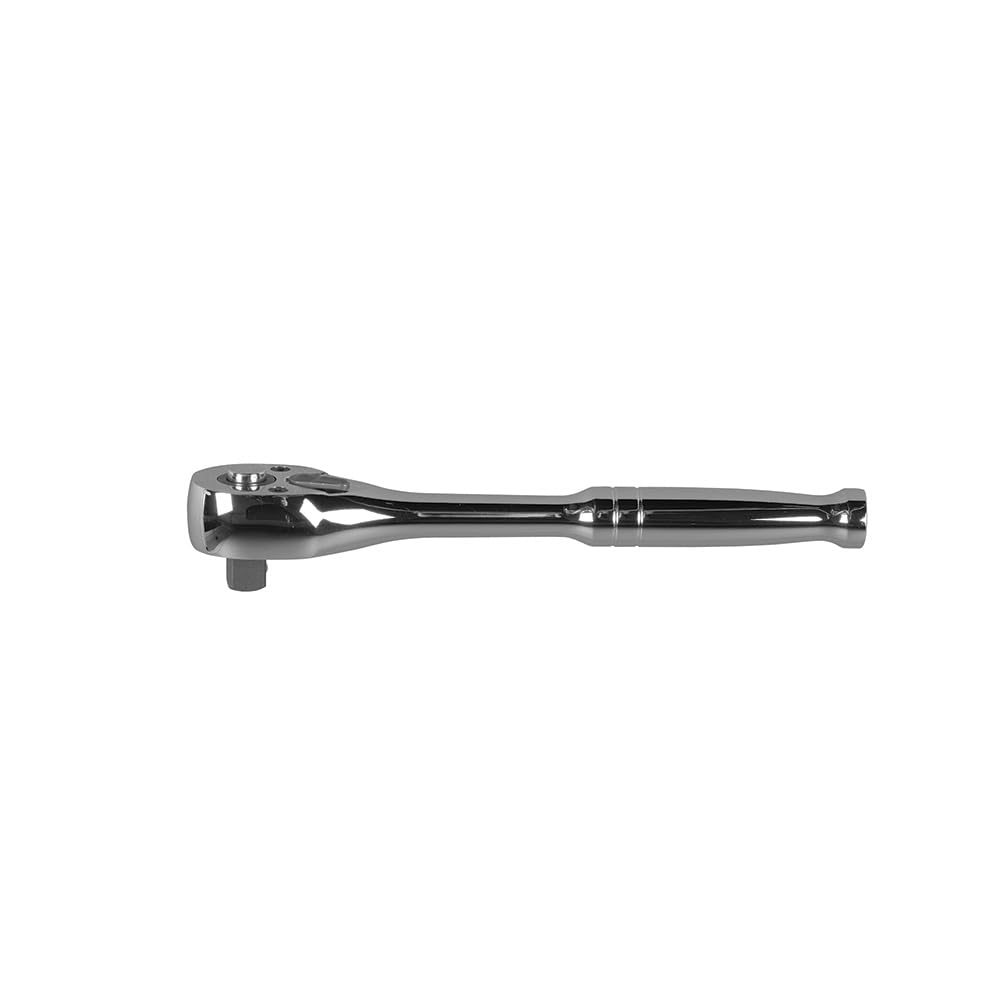
1. Klein Tools 65720 Ratchet Wrench
Our pick — 4.5+★ from 450+ verified ratings; the strongest balance of quality and price.
The 7-inch 3/8-drive that becomes the ratchet you grab without thinking.
This is the tool for the person who owns one ratchet and wants it to be right. The Klein 65720 runs a 3/8-inch drive — the everyday size that accepts the sockets most home and auto jobs call for — on a 7-inch body that fits a standard toolbox drawer. The head carries a 72-tooth gear with a 5-degree swing arc, so it needs very little room to click to the next tooth.
What wins people over is the build. It is forged from alloy steel with a chrome-plated finish that resists corrosion, and the consensus across its review pages is that it feels solid the moment you pick it up. The 4.5+ stars across 400+ ratings say the same thing in shorthand. A quick-release button pops sockets off, a reversible dial switch flicks direction with your thumb, and Klein backs the tool with a lifetime warranty on material defects and workmanship for the normal life of the product.
The honest limit is tooth count. At 72 teeth it is coarser than the 90-tooth DURATECH and Capri options here — 72 versus 90 — so in a gap tighter than 5 degrees of swing it will run out of room where those keep clicking. For most 3/8-inch jobs that never comes up. It only matters if you routinely work in the tightest corners.
What earns it the top slot
- Forged alloy steel body with a chrome-plated, corrosion-resistant finish
- Quick-release button plus reversible dial switch for one-hand socket changes
- Lifetime warranty on material defects and workmanship
- 7-inch length that stores easily and handles everyday 3/8-inch work
Where it gives ground
- 72-tooth gear needs a 5-degree swing arc, coarser than the 90-tooth picks here
- No extension or length adjustment built in
Reach for this if: you want one dependable 3/8-inch ratchet for home, appliance, and light auto work.
Think twice if: your jobs live in gaps tighter than a 5-degree arc — a finer gear will serve you better.
2. DURATECH 1/2-Inch Drive Ratchet
Fifteen inches of handle and a 4-degree swing for the bolt that refuses to move.
When a fastener is seized, leverage beats finesse. This DURATECH runs a 15-inch handle on a 1/2-inch drive, so you get real turning power on the bigger bolts without reaching for a breaker bar. The 90-tooth gear drops the swing arc to 4 degrees, meaning it clicks to the next tooth in a space the Klein’s 72-tooth gear cannot manage.
The chrome vanadium steel body wears a full polished finish that wipes clean, and the comfort-grip handle is shaped so you can pull all day without gloves. The teardrop head is enclosed and sealed to keep dust, dirt, and liquids out of the gears — that keeps the internal lubrication where it belongs and gives the mechanism a long working life. A reversible switch lets you flip direction mid-project without pulling the socket off the fastener.
The catch is durability, and it is the one mixed signal on this tool. The ratcheting action and the leverage get consistent praise, but the mechanism has a reported history of giving out under hard use. Treat it as a leverage tool for the occasional stubborn bolt rather than a shop-floor workhorse you lean on every day.
The handle length payoff: 15 inches of handle on a 1/2-inch drive is designed for stubborn bolts and tight, narrow working environments, so you push less and turn more.
Size it to the job: the sealed teardrop head and 4-degree arc make it the pick for clearance work, but the mixed durability reports mean the hardest daily torque jobs deserve a beefier tool.
Best matched to: the DIY mechanic facing occasional rusted or over-torqued bolts who wants leverage without a second tool.
Worth passing on if: you need a ratchet that takes maximum torque every single day.
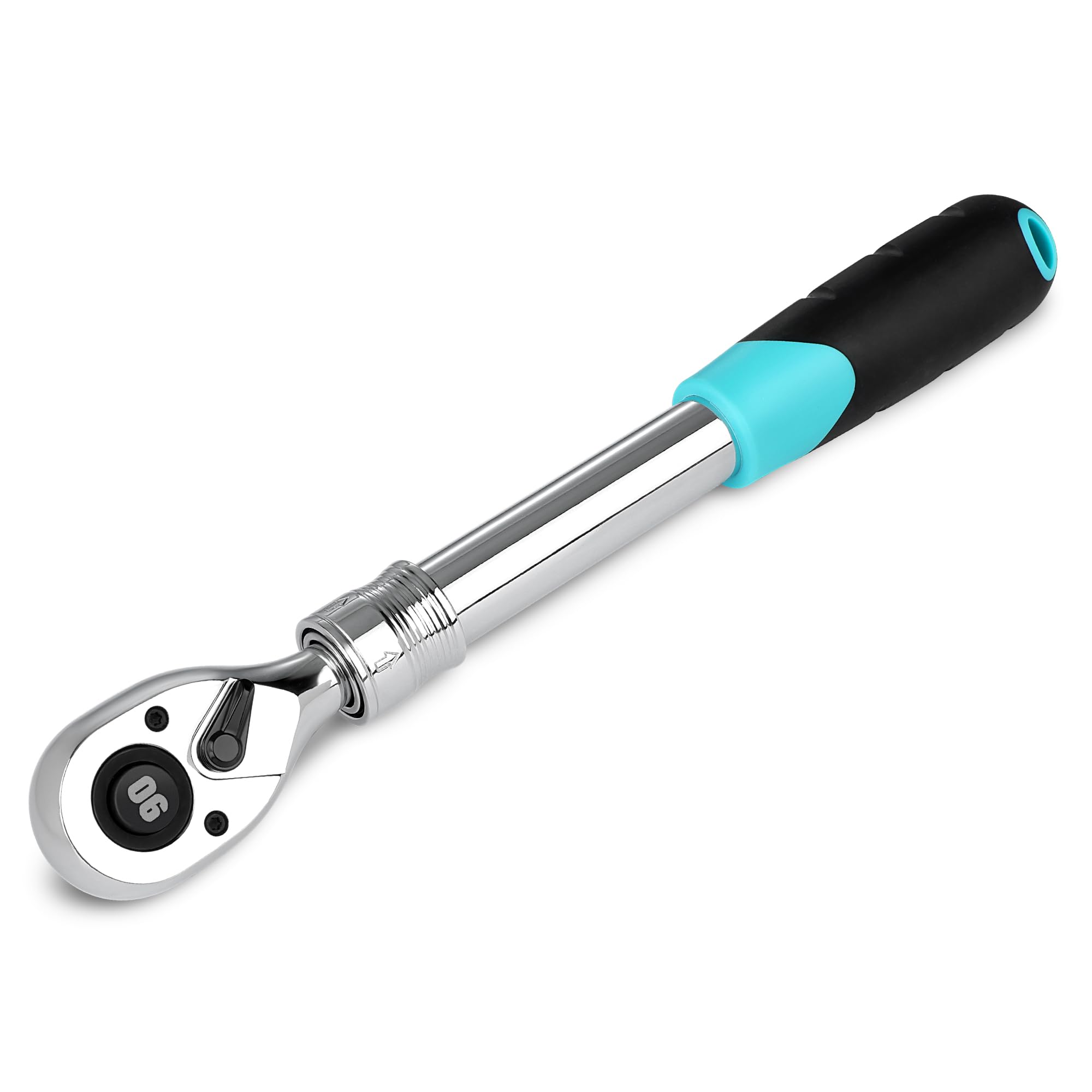
3. DURATECH 1/2-Inch Extendable Ratchet
One handle that slides from compact to full reach when a bolt needs more room.
Most ratchets are one length, fixed from the factory. This DURATECH adjusts: a card-slot locking design on a carbon steel adjustment tube lets you set the handle anywhere from 11-4/5 inches to 17 inches, with 6 card slots across 5 sections of length. Slide it short to store and work in a tight bay, extend it out when you need reach and leverage on a tough bolt.
The working end is a 90-tooth gear with a 4-degree swing arc, so it keeps clicking in narrow spots between adjustments. The head is a low-profile teardrop that clears low ceilings of space, and the body is chrome alloy steel with a Cr-Mo head and a polished finish that resists corrosion. A soft plastic rubber grip keeps your hand from slipping when you are pulling hard, and the quick-release button lets you swap sockets with one hand — a smooth forward/reverse switch handles direction changes without pulling the socket.
Extendability is the draw, and it shows up in what owners single out — the handle and the ability to reach further both get frequent praise, and it handles tough bolts well. The reality check is that a telescoping shaft is a moving part, so keep the card slots clean and treat the lock with care; that is the one component to look after on this tool.
Why it earns a spot
- Handle adjusts from 11-4/5 inches to 17 inches across 5 sections, 6 card slots
- 90-tooth gear with a 4-degree swing arc for narrow clearances
- Quick-release button allows one-handed socket changes
- Soft rubber grip for slip resistance under hard pulling
The practical limits
- The telescoping lock is a moving part that needs occasional attention
- 1/2-inch drive only — you will need adapters for smaller sockets
Pick this when: you want adjustable reach from a single 1/2-inch ratchet instead of owning two fixed handles.
Look elsewhere when: you want a sealed, no-adjustment tool you never have to think about.
4. 3-Piece Ratchet Wrench Set

Three drive sizes in one set for the buyer who is building a toolbox from scratch.
If you own no ratchets yet, buying a single drive is a false economy — different fasteners need different drives. This Ryrura set puts a 1/4-inch, 3/8-inch, and 1/2-inch drive in the same kit, so small screws in furniture and appliances, mid-size auto and motorcycle work, and larger automotive bolts are all covered without a trip back to the store.
Each ratchet runs a 72-tooth reversible gear with a 5-degree swing arc and a quick-release head — one touch on the center section swaps the socket. The chrome vanadium steel bodies carry a fully polished chrome-plated finish with a thread design, which makes them corrosion-resistant and easy to wipe clean. The non-slip surface keeps your grip when your hands are oily.
The one honest note is that the set runs a single 5.51-inch length across all three drives — so you get three sizes but not three different reaches. If a job needs true leverage or true stubby access, this set alone will not cover it. As a starting kit for household and light auto work, three drives at one length cover a lot of ground.
What it delivers: three drive sizes on a 72-tooth, 5-degree reversible mechanism with quick release — enough ratchet range to start a toolbox.
What it does not: one common length, so add a long handle or a stubby down the line if your jobs call for it.
Suits: first-toolbox buyers and light household fixers who want all three drives at once.
Skip if: you need leverage or extreme compactness — a single-purpose tool will serve those better.
5. DEWALT DWMT81098 Ratchet

The heavy steel 1/2-inch that feels like it will outlast the job.
Pick this DEWALT up and the first thing you notice is the weight — it is not a light tool, and that mass is the point. The chrome vanadium steel construction gives it a substantial feel that tells you it is built to take torque. It meets or exceeds ANSI/ASME standards, which is the benchmark for this category rather than a marketing line.
At the business end, a 72-tooth gear delivers high-torque ratcheting with a 5-degree arc swing, and the slim head design is shaped for maneuverability in restricted areas. The quick-release button gives a positive lock on sockets so they stay put until you press it. The contoured handle has anti-slip grooves, and a low-profile directional lever sits out of the way so you do not bump it mid-turn.
The weight cuts both ways. It is part of why the tool feels rugged, and owners find it works smoothly and sits well in hand — but a few find it heavier than they would like for overhead or extended use. If you work above your head for long stretches, that heft becomes a factor. For flat, heavy-duty pulling on a 1/2-inch drive, it is a comfortable tool to have in your grip.
The construction case: chrome vanadium steel, ANSI/ASME compliance, and a 72-tooth high-torque gear with a 5-degree arc swing — this is a 1/2-inch built for daily duty.
The weight trade-off: the substantial body that makes it feel rugged is the same reason some find it heavy for long overhead jobs.
Fits: the mechanic or serious DIYer who wants a sturdy 1/2-inch for torque-heavy jobs and does not mind the heft.
Think again if: you do long stretches of overhead work — the mass will wear on your arm.
6. Ratchet Set Mechanic Hand Tool

A three-size set that gives each drive its own length and a tray to live in.
Where the Ryrura set gives you three drives at one common length, the TOMMARS set matches length to drive size: the 1/4-inch runs 5.9 inches, the 3/8-inch runs 7.9 inches, and the 1/2-inch runs 9.8 inches. That means the small drive stays nimble for furniture and appliance screws while the bigger drive brings reach to automotive and motorcycle bolts.
All three are chrome vanadium alloy steel with a mirror-polished finish that resists rust and corrosion. Each head carries a reversible 72-tooth gear with a 5-degree swing arc, and the biased drive switch flips direction quickly. The quick-release head locks the socket in place and releases it with a simple touch to the middle, and the flush mount design lets the compact heads slip into tight spaces. The ergonomic handle is shaped to reduce slipping and hand fatigue.
The set comes in an EVA-foam tray, which is a bigger deal than it sounds — three loose ratchets in a drawer become a hunt every time, and the tray keeps them organized and within reach. It is a kit built for keeping your bench organized rather than for maximum torque on any one drive.
The matching logic: 5.9, 7.9, and 9.8 inches across the three drives — each ratchet is sized for the jobs its drive size actually handles.
The one gap: the 5-degree arc is coarser than a fine 90-tooth or 100-tooth gear, so the tightest clearances favor other picks.
A natural fit for: the home or pro mechanic who wants three drive sizes, three lengths, and a tray to keep them sorted.
Not the ideal match if: a single ultra-fine ratchet for tight spaces is your priority.
7. Neiko 03000A Ratchet-Wrench Set

The finest-toothed set here, with a 3.6-degree arc that fits almost anywhere.
Teeth are what this set is about. The 100-tooth gear gives a 3.6-degree working swing arc — finer than the 90-tooth tools and much finer than the 72-tooth options, so it clicks a full revolution in less space than any of them. In a tight corner it is the one that keeps turning when a coarser head runs out of room.
The three-piece kit covers a 1/4-inch, 3/8-inch, and 1/2-inch drive, and each full-polished ratchet has a teardrop head made from strong CrMo material with a chrome vanadium steel handle. A forward and reverse switch handles direction changes, and the quick-release button lets you change sockets with the flick of a thumb. The easy-grip handle is shaped for leverage without hand fatigue, and the set comes in an EVA-foam storage tray.
The mixed signal here is the direction switch, which has a reported history of failing under hard use — worth knowing if you change direction hard and often. The polished chrome finish is another small thing: it shows fingerprints readily, so keep a rag nearby. What the set delivers well is smooth operation and a fine arc across three drive sizes.
What the set gets right
- 100-tooth gear with a 3.6-degree swing arc — the finest fit here
- Three drives: 1/4-inch, 3/8-inch, and 1/2-inch in one kit
- CrMo teardrop heads with chrome vanadium steel handles
- EVA-foam tray keeps all three organized
What to weigh
- The direction switch is the known weak point under heavy use
- The polished finish picks up fingerprints quickly
Choose it for: the finest swing arc on this list across three drive sizes, ideal for tight engine-bay access.
Choose differently if: you flick the reverse switch hard and often — a sturdier switch belongs in your toolbox.
8. Capri Tools 1/2 in. Drive Ratchet

Twenty-five inches of handle for the bolt that needs everything you have.
If leverage is the whole job, this is the tool. At 25 inches long the Capri handle dwarfs the 15-inch DURATECH and the 12.01-inch DEWALT, so you can put real force into a stubborn fastener without straining. It runs a 90-tooth gear needing only a 4-degree swing arc, so despite its length it still works in a tight spot once you have it positioned.
The gear is a true single-pawl design, which is what gives it the smooth ratcheting action the tool is known for. A low-profile head clears spaces with little room, the extra-long handle extends reach, and an anti-dust seal keeps debris out of the gears while holding internal lubrication in. A dual-direction gear flips with your thumb. The soft ergonomic contour grip gives you a sure hold, and the MaxChrome plating is polished and chrome-plated for durability and corrosion resistance.
The weight is the honest cost of all that length: at 2.7 pounds it is a substantial tool, so it is one you bring to a job rather than carry in a pocket. Durability under heavy torque has also drawn mixed feedback, so lean on the length for the occasional tough bolt rather than day-in, day-out maximum-force work.
The leverage math: a 25-inch handle on a 1/2-inch drive with a 4-degree arc — length for torque and a fine gear for tight placement in one tool.
The honest trade: at 2.7 pounds it is heavy, and the mechanism is best suited to occasional hard pulls rather than constant maximum torque.
Get this one if: you face big, stubborn fasteners and want the longest lever here to work them loose.
Pass if: you need a compact tool or a ratchet that takes constant maximum torque.
Know the Specs
Tooth Count and Swing Arc
The tooth count is how many gear teeth sit inside the ratchet head. Each tooth sets how far the handle must move before it clicks to the next one — the swing arc. A 90-tooth ratchet needs 4 degrees; a 72-tooth needs 5 degrees; a 100-tooth needs 3.6 degrees. The finer the arc, the better the tool fits in spaces too narrow for a full stroke. Finer gears also click in smaller steps, which usually feels smoother in the hand.
Drive Size and Head Type
The drive size is the square peg on the head that sockets snap onto. A 1/4-inch drive takes small sockets for furniture and appliance screws. A 3/8-inch drive is the everyday mid-size for auto and motorcycle work. A 1/2-inch drive takes the larger sockets and higher torque. A teardrop head is shaped with a rounded top and narrower snout to slip into confined areas, and a low-profile head clears spaces with little vertical room.
Handle Length and Leverage
Handle length sets your leverage — the longer the handle, the more turning power you get from the same effort. Standard handles run around 7 inches on a 3/8-inch drive; extra-long options run 15, 25, and beyond on a 1/2-inch drive. Stubby handles run under 6 inches for access at the expense of force. Extra-long handles also put the socket further from your grip, which helps around obstructions in the bay.
Reversible Switch and Quick Release
The reversible switch flips the ratcheting direction so you can change from loosening to tightening with a thumb flip, without pulling the socket off the fastener. Quick release is a button that locks the socket onto the head and pops it free with a press, allowing one-handed socket changes. Both save time mid-project. They are also moving parts, so they are the components to look after on any ratchet.
Common Questions
Is a 90-tooth ratchet better than a 72-tooth ratchet?
What drive size should I buy first?
Will a 25-inch ratchet still fit in an engine bay?
What does quick release actually do on a ratchet?
Do I need an extendable ratchet or two fixed handles?
Is a stubby ratchet worth owning on its own?
How do I keep my ratchet’s gears working smoothly?
Can a 1/2-inch ratchet be used with 3/8-inch sockets?
What is the difference between 72-tooth and 100-tooth ratcheting?
Should I choose an SAE or metric ratchet?
The Bottom Line
For most buyers, the socket wrench ratchet winner is the Klein Tools 65720 because it puts a forged alloy steel 3/8-inch drive with a 72-tooth gear, quick release, and reversible switch into one 7-inch tool that handles everyday work. If leverage on tough bolts is your recurring problem, reach for the Capri Tools 25-inch or the DURATECH 15-inch long handle. And for cramped, hard-to-reach fasteners, the DURATECH 3-piece stubby set is the one to grab.
How we choose
We do not accept paid placement. Every pick is matched to a real buyer and a real use-case; we do not hands-on test units.
Sources
Specifications: manufacturer listings and product documentation. Review insights: verified customer reviews, as of November 2026. Pricing: not shown on this page (it changes often); check the current price via the retailer link.
As an Amazon Associate, Tactical Gear Guy earns from qualifying purchases. This does not affect which products we feature.