Specs are compiled from manufacturer listings and verified buyer reviews and can change over time — please confirm the key details on the product page before buying.
Buy the watch whose compass you can trust when the trail disappears — and skip the ones that make you re-calibrate before every trip. That is the whole decision in one line. A tactical watch with a compass lives or dies on three things: a heading that holds true without fiddling, a battery that survives a multi-day outing, and a body that shrugs off rock, rain and cold. Everything else is decoration.
This guide is built by comparing the manufacturers’ published specifications and the patterns across verified customer reviews, so you get each pick’s real strengths and trade-offs instead of marketing spin.
Below you will find nine watches grouped by what they actually do well, from a solar-charged Garmin that never needs a cable to a budget digital unit that runs on a coin cell for months. Each entry names the real trade-off so you can match a watch to your terrain, then pick the best tactical watch with compass for your kit.
Top Picks

How To Choose The Best Tactical Watch with Compass
Most buyers assume the compass is the hard part. It is not. A digital compass is cheap to build, so almost every watch here has one. The real differences sit in how that heading behaves in the field, and in whether the watch still has power when you need it.
Compass type: 3-axis sensor versus digital dial
A 3-axis compass (a sensor that reads heading accurately even when the watch is tilted away from flat) is what you want on broken ground. A flat two-axis reading drifts when you hold your wrist at an angle, which is most of the time on a slope. Digital compasses with a calibration routine are common; just know that you will need to re-run that routine after a big change in location. Some watches in this list carry a compass that buyers report cannot be calibrated at all, so read the individual entries before you commit.
Power: solar, rechargeable, or coin cell
Three power systems show up here, and each changes your packing list. Solar charging tops up the battery from daylight and, in the right conditions, removes the cable entirely. A rechargeable lithium battery with a charging cable gives you a fixed run time between charges. A coin cell (a flat button battery like a CR2430 or CR2032) runs for months or years and needs no cable at all — but you cannot top it up mid-trip, you replace it.
Sensors: altimeter and barometer
An altimeter estimates your elevation; a barometer reads air pressure. The two are linked, because air pressure shifts with height, so a barometer reading becomes an altitude reading. That also means both need calibrating against a known reference to be trustworthy. Body heat skews a wrist thermometer, which is why several makers tell you to take the watch off for a true ambient reading.
Water resistance ratings explained
A 50 m rating handles rain, hand washing and surface swimming — not diving, and not hot showers. A 100 m rating is a tougher seal. An IP68 rating means dust-tight and able to survive water immersion, but one maker here explicitly says sea water and saunas are out. Match the rating to your real exposure, not the number that sounds biggest.
Side-by-Side Comparison
| Model | Best For | Compass / Sensors | Power System | Case & Band | Amazon |
|---|---|---|---|---|---|
| Garmin Instinct 2X Solar Tactical Edition★ Best Overall | Serious backcountry use | 3-axis compass + barometric altimeter | Solar charging, lithium polymer | 50 mm fiber-reinforced polymer, 26 mm silicone | Amazon |
| Tiwain Military Smart WatchSmart Value | Smart features on a budget | Compass, altimeter, barometer | 530 mAh rechargeable, 30-day standby | ABS + zinc alloy, 22 mm band | Amazon |
| North Edge Apache 46No-App Simple | No-app simplicity | Compass, altimeter, barometer | CR2430 coin cell | Metal case, nylon & silicone bands | Amazon |
| Apache Military Tactical Watch (Nylon Band) | Step and calorie tracking | Digital compass, altimeter, barometer | Nonstandard coin cell | Metal case, durable nylon band | Amazon |
| FitMoon Military Smart Watch | Hands-free calls outdoors | Digital compass, altimeter, barometer | 530 mAh rechargeable, 30-day standby | Zinc alloy bezel + ABS, 22 mm silicone | Amazon |
| North Edge Apache Tactical Sports Watch | Long battery, big face | Compass, altimeter, barometer, thermometer | CR2032 coin cell, 18-month life | 50 mm metal case, 24 mm band | Amazon |
| DIDITIME Tactical Watch | Light training wear | Compass, pedometer, metronome | CR2430 coin cell | Carbon fiber case, nylon strap | Amazon |
| Timex Expedition North Tide-Temp-Compass | Analogue-look field wear | Compass, temperature, tide | Lithium metal battery | 43 mm case | Amazon |
| Garmin Instinct 2 Solar Tactical Edition | Tactical field ops | 3-axis compass + barometric altimeter | Solar charging, 300 mAh lithium polymer | Fiber-reinforced polymer, 22 mm silicone | Amazon |
Detailed Reviews
1. Garmin Instinct 2X Solar – Tactical Edition, Coyote Tan
Our pick — 4.5+★ from 650+ verified ratings; the strongest balance of quality and price.
A solar-charging tactical watch with a built-in LED flashlight and a 3-axis compass.
The number to fix in your head is three hours. Expose this watch to three hours of direct sunlight at 50,000 lux per day — bright open daylight — and Garmin claims the battery reaches effectively unlimited life in smartwatch mode. That single claim reframes a multi-day trip: you stop budgeting charge around a wall socket and start budgeting daylight. The Power Glass lens is also rated to pull in 50% more energy than the standard Instinct 2 solar, so the solar trickle arrives faster here.
Navigation is where the 3-axis compass and barometric altimeter earn their keep. A 3-axis sensor reads your heading even when your wrist is tilted, so the bearing stays usable on a scree slope instead of demanding you hold the face flat like a plate. Multi-band signal reception (a receiver that pulls from more than one satellite frequency band) is stated to deliver more accurate positioning than single-band devices — meaningful in a canyon where single-band fix drifts. Add the tactical extras and this becomes a field tool: a ballistics calculator, jumpmaster activity, waypoint projection and a stealth mode that shuts off wireless communication and data sharing.
Durability is stated plainly: built to U.S. military standard 810 for thermal, shock and water resistance, in a 50 mm fiber-reinforced polymer case. The built-in LED flashlight with variable intensities and strobe modes is the sleeper feature — a light on your wrist for night navigation or a tent search, no headlamp digging.
Where the 2X Solar pulls ahead
- Solar charging that reaches effectively unlimited smartwatch battery life with 3 hours of 50,000 lux daylight daily
- 3-axis compass and barometric altimeter for a heading that holds when your wrist is tilted
- Built to U.S. military standard 810 for thermal, shock and water resistance
- Built-in LED flashlight with variable intensities and SOS strobe
- Multi-band signal reception for more accurate positioning than single-band watches
What to weigh before you buy
- The 50 mm case reads large on a narrow wrist
- Unlimited battery life depends on real daylight, so a dark winter trip changes the math
- The tactical toolkit is deeper than a casual hiker will ever touch
Built for: the backpacker or field operator who wants a heading, an altitude reading and a light on one wrist without a charging routine.
Think twice if: you have a slim wrist and prefer a low-profile case — the 50 mm body is the one trade-off you cannot dial back.
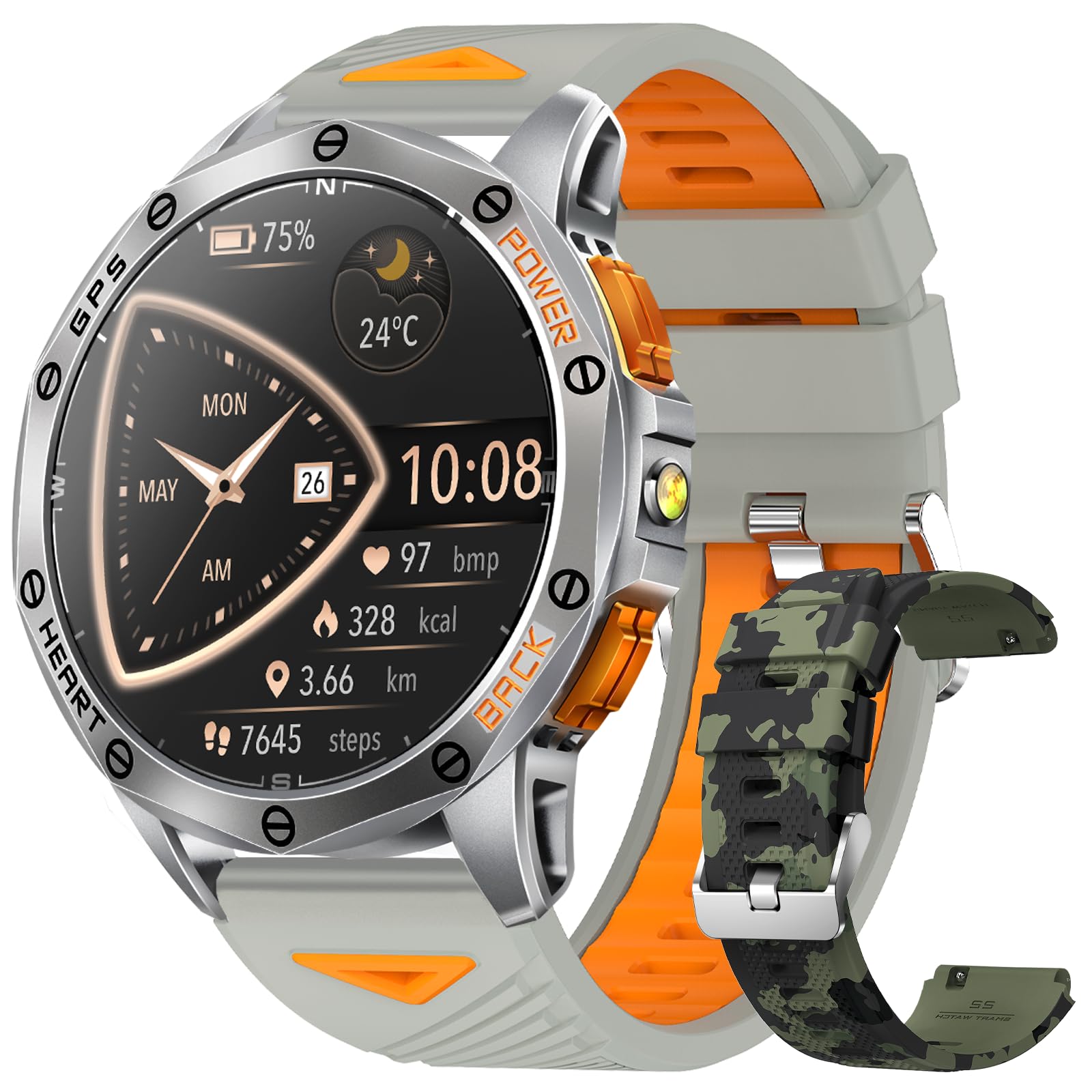
2. Tiwain Military Smart Watch
Built-in six-system GPS and a 1.43-inch AMOLED screen at a budget-tier price.
If you want compass, altitude and position data without strapping on a premium-priced unit, this is the entry point. The sensor stack is real: a compass, altimeter and barometer feed you altitude, air pressure and heading on a 1.43-inch AMOLED touchscreen (an OLED panel that lights each pixel itself, so it reads clearly in daylight). GPS support spans six satellite systems — GPS, GLONASS, Beidou, Galileo, NAVIC and QZSS — which is a wide net for a watch in this tier. Band width is 22 millimeters.
The power story is the one buyers talk about most in a good way. A 530 mAh battery runs 7-10 days on a full charge, tops up in 2 hours, and holds up to 30 days in standby. Continuous GPS use is stated at about 3 days — enough for a weekend route, not a week-long expedition. An IP68 rating covers rain and sweat, but the maker is clear that sea water and saunas are out.
Now the honest part. Functionality and durability come back mixed across the review base, with some units reported to stop working within months. Quality and value are the two things buyers praise hardest, and the appearance earns steady approval — but this is a smartwatch built to a price, not a field instrument. Treat the 170+ sport modes and phone-call handling as the reason to buy, and treat the compass as a useful aid, not a survey tool.
What lands well: the AMOLED screen, the six-system GPS and the 530 mAh battery at a budget-friendly tier make this the smartest value in the group.
The honest catch: reliability is the gamble — some buyers get years of service, others get a watch that quits, so buy it as a smart outdoor watch first.
Reach for this if: you want GPS, compass and a bright AMOLED face without spending premium money.
Look elsewhere if: you need a watch you can trust as the only navigational tool on a serious trip.
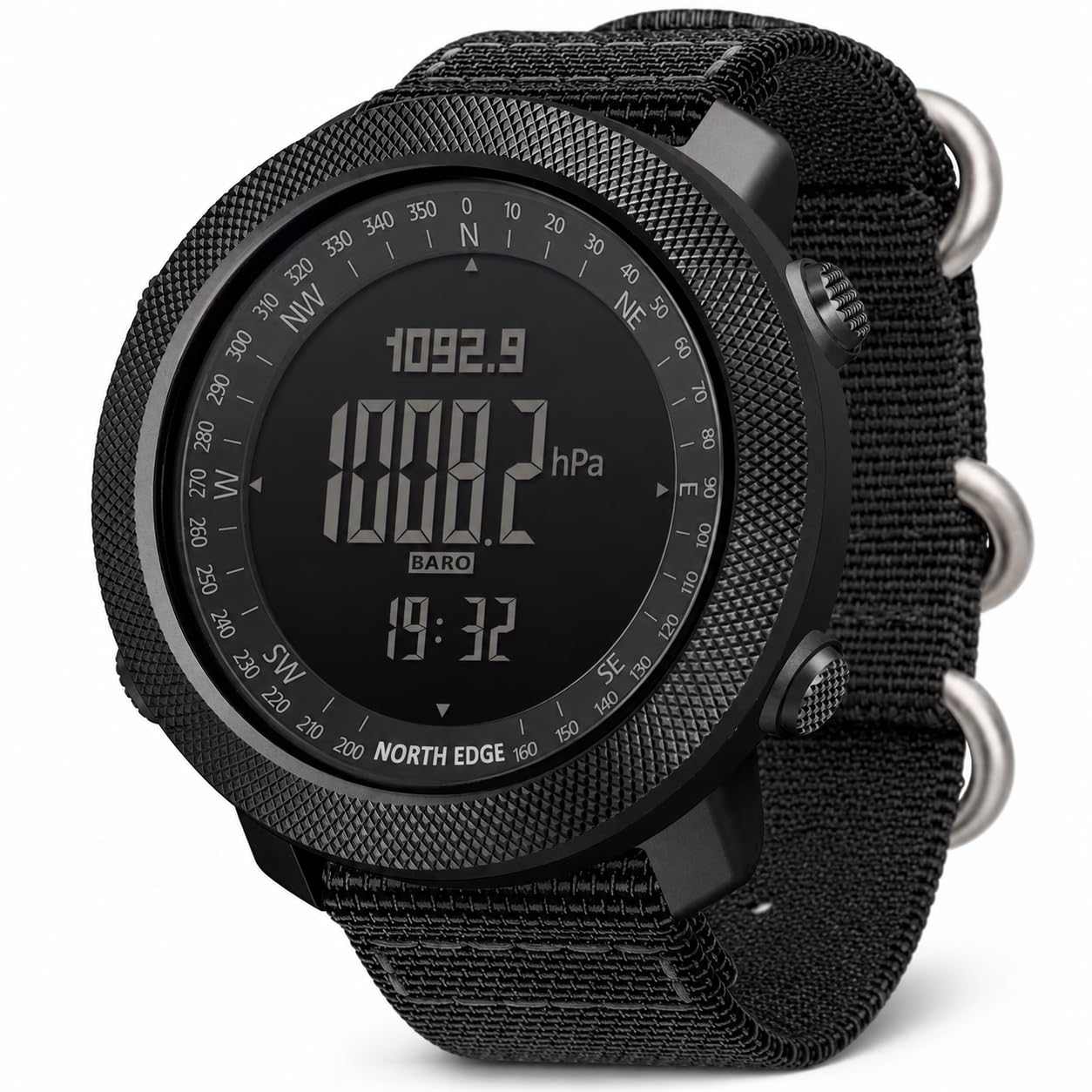
3. NORTH EDGE Apache 46
A coin-cell watch with compass, altimeter and barometer that needs no app or Bluetooth pairing.
For anyone who has watched a smartwatch die on a cold morning with a flat battery, this is the appeal: nothing to charge, nothing to pair. The watch runs on a single CR2430 coin cell, and the maker states outright that no app or Bluetooth connection is required. Compass, altimeter and barometer are all onboard, and a 50 m water-resistance rating handles rain, hand washing and surface swimming. The negative digital display is designed for a subdued outdoor look, and you press the LIGHT button to fire the EL backlight when the light drops.
This is also the pick that tells you the truth about the sensors rather than overpromising. The maker’s own guidance says to calibrate the compass before first use and again whenever the direction seems off. Altitude readings shift with atmospheric pressure, so calibrating against a known elevation sharpens them. Body heat skews the thermometer, so you take the watch off for a true ambient reading. None of that is a flaw — it is how pressure-based sensors work — but it means this watch rewards a little setup knowledge.
What buyers respond to is the build. Descriptions of it as beefy and substantial come up repeatedly, and the metal case sets the tone. The counterweight is the setup: the instructions draw mixed feedback and some buyers find them hard to follow, which makes the calibration ritual slower than it should be on day one.
Why it appeals to the app-averse
- Coin-cell power with no charging cable and no phone pairing
- Compass, altimeter and barometer onboard with clear calibration guidance
- Substantial metal build buyers keep describing as beefy
- 50 m water resistance for rain, washing and surface swimming
The friction to plan around
- Instructions are hard going, so first-time setup takes patience
- Durability feedback is split across the review base
- No smartwatch extras — no calls, no notifications, no app sync
Suits the analogue-minded: someone who wants a real compass and altitude reading without a phone in the loop.
Not for gadget hunters: there is no app layer here, so if you want calls and notifications on your wrist, look at a smart model instead.
4. Apache Military Tactical Watch

A nylon-banded digital watch with a pedometer, a 100-lap chronograph and a digital compass.
This Apache leans on fitness tracking as much as navigation. The pedometer logs steps, calories and distance, and the chronograph counts up to 99 hours 59 minutes 59.99 seconds with 100 lap groups. A countdown timer runs the same span, and the stopwatch covers 0 to 59:59. Those are working numbers for interval training or pace work, not decoration.
The sensor set matches the category brief: a digital compass, an altimeter with an altitude trend chart and climb rate, and a barometer with an air-pressure trend chart that feeds a weather forecast. Temperature measurement is rated from -10 to +60 ℃ (14 to 140 ℉), though body heat will skew a wrist reading. Two alarm sets, a second-time zone and a full calendar (year range 2000-2099) round out the daily wear. An EL backlight handles low light.
Here is the thing to understand: this is a very new listing with a thin review base, so there is no deep owner history to lean on yet. The feature sheet is unusually complete for the tier, and the stack of environment tools is the reason to consider it. Just go in knowing you are an early buyer rather than following a crowd.
The draw: a genuinely full toolset — compass, altimeter, barometer, weather forecast, pedometer and a 100-lap chronograph — in one durable nylon-banded case.
Read this before ordering: the listing is fresh, so treat verified owner experience as scarce and weigh the spec sheet on its own merits.
Worth a look if: you want step, calorie and lap tracking alongside compass and altitude readings in a nylon-band watch.
Hold off if: you prefer a model with a long track record of owner feedback behind it.
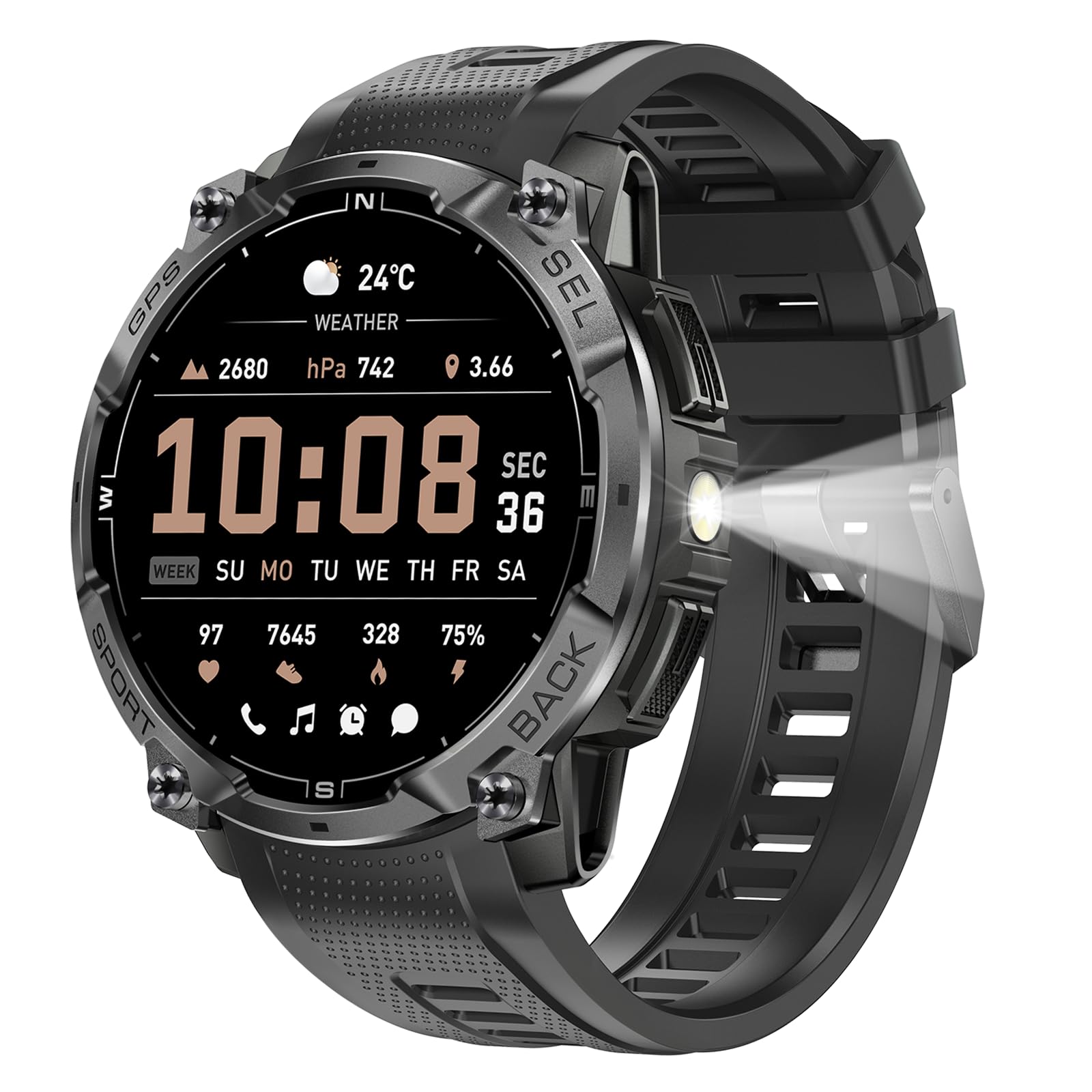
5. FitMoon Military Smart Watch for Men, Built-in GPS & Compass
Hands-free calls on a 1.43-inch AMOLED screen, with built-in GPS and a compass for the trail.
The headline here is independence from your phone. A built-in GPS with six satellite systems — GPS, GLONASS, Galileo, Beidou, NAVIC and QZSS — logs routes on its own, and a compass, altimeter and barometer capture heading, elevation and pressure in the same session. All of it shows on a 1.43-inch AMOLED screen, the same panel size as the Tiwain above but paired with a silicone band and a 26 centimeter band length.
Power is a 530 mAh battery good for 7-10 days of regular use, 30 days of standby and 3 days of continuous GPS, topped up in 2 hours. An IP68 rating covers rain, sweat and dust. A side button fires an LED flashlight rated to light up to 20 meters, which is a genuinely useful add when a route runs past dusk.
Build quality and reliability are what buyers single out as the strongest traits, alongside the sporty look and the wide spread of 170 sport modes. The one place to be careful is the compass itself — accuracy reports are not unanimous, with at least one buyer finding the readings off. So use the GPS as your primary navigation and let the compass confirm direction rather than lead. That is a reasonable division of labor on a watch at this tier.
What earns the space on your wrist
- Phone-free GPS across six satellite systems
- 1.43-inch AMOLED screen that stays legible in daylight
- Hands-free calls and incoming notifications from the wrist
- LED flashlight rated to 20 meters plus IP68 dust and water resistance
The honest limitations
- Compass accuracy is not universally praised, so treat GPS as primary
- Sea water and extended submersion are outside the IP68 brief
- Continuous GPS caps out around 3 days, so multi-day routes need a charge plan
The match: you want compass, GPS and call handling on a bright AMOLED face without dragging your phone out on the trail.
The mismatch: you plan to trust the compass alone for bearings in unfamiliar terrain.
6. North Edge Apache Tactical Sports Watch, Green

An 18-month CR2032 coin cell and a spare silicone band in the box.
The battery claim is the reason to look here: a Japanese CR2032 rated for 18 months of life. Pop the cell, walk away for a year and a half, come back, and you are still navigating. For a camping or hiking watch that sits in a pack between trips, that removes the charging chore entirely. The package also includes an extra silicone band to swap in when the nylon one needs a rest. Case diameter is 50 mm and band width is 24 millimeters.
The toolset is wide for a digital unit: compass, altimeter, barometer, thermometer, weather forecast, world time, dual time, pedometer with calorie and distance tracking, two alarms, countdown timer, stopwatch and an EL backlight. Water resistance is 50 m — fine for swimming, not diving, and the maker warns against pressing the buttons underwater or taking it into a hot bath. The metal case is the element that draws the most praise.
The trade-offs are stated plainly by the maker and confirmed by the review base: it is a big, heavy watch at 117 grams, and North Edge tells you to check whether that suits you before ordering. Functionality and durability feedback is mixed, with altimeter faults mentioned by some buyers. Weight and readability also come up as friction points. The design still earns consistent praise, and that is the through-line for this watch — it looks the part, and you accept some bulk and mixed sensor reliability for the coin-cell convenience.
The case for it: rare 18-month coin-cell life plus a full sensor suite makes it a low-maintenance field companion you can forget between outings.
The case against: at 117 g with a 50 mm case it wears heavy, and altitude readings are not immune to the faults some buyers hit.
Right call for: the occasional outdoorsman who wants a compass and altimeter ready without a charging habit.
Wrong call for: a small-wristed or weight-sensitive wearer who wants a slim daily piece.
7. DIDITIME Tactical Watch

A wrist metronome for pace work in a lightweight carbon fiber case, with a compass and pedometer.
Not many tactical watches carry a metronome, and that is the detail that sets this one apart. It keeps a beat so you can hold a pace or a cadence, which pairs neatly with the built-in pedometer for step and distance tracking. The compass handles navigation, and the breathable nylon strap keeps the whole thing wearable through a long session. Waterproofing is rated to 164FT.
Build quality is the trait that draws the most approval, with the soft material band coming in for comfort praise and the appearance earning steady approval too. The carbon fiber case keeps the weight down, which matters when you are wearing it for a full training block rather than a two-hour hike. A digital display keeps the time and fitness stats readable at a glance.
The honest read: functionality and durability both come back mixed, with some units reported to stop working over time and a durability note about a failure after light wear. Nothing here suggests a design flaw — it is a light-use watch with a fitting price — but if you need a compass you can bet your route on in bad weather, spend a step up. For training days and casual trail work, the metronome, pedometer and light case make a solid combination.
Pick this for: gym-to-trail days where pace cues, step counts and a compass all matter in a watch that stays light.
Pass on this for: hard expeditions where durability and compass precision carry real consequences.
8. Timex Men’s Expedition North Tide-Temp-Compass 43mm Watch

An analogue-style 43 mm field watch with a built-in compass, temperature reading and tide tracking.
This one goes a different direction from the digital models around it. The Expedition North is an analogue-style watch with a real compass built in, plus a temperature reading and tide tracking — the tide function being a specific nod to coastal and river work that most tactical watches ignore. The case measures 43 mm, which is the smallest footprint in this group and a sensible fit for a narrower wrist. It runs on a lithium metal battery.
Quality and appearance are what owners praise most, and the value is a recurring theme — it reads as a serious-looking field watch for the money. That measured, traditional look is the point: it slots into a pocket or under a sleeve without announcing itself as a gadget.
The caveat is already documented in the maker’s own review base. The compass is real, but reports note it cannot be calibrated, and temperature accuracy is one of the weaker points. Functionality and durability also split across feedback. So the right buyer here is someone who wants the aesthetic and the tide/temp/compass trio, not someone who needs a survey-grade bearing in zero visibility.
Where it shines: a distinct field-watch look paired with a real compass, a temperature reading and tide tracking in a compact 43 mm case.
Where it asks patience: the compass cannot be recalibrated, so treat the bearing as a reference point rather than a precision instrument.
Built for: the coastal hiker or traditionalist who wants a field watch with tide, temperature and a real compass in a smaller case.
Not built for: anyone who needs to calibrate and recheck their heading mid-route.
9. Garmin Instinct 2 Solar Tactical Edition, Black

The original tactical Instinct — 100 m water rated, with a stealth mode that cuts the radio.
Where the 2X builds in a flashlight and a ballistics calculator, this Instinct 2 Solar keeps the tactical core and adds a 100 m water rating — double the exposure tolerance of a 50 m field watch. Solar charging gives unlimited battery life in smartwatch mode with three hours of direct sunlight at 50,000 lux per day, and GPS mode runs up to 48 hours with continuous solar charging in the same light. The barometric altimeter and 3-axis compass are both here, alongside multiple satellite systems — GPS, GLONASS and Galileo — for tracking in terrain where GPS alone struggles.
The tactical layer is what separates it: Jumpmaster activity, waypoint projection, dual-position GPS format, preloaded tactical activity and a stealth mode that disables wireless communication and data sharing. The case is fiber-reinforced polymer with a 22 mm silicone band, built to U.S. military standard 810 for thermal, shock and water resistance. A 300 mAh lithium polymer cell and a 28-day average battery life keep the schedule.
Owners respond most to the appearance, the feature depth and the tracking quality, particularly the fitness and GPS side. The one thing that draws mixed feedback is battery — some find it runs for weeks without a daily charge, others report it not holding a charge well, so solar habits matter. That is the difference between the two Garmins here: the 2X offers more case and a flashlight, this one gives you the tighter 22 mm band and the classic tactical build.
Tactical features that stand out
- 100 m water rating against the 50 m on several field watches here
- Stealth mode disables wireless communication and data sharing
- Jumpmaster, waypoint projection and dual-position GPS format built in
- 3-axis compass, barometric altimeter and multi-GNSS tracking
Points to check against your plans
- Battery feedback splits, so solar charging behaviour matters
- No built-in flashlight, unlike the 2X above
- The tactical toolkit is deeper than most civilian wearers need
Choose this if: you want the classic tactical Instinct with a 100 m rating and a stealth mode that kills the radio.
Choose the 2X instead if: a built-in flashlight and a larger 50 mm case suit your kit better.
Know the Specs
3-Axis Compass
A standard compass reads heading when the dial sits flat. A 3-axis sensor (three motion axes, so tilt is measured as well as direction) keeps your heading readable when the watch is angled — which is most of the time on a slope or a rope. That is why a 3-axis sensor is worth more on rough ground than a flat reading that needs holding level. Digital compasses usually need a calibration routine before first use and after a big change in location.
Altimeter and Barometer
These two sensors work as a pair. An altimeter estimates your elevation; a barometer reads air pressure. Because pressure shifts with height, the barometer reading becomes the altitude figure. Both drift and need a known reference to sharpen accuracy, and body heat skews a wrist thermometer, so reading the true ambient temperature means taking the watch off for a few minutes.
Solar Charging
Solar charging (a lens over the dial that converts daylight into battery power) is what gives some watches effectively unlimited battery life in smartwatch mode. The figures that matter are exposure time and brightness — the watches here cite three hours of direct sunlight at 50,000 lux per day. Cloud, shade and a jacket sleeve cut that input, so solar is a helper rather than a guarantee.
Water Resistance Ratings
A 50 m rating handles rain, hand washing and surface swimming, and one maker warns against pressing buttons underwater or taking the watch into a hot bath. A 100 m rating is a tougher seal for more exposure. IP68 means dust-tight and able to survive water immersion, but one maker explicitly rules out sea water and saunas. Match the rating to where you actually wear the watch.
Common Questions
Do tactical watch compasses need calibrating before a hike?
Will a solar tactical watch run without a charging cable?
What is the difference between 50 m and 100 m water resistance?
Can I use a tactical watch compass without a phone connection?
How long do coin-cell tactical watches actually last?
Why does my watch thermometer not match the real temperature?
Is a 3-axis compass better than a flat digital compass?
Will a large 50 mm tactical watch fit a smaller wrist?
Can these watches take a swim, and what about sea water?
What does stealth mode actually switch off on a tactical watch?
The Bottom Line
For most buyers, the tactical watch with compass winner is the Garmin Instinct 2X Solar Tactical Edition because it pairs a 3-axis compass and barometric altimeter with solar charging and a 50 mm military-standard build — the one combination that removes the charging chore and keeps your heading true on tilted ground. The wider review base actually sits with the Tiwain, which has more owner feedback on record, but the Garmin holds the higher score and the deeper field toolkit.
If what you really want is hands-free calls and a bright AMOLED face on a budget, grab the FitMoon Military Smart Watch. And for a no-app, coin-cell watch with an 18-month battery, the North Edge Apache Tactical Sports Watch is the one to reach for — just check the 117 gram weight against your wrist first, then go get the heading you can rely on.
How we choose
We do not accept paid placement. Every pick is matched to a real buyer and a real use-case; we do not hands-on test units.
Sources
Specifications: manufacturer listings and product documentation. Review insights: verified customer reviews, as of November 2026. Pricing: not shown on this page (it changes often); check the current price via the retailer link.
As an Amazon Associate, Tactical Gear Guy earns from qualifying purchases. This does not affect which products we feature.