Specs are compiled from manufacturer listings and verified buyer reviews and can change over time — please confirm the key details on the product page before buying.
The hardest part of buying car audio isn’t finding loud gear — it’s buying an amplifier that actually delivers the wattage printed on the box. Peak numbers on a subwoofer enclosure are marketing; continuous watts and a clean signal are what you hear. This guide splits the field into the two halves that really matter: the processing and amplification that shape your sound, and the subwoofer boxes that add the weight. Every pick here is a real, specific component you can bolt into a real vehicle, and each one has a clearly defined job in a system.
This guide is built by comparing the manufacturers’ published specifications and the patterns across verified customer reviews, so you get each pick’s real strengths and trade-offs instead of marketing spin.
Some picks here tune the sound you already have, others replace your whole dashboard. The trick is naming your car’s weak link — muddy signal, weak amplification, or missing bass — before you spend a cent. That logic drives this shortlist: each pick is here because it fixes one specific gap.
Top Picks
How To Choose Top Rated Car Sound Systems
Start by naming the weak link in your car instead of buying the biggest box on the page. A factory head unit that clips at high volume needs a processor or a new receiver. A car with decent speakers but no bottom end needs a subwoofer package. Buying a 12-inch enclosure for a system that already has a blown amplifier just buys you louder distortion.
Match the component to the hole in your system
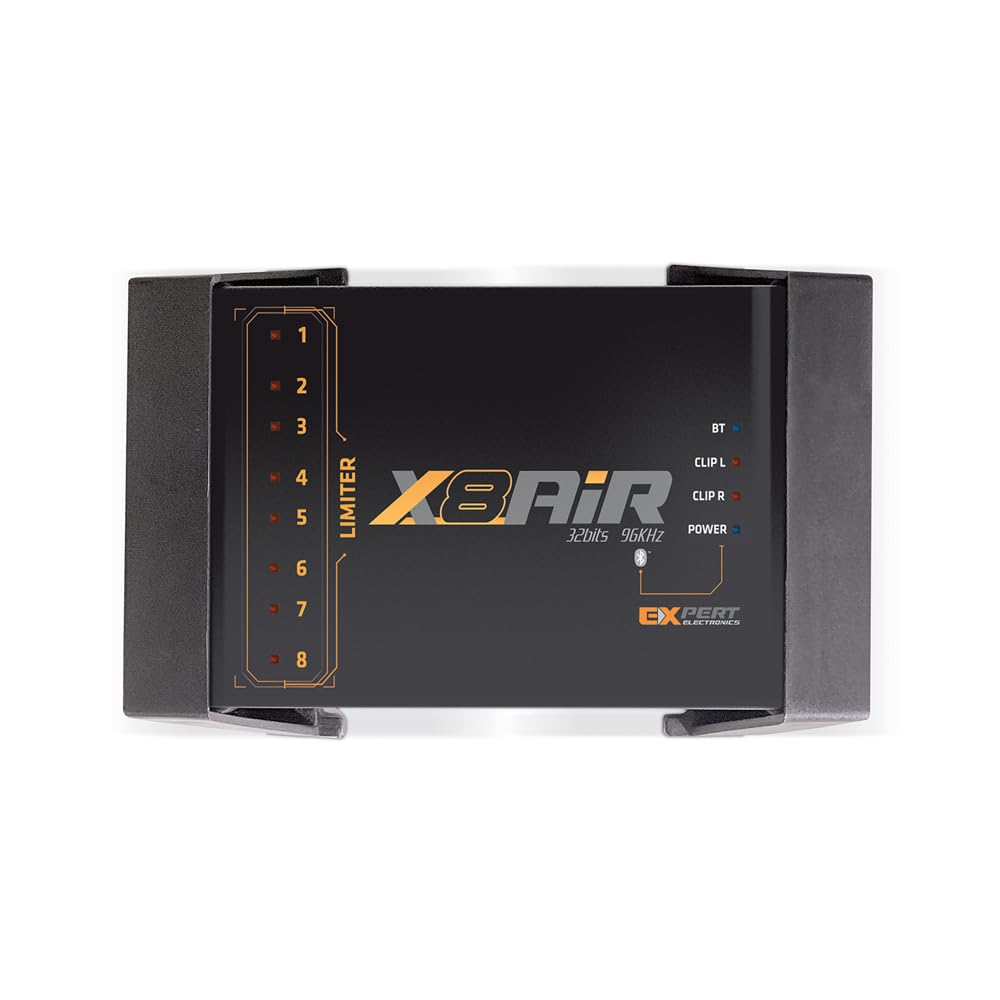
A DSP processor like the Banda X8AiR is the sneaky-smart upgrade. It takes your existing factory signal and reshapes it — 79 EQ bands per channel, time alignment, and crossover control — so your stock speakers suddenly sound placed and clean. A powered subwoofer like the KICKER Hideaway adds the low end without a separate amp or a huge box. A full package with amp and wiring is for the buyer who wants to start from scratch and get everything in one carton.
Read the power rating that actually applies
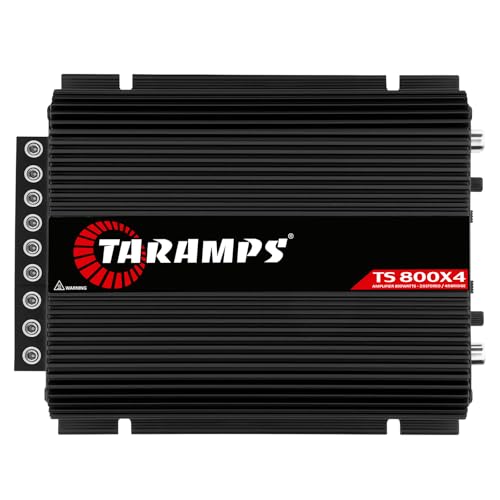
Peak watts are the number a manufacturer can print after squeezing the amp for a millisecond. RMS watts (root mean square — the continuous power it can hold) are the number that tells you how it plays at volume. The Taramps TS 800X4 is rated 800W RMS across four channels, so each speaker gets a real, sustained 200W at 2 Ohms. That is the figure you compare when sizing a subwoofer or picking speakers.
Check the fit and the wiring before the sound
Enclosure dimensions decide whether a sub box sits behind the seat or takes your whole trunk. A shallow 10-inch box is the difference between usable cargo space and a permanent blockade. Wiring kits matter just as much — gauge, fuse rating, and cable length are the parts that fail first in an amateur install. Buy a package with the kit included and you avoid hunting for an 8-gauge power wire three hours into the job.
Look at how the unit behaves after a year, not a day
Car audio lives in the worst conditions on Earth — heat, vibration, voltage swings, and dust. Judges like durability and reliability matter more here than in nearly any other electronics category, and the honest pattern in owner feedback is that a few units fail early while the rest run for years. Treat that as a reason to buy from a brand with a clear warranty and to leave headroom in your power settings rather than running everything at maximum.
Side-by-Side Comparison
| Model | Best For | Type | Power / Core Spec | Channels or Drivers | Amazon |
|---|---|---|---|---|---|
| Banda Audiopart X8AiR★ Best Overall | Tuning factory systems | DSP processor | 32-bit/96kHz DSP | 8 outputs | Amazon |
| Taramps TS 800X4Best Value | Powering four speakers | 4-channel amplifier | 800W RMS | 4 channels | Amazon |
| PLZ 10.1″ Single Din StereoMost Versatile | Upgrading an older dash | Head unit | 240W peak (60W x 4) | 2 subwoofer outputs | Amazon |
| Pioneer TS-A2500LB | Tight-space bass | Loaded sub enclosure | 1200W max / 300W nominal | Single 10″ driver | Amazon |
| MTX Terminator Dual 12″ | Full bass starter rig | Loaded enclosure + amp kit | 1200W peak system load | Dual 12″ drivers | Amazon |
| Rockville DK510 | Hard-hitting bass package | Enclosure + amp | 2400W peak / 600W RMS | Dual 10″ drivers | Amazon |
| KICKER 51HS10 Hideaway | Hidden under-seat bass | Powered subwoofer | 400W max | Single 10″ driver | Amazon |
| CT Sounds Dual 12″ Package | High-output complete build | Enclosure + amp + wiring | 1500W RMS amplifier | Dual 12″ drivers | Amazon |
| Pioneer AVH-W4500NEX | Wireless CarPlay receiver | Double DIN head unit | 14W RMS / 50W peak x 4 | 7″ touchscreen | Amazon |
Detailed Reviews
1. Banda Audiopart X8AiR DSP Car Audio Processor
Our pick — 4.5+★ from 250+ verified ratings; the strongest balance of quality and price.
The cheapest way to make a factory stereo sound expensive: reshape the signal, not the speakers.
If your car’s stereo is loud but flat, the problem is usually the signal, not the speakers. The X8AiR is a digital signal processor — a small box that sits between your head unit and your amplifiers and rewrites the sound before it reaches the speakers. Its core figure is a 32-bit/96kHz processor, meaning it handles the digital signal at high resolution so precise adjustments don’t add noise. It has 4 inputs and 8 outputs, so it can drive a multi-amplifier setup with component speakers and a subwoofer all tuned separately.
The dial that matters here is the equalizer: 79 bands per channel, plus time alignment (delays each speaker by a hair so the sound from every corner arrives at your ears together) and a phase control and peak limiter. You adjust all of it from a phone app over Bluetooth, so you can sit in the driver’s seat, play a track, and move a slider without crawling into the trunk. That is the difference between tuning by ear with live feedback and tuning by guesswork. It works with factory and aftermarket systems, and at 10.56 ounces it slips behind a dash panel without eating space.
What wins people over is raw performance — it’s the thing this processor’s reputation is built on, and owners consistently find the sound quality improves once the tuning is dialed in. It’s also a budget-friendly entry into real DSP tuning. The honest catches are real, though. Input options, Bluetooth behavior, and how much you can customize all draw split opinions, so don’t expect every factory harness to behave identically out of the gate. Reliability gets mixed marks too, which is the one thing to weigh if you’re running it hard.
Why the tuners like it
- 79 EQ bands per channel give you granular control over highs, mids, and bass
- Bluetooth app control means live tuning from the driver’s seat
- 8 outputs support a multi-amp build with separate subwoofer tuning
- 32-bit/96kHz processing keeps the signal clean through heavy EQ work
Where it can disappoint
- Input options and customizability split opinion among owners
- Reliability draws mixed feedback, so leave headroom in your settings
- Requires real tuning knowledge to hear what it can do
Pick this if: you already have decent speakers and amps but the sound is muddy — this rebuilds the signal without replacing hardware.
Look past it if: you want plug-and-play sound with zero tuning time; this rewards someone who’ll sit with the app and adjust.
2. Taramps TS 800X4 2 Ohms 800W RMS 4-Channel Amplifier
Four speakers, one small aluminum brick, and 200 real watts to each.
The number to care about here is 800W RMS delivered as 4 x 200W at 2 Ohms, or bridged into 2 x 400W at 4 Ohms. RMS means continuous power it can hold, not a millisecond spike, so each of your four speakers gets a genuine 200 watts. Class D (a highly efficient amplifier design that wastes less power as heat) keeps it small — the whole amp is 1.9 pounds of aluminum. Unlike a full-size premium amplifier, this one tucks into a corner of the trunk and barely shows.
The install story is the real seller for older cars. It has high-level speaker inputs with automatic turn-on, which means it can read the signal straight from a factory stereo and wake up when the radio does — no separate remote wire run to the dash. You get HPF, LPF, full-range, and gain adjustment (filters and level controls for shaping which frequencies each speaker plays) so you can keep bass out of your door speakers and send it to a sub instead. It’s built to run in cars, trucks, SUVs, motorcycles, boats, golf carts, ATVs, and UTVs, so it’s a genuinely universal amp for a project build.
Power is what this amplifier is known for, and it’s the clear reason it lands on this list at its tier. The trade-off is real, though: a small number of units simply stop working, and that’s the honest weak spot in an otherwise strong value. Run it within its rated 9 to 16 volts and give it clean airflow, and you’re playing the odds in your favor.
Against the CT Sounds setup: the CT Sounds package runs a 1500W RMS monoblock built for a dedicated subwoofer, while this Taramps splits its 800W RMS across four channels. If you’re powering door speakers, the Taramps wins on flexibility; if you’re feeding a big sub box, the dedicated monoblock leads.
What to budget for: you’ll still need an amp wiring kit, and the physical footprint is small enough that placement is easy — 6.89 x 5.43 x 1.89 inches gives you options behind a seat or under a trim panel.
Reach for this if: you’re amplifying four door speakers off a factory head unit and want automatic turn-on without extra wiring.
Hold off if: your build is a single high-power subwoofer — a dedicated monoblock is the better shape of amplifier for that job.
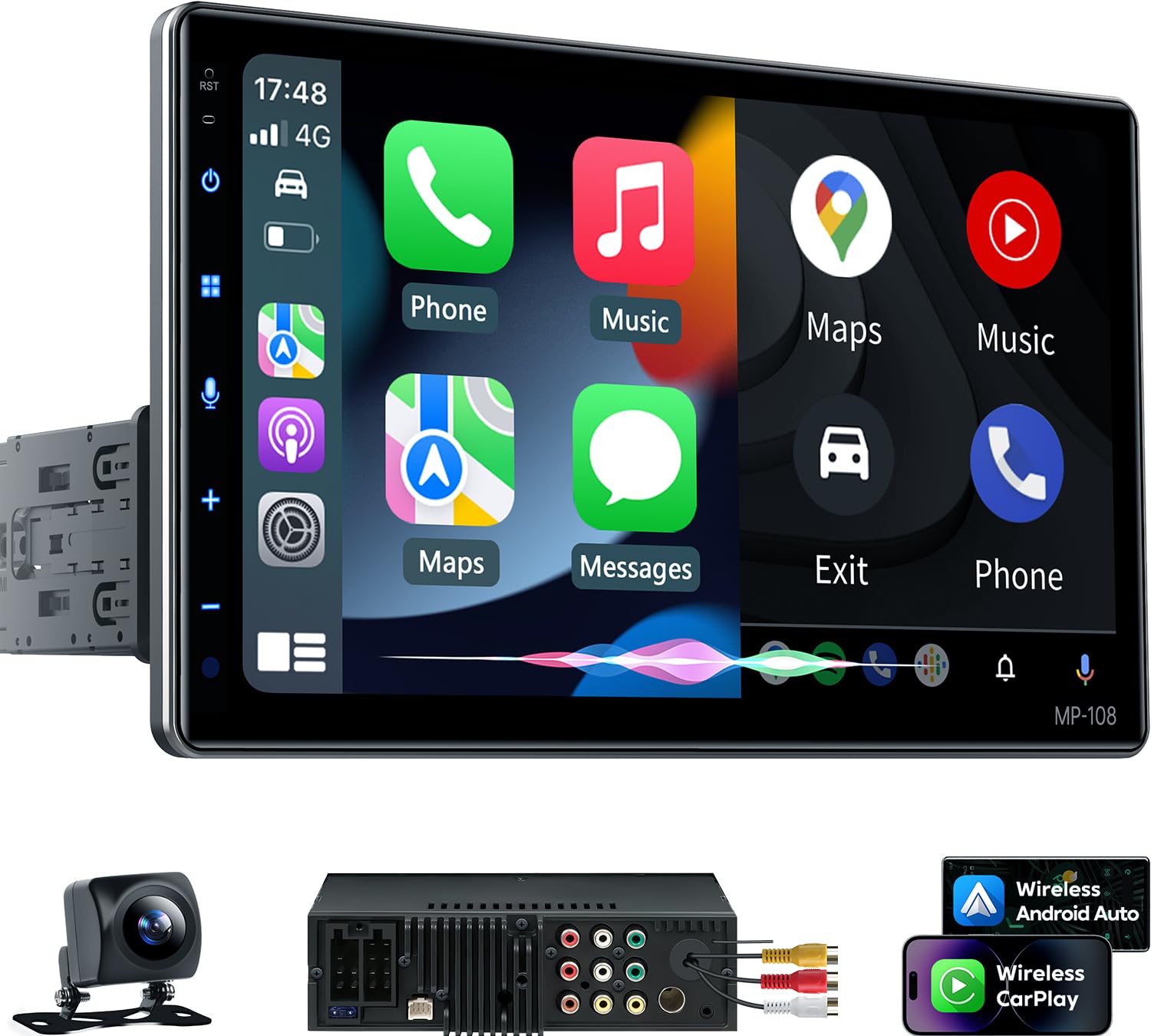
3. PLZ 10.1″ Wireless Single Din Car Radio
A ten-inch screen that drags an older dashboard into the CarPlay era.
This is the pick for the car that still has a basic single-DIN radio and a cracked plastic dash plate. The 10.1-inch IPS touchscreen displays at a wide viewing angle with multi-angle adjustment, and it fits most single or double-DIN openings. You get wired and wireless Apple CarPlay and Android Auto, meaning your phone’s navigation, calls, and music mirror onto the screen without a cable, plus voice control through Siri or Google Assistant.
On the audio side, the built-in DSP with a 10-band EQ lets you shape the sound, and it puts out 60W x 4 channels for 240W of peak power. Two subwoofer outputs feed a bass build. The independent Bluetooth 5.3 module with an extra antenna is a smart touch — Bluetooth 5.3 is a newer version of the short-range wireless standard, and the separate module plus antenna cuts electronic noise that plagues cheap head units in cars with lots of electrical gear.
The list of things owners like is long: functionality, value, sound, and the way it lifts an older interior all get strong marks. Installation is described as straightforward with clear instructions, though the listing is honest that some cars need an extra dash kit, wire harness adapter, or radio antenna adapter. The Bluetooth and connectivity side is where it can get fussy, so plan on a careful install and a willingness to sort out pairing settings on the first drive. Steering wheel control support keeps your hands on the wheel, and the included backup camera rounds out the package.
The head unit’s best arguments
- Wireless CarPlay and Android Auto without a cable each trip
- 10.1-inch IPS screen that modernizes an older dash
- Bluetooth 5.3 module with extra antenna for steadier calls
- Backup camera, remote, harness, and USB cables in the box
Where it needs planning
- Some cars need an extra dash kit or harness adapter to fit
- Connectivity draws split feedback among owners
- Professional installation recommended for a clean result
The right call for: a pre-CarPlay vehicle where you want navigation, music, and calls on a big screen.
Think twice if: your dash opening is unusual — measure it first, since a mismatch means buying a separate dash kit before anything works.
4. PIONEER A-Series TS-A2500LB Pre-Loaded Shallow Mount 10″ Sub

Deep bass that fits behind a pickup seat instead of eating the whole cab.
Shallow-mount subwoofers exist for one problem: trucks and hatchbacks where a normal box leaves no cargo room. The TS-A2500LB is a pre-loaded 10-inch sub in a sealed enclosure, rated at 1200W max and 300W nominal (nominal is the continuous power it’s built to handle daily). The cone uses a Glass-Fiber and Mica Reinforced IMPP construction — a stiff composite that resists flexing under heavy excursion, so the bass stays detailed rather than mushy. It’s the same DNA as Pioneer’s A-series full-range speakers, so if you already run those, the voice matches.
The 2Ω single voice coil wiring makes it easy to pair with a compatible amp, and efficiency is rated at 88 dB — that’s how loud it plays per watt, and a healthy figure means your amplifier doesn’t have to work as hard. You can position it facing up, down, or vertically, and the included feet and pads keep it planted. In real vehicles it fits behind seats and under rear truck benches, which is the whole point of the shallow case.
What owners rave about is output and presence — this sub can be heard around corners and adds real weight to the mix. Against the MTX dual-12-inch package, this is the compact alternative: one 10-inch driver in a slim box versus two 12-inch drivers that demand 13.5 inches of depth and 26.63 inches of width. If trunk space is tight, the Pioneer leads on fit; if you want maximum displacement, the MTX wins on sheer driver area. Durability draws a split opinion, so treat the power settings with some restraint and it should treat you well.
Built for this buyer: pickup owners and small-hatchback drivers who need bass without giving up the cargo area.
Not the pick if: you have a full-size trunk and want the biggest low-end shove — two 12-inch drivers with a dedicated amp will out-move this single 10.
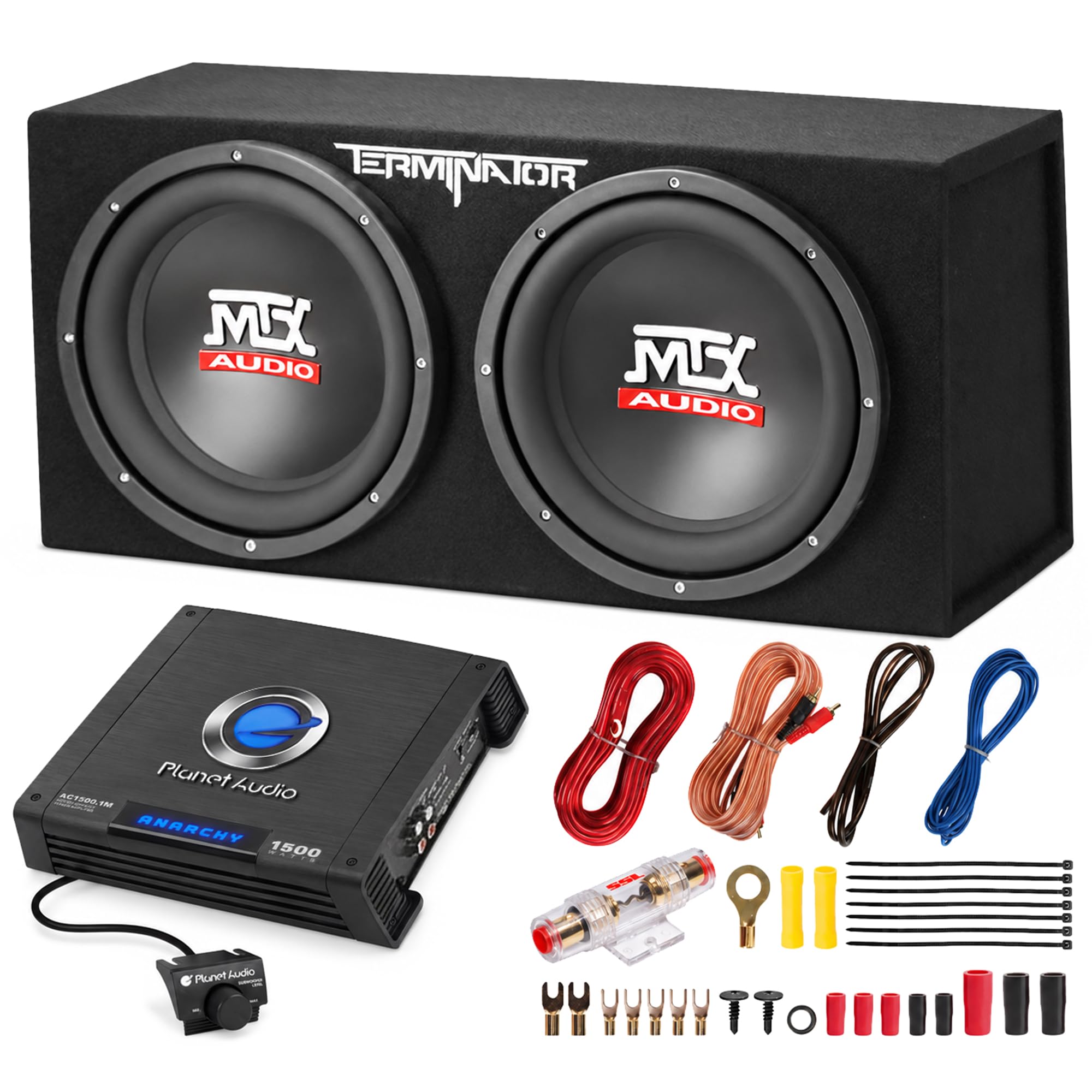
5. MTX Terminator Dual 12″ Subwoofers Enclosure
Everything a first bass build needs in one carton: box, amp, and wiring.
For a beginner, the hardest part of a subwoofer install isn’t the sub — it’s the shopping list of an amp, wiring kit, fuse, and enough knowledge to wire it safely. This MTX package bundles all three: a dual 12-inch loaded enclosure, a Planet Audio 1500W monoblock amplifier, and a Soundstorm 8 gauge complete amplifier wiring kit with RCA cables. The 1200W figure is peak system load, not continuous output, so read it as the ceiling, not the everyday power. The enclosure is built from 5/8-inch MDF wrapped in aircraft-grade black carpet and measures 13.5 inches deep by 26.63 inches wide by 14 inches tall — check your trunk before committing.
The amplifier side gives you high and low-level inputs, variable bass boost, and a low-pass filter, which is the basic set of controls you need to dial bass without flooding your midrange. It’s a mono amp (a single-channel amplifier built to drive subwoofers) with RCA connectivity, and it pairs with the included wiring kit so the whole chain matches.
Sound quality is the star here, and value follows close behind — the case and components deliver a lot for the tier. The honest trade-offs are the wiring kit and amp, both of which draw criticism, and a small number of systems develop amplifier failures or speaker blowouts down the line. This is the package to buy when you want a full weekend project with one box to open, not when you want to plug in and finish in an hour. Professional installation is recommended for the amp wiring and grounding.
What’s in the box: MTX TNE212D loaded enclosure, Planet Audio 1500W monoblock amp, and Soundstorm 8 gauge wiring kit with RCA — three purchases bundled into one.
The honest boundary: it needs a compatible head unit or line-output converter, and your vehicle’s electrical system has to support the added load. Plan on a fuse, a ground point, and some tuning time.
Go here if: you want a complete dual-12 bass setup without sourcing components separately.
Step away if: your trunk is small or your alternator is already strained — the box is large and the amp draws real current.
6. Rockville DK510 Dual 10″ K5 Subwoofer Enclosure

Two tens tuned to 38Hz, plus the amp and copper wiring to run them.
Tuning frequency is the spec that separates a boomy sub box from a clean one. This Rockville package is tuned to 38Hz — low enough for deep, resonant bass but high enough to stay tight — and the dual K5 10-inch subs deliver 2400W peak and 600W RMS. Unlike the bundled MTX kit with its 8 gauge wire, this one ships a 4-gauge wiring kit with 100% copper RCA, power, remote, and speaker cables, which is a heavier-duty gauge for a system pushing this much power.
The enclosure itself is serious hardware: 3/4-inch MDF that’s bonded, stapled, braced, and carpeted in aviation-grade tweed. Inside, the drivers use 2-inch 4-layer aluminum voice coils wound with OFC copper wire from Japan and a fiber-reinforced paper cone for clarity under load. The dB12 monoblock amplifier uses a MOSFET power supply with adjustable crossover and 2000W peak power.
Value is what this package is known for, with sound quality right behind it — it makes a car thump without spending the top tier. Installation is described as simple because everything needed ships together, and owners appreciate not hunting for parts. Durability is the honest caveat: a small slice of buyers report a speaker failing early, so give it clean power and don’t run it at full gain all day. That’s not a reason to skip it, just a reason to install it properly and respect the limits.
What makes the package work
- 600W RMS across dual 10s, tuned to 38Hz for tight low end
- 4-gauge copper wiring kit included for the heavier current draw
- Braced 3/4-inch MDF enclosure built to take the pressure
- MOSFET amplifier with adjustable crossover and 2000W peak
Worth knowing first
- A small number of speakers fail early under hard use
- Large footprint needs real trunk space
- Needs careful gain tuning to protect the drivers
Matches best with: a build that wants stronger RMS output than the entry-level dual-12 kits but isn’t ready for the highest tier.
Reconsider if: you plan to run it at full gain constantly — a bit of restraint keeps those voice coils alive.
7. KICKER 51HS10 Hideaway Compact Powered Subwoofer, 10-Inch

A powered sub that hides under the seat and asks nothing of your trunk.
The first thing to understand is that this is a self-powered subwoofer — the amp is built in, so you don’t buy a separate amplifier or wire one in. It’s a 10-inch driver in an all-aluminum frame rated at 400W max, with a frequency response down to 25 hertz (the lowest note it can reproduce; lower is deeper). It mounts under the seat, and the compact shape means it does its work where you’d never see it.
The control package is built for daily use. The included remote lets you change the bass level without touching the radio volume — so a podcast and a bass-heavy track can each sound right at the same volume knob position. You also get an adjustable low-pass crossover, a variable +6dB bass boost, a phase switch, and two auto turn-on options: DC-offset or signal sensing. The quick-connect Molex plug and harness bundles power, signal, and remote turn-on into one connector, and high- and low-level inputs let it integrate with nearly any factory or aftermarket head unit.
Quality and sound are what this sub is known for. It’s the pick for the owner whose stock system already sounds fine but has a hole where the bass should be — it fills that void without a trunk box or a wiring project. Reliability is the mixed side of the story, so buy it for the stealthy install and the remote control, not as a competition sub. Fit sits well in trucks, and setup comes with everything needed in the box.
The stealth angle: at 16.75 inches wide by 13 inches deep by 5.25 inches tall, it slides under a seat where a standard box never could.
The realistic expectation: 400W from a built-in amp is genuine bass reinforcement, not a window-rattling rebuild. Expect the low end to be present and controlled rather than earth-shaking.
Ideal for: drivers who want real bass without losing an inch of trunk or adding a visible box.
Skip the idea if: you want a sub that shakes the block — a separate amp and loaded enclosure get you there, this one stays subtle.
8. CT Sounds Dual 12″ 2600W Bass Package
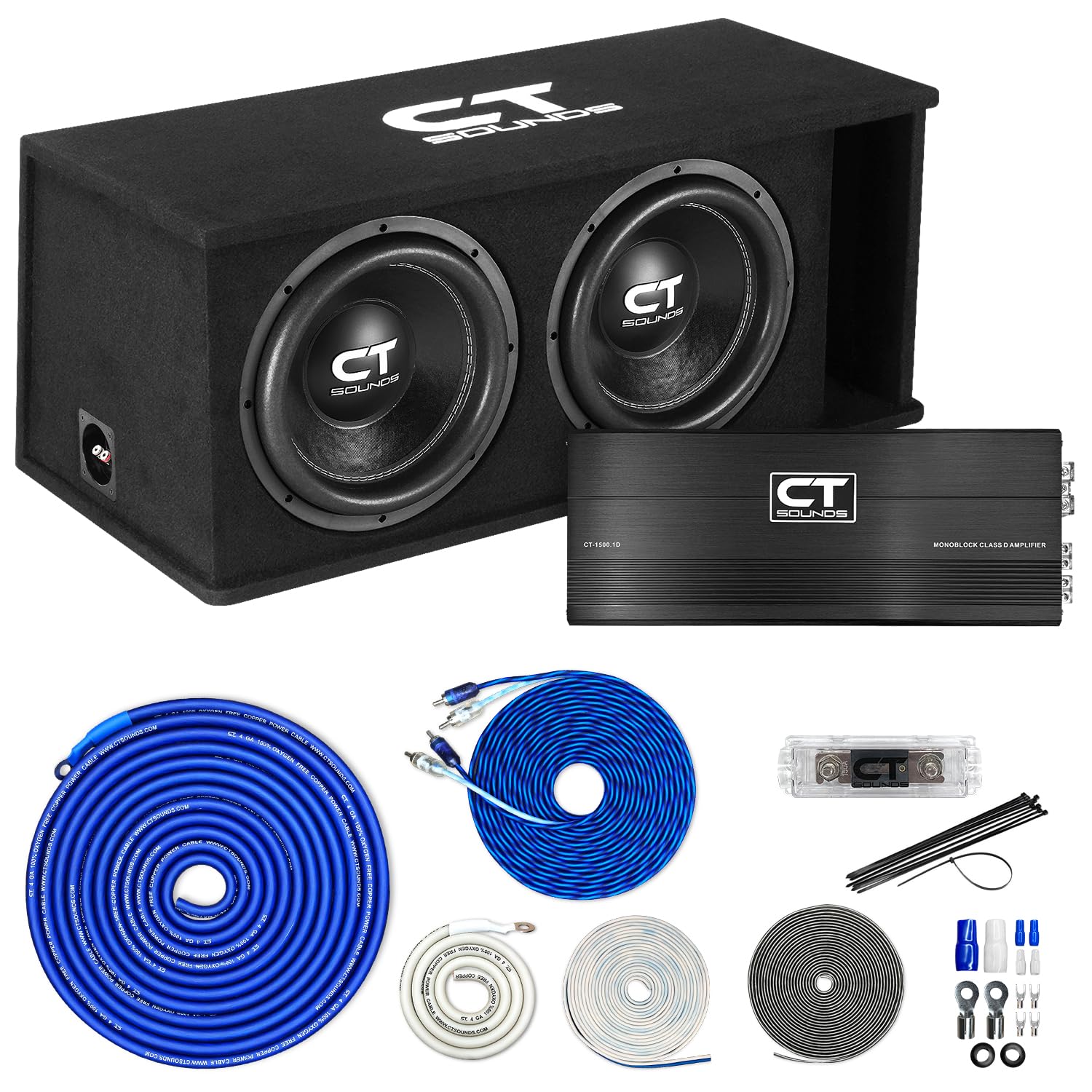
A pre-wired 1-Ohm dual-12 build that arrives ready to drop in.
Impedance is the number that decides how much power an amp can push, and this package is pre-wired to 1 Ohm — a low-resistance load that lets a compatible monoblock deliver its full rated power. The loaded enclosure is rated 1300W RMS and 2600W max, and the CT-1500.1D amplifier is rated 1500W RMS at 1 Ohm, so the two are matched from the start. That’s the appeal: one purchase, a matched pair, no impedance math on install day.
The enclosure details show real thought. It has a 1.25-inch front baffle, 10-inch mounting depth, 11.08-inch cutout diameter, 2.40 cubic feet of net volume, 33Hz tuning frequency, an 8-gauge terminal cup, and a kerf port design in an MDF box. The wiring kit includes 17-foot 4-gauge power and ground runs, 17 feet of 14-gauge speaker wire, 17 feet of RCA, 17 feet of 18-gauge remote wire, a fuse holder, and a 150A fuse. Size, for context: 35.5 inches wide by 16.85 inches deep by 14.8 inches tall — measure twice.
Owners mention the sound stays consistent even at high volume, which is the sign of an amp with headroom. Installation is straightforward because everything ships together. The honest note is that performance is a mixed bag: most units work well, but a small percentage break within a day of use. Buy from a seller with a clear return path, and keep your gain reasonable for the first week of use. Value holds up well against the MTX and Rockville packages — this sits at a higher output tier than both.
Why this package punches hard
- 1500W RMS amplifier matched to a pre-wired 1-Ohm enclosure
- 2.40 cubic feet of net volume and 33Hz tuning for deep, clean bass
- Complete 4-gauge OFC wiring kit with a 150A fuse
- Kerf port and 1.25-inch baffle built for pressure
The realities of a big build
- 35.5 inches wide needs a serious trunk
- Performance draws split feedback, a few units fail fast
- 1-Ohm load demands an electrical system that can keep up
For the serious upgrade: the buyer who wants a matched 1-Ohm, dual-12 build without sourcing parts one at a time.
Not for this buyer: a daily driver with a stock electrical system or a small trunk — this volume and current draw need room to breathe.
9. Pioneer AVH-W4500NEX 7″ Double Din Car Stereo
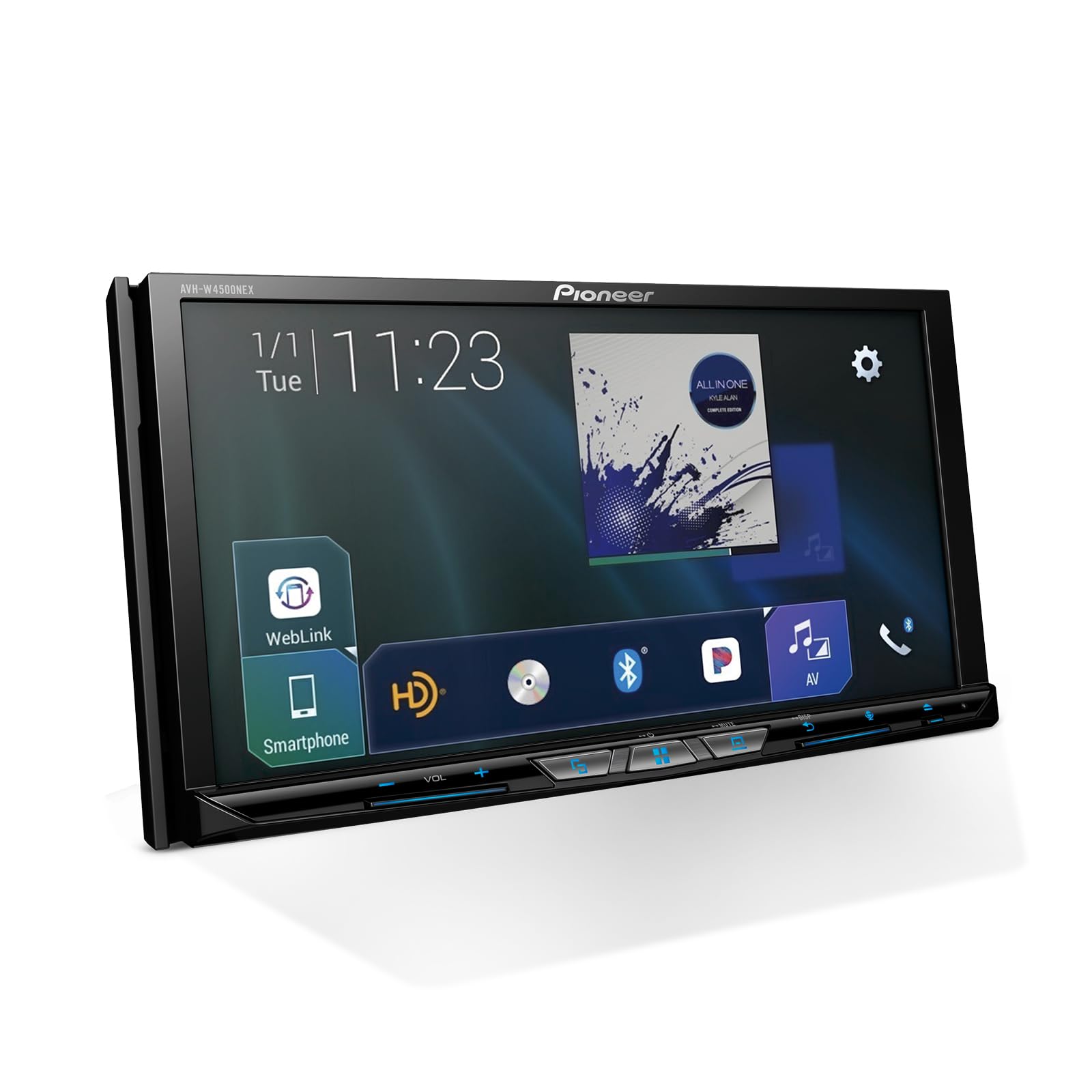
The premium receiver that still spins DVDs and runs wireless CarPlay.
This is the top of the receiver ladder here, and it earns the spot with a feature set you won’t find on budget head units. You get wired and wireless Apple CarPlay and Android Auto, built-in Bluetooth for hands-free calls and streaming on a 6.94-inch resistive touchscreen, and a motorized 7-inch display that retracts into the dash. It also plays DVDs and CDs — a rarity in the CarPlay era — and runs a built-in amplifier rated at 14 watts RMS and 50 watts peak across four channels, CTA-2006 compliant for measured, honest output.
The dual-zone AV feature is the standout for families: rear passengers can watch a separate source on optional rear-seat monitors and headphones while the front speakers play something else. Amazon Alexa support runs through Pioneer’s Vozsis and WebLink apps on a compatible phone. The standard 2-DIN design drops into a wide range of dashboards, and Pioneer recommends professional installation.
Sound quality and the wealth of input options are what this receiver is known for — the audio side is genuinely strong and matches the premium tier. The honest cost of all that: the screen is criticized for glare, performance can lag with slow start-up times, and wireless connectivity is inconsistent, with some owners reporting repeated crashes while others have zero trouble. Screen quality and general performance are the weak spots, so if a bright, snappy display matters more than disc playback or dual-zone, a newer receiver may suit you better.
Where it earns the premium badge: DVD/CD playback, dual-zone rear-seat entertainment, and wireless CarPlay on a motorized 7-inch display — a combination the budget receivers on this list can’t match.
Where it shows its age: resistive touch (the older, pressure-based screen type) instead of a glass capacitive panel, plus glare and lag concerns. Expect a capable receiver, not a modern tablet experience.
Worth it for: buyers who want premium audio, disc playback, and rear-seat entertainment in one double-DIN unit.
Look elsewhere if: you want a fast, glare-free touchscreen — that’s the honest weak point here.
Know the Specs
RMS vs Peak Watts
RMS (root mean square) is the continuous power a component can hold over time — the number that tells you how it plays at volume. Peak is the short-burst ceiling. A subwoofer rated at 300W nominal and 1200W max handles 300 watts cleanly all day but only brushes 1200 in short spikes. When matching an amp to a sub, compare RMS numbers, not peak. An amplifier rated higher than your sub’s RMS rating is fine if you set gain conservatively; an amplifier that’s too weak pushes distortion that’s harder on a driver than clean power.
Impedance and Ohm Ratings
Ohms measure electrical resistance, and the lower the number, the more power an amplifier can send into it. A 2-Ohm load pulls more current than a 4-Ohm load, and a 1-Ohm load pulls more still. That’s why a package pre-wired to 1 Ohm pairs with a dedicated monoblock built for it. Mismatching impedance — wiring a low-ohm box to an amp that’s not rated for it — is a fast way to overheat and damage the amplifier. Check both numbers before you connect anything.
Why DSP Tuning Changes Everything
A digital signal processor (DSP) takes the audio signal and reshapes it before amplification. With enough EQ bands — the X8AiR offers 79 per channel — plus time alignment and crossover control, you can correct the timing and frequency problems a car interior creates. A sub in the trunk always lags the doors, and time alignment delays every other speaker to match. That’s why a DSP often delivers the biggest single jump in perceived sound quality, even on stock speakers.
Enclosure Size and Tuning
A subwoofer enclosure is a tuned air space, and its size and port tuning decide how low and how tight it plays. A box tuned to 33Hz or 38Hz emphasizes deep bass without getting sloppy. Sealed boxes, like the Pioneer’s, give tighter response in a smaller space. Ported boxes with kerf ports, like the CT Sounds, move more air for more output. Shallow enclosures trade some depth for a footprint that fits behind a seat — the point is matching the box to the room your vehicle actually has.
Common Questions
Will a DSP processor work with my factory radio and speakers?
What is the difference between RMS and peak watts on a car amplifier?
Can I add a subwoofer to my factory stereo without replacing the head unit?
Will the MTX dual 12″ enclosure fit under the rear seat of my truck?
What gauge wiring kit do I need for a 1500W RMS amplifier?
Do I need a separate amplifier if I buy a powered subwoofer?
Will a 1-Ohm pre-wired subwoofer box damage my amplifier?
Is a 10-inch subwoofer better than a 12-inch for deep bass?
How much trunk space does a dual 12-inch subwoofer box take up?
Can I keep steering wheel controls with a new CarPlay head unit?
The Bottom Line
The smart play in car audio is rarely the biggest sub box. It’s the component that fixes your car’s actual weak link — and for most factory systems that link is the signal, not the speakers. The Banda Audiopart X8AiR takes the top spot because 79 EQ bands per channel, time alignment, and app-based control let you rebuild the sound you already own without buying new speakers or amplifiers. At its price, it’s the cheapest route to a genuinely different listening experience.
If your problem is power rather than tuning, the Taramps TS 800X4 delivers 800W RMS across four channels with automatic turn-on for factory radios, and its small aluminum frame disappears into the trunk. For the buyer who wants bass without a box in the cargo area, the KICKER 51HS10 Hideaway hides a self-powered 10-inch sub under the seat with a remote for bass level at any volume.
And if your dash is the weak point, the PLZ 10.1-inch single-DIN stereo brings wireless CarPlay, Android Auto, and a big IPS screen to an older vehicle. Match the component to the gap, wire it to the correct gauge and impedance, and keep your gain settings sane — that’s what separates a system that lasts from one that quits in a month.
How we choose
We do not accept paid placement. Every pick is matched to a real buyer and a real use-case; we do not hands-on test units.
Sources
Specifications: manufacturer listings and product documentation. Review insights: verified customer reviews, as of November 2026. Pricing: not shown on this page (it changes often); check the current price via the retailer link.
As an Amazon Associate, Tactical Gear Guy earns from qualifying purchases. This does not affect which products we feature.