Specs are compiled from manufacturer listings and verified buyer reviews and can change over time — please confirm the key details on the product page before buying.
If your heels keep slipping off the edge of a narrow walking pad, the fix is width — and that single measurement changes everything about how a desk walk feels. A wider belt means you stop aiming your feet and start walking normally while you type. Below are five pads whose walking surfaces give you genuine room, from a 16-inch belt up to a full 18 inches, with the real numbers on incline, speed, and weight limits so you can match one to your body and your room.
This guide is built by comparing the manufacturers’ published specifications and the patterns across verified customer reviews, so you get each pick’s real strengths and trade-offs instead of marketing spin.
A wide belt only helps if the machine stays steady under you, so belt width, motor size, and storage footprint all matter together. Here is how each of these pads handles that balance in a real home office. A wide belt keeps your stride natural while the pad stays compact enough to tuck into a corner.
Top Picks
How To Choose The Best Wide Walking Pad
Width is the reason you are here, so start there and work outward. A belt that is too narrow forces you into a shuffle with your arms out, which defeats the point of walking while you work. Everything else — motor, incline, storage — is judged against whether the deck itself fits you.
Belt width and deck length, read as one pair
The belt width is the side-to-side space your feet land in. The deck length is the front-to-back runway your stride travels along. A 16-inch-wide belt suits a careful, upright walk at desk pace, while an 18-inch belt leaves visible margin on either side of your shoes so you stop watching your feet. Length matters just as much: a 40-inch deck keeps you contained at slow speeds, and a 43-inch deck gives a longer stride room to land before the rear roller.
Why “full deck” changes the usable space
Many pads put the motor in a raised housing at the front, which eats into the surface your foot can safely reach. A full-deck design moves the drive system underneath the deck instead, so the belt you paid for is the belt you actually get to walk on. That is the difference between a listed belt length and a walkable one.
Motor horsepower and decibels in a shared room
Horsepower (HP) is the motor’s output rating — it tells you how much sustained push the machine has for heavier users and faster paces. Decibels (dB) measure sound, and lower is quieter; a pad rated under 45dB is roughly the level of a quiet conversation, while one rated under 25dB sits closer to a faint hum. If you take calls while you walk, the decibel figure is the spec worth checking first.
Incline: percent grade versus speed
Incline is the uphill angle of the deck, written as a percentage grade. Raising the grade makes a walk harder without asking you to speed up, which is why it appeals to anyone who wants effort but not a jog. Auto incline means the motor adjusts the deck for you; manual incline means you set it by hand before you start.
Storage footprint and how you move it
Ask whether the pad folds flat, stands upright on its own, or needs to lean on a wall. Freestanding upright storage lets you reclaim the floor between sessions without hunting for a wall, and built-in transport wheels decide whether repositioning it is a one-hand job or a two-person lift. Weigh the machine’s own weight against who will be moving it.
Side-by-Side Comparison
| Model | Best For | Belt Size | Max Incline | Weight Capacity | Amazon |
|---|---|---|---|---|---|
| HomeTro Walking Pad with Incline & Height Adjustable Handlebar★ Best Overall | All-height walkers who want arm support | 40″ x 16″ | 7% | 300 lbs | Amazon |
| MERACH W50 Walking Pad with 12% Auto InclineQuiet Runner | Quiet under-desk walking for heavier users | 16.5″ x 42.5″ | 12% | 400 lbs | Amazon |
| VITALWALK Apollo 11 Ultra Full-Deck Walking Pad | A roomy deck that stores upright on its own | 43″ x 18″ | 12% | 350 lbs | Amazon |
| Jogwell Walking Pad with 12% Auto Incline | Heavy users who want a wide deck | 43″ x 18″ | 12% | 450 lbs | Amazon |
Detailed Reviews
1. HomeTro Walking Pad Treadmill
Our pick — 4.5+★ from 250+ verified ratings; the strongest balance of quality and price.
The one pad here that puts adjustable arm support around a walking belt, not just a bare deck.
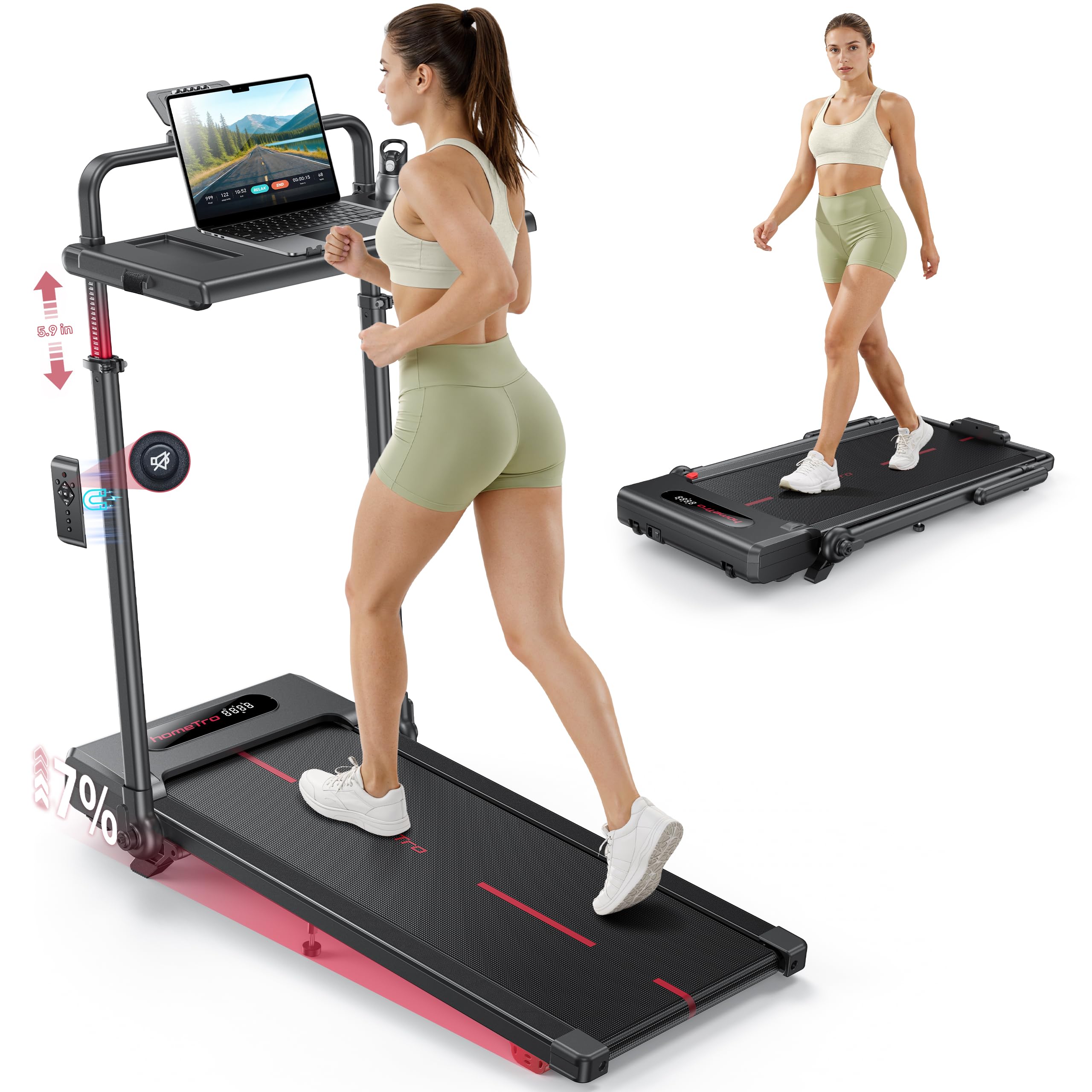
Most walking pads ask you to balance with nothing but your own core. This one hands you a handlebar that rotates 270 degrees and rises from 33 inches to 39 inches, so a tall user and a shorter user in the same house both get a bar at the right height. That adjustment is the reason it takes the top spot — it is the only pick in this group that supports you while you walk rather than leaving you to hold your own line.
The deck itself measures 40 inches long by 16 inches wide, with a multi-layer non-slip belt and silicone shock absorption built in to soften each step. Speed runs from 0.6 to 7.5 MPH. Compare that to the MERACH at 4.0 MPH and the gap is plain: this pad can carry you from a slow under-desk walk all the way into a genuine run, where the others top out around a brisk walk. Folded, it shrinks to 51 x 29 x 5.51 inches, the slimmest folded shape in this lineup.
Incline is manual with three levels — 0%, 3%, and 7% — and the maker states the 7% grade simulates an uphill climb and can push burn toward 500 kcal/hr. Note the honest trade-off: this tops out at 7% incline, well under the 15% the Rayspace offers, so if hill work is your goal another pick fits better. The 3.0HP motor runs rated under 45dB, quiet enough for a call, and the 300 lbs capacity is the lowest here. Buyers consistently single out the build quality first and the compact footprint second. The crowd favorite sits at 4.5+ stars across 250+ ratings — the strongest score in this group.
What earns it first place
- Armrests adjust from 33″ to 39″ and rotate 270 degrees for balance at any height
- 0.6–7.5 MPH range reaches jogging and running, versus 4.0 MPH on the MERACH
- Folds to 51 x 29 x 5.51 inches — the slimmest folded package here
- 3.0HP motor rated under 45dB for calls and late sessions
Where it asks you to compromise
- Manual 3-level incline tops out at 7%, well below the Rayspace’s 15%
- 300 lbs capacity is the lowest of the five
- 16″ belt is the narrowest deck in this wide-belt group
Worth it for: Anyone who wants a handlebar at their own height and a machine that can go from desk walk to run.
Think twice if: You need a deck wider than 16 inches or more than 7% incline for hill work.
2. MERACH W50 Walking Pad with 12% Auto Incline
A brushless motor rated under 25dB, which is quieter than a whisper on the spec sheet.
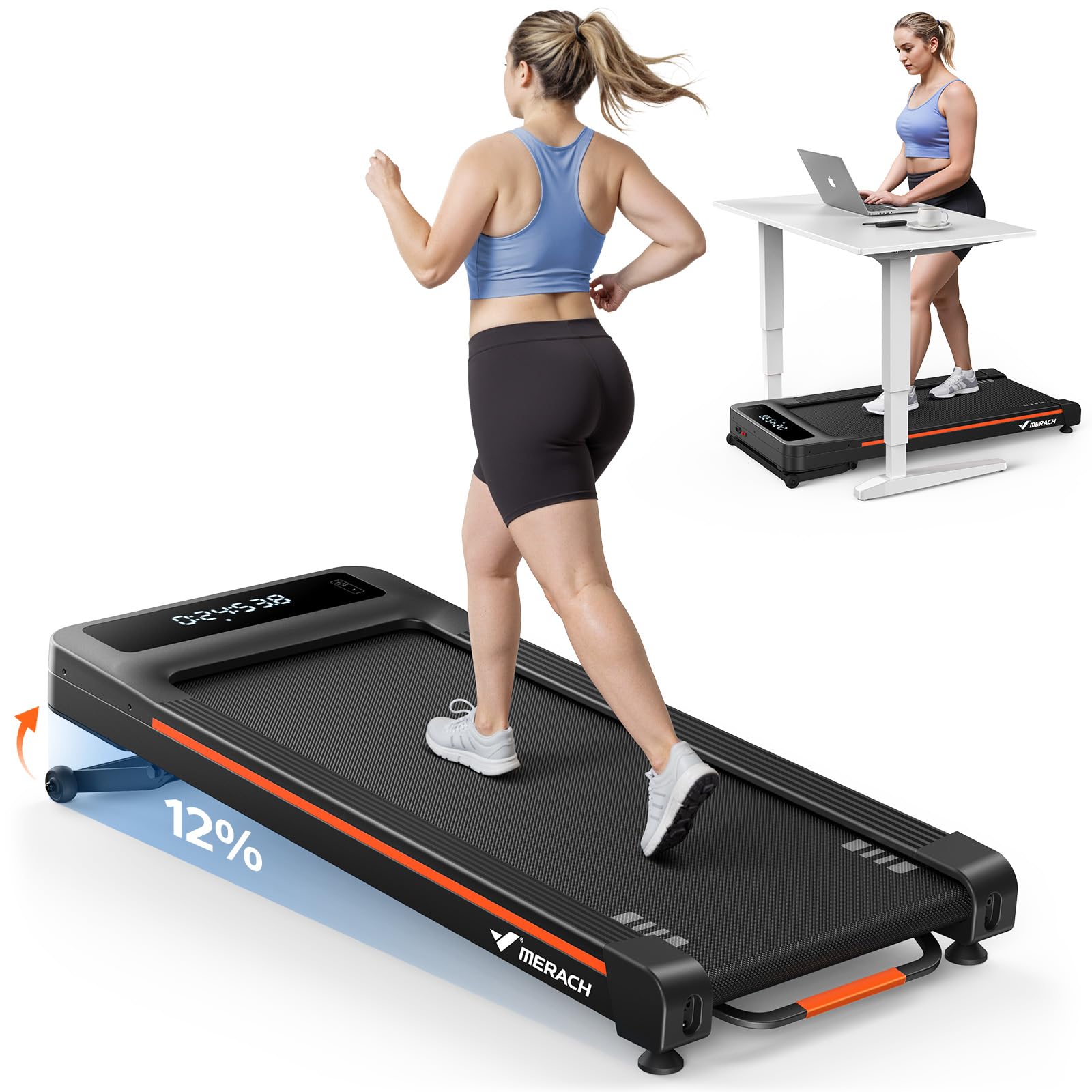
For a shared apartment or a bedroom workout at dawn, noise decides whether you actually use the thing. This pad is rated under 25dB, the lowest decibel figure in this group and well below the under-45dB HomeTro. A 3.5HP brushless motor drives a 16.5 x 42.5-inch non-slip belt, and the frame is rated to 400 lbs. The belt here is the widest of the three narrower pads — 16.5 inches versus the HomeTro’s 16 inches.
Incline runs to 12% automatically, and the maker states the 12% grade burns 2x more calories than flat walking. A multi-layer shock system is said to cut impact by up to 35% versus outdoor running, which matters if your knees drove you indoors. The LED screen tracks speed, time, distance, and calories, and you can change settings from the remote or the app without breaking stride.
What wins people over is the build: quality is the most-praised trait by a wide margin, with reliability and sturdiness close behind. Owners roll it around easily thanks to the wheels, and the 400 lbs rating holds up in real use. The honest wrinkle is sound — noise splits opinion, with some finding it surprisingly quiet and others hearing odd noises. Weigh that against the strong reliability pattern and it reads as a unit-by-unit quirk rather than a design flaw. At 4.0+ stars from a few hundred buyers, it has the deepest track record here after the HomeTro.
The case for the MERACH
- Rated under 25dB — the quietest motor spec in this lineup
- 16.5″ x 42.5″ belt edges out the HomeTro’s 16″ width
- 400 lbs capacity with 3.5HP brushless power
- 12% auto incline and impact-reducing shock layers
Honest friction points
- Noise is the one divisive trait — some units run louder than the rating suggests
- 4.0 MPH ceiling keeps it to walking and light jogging
- No handlebar, so balance is entirely on you
Best for: Quiet under-desk sessions where a whisper-level motor matters most.
skip it if: You want hill work past 12% or a deck wider than 16.5 inches.
3. VITALWALK Apollo 11 Ultra Full-Deck Walking Pad
A full 43 x 18-inch deck with the motor tucked underneath, not bulging out front.
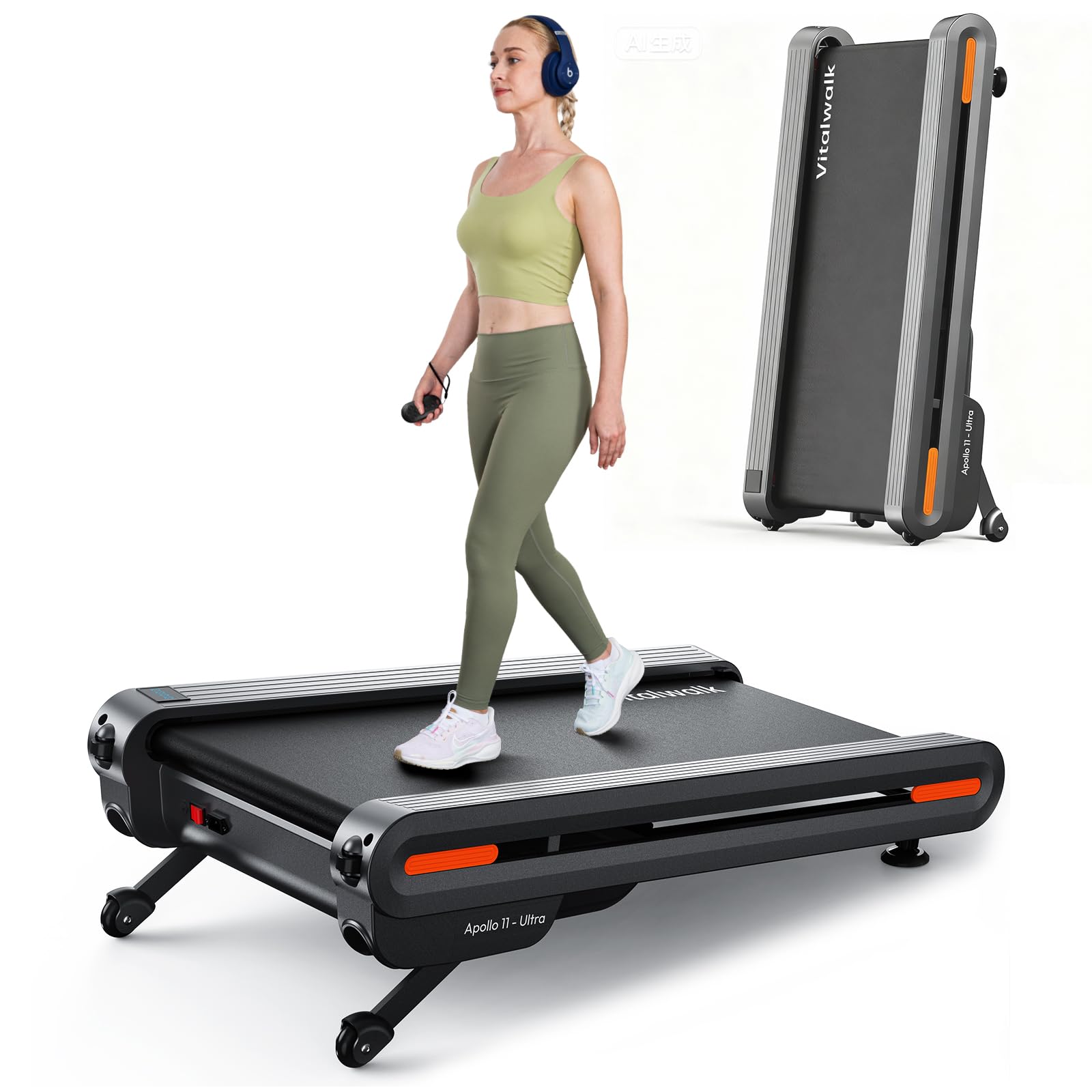
Here is the width you came for. The belt measures 43 inches long by 18 inches wide, and because the drive system sits beneath the deck rather than in a front housing, the whole surface is walkable. Extra-wide 3.35-inch side rails give you a stationary platform to step onto when you mount or pause. Compare that 18-inch width to the MERACH’s 16.5 inches and the extra margin on each side of your shoes is easy to feel at slow speeds.
Underneath sits a reinforced dual-layer steel frame carrying an 86 lb machine, rated for a 350 lb user. A 3.0HP motor drives speeds from 0.6 to 5 MPH, and the 7-layer walking belt pairs with 8 rubber cushioning supports plus 4 additional rubber pads to soften each step. Six incline levels reach up to 12% motorized incline, so you can add grade without adding speed.
Storage is where this pad separates itself. It stands upright on its own without leaning on a wall, taking just 1.9 sq. ft. of floor, and it tilts onto larger wheels to roll front-to-back or onto smaller bottom wheels to slide sideways. It arrives fully assembled. Performance and sturdiness are what owners bring up most, and it is described as non-wobbly and structurally sound. Sound is the split note here — some find it quiet, others less so — and 350 lbs is the second-lowest capacity in this group. Frame coverage runs 5 years, motor coverage 2 years, with lifetime technical support.
The deck is the story: 43 x 18 inches plus 3.35-inch side rails gives you a fully walkable surface, and the motor housing no longer steals front space.
Weight to respect: At 86 lbs it is a substantial machine, so plan the upright-storage spot before it arrives and move it on its wheels.
Choose it when: A genuinely wide, obstruction-free deck and self-standing storage are your top two priorities.
Consider the Jogwell instead if: You need more than 350 lbs of rated capacity on the same 18-inch deck.
4. Jogwell Walking Pad
An 18-inch deck rated to 450 lbs — the widest belt paired with the highest capacity here.
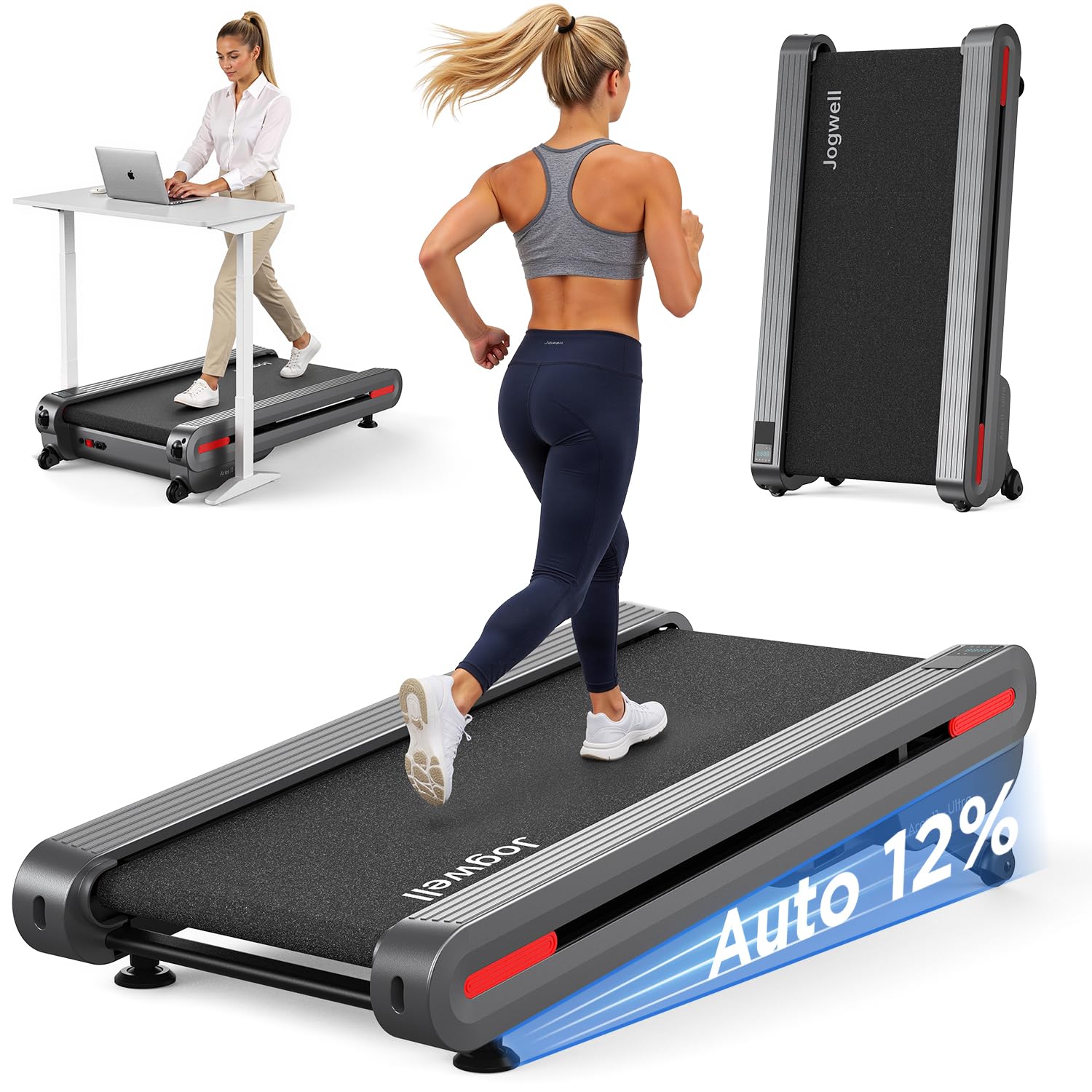
Bigger bodies need more than width; they need a frame that will not flex. This pad combines an 18 x 43-inch walking surface with a reinforced dual-layer alloy frame rated to 450 lbs, so the wide belt and the heavy-duty rating arrive together. That 450 lbs ties the Rayspace for the top rating in this group and stands 100 lbs above the VITALWALK’s 350 lbs on the same 18-inch deck width.
Power comes from a 3.5HP brushless motor good for a 5 MPH top speed. Incline reaches 12% across 6 adjustable levels, letting you raise the grade instead of the pace. A 7-layer belt with an 8-point cushioning system handles the step feel, and the full-deck design puts the drive beneath the deck to keep the front clear. Four transport wheels plus freestanding upright storage at 1.9 sq. ft. mean it moves between rooms without a fight.
At 90 lbs it is the heaviest machine on this list, which is the price of that 450 lbs rating — plan where it lives before it lands. The FitShow app handles workout tracking and progress data. Warranty runs 1 year on the product, 2 years on the motor, and 5 years on the frame, with lifetime technical support. Owners describe the build exceeding expectations, with the incline and sturdiness close behind, and the spacious running belt earns specific praise.
Pick this one if: You want an 18-inch-wide deck that will genuinely carry a heavier walker at 450 lbs.
Weigh the heft: 90 lbs is the heaviest here, so budget for wheels-and-a-plan rather than lifting it.
Know the Specs
Belt Width and Deck Length
Width is the side-to-side space your feet land in; length is the front-to-back runway your stride travels. An 18-inch belt leaves margin beside your shoes so you walk naturally, while a 16-inch belt asks for more care. The deck length works with it — a 43-inch deck gives a longer stride room to land before the rear roller than a 40-inch one. Match both to your shoe size and walking pace, not just the width number.
Motor Horsepower (HP)
Horsepower is the motor’s output rating. A 3.0HP motor handles steady walking and moderate use, while a 3.5HP unit has more sustained push for heavier users and faster paces. Higher HP tends to mean the machine holds speed without straining under load, which keeps the belt steady when you step down harder. The payoff is a belt that holds speed when you step down harder, not just a higher top speed.
Decibels (dB) and Shared Space
Decibels measure sound on a scale where lower is quieter. A pad rated under 45dB sits near the level of a quiet conversation, while one rated under 25dB is closer to a faint hum. If you take calls while you walk or share walls with a neighbor, the decibel figure matters more than most specs. Remember that real-world sound depends on the floor and mat beneath the machine, too.
Incline Percent Grade
Incline is the uphill angle of the deck, written as a percentage grade. A 7% grade is a gentle slope; a 12% or 15% grade climbs steadily. Auto incline means the motor adjusts the deck at a button press, while manual incline means you set it by hand before walking. More percent means more effort at the same pace, which is why incline lovers chase the steeper figures.
Common Questions
How wide should a walking pad belt be for a comfortable stride?
Is an 18-inch belt wide enough to jog on?
Does auto incline burn more calories than walking faster?
Can I use a wide walking pad under a standing desk?
How much weight can these wide walking pads hold?
How loud is a walking pad in an apartment?
Do wide walking pads fit in a small room when stored?
What is a full-deck walking pad and why does it matter?
Do I need a handlebar on a wide walking pad?
How fast can a wide walking pad go?
The Bottom Line
For most people, the wide walking pad winner is the HomeTro Walking Pad with Incline & Height Adjustable Handlebar because it pairs adjustable 33-to-39-inch armrests with a 0.6-to-7.5 MPH range that spans desk walking to running. If a genuine 18-inch deck is what you came for, the Jogwell brings that width with a 450 lbs rating, while the VITALWALK Apollo 11 Ultra offers the same full-deck width and stands upright in just 1.9 sq. ft. And if the steepest automated climb is your goal, the Rayspace tops out at a 15% grade. Whichever you choose, start with belt width and weight rating — those two numbers decide whether the pad fits you, and the rest is preference.
How we choose
We do not accept paid placement. Every pick is matched to a real buyer and a real use-case; we do not hands-on test units.
Sources
Specifications: manufacturer listings and product documentation. Review insights: verified customer reviews, as of November 2026. Pricing: not shown on this page (it changes often); check the current price via the retailer link.
As an Amazon Associate, Tactical Gear Guy earns from qualifying purchases. This does not affect which products we feature.