Specs are compiled from manufacturer listings and verified buyer reviews and can change over time — please confirm the key details on the product page before buying.
Buying a solar panel is mostly a math problem disguised as a shopping decision. You need enough watts to refill your battery bank in the hours of real sun you actually get, and you need cells that keep producing when a tree branch or a passing cloud cuts across them. The seven panels below cover that whole spread — from a foldable suitcase that hooks straight to a battery to a 350-watt briefcase built for big power stations. The standout is the Callsun 200W bifacial panel, the crowd favorite at 4.5+ stars across 500+ ratings, which owners say regularly pushes past its own label in full sun.
This guide is built by comparing the manufacturers’ published specifications and the patterns across verified customer reviews, so you get each pick’s real strengths and trade-offs instead of marketing spin.
Wattage, cell type, and voltage matching decide most of this purchase, and one wrong number can leave your panel unable to charge the battery you own. Here is how the top ten solar panels compare on the specs that actually govern whether your setup charges.
Top Picks


How To Choose The Best Top Ten Solar Panels
Start with the battery, not the panel. Whatever you are charging — a 12V battery bank, a portable power station, a van’s house battery — that device sets a voltage window and a connector type, and the panel has to land inside both. A 350-watt panel with a 50.2V open-circuit voltage is useless on a small 12-20V power station, while a rigid 100-watt panel that matches your controller will charge all day without complaint.
Match the voltage before you fall for the wattage
Open-circuit voltage (the panel’s maximum voltage with nothing attached) is the number that decides compatibility. A panel rated at 18 volts and a panel rated at 23.74 volts both feed 12V systems, but the higher-voltage panel needs a charge controller that can step that voltage down safely. Portable power stations have their own input ceiling, so check yours before you commit to a big panel.
Understand what cell type and busbar count buy you
N-type cells and P-type cells are two different silicon recipes. N-type panels, like the Callsun, ECO-WORTHY, Renogy, and ZOUPW picks here, tend to hold their output better in heat and resist light-induced degradation over time. The busbar number (the thin metal strips that carry current across each cell) tells you how many paths the current has — 16BB means more paths and fewer hot spots than a 10BB or 9BB layout.
Decide how much shade tolerance you actually need
A rooftop panel with a clean sky view does not need anti-shade engineering. A van roof parked under trees does. Panels that split into independent halves, like the Callsun’s dual-module design, let the unshaded side keep generating when the other is blocked. The Renogy ShadowFlux takes a different route to the same goal. If your mounting spot is truly open, you can spend your budget on raw watts instead.
Portable or rigid — pick your mounting reality first
Foldable panels weigh less and travel, but they trade away the fixed roof mount’s permanence. Rigid glass-and-aluminum panels take up roof space and stay put. Look at folded size and weight if the panel lives in a truck bed or a backpack, and look at framed dimensions if it bolts to a roof rack.
Side-by-Side Comparison
| Model | Best For | Max Power | Efficiency | Weight | Amazon |
|---|---|---|---|---|---|
| Callsun N-Type 16BB 200W Bifacial★ Best Overall | Best overall for van and RV rooftops | 200 watts | 25.6% | 23.8 pounds | Amazon |
| Renogy 100W Portable Solar PanelMost Portable | Foldable power-station charging | 100 watts | 25% | 7.3 pounds | Amazon |
| Renogy ShadowFlux 200W | Shaded rooftop installs | 200 watts | 25% | 23.8 pounds | Amazon |
| ZOUPW 350W Portable | Big power stations off-grid | 350 watts | 25% | 22.2 pounds | Amazon |
| ECO-WORTHY 400W 4-Pack | Building a 12V/24V bank | 100 watts each | 25% | 23.8 pounds | Amazon |
| DOKIO 100W Suitcase | Battery charging on the road | 100 watts | High Efficiency | 10.1 pounds | Amazon |
| JJN 100W 10BB Monocrystalline | Budget rooftop and shed power | 100 watts | 23% | 13.7 pounds | Amazon |
Detailed Reviews
1. Callsun N-Type 16BB 200W Bifacial Solar Panel
Our pick — 4.5+★ from 500+ verified ratings; the strongest balance of quality and price.
A 200-watt bifacial panel that owners say clears its own wattage rating in full sun.
The number to start with is 25.6% — the conversion efficiency at which this panel turns sunlight into usable current, and a figure that sits above most of what else is on this list. It does that with N-type cells and a 16BB busbar layout (16 thin metal paths per cell instead of fewer, which spreads current and cuts the risk of hot spots, the local scorch marks that quietly eat output). For a van roof where every square inch counts, that efficiency is the whole argument.
What wins owners over, though, is the bifacial build. A transparent backsheet lets the panel harvest reflected light off a white roof or light-colored ground as well as direct sun, and Callsun rates the rear-side gain at up to 30%. In practice buyers report output that clears the 200-watt label outright — owners mention these panels exceeding their 200-watt rating, with some builds reaching 421 watts in full sun. Whether you see that ceiling depends on what your mount reflects, but the headroom is real enough that it shapes how people size their charge controllers.
The anti-shade design is the third piece. This panel splits into two independent halves wired in parallel, so when one side is blocked by a branch or a rooftop vent, the other half keeps pushing power instead of the whole panel flatlining. Callsun puts the shade tolerance gain at up to 50% over a conventional single-string panel. Weighing 23.8 pounds and measuring 51.3 by 30.3 by 1.4 inches, it is built for a fixed roof mount rather than a carry bag — and it is heavier and larger than the DOKIO suitcase, which comes in at 10.1 pounds for its 100 watts. Pre-drilled holes on the back make rail mounting straightforward.
Where this panel earns its place
- 25.6% efficiency from N-type cells with 16BB busbar construction
- Transparent backsheet captures reflected light for up to 30% claimed rear-side gain
- Dual-module parallel wiring keeps half the panel producing when the other half is shaded
- IP68-rated junction box with an aluminum frame and 3.2mm tempered glass
What to weigh before you mount it
- At 23.8 pounds and 51.3 inches long, it needs a permanent roof mount, not a carry bag
- The bifacial bonus depends on a reflective surface underneath the panel
- The 25.6% efficiency is the highest here, but the 200-watt ceiling sits below the ZOUPW’s 350 watts
Built for: van, RV, and marine owners with a fixed roof spot and room for a 200-watt panel that squeezes the most out of every hour of sun.
The honest catch: a -0.3%/K temperature coefficient keeps output steady in heat, but you still need a reflective mounting surface to open up the bifacial gain.
2. Renogy 100W Portable Solar Panel for Power Stations
Seven pounds of foldable panel that slings into a pack and still hits 25% efficiency.
If the panel lives in a backpack rather than bolted to a roof, the 7.3-pound weight is the first spec that matters — and foldable to roughly 23 by 22 inches, this one slips behind a truck seat or into a hiking pack without a struggle. Renogy fits N-type cells and a 16BB layout into that foldable frame for 25% conversion efficiency, which the maker pitches against the 22.5% of standard 9BB panels. That is the same efficiency class as the Callsun above, in a form factor you can carry.
The port lineup is what makes it a power-station companion rather than a battery-only panel. You get one USB-C PD port at 45W max and two USB-A ports at 18W and 15W, so a phone, tablet, or camera can plug straight in while the main output feeds your station. The MC4 output cables are what connect to the big devices, and Renogy lists compatibility with the Jackery Explorer 300, EcoFlow RIVER 3 Max, Anker SOLIX C300 and C300 DC, BLUETTI Elite 30 V2, GRECELL T-500, and ALLWEI SGR-PPS300-2. It also charges 12V batteries, but only with a compatible solar charge controller, which is not included.
Out in the weather, an IP67 waterproof rating and an ETFE coating (a protective film over the cells) let it shrug off hail and rain, and Renogy rates it to work from -40°F to 185°F. The kickstands fold out to angle the panel at the sun, and parallel wiring means a shadow on one section does not drag the whole panel down. Customers note charging a flooded 12V battery in about four hours and using it successfully on sailboats. One thing to plan for: the 4-in-1 adapter cable for multi-device hookups is sold separately.
What shines: 25% N-type efficiency in a 7.3-pound foldable frame, USB-C PD and dual USB-A outputs, and IP67 weather sealing — a genuine grab-and-go charger that also feeds a power station.
Plan around: the MC4-only output means you need the separate 4-in-1 adapter for some power stations, and a charge controller is not included for 12V battery charging.
Reach for this if: you want a light panel that rides in a pack and charges a mid-size power station or a 12V battery through a controller you already own.
Look elsewhere if: you need to bolt something to a roof — this is built to fold and move, not to stay put.
3. Renogy ShadowFlux 200W N-Type Solar Panel
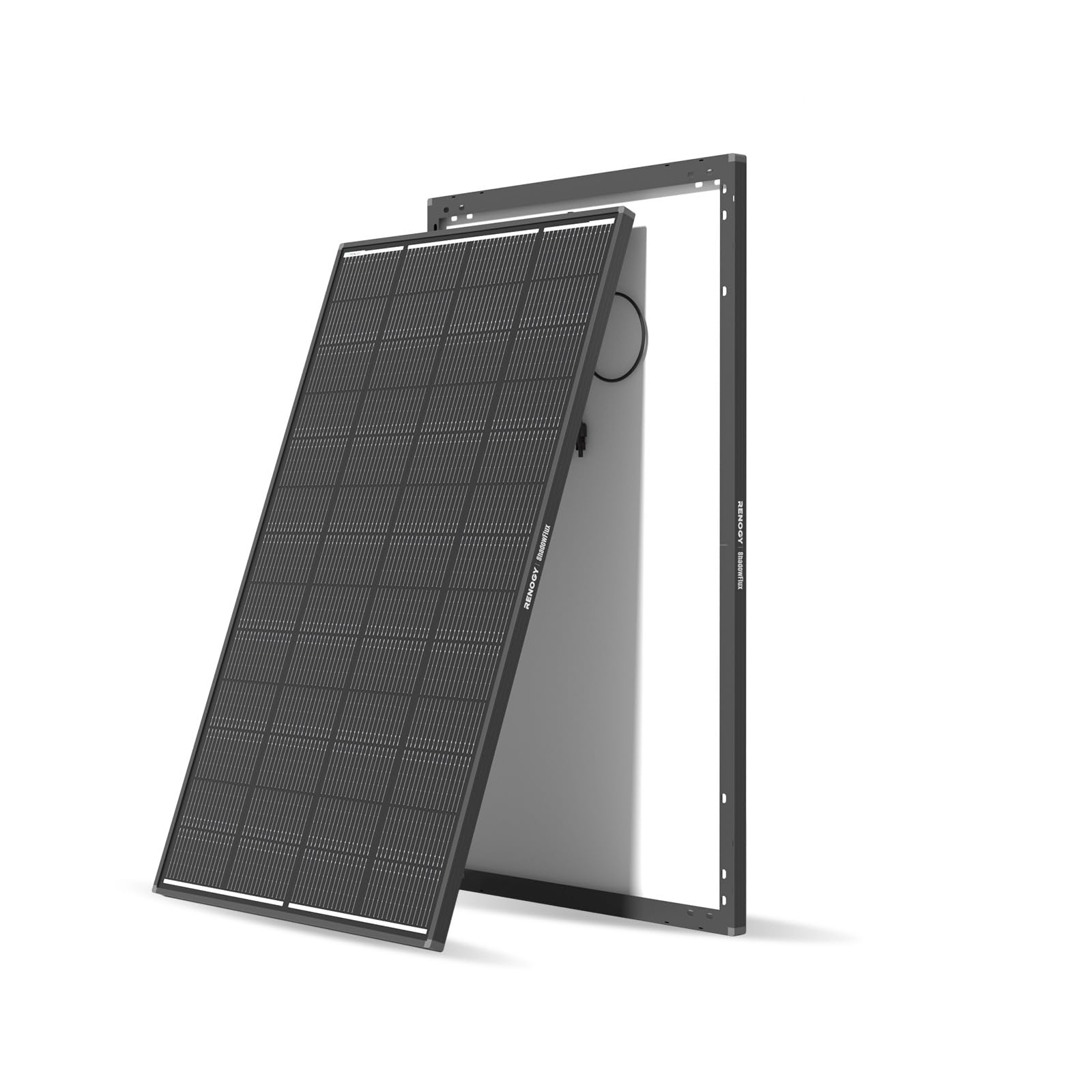
A 200-watt panel built for the worst-case roof — the one with a tree hanging over it.
Most 200-watt panels assume a clean sky view. The ShadowFlux does not. Its ShadowFlux anti-shading tech is engineered specifically for partial shade from buildings, plants, leaves, snow, and stains, cutting the hot-spot risk that normally turns one blocked row into a whole-panel outage. Set this against the Callsun’s dual-module approach: both chase the same goal of keeping output up when something crosses the sun, just by different engineering routes.
The cell spec is a match for the top of this list — N-type cells with 16BB technology at 25% efficiency, in a panel rated at 36.5 volts and 200 watts. That voltage is worth a note: 36.5 is higher than the Callsun’s 23.74 volts, so confirm your controller or power station input window before you buy. Renogy also claims this panel is 7% smaller and 10% more compact than PERC panels, and the 49.69 by 30.08 by 1.18-inch frame at 23.8 pounds fits tight rooftop real estate.
Reviewers point out it holding output in partial shade at roughly 350 to 365 watts, with at least one paired build hitting 730 watts on a clear sunny day — indicative of what these panels do when paired and tilted toward strong sun. The IP67-rated encapsulation adds water-vapor resistance for snow and small hail, and the warranty covers 5 years on output and workmanship with a 25-year output commitment at 80%.
Where it beats the crowd: genuine shade engineering in a 200-watt, 25%-efficiency N-type panel, with owners crediting it for solid output even under a partially covered RV port.
Suits you when: your mounting spot has trees, vents, or roof structures throwing shade for part of the day and you want the panel to keep working through it.
Second thought if: your roof is fully open — the Callsun’s bifacial backside does more for you there than shade tolerance does.
4. ZOUPW 350W Portable Solar Panel N-Type 16BB
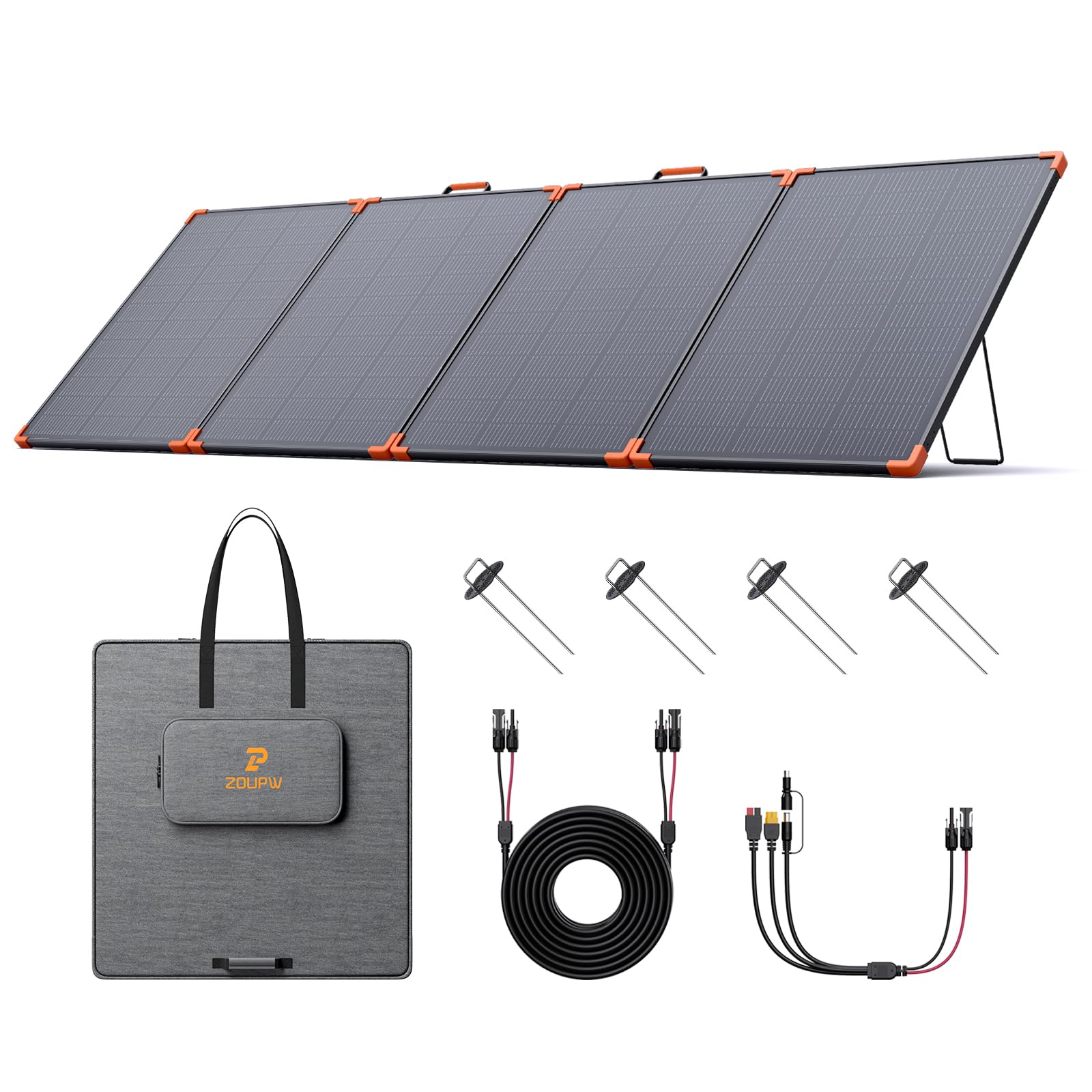
The wattage king here — 350 watts that fold into a briefcase and feed a big power station.
When you need to refill a 1kWh-plus solar generator in a day, raw watts are the ticket, and nothing else on this list delivers 350 of them. It does it with N-type monocrystalline cells and 16 busbars, rated at 25% efficiency, and ZOUPW’s pitch is that the N-type recipe avoids light-induced degradation (the slow drop in output that older cells suffer over years). Weighing 22.2 pounds and folding into a magnetic-handle briefcase, it is designed to deploy in about 10 seconds.
Here is the compatibility spec that makes or breaks the purchase: 50.2V open-circuit voltage. That voltage is what allows it to push maximum input into high-capacity generators, and the included 4-in-1 cable (XT60, Anderson, DC7909, DC8020) matches it to the EcoFlow Delta 2 and 3, BLUETTI AC200L and Elite 200 V2, Anker SolIX C1000 and C2000 Gen2, and the Jackery 2000 V2, 2000 Plus, and 3000 Pro. ZOUPW states plainly that it is not suitable for small 12-20V power stations — so if your generator is a compact one, this is the wrong panel for you.
The build backs up the wattage. An ETFE coating with an IP68 waterproof rating (junction box rated IP67) handles rain and dust, and four reinforced adjustable kickstands let you angle it to 45° to grab more sun than a flat-laid panel. Shoppers say 300 to 350 watts of real output, praise the rigid frame, and note it pushes 300+ watts into an RV battery. One caveat straight from the maker: it is not meant for long-term fixed mounting or permanent series or parallel connection.
Reasons this tops the wattage chart
- 350 watts of N-type 16BB output at 25% efficiency, the highest power on this list
- 50.2V open-circuit voltage for fast charging of large-capacity power stations
- 4-in-1 cable covers EcoFlow, BLUETTI, Anker, and Jackery connectors in one package
- IP68-rated ETFE build with four kickstands for angled positioning
The numbers you must respect
- 50.2V output will not work with small 12-20V power stations
- The maker does not recommend it for permanent fixed mounting or long-term series/parallel wiring
- At 22.2 pounds it is a carry — heavier than the Renogy foldable’s 7.3 pounds
Your pick if: you own a large-capacity power station with a 50.2V input window and want the most watts you can carry to camp.
Not your panel if: your generator is a small 12-20V unit or you plan to bolt the panel down for good.
5. ECO-WORTHY 400W Solar Panels N-Type 4-Pack
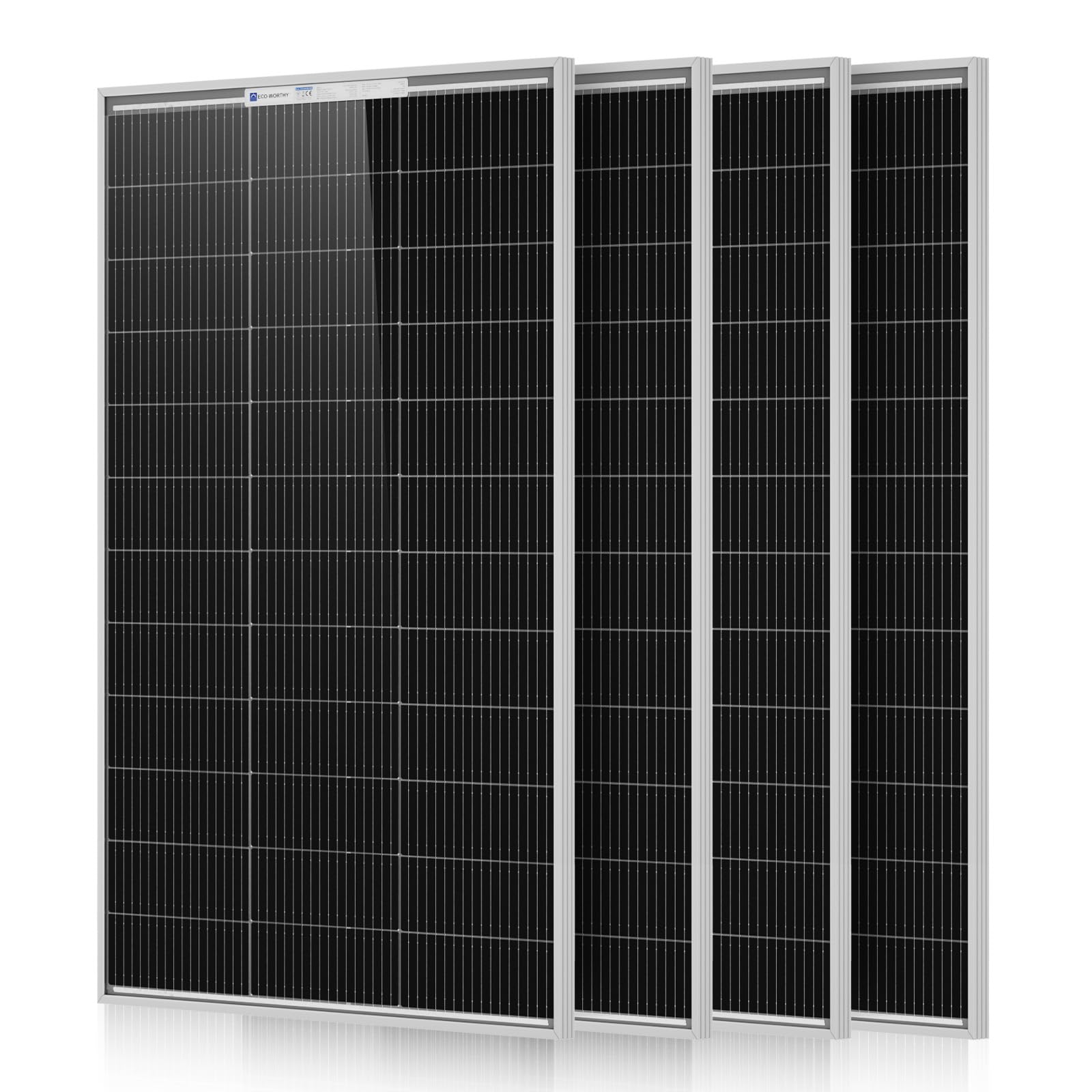
Four 100-watt panels in one box — the DIY route to building a bank you can grow later.
This is a different kind of purchase. Instead of one panel, you get four 100-watt N-type panels, each with 16BB busbar construction and a stated 25% efficiency. That basic building block is aimed at a 12V or 24V battery system for a shed, cabin, garden, or RV — wire them together and you have 400 watts of capacity to work with. The plugs are MC4, so the standard connectors on most controllers and combiners will mate up.
Owner sentiment here is warm on build and cold on consistent output, and both deserve to be stated honestly. The quality reads strong — sturdy, easy to install, with at least one build noting solid performance even in low light thanks to the pre-installed bypass diodes in the IP68 junction box. But output is the split point: reviews split sharply, with some units hitting the full 100 watts and others measuring only 50 to 60 watts. If you are wiring four into a bank, one underperforming panel pulls the total down, so test each one on arrival.
Each panel measures 35.63 by 23.03 by 1.18 inches and weighs 23.8 pounds, and the 1.18-inch edge thickness is there to help heat dissipate for steadier output. The thinner edge also gives more room for brackets. One practical heads-up: the four panels ship across two separate boxes, so budget for the second one to arrive before you start mounting.
Why hobbyist builders like it: four N-type 100-watt panels at 25% efficiency each, MC4 connectors, IP68 junction boxes, and pre-drilled mounting holes turn a small battery system into a real off-grid project.
The fair warning: output varies between units, so check each panel’s real wattage before you wire them into a permanent array.
Go this route if: you are assembling a 12V/24V bank for a shed, cabin, or RV and want four matched panels you can wire up and expand over time.
Steer away if: you want one panel you can trust at face value — a pair of these arrived well short of rated output for some owners.
6. DOKIO 100W Portable Solar Panel Suitcase
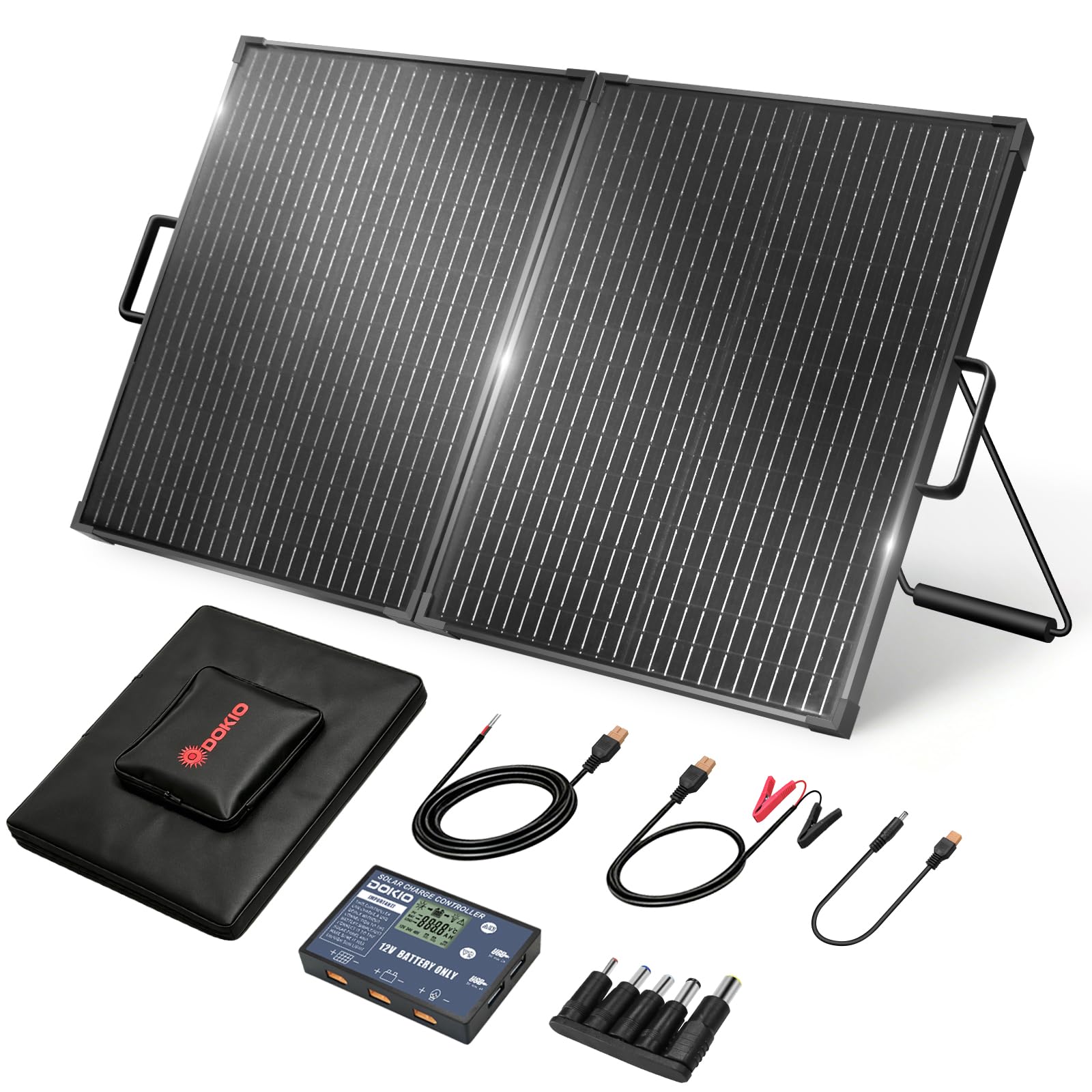
Unfold it, clip it to the battery, and let the built-in controller do the thinking.
The defining feature here is what is already in the box: an integrated PWM charge controller that protects against reverse polarity, overcharging, short-circuit, and reverse current, plus 5V 2A USB ports for phones. That means no separate controller to buy and wire up. Unfold the panel, hook the alligator clips to a 12V battery, and it starts charging — the one thing to watch is getting the polarity right on those clips. Buyers describe it working right out of the gate, with batteries brought back from partial drain.
With 18 volts maximum, 5.56 amps, and 100 watts, it sits below the Callson’s 23.74 volts and 8.43 amps output — the Callsun holds 8.43 amps to the DOKIO’s 5.56, a gap that matters when you are trying to push charge into a larger bank quickly. But at 10.1 pounds and folding to a compact suitcase, the DOKIO is the one you actually carry to a campsite where there is no outlet. The 9.8-foot cable gives you enough reach to follow the sun and keep the panel off a hot power station.
The sturdiness is the one honest gripe. Owners find the frame and folding stand on the flimsy side, so treat the kickstand gently when you angle the panel. If the frame holds up, the rest delivers good value — a built-in controller, dual USB, and a carrying bag, all in a dedicated outdoor package.
The case for it: a self-contained charging package — panel, PWM controller, USB ports, and bag — that hooks to a 12V battery with alligator clips and needs nothing else.
Treat with care: the folding frame and stand are the weak point, so set it up gently and it will serve you well.
Ideal for: campers and boaters who want to clip a panel to a 12V battery with zero extra parts to buy.
Consider the Callsun instead if: you are feeding a larger bank and want more amps and a fixed-mount frame.
7. JJN 100 Watt Solar Panel, 10BB Monocrystalline

A Grade A+ monocrystalline panel that makes a shed or rooftop build affordable.
Start with the price-tier reality: this is the entry point of the list, and it delivers a 100-watt panel at 23% conversion efficiency using Grade A+ large monocrystalline cells and a 10BB busbar layout. That efficiency is a step below the 25% and 25.6% N-type panels higher up, and the 10BB layout has fewer current paths than their 16BB design. But it generates up to 500Wh per day with 5 hours of direct sunlight, which is more than enough for a small rooftop or off-grid setup.
The durability spec is what surprised us for a budget panel. It is rated to withstand wind loads of 2100Pa and snow loads of 5100Pa, backed by a black corrosion-resistant aluminum frame, an IP65 junction box, and IP67 connectors. It weighs 13.7 pounds, so one person can move and mount it alone. Quality is the trait that earns the most praise from owners, with power output close behind — buyers report 80-90% of rated output, and one measures 3.7A in medium sunlight. It also handles ebike charging and is easy to hook up.
The honest caveat is durability over time. Some owners mention problems that show up after the first couple of years, while others see theirs run for far longer. That mixed record is the trade-off for the lower tier, and for a budget rooftop panel on a shed or farm system rather than a critical install, it is a fair one. The 30-year transferable output warranty does soften that risk.
Why it earns the budget slot
- 23% efficiency from Grade A+ monocrystalline cells at the lowest tier of this list
- Rated for 2100Pa wind and 5100Pa snow loads with an IP65 junction box for outdoor use
- Up to 500Wh per day with 5 hours of direct sun
The trade-offs to accept
- 10BB layout and 23% efficiency sit below the 16BB N-type panels higher up this list
- An after-a-couple-of-years durability risk is the entry price
- 100 watts means a small system, not a whole-home bank
Worth grabbing for: a shed, fence-line, or farm system where you want a dependable 100-watt panel at the entry tier and can accept slightly slower refills.
Step up if: your output expectations are strict or your install is mission-critical — the N-type panels above give you both more efficiency and a longer track record.
Know the Specs
Maximum power (watts)
This is the peak output the panel is rated to produce under standard test sunlight. It is your headline number — 100 watts on a small panel, 350 on the ZOUPW — but real output climbs above or falls below it depending on sun intensity, angle, and heat. When two panels carry the same watt rating, efficiency and cell type decide which one holds that output better hour after hour.
Efficiency (percent)
Efficiency tells you how much of the sunlight hitting the panel becomes electricity. A 25.6% panel turns more of each ray into power than a 23% panel, so for the same footprint you get more watts — the difference between a 100-watt panel at 23% and one at 25% is why efficiency matters most when mounting space is limited, as on a van roof.
Open-circuit voltage
This is the panel’s maximum voltage with nothing connected, and it is the gatekeeper for compatibility. A 50.2V panel will not charge a small 12-20V power station, while an 18V panel is built for 12V battery systems. Always check your controller or station’s input range before buying — voltage mismatch is the fastest way to buy a panel that will not work.
Bifacial and busbar design
Bifacial panels have a transparent backsheet that also catches reflected sunlight, boosting total output. The busbar count — the number of current-carrying metal strips per cell — tells you how much redundancy the panel has; 16BB gives more paths for current and fewer hot spots than 10BB. More busbars and bifacial design together mean more usable power from the same footprint.
Common Questions
Will the ZOUPW 350W panel work with my power station?
Do I need a separate charge controller for the DOKIO suitcase?
How much extra power does a bifacial panel really add?
Can the ECO-WORTHY 4-pack connect to a 24V system?
How much shade tolerance do the Callsun and ShadowFlux panels actually provide?
Do portable panels like the Renogy and ZOUPW come with cables for a battery?
Which panel is best for a van rooftop where space is tight?
Is a higher watt panel always the better buy?
How do I know if my power station is 12V or capable of higher voltage?
What does IP68 waterproofing cover on a solar panel?
The Bottom Line
The panel worth the most of your attention is the Callsun N-Type 16BB 200W Bifacial, because 25.6% efficiency, a dual-module anti-shade split, and a bifacial backsheet combine to make it the most forgiving 200-watt panel here for a fixed van or marine mount. If portability is the whole point, grab the Renogy 100W Portable — 7.3 pounds, 25% efficiency, and USB-C PD charging for your gear. And if you are feeding a large-capacity power station, the ZOUPW 350W Portable is the one to reach for, with the most watts on this list and a 50.2V output built for big generators.
One last nudge: check your controller and station’s voltage window before anything else. Every panel here is worth owning, but matching that voltage number is what separates a setup that charges all day from one that never gets going.
How we choose
We do not accept paid placement. Every pick is matched to a real buyer and a real use-case; we do not hands-on test units.
Sources
Specifications: manufacturer listings and product documentation. Review insights: verified customer reviews, as of November 2026. Pricing: not shown on this page (it changes often); check the current price via the retailer link.
As an Amazon Associate, Tactical Gear Guy earns from qualifying purchases. This does not affect which products we feature.