Specs are compiled from manufacturer listings and verified buyer reviews and can change over time — please confirm the key details on the product page before buying.
You want a pocket console that actually plays the games you remember, without spending an evening fighting firmware before your first session. The short answer: match the screen resolution and the chipset to the era of games you care about, and buy the storage you can expand rather than the library a seller preloads. This guide walks through nine portables that cover everything from licensed Atari plug-and-play units to an Android handheld that handles PS2-era titles.
This guide is built by comparing the manufacturers’ published specifications and the patterns across verified customer reviews, so you get each pick’s real strengths and trade-offs instead of marketing spin.
What separates a keeper from a drawer-dweller is rarely the game count on the box — it is the panel, the CPU, and whether the shell fits your pocket and your play style. That is the filter I used to build this list of top portable consoles.
Top Picks


How To Choose The Best Top Portable Consoles
The single biggest mistake buyers make is chasing the biggest game count on the listing instead of checking the panel and chipset. A console with 4,000 games and a tired panel will disappoint you faster than one with 100 titles you grew up loving. Start with the screen and the chip, then work outward to storage and battery.
Screen resolution and aspect ratio come first
Most retro libraries were built for a 4:3 picture (a squarish shape, taller than a modern widescreen). A 640×480 panel fits that shape naturally, so sprites land on whole pixels instead of getting smeared. A 720×720 square panel is a different compromise — it gives you more pixels per inch on a small body, which keeps text and menus crisp. Neither is automatically better; pick the one that matches the games you plan to play.
What the CPU and GPU actually decide
The processor sets your ceiling. A quad-core A53-class chip with a Mali-G31 graphics unit is comfortable with 8- and 16-bit era libraries. A Snapdragon 865 with an Adreno 650 GPU pushes into GameCube and PS2 territory. Decide which era you want before you compare anything else, because the chip is the one part you cannot upgrade later.
Battery, charging, and how you actually play
Pocket consoles list battery capacity in mAh (milliamp-hours — a rough measure of how long it runs). The realistic range across this group is 3,000mAh to 5,000mAh, with claimed runs between 6 and 8 hours. If you mostly play in ten-minute bursts on a commute, almost anything here works. If you want a long-haul flight companion, weight the bigger cells higher and remember that a Type-C fast charge cuts the turnaround.
Preloaded libraries versus your own files
Two very different products get sold under the same shelf. One arrives with hundreds or thousands of titles already installed; the other ships empty and expects you to supply your own game files. Neither is a trick — but know which one you are buying. If you want plug-and-play nostalgia, a licensed unit is the safer bet. If you want control over your library, go with the expandable-Storage models and accept a setup evening.
Side-by-Side Comparison
| Model | Best For | Screen | Battery | Storage | Amazon |
|---|---|---|---|---|---|
| X36 Ultra Retro Handheld★ Best Overall | Video plus retro gaming | 4.2″ 720×720 IPS | 3500mAh | 8GB + TF to 256GB | Amazon |
| Miyoo Mini PlusMost Pocketable | Pocket-first retro play | 3.5″ 640×480 IPS | 3000mAh | 64GB | Amazon |
| Retroid Pocket 5Top Performer | PS2-era emulation | 5.5″ 1080p touch | 5000mAh | 128GB + microSD | Amazon |
| Retroid Pocket Flip 2 | Big-screened clamshell | 5.5″ 1080p AMOLED | 5000mAh | 128GB | Amazon |
| RG35XX Pro | Preloaded multi-system play | 3.5″ 640×480 IPS | 3200mAh | 64GB | Amazon |
| Anbernic RG40XX H | Bigger panel, light body | 4.0″ 640×480 IPS | 3200mAh | 64GB | Amazon |
| R36S Purple Transparent | Budget open-source tinkering | 3.5″ 640×480 IPS | 3200mAh | 64GB | Amazon |
| Atari Pocket Player | Nostalgia on a trip | 2.8″ full-color vertical | 4 AA | 100 built-in games | Amazon |
| Atari Micro Player Pro | Desk display collectible | 2.75″ full-color | 4 AA | 100 built-in games | Amazon |
Detailed Reviews
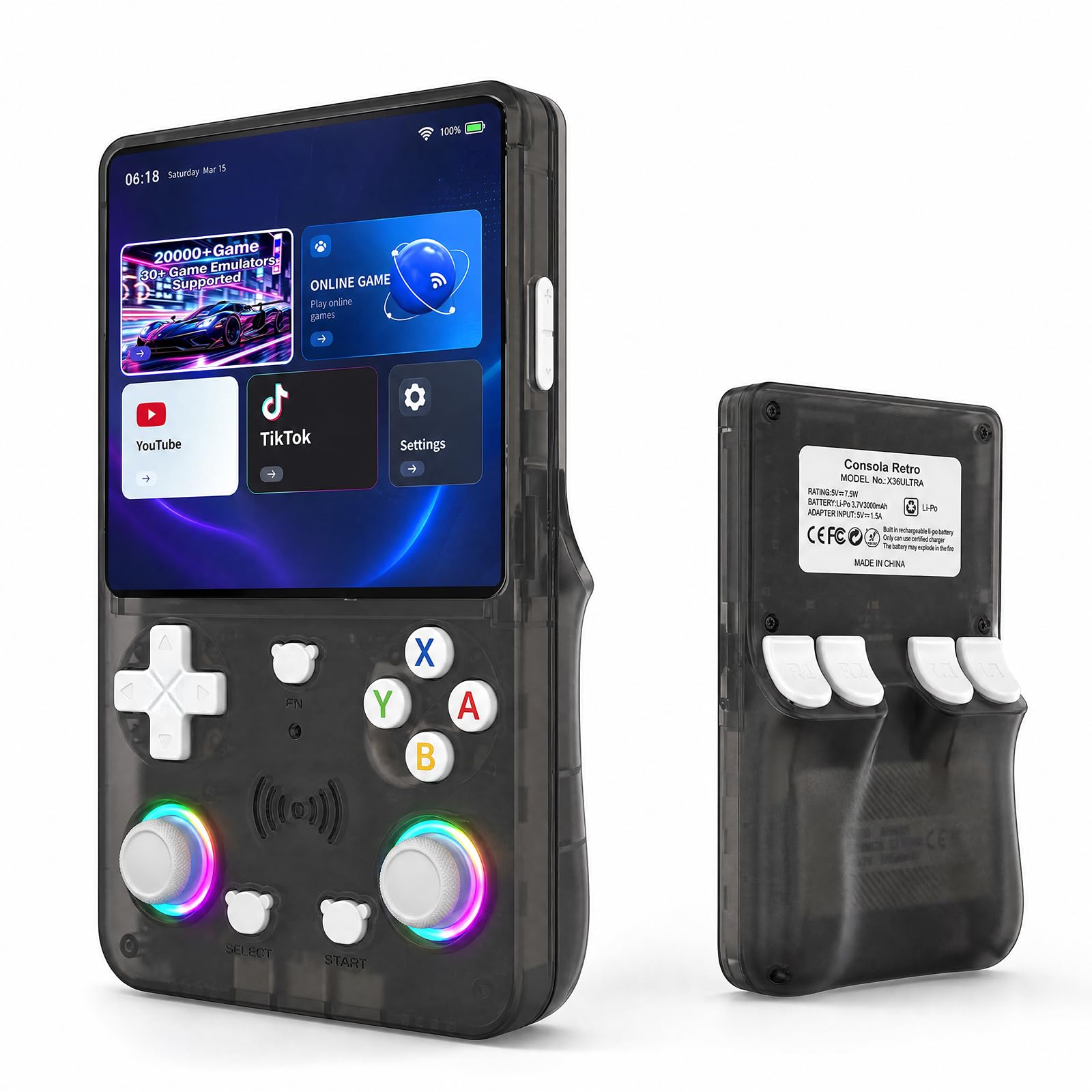
1. X36 Ultra Retro Handheld Game Console
Our pick — 4.5+★ from 650+ verified ratings; the strongest balance of quality and price.
A handheld that plays your old cartridges and your YouTube feed from the same pocket.
The X36 Ultra takes the top spot because it is the only console here that does two jobs well: retro emulation and full Android video. Its 4.2-inch OCA-laminated IPS panel at 720×720 separates it — OCA lamination means the touch layer is glued directly to the display, which cuts reflections so the screen stays readable in daylight. That square panel is unusual, and it gives you a dense, crisp picture on a body that slips into a jacket pocket. It runs a dual Android 10 system on a Qualcomm Gen1 quad-core CPU with a Mali 450 GPU (the graphics chip that renders the sprites and 3D scenes).
Then there is the library. The listing quotes 20,000+ classic games preloaded and support for a wide range of emulators, with playback described as smooth. The important number for a buyer is the 43.5x gap in games between this and the Atari Micro Player Pro — 4,353 versus 100. You are buying five figures of content in one device. Storage is 8GB of onboard memory plus a TF card slot that accepts 16GB up to 256GB, so you can top up later without buying a new console. That last point separates it from the Retroid Pocket Flip 2’s fixed 128GB.
Owners single out build quality as the most-discussed positive trait, followed by how much hardware you get for the outlay. The honesty note: the console runs a full Android system, so a little patience with the interface is part of the deal. If you want a single-purpose emulation machine with zero app-switching, a strictly retro model suits you better. If you want one device for a flight, a commute, and the odd YouTube clip, this is the one. 4.5+ stars across 600+ ratings.
What earns it the top spot
- 4.2-inch 720×720 IPS panel with OCA lamination to fight glare
- 3500mAh battery rated up to 8 hours; full recharge in about 2 hours via Type-C
- TF card expansion from 16GB to 256GB
- 8W cavity speaker, RGB joysticks, local room multiplayer
Where it asks for patience
- Dual-boot Android means a setup curve if you have never used one
- 8GB of onboard storage fills fast before you add a card
- Multicolour shell styling will not suit a minimal desk
Right for: anyone who wants retro games and modern video in one pocketable unit.
Think twice if: you want a pure emulation device with no Android layer to learn.
2. Miyoo Mini Plus with Portable Case
The one you genuinely forget is in your bag until you want five minutes of Tetris.
Start with the panel, because it is the reason to buy this model. A 3.5-inch IPS display at 640×480 (a 4:3 shape) renders retro tiles at their native proportions, so text is legible without stretching. Add an ARM Cortex-A7 CPU running an tune Linux game system, and the listing promises stable play without frame drops. Save and load states plus favourite and recent folders let you stop mid-level on a bus and pick it up at the same spot later.
The clock is the sleeper spec. RTC stands for a real-time clock — a small chip that keeps the in-game date and time running, which open up the time-based events some retro titles hide behind a calendar. The Retroid Pocket 5 and Flip 2 lean on Android apps for that; here it is built in. Battery is a 3000mAh cell rated up to 6 hours when fully charged, and the 64GB card arrives loaded. Stereo sound gives you left-and-right separation in headphones rather than one flat channel.
The honest trade-off is headroom. A Cortex-A7-class chip is built for older libraries, so if your wish list runs to PS2-era 3D titles, look at the Retroid Pocket 5 above that tier instead. For 8- and 16-bit play this is the more comfortable carry, and the included case plus screen protector means you can toss it in a bag without babying it. 4.0+ stars across 200+ ratings.
The quality read: the standout here is polish over raw power — an tune Linux build, RTC, stereo output, and save states in a genuinely small shell.
What it will not do: demanding later-generation 3D emulation is beyond a Cortex-A7 chip, so treat this as a 16-bit-era companion.
Pick this one when: portability is non-negotiable and your library lives in the 8- and 16-bit era.
Step up if: you need PS2-level titles, since this chipset tops out well below that.
3. Retroid Pocket 5 Retro Handheld
A Snapdragon 865 and an Adreno 650 GPU in a body that still fits a coat pocket.
If your idea of retro reaches into PS2 territory, this is where the list gets serious. The Retroid Pocket 5 pairs 8GB of RAM with 128GB of storage and a Snapdragon 865 processor driving an Adreno 650 GPU — desktop-class-by-handheld-standards silicon that handles demanding 3D emulation and cloud gaming services. The 5.5-inch 1080p touchscreen (1080p means a full-HD resolution, roughly twice the vertical pixel count of a 720p panel) is the other half of the story, and owners consistently single out how the picture holds up in open daylight.
Battery is a 5000mAh cell that keeps sessions going for hours on end, and the microSD slot means the 128GB is a floor, not a ceiling. One thing to note before you buy: no games ship on this unit. It runs Android 13 and expects you to bring your own library through emulators or app stores. The listing also warns that a fresh unit may arrive in battery protection mode and need at least 8 hours on the charger to wake up — a one-time step, not a fault.
The comparison that matters is against the Flip 2 below: same Snapdragon 865 platform, same 5000mAh, but a different screen and a different form factor. The Pocket 5 gives you a conventional slab with a matte finish and a lighter footprint, while the Flip 2 folds. Owners find the setup range from very easy to a hassle depending on their comfort with Android emulation front-ends. 4.5+ stars across 200+ ratings.
Why the power crowd likes it
- 8GB RAM and 128GB storage with microSD expansion
- 5.5-inch 1080p touchscreen paired with an Adreno 650 GPU
- 5000mAh battery, plus Android 13 with cloud-gaming support
What to line up in advance
- No games included; plan your emulator setup before it lands
- A first charge of at least 8 hours may be needed to exit battery protection
- Setup difficulty splits opinion among Android newcomers
Built for: players chasing PS2-era emulation and cloud gaming on a proper full-HD panel.
Not the fit if: you want to unbox and play — this one arrives empty on purpose.
4. Retroid Pocket Flip 2 Retro Game Console

A clamshell that snaps shut over its own AMOLED panel and tops the ratings here.
The Flip 2 takes the highest score on this list at 4.5+ stars, and the screen explains a lot of it. You get a 5.5-inch 1080p AMOLED panel (AMOLED means each pixel lights itself, so blacks go truly dark and colours stay punchy) rated at 500 nits brightness and 60Hz — nits being a measure of how bright the display can shine, which is what keeps it readable in a sunlit room. The clamshell design folds shut to guard that panel, and the reinforced hinge is built to resist the looseness that folding designs can develop over time. Under the same Snapdragon 865 and Adreno 650 GPU as the Pocket 5, with 8GB of LPDDR4x RAM and 128GB of UFS 3.1 storage.
The controls use Hall-effect analog sticks — magnetic sensors instead of physical wipers, which means they do not wear into drift the way older sticks can. Active cooling fights thermal throttling during long sessions, and Wi-Fi 6, Bluetooth 5.1, USB-C DisplayPort, and a 3.5mm jack cover every connection you would want. The 5000mAh battery pairs with 27W fast charging, so topping up mid-trip is quick.
Owners keep coming back to how well the Snapdragon 865 handles GameCube and PS2 emulation and how easy the clamshell is to carry — the folding shell genuinely shrinks the footprint. The catch is the same as the Pocket 5 above: no games are preloaded, and Android 13 means you supply the library. It also carries more mass than the slab model, at 10.72 ounces. For sheer picture quality and drift-resistant sticks, nothing here beats it. 4.5+ stars across 200+ ratings, the highest on this list.
The AMOLED advantage: a self-lit 1080p panel at 500 nits and 60Hz gives you the sharpest, most colour-saturated picture on this list, and the clamshell protects it when closed.
The mass you carry: at 10.72 ounces it is the heavier of the two Retroid models, and the empty game library means setup is on you.
Top of the tree for: anyone who prioritizes screen quality above all else and wants drift-free Hall-effect sticks.
Look past it if: you want preloaded titles from the start or the lightest possible pocket carry.
5. RG35XX Pro Handheld Game Console

Four thousand three hundred and fifty-three games already on the card, no setup evening required.
This is the plug-and-play option in the modern column. The 64GB card arrives carrying 4,353 games and support for 30+ simulators, so the first session starts the moment the battery is charged. Compare that to the Retroid Pocket Flip 2’s 128GB of empty space and the difference in approach is obvious: one is a library, the other is a platform. The preloaded library is what wins people over, and ease of use follows close behind — the Linux system accepts new emulators and games in the right format if you want to extend it.
The hardware reads like a serious emulation handheld. An H700 quad-core ARM Cortex-A53 at 1.5GHz with a dual-core G31 MP2 GPU (graphics silicon that handles the frame rendering) is tuned to smooth out dropped frames. The 3.5-inch IPS panel at 640×480 with OCA full lamination gives you a clear 4:3 picture, and tempered glass over it adds scratch and drop protection. Dual joysticks are the upgrade over single-stick designs — precise direction control for games that want an analog stick.
Connectivity is broader than most of this group: HDMI output to a TV, vibration motor, Wi-Fi for online pairing and streaming, and support for 2.4G wireless or wired controllers. Battery is a 3200mAh cell rated up to 8 hours, with fast charging over USB-C. The honest catch is reliability — a pattern of reports describes units that will not power on and others that work from the first charge, and battery drain gets flagged more than once. Treat that as a reason to buy from a seller with an easy return path rather than a reason to rule it out. 4.0+ stars across 200+ ratings.
The out-of-the-box argument
- 4,353 games and 30+ simulators already on a 64GB card
- H700 quad-core at 1.5GHz with a dual-core G31 MP2 GPU
- HDMI output, Wi-Fi, vibration, and 2.4G controller support
- 3200mAh battery rated up to 8 hours with USB-C fast charging
The reason to buy with care
- Reliability splits reports between flawless units and dead-on-arrival ones
- Battery drain comes up more than once
- Transparent teal shell is a bold look, not a neutral one
Made for: buyers who want thousands of games ready on day one and HDMI out to a TV.
Worth a pause if: you want the most consistent build record in this group.
6. Anbernic RG40XX H Retro Handheld

A four-inch screen on a body that weighs about 200g — size without the shoulder ache.
The pitch here is display real estate on a light frame. A 4.0-inch IPS panel at 640×480 with OCA full fit gives you the biggest squarish screen in the mid-range tier, and owners say the picture looks better than they expected. Since the 4:3 libraries were designed around this shape, that extra inch means larger sprites without distortion. Just as importantly, the console weighs roughly 200g — lighter than the R36S’s 266g — so a longer session does not turn into a wrist workout.
Under the glass sits a quad-core ARM Cortex-A53 CPU with a quad-core PowerVR SGX544MP GPU and 1GB of RAM. RAM is the working memory that keeps menus snappy, so a full gigabyte means the system responds quickly when you jump between titles. The 64GB TF card comes preloaded with 5000+ games on a Linux system. RGB joystick lighting supports constant, breathing, rainbow, marquee, and chasing effects with colour and brightness adjustment, which is a small detail that makes it feel less like a generic slab.
Connectivity covers HD output, vibration, Wi-Fi online pairing and streaming, and 2.4G wireless or wired controllers. The 3200mAh polymer lithium-ion battery is rated up to 8 hours of continuous play. The honest limits are game compatibility and the odd missing file — some buyers report titles stopping partway through — so if you need every ROM in your library to run, buy with a return window. It is also bigger in the hand than a 3.5-inch model, which cuts both ways. 3.5+ stars across 300+ ratings.
Screen-first logic: the 4.0-inch 640×480 IPS panel and 200g body are the reason to pick this over a smaller handheld.
Reality check: game compatibility and missing content come up in reports, so keep the receipt and test your must-haves early.
Choose it for: the largest 4:3 picture in this mid-range bracket without carrying extra weight.
Go elsewhere if: you expect a flawless hit rate on every preloaded title.
7. R36S Handheld Game Console with Portable Case
An open-source handheld for the player who enjoys the setup as much as the game.
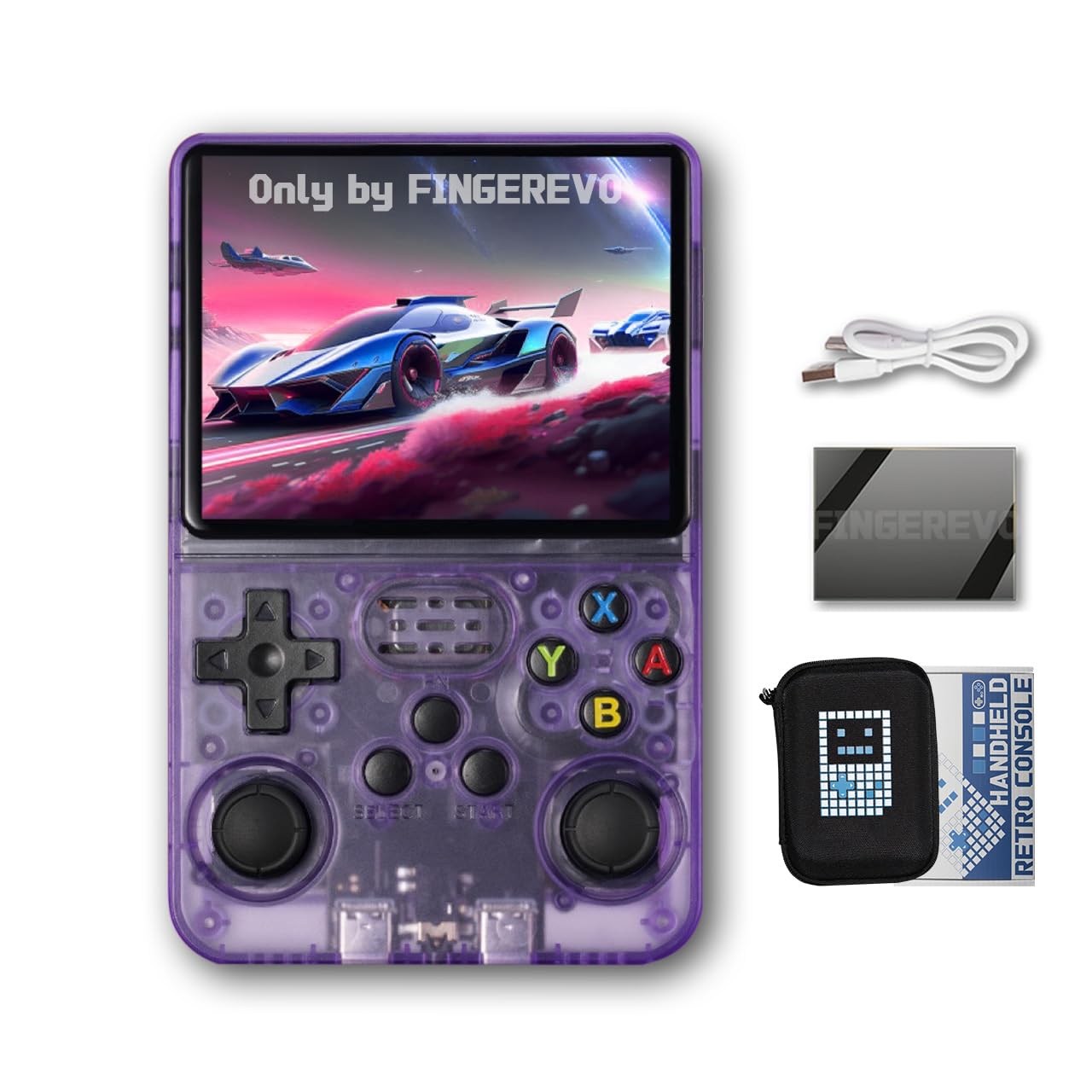
The R36S is the most honest example of the open-source approach: an RK3326 quad-core 64-bit A53 CPU with a Mali-G31 GPU and 60Hz operation, running a 3.5-inch 640×480 IPS OCA panel in 4:3. The listing is clear that you may need to supply your own game files, so this is a console for someone comfortable with a card reader and a folder structure. Purple Transparent is the signature finish, and it comes with an all-in-one portable case from FINGEREVO plus a screen protector and USB-C cable.
The 3200mAh battery is built in and the console plays from the start once charged. It weighs 266 g — heavier than the X36 Ultra’s 210g and the RG40XX H’s roughly 200g — so it is not the lightest pocket companion in this group. The shell shows its internals through the transparent plastic, which is a look collectors tend to love and minimalists tend to tolerate.
Set expectations on reliability. The most-discussed topic is whether units work as expected, and reports split between consoles that run perfectly from the first boot and games that fail to launch. That is a spectrum you manage with a good seller and a quick test session, not a flaw you can spec around. If you want a locked-down experience with no tinkering, the RG35XX Pro above is the easier start. If you enjoy open-source tinkering on a budget, this is the one. 3.5+ stars across 400+ ratings.
Why tinkerers gravitate to it
- 3.5-inch 640×480 IPS OCA panel in 4:3 with a 60Hz refresh
- RK3326 quad-core A53 CPU and Mali-G31 GPU
- Ships with a portable case, screen protector, and USB-C cable
Set your expectations here
- Games are not guaranteed; you prepare your own files
- 266 g is on the heavier side for this screen size
- Only one SD slot is populated, with the second empty
Suits the hobbyist: open-source fans who want a cheap entry point and do not mind prepping their own library.
Not for the plug-and-play crowd: you will need to test boot and launch behaviour early.
8. My Arcade Atari Pocket Player
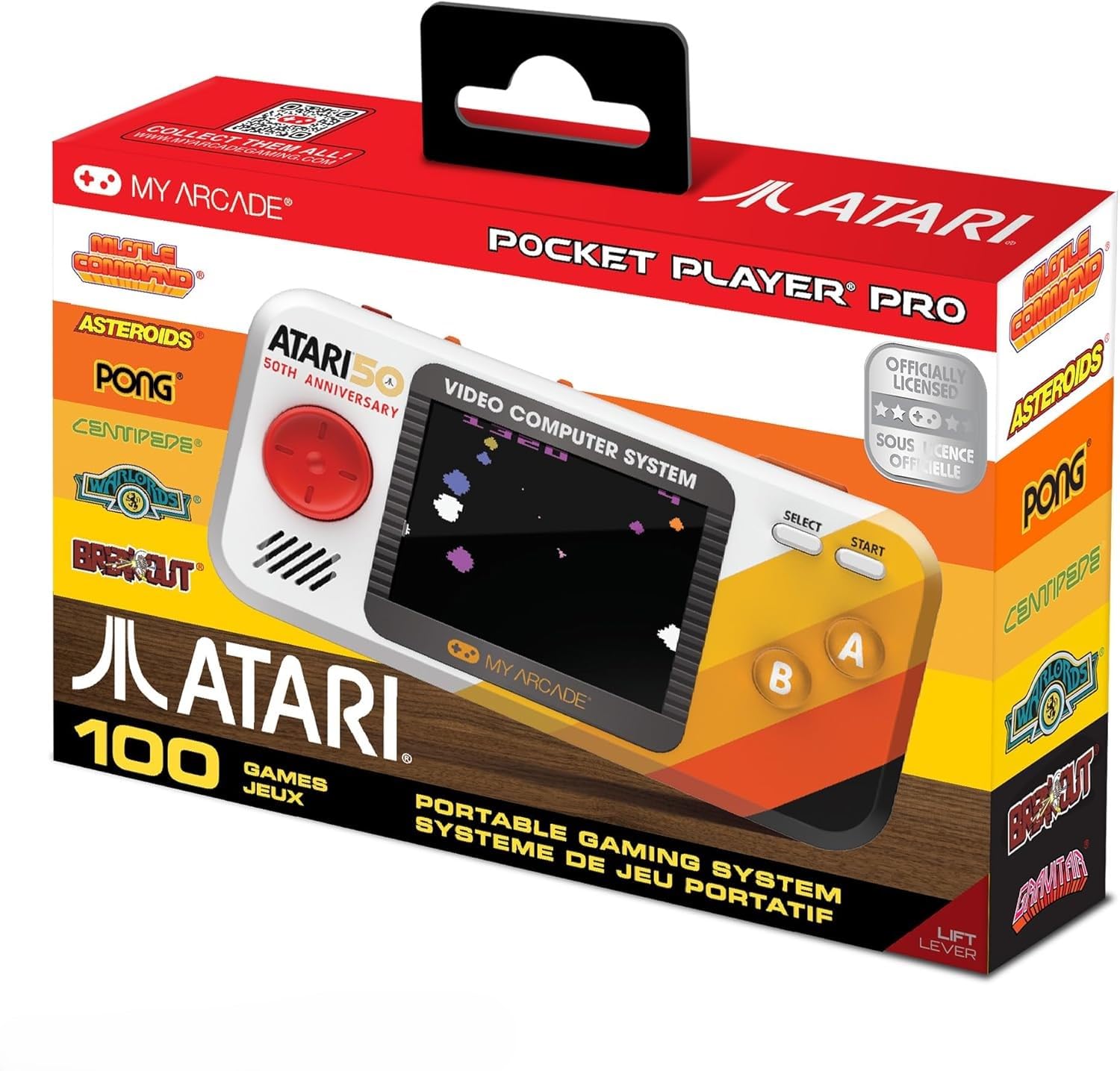
One hundred licensed Atari classics in a shell you can slip into a coat pocket.
This is a different animal from the emulation handhelds. It is officially licensed, so Asteroids, Centipede, Missile Command, Breakout, and Pong are the real thing rather than a curated approximation. The 2.8-inch full-colour vertical display is sized and oriented for portrait arcade play, and a 3.5mm headphone jack plus volume control and brightness adjustment keep it usable on a quiet train. At 5.8 inches long, 1.5 inches wide, and 2.8 inches high, it is a genuinely small package.
Power comes from 4 AA batteries (not included) or a USB-C cable (also not included), and the listing is explicit that you should use standard non-rechargeable batteries. That is a deliberate design choice, not a cost cut — AA cells mean you can resupply at any corner shop instead of hunting for a charger. There is no Wi-Fi, no app store, and no library to build. What you get is exactly the 100 games on the device, forever.
Owners talk about the fun factor most, and the 100 licensed Atari titles do the heavy lifting. Nostalgia is the real product here, and the 2.8-inch vertical screen delivers it for trips and waiting rooms. The honest catch is that 100 games is a fixed ceiling, and the 2.8-inch screen means you are squinting more than on a 3.5-inch panel. If you want a growing library, look at the RG35XX Pro’s 4,353 titles instead. If you want the Atari experience in your pocket with zero setup, this nails it. 4.0+ stars across 700+ ratings.
The no-fuss appeal: 100 licensed Atari titles, a 2.8-inch vertical display, headphone jack, and AA power with zero setup.
The ceiling you accept: no expansion, no app store, and a smaller screen than the 3.5-inch emulation units here.
Grab it for: a distraction-free trip companion where the games are already decided.
Skip the idea if: you want to add titles later or need a bigger picture.
9. My Arcade Atari Micro Player Pro
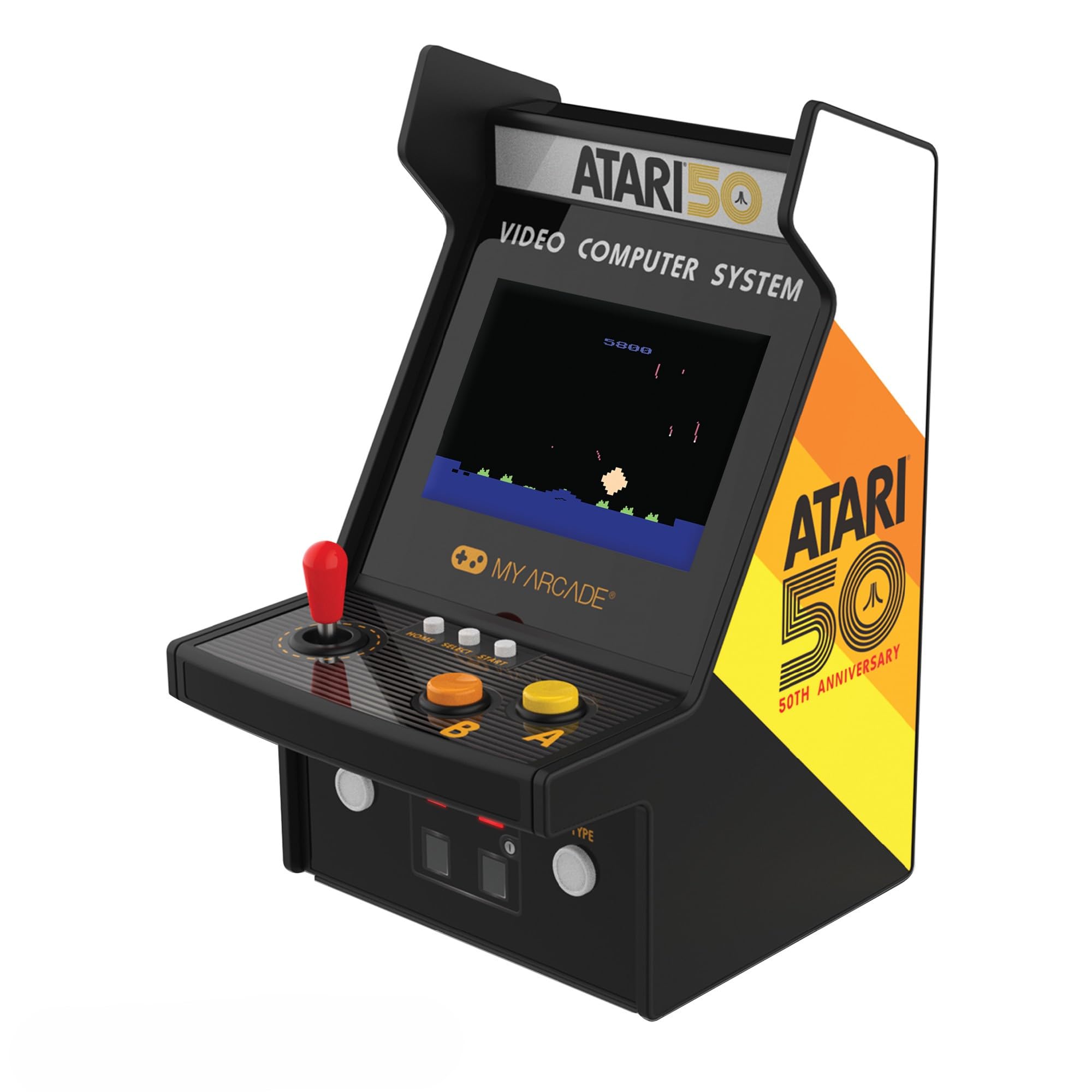
A little cabinet that lives on a shelf and brings back Asteroids on demand.
The Micro Player Pro is built to be seen as much as played. It is officially licensed, carries 100 games in one including Asteroids, Centipede, Millipede, Breakout, Missile Command, and Tempest, and stands on a 6.8-inch-high cabinet form that suits a game room, office desk, or display case. The 2.75-inch full-colour display keeps the sprites readable at rest, and there is a built-in speaker with volume control plus a 3.5mm headphone jack for private sessions.
Compare its footprint to the Handheld R36S: 5.8 inches long by 1.5 inches wide by 2.8 inches high versus the R36S’s taller-but-narrower build — the Micro Player Pro is a display object, not a pocket device. It runs on 4 AA batteries (not included) or a USB-C cable (not included), and My Arcade pitches the full Micro Player range as a set to collect. At 12 ounces it is stable enough to press buttons without sliding around a desk.
It is built for ten-minute bursts of nostalgia, and it delivers exactly that. The honest note is that it is a fixed library on a small screen — there is no way to add games and no way to resize the picture. Nothing here is meant for a high-score marathon; it is a ten-minute burst of nostalgia between tasks. If you want a conversational piece for a shelf and a quick game, this is it. If you want a serious emulation machine, the Retroid Pocket 5 above is the better fit at a higher tier. 4.5+ stars across 300+ ratings.
Why it earns shelf space
- 100 officially licensed Atari titles including Tempest and Millipede
- Built-in speaker with volume control and a 3.5mm headphone jack
- 12-ounce cabinet form that stays put on a desk
What you give up
- 2.75-inch screen is the smallest here
- No way to add games beyond the 100 built in
- Batteries and USB-C cable are not included
A display piece for: the collector who wants Atari archaeology on a desk with zero setup.
Not for marathon sessions: a fixed 100-game library on a 2.75-inch screen runs out of scope fast.
Know the Specs
Resolution and aspect ratio
Resolution is the pixel count on the display (640×480, 720×720, or 1080p). Aspect ratio is the shape of that picture — 4:3 is the classic squarish retro format, while 16:9 is modern widescreen. A 640×480 panel on a 3.5-inch screen gives you a higher pixel density than a 1080p panel stretched over a larger body, which is why older titles often look crisper on the smaller device. Match the shape to your library and you will see less stretching and fewer black bars.
Battery capacity and real runtime
Battery capacity in mAh (milliamp-hours) is a rough measure of how much energy the cell holds. This group spans 3,000mAh up to 5,000mAh, with claimed runtimes from around 6 hours up to 8 hours. Bigger cells generally mean longer sessions, but screen size and chip power also drain them faster. Charging speed matters too: USB-C fast charging cuts your downtime, while AA-powered units avoid charging entirely by letting you swap cells.
CPU, GPU, and emulation ceiling
The CPU and GPU decide which generations you can play. A quad-core A53-class chip with a Mali-G31 or PowerVR SGX544MP graphics unit handles 8- and 16-bit libraries well. A Snapdragon 865 with an Adreno 650 GPU pushes into GameCube and PS2 territory. Neither is upgradeable, so this is the spec to settle before you buy anything else. RAM (often 1GB to 8GB) affects how snappy the menus and multi-app switching feel.
Storage and preloaded libraries
Storage is where your games live. Some units ship with 64GB or 128GB already on board, and some add a microSD or TF slot for expansion — a TF card is the same physical format as microSD. A preloaded library means the card arrives full; an empty one expects you to supply your own files. If you want to add titles over time, prioritize an expansion slot over a bigger preloaded count.
Common Questions
Do portable consoles come with games already loaded?
Is a 640×480 screen good enough for retro games?
How long does the battery actually last on a pocket console?
Can I add more games to a preloaded handheld?
What is a Hall-effect analog stick and why does it matter?
Will a handheld console connect to a TV?
Is the Retroid Pocket 5 or the Flip 2 better for PS2 games?
What does OCA lamination do on a handheld screen?
Do I need Wi-Fi on a retro handheld?
How do AA batteries compare with a built-in rechargeable on a handheld?
The Bottom Line
For most buyers, the strongest top portable consoles pick is the X36 Ultra because it pairs a 4.2-inch 720×720 OCA-laminated IPS panel with a dual Android 10 system and a 3500mAh battery — one device for retro play and video, with a TF slot that reaches 256GB. If picture quality is what you care about most, the Retroid Pocket Flip 2 leads on display with its 5.5-inch 1080p AMOLED panel, 500 nits of brightness, and drift-free Hall-effect sticks. And if you want thousands of games ready the moment it arrives, the RG35XX Pro puts 4,353 titles on the card before you open the box.
One honest nudge before you decide: the Flip 2 sits at 4.5+ stars, the top score in this group, so if the budget stretches to the premium tier and you do not mind supplying your own games, it is the one that will feel special every time you open the lid.
How we choose
We do not accept paid placement. Every pick is matched to a real buyer and a real use-case; we do not hands-on test units.
Sources
Specifications: manufacturer listings and product documentation. Review insights: verified customer reviews, as of November 2026. Pricing: not shown on this page (it changes often); check the current price via the retailer link.
As an Amazon Associate, Tactical Gear Guy earns from qualifying purchases. This does not affect which products we feature.