Specs are compiled from manufacturer listings and verified buyer reviews and can change over time — please confirm the key details on the product page before buying.
Buying a stone cutting machine is really a question of three things: what material you are cutting, how thick it is, and whether you can reach a power outlet. Get those three answers right and the machine choice falls into place almost automatically. Get them wrong and you end up with a saw that either stalls on hard porcelain or sprays slurry across a finished floor. This guide sorts the eleven strongest options on Amazon into what each one actually does well, so you can match the tool to your job instead of guessing.
This guide is built by comparing the manufacturers’ published specifications and the patterns across verified customer reviews, so you get each pick’s real strengths and trade-offs instead of marketing spin.
Below you will find wet tile saws for bathroom remodels, gas cut-off saws for driveways, and walk-behind units for slab work, each with its blade size, cutting depth, and water or dust setup spelled out in plain terms. Every pick here earns its place on real cutting capacity, and the full breakdown follows in this stone cutting machine guide.
Top Picks

How To Choose The Best Stone Cutting Machine
Start with the stone itself. A porcelain floor tile and a three-inch concrete slab are different jobs, and no single machine handles both well. The first decision is whether you are trimming tile indoors or slicing masonry outdoors, because that one answer rules out half the field.
Match the blade diameter to your thickest cut
Blade diameter sets the ceiling on how deep the saw can go. A small 5-inch blade on a masonry saw handles tile and thin stone, while a 16-inch blade on a concrete cutter reaches far deeper into a slab. Look at the stated maximum cutting depth rather than the blade size alone, because the housing and guard decide how much of the blade actually reaches the material. If your stone is thicker than the rated depth, the saw simply will not get through it in one pass.
Decide between wet cutting and dry cutting
Wet saws run water onto the blade to carry dust away and cool the cut. That keeps the work area cleaner and helps a diamond blade last, which matters on hard porcelain and granite. Dry cutting suits quick outdoor work and rough masonry, but it throws dust, so a dust port or a vacuum hookup earns its keep. Several machines here run both ways, which gives you the option per job.
Check the amperage and RPM against your hardest material
Amperage tells you how much muscle the motor has, and RPM tells you how fast the blade spins. A 15-amp motor turning at a high speed eats through dense tile, while a lower-powered unit may bog down on hard red granite or engineered stone. Stone is unforgiving: if the motor cannot hold speed, the blade stalls mid-cut and leaves a rough edge. Match the wattage or amperage to your densest material, not your average one.
Side-by-Side Comparison
| Model | Best For | Blade Size | Max Cut Depth | Weight | Amazon |
|---|---|---|---|---|---|
| DEWALT Wet Tile Saw with Stand (D24000S)★ Best Overall | Large-format tile and precision slab work | 10 inches | 3 1/8 inches | 69 lbs | Amazon |
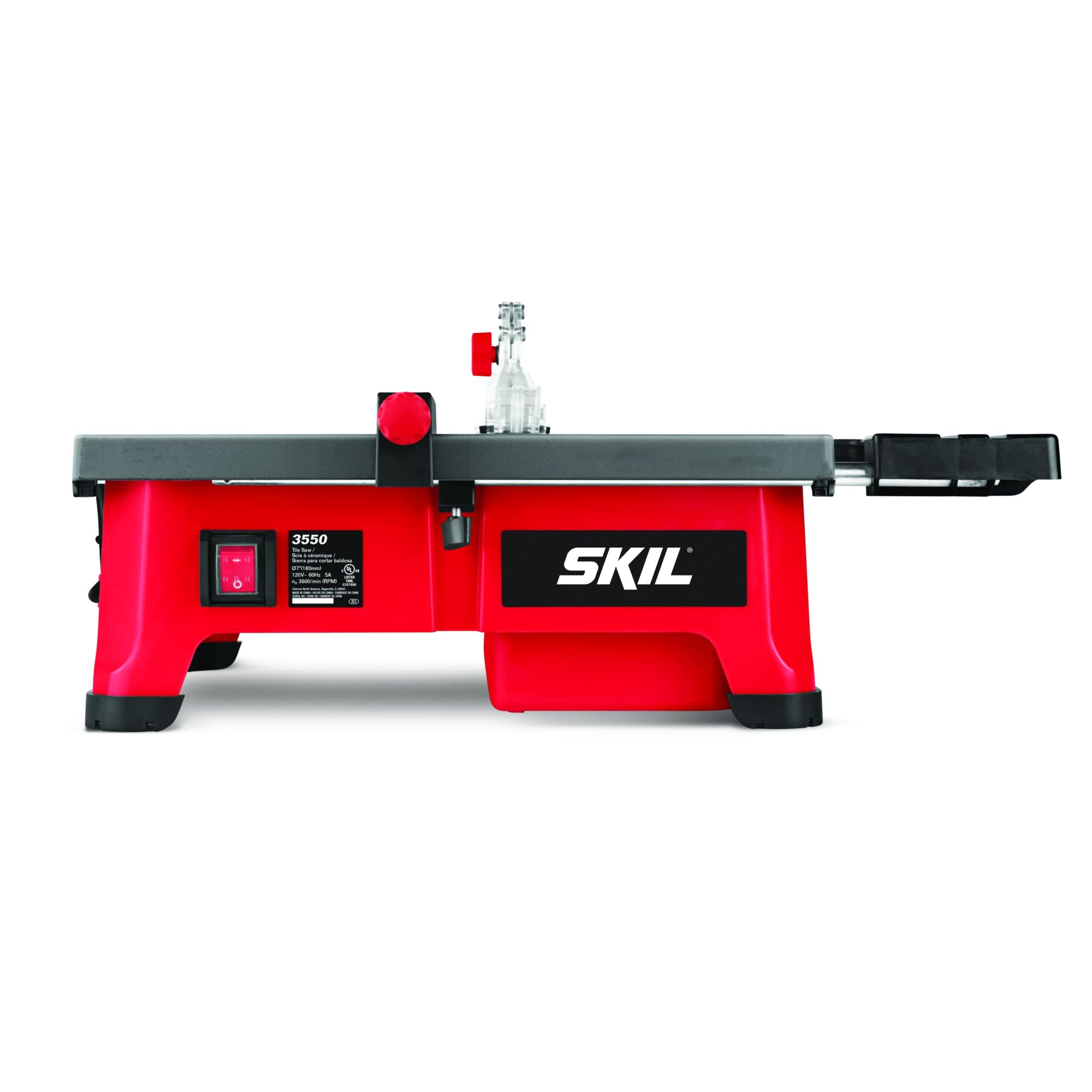
| Skil 3550-02 7-Inch Wet Tile SawBest Value | Small bathroom floors and DIY infill | 7 inches | — | 22.1 lbs | Amazon |
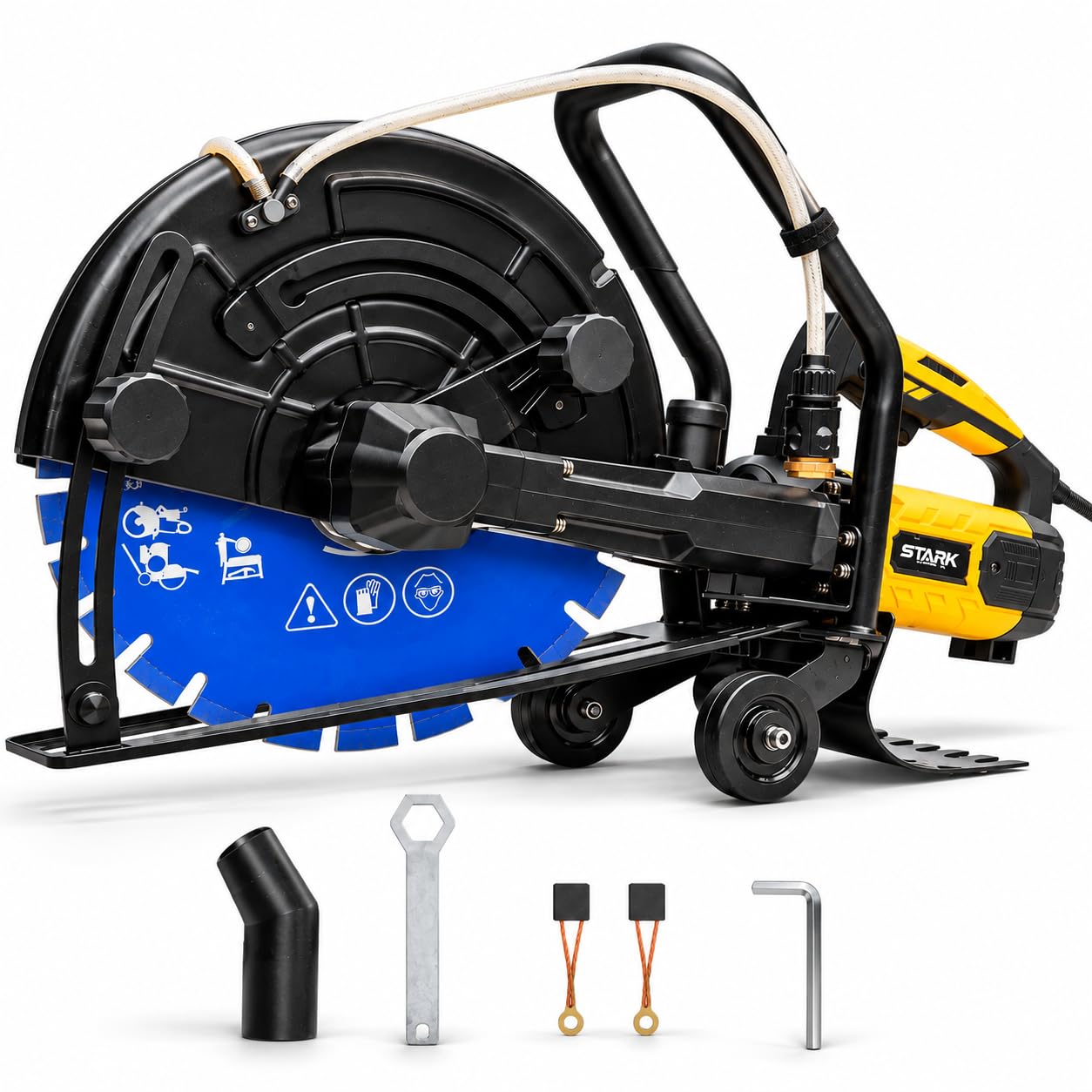
| XtremepowerUS 2600W 16-Inch Concrete SawHeaviest Cutting Depth | Concrete, brick and foundation cuts | 16 inches | 6 inches | 40 lbs | Amazon |
| FLEX CS 40 Wet Tile Saw | Portable flagstone and thick stone | 5 inches | 41 mm | 9 lbs | Amazon |
| Alpha 4-1/2″ Wet Stone Cutter | Hard porcelain and dense granite | 4-1/2 inches | — | 15.6 lbs | Amazon |
| PORTER-CABLE PCE980 Wet Tile Saw | Repeatable rip and miter cuts | 7 inches | — | 32 lbs | Amazon |
| SKILSAW SPT79-00 Medusaw | Flagstone and concrete with dust control | 7 inches | — | 16.9 lbs | Amazon |
| SKIL 7″ Walk Behind Worm Drive SPT79A-10 | Large slab grids on big jobs | 7 inches | — | 31.7 lbs | Amazon |
| VEVOR Wet Tile Saw with Stand 10 Inch | Large tile with a big wet tray | 10 inches (65Mn steel) | 3.8 inches / 95 mm | 116.4 lbs | Amazon |
| Husqvarna K 770 Gasoline Power Cutter | Cordless concrete and masonry cutting | 14 inches | 5 inches | 22.4 lbs | Amazon |
| DEWALT Wet Tile Saw with Stand (D36000S) | Oversized tile and heavy-duty jobsites | 10 inches | — | 91 lbs | Amazon |
Detailed Reviews
1. DEWALT Wet Tile Saw with Stand, 10-Inch, Corded (D24000S)
Our pick — 4.5+★ from 800+ verified ratings; the strongest balance of quality and price.
For big tile and clean edges, the 10-inch blade with a 3 1/8-inch plunge handles it.
The number to circle here is the 3 1/8-inch maximum depth of cut paired with a 28-inch rip capacity when you use the plunge. That is enough to halve a large porcelain tile and rip a slab down the middle, and the diagonal capacity of 18 inches by 18 inches covers bigger squares without flipping the piece. A wet saw this size tends to be the one you call when straight and fast both matter, and the 1.5 peak horsepower motor on a 120V supply has the headroom to hold speed through porcelain and travertine.
DEWALT builds in a cutline indicator and stainless steel rollers, and the published figure for that setup is accuracy to within 1/32 inch over 18-inch cuts. Owners frame it the same way — as buyers report, “Cutline indicator and stainless steel rollers provide stable, accurate cutting to within 1/32 inch over 18 inch cuts.” Accuracy at that level changes what the tool is for: it turns a wet saw into a layout tool, not just a trimmer. The water containment does its share too, keeping slurry in the pan instead of across your grout lines.
Performance is what earns this saw its following, and the build holds up to daily jobsite use. The honest trade-off is weight — this is a 69-pound machine, and it lands in the mixed column when owners talk about carrying it. The compact frame does let you stow it in a vehicle, and it ships complete with the stand, a 10-inch XP4 porcelain blade, the submersible pump, and both trays, so there is no shopping trip before your first cut. If your work is large-format tile and precision edges, the bulk is the price of that stability.
What earns it first place
- Cutline indicator plus stainless rollers hold cuts to within 1/32 inch over 18 inches
- 10-inch blade with 3 1/8-inch depth and 28-inch plunge rip capacity
- Ideal for hard materials like porcelain and travertine, checked against the 1.5 peak horsepower spec
- Ships with stand, blade, pump, water pan and trays in the box
The weight trade-off
- At 69 lbs, moving it to a job site takes real effort
- Full assembly is a two-person job for the stand
Who gets the most from it: buyers cutting large porcelain, marble or travertine who need repeatable, square edges and a wet setup that keeps the room clean.
Where the trade-off lives: think carefully if you are a solo remodeler lugging the saw between floors all day — 69 lbs is a load.
2. Skil 3550-02 7-Inch Wet Tile Saw
A bathroom-floor tiler that keeps the water put and the cleanup short.
Most home tilers underestimate how much mess a wet saw makes. The HydroLock system on this Skil is designed to hold water near the blade, and that single feature is the reason it suits a small bathroom floor or an infill job where you are cutting inside the house. The sliding side extension supports tile up to 18 inches by 18 inches, so a standard floor tile fits without tipping off the table.
The aluminum table top is built to resist rust, which matters when water is on it all day. You get an adjustable rip fence with a miter gauge for straight and miter cuts, and the bevel stops at 0, 22.5 and 45 degrees so you can turn a corner with a factory look. At 22.1 pounds this is a saw you carry out with one hand and store on a shelf. For light tile trimming the size is a genuine advantage — you are not wrestling a heavy deck just to cut a few pieces of porcelain.
Here is where this one earns its label honestly: it is a small-format cutter. The published cutting feedback is split — some tile cuts nicely and some jobs do not come out perfectly straight on this class of saw. Durability and stability also show up as the weaker areas, so on a long professional run you would want a sturdier deck. For a weekend bathroom project, a careful cut-and-check rhythm on a light saw is a fair trade for the low weight and the water control.
Where it makes sense: DIY bathroom floors, infill pieces, and small tile jobs indoors where the water containment pays you back in cleanup time.
The honest limit: perfect factory-straight cuts on dense porcelain are not this saw’s strong suit — dry-fit each piece before you commit the adhesive.
Reach for this if: you are tiling a small floor in your own home and want a light, rust-resisting saw that keeps water off the floor.
Look elsewhere if: your work is large-format tile or daily professional cuts — a bigger 10-inch deck serves that better.
3. XtremepowerUS 2600W 16-Inch Electric Concrete Saw
Six inches of cut depth from a 16-inch blade — this one is for slabs, not tiles.
The comparison that matters is right in the numbers: a 16-inch blade against the FLEX CS 40’s 5-inch blade. That extra reach is why this saw can cut 6 inches deep into concrete while the compact saw tops out at 41 mm. The 2600W motor turns the blade at a no-load speed up to 4,700 RPM, and the 20-amp draw means you are plugging into a proper circuit, not a household extension cord.
Owners describe the cutting the way you want to hear it — owners mention it slicing through 2-3 inches of concrete with ease. That is 2-3 inches against its 6-inch rated depth, which tells you where it feels comfortable. The wet/dry design is genuinely flexible: the built-in water feed with a control valve drops dust and helps the blade, while the dust extraction port and metal guard keep the cutting line visible. There is a double-protection switch so the trigger and safety lock both have to engage before the blade turns.
The catch worth weighing is breaker behavior. This is a 20-amp tool, and customers note it frequently trips a 20-amp breaker, so your power source has to be up to it. It also weighs 40 pounds, which is exactly the trade-off against the FLEX CS 40’s 9 pounds — you carry a lot more saw for that extra cutting depth. Durability lands as a split verdict, with some units holding up well. Rig a dedicated circuit before your first cut and this remains a lot of depth for the money.
What justifies its spot: a 6-inch maximum cut depth and a 2600W motor for concrete, brick and foundation work, with wet and dry cutting both available.
Power up before you cut: budget for a circuit that can feed a 20-amp tool, and expect the saw’s 40 lbs to be felt when you move it.
Pitched at you if: you are cutting concrete slabs, brick or masonry outdoors and need depth that a tile saw cannot give.
Think again if: your only outlet is a shared household circuit — the 20-amp draw will find its limit fast.
4. FLEX CS 40 Wet Tile Saw

Nine pounds, five-inch blade, and it still takes on a 1 3/4-inch flagstone.
Nine pounds is the whole story here. Set it against the XtremepowerUS at 40 pounds and the FLEX weighs 9 pounds, which is why it lives in a truck bed or a tile bag rather than a workshop. The 5-inch blade with a 7/8-inch arbor and a 20mm adapter ring spins at 12,000 RPM, and the tilting range runs 0 to 45 degrees for bevels.
For a saw this compact, the maximum cut thickness is a real 41 mm at 90 degrees. Owners put that to work on tougher stone than you might expect — one owner reports it cutting 1 3/4-inch flagstone without strain. There is a 4m water hose with a bronze valve in the box, plus a parallel guide and a curve-cut blade flange, so you can follow an edge or cut a curve without hunting for parts.
Where it asks for patience is the small blade. A 5-inch wheel gives you less depth per pass than the 10-inch DEWALT saws, so thick stone means more planning and fewer hero cuts. The footprint is also modest at 11.02 inches by 8.86 inches, which is a blessing for transport and a limitation for large tiles. If you cut flagstone and stone veneer on the move, this is the pick that will not wreck your back at the end of the day.
Why the size sells it
- 9 lbs makes it a genuine carry-along saw
- 12,000 RPM with a 0-45 degree tilt for bevel work
- Ships with a 4m hose, bronze valve, parallel guide and curve-cut flange
- Handles thicker stone than the compact size suggests
The small-blade caveat
- 5-inch blade limits depth per pass on thick slabs
- Small deck is not built for oversized tile
It fits you if: you cut flagstone, stone veneer or trim on site and want a saw you can carry in one hand.
Keep walking if: you need to halve large-format tile — the 5-inch blade and small deck are wrong for that job.
5. Alpha 4-1/2″ Wet Stone Cutter – 110v

The dense-stone specialist built to chew through porcelain and hard red granite.
This one is aimed squarely at material that fights back. The maker rates its motor for hard dense surfaces including porcelain, hard red granites and engineered stone, and the water-feed supply is there to knock down the dust those cuts throw. If you have ever tried to push a blade through engineered quartz on an underpowered saw, you know the stall-and-screech that follows; the Alpha is offered as the answer to that class of material.
The 4-1/2-inch format keeps it at 15.6 pounds and makes it easy to work a countertop edge or a hearth rather than a full floor. A built-in GFCI — a ground fault circuit interrupter that cuts power if current leaks — protects you in a wet cutting environment where a shock would otherwise be a real risk. It ships with a stand and a set of self-stick felt strips so the base does not scratch a finished surface.
The motor is where you should set expectations. Owner feedback splits: some find it powers through, and others report it bogs down on the hardest stone. That is the behavior of a cutter this size doing dense work, so lean on slow feed pressure rather than force. The base plate accepts guides in several orientations, which helps on long, straight cuts. One year of tool warranty backs it, and for a blade this size the price of entry is modest.
What it does best: a compact 4-1/2-inch wet cutter built for dense porcelain and granite, with built-in GFCI for wet work.
Cut slower, not harder: the motor can bog on the densest stone, so light pressure and steady passes keep the edge clean.
This one is for: countertop and edge work where the stone is hard and the cuts are short, and you want GFCI protection at the tool.
Not the tool for: long rips in thick stone, where a larger blade and more motor are the better match.
6. PORTER-CABLE PCE980 Tile Saw

An onboard miter square that turns repeat rips into a rhythm instead of a guess.
Repeat cuts are the difference between a fast job and a slow one, and this saw is built for them. The onboard miter square lines up miter cuts and gives you repeatable rip cuts without marking each piece, which matters when you are laying a floor and every tile needs the same trim. The roll cage doubles as a carrying handle and protects the cutting cart, so the saw survives the trip in the truck bed. The stainless steel fixed deck is chosen to hold up to water and jobsite abuse, and the 7-inch blade with a 2,850 RPM motor runs through porcelain.
The splash guard keeps water off you rather than across the room, and a drain plug lets you empty the pan over a bucket without a mess. The published body handles 12-inch square mesh stone tiles, which is the kind of mosaic and large-format work where a steady deck pays off. Owners praise build quality most, followed by value for money, and rate cutting performance consistently high.
The trade-off is in the sliding table. Many find it smooth, while others report traverse slop — play that lets the cart wander and shows up as chipping at the end of a cut. Durability and sliding-table feedback both come in mixed, so it is worth checking cart tightness before a finish work run. It weighs 32 pounds, which puts it in the middle of this group and easy enough to move. For repeatable cuts on mid-size tile, the miter square and deck make a strong case.
Its strongest card: onboard miter square plus a stainless fixed deck for repeatable straight, rip and miter cuts in one pass.
Keep the cart tight: the sliding table shows some play on some units, so check it before cutting visible edges.
Pick it when: your job is mid-size tile with lots of repeat rips and miters, and you want a saw you can carry with a roll cage.
Skip it when: you need large-format capacity — the 7-inch blade and shorter split are built for smaller tile.
7. SKILSAW SPT79-00 15-Amp Medusaw Worm Drive Saw for Concrete

A worm-drive concrete saw with wheels under it and a retractable pointer up front.
Worm drive gearing is the old reliable for cutting dense material, and here it comes wrapped in a 7-inch, 15-amp setup that weighs 16.9 pounds. The integrated rolling foot plate with rubber wheels lets the saw glide across a concrete surface instead of fighting you, and the adjustable plunge lock and retractable front pointer track the cut line and pull back in tight spaces. It is a system, not just a blade and a motor.
The dust side is where this saw draws deserved attention. The wet/dry dust management cuts dust for cleaner work, and the dual water spray system in the reviews is credited with quenching dust effectively. If you have cut concrete in a driveway with a cloud around your head, you understand how much that changes the day. Rust-resistant brackets and fasteners protect against corrosion, and GFCI protection reduces the risk of shock during wet cutting.
Quality is the quality here: the worm drive and steady build are what owners notice first, with performance and cut quality following. Flagstone cutting comes up as a smooth match for this saw. It is not the deepest cutter on this list — the XtremepowerUS goes to 6 inches and this does not — but for clean cuts with dust held down, it hits a useful middle. The 15-amp draw means a proper circuit, as with any saw this size.
What owners come for
- Worm drive power in a 16.9-lb body
- Rolling foot plate and retractable pointer for tracking a line
- Wet/dry dust management plus GFCI protection
- A proven match for flagstone and concrete cutting
Where the limits sit
- 7-inch blade gives less depth than a dedicated concrete cutter
- Needs a circuit that can carry a 15-amp tool
Best suited to: flagstone, concrete and masonry work where dust control and a line-tracking pointer matter more than maximum depth.
Look elsewhere for: deep slab cuts that need a 16-inch blade — this saw is built for mid-depth work.
8. SKIL SPT79A-10 Walk Behind Worm Drive Skilsaw
 alt=”SKIL 7 Walk Behind Worm Drive Skilsaw for Concrete SPT79A-10″>
You walk it, not carry it — a worm-drive concrete saw on a folding handle.
The walk-behind format is the point. The height-adjustable folding handle extends to your working height and folds for transport, and the two-finger trigger is shaped to reduce fatigue on long grid runs. The Dual-Field motor is designed to increase cooling and extend tool life, which is the sort of thing you care about when the saw is earning its keep five days a week. Die-cast aluminum housings, guard and foot with rust-resistant brackets hold up to wet cutting and weather.
Throughput is the real-world story. One owner reports cutting a 12 x 12 grid into a 5,000 sq. ft. slab in about 3 hours. Wet/dry dust management keeps cuts cleaner and the tool cooler, and the saw ships with a vacuum adapter, water feed attachment, side handle, wrench and carry bag. At 31.7 pounds it is heavier than the handheld Medusaw but does not need to be lifted onto every cut.
Two things ask for your attention. Dust collection divides opinion — some owners find it makes a lot of dust, so a vacuum on the adapter is worth planning. And there is honest disagreement over speed against gas-powered units, so if raw pace on the biggest slabs is your only metric, weigh that. Straightness shows up as an area some would improve. For grid cutting on large pours, the folding handle and Dual-Field motor make a practical argument.
Built for the long run: a folding, height-adjustable handle and Dual-Field motor aimed at cooling and tool life on large slab grids.
Plan the dust route: hook the vacuum adapter up, since dust collection feedback is split and gas saws still set the speed benchmark.
For you if: you cut grids on large slabs and want a walk-behind worm drive that saves your back and works with a vacuum.
Not for you if: you need maximum cutting speed against gas saws, or you work mostly in tight indoor spaces.
9. VEVOR Wet Tile Saw with Stand 10 Inch 65Mn Steel Blade

A 10-inch wet saw on wheels, built to take on whole floors of large tile.
Capacity is what separates this from the small cutters. The 10-inch 65Mn steel blade rides a 4,500 RPM motor through ceramic, porcelain, floor tile and marble, and the cutting depth reaches 3.8 inches (95 mm). For large projects, the numbers that matter are the 36-inch (914 mm) tile capacity and the 24-inch (610 mm) diagonal capacity — both big enough to handle the oversized formats that stall a 7-inch saw.
The wet side runs a detachable PP water reservoir and a pump system that keeps the cutting area cleaner and reduces dust exposure. An infrared guide line helps you align the blade to your mark, and the built-in scale handles both straight and diagonal cuts. Two non-slip rubber wheels on the base let you roll it between rooms rather than lift it. It is a machine built around the tile, not around your arms.
The obvious cost is weight: this is a 116.4-pound saw, and it lives where you park it. That is fine for a renovation that stays in one room and a real nuisance if you are moving between sites every day. Reviewers point out it cutting tile cleanly, and praise the blade quality and cutting performance. If big-format work is your mainstay, a heavy stationary platform is the right tool for the job.
The capacity case: a 10-inch blade with 3.8-inch depth, 36-inch tile capacity and a 24-inch diagonal, all in one wet platform.
It stays put: at 116.4 lbs this is a jobsite fixture, so plan it for one location rather than a daily commute.
Worth it for you if: your work is large tile, floor tile or marble and you want a big wet tray with an infrared guide and rubber wheels.
Reconsider if: you need to carry the saw up stairs — the 116.4-lb body is a two-person job at minimum.
10. Husqvarna K 770 Gasoline Power Cutter

No cord, no breaker, no outlet — a gas saw for the middle of a driveway.
Gas power is the reason this saw exists on a list full of corded machines. There is no 15-amp or 20-amp circuit to trip, so you can cut where the power does not reach. The 14-inch blade and a maximum cutting depth of 5 inches put it firmly in concrete and masonry territory, and the 22.4-pound body is light for a machine with this reach.
The build details are aimed at keeping it running. Semi-automatic smart tension handles the belt, cutting the risk of under- or over-tensioning, and the cast magnesium crankcase uses a 3-bolt joint to attach the cutting head for higher torsional rigidity. A poly-v belt, a maintenance-free Durastarter and an active air filtration system are all there to stretch the service intervals. Owners praise its cutting performance most, followed closely by reliability.
The facts to sort first: the saw arrives without a blade, so budget for one before you cut, and a market for blades sits separately. It is also a 5-inch depth machine, so a deeper slab cut needs a different tool. The weight divides opinion — some find it right, some find it a touch heavy. Starting is consistently the happy part, with first-pull starts the common report. For remote work with no source of electricity, the trade-offs are reasonable ones.
What makes it the gas pick
- Cordless gas power solves the no-outlet jobsite
- 14-inch blade with 5-inch maximum cut depth
- Reliability is the standout trait in owner feedback
- Rated for easy first-pull starting
Know before you buy
- Blade is not included, so add one to your first order
- At 5 inches of depth it is not a deep-slab tool
Make it yours if: the cut is off the grid — a driveway, a remote foundation, a job with no power nearby.
Steer clear if: you cut indoors or need more than 5 inches of depth, where a corded or larger saw serves better.
11. DEWALT Wet Tile Saw with Stand, 10 Inch, 15-Amp (D36000S)

Built to halve a 36-inch tile — the deepest rip capacity on this page.
The headline spec is a 37-inch rip cut capacity, or 41 inches with the plunge, plus 18 inches of cutting clearance to the left of the blade. Together that means you can rip a 36-inch by 36-inch tile in half, which is beyond what most wet saws on this list can do. The 8-1/2-inch crosscut capacity is sized for 6-inch sills and 8-inch by 48-inch planks at a 30% offset. A 10-inch blade, stainless-steel rollers and a rigid frame hold accuracy to within 1/32 inch over 30-inch cuts.
The water system keeps the work area clean and dry even on big pieces — 18-inch by 36-inch and 24-inch by 24-inch tiles fit fully inside the water tray. Integrated storage for the cart extension, miter guide and wrenches means the accessories travel with the saw rather than getting lost. The 15-amp motor produces 1220 MWO (a motor-output rating) for demanding material, and the 28-7/8-inch width from column to cart edge lets it roll through a standard 30-inch door frame.
Weight is the honest cost of all that capacity. At 91 lbs this saw is about as heavy as a portable wet saw gets, and assembly in the feedback ranges from simple to complicated depending on the owner. It is the bigger brother to the DEWALT D24000S earlier in this list: more rip capacity, more weight, and a higher ceiling for oversized tile. Owners praise the blade quality most, followed closely by cutting performance and motor power. If your work regularly involves large planks and oversized slabs, those trade-offs are ones you make once.
Rip capacity that changes jobs: 37 inches (41 with plunge) and 18 inches of left-side clearance let it halve a 36-inch tile.
What you trade: 91 lbs of saw and a wider assembly job, so it is a shop or truck-mounted tool, not a lift-and-carry.
This belongs in your truck if: oversized tile and long planks are routine and you need rip capacity no compact saw can match.
Not the saw for you if: your tile is standard size and you work alone — the 91-lb body makes every move a decision.
Know the Specs
Blade diameter and maximum cut depth
Blade diameter is the size of the cutting wheel, and maximum cut depth is how far the blade can reach into the material. They are related but not identical: the housing and guard decide how much of the blade you actually get to use. A 10-inch blade on the DEWALT D24000S reaches 3 1/8 inches deep, while a 16-inch blade on the XtremepowerUS reaches 6 inches. Always buy by cut depth for your thickest stone, since a saw that cannot reach through the piece is a saw that cannot finish the job in one pass.
Amperage, wattage and motor speed
Amperage tells you how much current the motor draws, and wattage tells you thepower it consumes. RPM tells you how fast the blade spins. These together decide whether the saw holds speed on dense stone. A 15-amp motor at 2,850 RPM like the PORTER-CABLE is built for porcelain, while a 2600W motor turning up to 4,700 RPM on the XtremepowerUS has more headroom for concrete. If the motor cannot hold speed, the blade stalls and leaves a rough edge, so match the rating to your densest material rather than your average one. A higher amperage also means your circuit has to carry it, which is why the 20-amp XtremepowerUS can trip a household breaker.
Wet cutting versus dry cutting
Wet cutting runs water onto the blade to carry dust away and cool the cut. That keeps the work area cleaner, helps a diamond blade last, and reduces the dust you breathe. Dry cutting suits quick outdoor work but throws a cloud, so a dust port or vacuum hookup matters. Several saws here run both ways, including the XtremepowerUS with its water valve and dust extraction port. For hard porcelain and granite, wet cutting is usually the cleaner, kinder option.
Rip capacity and diagonal clearance
Rip capacity is how wide a cut the saw can make across a straight line, and diagonal clearance is how big a tile it can cut corner to corner. Both decide whether a saw can handle large-format tile. The DEWALT D36000S rips to 37 inches and clears 18 inches left of the blade, so it can halve a 36-inch tile. A smaller 7-inch saw has a shorter split and stops at mid-size tile. Check both numbers against the biggest piece you plan to cut before you buy.
Common Questions
What is the difference between a wet tile saw and a concrete saw?
Can a stone cutting machine cut through porcelain tile?
Do I need a special circuit for a 20-amp concrete saw?
How deep can a stone cutting machine cut in one pass?
Is a gas power cutter better than a corded concrete saw?
How much water does a wet tile saw need and how do I drain it?
Will a walk-behind concrete saw fit through a standard door?
What does GFCI on a stone cutting machine actually protect against?
Can I cut large 36-inch tile with a standard 7-inch wet saw?
Do stone cutting machines come with a blade included?
The Bottom Line
For most buyers, the stone cutting machine winner is the DEWALT D24000S because its 10-inch blade, 3 1/8-inch depth and 1/32-inch accuracy handle both large-format porcelain and hard stone in one machine. If you need depth into concrete and brick rather than tile, grab the XtremepowerUS 2600W 16-Inch saw and its 6-inch maximum cut. And for flagstone or trim you carry from site to site, the 9-pound FLEX CS 40 is the one to reach for.
Before you order, run the three checks that decide the job: the thickness of your thickest stone against the rated cut depth, the size of your largest tile against the rip and diagonal capacity, and whether the saw’s amperage matches the circuit you actually have. Get those right and any of these saws will cut clean and straight. The DEWALT D24000S holds the strongest combination of accuracy, capacity and a complete kit in the box, which is why it tops the list.
How we choose
We do not accept paid placement. Every pick is matched to a real buyer and a real use-case; we do not hands-on test units.
Sources
Specifications: manufacturer listings and product documentation. Review insights: verified customer reviews, as of November 2026. Pricing: not shown on this page (it changes often); check the current price via the retailer link.
As an Amazon Associate, Tactical Gear Guy earns from qualifying purchases. This does not affect which products we feature.