Specs are compiled from manufacturer listings and verified buyer reviews and can change over time — please confirm the key details on the product page before buying.
If your kitchen freezer is jammed with one bag of peas and a mystery container from last winter, a small chest freezer fixes that in one move. You want extra cold storage for batch cooking, a bulk meat buy, or a garage overflow — without losing a whole corner of the kitchen. The picks below all land in roughly the 2.0 to 7.0 cubic feet range, so you get real frozen capacity in a footprint that still fits an apartment, a dorm, or a spare wall. One honest note up front: this list uses flexible, human-like matching for that small/compact size band, so not every pick is the exact cubic footage you typed in. The nearest same-type size does the same job, and we flag capacity clearly for each one.
This guide is built by comparing the manufacturers’ published specifications and the patterns across verified customer reviews, so you get each pick’s real strengths and trade-offs instead of marketing spin.
Frost build-up, door hinges, and daily power draw separate a good compact freezer from a noisy one that ices over. This list covers the best small freezers for home use, with honest capacity, noise, and defrost notes for each.
Top Picks

How To Choose The Best Small Freezers for Home
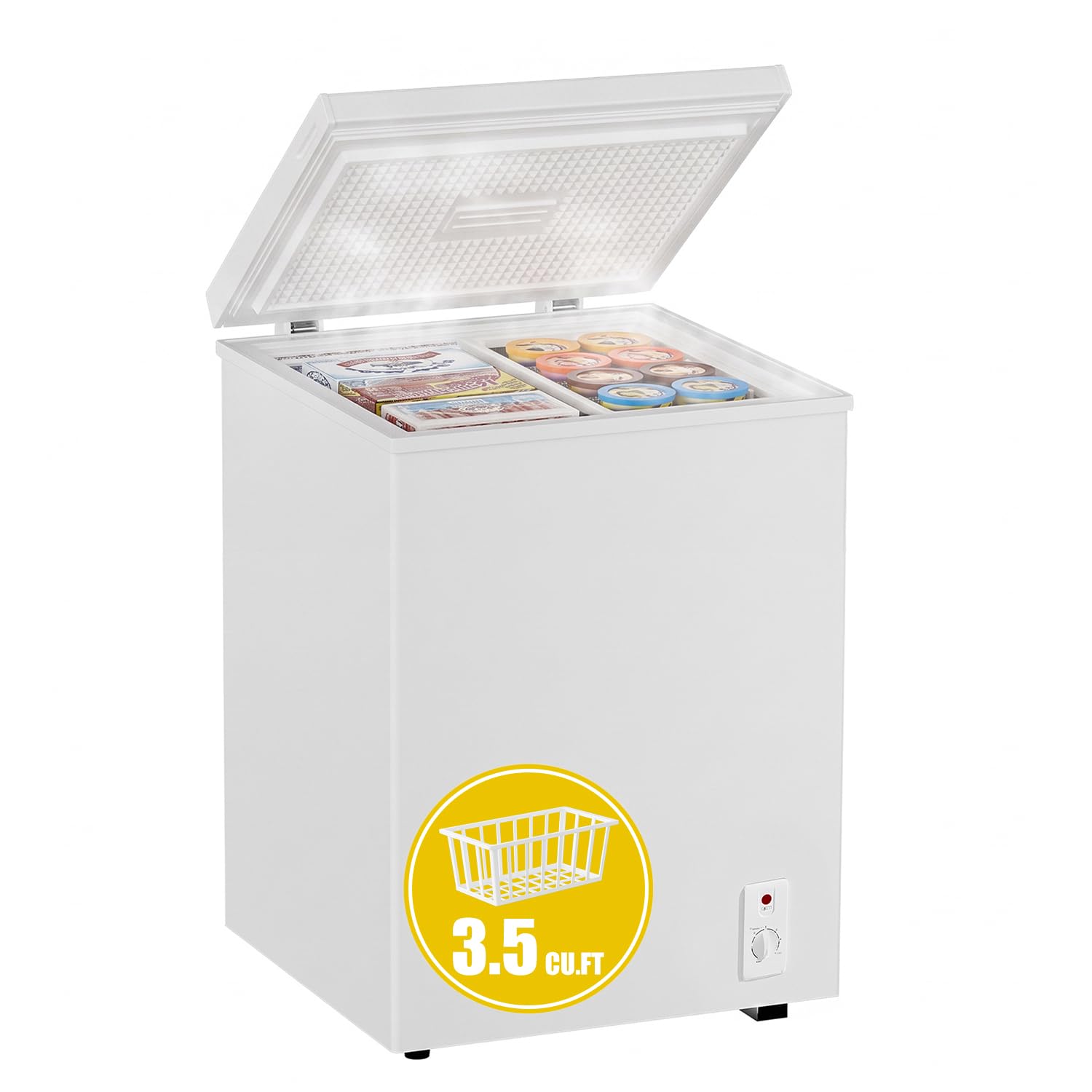
The mistake most first-time buyers make is shopping by cubic feet alone. Two freezers both labeled 3.5 cubic feet can hold very different amounts of actual food, and one can run far quieter or use less electricity than the other. What you should really compare is how much food weight each one swallows, how cold it gets, and how loud it hums while you are watching TV in the next room.
Match capacity to how much food you actually freeze
Think in pounds and meals, not just numbers on the box. A freezer holding 60 lbs of beef or 84 lbs of fish is enough for a two-person household doing a bulk-shop once a quarter. If you are feeding four or more, look at 5.0 to 7.0 cubic feet so you are not playing freezer Tetris every week. A small upright model with removable shelves lets you adjust shelf height for tall items, while a chest model keeps a deeper, wider well for large cuts.
Decide between chest and upright before anything else
A chest freezer opens from the top and holds more food in the same floor space, because cold air stays put when you lift the lid. An upright freezer opens like a fridge, so you can see everything at once and reach the back without digging. Chest freezers suit long storage of large cuts; uprights suit daily grab-and-go.
Check the noise rating if it lives near your living space
Decibels (dB) measure how loud the compressor hums. A freezer rated at or under 42 dB is about the level of a quiet library conversation, so it won’t cut across a movie. Under 38 dB is quieter still and works well in a studio apartment or a bedroom corner. Garage placement gives you more slack on noise, but garages swing in temperature, so a “garage ready” model is worth the extra thought there.
Look at defrost and drainage before you buy
Most compact freezers are manual defrost, meaning ice slowly builds on the walls and you clear it out yourself. A drain port at the bottom makes that job far easier: you pull a plug and let meltwater run into a bucket instead of bailing it out with towels. If you dread maintenance, factor the drain in as a must-have, not a bonus.
Side-by-Side Comparison
| Model | Best For | Capacity | Temperature Range | Noise / Power | Amazon |
|---|---|---|---|---|---|
| EUHOMY 3.5 Cu Ft Chest Freezer★ Best Overall | Best Overall | 3.5 cu ft | -11.2°F to 14°F | ≤42 dB | Amazon |
| BODACIOUS 3.5 Cu Ft Compact ChestLowest Daily Draw | Lowest Daily Draw | 3.5 cu ft | 6 settings | Whisper-quiet | Amazon |
| DEMULLER 3.5 Cu Ft with Temp DisplayPrecise Temp Control | Precise Temp Control | 3.5 cu ft | -15°F to 41°F | <38 dB | Amazon |
| LifePlus 3.5 Cu Ft Chest Freezer | Low Running Cost | 3.5 cu ft | -7.6°F to 21.2°F | 0.37 kWh/day | Amazon |
| WANAI 3.5 Cu Ft Chest Freezer | Best for Small Spaces | 3.5 cu ft | Level 1-2: 32-50°F / 3-7: -11.2-32°F | Low-noise | Amazon |
| BLACK+DECKER 2.0 Cu Ft Compact Chest | Smallest Footprint | 2.0 cu ft | Mechanical dial | Manual defrost | Amazon |
| BANGSON 3.0 Cu Ft Upright Freezer | Best Upright | 3.0 cu ft | -11.2°F to 10.4°F | Reversible door | Amazon |
| Midea 7.0 Cu Ft Convertible | Largest Capacity | 7.0 cu ft | 0°F to 110°F (freezer mode) | 48-hr outage hold | Amazon |
| FRIGIDAIRE 5.0 Cu Ft Chest | Garage Ready | 5.0 cu ft | 7 thermostat settings | Aluminum liner | Amazon |
Detailed Reviews
1. EUHOMY 3.5 Cubic Feet Chest Freezer
Our pick — 4.5+★ from 650+ verified ratings; the strongest balance of quality and price.
The 3.5-cubic-foot freezer that swallows 60 lbs of beef and still opens with one hand.
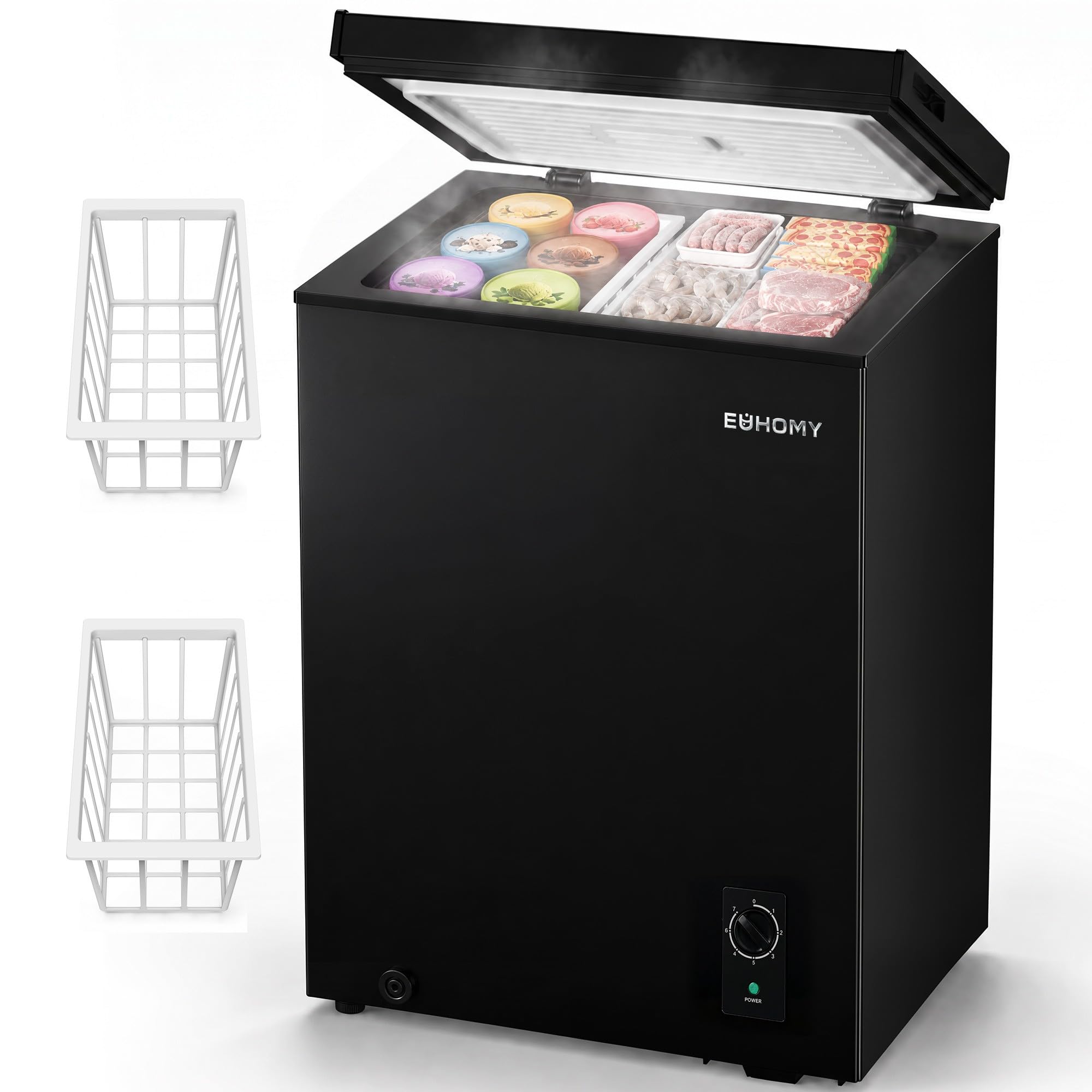
If you have ever skipped a bulk meat deal because your fridge freezer had no room, this is the fix. The EUHOMY packs its food capacity into 3.5 cubic feet, and that space holds up to 60 lbs of beef, 84 lbs of fish, or 100 lbs of chicken — enough for a holiday turkey plus sides, or a quarter of a cow split with a friend. It takes about 2.8 square feet of floor space, so it tucks into a kitchen corner without eating the room.
What wins people over is how reliably it holds temperature. You set one of seven thermostat levels, from “0” (off) through “7” (coldest), and it stays where you put it — the operating range runs from -11.2°F to 14°F, cold enough to keep meat solid for months. It does that on roughly 0.53 kWh of power a day. Compared with the LifePlus 3.5-cubic-foot chest below, which draws about 0.37 kWh a day, the EUHOMY uses a bit more electricity — but you are buying steadier, deeper cold for that trade.
Practical touches make it easy to live with. The lid holds open at either 45° or 90° so both hands stay free while you load it, and two storage baskets keep small items from vanishing to the bottom. A drainage port at the base makes defrosting a drain-and-wipe job rather than a towel marathon. The EUHOMY is also the heavier build here at 46.3 pounds, versus 38.8 pounds for the BODACIOUS below — more heft to move into place, but it feels planted once it is there. The honest caveat: this is manual defrost, so ice builds over time and you manage it yourself, and a few buyers found the price harder to justify than they expected.
Where this freezer earns its keep
- Holds up to 60 lbs of beef, 84 lbs of fish, or 100 lbs of chicken in one well
- Stable -11.2°F to 14°F range on a 7-level dial
- Lid locks open at 45° or 90° for hands-free loading
- Two baskets plus a bottom drain port for easier defrosts
- Runs at ≤42 dB — quiet enough for a kitchen wall
What to plan around
- Manual defrost, so you clear ice build-up yourself
- Heavier at 46.3 pounds — get help carrying it in
- Uses more daily power than the most efficient 3.5-cubic-foot pick here
Reach for this if: you want the strongest all-around small chest freezer for a family that buys in bulk.
Think twice if: you want the absolute lowest energy draw or never want to defrost by hand.
2. 3.5 Cu. Ft. Compact Chest Freezer
The lean, quiet freezer that sips 0.37 kWh a day and slides into a tight corner.
This is the pick for anyone who flinches at the power bill. It runs on 0.37 kWh of electricity per day — the maker puts that at about 2 a day at a 12-cent-per-kWh rate, which makes it the lightest power draw of the 3.5-cubic-foot chests here. It is also the smallest build in that group, at 16.73″D x 20.47″W x 28.54″H. Compared with the EUHOMY above at 18.89″D x 21.46″W x 33.64″H, it is the more compact unit — easier to wedge into a garage nook, an RV bay, or a gap beside the kitchen cabinets.
Weighing 38.8 pounds against the EUHOMY’s 46.3 pounds, it is the easier one to carry up a stairwell and shift around solo. You get six customizable temperature settings via a mechanical dial, and manual defrost with a frost drainage port so clearing ice is a drain-and-wipe rather than a scraped-knuckle fight. What owners keep coming back to is how quiet it stays while running — it does not cycle on constantly and does not intrude, which is the whole reason a studio or dorm buyer picks a compact unit.
The catch is precision: six settings on a mechanical dial is coarser than the electronic 1°F control you get on the DEMULLER below, so if you freeze a lot of delicate items and want exact temps, that matters. For everyday meat, veg, and ice cream, the dial covers you comfortably. Where you might hesitate: the lid is stainless steel, but this is a straightforward, no-frills unit, so you are buying efficiency and quiet over extra bells.
Efficiency is the whole pitch: 0.37 kWh a day and the most compact footprint in the 3.5-cubic-foot tier make it a natural fit for small rooms and budget-minded households.
The right call for: apartment dwellers and RV owners who want low running cost and a smaller body.
Hold off if: you want exact electronic temperature control rather than a six-step dial.
3. DEMULLER Deep Freezer Chest 3.5 Cubic Feet
A digital panel that nails the temp to 1°F, and a hum you forget is there.
If you want to set a number and trust it, this is the freezer to look at. The DEMULLER uses electronic control with an intelligent digital display that holds temperature to within 1°F, and it covers a wide -15°F to 41°F range. That spread lets you run it hard for ice cream or seafood, or back it off toward fridge-like cooling for drinks and fresh items — flexibility the simpler dial units here do not offer.
Cold reaches food fast, too. D-shaped cooling tubes (metal tubes shaped like a D that wrap the inside walls) spread cold around the whole interior rather than just the walls, so chilled drinks and fresh food come down to temperature quickly. On sound, it runs under 38 db (decibels, a measure of loudness) thanks to a high-efficiency compressor (the pump that does the cooling) — the quietest spec of the compact chests in this list, and a real difference if the freezer sits in a shared living space or just off the bedroom.
The size suits smaller homes: 3.5 cubic feet in 17″D x 21″W x 30″H, aimed at apartments, dorm rooms, and RVs. It ships with a built-in handle, a drain hole, and a basket, so setup is straightforward. The honest note is that all the electronic convenience means one more thing to learn than a plain knob — but the trade is worth it if precision matters. And as with any manual-defrost compact freezer, ice will build and you will clear it.
Standout spec: 1°F digital control across -15°F to 41°F puts this at the head of the compact class for anyone who freezes to a schedule.
Pick this one when: exact temperature matters — think ice cream, seafood, or a mix of frozen and near-fridge items.
Pass if: a simple mechanical dial is all you want and you would rather not manage a digital panel.
4. LifePlus Chest Freezer 3.5 Cubic Feet
A 0.37-kWh-per-day chest with hinges that hold the lid where you leave it.
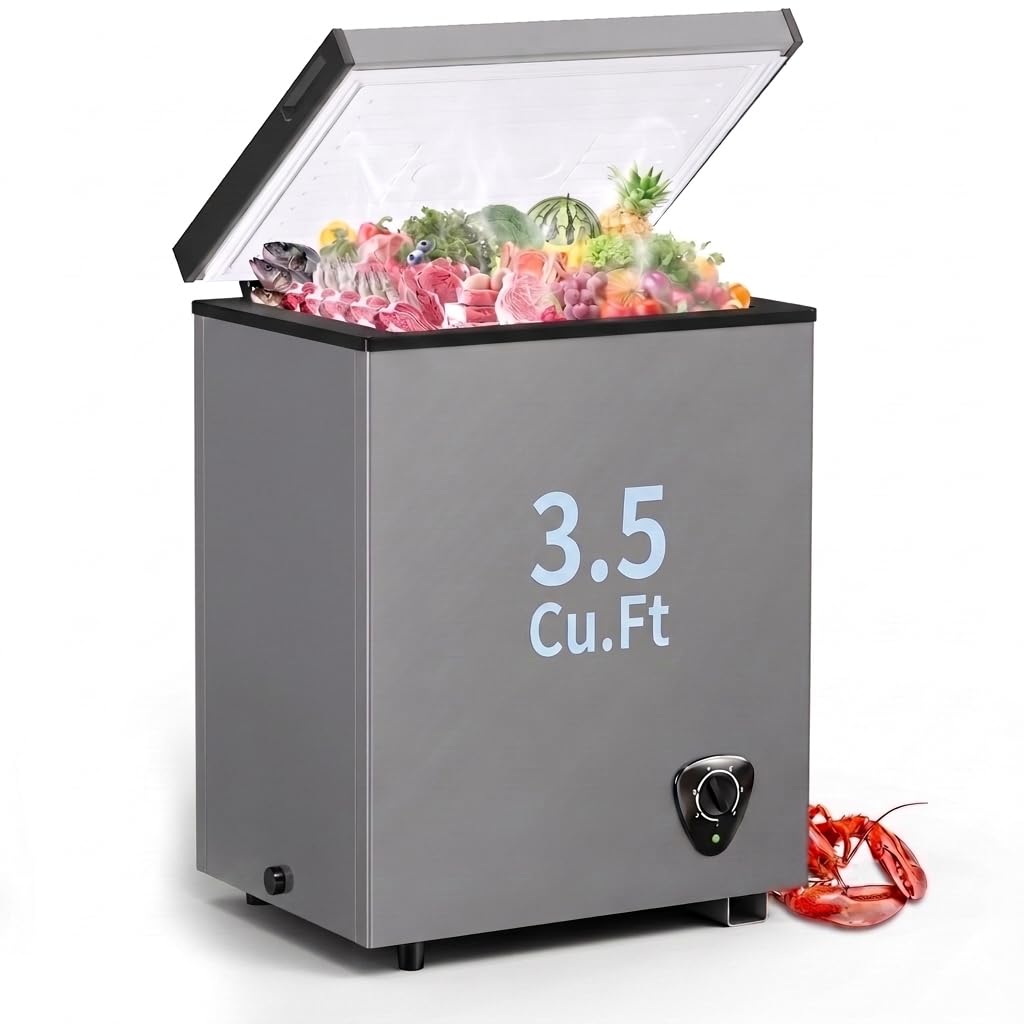
Start with what it costs to run: 0.37 kWh of electricity a day, thanks to an R600a high-efficiency compressor. That is one of the lower daily draws among the 3.5-cubic-foot chests in this list. It cools fast and locks cold air in, so food keeps its quality over long storage. The -7.6°F to 21.2°F range on seven adjustable settings covers frozen meat, veg, and ice cream comfortably, with a hanging top basket to keep day-to-day items reachable.
The door is where it quietly beats plain-lid units. Strong, balanced metal hinges and recessed handles let you park the lid open at different angles, roughly 70 to 90 degrees, so you can load with both hands while the door stays put instead of dropping on your fingers. Buyers report liking how much fits — 60 pounds of ground venison is one case that gets cited, which tells you how big the well really is despite the compact body.
It measures 22.4 x 18.5 x 29.5 inches and sits freestanding, so an apartment or kitchen corner works. The compressor runs quietly so it does not cut across daily life, and the interior is stain resistant. Two reminders worth knowing: it is manual defrost, and the model number in the listing (BD-74DGray) is note for warranty paperwork. Running-cost math depends on your local electricity rate, so treat any day-rate figures as a rough guide.
Why it appeals
- 0.37 kWh/day on an R600a high-efficiency compressor
- Hinges hold the lid open at multiple angles for hands-free loading
- -7.6°F to 21.2°F across seven adjustable settings
- Hanging basket keeps small items from sinking
Keep in mind
- Manual defrost — plan for periodic ice clearing
- Narrower temperature floor than the electronic DEMULLER’s -15°F
Choose it for: low operating cost and a chest that loads without the lid fighting you.
Look elsewhere if: you need sub-zero extremes for specialty freezing.
5. WANAI 3.5 Cu.ft Chest Freezer

A narrow 16.3-inch-wide body that fits first-apartment gaps other chests skip.
When floor space is the whole problem, the footprint decides it. This WANAI is 20.7″D x 16.3″W x 29.5″H, and at 38 pounds it is the easiest here to slide into a narrow kitchen gap or a first apartment’s spare corner. Its seven-grade thermostat does double duty: levels 1-2 hold 32°F to 50°F for drinks and fruit, while levels 3-7 dip to -11.2°F to 32°F for meat and seafood. That single dial spans chilled and deep-frozen in one box.
Everyday liveability is well thought out. A hanging removable basket holds small, frequently used items and pulls right out for fast access, freeing the deep well for big food packages. Adjustable legs level the unit on an uneven garage or basement floor. Manual defrost comes with a drain hole so meltwater runs out instead of pooling. Owners describe it as perfect for limited space — one comparison that sticks is it holding six gallons of ice cream — which says plenty about usable interior.
What it costs you: a dial thermostat and manual defrost, the same no-frills setup as the other compact chests here. Setup requires letting it stand upright at least 24 hours before you plug in, so plan the delivery day around that. It runs quietly and keeps temperature steady, which is exactly what a secondary freezer tucked in a corner needs to do.
The space-saving play: 16.3 inches of width and 38 pounds of heft make this the compact pick that actually fits tight spots.
Suits you if: your only free floor space is a narrow gap or a small apartment corner.
Choose differently if: you would rather have electronic temp control or a wider loading well.
6. BLACK+DECKER 2.0 Cu. Ft. Compact Chest Freezer, BCFK206
Two cubic feet that still packs in 70 lbs of frozen food — the smallest real option here.
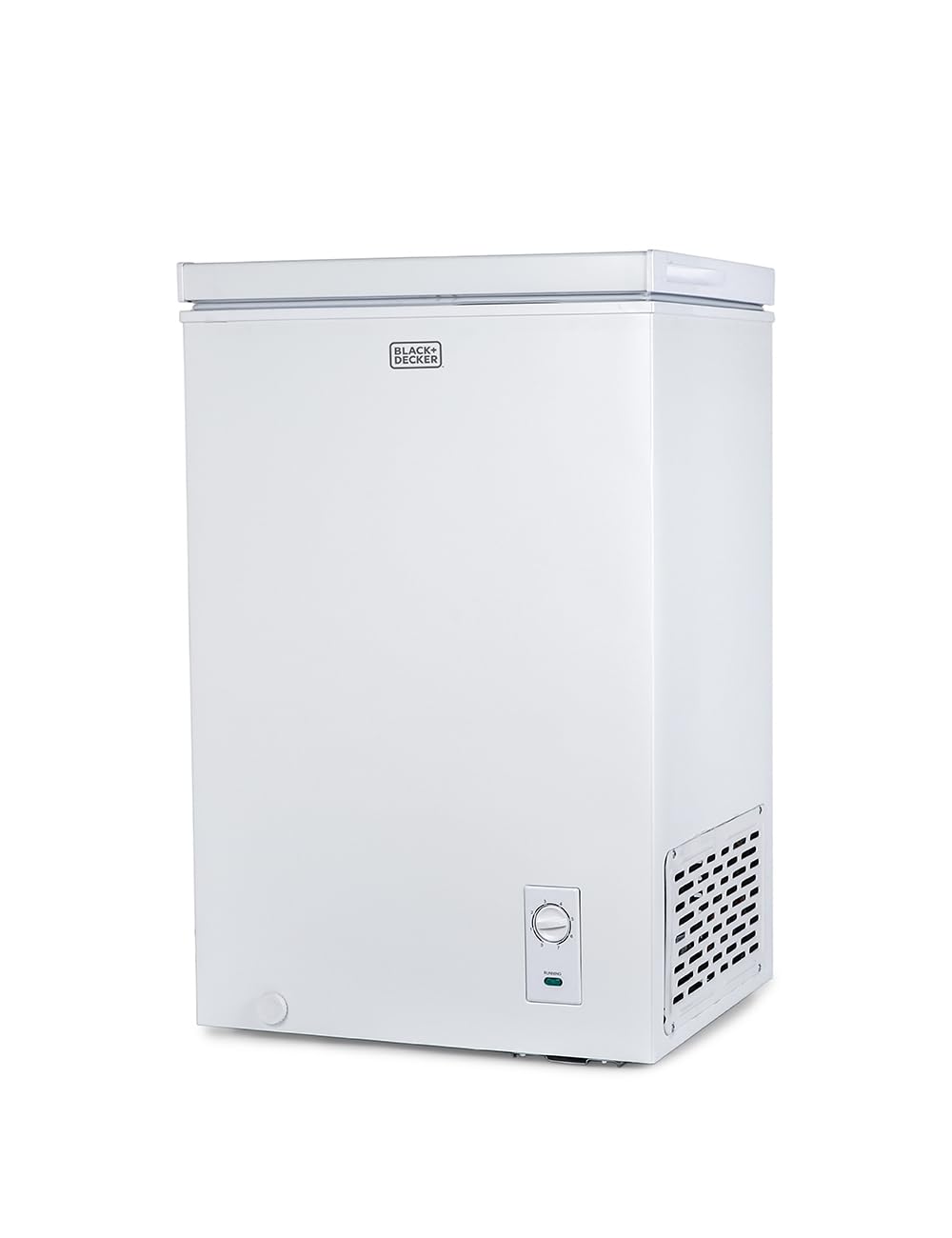
This is the go-small pick. At 2.0 cubic feet, the BLACK+DECKER holds a listed 70 lbs. of frozen foods — cold meat, frozen dinners, ice cream — in a body measuring 17.3″D x 20.9″W x 27.6″H. If you live in a small apartment and just need a second cold spot for overflow, that combination of modest size and real poundage covers you without claiming a whole utility room.
The controls are refreshingly simple. A mechanical temperature dial with an indicator light sits outside the cabinet, so you can adjust the cold without opening the lid and losing the chill. Inside, a removable basket keeps smaller items organized and easy to grab. Maintenance is manual defrost with an easy-access drain, which takes the sting out of clearing ice.
Where you should weigh it carefully: it is the smallest capacity on this list, so it is best as a supplement to your kitchen freezer, not a replacement for a family’s main frozen storage. Quality and functionality land well, but a few buyers found temperature consistency hit-or-miss — some saw it hold cold well, others felt it did not reach their target. For light, supplementary use it delivers; treat it as backup capacity, not the primary deep freeze.
Working in its favor
- 2.0 cu ft holds up to 70 lbs of frozen food
- Outside mechanical dial with indicator light — adjust without opening the lid
- Removable basket plus an easy-access defrost drain
- Smallest body here, ideal for apartments
Size up for
- Only 2.0 cu ft — a supplement, not a main freezer for a family
- Temperature consistency varied for some buyers
Made for: apartment dwellers who want modest overflow storage in the least floor space.
Size up instead if: you are freezing for four or more people every week.
7. BANGSON 3.0 Cu.ft Compact Upright Freezer
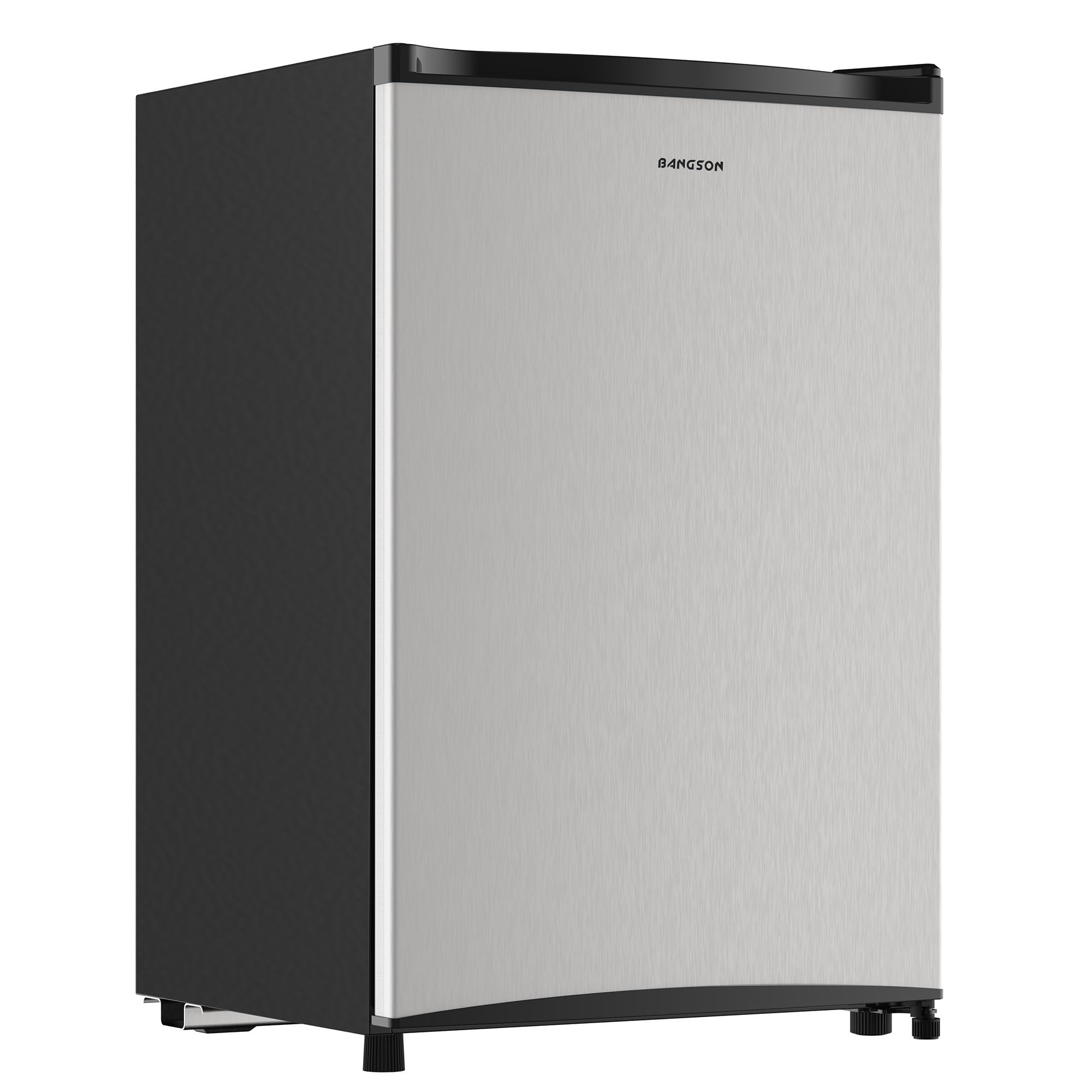
The upright that fits under a loft bed and freezes ice cubes in 45 minutes.
Not everyone wants to bend over a chest lid. This BANGSON opens like a fridge, so you see the whole interior at a glance and reach the back without digging. It is 3.0 cubic feet in a 20.28″W x 18.9″D x 31.57″H body, sized for two to three people, a dorm, or a workplace kitchen. It freezes fast, too — ice cubes are ready in about 45 minutes, which tells you the cold gets to the food quickly.
The size is what people talk about most, and for good reason: it slips under a loft bed or onto a dresser in a bedroom, so students and small-space renters can keep real frozen storage within reach. The reversible door and flush-back design give you placement freedom, letting you set which way it swings to suit the room. Adjustable leveling legs keep it steady on less-than-perfect floors. Five temperature levels, set from the rear, cover -11.2°F to 10.4°F.
Removable inner shelves let you drop a shelf to fit a tall item, which is the flexibility a chest cannot match. One honest note: the bottom shelf has a smaller usable capacity than the upper shelves, so plan the bulk of your tall items higher up. Some buyers flag noise, and a few found durability varied — worth knowing if it will sit right by your bed. For dorm or office duty, the upright format and quick freeze make it a strong fit.
Format is the draw: a reversible upright door, removable shelves, and a sub-45-minute ice-cube freeze suit dorm rooms and office kitchens better than a chest lid.
Best for: dorm rooms, offices, and bedrooms where a lift-up chest lid would be awkward.
Reconsider if: you need the deepest bulk capacity or the quietest possible unit for a bedside spot.
8. Midea 7.0 Cu.ft Chest Freezer

A 7.0-cubic-foot chest that flips to fridge mode and holds cold through an outage.
For a bigger household or a serious meal-prepper, capacity is the deciding factor. This Midea runs 7.0 cubic feet — the roomiest option here — sized for families of four or more or as a second freezer in a garage or basement. It fits a lot of real food; one reference point that lands is eight weeks of meals fitting inside. That is bulk storage you can meal-prep a season around.
Two features cut against the usual chest limits. First, it converts between freezer and fridge modes, so it adapts as your storage needs shift from frozen stock to fresh overflow. Second, it is garage ready — tested to run from 0°F to 110°F in freezer mode, and 38°F to 110°F in fridge mode, so a non-climate-controlled garage does not knock it off its game. Add power-outage protection that keeps items frozen for up to 48 hours and you have a unit built for real households.
The practical size is 30.3″W x 22″D x 33.5″H, so clear the floor space before it arrives. It is the heaviest pick at 65.3 pounds, so bring a second person for the carry-in. Adjustable legs help level it, and a removable plastic basket keeps smaller items handy, with an LED light inside. A 1-year parts-and-labor warranty backs it — but register the product on Midea’s site for faster support if anything comes up.
Why big households like it
- 7.0 cu ft — room for eight weeks of meals
- Converts between freezer and fridge modes
- Garage ready from 0°F to 110°F in freezer mode
- Keeps items frozen up to 48 hours after power loss
Before you commit
- 65.3 pounds and a wide footprint — measure and get help moving it
- The biggest capacity here, so it needs real floor space to justify
Pick it when: you feed a family of four or more and want a convertible, garage-ready workhorse.
Skip the size if: you only need a small overflow corner freezer.
9. FRIGIDAIRE EFRF5003-BLACK Chest Deep Freezer, 5.0 Cu. Ft.

A 5.0-cubic-foot garage-ready chest with a durable aluminum liner and simple dial.
Meal-preppers who work out of the garage will get the most from this one. At 5.0 cubic feet it stores frozen appetizers, freezer meals, meats, and treats with room to spare — a step up from the compact 3.5-cubic-foot tier without tipping into full-size territory. It is built for garage duty, so a spare spot beside the car or in a basement makes sense for it, and the space still works for a large family’s extra frozen stock.
Inside, an aluminum interior liner is designed for durability and reliable long-term preservation, which matters when the freezer lives where temperatures swing. A seven-setting adjustable thermostat knob lets you dial in your temperature. A removable vinyl-coated wire basket keeps smaller daily items organized and reachable at the top, and a power-on indicator light lets you confirm it is running at a glance. Owners like how the top baskets hold the everyday stuff while the deep well takes the bulk.
Maintenance is manageable: an easy-access exterior defrost drain makes clearing ice a simpler chore. The dimensions are 23″D x 28″W x 35″H, so measure the garage wall before it shows up. This is the straightforward, sturdy-basics pick of the premium group.
The garage-basics verdict: 5.0 cubic feet, a seven-setting thermostat, and an aluminum liner make this the no-fuss bulk storage choice for a spare room or garage.
Tailored to: meal-preppers and large families who want a garage-ready chest bigger than a compact but short of a full-size unit.
Not the fit if: you want fridge conversion, power-outage holding, or the smallest possible footprint.
Know the Specs
Capacity in Cubic Feet vs Food Weight
Cubic feet measures the empty space inside; food weight in pounds tells you how much actually fits. A 3.5-cubic-foot chest can hold up to 60 lbs of beef or 84 lbs of fish, so the number is closer than the space number suggests. A 2.0-cubic-foot model holds up to 70 lbs of frozen food. Read both figures before deciding, because a compact freezer that “looks small” can still swallow a big bulk buy.
Temperature Range and Thermostat Levels
The temperature range sets how cold the freezer can go, and the number of settings sets how finely you can fine-tune it. A dial with seven levels (like 0 off through 7 coldest) or six settings lets you pick what suits chicken, beef, or seafood. An electronic panel with 1°F control is finer still.
Energy Draw in kWh per Day
A kWh (kilowatt-hour) is the unit on your electricity bill for power used over time. Daily figures in the 0.37 to 0.53 kWh range show how much a compact freezer draws on a typical day, so a lower number means a smaller running cost. Your actual cost depends on your local electricity rate, so treat any day-rate estimate as a guide rather than a fixed bill.
Noise Level in Decibels (dB)
A decibel is a measure of sound level. A freezer under 42 dB is roughly as quiet as a library conversation, and under 38 dB is quieter still. If the freezer sits near where you watch TV or sleep, aim for the lower end. A garage or basement spot gives you more tolerance for a louder compressor.
Manual Defrost and Drain Ports
Most compact freezers are manual defrost, meaning frost slowly builds on the inner walls and you clear it yourself every so often. A drain port at the bottom lets you pull a plug and let meltwater out into a bucket, which makes the job far less messy than bailing with towels. Budget for a defrost session a couple of times a year depending on how humid your space is.
Chest vs Upright and Reversible Doors
A chest freezer opens from the top and holds a deep, wide well that suits large cuts and bulk storage. An upright opens like a fridge with removable shelves, so you can see and reach everything at once — useful in a dorm or office. A reversible door on an upright lets you choose which way it swings, and hinge styles that hold a chest lid open at 45° or 90° free up both hands while loading.
Common Questions
How much food actually fits in a 3.5 cubic foot chest freezer?
Do I have to defrost a small chest freezer by hand?
How loud is a compact freezer in decibels?
Can a small chest freezer go in a garage?
Is a chest freezer or an upright freezer better for small homes?
How long should a small freezer stand before I plug it in?
What do thermostat levels like 1 to 7 mean on a freezer?
Will a 2.0 cubic foot freezer replace my kitchen freezer?
Can a chest freezer be switched to fridge mode?
Does a lower kWh per day really lower my power bill?
The Bottom Line
For most homes, the small freezers for home winner is the EUHOMY 3.5 Cubic Feet Chest Freezer because it balances real bulk capacity with steadier cold — 3.5 cubic feet that holds up to 60 lbs of beef, a 7-level dial running -11.2°F to 14°F, and a lid that stays open at 45° or 90° while you load it. If low running cost is your priority, the LifePlus 3.5 Cubic Feet Chest Freezer sips 0.37 kWh a day and holds its lid at multiple angles. Want exact temperature control down to 1°F? The DEMULLER 3.5 Cubic Feet Chest Freezer is the one to reach for. And if you are feeding four or more, the Midea 7.0 Cu.ft Chest Freezer converts between freezer and fridge and keeps food frozen through a power outage.
Before you commit, do two things: measure the floor gap, and decide whether you can live with manual defrost (you scrape off ice buildup yourself instead of the freezer doing it). Those two factors sort most buyers faster than any spec sheet. Every pick here is a genuine freezer that does its core job — the difference is if you want maximum bulk, the quietest hum, exact temps, or a footprint that slips under a loft bed. Match it to the space and the food, and you will not regret the call.
How we choose
We do not accept paid placement. Every pick is matched to a real buyer and a real use-case; we do not hands-on test units.
Sources
Specifications: manufacturer listings and product documentation. Review insights: verified customer reviews, as of November 2026. Pricing: not shown on this page (it changes often); check the current price via the retailer link.
As an Amazon Associate, Tactical Gear Guy earns from qualifying purchases. This does not affect which products we feature.